REVIEW 2 major objections 5 minor 37 references
Design and Performance of a Universal SiPM Readout System for X- and Gamma-Ray Missions
T0 review · 2 major / 5 minor · reviewed 2026-08-10 · deepseek-v4-flash
Pith's one-line read A single COTS-based readout board handles 64 SiPM channels at 1.8 W and passed space qualification tests, giving small gamma-ray missions a reusable front end.
desk verdict A genuinely useful 64-channel SiPM readout paper whose only real overreach is calling the design 'space qualified' on the basis of a single limited proton run. read the letter →
The pith
A machine-rendered reading of the paper's core claim, the machinery that carries it, and where it could break.
The reading
What carries the argument
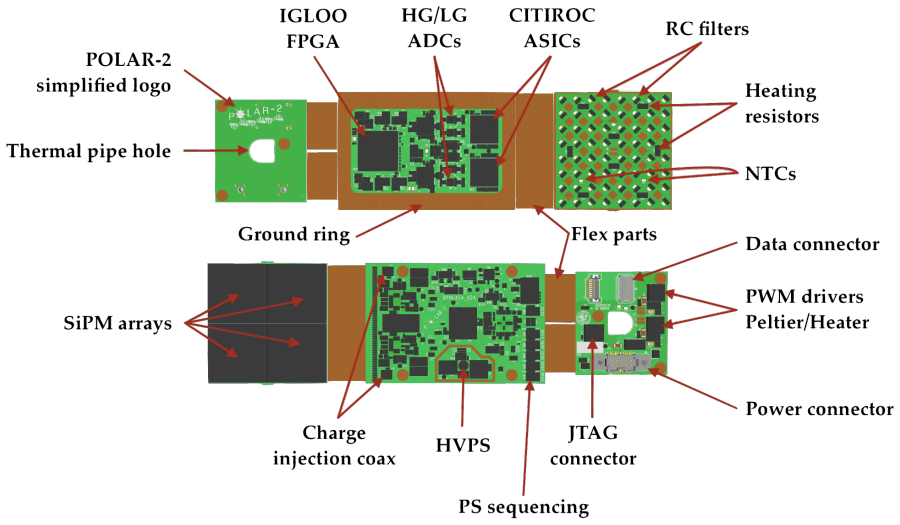
The load-bearing object is the FEE itself, a rigid-flex assembly of three PCBs: a SiPM board carrying filters, temperature sensors, and heating resistors; a main board with the ASICs, FPGA, ADCs, DACs, and DC/DC converter; and a connector board with LVDS data lines, power, and Peltier/heater drivers. Two Citiroc 1A ASICs give each of 32 channels separate high- and low-gain amplifiers plus charge and time thresholds, and the IGLOO FPGA implements the trigger logic and data packaging. The LT3482 DC/DC converter supplies the SiPM bias from 0 to 90 V and can keep up with the dark-current increase caused by radiation damage. The key performance mechanism is the pairing of high-gain and low-gain outputs, which allows sub-keV-level photo-electron counting at low energies while extending the readable range into the hundreds of keV without switching modes.
What would settle it
Take an unirradiated FEE and expose it to proton beams of different energies and dose rates, continuing past 0.76 Gy total dose while logging the LT3482 output voltage, FPGA configuration integrity, ADC baseline noise, and ASIC gain; if any component fails or performance drifts before a mission-equivalent dose for a chosen orbit, the general space-qualification claim is falsified. A quicker test is to couple the same board to a slow scintillator such as BGO and see whether the 12.5 ns shaping time still yields usable spectra.
Extended reading notes
Core claim
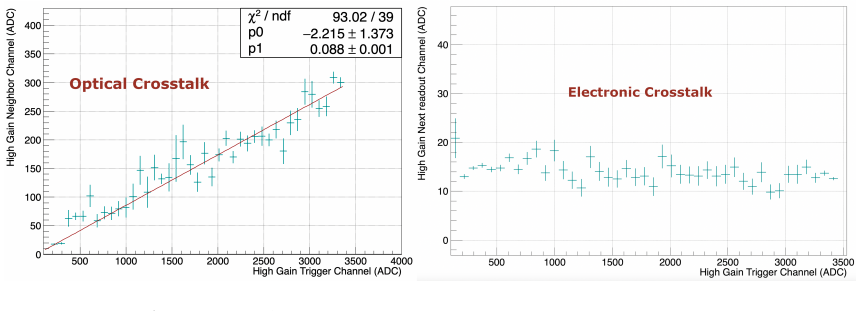
The central claim is that the front-end readout electronics (FEE), built around two Citiroc 1A 32-channel ASICs, one IGLOO FPGA, and an LT3482 DC/DC converter on a rigid-flex three-board assembly, reads out 64 SiPM channels at 1.78 W with no significant electronic noise or crosstalk. In the authors' own characterization, the design allows readout of 64 SiPM channels with typical power consumption of 1.8 W and cost, excluding SiPMs, of about 3000 USD. With plastic scintillators it keeps a charge-trigger threshold below 10 keV and resolves individual photo-electron peaks; with GAGG it reaches a 3.75 keV threshold, a dynamic range beyond 600 keV, and energy resolution comparable to earlier GAGG/SiPM instruments. The same trigger logic can be simplified for spectrometry, and the board passed thermal vacuum cycling, stepwise 58 MeV proton irradiation equivalent to about 11 years in low Earth orbit under POLAR-2 shielding, and launch-level vibration and shock tests.
Load-bearing premise
The qualification claim rests on the assumption that one stepwise proton irradiation run at 58 MeV, with a total dose of 0.76 Gy under POLAR-2-like shielding, plus the thermal, vibration, and shock tests, is representative of years in orbit for any mission; the paper itself states that the 11-year low-Earth-orbit equivalence cannot be directly translated to other missions.
Editorial extensions
If this is right
- One board can serve as the front end for POLAR-2's 6400-channel array within the 300 W mission power budget, while the same board with a changed SiPM layout becomes a CubeSat spectrometer.
- With GAGG, the system delivers a trigger threshold near 3.75 keV and a low-gain dynamic range beyond 600 keV; adjusting the ASIC gain DACs should push the high end toward MeV energies.
- At rates of several kHz the system can record bright gamma-ray bursts such as GRB 170127C without significant dead time, and only exceptional events like GRB 221009A would exceed its rate capability.
- Because nearly all components are COTS, procurement cost and export restrictions shrink, and the paper encourages other groups to reuse or modify the design for small space missions.
- Planned upgrades such as the 64-channel Radioroc 2 ASIC, linearly graded SiPMs, and cryogenic SiPM readout are natural extensions of the same architecture rather than redesigns.
Reading between the lines
- As an editor's extrapolation, the architecture's value would rise most if the proposed Radioroc 2 upgrade works: the same board organization could then read 128 channels, roughly doubling channel density under the same power envelope.
- The 'universal' label is so far bounded by the scintillator types tested; slow BGO and other long-decay crystals have not yet been measured, so the design's generality should be read as covering fast and medium-speed scintillators until those tests run.
- If a mission targets an orbit outside POLAR-2's 383 km LEO conditions, the 11-year-equivalent irradiation result is not sufficient by itself; a mission-specific proton-energy and dose-rate test is the natural next step, as the paper itself cautions.
Signed reviews
Editorial analysis
A structured set of objections, weighed in public.
Referee Report
Summary. The paper describes a 64-channel SiPM readout system (front-end electronics, FEE) built around two Citiroc-1A ASICs and a Microsemi IGLOO FPGA, with COTS power, ADC, and connector components. It reports the system's power consumption (~1.8 W), channel-gain uniformity, electronic noise, rate capability, crosstalk, and spectral performance with plastic (EJ-248M) and high-Z (GAGG:Ce) scintillators. It also reports thermal-vacuum, proton-irradiation, vibration, and shock tests, and concludes that the design is 'space qualified' and suitable for missions such as POLAR-2, BSD, and CubeSat spectrometers.
Significance. If accepted as stated, the paper would provide a useful, reusable front-end design for small gamma-ray and X-ray missions: 64 channels at about 1.8 W and roughly 3 kUSD, using COTS parts and avoiding export restrictions. The bench characterizations are direct measurements rather than simulations, including noise pedestals, gain uniformity, crosstalk correlations, and rate limits, and the scintillator spectra show the system can serve both fast plastic and slower high-Z scintillators. The main weakness is that the 'space qualified' conclusion rests on a single, limited radiation campaign, so the generalizable qualification claim is not yet supported by the evidence.
major comments (2)
- [Abstract; §6.2; Conclusion] The abstract and conclusion claim the design is 'space qualified' and 'capable of surviving both launch conditions as well as long-duration operation in orbit.' This is broader than the evidence in §6.2. The proton irradiation used one board, a single beam energy (58 MeV), six partial-illumination steps totaling 0.76 Gy, with data acquisition runs only between steps, and the text itself states that the 11-year LEO equivalence 'cannot be directly translated to other missions.' No single-event effects (SEU, latch-up, or DC/DC burnout) were tested, and the COTS FPGA, ADCs, and LT3482 have no independent radiation qualification. Please either temper the language to 'qualified for the POLAR-2 LEO environment' or add powered, multi-energy irradiation and SEE testing to support the general claim.
- [§6.3; Conclusion] The launch-survivability conclusion is based on vibration and shock tests of a single functional unit mounted in a POLAR-2-specific mechanical frame with rubber dampers. The authors acknowledge in §6.3 that the damping is specific to the POLAR-2 prototype, but the Conclusion still states the system can survive 'launch conditions' without that caveat. Please include the caveat in the conclusion, or test the electronics in a more generic mounting configuration if a broader claim is intended.
minor comments (5)
- [Table 1] The caption of Table 1 is a placeholder text 'Your caption.' This must be replaced with a descriptive caption before publication.
- [§3.4] The photon flux quoted for GRB 221009A appears as '1020 ph cm−2 s−1', which is likely a typesetting error; if it is meant to be 10^20 it is physically implausible, and if it is meant to be 10^4 or another value the notation should be corrected.
- [Keywords] The keyword line contains stray superscripts after 'X-ray' and 'Gamma-Ray' (shown as 'X-ray 1, Gamma-Ray 2'), which appear to be formatting artifacts and should be removed.
- [§6.1] The thermal vacuum test description gives a total duration of one week and a temperature cycling period of 1600 seconds, but it would be clearer to state the number of thermal cycles performed and the dwell time at each temperature.
- [§5.3] The claim that the energy resolution is comparable to reference [35] could be strengthened by adding a direct numerical comparison or an overlay of the measured resolution values with those from the cited work.
Circularity Check
No significant circularity: the central performance and qualification claims rest on direct measurements reported in this paper.
full rationale
The paper's load-bearing claims—64-channel readout at ~1.8 W, low electronic noise and crosstalk, kHz-level rate capability, useful spectra with plastic and GAGG scintillators, and successful thermal-vacuum, irradiation, vibration, and shock tests—are supported by direct measurements and test campaigns described in Sections 3–6, not derived from the quantities they claim to establish. The few derived figures (e.g., the 3.75 keV threshold, 2.3 p.e./keV light yield, and SiPM saturation curves) are calibration conversions obtained from measured ADC peak positions, finger spacings, and datasheet parameters; they are descriptive rather than circular predictions. The paper cites earlier work by the same authors for context and supporting calibrations: [24] for SiPM radiation damage annealing, [25] for POLAR-2 calibration details, [31] for beam-test response, [32] for optical light-yield optimization, and [33] for the finger-width relation. These citations are not load-bearing in the sense that the present paper's conclusions reduce to them; the key qualification and performance data are contained in this manuscript, and the cited results are independent companion studies rather than fitted inputs renamed as predictions. The 'space qualified' claim is supported by the qualification tests in Section 6, with the paper itself explicitly noting that the 11-year LEO equivalence 'cannot be directly translated to other missions.' Whether that single irradiation campaign suffices for a general space-qualified statement is a correctness or generality concern, not a circularity of the derivation chain.
Assumptions & free parameters
free parameters (4)
- SiPM over-voltage =
3.0 V
- Charge threshold =
250 ADC, corresponding to 3.75 keV and 8.3 p.e. in the GAGG test
- Finger fit parameters =
49 ADC/p.e., sigma_e = 11.9 ADC, sigma_1 = 3.4 ADC
- Shaping time =
12.5 ns
assumptions (6)
- domain assumption The Citiroc 1A ASIC provides the described two-threshold, two-gain readout behavior and has the claimed radiation tolerance (TRL 8).
- domain assumption Hamamatsu S13361 datasheet values for PDE, crosstalk, and microcell count are accurate enough for the saturation calculation.
- domain assumption The POLAR-2 radiation environment simulation (0.0789 Gy/yr at 383 km altitude) and the shielding model are correct.
- domain assumption The scintillation yield of GAGG is about 60 optical photons per keV.
- standard math Gaussian and error-function fits adequately describe the measured pedestal, photo-electron, and threshold distributions.
- domain assumption The SiPM saturation relation from reference [24] applies to this system.
Cite this review
Pith. "Pith review of Design and Performance of a Universal SiPM Readout System for X- and Gamma-Ray Missions." pith.science (2026). https://pith.science/paper/QO3PE3WR
@misc{pith2026250107758,
  author       = {Pith},
  title        = {Pith review of: Design and Performance of a Universal SiPM Readout System for X- and Gamma-Ray Missions},
  year         = {2026},
  howpublished = {\url{https://pith.science/paper/QO3PE3WR}},
  note         = {Machine review of arXiv:2501.07758}
}
read the original abstract
The advent of both multi-messenger and time-domain astrophysics over the last decade has seen a large interest in the development of small-scale, cheap, and robust gamma-ray detectors. This has been further encouraged by the availability of CubeSat platforms. Of particular interest are detectors capable of producing spectral and localization measurements of X and gamma-ray transients to allow for accurate follow-up measurements at different wavelengths. A vast number of the instruments developed for such purposes in the last years use a combination of scintillators and Silicon Photomultipliers (SiPMs) for photon detection. Here, we present the design, performance, and space qualification of a readout system capable of reading out 64 SiPM channels. This low-power and low-cost system was originally designed for the POLAR-2 mission, a large scale gamma-ray polarimeter. However, its flexible design makes it equally suitable for use on various CubeSat missions. The system was found to perform well when reading out both plastic and high Z scintillators using a total of 1.8~W. The space qualified design furthermore relies on commercial off-the-shelf components, thereby also removing most international export issues. In this paper, we will present the overall design, the performance of the electronics, its performance when reading out various scintillators and the successful space-qualification of this design.
Figures


Figures from the paper (15 more)




Reference graph
Works this paper leans on
-
[1]
B. P. Abbott, et al., Gravitational Waves and Gamma-rays from a Binary Neutron Star Merger: GW170817 and GRB 170817A, Astro- phys. J. Lett. 848 (2) (2017) L13. arXiv:1710.05834, doi:10.3847/2041- 8213/aa920c
arXiv 2017
-
[2]
G. J. Fishman, C. A. Meegan, R. B. Wilson, M. N. Brock, J. M. Horack, C. Kouveliotou, S. Howard, W. S. Paciesas, M. S. Briggs, G. N. Pendle- ton, T. M. Koshut, R. S. Mallozzi, M. Stollberg, J. P. Lestrade, The First BATSE Gamma-Ray Burst Catalog, The Astrophysical Journal Supplement 92 (1994) 229. doi:10.1086/191968
doi:10.1086/191968 1994
-
[3]
C. Meegan, G. Lichti, P. N. Bhat, E. Bissaldi, M. S. Briggs, V. Con- naughton, R. Diehl, G. Fishman, J. Greiner, A. S. Hoover, A. J. van der Horst, A. von Kienlin, R. M. Kippen, C. Kouveliotou, S. McBreen, W. S. Paciesas, R. Preece, H. Steinle, M. S. Wallace, R. B. Wilson, C. Wilson- Hodge, The Fermi Gamma-ray Burst Monitor, The Astrophysical Journal 702 ...
arXiv 2009
-
[4]
N. Produit, T. Bao, T. Batsch, T. Bernasconi, I. Britvich, F. Cadoux, I. Cernuda, J. Chai, Y. Dong, N. Gauvin, W. Hajdas, M. Kole, M. Kong, R. Kramert, L. Li, J. Liu, X. Liu, R. Marcinkowski, S. Orsi, M. Pohl, D. Rapin, D. Rybka, A. Rutczynska, H. Shi, P. Socha, J. Sun, L. Song, J. Szabelski, I. Traseira, H. Xiao, R. Wang, X. Wen, B. Wu, L. Zhang, L. Zhan...
work page 2018
-
[5]
Pál, et al., GRBAlpha: The smallest astrophysical space observatory - I
A. Pál, et al., GRBAlpha: The smallest astrophysical space observatory - I. Detector design, system description, and satellite operations, As- tron. Astrophys. 677 (2023) A40. arXiv:2302.10048, doi:10.1051/0004- 6361/202346182
arXiv 2023
-
[6]
F. Münz, et al., GRBAlpha and VZLUSAT-2: GRB observations with CubeSats after 3 years of operations, Proc. SPIE Int. Soc. Opt. Eng. 13093 (2024) 130936J. arXiv:2407.12555, doi:10.1117/12.3025855. 43
-
[7]
A. A. Myers, et al., BurstCube: a CubeSat for gravitational wave counterparts, Proc. SPIE Int. Soc. Opt. Eng. 13093 (2024) 130932F. doi:10.1117/12.3020456
-
[8]
J. E. Grove, et al., Glowbug, a Low-Cost, High-Sensitivity Gamma-Ray Burst Telescope, in: 71st Yamada Conference: Gamma-ray Bursts in the Gravitational Wave Era 2019, 2020. arXiv:2009.11959
work page Pith review arXiv 2019
Show all 37 references
-
[9]
Rahin, L
R. Rahin, L. Moleri, A. Vdovin, A. Feigenboim, S. Margolin, S. Tarem, E. Behar, M. Ghelman, A. Osovizky, GALI: a gamma-ray burst localiz- ing instrument, in: J.-W. A. den Herder, S. Nikzad, K. Nakazawa (Eds.), Space Telescopes and Instrumentation 2020: Ultraviolet to Gamma Ray...
2020 doi
-
[10]
Laviron, Développement d’un prototype de télescope Compton et astronomie gamma, Ph.D
A. Laviron, Développement d’un prototype de télescope Compton et astronomie gamma, Ph.D. thesis, Laboratoire de Physique des 2 Infinis Irène Joliot-Curie, France (2022)
2022
-
[11]
Murphy, A
D. Murphy, A. Ulyanov, S. McBreen, M. Doyle, R. Dunwoody, J. Man- gan, J. Thompson, B. Shortt, A. Martin-Carrillo, L. Hanlon, A compact instrument for gamma-ray burst detection on a CubeSat platform I: De- sign drivers and expected performance, Exper. Astron. 52 (1-2) (2021) 5...
2021 doi
-
[12]
L. J. Mitchell, B. F. Phlips, R. S. Woolf, A. L. Hutcheson, W. N. John- son, M. Johnson-Rambert, On-orbit results of the GAGG radiation in- struments, in: O. H. Siegmund, K. Hoadley (Eds.), UV, X-Ray, and Gamma-Ray Space Instrumentation for Astronomy XXIII, Vol. 12678 of Socie...
2023 doi
-
[13]
Wen, et al., GRID: a student project to monitor the transient gamma- ray sky in the multi-messenger astronomy era, Exper
J. Wen, et al., GRID: a student project to monitor the transient gamma- ray sky in the multi-messenger astronomy era, Exper. Astron. 48 (1) (2019) 77–95. arXiv:1907.06842, doi:10.1007/s10686-019-09636-w
2019 arXiv
-
[14]
Chang, et al., The Gamma-ray Transients Monitor (GTM) on board Formosat-8B and its GRB detection efficiency, Adv
H.-K. Chang, et al., The Gamma-ray Transients Monitor (GTM) on board Formosat-8B and its GRB detection efficiency, Adv. Space Res. 69 (2022) 1249–1255. doi:10.1016/j.asr.2021.10.044. 44
2022 doi
-
[15]
Vestrand, P
T. Vestrand, P. Bloser, A. Hoover, L. Parker, J. Wren, The Mini Astro- physical MeV Background Observatory (MAMBO): A CubeSat for Mea- suring the MeV Extragalactic Gamma-Ray Background, PoS ICRC2019 (2020) 608. doi:10.22323/1.358.0608
2020 doi
-
[16]
L. J. Mitchell, B. F. Phlips, R. S. Woolf, T. T. Finne, W. N. John- son, Strontium iodide radiation instrumentation II (SIRI-2), in: O. H. Siegmund (Ed.), UV, X-Ray, and Gamma-Ray Space Instrumenta- tion for Astronomy XXI, Vol. 11118 of Society of Photo-Optical In- strumentati...
2019 doi
-
[17]
P. Lv, S. L. Xiong, X. L. Sun, J. G. Lv, Y. G. Li, A low-energy sensitive compact gamma-ray detector based on LaBr3 and SiPM for GECAM, Journal of Instrumentation 13 (8) (2018) P08014. arXiv:1803.07803, doi:10.1088/1748-0221/13/08/P08014
2018 arXiv
-
[18]
R. S. Woolf, D. Kocevski, J. E. Grove, M. S. Briggs, E. Burns, J. M. Davis, T. T. Finne, C. Fletcher, A. Goldstein, R. K. Hamburg, B. Hohl, B. A. Hristov, C. M. Hui, P. A. Jenke, M. T. Kerr, J. E. Stump, C. M. Vaughan, P. Veres, C. Wilson-Hodge, J. R. Wood, Development of the ...
2024
-
[19]
Produit, et al., POLAR-2, the next generation of GRB po- larization detector, PoS ICRC2023 (2023) 550
N. Produit, et al., POLAR-2, the next generation of GRB po- larization detector, PoS ICRC2023 (2023) 550. arXiv:2309.00518, doi:10.22323/1.444.0550
2023 arXiv
-
[20]
H. Li, R. Walter, N. Produit, F. Hubert, Measuring the cosmic x-ray background accurately, Experimental Astronomy 56 (1) (2023) 141–170. doi:10.1007/s10686-023-09896-7
2023 doi
-
[21]
Produit, H
N. Produit, H. Li, R. Walter, The Cosmic X-ray Background explorer (CXBe), PoS ICRC2023 (2023) 911. doi:10.22323/1.444.0911. 45
2023 doi
-
[22]
Zhang, et al., The enhanced X-ray Timing and Polarimetry mis- sion—eXTP, Sci
S.-N. Zhang, et al., The enhanced X-ray Timing and Polarimetry mis- sion—eXTP, Sci. China Phys. Mech. Astron. 62 (2) (2019) 29502. arXiv:1812.04020, doi:10.1007/s11433-018-9309-2
2019 arXiv
-
[23]
A. Gola, K. Majumdar, G. Casse, K. Mavrokoridis, S. Merzi, L. P. Franca, First Demonstration of the Use of LG-SiPMs for Optical Read- out of a TPC, JINST 15 (12) (2020) P12017. arXiv:2009.05086, doi:10.1088/1748-0221/15/12/P12017
2020 arXiv
-
[24]
De Angelis, et al., Temperature dependence of radiation damage an- nealing of Silicon Photomultipliers, Nucl
N. De Angelis, et al., Temperature dependence of radiation damage an- nealing of Silicon Photomultipliers, Nucl. Instrum. Meth. A 1048 (2023) 167934. arXiv:2212.08474, doi:10.1016/j.nima.2022.167934
2023 arXiv
-
[25]
De Angelis, Development of the next generation space-based compton polarimeter and energy resolved polarization analysis of gamma-ray bursts prompt emission, Ph.D
N. De Angelis, Development of the next generation space-based compton polarimeter and energy resolved polarization analysis of gamma-ray bursts prompt emission, Ph.D. thesis, Département de Physique Nucléaire et Corpusculaire, Université de Genève (2023). doi:10.13097/archive-...
2023 doi
-
[26]
Fleury, S
J. Fleury, S. Callier, C. de La Taille, N. Seguin, D. Thienpont, F. Du- lucq, S. Ahmad, G. Martin, Petiroc and Citiroc: front-end ASICs for SiPM read-out and ToF applications, JINST 9 (2014) C01049. doi:10.1088/1748-0221/9/01/C01049
2014 doi
-
[27]
Contino, et al., An ASIC front-end for fluorescence and Cherenkov light detection with SiPM for space and ground applications, Nucl
G. Contino, et al., An ASIC front-end for fluorescence and Cherenkov light detection with SiPM for space and ground applications, Nucl. In- strum. Meth. A 980 (2020) 164510. doi:10.1016/j.nima.2020.164510
2020
-
[28]
Mitchell, B
L. Mitchell, B. Phlips, W. N. Johnson, M. Johnson-Rambert, R. Woolf, A. Mazzi, A. Gola, Radiation damage assessment of sipms for scintillation detectors, Nuclear Instruments and Meth- ods in Physics Research Section A: Accelerators, Spectrome- ters, Detectors and Associated Eq...
2022
-
[29]
Merzi, F
S. Merzi, F. Acerbi, C. Aicardi, D. Fiore, V. Goiffon, A. G. Gola, O. Marcelot, A. Materne, O. Saint-Pe, Radiation damage on silicon photomultipliers from ionizing and non-ionizing radiation of low-earth 46 orbit operations, Sensors 24 (15) (2024). doi:10.3390/s24154990. URLht...
2024 doi
-
[30]
Ripa, et al., The peak flux of GRB 221009A measured with GRBAlpha, Astron
J. Ripa, et al., The peak flux of GRB 221009A measured with GRBAlpha, Astron. Astrophys. 677 (2023) L2. arXiv:2302.10047, doi:10.1051/0004-6361/202346128
2023 arXiv
-
[31]
Kole, et al., Response of the first POLAR-2 prototype to po- larized beams, JINST 19 (08) (2024) P08002
M. Kole, et al., Response of the first POLAR-2 prototype to po- larized beams, JINST 19 (08) (2024) P08002. doi:10.1088/1748- 0221/19/08/P08002
2024 doi
-
[32]
N. De Angelis, et al., Optimizing the light output of a plastic scintillator and SiPM based detector through optical characterization and simula- tion: A case study for POLAR-2, Accepted in JINST (2024)
2024
-
[33]
N. De Angelis, Master thesis, département de physique nucléaire et cor- pusculaire, université de genève, studies of readout electronics and op- tical elements for a gamma-ray telescope (2019). URLhttps://cds.cern.ch/record/2683289
2019
-
[34]
Virgilli, F
E. Virgilli, F. Frontera, V. Valsan, V. Liccardo, V. Carassiti, S. Squerzanti, M. Statera, M. Parise, S. Chiozzi, F. E. an d E. Car- oli, J. Stephen, N. Auricchio, S. Silvestri, A. Basili, F. C. ssese, L. Re- canatesi, V. Guidi, V. Bellucci, R. Camattari, C. Ferrari, A. Zappet...
2013
-
[35]
Yoneyama, J
M. Yoneyama, J. Kataoka, M. Arimoto, T. Masuda, M. Yoshino, K. Ka- mada, A. Yoshikawa, H. Sato, Y. Usuki, Evaluation of GAGG:Ce scin- tillators for future space applications, JINST 13 (02) (2018) P02023. doi:10.1088/1748-0221/13/02/P02023
2018 doi
-
[36]
Weeroc (2025). [link]. URLhttps://www.weeroc.com/read_out_chips/citiroc-1a/ 47
2025
-
[37]
Pearce, et al., Science prospects for SPHiNX – A small satel- lite GRB polarimetry mission, Astropart
M. Pearce, et al., Science prospects for SPHiNX – A small satel- lite GRB polarimetry mission, Astropart. Phys. 104 (2019) 54–63. arXiv:1808.05384, doi:10.1016/j.astropartphys.2018.08.007. 48
2019 arXiv
Reviewed August 10, 2026 · model on record in the stance chip above.
Discussion (0). Continue with ORCID to comment.