REVIEW 2 major objections 8 minor 292 references
High-Contrast Imaging: Hide and Seek with Exoplanets
T0 review · 2 major / 8 minor · reviewed 2026-08-10 · deepseek-v4-flash
Pith's one-line read Direct imaging is the only technique that finds and characterizes massive young planets on orbits beyond 10 au — a niche radial velocity and transits cannot fill — and it is the road to reflected-light and habitable-zone planets.
desk verdict A useful but flawed review: solid synthesis of the field through 2024, with a few small errors a referee should catch. read the letter →
The pith
A machine-rendered reading of the paper's core claim, the machinery that carries it, and where it could break.
The reading
What carries the argument
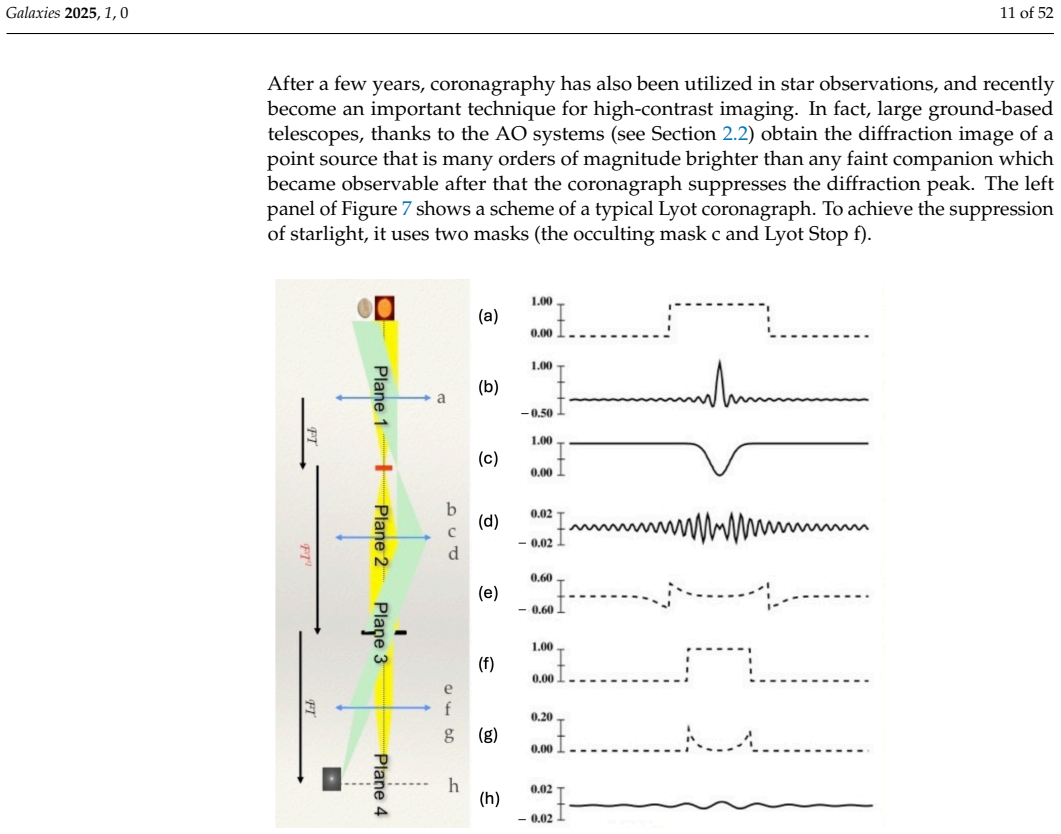
High-contrast imaging itself is the carrying mechanism: a large ($D \geq 5$ m) telescope working near its diffraction limit, an extreme adaptive-optics loop holding the Strehl ratio near 90%, a coronagraph that suppresses the stellar diffraction pattern, and differential imaging — angular (ADI), spectral (SDI), or polarimetric — that separates the rotating signal of a genuine companion from quasi-static speckle noise. The defining physical scalings are the two contrast ratios, $C_{\rm OPT}=F_{p,\rm reflected}/F_\star$ and $C_{\rm IR}=F_{p,\rm intrinsic}/F_\star$, which set the boundary between what is observable now (young self-luminous planets near $10^{-6}$ contrast) and what needs space or ELT coronagraphs (reflected-light planets near $10^{-9}$ to $10^{-10}$). The speckle pattern, not photon noise, is the noise floor, and the review's central methodological claim is that rotating the field (ADI), splitting wavelengths (SDI), or splitting polarization turns that quasi-static floor into a removable background.
What would settle it
Compare model-independent dynamical masses, from Gaia/Hipparcos proper-motion anomaly and radial velocity, with the photometric masses from hot-start and cold-start evolutionary models for a sample of roughly twenty directly imaged companions; if the cold-start masses systematically match the dynamical ones, the occurrence rates in the review's tables shift by up to an order of magnitude, and if the planet/brown-dwarf boundary moves, the 'massive young exoplanet' niche itself needs redrawing.
Extended reading notes
Core claim
The paper's central assertion, stated in its conclusions, is that high-contrast imaging is fundamental for finding massive young exoplanets at large separations (>10 au) from their host stars — a niche that no other detection technique covers — and that this population carries direct information about how planets form. The supporting case is a two-decade record assembled from first detections (the 2004 image of a planetary-mass companion, the 2008 HR 8799 system), the second-generation imagers SPHERE, GPI, and SCExAO, and the SHINE and GPIES surveys of 500–600 stars. The review interprets the survey statistics as showing that wide-orbit giant planets are rare overall, more common around A and B stars than around FGK and M stars, and declining in frequency beyond about 10 au, and it reads the resulting mass–separation distribution as evidence that core accretion dominates planet formation while gravitational instability contributes at the widest separations and in the brown-dwarf regime. It further asserts that because the planet's own photons are detected, low- and medium-resolution spectra reveal molecular composition and clouds, and that coupling imaging with radial velocity and proper-motion astrometry is converting model-dependent masses into dynamical benchmarks.
Load-bearing premise
Every mass, planet/brown-dwarf boundary, and occurrence rate in the review inherits from theoretical hot-start and cold-start evolutionary models whose initial conditions are unmeasured, and the paper itself states that direct imaging cannot measure mass and that survey rates differ by an order of magnitude between the two model families.
Editorial extensions
If this is right
- The demographic result — giant planets beyond roughly 10 au are rare, with occurrence rates around a few percent for FGK stars and higher for A and B stars — becomes a direct constraint on core-accretion and gravitational-instability formation models.
- Low- and medium-resolution spectra of directly imaged companions, revealing water, methane, and cloud properties, provide a reference library for interpreting the cooler atmospheres found by transit and radial-velocity surveys.
- Coupling imaging with radial velocity and proper-motion astrometry converts model-dependent masses into dynamical masses, calibrating the evolutionary models on which every indirect mass estimate depends.
- ELT instruments and space coronagraphs (Roman, then a Habitable Worlds Observatory class mission) will reach contrasts of $10^{-8}$ to $10^{-9}$, making reflected-light Jupiter analogs and, optimistically, planets in the habitable zone directly imageable.
- Survey strategy shifts from blind imaging of hundreds of stars to informed targets flagged by astrometric acceleration, which has already yielded the low-mass planets AF Lep b and HIP 99770 b.
Reading between the lines
- If the predicted ELT and space contrasts are reached, the first 'habitable' environments directly imaged are likely to be moons of giant planets rather than Earth-like planets themselves — a science case the review mentions only in passing.
- The proper-motion-anomaly-plus-imaging synergy demonstrated on AF Lep b and HIP 99770 b could be run systematically across the 500–600 stars already observed by SHINE and GPIES, converting those survey samples from model-dependent to dynamical-mass statistics without any new imaging.
- The order-of-magnitude spread between hot-start and cold-start occurrence rates implies that the field's headline demographics should be published as a model-range rather than a single number until dynamical masses settle the question.
Editorial analysis
A structured set of objections, weighed in public.
Referee Report
Summary. This review paper by Claudi and Mesa surveys the field of high-contrast imaging (HCI) of exoplanets, covering the physical challenges (star–planet contrast, diffraction, speckles), the instrumental solutions (adaptive optics, coronagraphs), observing strategies and post-processing algorithms, current and future ground- and space-based instruments, benchmark directly imaged systems, and the demographic results from large surveys such as SHINE, GPIES, IDPS, and WEIRD/PSYM-WIDE. The central concluding claim, stated in Section 8, is that HCI is uniquely able to find and characterize massive young planets at separations larger than about 10 au, a regime poorly covered by other techniques, and that these observations provide clues to the formation mechanisms of wide-orbit giant planets and brown dwarfs.
Significance. The review is a useful and clearly structured synthesis for a broad astronomy readership. Its main strengths are the up-to-date compilation of instruments, surveys, and benchmark objects—including recent JWST results and astrometric discoveries such as AF Lep b, HD 206893 c, and epsilon Ind b—the didactic explanation of speckle suppression and post-processing techniques, and the explicit acknowledgment in Section 1 that planetary masses are inferred from evolutionary models subject to unknown initial conditions. The paper does not present new data or analysis, but as a review it provides a serviceable reference connecting instrumentation, algorithms, and demographics. If the internal inconsistencies identified below are corrected, the review will be a reliable entry point to the field.
major comments (2)
- [Section 7, Table 4] In the paragraph discussing the WEIRD/PSYM-WIDE surveys, the text states: 'with a low frequency of 0.1% in the case of the hot start model.' Table 4, however, reports for the same surveys '<5.2' under note f (cold start) and '11+11−5' under note g (hot start). The text and table therefore contradict each other on the model-dependent occurrence rates. Because these rates are the demographic basis for the Section 8 claim that HCI hints at formation mechanisms, the discrepancy must be resolved and the quoted values cross-checked against the original source before publication.
- [Section 8] The concluding claim that HCI 'hints at these objects' formation mechanisms' is stated without the caveat, acknowledged in Section 1 and visible in Table 4, that inferred companion masses and survey occurrence rates depend strongly on whether hot-start or cold-start evolutionary models are adopted. The WEIRD/PSYM-WIDE row alone shows an order-of-magnitude spread depending on the adopted model. Please add an explicit qualification in Section 8, for example noting the model sensitivity and the emerging role of dynamical-mass measurements from astrometry and interferometry in breaking this degeneracy, so that the summary does not overstate the robustness of the formation-mechanism interpretation.
minor comments (8)
- [Abstract] The phrase 'low mass companions at wide separation (≤ 5–6 au)' is internally contradictory and also contradicts the later text and Section 8; it should read '≥ 5–6 au' or '≳ 5 au'.
- [Abstract and Section 1] The abstract cites 'about 5700 exoplanets,' while Section 1 states 'about 7300 confirmed objects in August 2024'; please harmonize the numbers.
- [Section 2, Equation (4)] Equation (4) is physically incorrect because it uses the planetary radius Rp instead of the stellar radius R*: the correct equilibrium temperature is Teq = T*(R*/a)^(1/2)[(1−AB)/(4f)]^(1/4). As written, the equation lacks the dependence on the stellar radius and should be corrected.
- [Section 6] Several names are mistyped: 'GJ 299 B' should be 'GJ 229 B' in the first paragraph; 'Ross (AB) b' should be 'Ross 458 (AB) b' in Section 6.5; and 'HIP 66426' in the Figure 12 caption should be 'HIP 65426'.
- [Section 6.8] The object name '2MASS J21265040?8140293' contains a garbled character (likely a dash), and 'standaloneobject' is missing a space; please fix both.
- [Section 4.2.1] The phrase 'the detection of very planets' should presumably read 'very young planets' or 'planetary-mass companions'.
- [Section 6.9] The text says HIP 65426 b was detected in 'all seven observational filters' but then lists eight filters (F250M, F300M, F356M, F356W, F410M, F444W, F1140C, F1550C); please correct the count.
- [Section 8] On first mention, the observatory should be referred to as the 'Nancy Grace Roman Space Telescope' rather than the 'Roman Telescope'.
Circularity Check
No significant circularity: the review synthesizes externally published survey results and discloses its model-dependent caveats.
full rationale
This paper is a review, not a derivation or prediction pipeline: it introduces no new fitted parameters, no new survey yields, and no equations whose output is defined by their own input. The occurrence-rate numbers in Section 7 and Table 4 are explicitly attributed to independent published surveys (IDPS, GPIES, SHINE, WEIRD/PSYM-WIDE, etc.), and Section 8's central claim that HCI is fundamental for finding massive young exoplanets at separations >10 au and hints at formation mechanisms is explicitly anchored to those external demographic results and to external reviews (e.g., [17,35,36]). The few self-citations (e.g., Mesa et al. 2019 for PDS 70, Mesa et al. 2023 for AF Lep b, Claudi et al. 2019 for HD 142527B) report empirical detections and characterizations; they are not used to justify the review's statistical or formation conclusions, so they are not load-bearing. The hot-start versus cold-start evolutionary-model dependence is disclosed by the authors themselves in Section 1 ('Large differences in the inferred value of planetary mass are foreseen between the so-called hot-start and cold-start models') and is therefore a flagged model-uncertainty caveat rather than a hidden circular reduction. No step in the paper reduces a prediction to a fitted input or imports an unverified uniqueness claim from prior work by the same authors.
Assumptions & free parameters
assumptions (4)
- domain assumption Planet flux is modeled as reflected starlight or blackbody self-emission using Equations (1)-(3).
- domain assumption Masses and luminosities of substellar objects are derived from the evolutionary models of Burrows et al. and Baraffe et al.
- domain assumption The IAU deuterium-burning limit of about 13 Jupiter masses defines the planet/brown dwarf boundary.
- standard math Fourier optics, Airy diffraction, and Fried parameter statistics describe image formation.
Cite this review
Pith. "Pith review of High-Contrast Imaging: Hide and Seek with Exoplanets." pith.science (2026). https://pith.science/paper/UVWR3EJL
@misc{pith2026250107976,
  author       = {Pith},
  title        = {Pith review of: High-Contrast Imaging: Hide and Seek with Exoplanets},
  year         = {2026},
  howpublished = {\url{https://pith.science/paper/UVWR3EJL}},
  note         = {Machine review of arXiv:2501.07976}
}
abstract
So far, most of the about 5700 exoplanets have been discovered mainly with radial velocity and transit methods. These techniques are sensitive to planets in close orbits, not being able to probe large star--planet separations. $\mu$-lensing is the indirect method that allows us to probe the planetary systems at the snow-line and beyond, but it is not a repeatable observation. On the contrary, direct imaging (DI) allows for the detection and characterization of low mass companions at wide separation (\mbox{$\leq$ 5--6 au}). The main challenge of DI is that a typical planet--star contrast ranges from $10^{-6}$, for a young Jupiter in emitted light, to $10^{-9}$ for Earth in reflected light. In the last two decades, a lot of efforts have been dedicated to combining large (D $\geq$ 5 m) telescopes (to reduce the impact of diffraction) with coronagraphs and high-order adaptive optics (to correct phase errors induced by atmospheric turbulence), with sophisticated image post-processing, to reach such a contrast between the star and the planet in order to detect and characterize cooler and closer companions to nearby stars. Building on the first pioneering instrumentation, the second generation of high-contrast imagers, SPHERE, GPI, and SCExAO, allowed us to probe hundreds of stars (e.g., 500--600 stars using SHINE and GPIES), contributing to a better understanding of the demography and the occurrence of planetary systems. The DI offers a possible clear vision for studying the formation and physical properties of gas giant planets and brown dwarfs, and the future DI (space and ground-based) instruments with deeper detection limits will enhance this vision. In this paper, we briefly review the methods, the instruments, the main sample of targeted stars, the remarkable results, and the perspective of this rising technique.
Figures


Figures from the paper (9 more)




Reference graph
Works this paper leans on
-
[1]
Dyson, F.W.; Eddington, A.S.; Davidson, C. A Determination of the Deflection of Light by the Sun’s Gravitational Field, from Observations Made at the Total Eclipse of May 29, 1919. Philos. Trans. R. Soc. Lond. Ser. A 1920, 220, 291–333. https://doi.org/10.1098/rsta.1920.0009
arXiv 1919
-
[2]
A giant planet candidate near a young brown dwarf
Chauvin, G.; Lagrange, A.M.; Dumas, C.; Zuckerman, B.; Mouillet, D.; Song, I.; Beuzit, J.L.; Lowrance, P . A giant planet candidate near a young brown dwarf. Direct VLT/NACO observations using IR wavefront sensing. Astron. Astrophys. 2004, 425, L29–L32. https://doi.org/10.1051/0004-6361:200400056
-
[3]
Direct Imaging of Multiple Planets Orbiting the Star HR 8799
Marois, C.; Macintosh, B.; Barman, T.; Zuckerman, B.; Song, I.; Patience, J.; Lafrenière, D.; Doyon, R. Direct Imaging of Multiple Planets Orbiting the Star HR 8799. Science 2008, 322, 1348. https://doi.org/10.1126/science.1166585
-
[4]
A Jupiter-mass companion to a solar-type star.Nature 1995, 378, 355–359
Mayor, M.; Queloz, D. A Jupiter-mass companion to a solar-type star.Nature 1995, 378, 355–359. https://doi.org/10.1038/378355a0
doi:10.1038/378355a0 1995
-
[5]
Extrasolar planet characteristics in the visible wavelength range
Traub, W.A. Extrasolar planet characteristics in the visible wavelength range. In Proceedings of the Conference on Towards Other Earths: DARWIN/TPF and the Search for Extrasolar Terrestrial Planets; 22-25 April 2003, Heidelberg, Germany. Fridlund, M., Henning, T., Lacoste, H., Eds.; Noordwijk, Netherlands: ESA Publications Division 2003; Volume 539, pp. 231–239
2003
-
[6]
How to Characterize Habitable Worlds and Signs of Life
Kaltenegger, L. How to Characterize Habitable Worlds and Signs of Life. Annu. Rev. Astron. Astrophys. 2017, 55, 433–485. https://doi.org/10.1146/annurev-astro-082214-122238
-
[7]
JWST/NIRCam Discovery of the First Y+Y Brown Dwarf Binary: WISE J033605.05-014350.4
Calissendorff, P .; De Furio, M.; Meyer, M.; Albert, L.; Aganze, C.; Ali-Dib, M.; Bardalez Gagliuffi, D.C.; Baron, F.; Beichman, C.A.; Burgasser, A.J.; et al. JWST/NIRCam Discovery of the First Y+Y Brown Dwarf Binary: WISE J033605.05-014350.4. Astrophys. J. Lett. 2023, 947, L30. https://doi.org/10.3847/2041-8213/acc86d
-
[8]
CFBDSIR J1458+1013B: A Very Cold (>T10) Brown Dwarf in a Binary System.Astrophys
Liu, M.C.; Delorme, P .; Dupuy, T.J.; Bowler, B.P .; Albert, L.; Artigau, E.; Reylé, C.; Forveille, T.; Delfosse, X. CFBDSIR J1458+1013B: A Very Cold (>T10) Brown Dwarf in a Binary System.Astrophys. J. 2011, 740, 108. https://doi.org/10.1088/0004-637X/740/2/108
Show all 292 references
-
[9]
Individual, Model-independent Masses of the Closest Known Brown Dwarf Binary to the Sun
Garcia, E.V .; Ammons, S.M.; Salama, M.; Crossfield, I.; Bendek, E.; Chilcote, J.; Garrel, V .; Graham, J.R.; Kalas, P .; Konopacky, Q.; et al. Individual, Model-independent Masses of the Closest Known Brown Dwarf Binary to the Sun. Astrophys. J. 2017, 846, 97. https://doi.org...
2017 doi
-
[10]
HST astrometry of the closest brown dwarfs-II
Bedin, L.R.; Dietrich, J.; Burgasser, A.J.; Apai, D.; Libralato, M.; Griggio, M.; Fontanive, C.; Pourbaix, D. HST astrometry of the closest brown dwarfs-II. Improved parameters and constraints on a third body. Astron. Nachrichten 2024, 345, e20230158. https://doi.org/10.1002/a...
2024 doi
-
[11]
Direct discovery of the inner exoplanet in the HD 206893 system
Hinkley, S.; Lacour, S.; Marleau, G.D.; Lagrange, A.M.; Wang, J.J.; Kammerer, J.; Cumming, A.; Nowak, M.; Rodet, L.; Stolker, T.; et al. Direct discovery of the inner exoplanet in the HD 206893 system. Evidence for deuterium burning in a planetary-mass companion. Astron. Astro...
2023 doi
-
[12]
The Gemini Deep Planet Survey
Lafrenière, D.; Doyon, R.; Marois, C.; Nadeau, D.; Oppenheimer, B.R.; Roche, P .F.; Rigaut, F.; Graham, J.R.; Jayawardhana, R.; Johnstone, D.; et al. The Gemini Deep Planet Survey. Astrophys. J. 2007, 670, 1367–1390. https://doi.org/10.1086/522826. Galaxies 2025, 1, 0 37 of 52
2007 doi
-
[13]
Deep imaging survey of young, nearby austral stars
Chauvin, G.; Lagrange, A.M.; Bonavita, M.; Zuckerman, B.; Dumas, C.; Bessell, M.S.; Beuzit, J.L.; Bonnefoy, M.; Desidera, S.; Farihi, J.; et al. Deep imaging survey of young, nearby austral stars . VLT/NACO near-infrared Lyot-coronographic observations. Astron. Astrophys. 2010...
2010 doi
-
[14]
Discovery and spectroscopy of the young jovian planet 51 Eri b with the Gemini Planet Imager
Macintosh, B.; Graham, J.R.; Barman, T.; De Rosa, R.J.; Konopacky, Q.; Marley, M.S.; Marois, C.; Nielsen, E.L.; Pueyo, L.; Rajan, A.; et al. Discovery and spectroscopy of the young jovian planet 51 Eri b with the Gemini Planet Imager. Science 2015, 350, 64–67. https://doi.org/...
2015 doi
-
[15]
The SPHERE infrared survey for exoplanets (SHINE)
Desidera, S.; Chauvin, G.; Bonavita, M.; Messina, S.; LeCoroller, H.; Schmidt, T.; Gratton, R.; Lazzoni, C.; Meyer, M.; Schlieder, J.; et al. The SPHERE infrared survey for exoplanets (SHINE). I. Sample definition and target characterization. Astron. Astrophys. 2021, 651, A70....
2021 doi
-
[16]
The SPHERE infrared survey for exoplanets (SHINE)
Langlois, M.; Gratton, R.; Lagrange, A.M.; Delorme, P .; Boccaletti, A.; Bonnefoy, M.; Maire, A.L.; Mesa, D.; Chauvin, G.; Desidera, S.; et al. The SPHERE infrared survey for exoplanets (SHINE). II. Observations, data reduction and analysis, detection performances, and initial...
2021 doi
-
[17]
The SPHERE infrared survey for exoplanets (SHINE)
Vigan, A.; Fontanive, C.; Meyer, M.; Biller, B.; Bonavita, M.; Feldt, M.; Desidera, S.; Marleau, G.D.; Emsenhuber, A.; Galicher, R.; et al. The SPHERE infrared survey for exoplanets (SHINE). III. The demographics of young giant exoplanets below 300 au with SPHERE. Astron. Astr...
2021 doi
-
[18]
Transmission Spectra as Diagnostics of Extrasolar Giant Planet Atmospheres
Brown, T.M. Transmission Spectra as Diagnostics of Extrasolar Giant Planet Atmospheres. Astrophys. J. 2001, 553, 1006–1026. https://doi.org/10.1086/320950
2001 doi
-
[19]
Infrared Transmission Spectra for Extrasolar Giant Planets
Tinetti, G.; Liang, M.C.; Vidal-Madjar, A.; Ehrenreich, D.; Lecavelier des Etangs, A.; Yung, Y.L. Infrared Transmission Spectra for Extrasolar Giant Planets. Astrophys. J. Lett. 2007, 654, L99–L102. https://doi.org/10.1086/510716
2007 doi
-
[20]
Detection of Thermal Emission from an Extrasolar Planet
Charbonneau, D.; Allen, L.E.; Megeath, S.T.; Torres, G.; Alonso, R.; Brown, T.M.; Gilliland, R.L.; Latham, D.W.; Mandushev, G.; O’Donovan, F.T.; et al. Detection of Thermal Emission from an Extrasolar Planet. Astrophys. J. 2005, 626, 523–529. https://doi.org/10.1086/429991
2005 doi
-
[21]
Synthetic Spectra and Colors of Young Giant Planet Atmospheres: Effects of Initial Conditions and Atmospheric Metallicity
Fortney, J.J.; Marley, M.S.; Saumon, D.; Lodders, K. Synthetic Spectra and Colors of Young Giant Planet Atmospheres: Effects of Initial Conditions and Atmospheric Metallicity. Astrophys. J. 2008, 683, 1104–1116. https://doi.org/10.1086/589942
2008 doi
-
[22]
Photometric and Spectral Signatures of Three-dimensional Models of Transiting Giant Exoplanets
Burrows, A.; Rauscher, E.; Spiegel, D.S.; Menou, K. Photometric and Spectral Signatures of Three-dimensional Models of Transiting Giant Exoplanets. Astrophys. J. 2010, 719, 341–350. https://doi.org/10.1088/0004-637X/719/1/341
2010 doi
-
[23]
Structure and evolution of super-Earth to super-Jupiter exoplanets
Baraffe, I.; Chabrier, G.; Barman, T. Structure and evolution of super-Earth to super-Jupiter exoplanets. I. Heavy element enrichment in the interior. Astron. Astrophys. 2008, 482, 315–332. https://doi.org/10.1051/0004-6361:20079321
2008 doi
-
[24]
On the Luminosity of Young Jupiters.Astrophys
Marley, M.S.; Fortney, J.J.; Hubickyj, O.; Bodenheimer, P .; Lissauer, J.J. On the Luminosity of Young Jupiters.Astrophys. J. 2007, 655, 541–549. https://doi.org/10.1086/509759
2007 doi
-
[25]
Spectral and Photometric Diagnostics of Giant Planet Formation Scenarios
Spiegel, D.S.; Burrows, A. Spectral and Photometric Diagnostics of Giant Planet Formation Scenarios. Astrophys. J. 2012, 745, 174. https://doi.org/10.1088/0004-637X/745/2/174
2012 doi
-
[26]
High-Contrast Observations in Optical and Infrared Astronomy
Oppenheimer, B.R.; Hinkley, S. High-Contrast Observations in Optical and Infrared Astronomy. Annu. Rev. Astron. Astrophys. 2009, 47, 253–289. https://doi.org/10.1146/annurev-astro-082708-101717
2009 doi
-
[27]
Adaptive Optics for Astronomy
Davies, R.; Kasper, M. Adaptive Optics for Astronomy. Annu. Rev. Astron. Astrophys. 2012, 50, 305–351. https://doi.org/10.114 6/annurev-astro-081811-125447
2012
-
[28]
Optical interferometry in astronomy
Monnier, J.D. Optical interferometry in astronomy. Rep. Prog. Phys. 2003, 66, 789–857. https://doi.org/10.1088/0034-4885/66/5 /203
2003 doi
-
[29]
Formation and evolution of planetary systems: The impact of high-angular resolution optical techniques
Absil, O.; Mawet, D. Formation and evolution of planetary systems: The impact of high-angular resolution optical techniques. Astron. Astrophys. Rev. 2010, 18, 317–382. https://doi.org/10.1007/s00159-009-0028-y
2010 doi
-
[30]
Optical Interferometry
Quirrenbach, A. Optical Interferometry. Annu. Rev. Astron. Astrophys. 2001, 39, 353–401. https://doi.org/10.1146/annurev.astro. 39.1.353
2001 doi
-
[31]
Modern optical astronomy: Technology and impact of interferometry
Saha, S.K. Modern optical astronomy: Technology and impact of interferometry. Rev. Mod. Phys. 2002, 74, 551–600. https: //doi.org/10.1103/RevModPhys.74.551
2002 doi
-
[32]
First light for GRAVITY: Phase referencing optical interferometry for the Very Large Telescope Interferometer
GRAVITY Collaboration.; Abuter, R.; Accardo, M.; Amorim, A.; Anugu, N.; Ávila, G.; Azouaoui, N.; Benisty, M.; Berger, J.P .; Blind, N.; et al. First light for GRAVITY: Phase referencing optical interferometry for the Very Large Telescope Interferometer. Astron. Astrophys. 2017...
2017 doi
-
[33]
Review and scientific prospects of high-contrast optical stellar interferometry
Defrère, D.; Absil, O.; Berger, J.P .; Danchi, W.C.; Dandumont, C.; Eisenhauer, F.; Ertel, S.; Gardner, T.; Glauser, A.; Hinz, P .; et al. Review and scientific prospects of high-contrast optical stellar interferometry. In Proceedings of the Optical and Infrared Interferometry...
2020
-
[34]
Direct Imaging of Exoplanets
Traub, W.A.; Oppenheimer, B.R. Direct Imaging of Exoplanets. In Exoplanets; Seager, S., Ed.; Publisher: The University of Arizona Press, Tucson, Arizona, USA 2010; pp. 111–156
2010
-
[35]
Imaging Extrasolar Giant Planets
Bowler, B.P . Imaging Extrasolar Giant Planets. Pub. Astron. Soc. Pac. 2016, 128, 102001. https://doi.org/10.1088/1538-3873/128/ 968/102001
2016 doi
-
[36]
Direct Imaging and Spectroscopy of Extrasolar Planets
Currie, T.; Biller, B.; Lagrange, A.; Marois, C.; Guyon, O.; Nielsen, E.L.; Bonnefoy, M.; De Rosa, R.J. Direct Imaging and Spectroscopy of Extrasolar Planets. In Proceedings of the Protostars and Planets VII held 10-15 April 2023 at Kyoto, Japan. Galaxies 2025, 1, 0 38 of 52 A...
-
[37]
An Introduction to High Contrast Differential Imaging of Exoplanets and Disks
Follette, K.B. An Introduction to High Contrast Differential Imaging of Exoplanets and Disks. Pub. Astron. Soc. Pac. 2023, 135, 093001. https://doi.org/10.1088/1538-3873/aceb31
2023 doi
-
[38]
A Coronagraphic Survey for Companions of Stars within 8 Parsecs
Oppenheimer, B.R.; Golimowski, D.A.; Kulkarni, S.R.; Matthews, K.; Nakajima, T.; Creech-Eakman, M.; Durrance, S.T. A Coronagraphic Survey for Companions of Stars within 8 Parsecs. Astron. J. 2001, 121, 2189–2211. https://doi.org/10.1086/319941
2001 doi
-
[39]
Evolution of a Habitable Planet
Kasting, J.F.; Catling, D. Evolution of a Habitable Planet. Annu. Rev. Astron. Astrophys. 2003, 41, 429–463. https://doi.org/10.114 6/annurev.astro.41.071601.170049
2003
-
[40]
Planetary Sciences; Publisher: Cambridge University Press, Cambridge, UK, 2010
de Pater, I.; Lissauer, J.J. Planetary Sciences; Publisher: Cambridge University Press, Cambridge, UK, 2010
2010
-
[41]
The theory of brown dwarfs and extrasolar giant planets
Burrows, A.; Hubbard, W.B.; Lunine, J.I.; Liebert, J. The theory of brown dwarfs and extrasolar giant planets. Rev. Mod. Phys. 2001, 73, 719–765. https://doi.org/10.1103/RevModPhys.73.719
2001 doi
-
[42]
Evolutionary models for cool brown dwarfs and extrasolar giant planets
Baraffe, I.; Chabrier, G.; Barman, T.S.; Allard, F.; Hauschildt, P .H. Evolutionary models for cool brown dwarfs and extrasolar giant planets. The case of HD 209458. Astron. Astrophys. 2003, 402, 701–712. https://doi.org/10.1051/0004-6361:20030252
2003 doi
-
[43]
Principles of Optics; Publisher: Pergamon Press, Oxford, England 1999
Born, M.; Wolf, E. Principles of Optics; Publisher: Pergamon Press, Oxford, England 1999
1999
-
[44]
Speckle Noise and the Detection of Faint Companions
Racine, R.; Walker, G.A.H.; Nadeau, D.; Doyon, R.; Marois, C. Speckle Noise and the Detection of Faint Companions. Pub. Astron. Soc. Pac. 1999, 111, 587–594. https://doi.org/10.1086/316367
1999 doi
-
[45]
Speckle Noise and Dynamic Range in Coronagraphic Images
Soummer, R.; Ferrari, A.; Aime, C.; Jolissaint, L. Speckle Noise and Dynamic Range in Coronagraphic Images. Astrophys. J. 2007, 669, 642–656. https://doi.org/10.1086/520913
2007 doi
-
[46]
The Possibility of Compensating Astronomical Seeing
Babcock, H.W. The Possibility of Compensating Astronomical Seeing. Pub. Astron. Soc. Pac. 1953, 65, 229. https://doi.org/10.108 6/126606
1953
-
[47]
Successful tests of adaptive optics
Merkle, F.; Kern, P .; Léna, P .; Rigaut, F.; Fontanella, J.C.; Rousset, G.; Boyer, C.; Gaffard, J.P .; Jagourel, P . Successful tests of adaptive optics. Messenger 1989, 58, 1–4
1989
-
[48]
Adaptive optics on a 3.6-m telescope—Results and performance
Rigaut, F.; Rousset, G.; Kern, P .; Fontanella, J.C.; Gaffard, J.P .; Merkle, F.; Léna, P . Adaptive optics on a 3.6-m telescope—Results and performance. Astron. Astrophys. 1991, 250, 280–290
1991
-
[49]
Adaptive Optics for Astronomy: Principles, Performance, and Applications
Beckers, J.M. Adaptive Optics for Astronomy: Principles, Performance, and Applications. Annu. Rev. Astron. Astrophys. 1993, 31, 13–62. https://doi.org/10.1146/annurev.aa.31.090193.000305
1993
-
[50]
First diffraction-limited astronomical images with adaptive optics
Rousset, G.; Fontanella, J.C.; Kern, P .; Gigan, P .; Rigaut, F. First diffraction-limited astronomical images with adaptive optics. Astron. Astrophys. 1990, 230, L29–L32
1990
-
[51]
Pupil plane wavefront sensing with an oscillating prism
Ragazzoni, R. Pupil plane wavefront sensing with an oscillating prism. J. Mod. Opt. 1996, 43, 289–293. https://doi.org/10.1080/ 09500349608232742
1996
-
[52]
First light AO (FLAO) system for LBT: Final integration, acceptance test in Europe, and preliminary on-sky commissioning results
Esposito, S.; Riccardi, A.; Fini, L.; Puglisi, A.T.; Pinna, E.; Xompero, M.; Briguglio, R.; Quirós-Pacheco, F.; Stefanini, P .; Guerra, J.C.; et al. First light AO (FLAO) system for LBT: Final integration, acceptance test in Europe, and preliminary on-sky commissioning results...
2010
-
[54]
The Gemini Planet Imager: Looking back over five years and forward to the future
Macintosh, B.; Chilcote, J.K.; Bailey, V .P .; de Rosa, R.; Nielsen, E.; Norton, A.; Poyneer, L.; Wang, J.; Ruffio, J.B.; Graham, J.R.; et al. The Gemini Planet Imager: Looking back over five years and forward to the future. In Proceedings of the Adaptive Optics Systems VI; he...
2018
-
[55]
Limitations and applicability of the Maréchal approximation
Ross, T.S. Limitations and applicability of the Maréchal approximation. Appl. Opt. 2009, 48, 1812. https://doi.org/10.1364/AO. 48.001812
2009 doi
-
[56]
Wizinowich, P .L.; Le Mignant, D.; Bouchez, A.H.; Campbell, R.D.; Chin, J.C.Y.; Contos, A.R.; van Dam, M.A.; Hartman, S.K.; Johansson, E.M.; Lafon, R.E.; et al. The W. M. Keck Observatory Laser Guide Star Adaptive Optics System: Overview. Pub. Astron. Soc. Pac. 2006, 118, 297–...
2006 doi
-
[57]
First light of the ESO Laser Guide Star Facility
Bonaccini Calia, D.; Allaert, E.; Alvarez, J.L.; Araujo Hauck, C.; Avila, G.; Bendek, E.; Buzzoni, B.; Comin, M.; Cullum, M.; Davies, R.; et al. First light of the ESO Laser Guide Star Facility. In Proceedings of the Advances in Adaptive Optics II; held on 24, May, 2006 in Orl...
2006
-
[58]
Laser guide star upgrade of Altair at Gemini North
Boccas, M.; Rigaut, F.; Bec, M.; Irarrazaval, B.; James, E.; Ebbers, A.; D’Orgeville, C.; Grace, K.; Arriagada, G.; Karewicz, S.; et al. Laser guide star upgrade of Altair at Gemini North. In Proceedings of the Advances in Adaptive Optics II; held on 24, May, 2006 in Orlando, ...
2006
-
[59]
Commissioning status of Subaru laser guide star adaptive optics system
Hayano, Y.; Takami, H.; Oya, S.; Hattori, M.; Saito, Y.; Watanabe, M.; Guyon, O.; Minowa, Y.; Egner, S.E.; Ito, M.; et al. Commissioning status of Subaru laser guide star adaptive optics system. In Proceedings of the Adaptive Optics Systems II; held on 27 June, 2010 in San Die...
2010
-
[60]
Extreme Adaptive Optics
Guyon, O. Extreme Adaptive Optics. Annu. Rev. Astron. Astrophys. 2018, 56, 315–355. https://doi.org/10.1146/annurev-astro-08 1817-052000
2018 doi
-
[61]
The study of the solar corona and prominences without eclipses (George Darwin Lecture, 1939)
Lyot, B. The study of the solar corona and prominences without eclipses (George Darwin Lecture, 1939). Mon. Not. R. Astron. Soc. 1939, 99, 580. https://doi.org/10.1093/mnras/99.8.580
1939 doi
-
[62]
Ground-based Coronagraphy with High-order Adaptive Optics
Sivaramakrishnan, A.; Koresko, C.D.; Makidon, R.B.; Berkefeld, T.; Kuchner, M.J. Ground-based Coronagraphy with High-order Adaptive Optics. Astrophys. J. 2001, 552, 397–408. https://doi.org/10.1086/320444
2001 doi
-
[63]
Theoretical Limits on Extrasolar Terrestrial Planet Detection with Coronagraphs
Guyon, O.; Pluzhnik, E.A.; Kuchner, M.J.; Collins, B.; Ridgway, S.T. Theoretical Limits on Extrasolar Terrestrial Planet Detection with Coronagraphs. Astrophys. J. Suppl. 2006, 167, 81–99. https://doi.org/10.1086/507630
2006 doi
-
[64]
Imaging exoplanets with coronagraphic instruments
Galicher, R.; Mazoyer, J. Imaging exoplanets with coronagraphic instruments. Comptes Rendus Phys. 2024, 24, 133. https: //doi.org/10.5802/crphys.133
2024 doi
-
[65]
A Coronagraph with a Band-limited Mask for Finding Terrestrial Planets
Kuchner, M.J.; Traub, W.A. A Coronagraph with a Band-limited Mask for Finding Terrestrial Planets. Astrophys. J. 2002, 570, 900–908. https://doi.org/10.1086/339625
2002 doi
-
[66]
The Four-Quadrant Phase Mask Coronagraph
Boccaletti, A.; Riaud, P .; Baudoz, P .; Baudrand, J.; Rouan, D.; Gratadour, D.; Lacombe, F.; Lagrange, A.M. The Four-Quadrant Phase Mask Coronagraph. IV . First Light at the Very Large Telescope. Pub. Astron. Soc. Pac. 2004, 116, 1061–1071. https: //doi.org/10.1086/425735
2004 doi
-
[67]
The Four-Quadrant Phase-Mask Coronagraph
Rouan, D.; Riaud, P .; Boccaletti, A.; Clénet, Y.; Labeyrie, A. The Four-Quadrant Phase-Mask Coronagraph. I. Principle. Pub. Astron. Soc. Pac. 2000, 112, 1479–1486. https://doi.org/10.1086/317707
-
[68]
L′-band AGPM vector vortex coronagraph’s first light on VLT/NACO
Mawet, D.; Absil, O.; Delacroix, C.; Girard, J.H.; Milli, J.; O’Neal, J.; Baudoz, P .; Boccaletti, A.; Bourget, P .; Christiaens, V .; et al. L′-band AGPM vector vortex coronagraph’s first light on VLT/NACO. Discovery of a late-type companion at two beamwidths from an F0V star...
2013 doi
-
[69]
Spectral and angular differential imaging with SPHERE/IFS
Kiefer, S.; Bohn, A.J.; Quanz, S.P .; Kenworthy, M.; Stolker, T. Spectral and angular differential imaging with SPHERE/IFS. Assessing the performance of various PCA-based approaches to PSF subtraction. Astron. Astrophys. 2021, 652, A33. https: //doi.org/10.1051/0004-6361/202140285
2021 doi
-
[70]
Photometric Light Curves and Polarization of Close-in Extrasolar Giant Planets
Seager, S.; Whitney, B.A.; Sasselov, D.D. Photometric Light Curves and Polarization of Close-in Extrasolar Giant Planets. Astrophys. J. 2000, 540, 504–520. https://doi.org/10.1086/309292
-
[71]
Using polarimetry to detect and characterize Jupiter-like extrasolar planets
Stam, D.M.; Hovenier, J.W.; Waters, L.B.F.M. Using polarimetry to detect and characterize Jupiter-like extrasolar planets. Astron. Astrophys. 2004, 428, 663–672. https://doi.org/10.1051/0004-6361:20041578
2004 doi
-
[72]
Search and investigation of extra-solar planets with polarimetry
Schmid, H.M.; Beuzit, J.L.; Feldt, M.; Gisler, D.; Gratton, R.; Henning, T.; Joos, F.; Kasper, M.; Lenzen, R.; Mouillet, D.; et al. Search and investigation of extra-solar planets with polarimetry. In Proceedings of the IAU Colloq. 200: Direct Imaging of Exoplanets: Science & ...
2005 doi
-
[73]
SPHERE/ZIMPOL high resolution polarimetric imager
Schmid, H.M.; Bazzon, A.; Roelfsema, R.; Mouillet, D.; Milli, J.; Menard, F.; Gisler, D.; Hunziker, S.; Pragt, J.; Dominik, C.; et al. SPHERE/ZIMPOL high resolution polarimetric imager. I. System overview, PSF parameters, coronagraphy, and polarimetry. Astron. Astrophys. 2018,...
2018 doi
-
[74]
Imaging Polarimetric Observations of a New Circumstellar Disk System
Kuhn, J.R.; Potter, D.; Parise, B. Imaging Polarimetric Observations of a New Circumstellar Disk System. Astrophys. J. Lett. 2001, 553, L189–L191. https://doi.org/10.1086/320686
2001 doi
-
[75]
Laser Guide Star Adaptive Optics Imaging Polarimetry of Herbig Ae/Be Stars
Perrin, M.D.; Graham, J.R.; Kalas, P .; Lloyd, J.P .; Max, C.E.; Gavel, D.T.; Pennington, D.M.; Gates, E.L. Laser Guide Star Adaptive Optics Imaging Polarimetry of Herbig Ae/Be Stars. Science 2004, 303, 1345–1348. https://doi.org/10.1126/science.1094602
2004 doi
-
[76]
The Solar-System-Scale Disk around AB Aurigae
Oppenheimer, B.R.; Brenner, D.; Hinkley, S.; Zimmerman, N.; Sivaramakrishnan, A.; Soummer, R.; Kuhn, J.; Graham, J.R.; Perrin, M.; Lloyd, J.P .; et al. The Solar-System-Scale Disk around AB Aurigae. Astrophys. J. 2008, 679, 1574–1581. https: //doi.org/10.1086/587778
2008 doi
-
[77]
Spectral appearance of the planetary-surface accretion shock: Global spectra and hydrogen-line profiles and fluxes
Aoyama, Y.; Marleau, G.D.; Mordasini, C.; Ikoma, M. Spectral appearance of the planetary-surface accretion shock: Global spectra and hydrogen-line profiles and fluxes. arXiv 2020, arXiv:2011.06608. https://doi.org/10.48550/arXiv.2011.06608
-
[78]
Theoretical Model of Hydrogen Line Emission from Accreting Gas Giants
Aoyama, Y.; Ikoma, M.; Tanigawa, T. Theoretical Model of Hydrogen Line Emission from Accreting Gas Giants. Astrophys. J. 2018, 866, 84. https://doi.org/10.3847/1538-4357/aadc11
2018 doi
-
[80]
Accreting protoplanets: Spectral signatures and magnitude of gas and dust extinction at H α
Marleau, G.D.; Aoyama, Y.; Kuiper, R.; Follette, K.; Turner, N.J.; Cugno, G.; Manara, C.F.; Haffert, S.Y.; Kitzmann, D.; Ringqvist, S.C.; et al. Accreting protoplanets: Spectral signatures and magnitude of gas and dust extinction at H α. Astron. Astrophys. 2022, 657, A38. http...
2022 doi
- [81]
-
[82]
Kinematic Evidence of an Embedded Protoplanet in HD 142666 Identified by Machine Learning
Terry, J.P .; Hall, C.; Abreau, S.; Gleyzer, S. Kinematic Evidence of an Embedded Protoplanet in HD 142666 Identified by Machine Learning. Astrophys. J. 2023, 947, 60. https://doi.org/10.3847/1538-4357/acc737
2023 doi
-
[84]
First light of the Gemini Planet Imager
Macintosh, B.; Graham, J.R.; Ingraham, P .; Konopacky, Q.; Marois, C.; Perrin, M.; Poyneer, L.; Bauman, B.; Barman, T.; Burrows, A.S.; et al. First light of the Gemini Planet Imager. Proc. Natl. Acad. Sci. USA 2014, 111, 12661–12666. https: //doi.org/10.1073/pnas.1304215111
2014 doi
-
[85]
Chilcote, J.; Konopacky, Q.; Hamper, R.; Macintosh, B.; Marois, C.; Savransky, D.; Soummer, R.; Veran, J.P .; Gemini Planet Imager
-
[86]
GPI 2.0: Upgrade of the Gemini Planet Imager
0. GPI 2.0: Upgrade of the Gemini Planet Imager. In Proceedings of the AAS/Division for Extreme Solar Systems held on 16 ? 21 March 2024, in Christchurch, NZ AAS/Division for Extreme Solar Systems Abstracts; Publisher: America Astronomical Society, Washington DC, USA 2024; Vol...
2024
-
[87]
SPHERE IFS: The spectro differential imager of the VLT for exoplanets search
Claudi, R.U.; Turatto, M.; Gratton, R.G.; Antichi, J.; Bonavita, M.; Bruno, P .; Cascone, E.; De Caprio, V .; Desidera, S.; Giro, E.; et al. SPHERE IFS: The spectro differential imager of the VLT for exoplanets search. In Proceedings of the Ground-Based and Airborne Instrument...
2008
-
[88]
The infra- red dual imaging and spectrograph for SPHERE: Design and performance
Dohlen, K.; Langlois, M.; Saisse, M.; Hill, L.; Origne, A.; Jacquet, M.; Fabron, C.; Blanc, J.C.; Llored, M.; Carle, M.; et al. The infra- red dual imaging and spectrograph for SPHERE: Design and performance. In Proceedings of the Ground-Based and Airborne Instrumentation for ...
2008
-
[90]
Polarimetric imaging mode of VLT/SPHERE/IRDIS
de Boer, J.; Langlois, M.; van Holstein, R.G.; Girard, J.H.; Mouillet, D.; Vigan, A.; Dohlen, K.; Snik, F.; Keller, C.U.; Ginski, C.; et al. Polarimetric imaging mode of VLT/SPHERE/IRDIS. I. Description, data reduction, and observing strategy. Astron. Astrophys. 2020, 633, A63...
2020 doi
-
[91]
Polarimetric imaging mode of VLT/SPHERE/IRDIS
van Holstein, R.G.; Girard, J.H.; de Boer, J.; Snik, F.; Milli, J.; Stam, D.M.; Ginski, C.; Mouillet, D.; Wahhaj, Z.; Schmid, H.M.; et al. Polarimetric imaging mode of VLT/SPHERE/IRDIS. II. Characterization and correction of instrumental polarization effects. Astron. Astrophys...
2020 doi
-
[92]
Exoplanet characterization with long slit spectroscopy
Vigan, A.; Langlois, M.; Moutou, C.; Dohlen, K. Exoplanet characterization with long slit spectroscopy. Astron. Astrophys. 2008, 489, 1345–1354. https://doi.org/10.1051/0004-6361:200810090
2008 doi
-
[93]
High-order adaptive optics requirements for direct detection of extrasolar planets: Application to the SPHERE instrument
Fusco, T.; Rousset, G.; Sauvage, J.F.; Petit, C.; Beuzit, J.L.; Dohlen, K.; Mouillet, D.; Charton, J.; Nicolle, M.; Kasper, M.; et al. High-order adaptive optics requirements for direct detection of extrasolar planets: Application to the SPHERE instrument. Opt. Express 2006, 1...
2006 doi
-
[94]
Final performance and lesson-learned of SAXO, the VLT-SPHERE extreme AO: From early design to on-sky results
Fusco, T.; Sauvage, J.F.; Petit, C.; Costille, A.; Dohlen, K.; Mouillet, D.; Beuzit, J.L.; Kasper, M.; Suarez, M.; Soenke, C.; et al. Final performance and lesson-learned of SAXO, the VLT-SPHERE extreme AO: From early design to on-sky results. In Proceedings of the Adaptive Op...
2014
-
[95]
Upgrading the high contrast imaging facility SPHERE: Science drivers and instrument choices
Boccaletti, A.; Chauvin, G.; Wildi, F.; Milli, J.; Stadler, E.; Diolaiti, E.; Gratton, R.; Vidal, F.; Loupias, M.; Langlois, M.; et al. Upgrading the high contrast imaging facility SPHERE: Science drivers and instrument choices. In Proceedings of the Ground- Based and Airborne...
2022
-
[96]
MedRes: A new MEDium RESolution integral field spectrograph for SPHERE
Gratton, R.; Keller, C.; Diolaiti, E.; Baruffolo, A.; Bonnefoy, M.; D’Orazi, V .; Langlois, M.; Loupias, M.; N’Diaye, M.; Pantin, E.; et al. MedRes: A new MEDium RESolution integral field spectrograph for SPHERE. In Proceedings of the Ground-Based and Airborne Instrumentation ...
2022
-
[97]
The high-contrast performance of the Keck Planet Imager and Characterizer
Wang, J.J.; Mawet, D.; Xuan, J.W.; Hsu, C.C.; Ruffio, J.B.; Horstman, K.; Xin, Y.; Delorme, J.R.; Jovanovic, N.; Zhang, Y.; et al. The high-contrast performance of the Keck Planet Imager and Characterizer. arXiv 2024, arXiv:2406.15028, https: //doi.org/10.48550/arXiv.2406.15028
-
[98]
The Enhanced Resolution Imager and Spectrograph for the VLT
Davies, R.; Absil, O.; Agapito, G.; Agudo Berbel, A.; Baruffolo, A.; Biliotti, V .; Black, M.; Bonaglia, M.; Bonse, M.; Briguglio, R.; et al. The Enhanced Resolution Imager and Spectrograph for the VLT. Astron. Astrophys. 2023, 674, A207. https: //doi.org/10.1051/0004-6361/202346559
2023 doi
-
[99]
NIX, the imager for ERIS: The AO instrument for the VLT
Pearson, D.; Taylor, W.; Davies, R.; MacIntosh, M.; Henry, D.; Lunney, D.; Waring, C.; Gao, X.; Lightfoot, J.; Glauser, A.M.; et al. NIX, the imager for ERIS: The AO instrument for the VLT. In Proceedings of the Ground-Based and Airborne Instrumentation for Astronomy VI; held ...
2016
-
[100]
The ERIS Adaptive Optics System: First on-sky results of the ongoing commissioning at the VLT-UT4
Riccardi, A.; Puglisi, A.; Grani, P .; Briguglio, R.; Esposito, S.; Agapito, G.; Biliotti, V .; Bonaglia, M.; Carbonaro, L.; Xompero, M.; et al. The ERIS Adaptive Optics System: First on-sky results of the ongoing commissioning at the VLT-UT4. In Proceedings of the Adaptive Op...
2022
-
[101]
The Subaru Coronagraphic Extreme-AO Project
Martinache, F.; Guyon, O. The Subaru Coronagraphic Extreme-AO Project. In Proceedings of the Techniques and Instrumen- tation for Detection of Exoplanets IV; held on 4?5 August 2009. in San Diego, CA, USA Society of Photo-Optical Instrumen- tation Engineers (SPIE) Conference S...
2009 doi
-
[102]
The Subaru Coronagraphic Extreme Adaptive Optics System: Enabling High-Contrast Imaging on Solar-System Scales
Jovanovic, N.; Martinache, F.; Guyon, O.; Clergeon, C.; Singh, G.; Kudo, T.; Garrel, V .; Newman, K.; Doughty, D.; Lozi, J.; et al. The Subaru Coronagraphic Extreme Adaptive Optics System: Enabling High-Contrast Imaging on Solar-System Scales. Pub. Astron. Soc. Pac. 2015, 127,...
2015 doi
-
[103]
The CHARIS IFS for high contrast imaging at Subaru
Groff, T.D.; Kasdin, N.J.; Limbach, M.A.; Galvin, M.; Carr, M.A.; Knapp, G.; Brandt, T.; Loomis, C.; Jarosik, N.; Mede, K.; et al. The CHARIS IFS for high contrast imaging at Subaru. In Proceedings of the Techniques and Instrumentation for Detection of Exoplanets VII; Held 10-...
2015
-
[104]
VAMPIRES: Probing the innermost regions of protoplanetary systems with polarimetric aperture-masking
Norris, B.R.M.; Tuthill, P .G.; Jovanovic, N.; Schworer, G.; Guyon, O.; Martinache, F.; Stewart, P .N. VAMPIRES: Probing the innermost regions of protoplanetary systems with polarimetric aperture-masking. In Proceedings of the Optical and Infrared Interferometry IV; held on 22...
2014
-
[105]
SHARK-VIS the LBT high contrast imager at visible wavelengths
Mattioli, M.; Pedichini, F.; Antoniucci, S.; Li Causi, G.; Piazzesi, R.; Stangalini, M.; Testa, V . SHARK-VIS the LBT high contrast imager at visible wavelengths. In Proceedings of the Ground-based and Airborne Instrumentation for Astronomy VII; held on 10-15 June 2018, Austin...
2018
-
[106]
High Contrast Imaging in the Visible: First Experimental Results at the Large Binocular Telescope
Pedichini, F.; Stangalini, M.; Ambrosino, F.; Puglisi, A.; Pinna, E.; Bailey, V .; Carbonaro, L.; Centrone, M.; Christou, J.; Esposito, S.; et al. High Contrast Imaging in the Visible: First Experimental Results at the Large Binocular Telescope. Astron. J. 2017, 154, 74. https...
2017 doi
-
[107]
Fast cadence speckle-free high-contrast imaging: SFADI and SFI
Li Causi, G.; Stangalini, M.; Antoniucci, S.; Pedichini, F.; Mattioli, M.; Testa, V .; Piazzesi, R. Fast cadence speckle-free high-contrast imaging: SFADI and SFI. In Proceedings of the Adaptive Optics Systems VI; held on 10-15 June 2018 in Austin, TX, USA Galaxies 2025, 1, 0 ...
2018
-
[108]
swim” in the LBT Northern Hemisphere “ocean
Farinato, J.; Baruffolo, A.; Bergomi, M.; Bianco, A.; Biondi, F.; Briegel, F.; Carolo, E.; Carlotti, A.; Chavan, S.; Chinellato, S.; et al. SHARK-NIR, ready to “swim” in the LBT Northern Hemisphere “ocean”. In Proceedings of the Adaptive Optics Systems VIII; held on 17-23 July...
2022
- [109]
-
[110]
MagAO-X first light
Males, J.R.; Close, L.M.; Guyon, O.; Hedglen, A.D.; Van Gorkom, K.; Long, J.D.; Kautz, M.; Lumbres, J.; Schatz, L.; Rodack, A.; et al. MagAO-X first light. In Proceedings of the Adaptive Optics Systems VII held on 14-18 December 2020, Online Only. Society of Photo-Optical Inst...
2020
-
[111]
Optical and mechanical design of the extreme AO coronagraphic instrument MagAO-X
Close, L.M.; Males, J.R.; Durney, O.; Sauve, C.; Kautz, M.; Hedglen, A.; Schatz, L.; Lumbres, J.; Miller, K.; Van Gorkom, K.; et al. Optical and mechanical design of the extreme AO coronagraphic instrument MagAO-X. In Proceedings of the Adaptive Optics Systems VI held on 10-15...
2018
-
[112]
The Separation and H α Contrasts of Massive Accreting Planets in the Gaps of Transitional Disks: Predicted H α Protoplanet Yields for Adaptive Optics Surveys
Close, L.M. The Separation and H α Contrasts of Massive Accreting Planets in the Gaps of Transitional Disks: Predicted H α Protoplanet Yields for Adaptive Optics Surveys. Astron. J. 2020, 160, 221. https://doi.org/10.3847/1538-3881/abb375
2020 doi
-
[113]
High-contrast imaging with the Hubble Space Telescope: Performance and lessons learned
Krist, J.E. High-contrast imaging with the Hubble Space Telescope: Performance and lessons learned. In Proceedings of the Optical, Infrared, and Millimeter Space Telescopes; held on 21-25 June 2004 in Glasgow, UK. Society of Photo-Optical Instrumentation Engineers (SPIE) Confe...
2004 doi
-
[114]
An Infrared Coronagraphic Survey for Substellar Companions
Lowrance, P .J.; Becklin, E.E.; Schneider, G.; Kirkpatrick, J.D.; Weinberger, A.J.; Zuckerman, B.; Dumas, C.; Beuzit, J.L.; Plait, P .; Malumuth, E.; et al. An Infrared Coronagraphic Survey for Substellar Companions. Astron. J. 2005, 130, 1845–1861. https://doi.org/10.1086/432839
2005 doi
-
[115]
MagAO-X and HST High-contrast Imaging of the AS209 Disk at H α
Cugno, G.; Zhou, Y.; Thanathibodee, T.; Calissendorff, P .; Meyer, M.R.; Edwards, S.; Bae, J.; Benisty, M.; Bergin, E.; De Furio, M.; et al. MagAO-X and HST High-contrast Imaging of the AS209 Disk at H α. Astron. J. 2023, 166, 162. https: //doi.org/10.3847/1538-3881/acf375
2023 doi
-
[116]
The JWST/NIRCam coronagraph flight occulters
Krist, J.E.; Balasubramanian, K.; Muller, R.E.; Shaklan, S.B.; Kelly, D.M.; Wilson, D.W.; Beichman, C.A.; Serabyn, E.; Mao, Y.; Echternach, P .M.; et al. The JWST/NIRCam coronagraph flight occulters. In Proceedings of the Space Telescopes and Instrumentation 2010: Optical, Inf...
2010
-
[117]
The Near Infrared Imager and Slitless Spectrograph for the James Webb Space Telescope
Sivaramakrishnan, A.; Tuthill, P .; Lloyd, J.P .; Greenbaum, A.Z.; Thatte, D.; Cooper, R.A.; Vandal, T.; Kammerer, J.; Sanchez- Bermudez, J.; Pope, B.J.S.; et al. The Near Infrared Imager and Slitless Spectrograph for the James Webb Space Telescope. IV . Aperture Masking Inter...
2023 doi
-
[118]
The Mid-Infrared Instrument for the James Webb Space Telescope, V: Predicted Performance of the MIRI Coronagraphs
Boccaletti, A.; Lagage, P .O.; Baudoz, P .; Beichman, C.; Bouchet, P .; Cavarroc, C.; Dubreuil, D.; Glasse, A.; Glauser, A.M.; Hines, D.C.; et al. The Mid-Infrared Instrument for the James Webb Space Telescope, V: Predicted Performance of the MIRI Coronagraphs. Pub. Astron. So...
2015 doi
-
[119]
The key science drivers for MICHI: A thermal-infrared instrument for the TMT
Packham, C.; Honda, M.; Chun, M.; Sakon, I.; Richter, M.; Okamoto, Y.; Kataza, H.; Marois, C.; Meyer, M.; Puravankara, M.; et al. The key science drivers for MICHI: A thermal-infrared instrument for the TMT. In Proceedings of the Ground-Based and Airborne Instrumentation for A...
2020
-
[120]
The Planetary Systems Imager adaptive optics system: An initial optical design and performance analysis tool for the PSI-Red AO system
Jensen-Clem, R.; Hinz, P .; von Kooten, M.; Fitzgerald, M.P .; Sallum, S.; Mazin, B.; Chun, M.; Max, C.; Millar-Blanchaer, M.; Guyon, O.; et al. The Planetary Systems Imager adaptive optics system: An initial optical design and performance analysis tool for the PSI-Red AO syst...
2021
-
[121]
METIS first light imager and spectrograph for the ELT: Overview of the near and mid-infrared detector subsystems
Serra, B.; Ives, D.J.; Accardo, M.; Conzelmann, R.D.; Leveratto, S.; Mueller, E.; George, E.M.; Bezawada, N.N.; Alvarez, D.; Sedghi, B.; et al. METIS first light imager and spectrograph for the ELT: Overview of the near and mid-infrared detector subsystems. In Proceedings of t...
2024
-
[122]
HARMONI at ELT: Project status and instrument overview
Thatte, N.A.; Melotte, D.; Neichel, B.; Le Mignant, D.; Rees, P .; Clarke, F.; Ferraro-Wood, V .; Gonzalez, O.; Jones, M.; Álvarez Urueña, A.; et al. HARMONI at ELT: Project status and instrument overview. In Proceedings of the Ground-Based and Airborne Instrumentation for Ast...
2022
-
[123]
PCS—A Roadmap for Exoearth Imaging with the ELT.Messenger 2021, 182, 38–43
Kasper, M.; Cerpa Urra, N.; Pathak, P .; Bonse, M.; Nousiainen, J.; Engler, B.; Heritier, C.T.; Kammerer, J.; Leveratto, S.; Rajani, C.; et al. PCS—A Roadmap for Exoearth Imaging with the ELT.Messenger 2021, 182, 38–43. https://doi.org/10.18727/0722-6691/5221
2021 doi
-
[124]
WFIRST-2.4: What Every Astronomer Should Know
Spergel, D.; Gehrels, N.; Breckinridge, J.; Donahue, M.; Dressler, A.; Gaudi, B.S.; Greene, T.; Guyon, O.; Hirata, C.; Kalirai, J.; et al. WFIRST-2.4: What Every Astronomer Should Know. arXiv 2013, arXiv:1305.5425. https://doi.org/10.48550/arXiv.1305.5425
-
[125]
A New Algorithm for Point-Spread Function Subtraction in High-Contrast Imaging: A Demonstration with Angular Differential Imaging
Lafrenière, D.; Marois, C.; Doyon, R.; Nadeau, D.; Artigau, É. A New Algorithm for Point-Spread Function Subtraction in High-Contrast Imaging: A Demonstration with Angular Differential Imaging. Astrophys. J. 2007, 660, 770–780. https: //doi.org/10.1086/513180
2007 doi
-
[126]
TLOCI: A Fully Loaded Speckle Killing Machine
Marois, C.; Correia, C.; Véran, J.P .; Currie, T. TLOCI: A Fully Loaded Speckle Killing Machine. In Proceedings of the Exploring the Formation and Evolution of Planetary Systems; held on 2 June 2013 in Victoria, Canada Booth, M., Matthews, B.C., Graham, J.R., Eds.; Publisher: ...
2013 doi
-
[127]
Improving signal-to-noise in the direct imaging of exoplanets and circumstellar disks with MLOCI
Wahhaj, Z.; Cieza, L.A.; Mawet, D.; Yang, B.; Canovas, H.; de Boer, J.; Casassus, S.; Ménard, F.; Schreiber, M.R.; Liu, M.C.; et al. Improving signal-to-noise in the direct imaging of exoplanets and circumstellar disks with MLOCI. Astron. Astrophys. 2015, 581, A24. https://doi...
2015 doi
-
[128]
Detection and Characterization of Exoplanets and Disks Using Projections on Karhunen-Loève Eigenimages
Soummer, R.; Pueyo, L.; Larkin, J. Detection and Characterization of Exoplanets and Disks Using Projections on Karhunen-Loève Eigenimages. Astrophys. J. Lett. 2012, 755, L28. https://doi.org/10.1088/2041-8205/755/2/L28
2012 doi
-
[129]
PYNPOINT: An image processing package for finding exoplanets
Amara, A.; Quanz, S.P . PYNPOINT: An image processing package for finding exoplanets. Mon. Not. R. Astron. Soc. 2012, 427, 948–955. https://doi.org/10.1111/j.1365-2966.2012.21918.x
2012
-
[130]
Performance of the VLT Planet Finder SPHERE
Mesa, D.; Gratton, R.; Zurlo, A.; Vigan, A.; Claudi, R.U.; Alberi, M.; Antichi, J.; Baruffolo, A.; Beuzit, J.L.; Boccaletti, A.; et al. Performance of the VLT Planet Finder SPHERE. II. Data analysis and results for IFS in laboratory. Astron. Astrophys. 2015, 576, A121. https:/...
2015 doi
-
[131]
Astrometric and photometric accuracies in high contrast imaging: The SPHERE speckle calibration tool (SpeCal)
Galicher, R.; Boccaletti, A.; Mesa, D.; Delorme, P .; Gratton, R.; Langlois, M.; Lagrange, A.M.; Maire, A.L.; Le Coroller, H.; Chauvin, G.; et al. Astrometric and photometric accuracies in high contrast imaging: The SPHERE speckle calibration tool (SpeCal). Astron. Astrophys. ...
2018 doi
-
[132]
VIP: Vortex Image Processing Package for High-contrast Direct Imaging
Gomez Gonzalez, C.A.; Wertz, O.; Absil, O.; Christiaens, V .; Defrère, D.; Mawet, D.; Milli, J.; Absil, P .A.; Van Droogenbroeck, M.; Cantalloube, F.; et al. VIP: Vortex Image Processing Package for High-contrast Direct Imaging. Astron. J. 2017, 154, 7. https://doi.org/10.3847...
2017 doi
-
[133]
Exoplanet detection in angular differential imaging by statistical learning of the nonstationary patch covariances
Flasseur, O.; Denis, L.; Thiébaut, É.; Langlois, M. Exoplanet detection in angular differential imaging by statistical learning of the nonstationary patch covariances. The PACO algorithm. Astron. Astrophys. 2018, 618, A138. https://doi.org/10.1051/0004-6361/ 201832745
2018 doi
-
[134]
PACO ASDI: An algorithm for exoplanet detection and characterization in direct imaging with integral field spectrographs
Flasseur, O.; Denis, L.; Thiébaut, É.; Langlois, M. PACO ASDI: An algorithm for exoplanet detection and characterization in direct imaging with integral field spectrographs. Astron. Astrophys. 2020, 637, A9. https://doi.org/10.1051/0004-6361/201937239
2020 doi
-
[136]
deep PACO: Combining statistical models with deep learning for exoplanet detection and characterization in direct imaging at high contrast
Flasseur, O.; Bodrito, T.; Mairal, J.; Ponce, J.; Langlois, M.; Lagrange, A.M. deep PACO: Combining statistical models with deep learning for exoplanet detection and characterization in direct imaging at high contrast. arXiv 2023, arXiv:2303.02461, https://doi.org/10.48550/arX...
-
[137]
Direct exoplanet detection and characterization using the ANDROMEDA method: Performance on VLT/NaCo data
Cantalloube, F.; Mouillet, D.; Mugnier, L.M.; Milli, J.; Absil, O.; Gomez Gonzalez, C.A.; Chauvin, G.; Beuzit, J.L.; Cornia, A. Direct exoplanet detection and characterization using the ANDROMEDA method: Performance on VLT/NaCo data. Astron. Astrophys. 2015, 582, A89. https://...
2015 doi
-
[138]
Improving and Assessing Planet Sensitivity of the GPI Exoplanet Survey with a Forward Model Matched Filter
Ruffio, J.B.; Macintosh, B.; Wang, J.J.; Pueyo, L.; Nielsen, E.L.; De Rosa, R.J.; Czekala, I.; Marley, M.S.; Arriaga, P .; Bailey, V .P .; et al. Improving and Assessing Planet Sensitivity of the GPI Exoplanet Survey with a Forward Model Matched Filter. Astrophys. J. 2017, 842...
2017 doi
-
[139]
Regime-switching model detection map for direct exoplanet detection in ADI sequences
Dahlqvist, C.H.; Cantalloube, F.; Absil, O. Regime-switching model detection map for direct exoplanet detection in ADI sequences. Astron. Astrophys. 2020, 633, A95. https://doi.org/10.1051/0004-6361/201936421
2020 doi
-
[140]
Improving the RSM map exoplanet detection algorithm
Dahlqvist, C.H.; Louppe, G.; Absil, O. Improving the RSM map exoplanet detection algorithm. PSF forward modelling and optimal selection of PSF subtraction techniques. Astron. Astrophys. 2021, 646, A49. https://doi.org/10.1051/0004-6361/202039597
2021 doi
-
[141]
Auto-RSM: An automated parameter-selection algorithm for the RSM map exoplanet detection algorithm
Dahlqvist, C.H.; Cantalloube, F.; Absil, O. Auto-RSM: An automated parameter-selection algorithm for the RSM map exoplanet detection algorithm. Astron. Astrophys. 2021, 656, A54. https://doi.org/10.1051/0004-6361/202141446. Galaxies 2025, 1, 0 44 of 52
2021 doi
-
[142]
STIM map: Detection map for exoplan- ets imaging beyond asymptotic Gaussian residual speckle noise
Pairet, B.; Cantalloube, F.; Gomez Gonzalez, C.A.; Absil, O.; Jacques, L. STIM map: Detection map for exoplan- ets imaging beyond asymptotic Gaussian residual speckle noise. Mon. Not. R. Astron. Soc. 2019, 487, 2262–2277. https://doi.org/10.1093/mnras/stz1350
2019 doi
-
[143]
MAYONNAISE: A morphological components analysis pipeline for circumstellar discs and exoplanets imaging in the near-infrared
Pairet, B.; Cantalloube, F.; Jacques, L. MAYONNAISE: A morphological components analysis pipeline for circumstellar discs and exoplanets imaging in the near-infrared. Mon. Not. R. Astron. Soc. 2021, 503, 3724–3742. https://doi.org/10.1093/mnras/stab607
2021 doi
-
[144]
TRAP: A temporal systematics model for improved direct detection of exoplanets at small angular separations
Samland, M.; Bouwman, J.; Hogg, D.W.; Brandner, W.; Henning, T.; Janson, M. TRAP: A temporal systematics model for improved direct detection of exoplanets at small angular separations. Astron. Astrophys. 2021, 646, A24. https://doi.org/10.1051/ 0004-6361/201937308
2021
-
[145]
Discovery of a cool brown dwarf
Nakajima, T.; Oppenheimer, B.R.; Kulkarni, S.R.; Golimowski, D.A.; Matthews, K.; Durrance, S.T. Discovery of a cool brown dwarf. Nature 1995, 378, 463–465. https://doi.org/10.1038/378463a0
1995 doi
-
[146]
The cool brown dwarf Gliese 229 B is a close binary.arXiv 2024, arXiv:2410.11953
Xuan, J.W.; Mérand, A.; Thompson, W.; Zhang, Y.; Lacour, S.; Blakely, D.; Mawet, D.; Oppenheimer, R.; Kammerer, J.; Batygin, K.; et al. The cool brown dwarf Gliese 229 B is a close binary.arXiv 2024, arXiv:2410.11953. https://doi.org/10.48550/arXiv.2410.11953
-
[147]
The minimum Jeans mass or when fragmentation must stop
Low, C.; Lynden-Bell, D. The minimum Jeans mass or when fragmentation must stop. Mon. Not. R. Astron. Soc. 1976, 176, 367–390. https://doi.org/10.1093/mnras/176.2.367
1976 doi
-
[148]
On the fragmentation of cosmic gas clouds
Silk, J. On the fragmentation of cosmic gas clouds. II. Opacity-limited star formation. Astrophys. J. 1977, 214, 152–160. https://doi.org/10.1086/155240
1977 doi
-
[149]
Formation of Planetary-Mass Objects by Protostellar Collapse and Fragmentation
Boss, A.P . Formation of Planetary-Mass Objects by Protostellar Collapse and Fragmentation. Astrophys. J. Lett. 2001, 551, L167–L170. https://doi.org/10.1086/320033
2001 doi
-
[151]
Discovery of a Planetary-mass Companion to a Brown Dwarf in Taurus
Todorov, K.; Luhman, K.L.; McLeod, K.K. Discovery of a Planetary-mass Companion to a Brown Dwarf in Taurus. Astrophys. J. Lett. 2010, 714, L84–L88. https://doi.org/10.1088/2041-8205/714/1/L84
2010 doi
-
[152]
The Extremely Red, Young L Dwarf PSO J318.5338-22.8603: A Free-floating Planetary-mass Analog to Directly Imaged Young Gas-giant Planets
Liu, M.C.; Magnier, E.A.; Deacon, N.R.; Allers, K.N.; Dupuy, T.J.; Kotson, M.C.; Aller, K.M.; Burgett, W.S.; Chambers, K.C.; Draper, P .W.; et al. The Extremely Red, Young L Dwarf PSO J318.5338-22.8603: A Free-floating Planetary-mass Analog to Directly Imaged Young Gas-giant P...
2013 doi
-
[153]
Precise radial velocities of giant stars
Quirrenbach, A.; Trifonov, T.; Lee, M.H.; Reffert, S. Precise radial velocities of giant stars. XI. Two brown dwarfs in 6:1 mean motion resonance around the K giant star ν Ophiuchi. Astron. Astrophys. 2019, 624, A18. https://doi.org/10.1051/0004-6361/201834423
2019 doi
-
[154]
How Dry is the Brown Dwarf Desert? Quantifying the Relative Number of Planets, Brown Dwarfs, and Stellar Companions around Nearby Sun-like Stars
Grether, D.; Lineweaver, C.H. How Dry is the Brown Dwarf Desert? Quantifying the Relative Number of Planets, Brown Dwarfs, and Stellar Companions around Nearby Sun-like Stars. Astrophys. J. 2006, 640, 1051–1062. https://doi.org/10.1086/500161
2006 doi
-
[155]
Transitional Disks as Signposts of Young, Multiplanet Systems
Dodson-Robinson, S.E.; Salyk, C. Transitional Disks as Signposts of Young, Multiplanet Systems. Astrophys. J. 2011, 738, 131. https://doi.org/10.1088/0004-637X/738/2/131
2011 doi
-
[156]
An Observational Perspective of Transitional Disks
Espaillat, C.; Muzerolle, J.; Najita, J.; Andrews, S.; Zhu, Z.; Calvet, N.; Kraus, S.; Hashimoto, J.; Kraus, A.; D’Alessio, P . An Observational Perspective of Transitional Disks. In Proceedings of the Protostars and Planets VI; held on 14-20 July, 2013 in Heidelberg, Germany....
2013 doi
-
[157]
The Origin and Evolution of Transition Discs: Successes, Problems, and Open Questions
Owen, J.E. The Origin and Evolution of Transition Discs: Successes, Problems, and Open Questions. Pub. Astron. Soc. Aust. 2016, 33, e005. https://doi.org/10.1017/pasa.2016.2
2016 doi
-
[158]
A Likely Close-in Low-mass Stellar Companion to the Transitional Disk Star HD 142527
Biller, B.; Lacour, S.; Juhász, A.; Benisty, M.; Chauvin, G.; Olofsson, J.; Pott, J.U.; Müller, A.; Sicilia-Aguilar, A.; Bonnefoy, M.; et al. A Likely Close-in Low-mass Stellar Companion to the Transitional Disk Star HD 142527. Astrophys. J. Lett. 2012, 753, L38. https://doi.o...
2012 doi
-
[159]
Discovery of H α Emission from the Close Companion inside the Gap of Transitional Disk HD 142527
Close, L.M.; Follette, K.B.; Males, J.R.; Puglisi, A.; Xompero, M.; Apai, D.; Najita, J.; Weinberger, A.J.; Morzinski, K.; Rodigas, T.J.; et al. Discovery of H α Emission from the Close Companion inside the Gap of Transitional Disk HD 142527. Astrophys. J. Lett. 2014, 781, L30...
2014 doi
-
[160]
Polarized Light Imaging of the HD 142527 Transition Disk with the Gemini Planet Imager: Dust around the Close-in Companion
Rodigas, T.J.; Follette, K.B.; Weinberger, A.; Close, L.; Hines, D.C. Polarized Light Imaging of the HD 142527 Transition Disk with the Gemini Planet Imager: Dust around the Close-in Companion. Astrophys. J. Lett. 2014, 791, L37. https: //doi.org/10.1088/2041-8205/791/2/L37
2014 doi
-
[161]
An M-dwarf star in the transition disk of Herbig HD 142527
Lacour, S.; Biller, B.; Cheetham, A.; Greenbaum, A.; Pearce, T.; Marino, S.; Tuthill, P .; Pueyo, L.; Mamajek, E.E.; Girard, J.H.; et al. An M-dwarf star in the transition disk of Herbig HD 142527. Physical parameters and orbital elements. Astron. Astrophys. 2016, 590, A90. ht...
2016 doi
-
[162]
SPHERE dynamical and spectroscopic characterization of HD 142527B
Claudi, R.; Maire, A.L.; Mesa, D.; Cheetham, A.; Fontanive, C.; Gratton, R.; Zurlo, A.; Avenhaus, H.; Bhowmik, T.; Biller, B.; et al. SPHERE dynamical and spectroscopic characterization of HD 142527B. Astron. Astrophys. 2019, 622, A96. https: //doi.org/10.1051/0004-6361/201833990
2019 doi
-
[163]
Confirmation and Characterization of the Protoplanet HD 100546 b—Direct Evidence for Gas Giant Planet Formation at 50 AU
Quanz, S.P .; Amara, A.; Meyer, M.R.; Girard, J.H.; Kenworthy, M.A.; Kasper, M. Confirmation and Characterization of the Protoplanet HD 100546 b—Direct Evidence for Gas Giant Planet Formation at 50 AU. Astrophys. J. 2015, 807, 64. https: //doi.org/10.1088/0004-637X/807/1/64
2015 doi
-
[164]
Resolving the HD 100546 Protoplanetary System with the Gemini Planet Imager: Evidence for Multiple Forming, Accreting Planets
Currie, T.; Cloutier, R.; Brittain, S.; Grady, C.; Burrows, A.; Muto, T.; Kenyon, S.J.; Kuchner, M.J. Resolving the HD 100546 Protoplanetary System with the Gemini Planet Imager: Evidence for Multiple Forming, Accreting Planets. Astrophys. J. Lett. 2015, 814, L27. https://doi....
2015 doi
-
[165]
The SPHERE view of the planet-forming disk around HD 100546
Garufi, A.; Quanz, S.P .; Schmid, H.M.; Mulders, G.D.; Avenhaus, H.; Boccaletti, A.; Ginski, C.; Langlois, M.; Stolker, T.; Augereau, J.C.; et al. The SPHERE view of the planet-forming disk around HD 100546. Astron. Astrophys. 2016, 588, A8. https://doi.org/10.1051/0004-6361/201527940
2016 doi
-
[166]
High-contrast study of the candidate planets and protoplanetary disk around HD 100546
Sissa, E.; Gratton, R.; Garufi, A.; Rigliaco, E.; Zurlo, A.; Mesa, D.; Langlois, M.; de Boer, J.; Desidera, S.; Ginski, C.; et al. High-contrast study of the candidate planets and protoplanetary disk around HD 100546. Astron. Astrophys. 2018, 619, A160. https://doi.org/10.1051...
2018 doi
-
[167]
The Gemini Planet Imager Exoplanet Survey: Giant Planet and Brown Dwarf Demographics from 10 to 100 au
Nielsen, E.L.; De Rosa, R.J.; Macintosh, B.; Wang, J.J.; Ruffio, J.B.; Chiang, E.; Marley, M.S.; Saumon, D.; Savransky, D.; Ammons, S.M.; et al. The Gemini Planet Imager Exoplanet Survey: Giant Planet and Brown Dwarf Demographics from 10 to 100 au. Astron. J. 2019, 158, 13. ht...
2019 doi
-
[168]
SHINE, The SpHere INfrared survey for Exoplanets
Chauvin, G.; Desidera, S.; Lagrange, A.M.; Vigan, A.; Feldt, M.; Gratton, R.; Langlois, M.; Cheetham, A.; Bonnefoy, M.; Meyer, M. SHINE, The SpHere INfrared survey for Exoplanets. In Proceedings of the SF2A-2017: Proceedings of the Annual meeting of the French Society of Astro...
2017
-
[170]
The Hipparcos-Gaia Catalog of Accelerations: Gaia EDR3 Edition
Brandt, T.D. The Hipparcos-Gaia Catalog of Accelerations: Gaia EDR3 Edition. Astrophys. J. Suppl. 2021, 254, 42. https: //doi.org/10.3847/1538-4365/abf93c
2021 doi
-
[171]
Stellar and substellar companions from Gaia EDR3
Kervella, P .; Arenou, F.; Thévenin, F. Stellar and substellar companions from Gaia EDR3. Proper-motion anomaly and resolved common proper-motion pairs. Astron. Astrophys. 2022, 657, A7. https://doi.org/10.1051/0004-6361/202142146
2022 doi
-
[172]
Results from The COPAINS Pilot Survey: Four new BDs and a high companion detection rate for accelerating stars
Bonavita, M.; Fontanive, C.; Gratton, R.; Muži´ c, K.; Desidera, S.; Mesa, D.; Biller, B.; Scholz, A.; Sozzetti, A.; Squicciarini, V . Results from The COPAINS Pilot Survey: Four new BDs and a high companion detection rate for accelerating stars. Mon. Not. R. Astron. Soc. 2022...
2022 doi
-
[173]
No Clear, Direct Evidence for Multiple Protoplanets Orbiting LkCa 15: LkCa 15 bcd are Likely Inner Disk Signals
Currie, T.; Marois, C.; Cieza, L.; Mulders, G.D.; Lawson, K.; Caceres, C.; Rodriguez-Ruiz, D.; Wisniewski, J.; Guyon, O.; Brandt, T.D.; et al. No Clear, Direct Evidence for Multiple Protoplanets Orbiting LkCa 15: LkCa 15 bcd are Likely Inner Disk Signals. Astrophys. J. Lett. 2...
2019 doi
-
[174]
GQ Lup and its common proper motion companion
Mugrauer, M.; Neuhäuser, R. GQ Lup and its common proper motion companion. Astron. Nachrichten 2005, 326, 701–708. https://doi.org/10.1002/asna.200510410
2005 doi
-
[176]
Images of a fourth planet orbiting HR 8799
Marois, C.; Zuckerman, B.; Konopacky, Q.M.; Macintosh, B.; Barman, T. Images of a fourth planet orbiting HR 8799. Nature 2010, 468, 1080–1083. https://doi.org/10.1038/nature09684
2010 doi
-
[177]
A probable giant planet imaged in the β Pictoris disk
Lagrange, A.M.; Gratadour, D.; Chauvin, G.; Fusco, T.; Ehrenreich, D.; Mouillet, D.; Rousset, G.; Rouan, D.; Allard, F.; Gendron, É.; et al. A probable giant planet imaged in the β Pictoris disk. VLT/NaCo deep L ′-band imaging. Astron. Astrophys. 2009, 493, L21–L25. https://do...
2009 doi
-
[178]
Evidence for an additional planet in the β Pictoris system
Lagrange, A.M.; Meunier, N.; Rubini, P .; Keppler, M.; Galland, F.; Chapellier, E.; Michel, E.; Balona, L.; Beust, H.; Guillot, T.; et al. Evidence for an additional planet in the β Pictoris system. Nat. Astron. 2019, 3, 1135–1142. https://doi.org/10.1038/s41550-019-0857-1
2019 doi
-
[179]
Distances, Luminosities, and Temperatures of the Coldest Known Substellar Objects
Dupuy, T.J.; Kraus, A.L. Distances, Luminosities, and Temperatures of the Coldest Known Substellar Objects. Science 2013, 341, 1492–1495. https://doi.org/10.1126/science.1241917
2013 doi
-
[180]
A new benchmark T8-9 brown dwarf and a couple of new mid-T dwarfs from the UKIDSS DR5+ LAS.Mon
Goldman, B.; Marsat, S.; Henning, T.; Clemens, C.; Greiner, J. A new benchmark T8-9 brown dwarf and a couple of new mid-T dwarfs from the UKIDSS DR5+ LAS.Mon. Not. R. Astron. Soc. 2010, 405, 1140–1152. https://doi.org/10.1111/j.1365-2966.2010.16524.x
2010
-
[181]
Hip 63510C, Hip 73786B, and nine new isolated high proper motion T dwarf candidates from UKIDSS DR6 and SDSS DR7
Scholz, R.D. Hip 63510C, Hip 73786B, and nine new isolated high proper motion T dwarf candidates from UKIDSS DR6 and SDSS DR7. Astron. Astrophys. 2010, 515, A92. https://doi.org/10.1051/0004-6361/201014264
2010 doi
-
[182]
LkCa 15: A Young Exoplanet Caught at Formation? Astrophys
Kraus, A.L.; Ireland, M.J. LkCa 15: A Young Exoplanet Caught at Formation? Astrophys. J. 2012, 745, 5. https://doi.org/10.1088/ 0004-637X/745/1/5
2012
-
[183]
Accreting protoplanets in the LkCa 15 transition disk
Sallum, S.; Follette, K.B.; Eisner, J.A.; Close, L.M.; Hinz, P .; Kratter, K.; Males, J.; Skemer, A.; Macintosh, B.; Tuthill, P .; et al. Accreting protoplanets in the LkCa 15 transition disk. Nature 2015, 527, 342–344. https://doi.org/10.1038/nature15761
2015 doi
-
[184]
2MASS J035523.37+113343.7: A Young, Dusty, Nearby, Isolated Brown Dwarf Resembling a Giant Exoplanet
Faherty, J.K.; Rice, E.L.; Cruz, K.L.; Mamajek, E.E.; Núñez, A. 2MASS J035523.37+113343.7: A Young, Dusty, Nearby, Isolated Brown Dwarf Resembling a Giant Exoplanet. Astron. J. 2013, 145, 2. https://doi.org/10.1088/0004-6256/145/1/2
2013 doi
-
[185]
A nearby young M dwarf with a wide, possibly planetary-mass companion
Deacon, N.R.; Schlieder, J.E.; Murphy, S.J. A nearby young M dwarf with a wide, possibly planetary-mass companion. Mon. Not. R. Astron. Soc. 2016, 457, 3191–3199. https://doi.org/10.1093/mnras/stw172
2016 doi
-
[186]
Discovery of a warm, dusty giant planet around HIP 65426
Chauvin, G.; Desidera, S.; Lagrange, A.M.; Vigan, A.; Gratton, R.; Langlois, M.; Bonnefoy, M.; Beuzit, J.L.; Feldt, M.; Mouillet, D.; et al. Discovery of a warm, dusty giant planet around HIP 65426. Astron. Astrophys. 2017, 605, L9. https://doi.org/10.1051/0004 -6361/201731152
2017 doi
-
[187]
Carter, A.L.; Hinkley, S.; Kammerer, J.; Skemer, A.; Biller, B.A.; Leisenring, J.M.; Millar-Blanchaer, M.A.; Petrus, S.; Stone, J.M.; Ward-Duong, K.; et al. The JWST Early Release Science Program for Direct Observations of Exoplanetary Galaxies 2025, 1, 0 46 of 52 Systems I: H...
2025 doi
-
[188]
Orbital and atmospheric characterization of the planet within the gap of the PDS 70 transition disk
Müller, A.; Keppler, M.; Henning, T.; Samland, M.; Chauvin, G.; Beust, H.; Maire, A.L.; Molaverdikhani, K.; van Boekel, R.; Benisty, M.; et al. Orbital and atmospheric characterization of the planet within the gap of the PDS 70 transition disk. Astron. Astrophys. 2018, 617, L2...
2018 doi
-
[189]
Discovery of a planetary-mass companion within the gap of the transition disk around PDS 70
Keppler, M.; Benisty, M.; Müller, A.; Henning, T.; van Boekel, R.; Cantalloube, F.; Ginski, C.; van Holstein, R.G.; Maire, A.L.; Pohl, A.; et al. Discovery of a planetary-mass companion within the gap of the transition disk around PDS 70. Astron. Astrophys. 2018, 617, A44. htt...
2018 doi
-
[190]
Two accreting protoplanets around the young star PDS 70
Haffert, S.Y.; Bohn, A.J.; de Boer, J.; Snellen, I.A.G.; Brinchmann, J.; Girard, J.H.; Keller, C.U.; Bacon, R. Two accreting protoplanets around the young star PDS 70. Nat. Astron. 2019, 3, 749–754. https://doi.org/10.1038/s41550-019-0780-5
2019 doi
-
[191]
Direct imaging and astrometric detection of a gas giant planet orbiting an accelerating star
Currie, T.; Brandt, G.M.; Brandt, T.D.; Lacy, B.; Burrows, A.; Guyon, O.; Tamura, M.; Liu, R.Y.; Sagynbayeva, S.; Tobin, T.; et al. Direct imaging and astrometric detection of a gas giant planet orbiting an accelerating star. Science 2023, 380, 198–203. https://doi.org/10.1126...
2023 doi
-
[192]
AF Lep b: The lowest-mass planet detected by coupling astrometric and direct imaging data
Mesa, D.; Gratton, R.; Kervella, P .; Bonavita, M.; Desidera, S.; D’Orazi, V .; Marino, S.; Zurlo, A.; Rigliaco, E. AF Lep b: The lowest-mass planet detected by coupling astrometric and direct imaging data. Astron. Astrophys. 2023, 672, A93. https: //doi.org/10.1051/0004-6361/...
2023 doi
-
[193]
Direct imaging discovery of a super-Jovian around the young Sun-like star AF Leporis
De Rosa, R.J.; Nielsen, E.L.; Wahhaj, Z.; Ruffio, J.B.; Kalas, P .G.; Peck, A.E.; Hirsch, L.A.; Roberson, W. Direct imaging discovery of a super-Jovian around the young Sun-like star AF Leporis. Astron. Astrophys. 2023, 672, A94. https://doi.org/10.1051/0004-636 1/202345877
2023 doi
-
[194]
Astrometric Accelerations as Dynamical Beacons: A Giant Planet Imaged inside the Debris Disk of the Young Star AF Lep
Franson, K.; Bowler, B.P .; Zhou, Y.; Pearce, T.D.; Bardalez Gagliuffi, D.C.; Biddle, L.I.; Brandt, T.D.; Crepp, J.R.; Dupuy, T.J.; Faherty, J.; et al. Astrometric Accelerations as Dynamical Beacons: A Giant Planet Imaged inside the Debris Disk of the Young Star AF Lep. Astrop...
2023 doi
-
[195]
M, S.K.; Feng, F.; Bonse, M.J.; Boogaard, L.A.; Burt, J.A.; et al
Matthews, E.C.; Carter, A.L.; Pathak, P .; Morley, C.V .; Phillips, M.W.; P . M, S.K.; Feng, F.; Bonse, M.J.; Boogaard, L.A.; Burt, J.A.; et al. A temperate super-Jupiter imaged with JWST in the mid-infrared. Nature 2024. https://doi.org/10.1038/s41586-024-07837-8
2024 doi
-
[196]
2MASS J15491331-3539118: A new low-mass wide companion of the GQ Lup system
Alcalá, J.M.; Majidi, F.Z.; Desidera, S.; Frasca, A.; Manara, C.F.; Rigliaco, E.; Gratton, R.; Bonnefoy, M.; Covino, E.; Chauvin, G.; et al. 2MASS J15491331-3539118: A new low-mass wide companion of the GQ Lup system. Astron. Astrophys. 2020, 635, L1. https://doi.org/10.1051/0...
2020 doi
-
[197]
Evidence for a co-moving sub-stellar companion of GQ Lup
Neuhäuser, R.; Guenther, E.W.; Wuchterl, G.; Mugrauer, M.; Bedalov, A.; Hauschildt, P .H. Evidence for a co-moving sub-stellar companion of GQ Lup. Astron. Astrophys. 2005, 435, L13–L16. https://doi.org/10.1051/0004-6361:200500104
2005 doi
-
[198]
GQ Lup B Visible and Near-Infrared Photometric Analysis
Marois, C.; Macintosh, B.; Barman, T. GQ Lup B Visible and Near-Infrared Photometric Analysis. Astrophys. J. Lett. 2007, 654, L151–L154. https://doi.org/10.1086/511071
2007 doi
-
[199]
First High-Contrast Science with an Integral Field Spectrograph: The Substellar Companion to GQ Lupi
McElwain, M.W.; Metchev, S.A.; Larkin, J.E.; Barczys, M.; Iserlohe, C.; Krabbe, A.; Quirrenbach, A.; Weiss, J.; Wright, S.A. First High-Contrast Science with an Integral Field Spectrograph: The Substellar Companion to GQ Lupi. Astrophys. J. 2007, 656, 505–514. https://doi.org/...
2007 doi
-
[200]
Near-infrared integral-field spectroscopy of the companion to GQ Lupi
Seifahrt, A.; Neuhäuser, R.; Hauschildt, P .H. Near-infrared integral-field spectroscopy of the companion to GQ Lupi. Astron. Astrophys. 2007, 463, 309–313. https://doi.org/10.1051/0004-6361:20066463
2007 doi
-
[201]
Hints of a Population of Solar System Analog Planets from ALMA
Long, D.E.; Zhang, K.; Teague, R.; Bergin, E.A. Hints of a Population of Solar System Analog Planets from ALMA. Astrophys. J. Lett. 2020, 895, L46. https://doi.org/10.3847/2041-8213/ab94a8
2020 doi
-
[202]
A Pilot Radio Search for Magnetic Activity in Directly Imaged Exoplanets.Astron
Cendes, Y.; Williams, P .K.G.; Berger, E. A Pilot Radio Search for Magnetic Activity in Directly Imaged Exoplanets.Astron. J. 2022, 163, 15. https://doi.org/10.3847/1538-3881/ac32c8
2022 doi
-
[203]
VLT/SPHERE exploration of the young multiplanetary system PDS70
Mesa, D.; Keppler, M.; Cantalloube, F.; Rodet, L.; Charnay, B.; Gratton, R.; Langlois, M.; Boccaletti, A.; Bonnefoy, M.; Vigan, A.; et al. VLT/SPHERE exploration of the young multiplanetary system PDS70. Astron. Astrophys. 2019, 632, A25. https: //doi.org/10.1051/0004-6361/201936764
2019 doi
-
[204]
A Nongray Theory of Extrasolar Giant Planets and Brown Dwarfs
Burrows, A.; Marley, M.; Hubbard, W.B.; Lunine, J.I.; Guillot, T.; Saumon, D.; Freedman, R.; Sudarsky, D.; Sharp, C. A Nongray Theory of Extrasolar Giant Planets and Brown Dwarfs. Astrophys. J. 1997, 491, 856–875. https://doi.org/10.1086/305002
1997 doi
-
[205]
Evolutionary Models for Very Low-Mass Stars and Brown Dwarfs with Dusty Atmospheres
Chabrier, G.; Baraffe, I.; Allard, F.; Hauschildt, P . Evolutionary Models for Very Low-Mass Stars and Brown Dwarfs with Dusty Atmospheres. Astrophys. J. 2000, 542, 464–472. https://doi.org/10.1086/309513
-
[206]
Evolutionary models for low-mass stars and brown dwarfs: Uncertainties and limits at very young ages
Baraffe, I.; Chabrier, G.; Allard, F.; Hauschildt, P .H. Evolutionary models for low-mass stars and brown dwarfs: Uncertainties and limits at very young ages. Astron. Astrophys. 2002, 382, 563–572. https://doi.org/10.1051/0004-6361:20011638
2002 doi
-
[207]
Peering into the young planetary system AB Pic
Palma-Bifani, P .; Chauvin, G.; Bonnefoy, M.; Rojo, P .M.; Petrus, S.; Rodet, L.; Langlois, M.; Allard, F.; Charnay, B.; Desgrange, C.; et al. Peering into the young planetary system AB Pic. Atmosphere, orbit, obliquity, and second planetary candidate. Astron. Astrophys. 2023,...
2023 doi
-
[208]
A HARPS RV search for planets around young nearby stars
Grandjean, A.; Lagrange, A.M.; Keppler, M.; Meunier, N.; Mignon, L.; Borgniet, S.; Chauvin, G.; Desidera, S.; Galland, F.; Messina, S.; et al. A HARPS RV search for planets around young nearby stars. Astron. Astrophys. 2020, 633, A44. https://doi.org/10.1051/0004-6361/201936038
2020 doi
-
[209]
Young Nearby Loose Associations
Torres, C.A.O.; Quast, G.R.; Melo, C.H.F.; Sterzik, M.F. Young Nearby Loose Associations. InHandbook of Star Forming Regions; Volume II; Reipurth, B., Ed.; Publisher: Astronomical Society of the Pacific, San Francisco, CA, USA 2008; Volume 5. p. 757. https://doi.org/10.48550/a...
-
[210]
Spatially Resolved Spectroscopy of the Exoplanet HR 8799 c
Janson, M.; Bergfors, C.; Goto, M.; Brandner, W.; Lafrenière, D. Spatially Resolved Spectroscopy of the Exoplanet HR 8799 c. Astrophys. J. Lett. 2010, 710, L35–L38. https://doi.org/10.1088/2041-8205/710/1/L35
2010 doi
-
[211]
Stability of the Directly Imaged Multiplanet System HR 8799: Resonance and Masses
Fabrycky, D.C.; Murray-Clay, R.A. Stability of the Directly Imaged Multiplanet System HR 8799: Resonance and Masses. Astrophys. J. 2010, 710, 1408–1421. https://doi.org/10.1088/0004-637X/710/2/1408
2010 doi
-
[212]
VLT/NACO astrometry of the HR 8799 planetary system
Bergfors, C.; Brandner, W.; Janson, M.; Köhler, R.; Henning, T. VLT/NACO astrometry of the HR 8799 planetary system. L′-band observations of the three outer planets. Astron. Astrophys. 2011, 528, A134. https://doi.org/10.1051/0004-6361/201116493
2011 doi
-
[213]
First Light LBT AO Images of HR 8799 bcde at 1.6 and 3.3 µm: New Discrepancies between Young Planets and Old Brown Dwarfs
Skemer, A.J.; Hinz, P .M.; Esposito, S.; Burrows, A.; Leisenring, J.; Skrutskie, M.; Desidera, S.; Mesa, D.; Arcidiacono, C.; Mannucci, F.; et al. First Light LBT AO Images of HR 8799 bcde at 1.6 and 3.3 µm: New Discrepancies between Young Planets and Old Brown Dwarfs. Astroph...
2012 doi
-
[214]
Masses, Radii, and Cloud Properties of the HR 8799 Planets
Marley, M.S.; Saumon, D.; Cushing, M.; Ackerman, A.S.; Fortney, J.J.; Freedman, R. Masses, Radii, and Cloud Properties of the HR 8799 Planets. Astrophys. J. 2012, 754, 135. https://doi.org/10.1088/0004-637X/754/2/135
2012 doi
-
[215]
LBT observations of the HR 8799 planetary system
Esposito, S.; Mesa, D.; Skemer, A.; Arcidiacono, C.; Claudi, R.U.; Desidera, S.; Gratton, R.; Mannucci, F.; Marzari, F.; Masciadri, E.; et al. LBT observations of the HR 8799 planetary system. First detection of HR 8799e in H band. Astron. Astrophys. 2013, 549, A52. https://do...
2013 doi
-
[216]
Gemini Planet Imager Spectroscopy of the HR 8799 Planets c and d
Ingraham, P .; Marley, M.S.; Saumon, D.; Marois, C.; Macintosh, B.; Barman, T.; Bauman, B.; Burrows, A.; Chilcote, J.K.; De Rosa, R.J.; et al. Gemini Planet Imager Spectroscopy of the HR 8799 Planets c and d. Astrophys. J. Lett. 2014, 794, L15. https://doi.org/10.1088/2041-820...
2014 doi
-
[217]
Astrometric Monitoring of the HR 8799 Planets: Orbit Constraints from Self-consistent Measurements
Konopacky, Q.M.; Marois, C.; Macintosh, B.A.; Galicher, R.; Barman, T.S.; Metchev, S.A.; Zuckerman, B. Astrometric Monitoring of the HR 8799 Planets: Orbit Constraints from Self-consistent Measurements. Astron. J. 2016, 152, 28. https://doi.org/10.3847/ 0004-6256/152/2/28
2016
-
[218]
First light of the VLT planet finder SPHERE
Zurlo, A.; Vigan, A.; Galicher, R.; Maire, A.L.; Mesa, D.; Gratton, R.; Chauvin, G.; Kasper, M.; Moutou, C.; Bonnefoy, M.; et al. First light of the VLT planet finder SPHERE. III. New spectrophotometry and astrometry of the HR 8799 exoplanetary system. Astron. Astrophys. 2016,...
2016 doi
-
[219]
First light of the VLT planet finder SPHERE
Bonnefoy, M.; Zurlo, A.; Baudino, J.L.; Lucas, P .; Mesa, D.; Maire, A.L.; Vigan, A.; Galicher, R.; Homeier, D.; Marocco, F.; et al. First light of the VLT planet finder SPHERE. IV . Physical and chemical properties of the planets around HR8799.Astron. Astrophys. 2016, 587, A5...
2016 doi
-
[220]
GPI Spectra of HR 8799 c, d, and e from 1.5 to 2.4 µm with KLIP Forward Modeling
Greenbaum, A.Z.; Pueyo, L.; Ruffio, J.B.; Wang, J.J.; De Rosa, R.J.; Aguilar, J.; Rameau, J.; Barman, T.; Marois, C.; Marley, M.S.; et al. GPI Spectra of HR 8799 c, d, and e from 1.5 to 2.4 µm with KLIP Forward Modeling. Astron. J. 2018, 155, 226. https://doi.org/10.3847/1538-...
2018 doi
-
[221]
The Orbital Architecture and Debris Disks of the HR 8799 Planetary System
Go´ zdziewski, K.; Migaszewski, C. The Orbital Architecture and Debris Disks of the HR 8799 Planetary System. Astrophys. J. Suppl. 2018, 238, 6. https://doi.org/10.3847/1538-4365/aad3d3
2018 doi
-
[222]
New constraints on the HR 8799 planetary system from mid-infrared direct imaging
Petit dit de la Roche, D.J.M.; van den Ancker, M.E.; Kissler-Patig, M.; Ivanov, V .D.; Fedele, D. New constraints on the HR 8799 planetary system from mid-infrared direct imaging. Mon. Not. R. Astron. Soc. 2020, 491, 1795–1799. https: //doi.org/10.1093/mnras/stz3117
2020 doi
-
[223]
On the Chemical Abundance of HR 8799 and the Planet c
Wang, J.; Wang, J.J.; Ma, B.; Chilcote, J.; Ertel, S.; Guyon, O.; Ilyin, I.; Jovanovic, N.; Kalas, P .; Lozi, J.; et al. On the Chemical Abundance of HR 8799 and the Planet c. Astron. J. 2020, 160, 150. https://doi.org/10.3847/1538-3881/ababa7
2020 doi
-
[224]
Orbital and dynamical analysis of the system around HR 8799
Zurlo, A.; Go´ zdziewski, K.; Lazzoni, C.; Mesa, D.; Nogueira, P .; Desidera, S.; Gratton, R.; Marzari, F.; Langlois, M.; Pinna, E.; et al. Orbital and dynamical analysis of the system around HR 8799. New astrometric epochs from VLT/SPHERE and LBT/LUCI. Astron. Astrophys. 2022...
2022 doi
-
[225]
First direct detection of an exoplanet by optical interferometry
GRAVITY Collaboration.; Lacour, S.; Nowak, M.; Wang, J.; Pfuhl, O.; Eisenhauer, F.; Abuter, R.; Amorim, A.; Anugu, N.; Benisty, M.; et al. First direct detection of an exoplanet by optical interferometry. Astrometry and K-band spectroscopy of HR 8799 e. Astron. Astrophys. 2019...
2019 doi
-
[226]
Reconnaissance of the HR 8799 Exosolar System
Oppenheimer, B.R.; Baranec, C.; Beichman, C.; Brenner, D.; Burruss, R.; Cady, E.; Crepp, J.R.; Dekany, R.; Fergus, R.; Hale, D.; et al. Reconnaissance of the HR 8799 Exosolar System. I. Near-infrared Spectroscopy. Astrophys. J. 2013, 768, 24. https://doi.org/10.1088/0004-637X/768/1/24
2013 doi
-
[227]
A high-contrast search for variability in HR 8799bc with VLT-SPHERE
Biller, B.A.; Apai, D.; Bonnefoy, M.; Desidera, S.; Gratton, R.; Kasper, M.; Kenworthy, M.; Lagrange, A.M.; Lazzoni, C.; Mesa, D.; et al. A high-contrast search for variability in HR 8799bc with VLT-SPHERE. Mon. Not. R. Astron. Soc. 2021, 503, 743–767. https://doi.org/10.1093/...
2021 doi
-
[228]
Atmospheric Monitoring and Precise Spectroscopy of the HR 8799 Planets with SCExAO/CHARIS
Wang, J.J.; Gao, P .; Chilcote, J.; Lozi, J.; Guyon, O.; Marois, C.; De Rosa, R.J.; Sahoo, A.; Groff, T.D.; Vievard, S.; et al. Atmospheric Monitoring and Precise Spectroscopy of the HR 8799 Planets with SCExAO/CHARIS. Astron. J. 2022, 164, 143. https: //doi.org/10.3847/1538-3...
2022 doi
-
[229]
A Circumstellar Disk around β Pictoris
Smith, B.A.; Terrile, R.J. A Circumstellar Disk around β Pictoris. Science 1984, 226, 1421–1424. https://doi.org/10.1126/science. 226.4681.1421
1984
-
[230]
Orbital characterization of the β Pictoris b giant planet
Chauvin, G.; Lagrange, A.M.; Beust, H.; Bonnefoy, M.; Boccaletti, A.; Apai, D.; Allard, F.; Ehrenreich, D.; Girard, J.H.V .; Mouillet, D.; et al. Orbital characterization of the β Pictoris b giant planet. Astron. Astrophys. 2012, 542, A41. https: //doi.org/10.1051/0004-6361/201118346
2012 doi
-
[231]
The position of β Pictoris b position relative to the debris disk
Lagrange, A.M.; Boccaletti, A.; Milli, J.; Chauvin, G.; Bonnefoy, M.; Mouillet, D.; Augereau, J.C.; Girard, J.H.; Lacour, S.; Apai, D. The position of β Pictoris b position relative to the debris disk. Astron. Astrophys. 2012, 542, A40. https://doi.org/10.1051/0004-6 361/20111...
2012 doi
-
[232]
The mass of the young planet Beta Pictoris b through the astrometric motion of its host star
Snellen, I.A.G.; Brown, A.G.A. The mass of the young planet Beta Pictoris b through the astrometric motion of its host star. Nat. Astron. 2018, 2, 883–886. https://doi.org/10.1038/s41550-018-0561-6
2018 doi
-
[233]
Post-conjunction detection of β Pictoris b with VLT/SPHERE
Lagrange, A.M.; Boccaletti, A.; Langlois, M.; Chauvin, G.; Gratton, R.; Beust, H.; Desidera, S.; Milli, J.; Bonnefoy, M.; Cheetham, A.; et al. Post-conjunction detection of β Pictoris b with VLT/SPHERE. Astron. Astrophys. 2019, 621, L8. https://doi.org/10.1051/ 0004-6361/201834302
2019
-
[234]
Peering into the formation history ofβ Pictoris b with VLTI/GRAVITY long-baseline interferometry
GRAVITY Collaboration.; Nowak, M.; Lacour, S.; Mollière, P .; Wang, J.; Charnay, B.; van Dishoeck, E.F.; Abuter, R.; Amorim, A.; Berger, J.P .; et al. Peering into the formation history ofβ Pictoris b with VLTI/GRAVITY long-baseline interferometry. Astron. Astrophys. 2020, 633...
2020 doi
-
[235]
New neighbours
Beuzit, J.L.; Ségransan, D.; Forveille, T.; Udry, S.; Delfosse, X.; Mayor, M.; Perrier, C.; Hainaut, M.C.; Roddier, C.; Roddier, F.; et al. New neighbours. III. 21 new companions to nearby dwarfs, discovered with adaptive optics. Astron. Astrophys. 2004, 425, 997–1008. https:/...
2004 doi
-
[236]
Neglected Clouds in T and Y Dwarf Atmospheres
Morley, C.V .; Fortney, J.J.; Marley, M.S.; Visscher, C.; Saumon, D.; Leggett, S.K. Neglected Clouds in T and Y Dwarf Atmospheres. Astrophys. J. 2012, 756, 172. https://doi.org/10.1088/0004-637X/756/2/172
2012 doi
-
[237]
Clouds in the Coldest Brown Dwarfs: Fire Spectroscopy of Ross 458C
Burgasser, A.J.; Simcoe, R.A.; Bochanski, J.J.; Saumon, D.; Mamajek, E.E.; Cushing, M.C.; Marley, M.S.; McMurtry, C.; Pipher, J.L.; Forrest, W.J. Clouds in the Coldest Brown Dwarfs: Fire Spectroscopy of Ross 458C. Astrophys. J. 2010, 725, 1405–1420. https://doi.org/10.1088/000...
2010 doi
-
[238]
Resolving the inner dust disks surrounding LkCa 15 and MWC 480 at mm wavelengths
Piétu, V .; Dutrey, A.; Guilloteau, S.; Chapillon, E.; Pety, J. Resolving the inner dust disks surrounding LkCa 15 and MWC 480 at mm wavelengths. Astron. Astrophys. 2006, 460, L43–L47. https://doi.org/10.1051/0004-6361:20065968
2006 doi
-
[239]
Confirmation of a Gapped Primordial Disk around LkCa 15
Espaillat, C.; Calvet, N.; Luhman, K.L.; Muzerolle, J.; D’Alessio, P . Confirmation of a Gapped Primordial Disk around LkCa 15. Astrophys. J. Lett. 2008, 682, L125. https://doi.org/10.1086/591270
2008 doi
-
[240]
Searching for the sub-stellar companions in the LkCa15 proto-planetary disk
Bonavita, M.; Chauvin, G.; Boccaletti, A.; Pietu, V .; Baudoz, P .; Beuzit, J.L.; Dutrey, A.; Guilloteau, S.; Lagrange, A.M.; Mouillet, D.; et al. Searching for the sub-stellar companions in the LkCa15 proto-planetary disk. Astron. Astrophys. 2010, 522, A2. https://doi.org/10....
2010 doi
-
[241]
Resolving the Planet-hosting Inner Regions of the LkCa 15 Disk
Thalmann, C.; Janson, M.; Garufi, A.; Boccaletti, A.; Quanz, S.P .; Sissa, E.; Gratton, R.; Salter, G.; Benisty, M.; Bonnefoy, M.; et al. Resolving the Planet-hosting Inner Regions of the LkCa 15 Disk. Astrophys. J. Lett. 2016, 828, L17. https: //doi.org/10.3847/2041-8205/828/2/L17
2016 doi
-
[242]
Spectro-astrometry of the pre-transitional star LkCa 15 does not reveal an accreting planet but extended H α emission
Mendigutía, I.; Oudmaijer, R.D.; Schneider, P .C.; Huélamo, N.; Baines, D.; Brittain, S.D.; Aberasturi, M. Spectro-astrometry of the pre-transitional star LkCa 15 does not reveal an accreting planet but extended H α emission. Astron. Astrophys. 2018, 618, L9. https://doi.org/1...
2018 doi
-
[243]
Two Rings and a Marginally Resolved, 5 au Disk around LkCa 15 Identified via Near-infrared Sparse Aperture Masking Interferometry
Blakely, D.; Francis, L.; Johnstone, D.; Soulain, A.; Tuthill, P .; Cheetham, A.; Sanchez-Bermudez, J.; Sivaramakrishnan, A.; Dong, R.; van der Marel, N.; et al. Two Rings and a Marginally Resolved, 5 au Disk around LkCa 15 Identified via Near-infrared Sparse Aperture Masking ...
2022 doi
-
[244]
Systematic Multiepoch Monitoring of LkCa 15: Dynamic Dust Structures on Solar System Scales
Sallum, S.; Eisner, J.; Skemer, A.; Murray-Clay, R. Systematic Multiepoch Monitoring of LkCa 15: Dynamic Dust Structures on Solar System Scales. Astrophys. J. 2023, 953, 55. https://doi.org/10.3847/1538-4357/ace16c
2023 doi
-
[245]
Search for associations containing young stars (SACY)
Torres, C.A.O.; Quast, G.R.; da Silva, L.; de La Reza, R.; Melo, C.H.F.; Sterzik, M. Search for associations containing young stars (SACY). I. Sample and searching method. Astron. Astrophys. 2006, 460, 695–708. https://doi.org/10.1051/0004-6361:20065602
2006 doi
-
[246]
The JWST Early Release Science Program for the Direct Imaging and Spectroscopy of Exoplanetary Systems
Hinkley, S.; Carter, A.L.; Ray, S.; Skemer, A.; Biller, B.; Choquet, E.; Millar-Blanchaer, M.A.; Sallum, S.; Miles, B.; Whiteford, N.; et al. The JWST Early Release Science Program for the Direct Imaging and Spectroscopy of Exoplanetary Systems. Pub. Astron. Soc. Pac. 2022, 13...
2022 doi
-
[247]
Polarimetric Imaging of Large Cavity Structures in the Pre-transitional Protoplanetary Disk around PDS 70: Observations of the Disk
Hashimoto, J.; Dong, R.; Kudo, T.; Honda, M.; McClure, M.K.; Zhu, Z.; Muto, T.; Wisniewski, J.; Abe, L.; Brandner, W.; et al. Polarimetric Imaging of Large Cavity Structures in the Pre-transitional Protoplanetary Disk around PDS 70: Observations of the Disk. Astrophys. J. Lett...
2012 doi
-
[248]
Keck/NIRC2 L ′-band Imaging of Jovian-mass Accreting Protoplanets around PDS 70
Wang, J.J.; Ginzburg, S.; Ren, B.; Wallack, N.; Gao, P .; Mawet, D.; Bond, C.Z.; Cetre, S.; Wizinowich, P .; De Rosa, R.J.; et al. Keck/NIRC2 L ′-band Imaging of Jovian-mass Accreting Protoplanets around PDS 70. Astron. J. 2020, 159, 263. https: //doi.org/10.3847/1538-3881/ab8aef
2020 doi
-
[249]
MIRACLES: Atmospheric characterization of directly imaged planets and substellar companions at 4-5 µm
Stolker, T.; Marleau, G.D.; Cugno, G.; Mollière, P .; Quanz, S.P .; Todorov, K.O.; Kühn, J. MIRACLES: Atmospheric characterization of directly imaged planets and substellar companions at 4-5 µm. II. Constraints on the mass and radius of the enshrouded planet PDS 70 b. Astron. ...
2020 doi
-
[250]
A Circumplanetary Disk around PDS70c
Benisty, M.; Bae, J.; Facchini, S.; Keppler, M.; Teague, R.; Isella, A.; Kurtovic, N.T.; Pérez, L.M.; Sierra, A.; Andrews, S.M.; et al. A Circumplanetary Disk around PDS70c. Astrophys. J. Lett. 2021, 916, L2. https://doi.org/10.3847/2041-8213/ac0f83
2021 doi
-
[251]
The Geneva- Copenhagen survey of the Solar neighbourhood
Nordström, B.; Mayor, M.; Andersen, J.; Holmberg, J.; Pont, F.; Jørgensen, B.R.; Olsen, E.H.; Udry, S.; Mowlavi, N. The Geneva- Copenhagen survey of the Solar neighbourhood. Ages, metallicities, and kinematic properties of ∼14 000 F and G dwarfs. Astron. Astrophys. 2004, 418, ...
2004 doi
-
[252]
A catalogue of chromospherically active binary stars (third edition)
Eker, Z.; Ak, N.F.; Bilir, S.; Do ˇgru, D.; Tüysüz, M.; Soydugan, E.; Bakı¸ s, H.; U ˇgra¸ s, B.; Soydugan, F.; Erdem, A.; et al. A catalogue of chromospherically active binary stars (third edition). Mon. Not. R. Astron. Soc. 2008, 389, 1722–1726. https: //doi.org/10.1111/j.13...
2008
-
[253]
Updated characterization of long-period single companion by combining radial velocity, relative astrometry, and absolute astrometry
Philipot, F.; Lagrange, A.M.; Rubini, P .; Kiefer, F.; Chomez, A. Updated characterization of long-period single companion by combining radial velocity, relative astrometry, and absolute astrometry. Astron. Astrophys. 2023, 670, A65. https://doi.org/10.105 1/0004-6361/20224539...
2023
-
[254]
Detection of the nearest Jupiter ana- logue in radial velocity and astrometry data.Mon
Feng, F.; Anglada-Escudé, G.; Tuomi, M.; Jones, H.R.A.; Chanamé, J.; Butler, P .R.; Janson, M. Detection of the nearest Jupiter ana- logue in radial velocity and astrometry data.Mon. Not. R. Astron. Soc. 2019, 490, 5002–5016. https://doi.org/10.1093/mnras/stz2912
2019 doi
-
[255]
The VLT/NaCo large program to probe the occurrence of exoplanets and brown dwarfs at wide orbits
Chauvin, G.; Vigan, A.; Bonnefoy, M.; Desidera, S.; Bonavita, M.; Mesa, D.; Boccaletti, A.; Buenzli, E.; Carson, J.; Delorme, P .; et al. The VLT/NaCo large program to probe the occurrence of exoplanets and brown dwarfs at wide orbits. II. Survey description, results, and perf...
2015 doi
-
[256]
Two decades of exoplanetary science with adaptive optics
Chauvin, G. Two decades of exoplanetary science with adaptive optics. In Proceedings of the Adaptive Optics Systems VI; held on 10-15 June 2018 in Austin, TX, USA Society of Photo-Optical Instrumentation Engineers (SPIE) Conference Series; Close, L.M., Schreiber, L., Schmidt, ...
2018 doi
-
[257]
A Coronagraphic Search for Brown Dwarfs around Nearby Stars
Nakajima, T.; Durrance, S.T.; Golimowski, D.A.; Kulkarni, S.R. A Coronagraphic Search for Brown Dwarfs around Nearby Stars. Astrophys. J. 1994, 428, 797. https://doi.org/10.1086/174288
1994 doi
-
[258]
Adaptive optics imaging survey of the Tucana-Horologium association
Chauvin, G.; Thomson, M.; Dumas, C.; Beuzit, J.L.; Lowrance, P .; Fusco, T.; Lagrange, A.M.; Zuckerman, B.; Mouillet, D. Adaptive optics imaging survey of the Tucana-Horologium association. Astron. Astrophys. 2003, 404, 157–162. https://doi.org/10.1051/00 04-6361:20030352
2003 doi
-
[259]
An infrared imaging search for low-mass companions to members of the young nearby β Pic and Tucana/Horologium associations
Neuhäuser, R.; Guenther, E.W.; Alves, J.; Huélamo, N.; Ott, T.; Eckart, A. An infrared imaging search for low-mass companions to members of the young nearby β Pic and Tucana/Horologium associations. Astron. Nachrichten 2003, 324, 535–542. https: //doi.org/10.1002/asna.200310167
2003 doi
-
[260]
A Search for Hot Massive Extrasolar Planets around Nearby Young Stars with the Adaptive Optics System NACO.Astrophys
Masciadri, E.; Mundt, R.; Henning, T.; Alvarez, C.; Barrado y Navascués, D. A Search for Hot Massive Extrasolar Planets around Nearby Young Stars with the Adaptive Optics System NACO.Astrophys. J. 2005, 625, 1004–1018. https://doi.org/10.1086/429687
2005 doi
-
[261]
An Imaging Survey for Extrasolar Planets around 45 Close, Young Stars with the Simultaneous Differential Imager at the Very Large Telescope and MMT
Biller, B.A.; Close, L.M.; Masciadri, E.; Nielsen, E.; Lenzen, R.; Brandner, W.; McCarthy, D.; Hartung, M.; Kellner, S.; Mamajek, E.; et al. An Imaging Survey for Extrasolar Planets around 45 Close, Young Stars with the Simultaneous Differential Imager at the Very Large Telesc...
2007 doi
-
[262]
A novel L-band imaging search for giant planets in the Tucana and β Pictoris moving groups
Kasper, M.; Apai, D.; Janson, M.; Brandner, W. A novel L-band imaging search for giant planets in the Tucana and β Pictoris moving groups. Astron. Astrophys. 2007, 472, 321–327. https://doi.org/10.1051/0004-6361:20077646
2007 doi
-
[263]
A Survey for Massive Giant Planets in Debris Disks with Evacuated Inner Cavities
Apai, D.; Janson, M.; Moro-Martín, A.; Meyer, M.R.; Mamajek, E.E.; Masciadri, E.; Henning, T.; Pascucci, I.; Kim, J.S.; Hillenbrand, L.A.; et al. A Survey for Massive Giant Planets in Debris Disks with Evacuated Inner Cavities. Astrophys. J. 2008, 672, 1196–1201. https://doi.o...
2008 doi
-
[264]
Constraints on Long-period Planets from an L′- and M-band Survey of Nearby Sun-like Stars: Observations
Heinze, A.N.; Hinz, P .M.; Sivanandam, S.; Kenworthy, M.; Meyer, M.; Miller, D. Constraints on Long-period Planets from an L′- and M-band Survey of Nearby Sun-like Stars: Observations. Astrophys. J. 2010, 714, 1551–1569. https://doi.org/10.1088/0004-6 37X/714/2/1551
2010 doi
-
[265]
Constraints on Long-period Planets from an L′- and M-band Survey of Nearby Sun-like Stars: Modeling Results
Heinze, A.N.; Hinz, P .M.; Kenworthy, M.; Meyer, M.; Sivanandam, S.; Miller, D. Constraints on Long-period Planets from an L′- and M-band Survey of Nearby Sun-like Stars: Modeling Results. Astrophys. J. 2010, 714, 1570–1581. https://doi.org/10.1088/00 04-637X/714/2/1570
2010 doi
-
[266]
High-contrast Imaging Search for Planets and Brown Dwarfs around the Most Massive Stars in the Solar Neighborhood
Janson, M.; Bonavita, M.; Klahr, H.; Lafrenière, D.; Jayawardhana, R.; Zinnecker, H. High-contrast Imaging Search for Planets and Brown Dwarfs around the Most Massive Stars in the Solar Neighborhood. Astrophys. J. 2011, 736, 89. https: //doi.org/10.1088/0004-637X/736/2/89
2011 doi
-
[267]
The International Deep Planet Survey
Vigan, A.; Patience, J.; Marois, C.; Bonavita, M.; De Rosa, R.J.; Macintosh, B.; Song, I.; Doyon, R.; Zuckerman, B.; Lafrenière, D.; et al. The International Deep Planet Survey. I. The frequency of wide-orbit massive planets around A-stars. Astron. Astrophys. 2012, 544, A9. ht...
2012 doi
-
[268]
The International Deep Planet Survey
Galicher, R.; Marois, C.; Macintosh, B.; Zuckerman, B.; Barman, T.; Konopacky, Q.; Song, I.; Patience, J.; Lafrenière, D.; Doyon, R.; et al. The International Deep Planet Survey. II. The frequency of directly imaged giant exoplanets with stellar mass. Astron. Astrophys. 2016, ...
2016 doi
-
[269]
High-resolution imaging of young M-type stars of the solar neighbourhood: Probing for companions down to the mass of Jupiter
Delorme, P .; Lagrange, A.M.; Chauvin, G.; Bonavita, M.; Lacour, S.; Bonnefoy, M.; Ehrenreich, D.; Beust, H. High-resolution imaging of young M-type stars of the solar neighbourhood: Probing for companions down to the mass of Jupiter. Astron. Astrophys. 2012, 539, A72. https:/...
2012 doi
-
[270]
Planets around Low-mass Stars (PALMS)
Bowler, B.P .; Liu, M.C.; Shkolnik, E.L.; Dupuy, T.J.; Cieza, L.A.; Kraus, A.L.; Tamura, M. Planets around Low-mass Stars (PALMS). I. A Substellar Companion to the Young M Dwarf 1RXS J235133.3+312720. Astrophys. J. 2012, 753, 142. https: //doi.org/10.1088/0004-637X/753/2/142
2012 doi
-
[271]
Planets around Low-mass Stars (PALMS)
Bowler, B.P .; Liu, M.C.; Shkolnik, E.L.; Tamura, M. Planets around Low-mass Stars (PALMS). II. A Low-mass Companion to the Young M Dwarf GJ 3629 Separated by 0.2′′. Astrophys. J. 2012, 756, 69. https://doi.org/10.1088/0004-637X/756/1/69
2012 doi
-
[272]
Planets around Low-mass Stars (PALMS)
Bowler, B.P .; Liu, M.C.; Shkolnik, E.L.; Tamura, M. Planets around Low-mass Stars (PALMS). IV . The Outer Architecture of M Dwarf Planetary Systems. Astrophys. J. Suppl. 2015, 216, 7. https://doi.org/10.1088/0067-0049/216/1/7. Galaxies 2025, 1, 0 50 of 52
2015 doi
-
[273]
A survey of young, nearby, and dusty stars conducted to understand the formation of wide-orbit gi- ant planets
Rameau, J.; Chauvin, G.; Lagrange, A.M.; Klahr, H.; Bonnefoy, M.; Mordasini, C.; Bonavita, M.; Desidera, S.; Dumas, C.; Girard, J.H. A survey of young, nearby, and dusty stars conducted to understand the formation of wide-orbit gi- ant planets. VLT/NaCo adaptive optics thermal...
2013 doi
-
[274]
Subaru Strategic Exploration of Exoplanets and Disks with HiCIAO/AO188 (SEEDS)
Tamura, M. Subaru Strategic Exploration of Exoplanets and Disks with HiCIAO/AO188 (SEEDS). In Proceedings of the Exoplanets and Disks: Their Formation and Diversity; held on 9-12 March 2009, in Kailua-Kona, Hawaii, USA. American Institute of Physics Conference Series; Usuda, T...
2009 doi
-
[275]
Direct Imaging Search for Extrasolar Planets in the Pleiades
Yamamoto, K.; Matsuo, T.; Shibai, H.; Itoh, Y.; Konishi, M.; Sudo, J.; Tanii, R.; Fukagawa, M.; Sumi, T.; Kudo, T.; et al. Direct Imaging Search for Extrasolar Planets in the Pleiades. Pub. Astron. Soc. Japan 2013, 65, 90. https://doi.org/10.1093/pasj/65.4.90
2013 doi
-
[276]
A Statistical Analysis of SEEDS and Other High-contrast Exoplanet Surveys: Massive Planets or Low-mass Brown Dwarfs? Astrophys
Brandt, T.D.; McElwain, M.W.; Turner, E.L.; Mede, K.; Spiegel, D.S.; Kuzuhara, M.; Schlieder, J.E.; Wisniewski, J.P .; Abe, L.; Biller, B.; et al. A Statistical Analysis of SEEDS and Other High-contrast Exoplanet Surveys: Massive Planets or Low-mass Brown Dwarfs? Astrophys. J....
2014 doi
-
[277]
The SEEDS Direct Imaging Survey for Planets and Scattered Dust Emission in Debris Disk Systems
Janson, M.; Brandt, T.D.; Moro-Martín, A.; Usuda, T.; Thalmann, C.; Carson, J.C.; Goto, M.; Currie, T.; McElwain, M.W.; Itoh, Y.; et al. The SEEDS Direct Imaging Survey for Planets and Scattered Dust Emission in Debris Disk Systems. Astrophys. J. 2013, 773, 73. https://doi.org...
2013 doi
-
[278]
SEEDS—Strategic explorations of exoplanets and disks with the Subaru Telescope
Tamura, M. SEEDS—Strategic explorations of exoplanets and disks with the Subaru Telescope. Proc. Jpn. Acad. Ser. B 2016, 92, 45–55. https://doi.org/10.2183/pjab.92.45
2016 doi
-
[279]
The Gemini/NICI Planet-Finding Campaign: The Frequency of Planets around Young Moving Group Stars
Biller, B.A.; Liu, M.C.; Wahhaj, Z.; Nielsen, E.L.; Hayward, T.L.; Males, J.R.; Skemer, A.; Close, L.M.; Chun, M.; Ftaclas, C.; et al. The Gemini/NICI Planet-Finding Campaign: The Frequency of Planets around Young Moving Group Stars. Astrophys. J. 2013, 777, 160. https://doi.o...
2013 doi
-
[280]
The Gemini NICI Planet-Finding Campaign: The Frequency of Giant Planets around Young B and A Stars
Nielsen, E.L.; Liu, M.C.; Wahhaj, Z.; Biller, B.A.; Hayward, T.L.; Close, L.M.; Males, J.R.; Skemer, A.J.; Chun, M.; Ftaclas, C.; et al. The Gemini NICI Planet-Finding Campaign: The Frequency of Giant Planets around Young B and A Stars. Astrophys. J. 2013, 776, 4. https://doi....
2013 doi
-
[281]
The Gemini Planet-finding Campaign: The Frequency Of Giant Planets around Debris Disk Stars
Wahhaj, Z.; Liu, M.C.; Nielsen, E.L.; Biller, B.A.; Hayward, T.L.; Close, L.M.; Males, J.R.; Skemer, A.; Ftaclas, C.; Chun, M.; et al. The Gemini Planet-finding Campaign: The Frequency Of Giant Planets around Debris Disk Stars. Astrophys. J. 2013, 773, 179. https://doi.org/10....
2013 doi
-
[282]
High contrast imaging at the LBT: The LEECH exoplanet imaging survey
Skemer, A.J.; Hinz, P .; Esposito, S.; Skrutskie, M.F.; Defrère, D.; Bailey, V .; Leisenring, J.; Apai, D.; Biller, B.; Bonnefoy, M.; et al. High contrast imaging at the LBT: The LEECH exoplanet imaging survey. In Proceedings of the Adaptive Optics Systems IV; held on 22-27 Ju...
2014
-
[283]
The LEECH Exoplanet Imaging Survey
Maire, A.L.; Skemer, A.J.; Hinz, P .M.; Desidera, S.; Esposito, S.; Gratton, R.; Marzari, F.; Skrutskie, M.F.; Biller, B.A.; Defrère, D.; et al. The LEECH Exoplanet Imaging Survey. Further constraints on the planet architecture of the HR 8799 system (Corrigendum). Astron. Astr...
2015 doi
-
[284]
The LEECH Exoplanet Imaging Survey: Limits on Planet Occurrence Rates under Conservative Assumptions
Stone, J.M.; Skemer, A.J.; Hinz, P .M.; Bonavita, M.; Kratter, K.M.; Maire, A.L.; Defrere, D.; Bailey, V .P .; Spalding, E.; Leisenring, J.M.; et al. The LEECH Exoplanet Imaging Survey: Limits on Planet Occurrence Rates under Conservative Assumptions. Astron. J. 2018, 156, 286...
2018 doi
-
[285]
SPOTS: The Search for Planets Orbiting Two Stars
Thalmann, C.; Desidera, S.; Bonavita, M.; Janson, M.; Usuda, T.; Henning, T.; Köhler, R.; Carson, J.; Boccaletti, A.; Bergfors, C.; et al. SPOTS: The Search for Planets Orbiting Two Stars. I. Survey description and first observations. Astron. Astrophys. 2014, 572, A91. https:/...
2014 doi
-
[286]
SPOTS: The Search for Planets Orbiting Two Stars
Bonavita, M.; Desidera, S.; Thalmann, C.; Janson, M.; Vigan, A.; Chauvin, G.; Lannier, J. SPOTS: The Search for Planets Orbiting Two Stars. II. First constraints on the frequency of sub-stellar companions on wide circumbinary orbits. Astron. Astrophys. 2016, 593, A38. https://...
2016 doi
-
[287]
SPOTS: The Search for Planets Orbiting Two Stars
Asensio-Torres, R.; Janson, M.; Bonavita, M.; Desidera, S.; Thalmann, C.; Kuzuhara, M.; Henning, T.; Marzari, F.; Meyer, M.R.; Calissendorff, P .; et al. SPOTS: The Search for Planets Orbiting Two Stars. III. Complete sample and statistical analysis.Astron. Astrophys. 2018, 61...
2018 doi
-
[288]
Searching for Planets in Holey Debris Disks with the Apodizing Phase Plate
Meshkat, T.; Bailey, V .P .; Su, K.Y.L.; Kenworthy, M.A.; Mamajek, E.E.; Hinz, P .M.; Smith, P .S. Searching for Planets in Holey Debris Disks with the Apodizing Phase Plate. Astrophys. J. 2015, 800, 5. https://doi.org/10.1088/0004-637X/800/1/5
2015 doi
-
[289]
Searching for gas giant planets on Solar system scales - a NACO/APP L ′-band survey of A- and F-type main-sequence stars
Meshkat, T.; Kenworthy, M.A.; Reggiani, M.; Quanz, S.P .; Mamajek, E.E.; Meyer, M.R. Searching for gas giant planets on Solar system scales - a NACO/APP L ′-band survey of A- and F-type main-sequence stars. Mon. Not. R. Astron. Soc. 2015, 453, 2533–2539. https://doi.org/10.109...
2015 doi
-
[290]
High Contrast Imaging with Spitzer: Constraining the Frequency of Giant Planets out to 1000 au Separations
Durkan, S.; Janson, M.; Carson, J.C. High Contrast Imaging with Spitzer: Constraining the Frequency of Giant Planets out to 1000 au Separations. Astrophys. J. 2016, 824, 58. https://doi.org/10.3847/0004-637X/824/1/58
2016 doi
-
[291]
The VLT/NaCo large program to probe the occurrence of exoplanets and brown dwarfs in wide orbits
Desidera, S.; Covino, E.; Messina, S.; Carson, J.; Hagelberg, J.; Schlieder, J.E.; Biazzo, K.; Alcalá, J.M.; Chauvin, G.; Vigan, A.; et al. The VLT/NaCo large program to probe the occurrence of exoplanets and brown dwarfs in wide orbits. I. Sample definition and characterizati...
2015 doi
-
[292]
The VLT/NaCo large program to probe the occurrence of exoplanets and brown dwarfs at wide orbits
Vigan, A.; Bonavita, M.; Biller, B.; Forgan, D.; Rice, K.; Chauvin, G.; Desidera, S.; Meunier, J.C.; Delorme, P .; Schlieder, J.E.; et al. The VLT/NaCo large program to probe the occurrence of exoplanets and brown dwarfs at wide orbits. IV . Gravitational instability rarely fo...
2017 doi
-
[293]
MASSIVE: A Bayesian analysis of giant planet populations around low-mass stars
Lannier, J.; Delorme, P .; Lagrange, A.M.; Borgniet, S.; Rameau, J.; Schlieder, J.E.; Gagné, J.; Bonavita, M.A.; Malo, L.; Chauvin, G.; et al. MASSIVE: A Bayesian analysis of giant planet populations around low-mass stars. Astron. Astrophys. 2016, 596, A83. https://doi.org/10....
2016 doi
-
[294]
PSYM-WIDE: A Survey for Large-separation Planetary-mass Companions to Late Spectral Type Members of Young Moving Groups
Naud, M.E.; Artigau, É.; Doyon, R.; Malo, L.; Gagné, J.; Lafrenière, D.; Wolf, C.; Magnier, E.A. PSYM-WIDE: A Survey for Large-separation Planetary-mass Companions to Late Spectral Type Members of Young Moving Groups. Astron. J. 2017, 154, 129. https://doi.org/10.3847/1538-3881/aa826b
2017 doi
-
[295]
WEIRD: Wide-orbit Exoplanet Search with InfraRed Direct Imaging
Baron, F.; Artigau, É.; Rameau, J.; Lafrenière, D.; Gagné, J.; Malo, L.; Albert, L.; Naud, M.E.; Doyon, R.; Janson, M.; et al. WEIRD: Wide-orbit Exoplanet Search with InfraRed Direct Imaging. Astron. J. 2018, 156, 137. https://doi.org/10.3847/1538-3881/aad599
2018 doi
-
[296]
The B-Star Exoplanet Abundance Study: A co-moving 16–25 M Jup companion to the young binary system HIP 79098
Janson, M.; Asensio-Torres, R.; André, D.; Bonnefoy, M.; Delorme, P .; Reffert, S.; Desidera, S.; Langlois, M.; Chauvin, G.; Gratton, R.; et al. The B-Star Exoplanet Abundance Study: A co-moving 16–25 M Jup companion to the young binary system HIP 79098. Astron. Astrophys. 201...
2019 doi
-
[297]
BEAST begins: Sample characteristics and survey performance of the B-star Exoplanet Abundance Study
Janson, M.; Squicciarini, V .; Delorme, P .; Gratton, R.; Bonnefoy, M.; Reffert, S.; Mamajek, E.E.; Eriksson, S.C.; Vigan, A.; Langlois, M.; et al. BEAST begins: Sample characteristics and survey performance of the B-star Exoplanet Abundance Study. Astron. Astrophys. 2021, 646...
2021 doi
-
[298]
The Young Suns Exoplanet Survey: Detection of a wide-orbit planetary-mass companion to a solar-type Sco-Cen member
Bohn, A.J.; Kenworthy, M.A.; Ginski, C.; Manara, C.F.; Pecaut, M.J.; de Boer, J.; Keller, C.U.; Mamajek, E.E.; Meshkat, T.; Reggiani, M.; et al. The Young Suns Exoplanet Survey: Detection of a wide-orbit planetary-mass companion to a solar-type Sco-Cen member. Mon. Not. R. Ast...
2020 doi
-
[299]
Two Directly Imaged, Wide-orbit Giant Planets around the Young, Solar Analog TYC 8998-760-1
Bohn, A.J.; Kenworthy, M.A.; Ginski, C.; Rieder, S.; Mamajek, E.E.; Meshkat, T.; Pecaut, M.J.; Reggiani, M.; de Boer, J.; Keller, C.U.; et al. Two Directly Imaged, Wide-orbit Giant Planets around the Young, Solar Analog TYC 8998-760-1. Astrophys. J. Lett. 2020, 898, L16. https...
2020 doi
-
[300]
Discovery of a directly imaged planet to the young solar analog YSES 2
Bohn, A.J.; Ginski, C.; Kenworthy, M.A.; Mamajek, E.E.; Pecaut, M.J.; Mugrauer, M.; Vogt, N.; Adam, C.; Meshkat, T.; Reggiani, M.; et al. Discovery of a directly imaged planet to the young solar analog YSES 2. Astron. Astrophys. 2021, 648, A73. https://doi.org/10.1051/0004-636...
2021 doi
Reviewed August 10, 2026 · model on record in the stance chip above.
Discussion (0). Continue with ORCID to comment.