REVIEW 4 major objections 4 minor 2 cited by
CrystalGRW: Generative Modeling of Crystal Structures with Targeted Properties via Geodesic Random Walks
T0 review · 4 major / 4 minor · reviewed 2026-08-10 · deepseek-v4-flash
Pith's one-line read CrystalGRW generates crystals 0.0053 Å from their DFT ground states and can steer the point group on request.
desk verdict Solid engineering contribution: RSGM + EquiformerV2 generates near-ground-state crystals with strong RMSD numbers, but the novelty and S.U.N. evaluation protocols need tightening before the claims fully hold. read the letter →
The pith
A machine-rendered reading of the paper's core claim, the machinery that carries it, and where it could break.
The reading
What carries the argument
The carrying object is the geodesic random walk on a product of Riemannian manifolds, meaning a random walk that follows shortest paths on curved spaces, one manifold per crystal property. Fractional coordinates diffuse on the 3D torus T3, atomic-type probabilities diffuse on a d-simplex that is first mapped by a uniform-spacing bijection to a d-hypercube with reflecting boundaries, and the lattice matrix diffuses in Euclidean R3×3; reverse time is driven by learned manifold-specific scores. Denoising is performed by EquiformerV2, an SO(3)-equivariant graph neural network whose l=1 output head predicts the coordinate score as an equivariant vector and whose l=0 heads predict atomic-type and lattice scores. The score-matching training objective uses a small-time asymptotic that replaces the true score by (1/t) times the inverse exponential map from the noised point toward the original data, and an adaptive timestep with a variance-exploding no-drift forward process is used in practice.
What would settle it
Hold out a random 10–20% of ALEX-MP-20 during training, generate a fresh batch, and check each claimed novel structure against the held-out set with the same StructureMatcher tolerances; if held-out structures reappear among 'novel' generations at well above chance, the novelty and RMSD claims are largely memorization. An even more direct check is to relax 100 claimed novel, unique structures with DFT and verify that their computed energies and forces genuinely sit near the convex hull rather than echoing training data.
Extended reading notes
Core claim
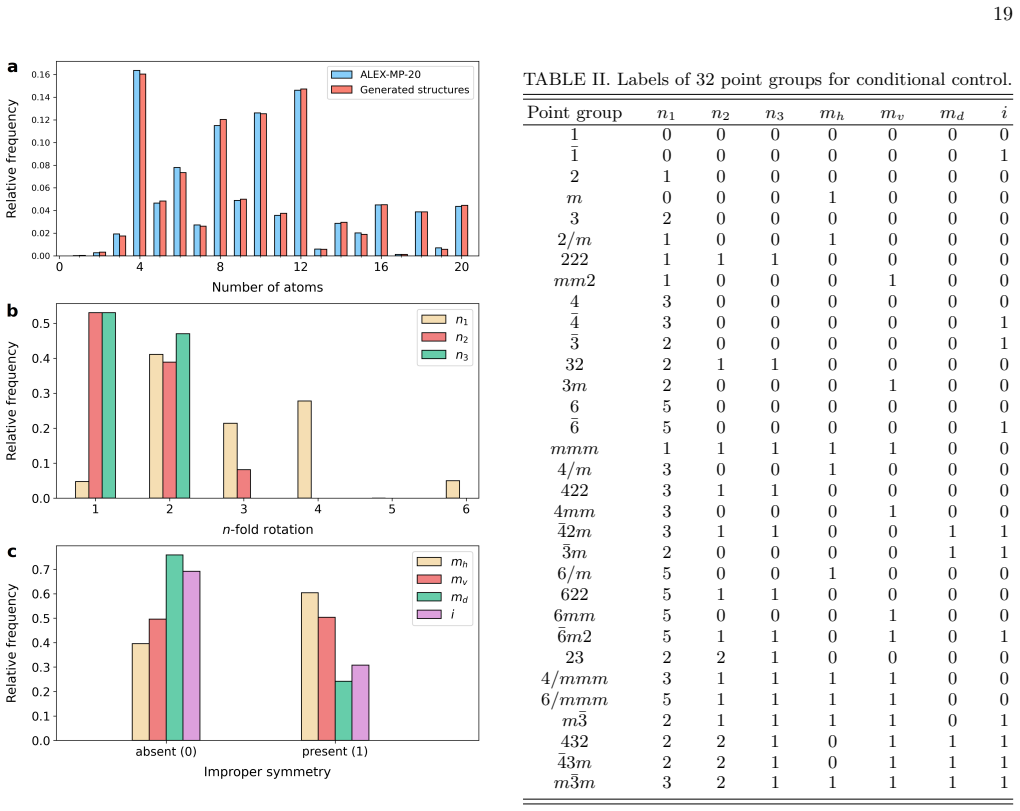
On its own terms, the paper's discovery is that a generative model built from geodesic random walks on manifolds can propose crystal structures that sit essentially on top of their DFT-relaxed geometries while remaining mostly valid, unique, and novel. Of $10^{4}$ generated samples, all pass a 0.5 Å interatomic-distance check and 90.74% are charge neutral; across the 1,436 structures relaxed with DFT, 95.0% have energy above hull below 100 meV/atom and the stable-unique-novel (S.U.N.) rate is 37.72%, comparable to MatterGen's 38.57%. The average RMSD between generated and relaxed structures is 0.0053 Å on ALEX-MP-20, with the novel subset at 0.011 Å, and 42.60% of generated structures already have DFT forces below the 0.02 eV/Å relaxation convergence threshold. Conditional generation guided by seven symmetry labels (three rotation axes, three mirror-plane types, and inversion) reproduces frequent point groups such as m-3m, 4/mmm, and 2/m with high success rates, while rare point groups tend to fall back to higher-symmetry relatives.
Load-bearing premise
The load-bearing premise is that the score functions learned on ALEX-MP-20 generalize to compositions, cell sizes, and geometries outside the training distribution, so the roughly 48% of generated structures counted as novel are newly invented crystals rather than reassembled pieces of training data.
Editorial extensions
If this is right
- Generated structures arrive close enough to their DFT ground states (0.0053 Å average RMSD) that many can skip most of the relaxation search, cutting the cost of downstream DFT validation.
- Point-group conditioning gives a handle for inverse design: a user can ask for cubic or hexagonal symmetry and receive candidates whose space group reflects that input.
- Because the S.U.N. rate is in line with MatterGen's while compositional validity is higher, the approach is a viable alternative for screening stable, unique, novel candidates from a large materials database.
- The same manifold decomposition applies to other periodic systems, since coordinates, occupancies, and lattice metrics are universal descriptors of any crystal.
Reading between the lines
- A natural extension the paper does not run: couple CrystalGRW to a machine-learned force field to pre-relax every generated candidate, then DFT only the survivors; the force predictions shown in the paper suggest this would be cheap.
- The seven-label point-group decomposition could generalize to space-group-level control, which would let users target specific Wyckoff settings rather than just the point-group class.
- The drop in uniqueness from 90% at 10^3 samples to 76% at 10^4, plus the 0.0014 Å RMSD for non-novel samples, hints that some 'novel' structures may be recombinations of training fragments; checking generation on a held-out subset of ALEX-MP-20 would separate interpolation from memorization.
Editorial analysis
A structured set of objections, weighed in public.
Referee Report
Summary. The manuscript introduces CrystalGRW, a score-based diffusion generative model for crystal structures that operates on a product of Riemannian manifolds: fractional coordinates on a 3-torus, atomic types on a hypercube/simplex via a uniform-spacing map, and lattice matrices in Euclidean space. The denoiser is an EquiformerV2 equivariant graph neural network, with a modified atomic-type estimation head and classifier-free guidance for point-group conditioning. The authors train on ALEX-MP-20, generate 10^4 structures, and report that all are structurally valid, 90.74% are compositionally valid, the average RMSD to DFT-relaxed structures is 0.0053 Å, the S.U.N. rate on a 1,436-structure DFT subset is 37.72%, and point-group conditioning is successful for the most frequent symmetry classes. The paper also provides algorithmic listings, hyperparameters, code/data availability, and DFT evaluation details.
Significance. If the evaluation gaps are closed, this is a useful contribution. The paper extends Riemannian score-based generative modeling to full crystal generation with an equivariant architecture, provides a detailed and reproducible experimental setup, compares against MatterGen and other baselines, and gives concrete generated structures with DFT-computed Ehull values that are checkable predictions. The very low reported RMSD values and the S.U.N. example table are promising scientific outputs. The main risk is not circularity in the training/evaluation design, but rather that the 'novel, close-to-ground-state' claim is not yet separated from memorization of training motifs and from possible favorable filtering in the DFT-evaluated subset.
major comments (4)
- [§II C and §IV D] The central S.U.N. comparison is not supported by the reported evaluation protocol. The 37.72% S.U.N. rate is computed on 1,436 structures whose selection from the 10^4 generated set is not described; if this subset is not a random or otherwise predefined sample, the comparison with MatterGen's 38.57% is invalid. In addition, §IV D states that structures containing Mo, Pd, Ir, or Pt were excluded from the Ehull analysis after observing anomalously low values; the number of affected structures and the stability statistics before exclusion are not reported. Please specify the subset construction, report the stability rate on the full generated set or on a clearly random subset, and give with/without-exclusion results so the reader can assess the bias introduced by these choices.
- [§II C and Appendix G] The novelty claim is not yet separated from memorization. StructureMatcher is used with ltol=0.2, stol=0.3, angle_tol=5.0 against ALEX-MP, and since the training set ALEX-MP-20 is contained in ALEX-MP, a 'novel' label only means that no training entry is within a loose match threshold. The very low non-novel RMSD (0.0014 Å), the higher novel RMSD (0.011 Å), and the drop in uniqueness/novelty at 10^4 samples make it plausible that many 'novel' samples are small perturbations of training motifs that happen to fall outside the tolerance window. No distance-to-nearest-training-structure histogram is reported for the novel set. Please provide this histogram, report novelty under tighter StructureMatcher tolerances, and, if possible, evaluate against ALEX-MP-ICSD so the reader can judge whether the novel structures are genuinely outside the training distribution.
- [Appendix A 4 and Algorithms 4-5] The uniform-spacing map is not a bijection on the full hypercube, and the paper's use of it in the diffusion loop may break species identity. H maps Δ^d to the sorted subset of C^d, while H^{-1} sorts an arbitrary vector A before differencing; Algorithms 1, 4, and 5 apply H^{-1} to A_t that has become unsorted after the geodesic random walk, so the result is a projection onto sorted order statistics rather than the inverse of H. This projection can decouple the d+1 species labels from the components of the simplex vector, and at large noise levels the sorted spacings are exchangeable over species, making the denoising task ill-posed. Please clarify how species identity is preserved through this projection, or modify the construction so that the forward and inverse maps are true inverses on the space actually used for the random walk.
- [§IV A and Appendix A 3] Equations (A5) and (A6) define the exponential and inverse exponential maps on T3 with cos/sin expressions that are the geodesic formulas for a sphere, not for a flat torus; on T3 the correct maps are componentwise addition/subtraction modulo 1. Since Eq. (3) and Algorithms 1-3 rely on these maps, the mathematical presentation is internally inconsistent. Please correct the formulas or explicitly state that the analytic form is illustrative and that the implementation uses modular wrapping, with the corresponding inverse map. As written, the appendix does not provide a reproducible definition of the torus score-matching objective.
minor comments (4)
- [Table II and Appendix D] The row for point group 432 in Table II lists labels (2,2,1,0,1,1,1), which do not match the verbal description in Appendix D that 432 has labels (3,2,1,0,0,0,0); please reconcile the table and the text.
- [Table I and Fig. 4] The footnote to Table I says RMSD is averaged over 10^3 structures sampled from the generation set, but the paper does not state whether this is the same 10^3 used for Fig. 4(b) nor how the 10^3 are sampled; please specify this to make the comparison with the 10^4-generation claims precise.
- [Throughout] There are several typographical errors, including 'acheiving', 'CryslGR W' in the code availability line, 'F orward', 'V ariation', 'pricipal', and 'ubutes'; a careful proofreading pass is needed.
- [Appendix A 4] The text states that the forward–inverse pair in Eqs. (A7)-(A10) is 'a bijection, so no information is lost'; this is only true between the simplex and the sorted subset of the hypercube, and the wording should be corrected even if the algorithmic concern in the major comments is resolved.
Circularity Check
No significant circularity: the generative model's stability and ground-state closeness claims are evaluated by external DFT calculations and StructureMatcher comparisons, not by construction from the training objective.
full rationale
The paper's central claims are that CrystalGRW generates structures that are mostly novel, unique, and close to their DFT ground states, with a S.U.N. rate of 37.72% and an average RMSD of 0.0053 Å. Walking the derivation chain, no target quantity is defined in terms of itself. The score functions are trained with a Riemannian score-matching loss (Eq. 3) that compares the network output to the inverse exponential map toward the original training structure; the reverse geodesic random walk (Eq. 2) uses those learned scores. The generated structures are then evaluated by external tools: DFT relaxation in VASP with the MPRelaxSet, Ehull computed via pymatgen PhaseDiagram against the ALEX-MP convex hull, and RMSD/novelty/uniqueness computed by pymatgen StructureMatcher. None of these evaluation quantities is read off from the model or fitted to the test set, so the 'close to DFT ground state' and 'stable' results are genuine forward predictions. The training set is the ALEX-MP-20 subset of the ALEX-MP evaluation database, and novelty is checked against the superset ALEX-MP, which makes the novelty criterion conservative rather than self-serving. The exclusion of Mo-, Pd-, Ir-, and Pt-containing structures from the 1,436-structure DFT stability subset is a disclosed sample-selection choice motivated by inconsistent Ehull values; it affects which structures are evaluated but does not make the evaluated RMSD or Ehull equal to any training label by construction. The self-citations in the paper are not load-bearing: Ref. [23] is contextual motivation for diffusion-based crystal generation, and Ref. [67] is a citation for the crystal graph construction; neither supplies a uniqueness theorem, an ansatz, or a fitted parameter that the central results depend on. The Riemannian diffusion theory is imported transparently from external prior work (RSGM, Ref. [47]) and is not replaced by a same-author claim. Therefore the derivation is self-contained with respect to the circularity patterns considered, and no circular step can be exhibited with a specific reduction.
Assumptions & free parameters
free parameters (4)
- Loss weights lambda (coordinates, atom types, lattice) =
1, 1, 1
- Noise scheduler endpoints h0, hf =
T3: 1e-4 to 1; Cd: 1e-6 to 5; R3x3: 1e-3 to 20
- Adaptive timestep exponent xi =
1
- Guidance strength w =
0.5
assumptions (5)
- standard math RSGM forward and reverse SDEs and score-matching objective are valid on Riemannian manifolds.
- standard math Varadhan's asymptotic approximation for the score holds with the target 1/t exp^{-1}(x_t, x_0).
- standard math The uniform-spacing transform H maps the d-simplex bijectively to the d-hypercube.
- standard math A drift-free random walk on a compact manifold converges to the uniform distribution.
- domain assumption DFT with PBE/GGA+U and the MPRelaxSet protocol gives reliable ground states and hull references.
Cite this review
Pith. "Pith review of CrystalGRW: Generative Modeling of Crystal Structures with Targeted Properties via Geodesic Random Walks." pith.science (2026). https://pith.science/paper/O2SZEQ3L
@misc{pith2026250108998,
  author       = {Pith},
  title        = {Pith review of: CrystalGRW: Generative Modeling of Crystal Structures with Targeted Properties via Geodesic Random Walks},
  year         = {2026},
  howpublished = {\url{https://pith.science/paper/O2SZEQ3L}},
  note         = {Machine review of arXiv:2501.08998}
}
read the original abstract
Determining whether a candidate crystalline material is thermodynamically stable depends on identifying its true ground-state structure, a central challenge in computational materials science. We introduce CrystalGRW, a diffusion-based generative model on Riemannian manifolds that proposes novel crystal configurations and can predict stable phases validated by density functional theory. The crystal properties, such as fractional coordinates, atomic types, and lattice matrices, are represented on suitable Riemannian manifolds, ensuring that new predictions generated through the diffusion process preserve the periodicity of crystal structures. We incorporate an equivariant graph neural network to also account for rotational and translational symmetries during the generation process. CrystalGRW demonstrates the ability to generate realistic crystal structures that are close to their ground states with accuracy comparable to existing models, while also enabling conditional control, such as specifying a desired crystallographic point group. These features help accelerate materials discovery and inverse design by offering stable, symmetry-consistent crystal candidates for experimental validation.
Figures


Figures from the paper (8 more)




Forward citations
Cited by 2 Pith papers
-
Open Materials Generation with Inference-Time Reinforcement Learning
Reinforcement learning can be applied to velocity-only flow models of crystals by adding small noise at inference time, matching score-based RL and cutting integration steps by roughly tenfold.
-
Multimodal Crystal Flow: Any-to-Any Modality Generation for Unified Crystal Modeling
MCFlow uses decoupled flow time axes for atom types and crystal structures so a single model handles crystal structure prediction, de novo generation, and atom-type generation.
Reference graph
Works this paper leans on
-
[1]
A. R. Oganov, C. J. Pickard, Q. Zhu, and R. J. Needs, Structure prediction drives materials discovery, Nature Reviews Materials 4, 331 (2019)
2019
-
[2]
R. J. Needs and C. J. Pickard, Perspective: Role of struc- ture prediction in materials discovery and design, APL Materials 4, 053210 (2016)
2016
-
[3]
A. R. Oganov and C. W. Glass, Crystal structure predic- tion using ab initio evolutionary techniques: Principles and applications, The Journal of Chemical Physics 124, 244704 (2006)
2006
-
[4]
Y. Wang, J. Lv, L. Zhu, and Y. Ma, Crystal structure prediction via particle-swarm optimization, Phys. Rev. B 82, 094116 (2010)
2010
-
[5]
Kirkpatrick, C
S. Kirkpatrick, C. D. Gelatt, and M. P. Vecchi, Optimiza- tion by simulated annealing, Science 220, 671 (1983)
1983
-
[6]
Laio and M
A. Laio and M. Parrinello, Escaping free-energy min- ima, Proceedings of the National Academy of Sciences 99, 12562 (2002)
2002
-
[7]
D. J. Wales and J. P. K. Doye, Global optimization by basin-hopping and the lowest energy structures of lennard-jones clusters containing up to 110 atoms, The Journal of Physical Chemistry A 101, 5111 (1997)
1997
-
[8]
Car and M
R. Car and M. Parrinello, Unified approach for molecular dynamics and density-functional theory, Phys. Rev. Lett. 55, 2471 (1985)
1985
Show all 95 references
-
[9]
Batatia, P
I. Batatia, P. Benner, Y. Chiang, A. M. Elena, D. P. Kov´ acs, J. Riebesell, X. R. Advincula, M. Asta, M. Avaylon, W. J. Baldwin, F. Berger, N. Bernstein, A. Bhowmik, S. M. Blau, V. C˘ arare, J. P. Darby, S. De, F. D. Pia, V. L. Deringer, R. Elijoˇ sius, Z. El-Machachi, F. Fal...
2024 arXiv
-
[10]
B. Deng, P. Zhong, K. Jun, J. Riebesell, K. Han, C. J. Bartel, and G. Ceder, Chgnet as a pretrained universal neural network potential for charge-informed atomistic modelling, Nature Machine Intelligence 5, 1031 (2023)
2023
-
[11]
Chen and S
C. Chen and S. P. Ong, A universal graph deep learn- ing interatomic potential for the periodic table, Nature Computational Science 2, 718 (2022)
2022
-
[12]
Y. Park, J. Kim, S. Hwang, and S. Han, Scal- able parallel algorithm for graph neural net- work interatomic potentials in molecular dynam- ics simulations, Journal of Chemical Theory and Computation 20, 4857 (2024), pMID: 38813770, https://doi.org/10.1021/acs.jctc.4c00190
2024 doi
-
[13]
Liao and T
Y.-L. Liao and T. Smidt, Equiformer: Equivariant graph attention transformer for 3d atomistic graphs (2023), arXiv:2206.11990 [cs.LG]
2023 arXiv
-
[14]
Y.-L. Liao, B. M. Wood, A. Das, and T. Smidt, Equiformerv2: Improved equivariant transformer for scaling to higher-degree representations, in The Twelfth International Conference on Learning Representations (2024)
2024
-
[15]
Bochkarev, Y
A. Bochkarev, Y. Lysogorskiy, and R. Drautz, Graph atomic cluster expansion for semilocal interactions be- yond equivariant message passing, Phys. Rev. X 14, 021036 (2024)
2024
-
[16]
L. R. Timmerman, S. Kumar, P. Suryanarayana, and A. J. Medford, Overcoming the chemical complexity bot- tleneck in on-the-fly machine learned molecular dynamics simulations, Journal of Chemical Theory and Computa- tion 20, 5788 (2024), pMID: 38975655
2024
-
[17]
Karimitari, W
N. Karimitari, W. J. Baldwin, E. W. Muller, Z. J. L. Bare, W. J. Kennedy, G. Cs´ anyi, and C. Sutton, Ac- curate crystal structure prediction of new 2d hybrid organic–inorganic perovskites, Journal of the American Chemical Society 146, 27392 (2024), pMID: 39344597
2024
-
[18]
M. Xu, S. Luo, Y. Bengio, J. Peng, and J. Tang, Learn- ing neural generative dynamics for molecular conforma- tion generation, in International Conference on Learning Representations (2021)
2021
-
[19]
M. Xu, L. Yu, Y. Song, C. Shi, S. Ermon, and J. Tang, Geodiff: A geometric diffusion model for molecular con- formation generation, in International Conference on Learning Representations (2022)
2022
-
[20]
J. Guan, W. W. Qian, X. Peng, Y. Su, J. Peng, and J. Ma, 3d equivariant diffusion for target-aware molecule generation and affinity prediction, in The Eleventh Inter- national Conference on Learning Representations (2023)
2023
-
[21]
M. Xu, A. S. Powers, R. O. Dror, S. Ermon, and J. Leskovec, Geometric latent diffusion models for 3D molecule generation, in Proceedings of the 40th Inter- national Conference on Machine Learning , Proceed- ings of Machine Learning Research, Vol. 202, edited by A. Krause, E. B...
2023
-
[22]
T. Xie, X. Fu, O.-E. Ganea, R. Barzilay, and T. S. Jaakkola, Crystal diffusion variational autoencoder for periodic material generation, in International Conference on Learning Representations (2022)
2022
-
[23]
Pakornchote, N
T. Pakornchote, N. Choomphon-anomakhun, S. Arrerut, C. Atthapak, S. Khamkaeo, T. Chotibut, and T. Bovorn- ratanaraks, Diffusion probabilistic models enhance varia- tional autoencoder for crystal structure generative mod- eling, Scientific Reports 14, 1275 (2024)
2024
-
[24]
R. Jiao, W. Huang, P. Lin, J. Han, P. Chen, Y. Lu, and Y. Liu, Crystal structure prediction by joint equivariant diffusion on lattices and fractional coordinates, in Work- shop on ”Machine Learning for Materials” ICLR 2023 (2023)
2023
-
[25]
R. Jiao, W. Huang, Y. Liu, D. Zhao, and Y. Liu, Space group constrained crystal generation, in The Twelfth International Conference on Learning Representations (2024)
2024
-
[26]
B. K. Miller, R. T. Q. Chen, A. Sriram, and B. M. Wood, Flowmm: Generating materials with riemannian flow matching (2024), arXiv:2406.04713 [cs.LG]
2024 arXiv
-
[27]
Sriram, B
A. Sriram, B. K. Miller, R. T. Q. Chen, and B. M. Wood, FlowLLM: Flow matching for material generation with large language models as base distributions, in The Thirty-eighth Annual Conference on Neural Information Processing Systems (2024)
2024
-
[28]
C. Zeni, R. Pinsler, D. Z¨ ugner, A. Fowler, M. Hor- ton, X. Fu, Z. Wang, A. Shysheya, J. Crabb´ e, S. Ueda, R. Sordillo, L. Sun, J. Smith, B. Nguyen, H. Schulz, S. Lewis, C.-W. Huang, Z. Lu, Y. Zhou, H. Yang, H. Hao, J. Li, C. Yang, W. Li, R. Tomioka, and T. Xie, A generative...
2025 doi
-
[29]
Sohl-Dickstein, E
J. Sohl-Dickstein, E. Weiss, N. Maheswaranathan, and S. Ganguli, Deep unsupervised learning using nonequilib- rium thermodynamics, in Proceedings of the 32nd Inter- national Conference on Machine Learning , Proceedings of Machine Learning Research, Vol. 37, edited by F. Bach a...
2015
-
[30]
J. Ho, A. Jain, and P. Abbeel, Denoising diffusion probabilistic models, in Advances in Neural Information Processing Systems , Vol. 33, edited by H. Larochelle, M. Ranzato, R. Hadsell, M. Balcan, and H. Lin (Cur- ran Associates, Inc., 2020) pp. 6840–6851
2020
-
[31]
Song and S
Y. Song and S. Ermon, Generative modeling by estimat- ing gradients of the data distribution, in Advances in Neural Information Processing Systems , Vol. 32, edited by H. Wallach, H. Larochelle, A. Beygelzimer, F. d'Alch´ e- Buc, E. Fox, and R. Garnett (Curran Associates, Inc., 2019)
2019
-
[32]
Y. Song, J. Sohl-Dickstein, D. P. Kingma, A. Kumar, S. Ermon, and B. Poole, Score-based generative model- ing through stochastic differential equations, in9th Inter- national Conference on Learning Representations, ICLR 2021, Virtual Event, Austria, May 3-7, 2021 (OpenRe- view...
2021
-
[33]
Karras, M
T. Karras, M. Aittala, T. Aila, and S. Laine, Elucidat- ing the design space of diffusion-based generative models, in Advances in Neural Information Processing Systems , edited by A. H. Oh, A. Agarwal, D. Belgrave, and K. Cho (2022)
2022
-
[34]
B. D. Anderson, Reverse-time diffusion equation mod- els, Stochastic Processes and their Applications 12, 313 (1982)
1982
-
[35]
F¨ ollmer, An entropy approach to the time reversal of diffusion processes, in Stochastic Differential Systems Fil- tering and Control, edited by M
H. F¨ ollmer, An entropy approach to the time reversal of diffusion processes, in Stochastic Differential Systems Fil- tering and Control, edited by M. Metivier and E. Pardoux 12 (Springer Berlin Heidelberg, Berlin, Heidelberg, 1985) pp. 156–163
1985
-
[36]
Cattiaux, G
P. Cattiaux, G. Conforti, I. Gentil, and C. L´ eonard, Time reversal of diffusion processes under a finite entropy con- dition, Annales de l’Institut Henri Poincar´ e, Probabilit´ es et Statistiques 59, 1844 (2023)
2023
-
[37]
I. V. Girsanov, On transforming a certain class of stochas- tic processes by absolutely continuous substitution of measures, Theory of Probability & Its Applications 5, 285 (1960), https://doi.org/10.1137/1105027
1960 doi
-
[38]
Karatzas and S
I. Karatzas and S. E. Shreve, in Brownian Motion and Stochastic Calculus (Springer New York, New York, NY, 1998)
1998
-
[39]
Arnaudon, F
M. Arnaudon, F. Barbaresco, and L. Yang, Medians and means in riemannian geometry: Existence, unique- ness and computation, in Matrix Information Geometry , edited by F. Nielsen and R. Bhatia (Springer Berlin Hei- delberg, Berlin, Heidelberg, 2013) pp. 169–197
2013
-
[40]
Takahara, K
I. Takahara, K. Shibata, and T. Mizoguchi, Generative inverse design of crystal structures via diffusion mod- els with transformers (2024), arXiv:2406.09263 [cond- mat.mtrl-sci]
2024 arXiv
-
[41]
G. Guo, T. Saidi, M. Terban, S. J. Billinge, and H. Lip- son, Diffusion models are promising for ab initio structure solutions from nanocrystalline powder diffraction data (2024), arXiv:2406.10796 [physics.comp-ph]
2024 arXiv
-
[42]
E. A. Riesel, T. Mackey, H. Nilforoshan, M. Xu, C. K. Badding, A. B. Altman, J. Leskovec, and D. E. Freedman, Crystal structure determination from pow- der diffraction patterns with generative machine learn- ing, Journal of the American Chemical Society 0, null (0), pMID: 39298266
-
[43]
K. Choudhary, Atomgpt: Atomistic generative pre- trained transformer for forward and inverse materials de- sign, The Journal of Physical Chemistry Letters 15, 6909 (2024), pMID: 38935647
2024
-
[44]
X. Luo, Z. Wang, J. Lv, L. Wang, Y. Wang, and Y. Ma, Crystalflow: A flow-based generative model for crystalline materials (2025), arXiv:2412.11693 [cond- mat.mtrl-sci]
2025
-
[45]
B. Jing, G. Corso, J. Chang, R. Barzilay, and T. S. Jaakkola, Torsional diffusion for molecular conformer generation, in Advances in Neural Information Process- ing Systems , edited by A. H. Oh, A. Agarwal, D. Bel- grave, and K. Cho (2022)
2022
-
[46]
Austin, D
J. Austin, D. D. Johnson, J. Ho, D. Tarlow, and R. van den Berg, Structured denoising diffusion mod- els in discrete state-spaces, in Advances in Neural Infor- mation Processing Systems , edited by A. Beygelzimer, Y. Dauphin, P. Liang, and J. W. Vaughan (2021)
2021
-
[47]
V. D. Bortoli, E. Mathieu, M. J. Hutchinson, J. Thorn- ton, Y. W. Teh, and A. Doucet, Riemannian score-based generative modelling, in Advances in Neural Information Processing Systems , edited by A. H. Oh, A. Agarwal, D. Belgrave, and K. Cho (2022)
2022
-
[48]
R. T. Q. Chen and Y. Lipman, Flow matching on general geometries, in The Twelfth International Conference on Learning Representations (2024)
2024
-
[49]
Ho and T
J. Ho and T. Salimans, Classifier-free diffusion guidance, in NeurIPS 2021 Workshop on Deep Generative Models and Downstream Applications (2021)
2021
-
[50]
Devroye, Non-uniform random variate generation (Springer, New York, NY, 2013) pp
L. Devroye, Non-uniform random variate generation (Springer, New York, NY, 2013) pp. 207–210
2013
-
[51]
T. S. Cohen, M. Geiger, J. K¨ ohler, and M. Welling, Spherical CNNs, in International Conference on Learning Representations (2018)
2018
-
[52]
Thomas, T
N. Thomas, T. E. Smidt, S. Kearnes, L. Yang, L. Li, K. Kohlhoff, and P. Riley, Tensor field networks: Rotation- and translation-equivariant neural networks for 3d point clouds, CoRR abs/1802.08219 (2018), 1802.08219
2018 arXiv
-
[53]
Passaro and C
S. Passaro and C. L. Zitnick, Reducing so(3) convo- lutions to so(2) for efficient equivariant gnns (2023), arXiv:2302.03655 [cs.LG]
2023 arXiv
-
[54]
Geiger, T
M. Geiger, T. Smidt, A. M., B. K. Miller, W. Boomsma, B. Dice, K. Lapchevskyi, M. Weiler, M. Tyszkiewicz, S. Batzner, D. Madisetti, M. Uhrin, J. Frellsen, N. Jung, S. Sanborn, M. Wen, J. Rackers, M. Rød, and M. Bailey, e3nn/e3nn: 2022-04-13 (2022)
2022
-
[55]
Schmidt, N
J. Schmidt, N. Hoffmann, H.-C. Wang, P. Borlido, P. J. M. A. Carri¸ co, T. F. T. Cerqueira, S. Botti, and M. A. L. Marques, Machine-learning-assisted determination of the global zero-temperature phase diagram of materials, Ad- vanced Materials 35, 2210788
-
[56]
Schmidt, H.-C
J. Schmidt, H.-C. Wang, T. F. T. Cerqueira, S. Botti, and M. A. L. Marques, A dataset of 175k stable and metastable materials calculated with the pbesol and scan functionals, Scientific Data 9, 64 (2022)
2022
-
[57]
A. Jain, S. P. Ong, G. Hautier, W. Chen, W. D. Richards, S. Dacek, S. Cholia, D. Gunter, D. Skinner, G. Ceder, et al. , Commentary: The materials project: A materials genome approach to accelerating materials innovation, APL materials 1, 011002 (2013)
2013
-
[58]
S. P. Ong, W. D. Richards, A. Jain, G. Hautier, M. Kocher, S. Cholia, D. Gunter, V. L. Chevrier, K. A. Persson, and G. Ceder, Python materials genomics (py- matgen): A robust, open-source python library for mate- rials analysis, Computational Materials Science 68, 314 (2013)
2013
-
[59]
Togo and I
A. Togo and I. Tanaka, Spglib: a software library for crystal symmetry search, https://github.com/spglib/ spglib (2018), arXiv:1808.01590
2018 arXiv
-
[60]
Mouhat and F
F. Mouhat and F. m. c.-X. Coudert, Necessary and suf- ficient elastic stability conditions in various crystal sys- tems, Phys. Rev. B 90, 224104 (2014)
2014
-
[61]
De Graef and M
M. De Graef and M. E. McHenry, Structure of Materi- als: An Introduction to Crystallography, Diffraction and Symmetry, 2nd ed. (Cambridge University Press, 2012)
2012
-
[62]
Pennec, Intrinsic statistics on riemannian manifolds: Basic tools for geometric measurements, Journal of Mathematical Imaging and Vision 25, 127 (2006)
X. Pennec, Intrinsic statistics on riemannian manifolds: Basic tools for geometric measurements, Journal of Mathematical Imaging and Vision 25, 127 (2006)
2006
-
[63]
S. R. S. Varadhan, On the behavior of the fundamental solution of the heat equation with variable coefficients, Communications on Pure and Applied Mathematics 20, 431 (1967)
1967
-
[64]
F. Bao, C. Li, J. Zhu, and B. Zhang, Analytic-dpm: an analytic estimate of the optimal reverse variance in diffusion probabilistic models, CoRR abs/2201.06503 (2022), 2201.06503
2022 arXiv
-
[65]
Watson, J
D. Watson, J. Ho, M. Norouzi, and W. Chan, Learning to efficiently sample from diffusion probabilistic models, CoRR abs/2106.03802 (2021), 2106.03802
2021 arXiv
-
[66]
P. W. Battaglia, J. B. Hamrick, V. Bapst, A. Sanchez- Gonzalez, V. Zambaldi, M. Malinowski, A. Tacchetti, D. Raposo, A. Santoro, R. Faulkner, C. Gulcehre, F. Song, A. Ballard, J. Gilmer, G. Dahl, A. Vaswani, K. Allen, C. Nash, V. Langston, C. Dyer, N. Heess, 13 D. Wierstra, P....
2018 arXiv
-
[67]
Pakornchote, A
T. Pakornchote, A. Ektarawong, and T. Chotibut, Straintensornet: Predicting crystal structure elastic properties using se(3)-equivariant graph neural networks, Phys. Rev. Res. 5, 043198 (2023)
2023
-
[68]
Hohenberg and W
P. Hohenberg and W. Kohn, Inhomogeneous electron gas, Physical review 136, B864 (1964)
1964
-
[69]
Kohn and L
W. Kohn and L. J. Sham, Self-consistent equations in- cluding exchange and correlation effects, Physical review 140, A1133 (1965)
1965
-
[70]
Kresse and D
G. Kresse and D. Joubert, From ultrasoft pseudopoten- tials to the projector augmented-wave method, Physical review b 59, 1758 (1999)
1999
-
[71]
Hobbs, G
D. Hobbs, G. Kresse, and J. Hafner, Fully unconstrained noncollinear magnetism within the projector augmented- wave method, Physical Review B 62, 11556 (2000)
2000
-
[72]
Kresse and J
G. Kresse and J. Furthm¨ uller, Efficiency of ab-initio total energy calculations for metals and semiconductors using a plane-wave basis set, Computational materials science 6, 15 (1996)
1996
-
[73]
Kresse and J
G. Kresse and J. Furthm¨ uller, Efficient iterative schemes for ab initio total-energy calculations using a plane-wave basis set, Physical review B 54, 11169 (1996)
1996
-
[74]
A. Jain, G. Hautier, C. J. Moore, S. P. Ong, C. C. Fis- cher, T. Mueller, K. A. Persson, and G. Ceder, A high- throughput infrastructure for density functional theory calculations, Computational Materials Science 50, 2295 (2011)
2011
-
[75]
H. J. Monkhorst and J. D. Pack, Special points for Brillouin-zone integrations, Physical review B 13, 5188 (1976)
1976
-
[76]
J. P. Perdew, K. Burke, and M. Ernzerhof, Generalized gradient approximation made simple, Physical review let- ters 77, 3865 (1996)
1996
-
[77]
L. Wang, T. Maxisch, and G. Ceder, Oxidation ener- gies of transition metal oxides within the gga+u frame- work, Physical Review B—Condensed Matter and Mate- rials Physics 73, 195107 (2006)
2006
-
[78]
A. Jain, G. Hautier, S. P. Ong, C. J. Moore, C. C. Fis- cher, K. A. Persson, and G. Ceder, Formation enthalpies by mixing gga and gga+ u calculations, Physical Review B—Condensed Matter and Materials Physics 84, 045115 (2011)
2011
-
[79]
C. J. Bartel, Review of computational approaches to predict the thermodynamic stability of inorganic solids, Journal of Materials Science 57, 10475 (2022)
2022
-
[80]
S. P. Ong, L. Wang, B. Kang, and G. Ceder, Li-fe-p-o2 phase diagram from first principles calculations, Chem- istry of Materials 20, 1798 (2008)
2008
-
[81]
S. P. Ong, A. Jain, G. Hautier, B. Kang, and G. Ceder, Thermal stabilities of delithiated olivine mpo4 (m=fe, mn) cathodes investigated using first principles calcula- tions, Electrochemistry Communications 12, 427 (2010). ACKNOWLEDGMENTS K.T. and T.B. acknowledge funding supp...
2010
-
[82]
Moving x1 along u by a geodesic yields a new point x2 = exp M x1 (u), (A1) where exp M x1 is the exponential map
General definitions Suppose u ∈ Tx1 M is a tangent vector at x1 ∈ M. Moving x1 along u by a geodesic yields a new point x2 = exp M x1 (u), (A1) where exp M x1 is the exponential map. Conversely, if x2 is known, we can recover v ∈ Tx2 M that points back toward x1 via v = exp −1...
-
[83]
Consider the Eu- clidean manifold Rd
Euclidean manifold R3×3 for lattice matrices A lattice matrix L lives in R3×3. Consider the Eu- clidean manifold Rd. The exponential map from a point x1 to x2 along a vector u ∈ Rd simply becomes x2 = exp Rd x1 (u) = x1 + u, (A3) and the corresponding inverse exponential map i...
-
[84]
In this compact manifold, one often wraps coordinates mod- ulo 1 to enforce periodic boundaries
3D torus T3 for fractional coordinates Fractional coordinates of crystal lattices have an intrin- sic periodicity, which we interpret as a 3D torus, T3. In this compact manifold, one often wraps coordinates mod- ulo 1 to enforce periodic boundaries. For an infinitesimal tangen...
-
[85]
One can naturally encodes this uncer- tainty in a probability vector a(i) = ( a(i) 1 , a(i) 2 ,
d-simplex ∆d and d-hypercube Cd for atomic types Each atomic site i can be occupied by any one of d + 1 possible species. One can naturally encodes this uncer- tainty in a probability vector a(i) = ( a(i) 1 , a(i) 2 , . . . , a(i) d ), where a(i) α ≥ 0 for all α ∈ {1, . . . , ...
-
[86]
Equivariant convolutions on graphs Building on the idea of preserving SE (3) symmetries (rotations and translations) in neural networks, the Ten- sor Field Network (TFN) [52] introduced a convolution that propagates features between pairs of nodes while maintaining equivarianc...
-
[87]
EquiformerV2 and SO2Attn Building on TFN-style operations, the Equiformer ar- chitecture [13] (and its successor, EquiformerV2 [14]) in- tegrates attention into equivariant message passing. Con- cretely, scalar features ( l = 0) undergo a standard at- tention mechanism, while ...
-
[88]
In principle, we could approximate this score by learning the manifold inverse exponential map directly from sCd,(i) θ (a(i) t , t) ≈ 1 t exp−1,Cd A(i) t A(i) 0
Atomic-type estimator For atomic-type variables, recall the goal to learn a score function sCd θ (a(i) t , t) that, at each timet, points from the noised A(i) t toward the original atomic-type config- uration A(i) 0 . In principle, we could approximate this score by learning t...
-
[89]
7 compares four approaches for predicting per- ovskite compositions where the models are trained with the Perov-5 dataset [22]
Comparisons of Model V ariants for Perovskite Compositions Fig. 7 compares four approaches for predicting per- ovskite compositions where the models are trained with the Perov-5 dataset [22]. Model I employs a scheme where the network predicts all three scores as in Eq. (B7). ...
-
[90]
SDE F ormulation and Score-Based Generative Modeling Consider a stochastic process xt ∈ M, where M is an arbitrary Riemannian manifold. In local coordinates, an SDE on M can be written as dxt = b(xt, t) dt + σ(xt, t) dBM t , (E1) where BM t denotes Brownian motion intrinsic to...
-
[91]
F okker–Planck Equation and Closed-F orm Solutions In local coordinates, the forward density p(x, t| x0) on a Riemannian manifold M satisfies a Fokker–Planck (Kolmogorov forward) equation of the form ∂ ∂t p(x, t| x0) = − div h p(x, t| x0) b(x, t) i + 1 2 trace h ∇2 p(x, t| x0)...
-
[92]
Linear Scheduler for the Diffusion Coefficient A common design choice in score-based or diffusion- based models is to let the diffusion amplitude σ(x, t) grow over time in a simple, linear fashion. Denoting the squared diffusion coefficient by g2(t), we set σ2(x, t) ≡ g2(t) = ...
-
[93]
It is bigger than ALEX-MP-20 dataset which is screened for mate- rials with Ehull < 100 meV and the number of atoms ≤ 20 atoms per unit cell
ALEX-MP dataset The dataset contains 845,995 materials, merged from Alexandria and Material Projects databases. It is bigger than ALEX-MP-20 dataset which is screened for mate- rials with Ehull < 100 meV and the number of atoms ≤ 20 atoms per unit cell. However, MatterGen eval...
-
[94]
StructureMatcher receives a pair of structures with the same compositions and determines the similarity of their lattice vectors and atomic positions within the Niggli cell
Uniqueness and novelty The similarity between two structures can be eval- uated using StructureMatcher from the pymatgen, with tolerance parameters set to ltol=0.2, stol=0.3, angle tol=5.0, following MatterGen’s setting [28]. StructureMatcher receives a pair of structures with...
-
[95]
structures, and Fig
Examples of generated structures Table IV presents example of S.U.N. structures, and Fig. 12 illustrates S.U.N. structures reported in Table IV. Table V shows generated structures that have RMSD > 0.1 ˚A. Table VI reports F1 scores, success rates, uniquenesses, and percentages...
Reviewed August 10, 2026 · model on record in the stance chip above.
Discussion (0). Continue with ORCID to comment.