REVIEW 4 major objections 5 minor 1 cited by
Cosmological Interactions with Phantom Scalar Field: Revisiting Background Phase-Space Analysis with Compactified Variables
T0 review · 4 major / 5 minor · reviewed 2026-08-10 · deepseek-v4-flash
Pith's one-line read A new compactified normalization puts phantom dark-energy models on a bounded phase space, where Big Rip endpoints are unstable and the late-time attractors are scaling solutions.
desk verdict Useful compactified-variable method, but the fixed-point analysis as written contains undefined parameters and contradictory inequalities that must be corrected before the stability claims are credible. read the letter →
The pith
A machine-rendered reading of the paper's core claim, the machinery that carries it, and where it could break.
The reading
What carries the argument
The central object is the compactified normalization defined in Eq. (11): $\chi = \dot{\phi}/(\sqrt{2}D)$, $\zeta^2 = V/D^2$, $\xi^2 = \rho_m/D^2$, $\eta = \sqrt{3}H/D$, $\lambda = V_{,\phi}/V$, with $D = \sqrt{\tfrac12\dot{\phi}^2 + V + \rho_m}$. By construction $\Xi \equiv \chi^2 + \zeta^2 + \xi^2 = 1$, so $(\chi,\zeta,\xi)$ live on the unit sphere, and the Friedmann equation gives a second constraint $\eta^2 = 1 - 2\chi^2$. For an exponential potential these constraints reduce a five-dimensional system to a two-dimensional compact dynamical system in $(\chi,\zeta)$, valid on the branch $\chi^2 \leq \tfrac12$ and $H > 0$. The compactness is what lets the authors enumerate all stationary points, including the Big Rip boundary points, and classify their stability directly.
What would settle it
Repeat the stationary-point and stability analysis for Model A with a non-exponential potential, for example $V = V_0\phi^2$, using the same compactified variables and evaluate the eigenvalues at the Big Rip points; if any Big Rip point becomes a stable attractor, or if the phase space is no longer compact, the central claim fails. Equivalently, take the negative root $\eta = -\sqrt{1-2\chi^2}$ and check whether the Big Rip points change from saddles and sources to attractors.
Extended reading notes
Core claim
On the paper's own terms, the central discovery is that the field equations of phantom scalar-field cosmologies with dark-matter interactions admit a normalization $D = \sqrt{\tfrac12\dot{\phi}^2 + V + \rho_m}$ such that the dimensionless state variables $\chi$, $\zeta$, $\xi$ lie on the unit sphere and the first Friedmann constraint closes the system, giving a compact two-dimensional phase space for exponential potentials. Within that compact space, each stationary point maps to a precise cosmological epoch. For Model A ($Q_A = \beta_0\dot{\phi}\rho_m$) there are five families of asymptotic solutions, and for Model B ($Q_B = \beta_0\dot{\phi}\rho_\phi$, with constant potential $\lambda = 0$) there are seven families. In both models the Big Rip solutions are sources or saddle points, so they are unstable under the interaction, and the late-time attractors are scaling solutions. The authors state these results agree with the Hubble-normalization analysis but are derived in a more formal, fully compactified framework.
Load-bearing premise
The broad claim rests on assuming an exponential potential for Model A and a constant potential for Model B, on the expanding branch $H>0$, and on leaving the parameter $\alpha$ in point $A_5$ unspecified; if the qualitative stability results change for general potentials, on the contracting branch, or for specific $\alpha$ values, the claimed generality of the compactified-variable insight would be weakened.
Editorial extensions
If this is right
- Big Rip solutions in both interacting models are unstable, so an interaction proportional to $\dot{\phi}$ can prevent a future singularity even when the dark energy is phantom.
- The late-time behavior of both models is a scaling solution, meaning dark matter and the phantom field reach a fixed ratio, which directly addresses the coincidence problem.
- The compactified phase space is complete in a way the Hubble-normalized variables are not, so stability classifications do not require an extra chart at infinity.
- For Model B, the matter-dominated epoch appears as a saddle point, so the model can pass through matter domination before reaching the accelerated attractor.
- The method transfers the standard exponential-potential phase-space analysis from quintessence to phantom fields with interactions.
Reading between the lines
- The same compactification could be applied to multiscalar or nonminimally coupled dark-energy models, where the unit-sphere constraint may still eliminate one dynamical variable.
- The analysis is restricted to the expanding branch $H > 0$; on the contracting branch the Big Rip points might change stability, which would matter for bouncing or cyclic cosmologies if the authors' assumptions are relaxed.
- The stability results for general potentials are delegated to a companion paper, so a natural test is to check whether the attractor structure found here survives for power-law or hyperbolic potentials.
- The dependence of the attractor regions on $\beta_0$ and $\lambda$ could be used to place observational constraints on the interaction strength from the requirement that the current universe lie near an accelerating scaling attractor.
Formalized claims in Lean
-
Claim #1: On the paper's own terms, the central discovery is that the field equations of phantom scalar-field cosmologies with dark-matter interactions allow a normalization $D = \sqrt{\tfrac12\dot{\phi}^2 + V + \rho_m}$ such that the dimensionless state variables $\chi$, $\zeta$, $\xi$ lie on the unit sphere and the first Friedmann constraint closes the system, giving a compact two-dimensional phase space
/-- @claim 1 On the paper's own terms, the central discovery is that the field equations of phantom scalar-field cosmologies with dark-matter interactions allow a normalization $D = \sqrt{\tfrac12\dot{\phi}^2 + V + \rho_m}$ such that the dimensionless state variables $\chi$, $\zeta$, $\xi$ lie on the unit sphere and the first Friedmann constraint closes the system, giving a compact two-dimensional phase space  -/
def central_claim : Prop :=
Editorial analysis
A structured set of objections, weighed in public.
Referee Report
Summary. The paper proposes a new compactified dimensionless normalization for spatially flat FLRW cosmologies containing a phantom scalar field and dark matter, defined by Eqs. (11)-(13), and applies it to two interacting models, QA = β0 φdot ρm and QB = β0 φdot ρφ. For an exponential potential in Model A and a constant potential in Model B, the field equations are reduced to two-dimensional dynamical systems, whose fixed points are classified. The central claim is that Big Rip stationary points are sources or saddles and that the future attractors are scaling solutions, so that interactions avoid future singularities even for phantom dark energy. The compactification idea is interesting, but the manuscript as written contains several uncorrected technical errors that prevent the central stability classification from being verified.
Significance. If the analysis were correct, the compactified normalization would be a genuinely useful alternative to Hubble-normalized variables: the constraint Ξ = 1 explicitly bounds the variables on a compact surface, and the paper addresses a physically relevant question, namely whether interaction terms can render Big Rip singularities unstable in phantom scalar field cosmologies. The paper also correctly connects the interaction models to earlier literature and clearly states the branch H > 0 and the restriction to exponential/constant potentials. These strengths are real. However, the central result rests on the fixed-point and stability analysis of the reduced systems, and that analysis is not reproducible as written because of the undefined parameter α in A5 and the contradictory attractor condition for A±4. The contribution is therefore conditional on a careful revision of the fixed-point computations.
major comments (4)
- [§2, Eq. (10)] The continuity equation for the scalar field is written as ˙ρφ + 3H(ρφ + pφ)ρφ = −Q. This contains an extra factor ρφ; the standard conservation equation is ˙ρφ + 3H(ρφ + pφ) = −Q. Since the reduced dynamical systems are derived from the cosmological field equations, this error must be corrected and the derivation of Eqs. (15)-(22) rechecked, because the extra factor would alter the scalar-field equation of motion if it were used.
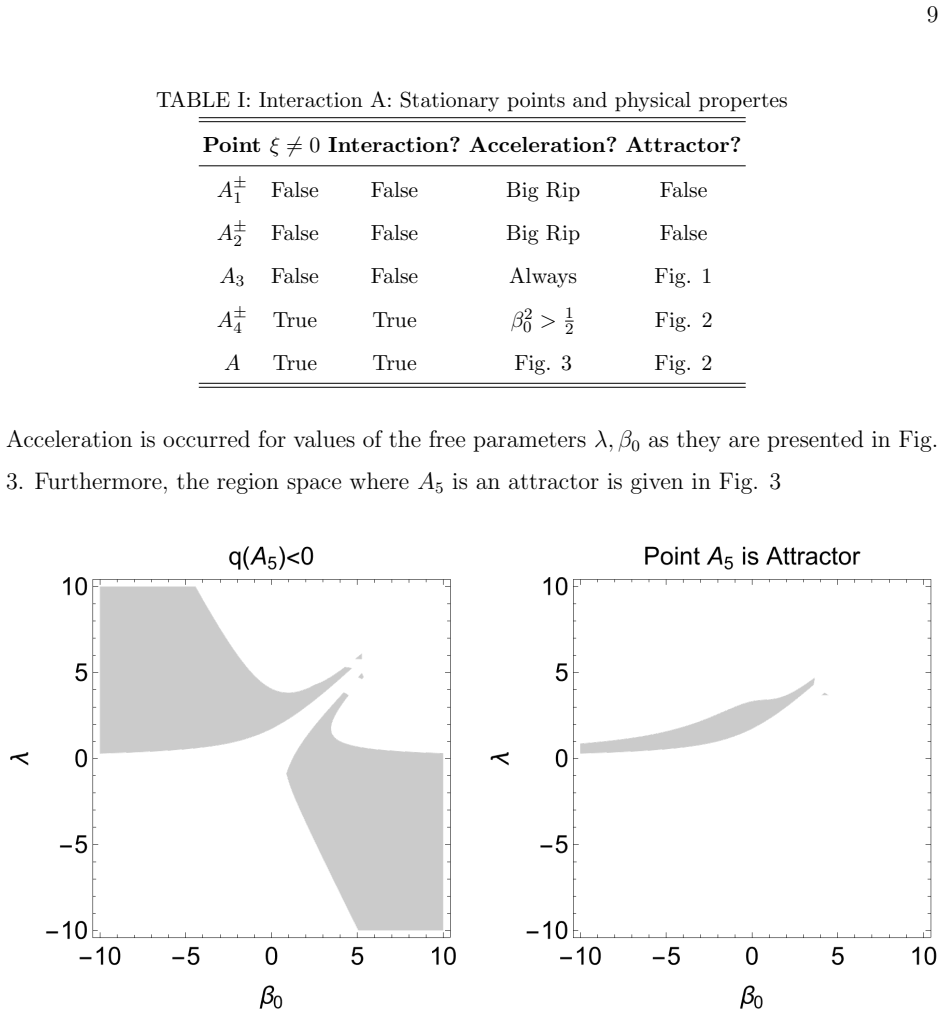
- [§3.1, fixed point A5] The stationary point A5 is defined by A5 = (sqrt(3/(3+2(α−λ)^2)), sqrt(2α(α−λ)−3)/3), but the parameter α appears nowhere in the definitions (11)-(12), in the interaction QA = β0 φdot ρm, or in the reduced system (21)-(22), which contains only λ and β0. No definition, physical meaning, or domain is given for α. Consequently A5, its physical parameters, its acceleration region, and its attractor region in Fig. 3 and Table I are undefined. The plots in Fig. 3 are labeled as regions in {β0, λ}, but A5 depends on α and not on β0, which is inconsistent. The authors must either define α in terms of the model parameters or replace it with the correct parameter before the fixed-point classification can be accepted.
- [§3.1, attractor condition for A±4] The stated attractor condition for A+4 is internally contradictory: for β0 > 0 it requires simultaneously λ > (2β0^2 − 3)/(2β0) and λ < (2β0^2 − 3)/(2β0). This is an empty condition. The same paragraph also gives a condition for A−4 with a different functional form. Since the stability properties of A±4 are part of the paper's central claim that Big Rip points are not future attractors, this contradiction must be resolved by presenting the actual eigenvalues and correct inequalities.
- [§3.1, eigenvalues for A±1 and A±2] The text states that A±1 and A±2 are sources or saddles depending on the sign of β0 − λ, but no eigenvalues or linearization calculation are shown for these points. Given that these points are identified with Big Rip singularities and that their instability is a headline conclusion, the eigenvalues should be reported explicitly so that the stability classification can be checked.
minor comments (5)
- [§3.1, captions of Figs. 4-5] The captions state 'We present the case where there not any interaction, α = 0, and the potential function is constant, λ = 0.' Since α is undefined and for α = 0 the point A5 is not real (its second coordinate becomes imaginary), the meaning of 'α = 0' is unclear; the intended no-interaction limit is likely β0 = 0, and the captions should be corrected.
- [Table II] In the B4 row, the acceleration condition is written as '6 ≤ a2 < 8', which should read '6 ≤ β0^2 < 8'.
- [Fig. 8 caption] The caption refers to the dynamical system (21), (22), but the figure is for Model B and should refer to system (25), (26).
- [§2, line after Eq. (9)] The phrase 'the continuous equation' should be 'the continuity equation', and further on 'dark sectior' should be 'dark sector'.
- [§4, Conclusions] The conclusion that the results 'agree with those obtained using Hubble normalization' is asserted without a direct comparison table or explicit mapping to the Hubble-normalized variables; adding a short comparison would make the novelty of the compactified approach easier to assess.
Circularity Check
No substantive circularity: the compactified phase-space analysis is derived from the field equations and the stability classification is an independent eigenvalue computation; self-citations are motivational, not load-bearing.
full rationale
The central derivation is self-contained. The variables (11) with D (12) are inserted into the Friedmann constraint (14) and the continuity equations (9)-(10) to produce the reduced systems (21)-(22) and (25)-(26). No observational data are fitted and no target conclusion is used as an input; the fixed-point and stability results come from standard linearization. The compactness of the variables is literally imposed by the defining constraint 'by definition, it follows Ξ ≡ χ^2 + ζ^2 + ξ^2 = 1' (Eq. 13), so the compactified character is a transparent definitional property rather than a hidden circular prediction. The self-citations do not carry the argument: [71] is cited for the normalization methodology ('Following the methodology established in [71]'), and [64] is cited for the motivation that interactions avoid singularities ('Where necessary the interactions are proportional to φ̇ in order to avoid the appearance of singularities, see the discussion in [64]') and for delegating general scalar-field potentials ('For more general potentials, the physical properties of the asymptotic solutions change slightly, as discussed in detail in [64]'). None of these citations introduces the exponential/constant-potential fixed points or their stability, which are computed in this paper. The paper does contain internal consistency defects that reduce reproducibility: the fixed point A5 in Sec. 3.1 depends on a parameter α that appears nowhere in the system, and the stated attractor condition for A+4 simultaneously requires λ > (2β0^2−3)/(2β0) and λ < (2β0^2−3)/(2β0). These are correctness concerns, not circularity, and under the review rules they do not raise the circularity score. The manuscript also explicitly restricts Model B to λ=0 and general potentials to [64], which narrows the claimed scope but does not make the presented derivation circular.
Assumptions & free parameters
assumptions (6)
- domain assumption Spatially flat FLRW geometry with dust dark matter and a phantom scalar field.
- domain assumption Exponential potential V = V0 e^{λϕ} for Model A and constant potential for Model B.
- domain assumption Interaction terms QA = β0 φdot ρm and QB = β0 φdot ρφ.
- ad hoc to paper Interactions proportional to φdot avoid singularities.
- domain assumption Restriction to the expanding branch H > 0 (η = +sqrt(1-2χ²)).
- standard math Standard dynamical systems background: linearization about fixed points determines stability.
Cite this review
Pith. "Pith review of Cosmological Interactions with Phantom Scalar Field: Revisiting Background Phase-Space Analysis with Compactified Variables." pith.science (2026). https://pith.science/paper/VUCPQSN4
@misc{pith2026250109177,
  author       = {Pith},
  title        = {Pith review of: Cosmological Interactions with Phantom Scalar Field: Revisiting Background Phase-Space Analysis with Compactified Variables},
  year         = {2026},
  howpublished = {\url{https://pith.science/paper/VUCPQSN4}},
  note         = {Machine review of arXiv:2501.09177}
}
read the original abstract
Energy transfer in the dark sector of the universe gives rise to new phenomena of special interest in modern cosmology. When dark energy is modeled as a phantom scalar field, interactions become crucial to avoid Big Rip singularities. In this work, we revisit the phase-space analysis of the field equations by introducing a new set of dimensionless variables distinct from the traditional Hubble normalization approach. These new variables define a compactified phase space for the evolution of physical parameters. We demonstrate that these compactified variables offer fresh insights into the phase-space analysis in gravitational theories, particularly when the dark energy fluid is allowed to possess a negative kinetic energy density.
Figures


Figures from the paper (5 more)


Forward citations
Cited by 1 Pith paper
-
Averaging Dynamics of Scalar Field-Matter Interacting Models in Anisotropic Universes: The Locally Rotationally Symmetric Bianchi I Spacetime
The authors apply averaging methods to classify late-time attractors for nine interacting dark sector models in Bianchi I cosmology, but the general interaction formula does not match the specific models analyzed.
Reference graph
Works this paper leans on
-
[71]
Pav´ on and B
D. Pav´ on and B. Wang, Gen. Rel. Grav. 41, 1 (2009)
2009
-
[64]
S. Chatzidakis, A. Giacomini, P.G.L. Leach, G. Leon and A. Paliathanasis, J. High Energ. Astroph. 36, 141 (2022)
work page 2022
-
[1]
INTRODUCTION The detailed analysis of cosmological observations [1–4] implies that the universe is dom- inated by two matter components that do not interact with light: dark matter and dark energy. Dark matter was introduced to explain the velocity profiles of galaxies and, on ∗Electronic address: genly.leon@ucn.cl †Electronic address: daya.shankar@woxsen...
arXiv 2025
-
[2]
COSMOLOGICAL INTERACTIONS On very large scales, the universe is described by the line element of the spatially flat FLR W geometry ds2 = −dt2 + a2(t) dx2 + dy2 + dz2 , (1) where a(t) is the expansion scale factor of the universe. Within the framework of General Relativity with two fluid components, the phantom field, and the dark matter, the gravitational...
-
[3]
COMP ACTIFIED NORMALIZA TION In contrast to the Hubble normalization studied in the recent work [64]; we adopt a different normalization approach based on matter. Following the methodology established in [71], we introduce a new set of dimensionless variables χ = ˙ϕ√ 2D , ζ2 = V (ϕ) D2 , ξ2 = ρm D2 , η = √ 3H D , λ = V,ϕ V , dτ = Ddt (11) where D = r 1 2 ...
-
[4]
Furthermore, the region space where A5 is an attractor is given in Fig. 3 FIG. 3: Interaction A: Region plots in the space of variables {β0, λ} where A5 describes cosmic acceleration (Left Fig.) and A5 is an attractor (Right Fig.). The above results are summarized in Table I. Moreover, in Fig. 4 we present phase-space portraits for the dynamical system (2...
-
[5]
CONCLUSIONS We have considered a spatially flat FLR W geometry where the dark sector of the universe consists of dark matter, described by a dust fluid source, and dark energy, modeled by a phantom scalar field. The introduction of the phantom field allows the equation of state 14 -0.6 -0.4 -0.2 0.0 0.2 0.4 0.6 0.0 0.2 0.4 0.6 0.8 1.0 χ ζ Interaction B:λ=...
work page 2022
- [6]
Show all 76 references
-
[7]
Kowalski et al., Astrophys
M. Kowalski et al., Astrophys. J. 686, 749 (2008)
2008
-
[8]
Komatsu et al., Astrophys
E. Komatsu et al., Astrophys. J. Suppl. Ser. 180, 330 (2009)
2009
-
[9]
Suzuki et
N. Suzuki et. al., Astrophys. J. 746, 85 (2012)
2012
-
[10]
Arbey and F
A. Arbey and F. Mahmoudi, Progress in Particle and Nuclear Physics 119, 103865 (2021)
2021
-
[11]
Li, X.-D
M. Li, X.-D. Li, S. Wang and Y. Wang, Frontiers of Physics, 8, 828 (2013)
2013
-
[12]
Clifton, P.G
T. Clifton, P.G. Ferreira, A. Padilla and C. Skordis, Phys. Rept. 513, 1 (2012)
2012
-
[13]
Perivolaropoulos and F
L. Perivolaropoulos and F. Skara, New Astronomy Reviews 95, 101659 (2022)
2022
-
[14]
Ratra and P.J.E
B. Ratra and P.J.E. Peebles, Phys. Rev. D 37, 3406 (1988)
1988
-
[15]
Peebles and B
P.J.E. Peebles and B. Ratra, Rev. Mod. Phys. 75, 559 (2003)
2003
-
[16]
N. Roy, S. Goswami and S. Das, Phys. Dark Univ. 36, 10137 (2022)
2022
-
[17]
Armendariz-Picon, V.F
C. Armendariz-Picon, V.F. Mukhanov and P.J. Steinhardt, Phys. Rev. D 63, 103510 (2001)
2001
-
[18]
Nicolis, R
A. Nicolis, R. Rattazzi and E. Trincherini, Phys. Rev. D 79, 064036 (2009)
2009
-
[19]
Deffayet, G
C. Deffayet, G. Esposito-Farese and A. Vikman, Phys. Rev. D 79, 084003 (2009)
2009
-
[20]
Dimakis, A
N. Dimakis, A. Paliathanasis, P.A. Terzis and T. Christodoulakis, 79, 618 (2019)
2019
-
[21]
Horndeski, Int
G.W. Horndeski, Int. J. Ther. Phys. 10, 363 (1974)
1974
-
[22]
Coley and R.J
A.A. Coley and R.J. van den Hoogen, Phys. Rev. D 023517 (2000)
2000
-
[23]
Kamenshchik, A
A.Yu. Kamenshchik, A. Tronconi, G. Venturi, S.Yu. Vernov, Phys. Rev. D 87, 063503 (2013)
2013
-
[24]
J¨ arv, M
L. J¨ arv, M. R¨ unkla, M. Saal and O. Vilson, Phys. Rev. D 97, 124025 (2018)
2018
-
[25]
Tsamparlis and A
M. Tsamparlis and A. Paliathanasis, Symmetry 10, 233 (2018)
2018
-
[26]
Basilakos, M
S. Basilakos, M. Tsamparlis and A. Paliathanasis, Phys. Rev. D 83, 103512 (2011)
2011
-
[27]
Christodoulakis, N
T. Christodoulakis, N. Dimakis and P.A. Terzis, J. Phys. A: Math. Theor. 47, 095202 (2014)
2014
-
[28]
Christodoulakis, N
T. Christodoulakis, N. Dimakis, P.A. Terzis, B. Vakili and E. Melas, Phys. Rev. D 89, 044031 (2014) 17
2014
-
[29]
Kukukakca, A.R
Y. Kukukakca, A.R. Akbrarieh and M. Amiri, Eur. Phys. J. C 84, 523 (2024)
2024
-
[30]
D. Laya, R. Bhaumik and S. Chakraborty, Eur. Phys. J. C 83, 701 (2023)
2023
-
[31]
Cariglia, A
M. Cariglia, A. Galajinsky, G.W. Gibbons and P.A. Horvathy, Eur. Phys. J. C 78, 314 (2018)
2018
-
[32]
Paliathanasis, Phys
A. Paliathanasis, Phys. Dark Univ. 44, 101466 (2024)
2024
-
[33]
Paliathanasis, J
A. Paliathanasis, J. Geom. Phys. 206, 105338 (2024)
2024
-
[34]
Copeland, A
E.J. Copeland, A. R. Liddle and D. Wands, Phys. Rev. D 57, 4686 (1998)
1998
-
[35]
Roy and N
N. Roy and N. Banerjee, Phys. Rev. D 95, 064048 (2017)
2017
-
[36]
Hrycyna and M
O. Hrycyna and M. Szydlowski, JCAP 12, 016 (2013)
2013
-
[37]
Mahata and S
N. Mahata and S. Chakraborty, Gen. Rel. Gravit. 46, 1721 (2014)
2014
-
[38]
De Arcia, T
R. De Arcia, T. Gonzales, F.A. Horta-Rangel, G. Leon and U. Nucamendi, Class. Quantum Grav. 14, 145001 (2018)
2018
-
[39]
Lazkoz, G
R. Lazkoz, G. Leon and I. Quiros, Phys. Lett. B 649, 103 (2007)
2007
-
[40]
Lazkoz and G
R. Lazkoz and G. Leon, Phys. Lett. B. 638, 303 (2006)
2006
-
[41]
G. Leon, A. Paliathanasis and J.L. Morales-Martinez, Eur. Phys. J. C 78, 753 (2018)
2018
-
[42]
Paliathanasis, Eur
A. Paliathanasis, Eur. Phys. J. C 8., 756 (2023)
2023
-
[43]
Paliahanasis and G
A. Paliahanasis and G. Leon, Eur. Phys. J. Plus 137, 165 (2022)
2022
-
[44]
Bruni and S
M. Bruni and S. Matarrese, Astrophys. J. 445, 958 (1997)
1997
-
[45]
Coley and S
A. Coley and S. Hervik, Class. Quantum Grav. 22, 579 (2005)
2005
-
[46]
Ganguly, R
A. Ganguly, R. Gannouji, R. Goswami and S. Ray, Class. Quantum Grav. 32, 105006 (2015)
2015
-
[47]
Sussman and G
R.A. Sussman and G. Izquierdo, Class. Quantum Grav. 28, 045006 (2011)
2011
-
[48]
Millano, K
A.D. Millano, K. Dialektopoulos, N. Dimakis, A. Giacomini and H. Shababi, Phys. Rev. D 109, 124044 (2024)
2024
-
[49]
Amendola, R
L. Amendola, R. Gannouji, D. Polarski and S. Tsujikawa, Phys. Rev. D 57, 083504 (2007)
2007
-
[50]
Paliathanasis, Phys
A. Paliathanasis, Phys. Dark Univ. 41, 101255 (2023)
2023
-
[51]
Guzman, L
M.-J. Guzman, L. Jarv and L. Pati, Phys. Rev. D 110, 124013 (2024)
2024
-
[52]
Amendola, Phys
L. Amendola, Phys. Rev. D 62, 043511 (2000)
2000
-
[53]
L. P. Chimento, Phys. Rev. D 81, 043525 (2010)
2010
-
[54]
Arevalo, A
F. Arevalo, A. P. R. Bacalhau and W. Zimdahl, Class. Quant. Grav. 29, 235001 (2012)
2012
-
[55]
W. Yang, S. Pan and J. D. Barrow, Phys. Rev. D 97, no. 4, 043529 (2018)
2018
-
[56]
Amendola, G.C
L. Amendola, G.C. Campos and R. Rosenfeld, Phys. Rev. D 75, 083506 (2007)
2007
-
[57]
Gao, S.-S
L.-Y. Gao, S.-S. Xue and X. Zhang, Chinese Phys. C 48, 051001 (2024) 18
2024
-
[58]
B. Wang, E. Abdalla, F. Atrio-Barandela and D. Pavon, Reports Prog. Phys. 87, 036901 (2024)
2024
-
[59]
Giare, Phys
W. Giare, Phys. Rev. D 109, 123545 (2024)
2024
-
[60]
Pan and W
S. Pan and W. Yang, On the Interacting Dark Energy Scenarios—The Case for Hubble Con- stant Tension. In: Di Valentino, E., Brout, D. (eds) The Hubble Constant Tension. Springer Series in Astrophysics and Cosmology. Springer, Singapore (2024)
2024
-
[61]
Faraoni, Phantom cosmology with general potentials, Class
V. Faraoni, Phantom cosmology with general potentials, Class. Quantum Grav. 22, 3235 (2005)
2005
-
[62]
Gonzalez, G
T. Gonzalez, G. Leon and I. Quiros, Class. Quantum Grav. 23, 3165 (2006)
2006
-
[63]
Paliathanasis, S
A. Paliathanasis, S. Pan and W. Yang, Int. J. Mod. Phys. D 12, 1950161 (2019)
2019
-
[65]
De Arcia, I
R. De Arcia, I. Quiros, U. Nucamendi and T. Gonzales, Phys. Dark Univ. 40, 101183 (2023)
2023
-
[66]
Paliathanasis, K
A. Paliathanasis, K. Duffy, A. Halder and A. Abebe, Phys. Dark Univ. 47, 101750 (2025)
2025
-
[67]
Curbelo, T
R. Curbelo, T. Gonzalez, G. Leon and I. Quiros, Class. Quantum Grav. 23, 1585 (2006)
2006
-
[68]
Halder, S.D
S. Halder, S.D. Odintsov, S. Pan, T. Saha and E.N. Saridakis, Interacting phantom dark energy: new accelerating scaling attractors (2024) [arXiv:2411.18300]
2024 arXiv
-
[69]
Paliathanasis, A
A. Paliathanasis, A. Halder and G. Leon, Revise the Dark Matter-Phantom Scalar Field Interaction (2024) [arXiv:2412.06501]
2024 arXiv
-
[70]
Amendola, G
L. Amendola, G. Camargo Campos and R. Rosenfeld, Phys. Rev. D 75, 083506 (2007)
2007
-
[72]
Salim and S.L
J.M. Salim and S.L. Sautu, Class. Quantum Grav. 13, 353 (1996)
1996
-
[73]
Quantum Grav
J.M.Salim and S.Sautu, Class. Quantum Grav. 15, 203 (1998)
1998
-
[74]
Khoury and A
J. Khoury and A. Wetlman, Phys. Rev. Lett. 93, 171104 (2004)
2004
-
[75]
Khoury and A
J. Khoury and A. Wetlman, Phys. Rev. D 69, 044026 (2004)
2004
-
[76]
G. Leon, A. Coley, A. Paliathanasis, J. Tot and B. Yildirim, Phys. Dark Univ. 45, 101503 (2024)
2024
Reviewed August 10, 2026 · model on record in the stance chip above.
Discussion (0). Continue with ORCID to comment.