REVIEW 2 major objections 4 minor 60 references
Nuclear level density of ${}^{128}$Te from $(\mathrm{p},\mathrm{p}'\gamma)$ scattering and complementary photonuclear data
T0 review · 2 major / 4 minor · reviewed 2026-08-10 · deepseek-v4-flash
Pith's one-line read A particle-gamma coincidence measurement yields the nuclear level density of 128Te up to 5.8 MeV with the scale and slope set by photonuclear data and known levels, avoiding constant-temperature or Fermi-gas normalization.
desk verdict A careful Oslo-method NLD measurement for 128Te that is independent of CT/FG parameterizations but not model-free—the photonuclear normalization rests on an untested spin-independence assumption, so the abstract's 'no model dependencies' claim is too strong. read the letter →
The pith
A machine-rendered reading of the paper's core claim, the machinery that carries it, and where it could break.
The reading
What carries the argument
The mechanism carrying the argument is the first-generation decay probability identity $P(E_x, E_\gamma) = \rho(E_x - E_\gamma) T(E_\gamma) / \sum_{E_\gamma} \rho(E_x - E_\gamma) T(E_\gamma)$ and the associated continuous ambiguity given by the exponential transformation of $\rho$ and $T$ (the scale–slope transformation). The paper fixes this ambiguity by using the photonuclear absorption cross-section as an external constraint on $T(E_\gamma)$ (fixing $B$ and $\alpha$) and complete discrete-level spectroscopy as a constraint on $\rho$ (fixing $A$). This yields an absolute level density without constant-temperature or Fermi-gas normalization.
What would settle it
Measure the gamma-ray strength function of 128Te using a probe that selects a narrow, high-spin window (for instance, by tagging specific final states in a particle-γ coincidence experiment or using a future high-resolution photon beam to isolate J^π = 1 states) and compare it with the photoabsorption-derived strength function. A significant mismatch would invalidate the spin-independence assumption and change the extracted level density. Alternatively, if new discrete levels are found below 3.345 MeV, the completeness assumption used to set the absolute normalization A would need revision, altering the level density scale.
Extended reading notes
Core claim
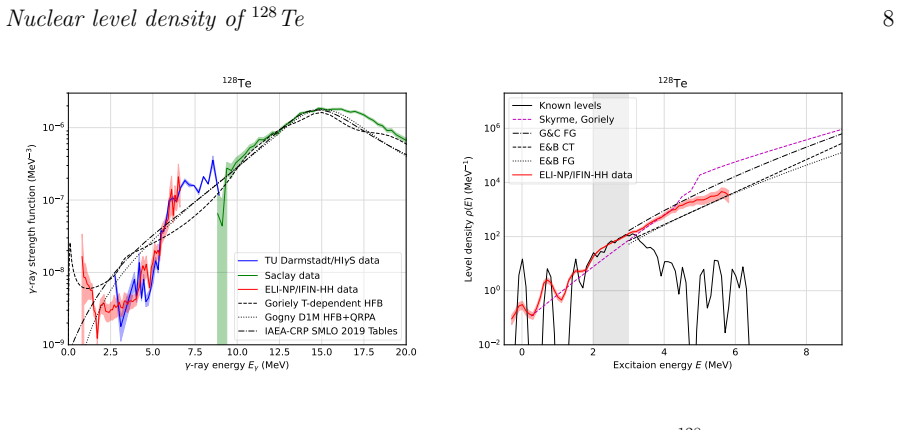
The central claim is that the nuclear level density of 128Te from about 0 to 5.8 MeV can be obtained directly from experimental data, with the absolute normalization fixed by photonuclear data and complete low-lying spectroscopy rather than by constant-temperature or Fermi-gas extrapolations. The coincidence measurement yields a decay probability matrix from which, through the standard particle-gamma coincidence analysis, one obtains a family of equally good solutions for the level density $\rho(E_x)$ and transmission coefficient $T(E_\gamma)$, related by the transformation $\tilde{\rho} = A \rho \exp[\alpha(E_x - E_\gamma)]$ and $\tilde{T} = B T \exp(\alpha E_\gamma)$. The slope parameter $\alpha$ and absolute scale $B$ are set by matching the transmission coefficient to the photoabsorption cross-section, and the scale $A$ of the level density is set by matching to the evaluated discrete level scheme in the 2–3 MeV region. The extracted level density, listed in Table 1, lies between the constant-temperature and Fermi-gas parametrizations, but clearly diverges from the microscopic Skyrme-force prediction. The authors emphasize that this removes the intrinsic model dependence of the normalization, leaving only the spin-independence (Brink-Axel) assumption about the strength function.
Load-bearing premise
The gamma-ray strength function determined from photoabsorption states, which are almost entirely spin ~1, is the same as the strength function that governs the decay of the much broader spin distribution populated in the (p,p'γ) reaction; if that equality fails, the normalization of the strength function is systematically off, and with it the level density's absolute scale and slope.
Editorial extensions
If this is right
- The tabulated level density can be used directly as input to statistical-model reaction-rate calculations for 128Te without the usual two-parameter model extrapolation.
- The measurement provides a benchmark against which constant-temperature and Fermi-gas parametrizations can be tested in this mass region.
- The observed divergence from the Skyrme-force calculation indicates that this microscopic model does not reproduce the empirical level density for 128Te.
- The same normalization strategy can be extended to other nuclei without neutron-resonance data, potentially removing model dependencies from many existing particle-gamma coincidence level densities.
- The gamma-ray strength function extracted from the same data set, once normalized, can be compared with photoabsorption results to test the spin-independence assumption.
Reading between the lines
- If the spin-independence assumption holds, a future measurement of the gamma-ray strength function from a low-spin photoexcitation on the same target should match the normalized strength function used here; a mismatch would directly probe the assumption's validity.
- The divergence from the Skyrme model, if it persists across neighboring tellurium isotopes, may signal missing correlations or pairing effects in the microscopic calculation rather than a single-nucleus anomaly.
- Applying the same photonuclear normalization to existing particle-gamma coincidence data on other nuclei could yield a systematic, model-independent set of level densities, and could be tested by comparing the resulting gamma-ray strength functions with photoabsorption data.
Editorial analysis
A structured set of objections, weighed in public.
Referee Report
Summary. This paper reports the extraction of the nuclear level density (NLD) of 128Te using the Oslo method applied to (p,p'γ) data measured with the ELI-NP/IFIN-HH setup. The three-parameter ambiguity (A, B, α) of the Oslo method is resolved by normalizing the γ-ray transmission coefficient to the photonuclear γ-ray strength function of Ref. [43] (fixing B and α) and the NLD to known discrete levels (fixing A), rather than to constant-temperature (CT) or Fermi-gas (FG) parameterizations. The resulting NLD is presented for excitation energies from 0 to 5.8 MeV and compared to CT, FG, and a Skyrme-based microscopic model. The paper finds that the experimental NLD lies between the CT and FG expectations and clearly deviates from the Skyrme prediction. Statistical and systematic uncertainties are propagated separately, with the 27% statistical / 73% systematic split resulting from χ²/NDF scaling.
Significance. If the underlying assumptions hold, this is a valuable new NLD measurement for 128Te and demonstrates a normalization route for the Oslo method that does not rely on CT or FG models, which is of interest for nuclear reaction rate calculations and for testing statistical-model input. The paper benefits from a clear presentation of the uncertainty propagation, including the χ²/NDF scaling and an explicit statistical/systematic decomposition. The central result, however, rests on the unverified spin-independence of the γ-ray strength function between the J^π≈1± ensemble probed by photon absorption and the broader spin distribution populated in (p,p'γ); this is load-bearing for the normalization and is acknowledged but not quantitatively addressed.
major comments (2)
- [Section 3, Eq. (3)-(5)] The normalization of B and α to the photoabsorption γSF of Ref. [43] assumes that the γSF is independent of the initial spin and parity, so that the J^π≈1± states probed by photon scattering are equivalent to the higher-spin states (up to J≈8, as shown in Fig. 4) populated in (p,p'γ). The slope and absolute scale of the extracted NLD are directly tied to α and A through Eq. (3), so a violation of spin-independence would bias the NLD and affect the comparison to CT, FG, and Skyrme models. The paper states this assumption explicitly in Section 3 and acknowledges it in the Conclusion, but it does not quantify the resulting uncertainty or exploit the HPGe-derived spin distribution to test it. I request a quantitative estimate of the systematic error in ρ(Ex) from a plausible spin-dependent γSF, or an explicit propagation of the measured spin distribution into the normalization; without this, the claim of model independence is stronger than the evidence supports.
- [Section 3, Eq. (5)] The χ² minimisation of the γSF normalization returns a reduced χ²/NDF = 2.65, yet the reported uncertainty σα/α = 3.4% is not scaled to χ²/NDF = 1 as is done for the Oslo-method fit in the same section. Since α and B set the NLD slope and scale via Eq. (3), an under-scaling of these uncertainties would propagate directly into the NLD error bars, particularly at the highest excitation energies. Please apply the same χ² scaling procedure to the photonuclear fit, or explain why the residual mismatch (χ²/NDF = 2.65) can be considered already consistent with the quoted uncertainties without inflation.
minor comments (4)
- [Section 3, Table 1] The NLD table lists energies down to -0.2875 MeV, which is unphysical for a level density. Please clarify whether this is an artifact of the binning or the first-generation subtraction, and consider truncating the table at Ex ≥ 0 to avoid confusion.
- [Section 3, last paragraph before Section 4] The sentence 'under the assumption that for at theγSF is independent of the initial spin' contains a typo and should read 'under the assumption that the γSF is independent of the initial spin'.
- [Section 4, Eq. (6)] The spin distribution from Eq. (6) is described as 'subtracted and normalised', but the normalization condition (e.g., sum to unity) is not specified. Please state the normalization explicitly so that the comparison with the models in Fig. 4 is reproducible.
- [Figure 3] The labels in the left panel of Figure 3 are small and some overlap; a larger font or a separate legend table would improve readability, as the comparison between data and the three theoretical γSF model curves is central to the discussion.
Circularity Check
No significant circularity: the Oslo-method normalization is anchored to external photoabsorption and discrete-level data, and the only non-independent comparison is explicitly disclaimed.
full rationale
The paper's derivation chain is self-contained with respect to circularity. The Oslo-method fit (Eq. 1) yields a one-parameter family of (rho, T) solutions; the three-parameter ambiguity (A, B, alpha) introduced in Eqs. (3)-(4) is resolved by external data: B and alpha are fixed by fitting the unnormalized transmission coefficient to the photonuclear gammaSF of Ref. [43] via Eq. (5), and A is fixed by complete discrete-level spectroscopy in the 2-3 MeV region from Ref. [46]. Neither of these anchors is the constant-temperature or Fermi-gas parametrization, so the abstract's claim of avoiding CT/FG normalization is accurate in the narrow sense stated. The comparison in Section 4 of the extracted gammaSF with the photoabsorption data is not presented as an independent prediction; the paper explicitly says 'since the photoabsorption cross-section was used to normalise the absolute magnitude and the total slope of the γSF, only the relative shapes can be used to evaluate the consistency.' The main physical caveat, the spin-independence/Brink-Axel assumption that equates the J^pi approximately 1+/- photoabsorption gammaSF with the gammaSF governing decays of the broader spin distribution in (p,p'gamma), is acknowledged in the Conclusion as a remaining uncertainty and is a limitation, not a circular reduction: the NLD values in Table 1 are not equal to any input by construction. The self-citations to Refs. [16] and [43] involve overlapping authorship (J. Isaak), but the cited photonuclear data are an external, published, independently falsifiable measurement, so they constitute real evidence rather than a load-bearing self-citation chain. No equation is shown to reduce to its own input, and no fitted parameter is renamed as a prediction.
Assumptions & free parameters
free parameters (3)
- Oslo-method normalization constant A =
not quoted; fixed by matching known levels at 2-3 MeV
- Oslo-method normalization constant B =
not quoted; fixed by chi2 fit to photoabsorption cross-section
- Oslo-method slope parameter alpha =
not quoted; sigma_alpha/alpha = 3.4% after chi2/NDF = 2.65
assumptions (5)
- domain assumption The gamma-ray strength function is independent of excitation energy and initial spin (Brink-Axel), so the gammaSF from J about 1 photonuclear states can be used to normalize the gammaSF from higher-spin states.
- domain assumption Dipole radiation with L=1 dominates the decay, so Eq. (2) can be applied with L=1.
- domain assumption The first-generation subtraction correctly removes cascade gamma rays so the remaining decay probability follows Eq. (1).
- domain assumption The known discrete level scheme of 128Te is complete up to 3.345 MeV, so the cumulative count at 2-3 MeV sets the absolute NLD scale.
- domain assumption The Geant4-based detector response used in the iterative unfolding is accurate enough that residual response errors are covered by the chi2/NDF scaling.
Cite this review
Pith. "Pith review of Nuclear level density of ${}^{128}$Te from $(\mathrm{p},\mathrm{p}'\gamma)$ scattering and complementary photonuclear data." pith.science (2026). https://pith.science/paper/KT3HBUKI
@misc{pith2026250109360,
  author       = {Pith},
  title        = {Pith review of: Nuclear level density of $^128$Te from $(\mathrmp,\mathrmp'\gamma)$ scattering and complementary photonuclear data},
  year         = {2026},
  howpublished = {\url{https://pith.science/paper/KT3HBUKI}},
  note         = {Machine review of arXiv:2501.09360}
}
abstract
We have extracted the nuclear level density of ${}^{128}$Te from a $(\mathrm{p},\mathrm{p} '\gamma)$ scattering experiment using the large-volume \labr\ and \cebr\ detectors from ELI-NP at the 9~MV Tandem facilities at IFIN-HH. The decay data were normalised using photonuclear data, resulting in nuclear level densities without intrinsic model dependencies from the constant temperature or Fermi gas models. The deduced nuclear level density follows in between the expectations from these two models, but we observe a clear divergence from a microscopic model based on the Skyrme force.
Figures


Figures from the paper (1 more)

Reference graph
Works this paper leans on
-
[43]
Isaak J, Savran D, Löher B, Beck T, Friman-Gayer U, Krishichayan, Pietralla N, Ponomarev V Y, Scheck M, Tornow W, Werner V, Zilges A and Zweidinger M 2021Phys. Rev. C 103 044317
-
[1]
Wiedeking M and Goriely S 2024Phil. Trans. R. Soc. A382 20230125
-
[2]
Guttormsen M, Ramsøy T and Rekstad J 1987Nucl. Instrum. Methods Phys. Res. A255 518
-
[3]
Guttormsen M, Tveter T S, Bergholt L, Ingebretsen F and Rekstad J 1996Nucl. Instrum. Methods Phys. Res. A374 371
-
[4]
Schiller A, Bergholt L, Guttormsen M, Melby E, Rekstad J and Siem S 2000Nucl. Instrum. Methods Phys. Res. A447 498
-
[5]
Larsen A C, Guttormsen M, Krtička M, Běták E, Bürger A, Görgen A, Nyhus H T, Rekstad J, Schiller A, Siem S, Toft H K, Tveten G M, Voinov A V and Wikan K 2011Phys. Rev. C 83 034315
-
[6]
Voinov A V, Renstrøm T, Bleuel D L, Grimes S M, Guttormsen M, Larsen A C, Liddick S N, Perdikakis G, Spyrou A, Akhtar S, Alanazi N, Brandenburg K, Brune C R, Danley T W, Dhakal S, Gastis P, Giri R, Massey T N, Meisel Z, Nikas S, Paneru S N, Parker C E and Richard A L 2019 Phys. Rev. C 99 054609
work page 2019
-
[7]
Roy P, Banerjee K, Rana T K, Kundu S, Pandit D, Quang Hung N, Ghosh T K, Mukhopadhyay S, Mondal D, Mukherjee G, Manna S, Sen A, Pal S, Pandey R, Paul D, Atreya K and Bhattacharya C 2021Eur. Phys. J. A57 48
Show all 60 references
-
[8]
Usman I, Buthelezi Z, Carter J, Cooper G R J, Fearick R W, Förtsch S V, Fujita H, Kalmykov Y, von Neumann-Cosel P, Neveling R, Poltoratska I, Richter A, Shevchenko A, Sideras-Haddad E, Smit F D and Wambach J 2011Phys. Rev. C 84 054322
-
[9]
Filipescu D, Anzalone A, Balabanski D L, Belyshev S S, Camera F, Cognata M L, Constantin P, Csige L, Cuong P V, Cwiok M, Derya V, Dominik W, Gai M, Gales S, Gheorghe I, Ishkhanov B S, Krasznahorkay A, Kuznetsov A A, Mazzocchi C, Orlin V N, Pietralla N, Sin M, Spitaleri C, Stop...
-
[10]
Gales S, Balabanski D L, Negoita F, Tesileanu O, Ur C A, Ursescu D and Zamfir N V 2016Phys. Scr. 91 093004
-
[11]
Gales S, Tanaka K A, Balabanski D L, Negoita F, Stutman D, Tesileanu O, Ur C A, Ursescu D, Andrei I, Ataman S, Cernaianu M O, D’Alessi L, Dancus I, Diaconescu B, Djourelov N, Filipescu D, Ghenuche P, Ghita D G, Matei C, Seto K, Zeng M and Zamfir N V 2018Rep. Prog. Phys. 81 094301
-
[12]
Extremes5 024402
Tanaka K A, Spohr K M, Balabanski D L, Balascuta S, Capponi L, Cernaianu M O, Cuciuc M, Cucoanes A, Dancus I, Dhal A, Doria D, Ghenuche P, Ghita D G, Kisyov S, Nastasa V, Ong Nuclear level density of 128Te 13 J F, Rotaru F, Sangwan D, Söderström P A, Stutman D, Suliman G, Tesi...
-
[13]
Constantin P, Matei C and Ur C A 2024Phys. Rev. Accel. Beams27 021601
-
[14]
Zilges A, Balabanski D L, Isaak J and Pietralla N 2022Prog. Part. Nucl. Phys.122 103903
-
[15]
Weller H R, Ahmed M W, Gao H, Tornow W, Wu Y K, Gai M and Miskimen R 2009Prog. Nucl. Part. Phys. 62 257
-
[16]
Isaak J, Savran D, Löher B, Beck T, Bhike M, Gayer U, Krishichayan, Pietralla N, Scheck M, Tornow W, Werner V, Zilges A and Zweidinger M 2019Phys. Lett. B788 225
-
[17]
thesis University of Oxford Oxford, United Kingdom
Brink D M 1955Some aspects of the interaction of fields with matterPh.D. thesis University of Oxford Oxford, United Kingdom
-
[18]
Axel P 1962Phys. Rev. 126 671
-
[19]
Camera F, Utsunomiya H, Varlamov V, Filipescu D, Baran V, Bracco A, Colo G, Gheorghe I, Glodariu T, Matei C and Wieland O 2016Rom. Rep. Phys.68 S539
-
[20]
Söderström P A, Açıksöz E, Balabanski D L, Camera F, Capponi L, Ciocan G, Cuciuc M, Filipescu D M, Gheorghe I, Glodariu T, Kaur J, Krzysiek M, Matei C, Roman T, Rotaru A, S,erban A B, State A, Utsunomiya H and Vasilca V 2022Nucl. Instrum. Methods Phys. Res. A1027 166171
-
[21]
Bucurescu D, Căta-Danil I, Ciocan G, Costache C, Deleanu D, Dima R, Filipescu D, Florea N, Ghit,ă D G, Glodariu T, Ivas,cu M, Lică R, Mărginean N, Mărginean R, Mihai C, Negret A, Nit,ă C R, Olăcel A, Pascu S, Sava T, Stroe L, S,erban A, S,uvăilă R, Toma S, Zamfir N V, Căta-Dan...
-
[22]
Aogaki S, Balabanski D L, Borcea R, Constantin P, Costache C, Cuciuc M, Kuşoğlu A, Mihai C, Mihai R E, Stan L, Söderström P A, Testov D, Turturică A, Ujeniuc S, Adachi S, Camera F, Ciocan G, Crespi F C L, Florea N M, Fujikawa Y, Furuno T, Gamba E, Gut,oiu R A, Kawabata T, Mill...
-
[23]
Kuşoğlu A, Constantin P, Söderström P A, Balabanski D L, Cuciuc M, Aogaki S, Ban R S, Borcea R, Corbu R, Costache C, Covali A, Dinescu I, Florea N M, Iancu V, Ionescu A, Marginean N M, Mihai C, Mihai R E, Nedelcu C, Coman A, Pai H, Pappalardo A, Sirbu O, L S, Sotty C, Testov D...
-
[24]
Kuşoğlu A, Balabanski D L, Hu R Z, Fan S Q, Xu F R, Constantin P, Söderström P A, Cuciuc M, Aogaki S, Ban R S, Borcea R, Coman A, Corbu R, Costache C, Covali A, Dinescu I, Florea N M, Iancu V, Ionescu A, Mărginean N M, Mihai C, Mihai R E, Nedelcu C V, Petruse T, Pai H, Pappala...
-
[25]
Kuşoğlu A, Balabanski D L, Hu R Z, Fan S Q, Xu F R, Constantin P, Söderström P A, Cuciuc M, Aogaki S, Ban R S, Borcea R, Coman A, Corbu R, Costache C, Covali A, Dinescu I, Florea N M, Iancu V, Ionescu A, Mărginean N M, Mihai C, Mihai R E, Nedelcu C V, Petruse T, Pai H, Pappala...
-
[26]
Kuşoğlu A 2024Sci. Bull. 69 3303
-
[27]
Wieland O, Bracco A, Camera F, Aogaki S, Balabanski D L, Boicu E, Borcea R, Boromiza M, Burducea I, Calinescu S, Coman A, Constantin P, Costache C, Ciemala M, Ciocan G, Clisu C, Crespi F C L, Cuciuc M, Dhal A, Djourelov N, Florea N M, Gheorghe I, Giaz A, Iancu D, Kahl D M, Kmi...
-
[28]
Söderström P A, Kuşoğlu A, Balabanski D L, Brezeanu M, Choudhury D, Gavrilescu A, Gut,oiu Nuclear level density of 128Te 14 R A, Ioannidis S, Lorusso G, Markova M, Roy R, Testov D, Adachi S, Aogaki S, Borcea R, Camera F, Constantin P, Costache C, Cuciuc M, Crespi F C L, Florea...
-
[29]
Sakanashi K, Kawabata T, Furuno T, Tamii A, Niina R, Okamoto S, Ito M, Adachi S, Akimune H, Matsuda Y, Kubono S, Aogaki S, Söderströom P A, Teodora M, Pai H, Cuciuc M, Tescov D, Borcea R, Turturica A, Mihai C and Neacse C 2024EPJ Web Conf 306 01047
-
[30]
Söderström P A, Markova M, Tsoneva N, Xu Y, Kuşoğlu A, Aogaki S, Balabanski D L, Ban S R, Borcea R, Brezeanu M, Camera F, Ciemała M, Ciocan G, Clisu C, Costache C, Crespi F C L, Cuciuc M, Dhal A, Dinescu I, Florea N M, Giaz A, Kmiecik M, Lelasseux V, Lica R, Mărginean N M, Mih...
2024 arXiv
-
[31]
Markova M, von Neumann-Cosel P, Larsen A C, Bassauer S, Görgen A, Guttormsen M, Bello Garrote F L, Berg H C, Bjørøen M M, Dahl-Jacobsen T, Eriksen T K, Gjestvang D, Isaak J, Mbabane M, Paulsen W, Pedersen L G, Pettersen N I J, Richter A, Sahin E, Scholz P, Siem S, Tveten G M, ...
-
[32]
Markova M, Larsen A C, von Neumann-Cosel P, Bassauer S, Görgen A, Guttormsen M, Garrote F L B, Berg H C, Bjørøen M M, Eriksen T K, Gjestvang D, Isaak J, Mbabane M, Paulsen W, Pedersen L G, Pettersen N I J, Richter A, Sahin E, Scholz P, Siem S, Tveten G M, Valsdottir V M and Wi...
-
[33]
Markova M, Larsen A C, Tveten G M, von Neumann-Cosel P, Eriksen T K, Bello Garrote F L, Crespo Campo L, Giacoppo F, Görgen A, Guttormsen M, Hadynska-Klek K, Klintefjord M, Renstrøm T, Sahin E, Siem S and Tornyi T G 2023Phys. Rev. C 108 014315
-
[34]
Markova M, Larsen A C, von Neumann-Cosel P, Litvinova E, Choplin A, Goriely S, Martinet S, Siess L, Guttormsen M, Pogliano F and Siem S 2024Phys. Rev. C 109 054311
-
[35]
Markova M, von Neumann-Cosel P and Litvinova E 2025Phys. Lett. B860 139216
-
[36]
Söderström P A, Matei C, Capponi L, Açıksöz E, Balabanski D L and Mitu I O 2021Appl. Radiat. Isot. 167 109441
-
[37]
Söderström P A, Balabanski D L, Ban R S, Ciocan G, Cuciuc M, Dhal A, Fugaru V, Iancu V, Rotaru A, S,erban A B, State A, Testov D, Turturică G V and Vasilca V 2023Appl. Radiat. Isot. 191 110559
-
[38]
Söderström P A, Capponi L, Iancu V, Lattuada D, Pappalardo A, Turturică G V, Açıksöz E, Balabanski D L, Constantin P, Guardo G L, Ilie M, Ilie S, Matei C, Nichita D, Petruse T and Spataru A 2019J. Instrum. 14 T11007
-
[39]
Agostinelli S, Allison J, Amako K, Apostolakis J, Araujo H, Arce P, Asai M, Axen D, Banerjee S, Barrand G, Behner F, Bellagamba L, Boudreau J, Broglia L, Brunengo A, Burkhardt H, Chauvie S, Chuma J, Chytracek R, Cooperman G, Cosmo G, Degtyarenko P, dell’Acqua A, Depaola G, Die...
-
[40]
Lattuada D, Balabanski D L, Chesnevskaya S, Costa M, Crucillà V, Guardo G L, Cognata M L, Matei C, Pizzone R G, Romano S, Spitaleri C, Tumino A and Xu Y 2017EPJ Web Conf.165 01034
-
[41]
Bassauer S, von Neumann-Cosel P and Tamii A 2016Phys. Rev. C 94 054313
-
[42]
Wiedeking M, Guttormsen M, Larsen A C, Zeiser F, Görgen A, Liddick S N, Mücher D, Siem S and Spyrou A 2021Phys. Rev. C 104 014311
-
[44]
Leprêtre A, Beil H, Bergére R, Carlos P, Fagot J, Miniac A D, Veyssiére A and Miyase H 1976 Nucl. Phys. A258 350
1976
-
[45]
Data Sheets163 109
Kawano T, Cho Y, Dimitriou P, Filipescu D, Iwamoto N, Plujko V, Tao X, Utsunomiya H, Varlamov V, Xu R, Capote R, Gheorghe I, Gorbachenko O, Jin Y, Renstrøm T, Sin M, Stopani K, Tian Y, Tveten G, Wang J, Belgya T, Firestone R, Goriely S, Kopecky J, Krtička M, Schwengner R, Siem...
-
[46]
Data Sheets129 191 Evaluated Nuclear Structure Data File at https://www.nndc.bnl.gov/nudat3/
Elekes Z and Timar J 2015Nucl. Data Sheets129 191 Evaluated Nuclear Structure Data File at https://www.nndc.bnl.gov/nudat3/
-
[47]
Data Sheets 110 3107 https://www-nds.iaea.org/RIPL-3/
Capote R, Herman M, Obložinský P, Young P, Goriely S, Belgya T, Ignatyuk A, Koning A, Hilaire S,PlujkoV,AvrigeanuM,BersillonO,ChadwickM,FukahoriT,GeZ,HanY,KailasS,Kopecky J, Maslov V, Reffo G, Sin M, Soukhovitskii E and Talou P 2009Nucl. Data Sheets 110 3107 https://www-nds.ia...
-
[48]
Guttormsen M, Ay K O, Ozgur M, Algin E, Larsen A C, Bello Garrote F L, Berg H C, Crespo Campo L, Dahl-Jacobsen T, Furmyr F W, Gjestvang D, Görgen A, Hagen T W, Ingeberg V W, Kheswa B V, Kullmann I K B, Klintefjord M, Markova M, Midtbø J E, Modamio V, Paulsen W, Pedersen L G, R...
2022
-
[49]
von Egidy T and Bucurescu D 2009Phys. Rev. C 80 054310
-
[50]
von Egidy T and Bucurescu D 2008Phys. Rev. C 78 051301(R)
-
[51]
Koning A J, Hilaire S and Duijvestijn M C 2008 TALYS-1.0Proceedings of the International Conference on Nuclear Data for Science and Technologyvol 211 ed Bersillon O, Gunsing F, Bauge E, Jacqmin R and Leray S (EDP Sciences) p 058
2008
-
[52]
Data Sheets113 2841
Koning A J and Rochman D 2012Nucl. Data Sheets113 2841
-
[53]
Hilaire S, Girod M, Goriely S and Koning A J 2012Phys. Rev. C 86 064317
-
[54]
Goriely S, Hilaire S, Péru S and Sieja K 2018Phys. Rev. C 98 014327
-
[55]
Goriely S, Dimitriou P, Wiedeking M, Belgya T, Firestone R, Kopecky J, Krticka M, Plujko V, Schwengner R, Siem S, Utsunomiya H, Hilaire S, Péru S, Cho Y S, Filipescu D M, Iwamoto N, Kawano T, Varlamov V and Xu R 2019Eur. Phys. J. A55 172
-
[56]
von Egidy T, Schmidt H H and Behkami A N 1988Nucl. Phys. A481 189
-
[57]
Gilbert A and Cameron A G W 1965Can. J. Phys.43 1446
-
[58]
Bethe H A 1936Phys. Rev. 50 332
-
[59]
Guttormsen M 2022 ROBIN, in OsloSoftware https://github.com/oslocyclotronlab/ oslo-method-software, DOI: 10.5281/zenodo.6024876
2022 doi
-
[60]
Data Nucl
Goriely S, Tondeur F and Pearson J M 2001Atom. Data Nucl. Data Tables77 311
Reviewed August 10, 2026 · model on record in the stance chip above.
Discussion (0). Continue with ORCID to comment.