REVIEW 3 major objections 5 minor 40 references
Eigenspectra of Minimally Doubled Fermions
T0 review · 3 major / 5 minor · reviewed 2026-08-10 · deepseek-v4-flash
Pith's one-line read This paper reports a numerical check that both Karsten-Wilczek and Borici-Creutz minimally doubled fermions obey the Atiyah-Singer index theorem in four spacetime dimensions, with index $-4$ on a topological-charge $-2$ $SU(3)$ lattice.
desk verdict First 4D MDF index theorem test, but the single configuration and Q_top mismatch keep it a suggestive demonstration, not a proof. read the letter →
The pith
A machine-rendered reading of the paper's core claim, the machinery that carries it, and where it could break.
The reading
What carries the argument
The load-bearing mechanism is the family of hermitian operators $H_{\mathrm{KW}}(m) = \gamma_5(D_{\mathrm{KW}} + m\, C_{\mathrm{sym}}\otimes 1)$ and $H_{\mathrm{BC}}(m) = \gamma_5(D_{\mathrm{BC}} + m\,(2C_{\mathrm{sym}}-1)\otimes 1)$, where $C_{\mathrm{sym}}$ is the symmetrized covariant shift over the four lattice directions. Spectral flow in $m$ counts sign changes of eigenvalues at $m=0$, and the flavored mass couples the two doubler species with opposite signs so their zero-mode contributions no longer cancel. The companion object is the modified chirality operator, $X_{\mathrm{KW}} = C_{\mathrm{sym}}\otimes \gamma_5$ for Karsten-Wilczek and $X_{\mathrm{BC}} = (2C_{\mathrm{sym}}-1)\otimes \gamma_5$ for Borici-Creutz, which assigns $\pm1$ to the zero-mode states. Together these operators turn a crossing count into the index and identify each crossing mode's chirality.
What would settle it
Cool or gradient-flow the roughened $Q_{\mathrm{top}} = -2$ configuration and measure the topological charge with a local gluonic definition: if it comes out significantly different from $-2$, the four near-zero modes cannot be attributed to an index of $-4$. Equally, repeat the spectral-flow count on a configuration of charge $+1$; the claim predicts exactly two zero-mode crossings of the opposite chirality.
Extended reading notes
Core claim
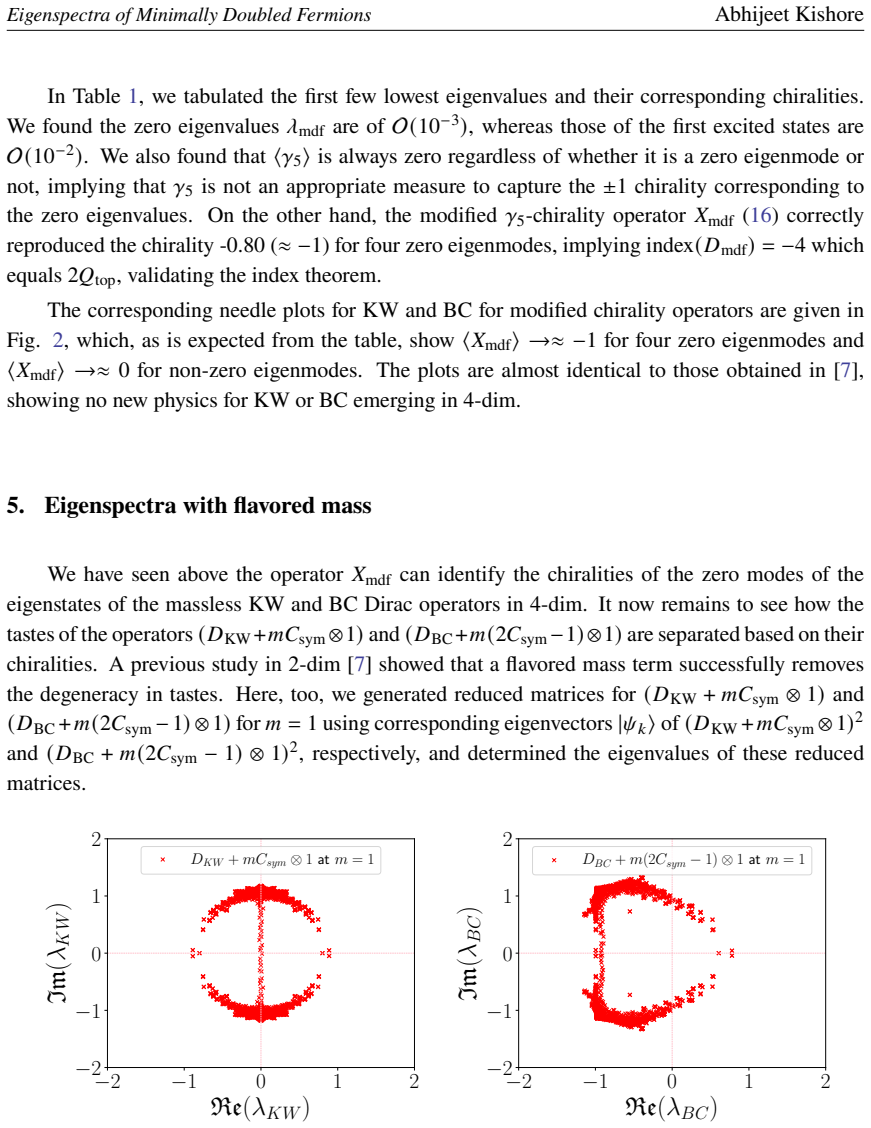
The paper's central claim is that the eigenspectra of Karsten-Wilczek and Borici-Creutz minimally doubled fermions in four dimensions satisfy the index theorem. On an $8^4$ $SU(3)$ lattice with a roughened background designed to have $Q_{\mathrm{top}} = -2$ (the gluonic charge estimator of Eq. (14) returns $-1.742$), the spectral flow of $\gamma_5(D_{\mathrm{mdf}} + m\, T)$ with the appropriate flavored mass term shows two double crossings at $m = 0$, i.e. four zero modes with negative slope, giving $\operatorname{index}(D_{\mathrm{mdf}}) = -4 = 2 Q_{\mathrm{top}}$. The ordinary $\gamma_5$ expectation value vanishes on every mode, so it cannot see the zero-mode chirality; the modified operators $X_{\mathrm{KW}} = C_{\mathrm{sym}}\otimes \gamma_5$ and $X_{\mathrm{BC}} = (2C_{\mathrm{sym}}-1)\otimes \gamma_5$ yield about $-0.80$ on the four near-zero modes, matching unit chirality within finite-volume accuracy. The paper also shows that with a bare mass the crossings cancel between the two doublers, and that a flavored mass term separates the two doubler tastes according to their $\pm1$ chirality.
Load-bearing premise
The load-bearing premise is that the roughened gauge field really has topological charge $-2$: the discretized charge computed from Eq. (14) is $-1.742$, so if the roughening at $\delta = 0.05$ has changed the true charge, the four near-zero modes would not establish index $-4$.
Editorial extensions
If this is right
- In any future four-dimensional simulation with Karsten-Wilczek or Borici-Creutz fermions, $\gamma_5$ alone cannot measure zero-mode chirality; the flavored-mass chirality operators must be used, otherwise topology appears to vanish.
- The spectral-flow-with-flavored-mass prescription is a working numerical route to the index for minimally doubled fermions in four dimensions, extending earlier two-dimensional checks to the dimension relevant for QCD.
- A single minimally doubled flavor on a background of charge $Q$ should produce $2Q$ zero modes, so low-mode counting in such simulations must account for the doubled multiplicity.
- Karsten-Wilczek and Borici-Creutz actions give the same index despite different doubler positions, supporting the view that index $= 2 Q_{\mathrm{top}}$ is a property of the minimally doubled construction rather than of one specific action.
Reading between the lines
- Going beyond the paper: the modified chirality operators look like the minimally doubled analogue of staggered-fermion taste projectors, so the same flavored-mass trick should assign chirality in other minimally doubled variants whose doubler pair sits at different momenta.
- The observed $-0.80$ rather than the ideal $-1$, together with zero-mode eigenvalues of order $10^{-3}$, is consistent with finite-volume and roughening effects; one testable prediction is that larger lattices or more roughening should move the four chiralities closer to $-1$ while keeping the crossing count at four.
- It would be natural to repeat the construction at $Q_{\mathrm{top}} = +1$ or $+2$: the factor-two relation predicts exactly two or four crossings of the opposite slope, which would separate the $2Q_{\mathrm{top}}$ factor from the specific $Q_{\mathrm{top}} = -2$ choice.
Editorial analysis
A structured set of objections, weighed in public.
Referee Report
Summary. This proceedings paper studies the eigenspectra of two minimally doubled fermion actions, Karsten-Wilczek (KW) and Borici-Creutz (BC), on a single 8^4 SU(3) lattice with a background gauge field nominally carrying topological charge Q_top = -2. Using spectral flow of the flavored-mass Hermitian operators, the authors observe four crossings of zero for both actions and interpret this as index(D_mdf) = 2 Q_top = -4. They also compute the chiralities of the low-lying eigenmodes with the modified chirality operators X_KW and X_BC, finding values near -0.8 for the four would-be zero modes and values near zero for the excited modes, whereas <gamma_5> is zero for all modes. The paper concludes that the 4D eigenspectra of KW and BC fermions satisfy the Atiyah-Singer index theorem and that the flavored mass term separates the doubler tastes.
Significance. If the result holds, this is a useful numerical step: it extends previous 2D index-theorem checks of minimally doubled fermions to 4D SU(3), treats both KW and BC variants, and uses established spectral-flow and modified-chirality methods rather than fitting parameters to force the index count. The observation that gamma_5 is not the correct chirality operator and that the modified operators X_KW and X_BC identify the zero-mode chiralities is a concrete, potentially reusable result for future MDF simulations. The paper also builds on externally defined gauge-field constructions and prior benchmarks, so the comparison is not circular in the sense of tuning parameters. However, the evidence is preliminary: all conclusions rest on a single configuration, no error bars are given, and the topological charge of the roughened field actually used is not independently established. The significance is therefore real but conditional on strengthening those points.
major comments (3)
- [Section 3, Eqs. (11)-(15) and text after Eq. (14)] The numerical demonstration is anchored to the assumption that the roughened field still has Q_top = -2. The construction in Eqs. (11)-(13) gives a nominal Q = -2 field, but roughening via Eq. (15) with delta = 0.05 is applied to the links, and the manuscript then reports that the same field gives Q_calc = -1.742 from Eq. (14). Since Q_calc is not an integer, the reader cannot distinguish between a discretization artifact of the Q operator and a genuine shift of the topological charge away from -2. The index prediction in Eq. (6) depends on the topological charge of the actual field used, not on the un-roughened construction, so the four crossings in Fig. 1 confirm the index theorem only if one already assumes Eq. (6) to infer Q from the crossing count. Please provide an independent determination of the topological charge of the roughened configuration, for example by cooling or gradient flow followed by rounding to an integer, or by showing that Q remains -2 over several roughening amplitudes.
- [Section 4, Table 1 and Figs. 1-2] All numerical results are based on a single 8^4 configuration with one roughening amplitude delta = 0.05. There is no ensemble of roughened fields, no error bar on the crossing count, and no check of stability under changes of volume, delta, or N_max. The four crossings in Fig. 1 are the central evidence for the index theorem, but with one realization there is no quantitative way to assess whether a different roughening realization or a larger volume could change the crossing count. Please add at least several independent roughening realizations, and ideally a second lattice volume or a scan in delta, and report the crossing count and chiralities with statistical errors. This is needed to support the word 'demonstrated' used in the abstract and conclusions.
- [Section 4, Table 1 and Eq. (16)] The modified chiralities are reported as -0.80 for the KW zero modes and -0.78/-0.80 for the BC zero modes, and the text states that these are 'approximately -1' and that the operators 'correctly reproduced' the chirality. The paper does not explain the 0.2 deficit. It could be a finite-volume effect, a truncation effect from restricting to the N_max eigenvector subspace, or an indication that X_mdf is not exactly the chiral projection operator on this background. Please provide a quantitative check, such as the dependence of <X_mdf> on N_max, on the lattice volume, or on the roughening amplitude, so that the reader can judge whether the deficit is controlled and does not affect the index count.
minor comments (5)
- [Section 3, Eq. (14)] Please state explicitly how F_mu_nu is computed from the link variables and why the resulting Q_calc = -1.742 is consistent with an integer-valued topological charge; as written, the non-integer value is unexplained.
- [Section 2, Eqs. (7)-(9)] The notation for the flavored mass term is hard to parse: C_sym is defined as an operator in Eq. (9), and the tensor product notation in Eqs. (7)-(8) should be explained, in particular which factor corresponds to spinor space and which to taste space.
- [Section 4, Table 1] The table reports eigenvalues such as 0.004962i without stating the convention; please clarify whether the real parts are zero by construction or numerically negligible, and whether the eigenvalues are all on the imaginary axis.
- [Section 4, Fig. 2] The caption says the needle plots show points 'reaching out to -1', while Table 1 lists modified chiralities of -0.80 and -0.78; please reconcile these two statements.
- [Section 5, Fig. 3] For the KW fermion at m = 1, the text notes that some eigenvalues remain at m = 0 and attributes this tentatively to the small lattice volume; please add a sentence explaining how this expectation would be checked, for example by increasing the volume or varying N_max.
Circularity Check
No significant circularity: the spectral-flow index count is an independent numerical measurement, not a refit of inputs.
full rationale
The paper's derivation chain is self-contained against the quantities it measures. The gauge background is generated by an explicit constant-field-strength construction (Eqs. 11-13) with nominal Q_top=-2 and then roughened (Eq. 15). The spectral flow of H_KW(m) and H_BC(m) (Eqs. 7-8) is computed with a standard Kalkreuter-Simma/LAPACK eigensolver, and the index is obtained by counting net eigenvalue crossings, an external criterion (Refs. 6, 7, 33) that is not tuned to force -4. The modified chirality operators X_KW and X_BC (Eq. 16) are taken from prior work by Creutz-Kimura-Misumi and Durr-Weber, not fitted here; their measured values (-0.80) are close to -1 but not imposed. The conclusion index(D_mdf)=-4=2Q_top follows from comparing the measured crossing count to the independently constructed Q_top. The numerical caveats (Q_calc=-1.742 from Eq. 14, chiralities -0.80 rather than -1, small-volume remnant at m=0) weaken the demonstration but do not make any prediction equivalent to an input by construction. The paper's own statement that the needle plots are almost identical to Ref. [7] is a novelty disclaimer, not a circularity. There is no load-bearing self-citation chain: the authors' own references (e.g., Refs. 10 and 32) appear only as contextual citations.
Assumptions & free parameters
free parameters (3)
- roughening amplitude delta =
0.05
- lattice size N =
8 (8^4 lattice)
- number of eigenvectors Nmax =
not specified
assumptions (5)
- standard math Atiyah-Singer index theorem relates the index of the Dirac operator to topological charge
- domain assumption Minimally doubled fermion actions are chiral with two species or doublers
- domain assumption Flavored mass terms and modified chirality operators defined in refs. [6,7] correctly separate tastes
- standard math Spectral flow counts the index as the net number of signed crossings near m = 0
- domain assumption The constructed gauge field in eqs. (11)-(13) has exact integer Q_top
Cite this review
Pith. "Pith review of Eigenspectra of Minimally Doubled Fermions." pith.science (2026). https://pith.science/paper/VJTXODEP
@misc{pith2026250110336,
  author       = {Pith},
  title        = {Pith review of: Eigenspectra of Minimally Doubled Fermions},
  year         = {2026},
  howpublished = {\url{https://pith.science/paper/VJTXODEP}},
  note         = {Machine review of arXiv:2501.10336}
}
abstract
In this work, we explored the eigenspectra of minimally doubled fermions, in both Karsten-Wilczek and Borici-Creutz realizations. We generated 4-dim $SU(3)$ gauge fields with a definite topological charge and calculated the chiralities of the eigenmodes for KW and BC fermions. We used the spectral flow of the eigenvalues for this purpose and demonstrated the Index theorem.
Figures


Reference graph
Works this paper leans on
-
[1]
L. H. Karsten,Lattice Fermions in Euclidean Space-time,Phys. Lett. B104 (1981) 315
work page 1981
-
[2]
F. Wilczek,Lattice Fermions,Phys. Rev. Lett.59 (1987) 2397
work page 1987
-
[3]
Creutz,Four-dimensional graphene and chiral fermions, JHEP04(2008) 017 [0712.1201]
M. Creutz,Four-dimensional graphene and chiral fermions, JHEP04(2008) 017 [0712.1201]
arXiv 2008
-
[4]
Borici,Creutz fermions on an orthogonal lattice,Phys
A. Borici,Creutz fermions on an orthogonal lattice,Phys. Rev. D78(2008) 074504 [0712.4401]
arXiv 2008
-
[5]
Topological Aspects of Fermions on a Honeycomb Lattice
D. Chakrabarti, S. Hands and A. Rago,Topological Aspects of Fermions on a Honeycomb Lattice,JHEP06 (2009) 060 [0904.1310]
work page Pith review arXiv 2009
- [6]
-
[7]
S. Dürr and J. H. Weber,Topological properties of minimally doubled fermions in two spacetime dimensions, Phys. Rev. D105 (2022) 114511 [2203.15699]
arXiv 2022
-
[8]
Pernici,Chiral invariance and lattice fermions with minimal doubling, Phys
M. Pernici,Chiral invariance and lattice fermions with minimal doubling, Phys. Lett. B346 (1995) 99 [hep-lat/9411012]
arXiv 1995
Show all 40 references
-
[9]
B. C. Tiburzi,Chiral Lattice Fermions, Minimal Doubling, and the Axial Anomaly, Phys. Rev. D82(2010) 034511 [1006.0172]
2010 arXiv
-
[10]
Basak, D
S. Basak, D. Chakrabarti and J. Goswami,Mixed action with Borici-Creutz fermions on a staggered sea, Phys. Rev. D96 (2017) 074505 [1707.06402]. 7 Eigenspectra of Minimally Doubled Fermions Abhijeet Kishore
2017 arXiv
-
[11]
D. A. Godzieba, S. Borsanyi, Z. Fodor, P. Parotto, R. A. Vig and C. H. Wong, Renormalization of Karsten-Wilczek Quarks on a Staggered Background,PoS LATTICE2023(2024) 283 [2401.07799]
2024 arXiv
-
[12]
J. H. Weber, S. Capitani and H. Wittig,Numerical studies of Minimally Doubled Fermions, PoSLATTICE2013(2014) 122 [1312.0488]
2014 arXiv
-
[13]
J. H. Weber,Correlation functions with Karsten-Wilczek fermions, PoSLATTICE2014 (2015) 071 [1601.06669]
2015 arXiv
-
[14]
J. H. Weber,QCD with Flavored Minimally Doubled Fermions, PoSLATTICE2016(2017) 250 [1611.08388]
2017 arXiv
-
[15]
Dürr and J
S. Dürr and J. H. Weber,Dispersion relation and spectral range of Karsten-Wilczek and Borici-Creutz fermions, Phys. Rev. D102 (2020) 014516 [2003.10803]
2020 arXiv
-
[16]
Ammer and S
M. Ammer and S. Durr,Eigenvalue based taste breaking of staggered, Karsten-Wilczek, and Boriçi-Creutz fermions with stout smearing in the Schwinger model,Phys. Rev. D111(2025) 014511 [2409.15024]
2025 arXiv
-
[17]
Durr and S
S. Durr and S. Capitani,Taste-splittings of staggered, Karsten-Wilczek and Borici-Creutz fermions under gradient flow in 2D, PoSLATTICE2024(2025) 460 [2411.18237]
2025 arXiv
-
[18]
J. H. Weber,Spin-taste structure of minimally doubled fermions, PoSLATTICE2023(2024) 353 [2312.08526]
2024 arXiv
-
[19]
Osmanaj and D
R. Osmanaj and D. Hyka,Minimally doubled fermions and spontaneous chiral symmetry breaking,EPJ Web Conf.175 (2018) 04002
2018
-
[20]
Capitani, M
S. Capitani, M. Creutz, J. Weber and H. Wittig,Renormalization of minimally doubled fermions, JHEP09(2010) 027 [1006.2009]
2010 arXiv
-
[21]
R. A. Vig, S. Borsanyi, Z. Fodor, D. Godzieba, P. Parotto and C. H. Wong,First dynamical simulations with minimally doubled fermions, PoSLATTICE2023(2024) 289 [2401.07651]
2024 arXiv
-
[22]
Capitani,Reducing the number of counterterms with new minimally doubled actions, Phys
S. Capitani,Reducing the number of counterterms with new minimally doubled actions, Phys. Rev. D89 (2014) 014501 [1307.7497]
2014 arXiv
-
[23]
Capitani,New actions for minimally doubled fermions and their counterterms, PoS LATTICE2013(2014) 121 [1308.4512]
S. Capitani,New actions for minimally doubled fermions and their counterterms, PoS LATTICE2013(2014) 121 [1308.4512]
2014 arXiv
-
[24]
Capitani, J
S. Capitani, J. Weber and H. Wittig,Minimally doubled fermions at one-loop level,PoS LAT2009(2009) 075 [0910.2597]
2009 arXiv
-
[25]
Capitani, J
S. Capitani, J. Weber and H. Wittig,Minimally doubled fermions at one loop, Phys. Lett. B 681 (2009) 105 [0907.2825]. 8 Eigenspectra of Minimally Doubled Fermions Abhijeet Kishore
2009 arXiv
-
[26]
Capitani, M
S. Capitani, M. Creutz, J. Weber and H. Wittig,Minimally doubled fermions and their renormalization,PoSLATTICE2010(2010) 093 [1010.0110]
2010 arXiv
-
[27]
Osmanaj and D
R. Osmanaj and D. Xhako,Hypercubic symmetry restoration of Boriçi - Creutz fermions: costs and effects, PoSLATTICE2021(2022) 497
2022
-
[28]
Kimura, S
T. Kimura, S. Komatsu, T. Misumi, T. Noumi, S. Torii and S. Aoki,Revisiting symmetries of lattice fermions via spin-flavor representation, JHEP01(2012) 048 [1111.0402]
2012 arXiv
-
[29]
Misumi,Phase structure for lattice fermions with flavored chemical potential terms,JHEP 08 (2012) 068 [1206.0969]
T. Misumi,Phase structure for lattice fermions with flavored chemical potential terms,JHEP 08 (2012) 068 [1206.0969]
2012 arXiv
-
[30]
Kimura, T
T. Kimura, T. Misumi and A. Ohnishi,QCD Phase Diagram with 2-flavor Lattice Fermion Formulations,PoSLATTICE2012(2012) 079 [1210.6357]
2012 arXiv
-
[31]
Misumi, T
T. Misumi, T. Kimura and A. Ohnishi,QCD phase diagram with 2-flavor lattice fermion formulations,Phys. Rev. D86 (2012) 094505 [1206.1977]
2012 arXiv
-
[32]
K. S. Shukre, D. Chakrabarti and S. Basak,Chiral Lagrangian for Karsten-Wilczek Minimally Doubled Fermion, PoSLATTICE2024(2025) 357 [2411.14848]
2025 arXiv
-
[33]
R. G. Edwards, U. M. Heller and R. Narayanan,Spectral flow, chiral condensate and topology in lattice QCD,Nucl. Phys. B535 (1998) 403 [hep-lat/9802016]
1998 arXiv
-
[34]
Kalkreuter and H
T. Kalkreuter and H. Simma,An Accelerated conjugate gradient algorithm to compute low lying eigenvalues: A Study for the Dirac operator in SU(2) lattice QCD,Comput. Phys. Commun.93 (1996) 33 [hep-lat/9507023]
1996 arXiv
-
[35]
The MIMD Lattice Computation (MILC) Collaboration
C. DeTar et al., “The MIMD Lattice Computation (MILC) Collaboration.” https://web.physics.utah.edu/~detar/milc
-
[36]
Gattringer and I
C. Gattringer and I. Hip,On the spectrum of the Wilson-Dirac lattice operator in topologically nontrivial background configurations,Nucl. Phys. B536 (1998) 363 [hep-lat/9712015]
1998 arXiv
-
[37]
Smit and J
J. Smit and J. C. Vink,Remnants of the Index Theorem on the Lattice, Nucl. Phys. B286 (1987) 485
1987
-
[38]
D. H. Adams,Theoretical foundation for the Index Theorem on the lattice with staggered fermions, Phys. Rev. Lett.104 (2010) 141602 [0912.2850]
2010 arXiv
-
[39]
D. H. Adams,Pairs of chiral quarks on the lattice from staggered fermions,Phys. Lett. B699 (2011) 394 [1008.2833]
2011 arXiv
-
[40]
T. Blum, N. H. Christ, C. Cristian, C. Dawson, X. Liao, G. Liu et al.,Chirality correlation within Dirac eigenvectors from domain wall fermions, Phys. Rev. D65(2002) 014504 [hep-lat/0105006]. 9
2002 arXiv
Reviewed August 10, 2026 · model on record in the stance chip above.
Discussion (0). Continue with ORCID to comment.