REVIEW 3 major objections 5 minor 65 references
Strange quark stars in modified vector MIT bag model: role of $\rho$ and $\phi$ mesons
T0 review · 3 major / 5 minor · reviewed 2026-08-10 · deepseek-v4-flash
Pith's one-line read Adding ρ and φ mesons to the vector MIT bag model can lift strange quark stars to 2.48 solar masses.
desk verdict First ρ/φ extension of the vector MIT bag model, but Eq. (11) drops the quark-vector interaction energy, so the 2.48/2.42 M⊙ maxima are inflated; fixable, but reject as is. read the letter →
The pith
A machine-rendered reading of the paper's core claim, the machinery that carries it, and where it could break.
The reading
What carries the argument
The central object is the modified vector MIT bag model with the Lagrangian of Eq. (1), which couples u, d, s quarks to ω, ρ, and φ vector mesons and includes two forms of quartic self-interactions, $L^{{Non}}$_{vec−I} = 2c_4 Tr[(g_M V)^4] and $L^{{Non}}$_{vec−II} = c_4 [Tr(g_M $V^{2}$)]^2 with c_4 = 1. The meson equations of motion (Eqs. 7–9) determine the field values, and the pressure is obtained from the energy density via p = −ε + Σ_i μ_i ρ_i, which is then fed into the TOV equations to find mass–radius relations.
What would settle it
Derive the energy density by Legendre-transforming the grand potential of the Lagrangian in Eq. (1), keeping the quark-vector interaction term Σ_i g_i^V φ_i ρ_i in ε, and recompute the TOV curves; the difference between the resulting maximum mass and 2.48 M⊙ at g_v = 3 would test the claim.
Extended reading notes
Core claim
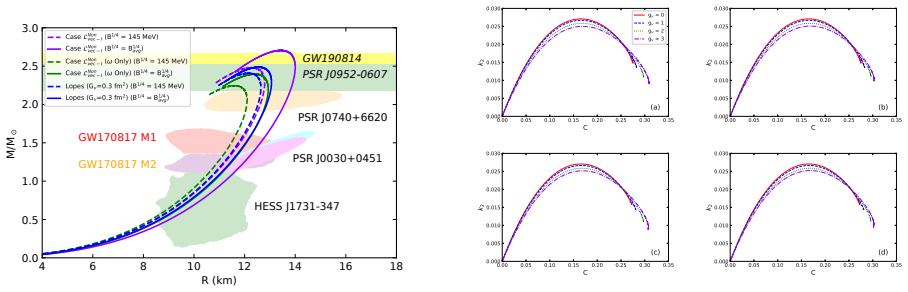
The central claim is that strange quark stars built from β-equilibrated u, d, s quark matter with electrons and muons can support masses above 2.4 M⊙ once the vector MIT bag model includes ρ and φ mesons in addition to ω, together with quartic self-interactions of the vector fields. With the coupling choice g_u^ω = g_d^ω = g_u^ρ = −g_d^ρ = g_s^φ/√2 = g_v, the maximum mass grows from 1.93 M⊙ (g_v = 0) to 2.48 M⊙ (g_v = 3, self-interaction form I) at $B^{{1/4}}$ = 145 MeV, and the corresponding radius grows from 10.60 km to 12.27 km. The authors find that including ρ and φ significantly enhances mass and radius relative to an ω-only model, and that the tidal deformability Λ increases with g_v, most visibly for low-mass stars.
Load-bearing premise
The reported masses and radii rest on Eq. (11) being the complete energy density of cold strange quark matter, with pressure then defined as p = −ε + Σ_i μ_i ρ_i; if that energy expression omits a contribution that should be present, every tabulated star property shifts.
Editorial extensions
If this is right
- If correct, strange quark stars are not necessarily low-mass objects; repulsive vector channels can push them above the 2 M⊙ pulsar-mass threshold.
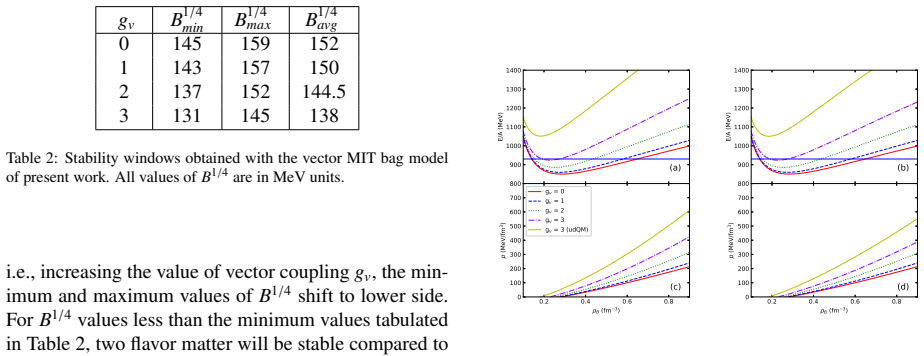
- The stable-bag window shifts downward as g_v grows (B^{1/4} from 145–159 MeV at g_v = 0 to 131–145 MeV at g_v = 3), so higher vector coupling demands a lower bag constant for three-flavor matter to be the ground state.
- The increase in Λ with g_v, especially for low-mass stars, provides a possible observational discriminator using future gravitational-wave tidal measurements.
- The two self-interaction forms produce nearly identical stars at g_v ≤ 2, so distinguishing them requires high-coupling (g_v ≈ 3) mass and radius measurements.
Reading between the lines
- The qualitative stiffening from ρ and φ is likely robust, but the numerical maximum masses could shift if the energy density is derived from the full thermodynamic potential rather than Eq. (11); a recalculation keeping the quark-vector interaction term Σ_i g_i^V φ_i ρ_i in ε would give corrected values.
- The same coupling scheme could be tested in hybrid star configurations to see whether ρ and φ also lift the maximum mass of stars with hadronic outer layers.
- Temperature-dependent extensions of this model could predict whether the ρ/φ stiffening persists in hot, lepton-rich matter relevant to binary merger remnants.
- The predicted range Λ_{1.4} ≈ 94–131 at g_v = 3 is testable with next-generation gravitational-wave detectors; if future events demand Λ_{1.4} below this, the model's coupling strength is disfavored.
Editorial analysis
A structured set of objections, weighed in public.
Referee Report
Summary. The paper extends the vector MIT bag model for strange quark stars by adding ρ and ϕ vector meson channels alongside ω, with two forms of quartic vector-meson self-interactions. The authors compute the equation of state for β-equilibrated, charge-neutral strange quark matter, solve the TOV equations to obtain mass–radius relations, and calculate tidal deformability, Love numbers, and gravitational redshift for several vector couplings g_v and bag constants B^{1/4}. The main quantitative claims are maximum masses up to 2.48 M⊙ and 2.42 M⊙ at g_v = 3 with B^{1/4} = 145 MeV, and up to 2.70 M⊙ when average stability-window bag constants are used, together with a monotonic stiffening of the EoS and an increase in radius and tidal deformability with g_v.
Significance. If the results were correct, the paper would be a useful systematic study of multi-channel vector repulsion in the vector MIT bag model, and the predicted stiffening with ρ and ϕ mesons would be relevant for interpreting massive compact objects and tidal-deformability constraints. The manuscript is clearly organized, covers a broad parameter scan, and compares with NICER, GW170817, GW190814, and other observational bounds, which are useful features. However, the central energy-density formula in Eq. (11) is thermodynamically inconsistent, and this invalidates the reported numerical results. The qualitative expectation that additional repulsive vector channels stiffen the EoS may survive a corrected calculation, but the quantitative conclusions and the headline maximum masses cannot be accepted as they stand.
major comments (3)
- [Sec. 2, Eq. (11)] The energy density in Eq. (11) omits the positive quark–vector interaction energy Σ_i g_i^V φ_i ρ_i. The single-particle energies in Eq. (2) include the mean-field shifts g_i^ωω + g_i^ρρ + g_i^φφ, so the total energy density must contain the corresponding interaction term. Using the equations of motion (7)–(9), one obtains p_paper = p_consistent + Σ_i g_i^V φ_i ρ_i, i.e., an extra positive contribution m_ω²ω² + m_ρ²ρ² + m_ϕ²ϕ² + φ ∂L_Non/∂φ. This spurious repulsion stiffens the EoS at all densities and directly inflates the maximum masses, radii, and tidal deformabilities in Tables 3–4 and Figs. 4–6, including the headline values 2.48/2.42 M⊙ in the abstract. The observation in Fig. 1 that pressure vanishes at the E/A minimum is an algebraic identity of Eqs. (11) and (13) and does not constitute a thermodynamic consistency check of the omitted term.
- [Sec. 4, Table 2 and Fig. 1] Because Eq. (11) underestimates the energy density, the energy per baryon E/A in Fig. 1 is too low, and the stability windows in Table 2 are therefore not reliable. The omitted positive interaction term raises E/A, which tends to shrink or shift the windows and to move the allowed B^{1/4} values; the common choice B^{1/4}=145 MeV used for Tables 3 and Figs. 4–6 may lie outside the corrected stability window. All results derived from this parameter choice are thus called into question.
- [Sec. 4, Fig. 5 and Conclusion] The comparison with Ref. [10] and the statement that inclusion of ρ and ϕ mesons 'significantly enhances both the mass and radius' are based on the inconsistent energy functional of Eq. (11). Since the same missing term affects the ω-only and the ω+ρ+ϕ calculations differently because the respective field values differ, the comparison cannot separate the physical effect of the new meson channels from the artifact of double-counted vector repulsion. The conclusion should be re-evaluated after correcting Eq. (11).
minor comments (5)
- [Figs. 6 and 8] The axis labels in Figs. 6 and 8 contain LaTeX artifacts such as '/uni2299' and '⊙⊙'; they should render as M/M☉.
- [Sec. 3, Eq. (20)] In Eq. (20), 'dϵ/d p' should presumably be 'dε/dp', and the bracket structure is difficult to parse; please format the equation more clearly.
- [Sec. 3, text after Eq. (20)] The quantity H(r) is described as 'the metric function'; it is actually the metric perturbation function in the tidal-deformability formalism, so the wording should be corrected.
- [Abstract] The phrase 'for two kind of non-linear self-interactions' should be 'for two kinds of non-linear self-interactions'.
- [Sec. 4, tidal deformability constraints] The constraint '70 ≤ Λ_1.4 ≤ 580' attributed to GW170817 should be accompanied by a specific citation to Ref. [32] at the point where it is first used.
Circularity Check
No significant circularity: model inputs are scanned parameters, and the derived star properties are compared to observations after the fact rather than being fitted from them.
full rationale
The paper's derivation chain is self-contained within its stated model assumptions. The vector couplings g_v and the bag constant B are chosen as free input parameters or from stability windows (Table 2), not fitted to the maximum masses, radii, or tidal deformabilities that are later reported. The EoS is computed from the Lagrangian and mean-field equations (Eqs. 1-13), the TOV equations are solved, and the resulting mass-radius relations are compared with observational constraints only afterward. The claim that including rho and phi mesons stiffens the EoS follows directly from the model's repulsive vector channels at fixed g_v, not from any constructed equivalence between input and output. The cited prior work is used for model motivation and comparison (e.g., Ref. [10] for the omega-only case), and the authors' own earlier papers are cited only as related models, not as the unique justification for the central result. There is no self-citation chain that forbids alternatives and no fitted parameter renamed as a prediction. The reader's skeptical note about Eq. (11) possibly omitting the positive quark-vector interaction energy is a thermodynamic-consistency or correctness concern, not circularity: even if the EoS is overly stiff, that would be an error within the model's assumptions rather than a reduction of the prediction to its own inputs. Therefore the circularity score is 0.
Assumptions & free parameters
free parameters (4)
- Vector coupling g_v =
0, 1, 2, 3
- Bag constant B^1/4 =
145 MeV or stability-window averages (138-152 MeV)
- Self-interaction coefficient c4 =
1 (dimensionless)
- Coupling ratios g_u^rho/g_u^omega and g_s^phi/g_u^omega =
1 and sqrt(2)
assumptions (4)
- domain assumption Strange quark matter is the absolute ground state (strange matter hypothesis)
- domain assumption Mean-field treatment of static vector meson fields with Lagrangian Eq (1)
- ad hoc to paper The thermodynamic relation p = -ε + Σ μ_i ρ_i with ε from Eq (11) gives the correct EoS
- standard math TOV equations describe static spherically symmetric strange stars
Cite this review
Pith. "Pith review of Strange quark stars in modified vector MIT bag model: role of $\rho$ and $\phi$ mesons." pith.science (2026). https://pith.science/paper/Q4QVOF5W
@misc{pith2026250111017,
  author       = {Pith},
  title        = {Pith review of: Strange quark stars in modified vector MIT bag model: role of $\rho$ and $\phi$ mesons},
  year         = {2026},
  howpublished = {\url{https://pith.science/paper/Q4QVOF5W}},
  note         = {Machine review of arXiv:2501.11017}
}
abstract
In the present work, we study the properties of strange quark stars (SQSs) using the vector MIT bag model with modification in vector channels. Unlike recent studies which only consider interactions through $\omega$ mesons, we analyze the possibility of $\rho$ and $\phi$ vector channels. We consider two types of higher order non-linear self-interaction terms for the vector mesons. With these modifications, we computed the equation of state (EoS) and mass-radius of strange stars for different values of vector coupling strength. Considerations of $\rho$ and $\phi$ vector mesons along with $\omega$, as well as an increase in the strength of vector coupling $g_v$, enhance the mass and radius of SQSs. For two kind of non-linear self-interactions of vector mesons considered in the present calculations, we observe the SQSs with maximum mass $2.48$ and $2.42 M_{\odot}$ for the vector coupling $g_v = 3$. Corresponding radii of these SQSs are found to be $12.27$ and $12.18$ km, respectively. We also calculate the tidal deformability parameter $\Lambda$, the Love number $k_2$ and the gravitational redshift of SQSs. The tidal deformability parameter $\Lambda$ is observed to increase with $g_v$, with appreciable effect for low mass stars.
Figures


Figures from the paper (4 more)



Reference graph
Works this paper leans on
-
[10]
L. L. Lopes, C. Biesdorf, D. e. P. Menezes, Phys. Scripta 96 (2021) 065303
work page 2021
-
[1]
A. R. Bodmer, Phys. Rev. D 4 (1971) 1601
work page 1971
- [2]
-
[3]
Witten, Phys
E. Witten, Phys. Rev. D 30 (1984) 272
1984
-
[4]
A. V . Olinto, Phys. Lett. B 192 (1987) 71
work page 1987
- [5]
- [6]
-
[7]
T. A. DeGrand, R. L. Ja ffe, K. Johnson, J. E. Kiskis, Phys. Rev. D 12 (1975) 2060
work page 1975
Show all 65 references
-
[8]
R. O. Gomes, V . Dexheimer, S. Han, S. Schramm, Mon. Not. Roy. Astron. Soc. 485 (2019) 4873
2019
-
[9]
Franzon, R
B. Franzon, R. O. Gomes, S. Schramm, Mon. Not. Roy. Astron. Soc. 463 (2016) 571
2016
-
[11]
Lugones, A
G. Lugones, A. G. Grunfeld, Phys. Rev. D 107 (2023) 043025
2023
-
[12]
O. G. Benvenuto, G. Lugones, Int. J. Mod. Phys. D 7 (1998) 29
1998
-
[13]
Chu, L.-W
P.-C. Chu, L.-W. Chen, Astrophys. J. 780 (2014) 135
2014
-
[14]
G. X. Peng, H. C. Chiang, J. J. Yang, L. Li, B. Liu, Phys. Rev. C 61 (2000) 015201
2000
-
[15]
X. J. Wen, X. H. Zhong, G. X. Peng, P. N. Shen, P. Z. Ning, Phys. Rev. C 72 (2005) 015204
2005
-
[16]
Kumari, A
M. Kumari, A. Kumar, Eur. Phys. J. C 81 (2021) 791
2021
-
[17]
Kumari, A
M. Kumari, A. Kumar, Eur. Phys. J. Plus 136 (2021) 19
2021
-
[18]
Li, S.-Y
C.-M. Li, S.-Y . Zuo, Y . Yan, Y .-P. Zhao, F. Wang, Y .-F. Huang, H.-S. Zong, Phys. Rev. D 101 (2020) 063023. 8
2020
-
[19]
Q. Wang, T. Zhao, H. Zong (2019). arXiv:1908.01325
2019 arXiv
-
[20]
Buballa, Phys
M. Buballa, Phys. Rept. 407 (2005) 205
2005
-
[21]
Hatsuda, T
T. Hatsuda, T. Kunihiro 247 (1994) 221
1994
-
[22]
C. H. Lenzi, A. S. Schneider, C. Providencia, R. M. Marinho 82 (2010) 015809
2010
-
[23]
Li, Z.-F
B.-L. Li, Z.-F. Cui, Z.-H. Yu, Y . Yan, S. An, H.-S. Zong, Phys. Rev. D 99 (2019) 043001
2019
-
[24]
Zhang, P.-C
Z. Zhang, P.-C. Chu, X.-H. Li, H. Liu, X.-M. Zhang, Phys. Rev. D 103 (2021) 103021
2021
-
[25]
Chu, X.-H
P.-C. Chu, X.-H. Li, H. Liu, M. Ju, Y . Zhou, Phys. Rev. C 108 (2023) 025808
2023
-
[26]
S. Pal, G. Chaudhuri, Phys. Rev. D 110 (2024) 123021
2024
-
[27]
Demorest, T
P. Demorest, T. Pennucci, S. Ransom, M. Roberts, J. Hessels, Nature 467 (2010) 1081
2010
-
[28]
Antoniadis, et al., Science 340 (2013) 6131
J. Antoniadis, et al., Science 340 (2013) 6131
2013
-
[29]
Linares, T
M. Linares, T. Shahbaz, J. Casares, Astrophys. J. 859 (2018) 54
2018
-
[30]
H. T. Cromartie, et al., Nature Astron. 4 (2019) 72
2019
-
[31]
B. P. Abbott, et al., Phys. Rev. Lett. 119 (2017) 161101
2017
-
[32]
B. P. Abbott, et al., Phys. Rev. Lett. 121 (2018) 161101
2018
-
[33]
Abbott, et al., Astrophys
R. Abbott, et al., Astrophys. J. Lett. 896 (2020) L44
2020
-
[34]
T. E. Riley, et al., Astrophys. J. Lett. 918 (2021) L27
2021
-
[35]
E. S. Fraga, R. D. Pisarski, J. Scha ffner-Bielich, Phys. Rev. D 63 (2001) 121702
2001
-
[36]
Alford, M
M. Alford, M. Braby, M. W. Paris, S. Reddy, Astrophys. J. 629 (2005) 969
2005
-
[37]
Podder, S
S. Podder, S. Pal, D. Sen, G. Chaudhuri, Nucl. Phys. A 1042 (2024) 122796
2024
-
[38]
M. Ju, P. Chu, X. Wu, H. Liu arXiv:2404.14775
-
[39]
Kumar, V
A. Kumar, V . B. Thapa, M. Sinha, Phys. Rev. D 107 (2023) 063024
2023
-
[40]
D. Sen, N. Alam, G. Chaudhuri, J. Phys. G 48 (2021) 105201
2021
-
[41]
D. Sen, N. Alam, G. Chaudhuri, Phys. Rev. D 106 (2022) 083008
2022
-
[42]
S. Pal, S. Podder, D. Sen, G. Chaudhuri, Phys. Rev. D 107 (2023) 063019
2023
-
[43]
S. Pal, G. Chaudhuri, Phys. Rev. D 108 (2023) 103028
2023
-
[44]
R. J. Furnstahl, B. D. Serot, H.-B. Tang, Nucl. Phys. A 618 (1997) 446
1997
-
[45]
Papazoglou, D
P. Papazoglou, D. Zschiesche, S. Schramm, J. Schaffner-Bielich, H. Stoecker, W. Greiner, Phys. Rev. C 59 (1999) 411
1999
-
[46]
Papazoglou, S
P. Papazoglou, S. Schramm, J. Scha ffner-Bielich, H. Stoecker, W. Greiner, Phys. Rev. C 57 (1998) 2576
1998
-
[47]
Dexheimer, S
V . Dexheimer, S. Schramm, Astrophys. J. 683 (2008) 943
2008
-
[48]
Cruz-Camacho, R
N. Cruz-Camacho, R. Kumar, M. Reinke Pelicer, J. Peterson, T. A. Manning, R. Haas, V . Dexheimer, J. Noronha-Hostler (2024). arXiv:2409.06837
2024 arXiv
-
[49]
P. Wang, V . E. Lyubovitskij, T. Gutsche, A. Faessler, Phys. Rev. C 67 (2003) 015210
2003
-
[50]
Kumari, A
M. Kumari, A. Kumar, Int. J. Mod. Phys. E 31 (2022) 2250050
2022
-
[51]
N. K. Glendenning, Compact stars: Nuclear physics, particle physics, and general relativity, 1997
1997
-
[52]
J. R. Oppenheimer, G. M. V olkoff, Phys. Rev. 55 (1939) 374
1939
-
[53]
Hinderer, Astrophys
T. Hinderer, Astrophys. J. 677 (2008) 1216
2008
-
[54]
Hinderer, B
T. Hinderer, B. D. Lackey, R. N. Lang, J. S. Read, Phys. Rev. D 81 (2010) 123016
2010
-
[55]
Postnikov, M
S. Postnikov, M. Prakash, J. M. Lattimer, Phys. Rev. D 82 (2010) 024016
2010
-
[56]
Lourenco, C
O. Lourenco, C. H. Lenzi, M. Dutra, E. J. Ferrer, V . de la Incera, L. Paulucci, J. E. Horvath, Phys. Rev. D 103 (2021) 103010
2021
-
[57]
M. B. Albino, R. Fariello, F. S. Navarra, Phys. Rev. D 104 (2021) 083011
2021
-
[58]
Fonseca, et al., Astrophys
E. Fonseca, et al., Astrophys. J. Lett. 915 (2021) L12
2021
-
[59]
M. C. Miller, et al., Astrophys. J. Lett. 918 (2021) L28
2021
-
[60]
T. E. Riley, et al., Astrophys. J. Lett. 887 (2019) L21
2019
-
[61]
M. C. Miller, et al., Astrophys. J. Lett. 887 (2019) L24
2019
-
[62]
R. W. Romani, D. Kandel, A. V . Filippenko, T. G. Brink, W. Zheng, Astrophys. J. Lett. 934 (2022) L17
2022
-
[63]
Doroshenko, V
V . Doroshenko, V . Suleimanov, G. P ¨uhlhofer, A. Santangelo, Nature Astron. 6 (2022) 1444
2022
-
[64]
Prakash, J
M. Prakash, J. M. Lattimer, A. W. Steiner, D. Page, Nucl. Phys. A 715 (2003) 835
2003
-
[65]
G. H. Bordbar, F. Sadeghi, F. Kayanikhoo, A. Poostforush, In- dian J. Phys. 95 (2021) 1061. 9
2021
Reviewed August 10, 2026 · model on record in the stance chip above.
Discussion (0). Continue with ORCID to comment.