REVIEW 5 minor 1 cited by
Status of the Short-Baseline Near Detector at Fermilab
T0 review · 0 major / 5 minor · reviewed 2026-08-10 · deepseek-v4-flash
Pith's one-line read This paper reports that the Short-Baseline Near Detector at Fermilab has been filled, commissioned, and begun taking beam data in summer 2024, with early data already showing a clear neutrino beam-window excess and first candidate events…
desk verdict A clean, honest conference status report; the only new content is the first 25.5 hours of commissioning plots, and the paper does not overclaim them. read the letter →
The pith
A machine-rendered reading of the paper's core claim, the machinery that carries it, and where it could break.
The reading
What carries the argument
The central object is the SBND detector itself: a liquid argon time projection chamber with an active volume of $4 \times 4 \times 5$ meters (112 tons), split by a cathode into two TPCs. Each anode has two induction planes and one collection plane, totaling 11,264 sense wires at 3 mm pitch, with the cathode at -100 kV giving a 500 V/cm drift field. Three timing and trigger systems make the background rejection work: the 1.6 $\mu$s beam spill defines the neutrino window; the cosmic ray tagger's scintillator walls locate charged particles crossing the cryostat; and the photon detection system records scintillation light, with TPB-coated foils on the cathode allowing drift-direction reconstruction from light alone. The combination is what lets the experiment attribute the beam-window excess to neutrinos and, at full statistics, measure unoscillated rates precisely.
What would settle it
A concrete test: in the next data-taking period, measure the number of beam-window events as a function of delivered protons-on-target. If the excess is genuine neutrino interactions, the rate will scale linearly with POT and vanish in beam-off periods; a plateau or a beam-off excess would refute the claim that the candidate events are neutrinos.
Extended reading notes
Core claim
On the paper's own terms, the discovery is operational: SBND has transitioned from construction to physics-capable running at its nominal 500 V/cm electric field, with TPC noise and argon purity meeting design requirements. The detector's three subsystems — the wire-based TPC, the photon detection system with 120 PMTs and 192 X-ARAPUCA units, and the surrounding cosmic ray tagger — are working together to tag beam neutrinos and reject cosmic muons. Early data show the expected beam-window excess and the first charged-current $\nu_\mu$ candidate with visible muon and pion activity. The paper's forward-looking claim is that this performance, sustained, yields over a million neutrino interactions per year and percent-level control of flux and cross-section uncertainties for the SBN sterile neutrino search.
Load-bearing premise
The assumption that the early commissioning performance, including the beam-window excess, will translate into sustained physics runs with over a million neutrino interactions per year and percent-level systematic control, without unmodeled backgrounds or detector degradation, is not yet demonstrated by the 25.5 hours of data shown.
Editorial extensions
If this is right
- SBND will record over a million neutrino interactions per year, yielding world-leading statistics for neutrino-argon cross-section measurements.
- Its precise characterization of the unoscillated event rate will let the SBN program constrain BNB flux and neutrino-argon cross-section systematics to the percent level.
- The same data set supports a broad beyond-Standard-Model search program, including heavy neutral leptons, heavy QCD axions, and dark photons.
- The detector's light-detection research and development, including X-ARAPUCA sensors and TPB-coated reflective foils, is directly relevant to the DUNE far detector's light system.
- Together with MicroBooNE and ICARUS, SBND will test the LSND and MiniBooNE anomalies and the eV-scale sterile neutrino hypothesis.
Reading between the lines
- If the beam-window excess seen in 25.5 hours persists, the rate should scale linearly with protons-on-target; checking that scaling in the upcoming run is the fastest way to confirm the signal is neutrino interactions.
- The three-detector same-technology design implies a testable cross-check: the unoscillated spectrum measured by SBND must be consistent with the spectra at MicroBooNE and ICARUS once beam divergence is modeled, so internal disagreement would flag an unmodeled systematic.
- A near-detector measurement of the electron-like excess at 110 m could, even at modest statistics, distinguish beam-related backgrounds from oscillation-like signals because the oscillation phase would not have developed over so short a baseline.
- The claimed million-event year depends on continuous running through the BNB cycle; a direct stress test is whether the 2024 fall run maintains the nominal field and purity for the full season.
Editorial analysis
A structured set of objections, weighed in public.
Referee Report
Summary. This paper is an ICHEP 2024 proceedings status report for the Short-Baseline Near Detector (SBND) at Fermilab. It describes SBND's role in the Short-Baseline Neutrino (SBN) program, its liquid-argon TPC design, the photon detection system and cosmic ray tagger, and the status of detector commissioning in mid-2024. The paper presents early data: 25.5 hours of beam-timing distributions for PMT flashes and CRT space points, which show an excess during the 1.6-microsecond BNB beam window, and a candidate charged-current event display. The text carefully hedges the operational status, stating that data taking at nominal field started in July 2024, that physics-quality runs will start in fall 2024, and that the beam-window excess is 'expected.' The paper projects a rich physics program including sterile neutrino searches, high-statistics neutrino-argon cross-section measurements, and BSM searches.
Significance. If the commissioning proceeds as described, SBND will become a key near detector for the SBN sterile neutrino search, providing precise characterization of the unoscillated event rate and constraining flux and cross-section systematic uncertainties. The paper's hedged language is appropriate for a status report: the million-event projection is a plan, not a measurement, and the early data are presented as candidates rather than calibrated signals. The main potential concern—that the beam-window excess is asserted without a statistical significance or background model—does not undermine the paper's central claim, because the text explicitly labels the excess as expected and does not claim a neutrino measurement. The paper would be strengthened by adding uncertainties to the timing plots and clarifying the event-rate projection, but the current claims are internally consistent with a commissioning status.
minor comments (5)
- [Abstract vs. Section 3] The abstract states that SBND 'will record over a million neutrino interactions per year,' while Section 3, bullet point 2, says 'With O(10^6) neutrino interactions in 3 years of data taking.' These numbers differ by roughly a factor of three; please reconcile the projected event rate or clarify that the abstract refers to the total signal sample including all interaction types while the Section 3 number refers to a specific channel.
- [Figure 5] The beam-window timing distributions in Figure 5 are shown without statistical or systematic uncertainties and without a background model. Since the text describes the excess as 'clearly visible,' please add a brief qualification that this is a preliminary qualitative observation, or include a rough significance estimate, so that the strength of the claim matches the supporting data.
- [Figure 3 caption] The caption for Figure 3 contains a large block of text copied from another document, including internal references such as 'Figure 3.16' and 'Section 3.3.1.5.' This appears to be a formatting error; please replace the caption with a concise description of the CRT working principle that belongs to this paper.
- [Section 4] The statement that 'The TPC noise and argon purity have been monitored with values meeting the design requirements' is unsupported by any data or reference. Please add a citation to a technical note or provide representative measured values, or soften the claim to indicate that the monitoring is ongoing.
- [Sections 3 and 4] Several dates are given without a year (e.g., 'filled between February and April,' 'started in July,' 'finished with the top walls in September 2024'). While the ICHEP 2024 context makes the year evident, adding the year explicitly would improve clarity for readers not familiar with the timeline.
Circularity Check
No significant circularity: the paper is a self-contained status report whose claims are hedged and whose early-data evidence is presented as preliminary, not as a derived prediction.
full rationale
The paper reports the commissioning status of SBND and presents early timing data, without deriving any fitted quantity or claiming that a measurement validates a model. The central assertions ('detector is currently being commissioned', 'expected to take neutrino data this year', 'will record over a million neutrino interactions per year') are explicitly framed as plans and expectations, not as results obtained from the data shown. The 25.5 hours of PMT and CRT beam-gate plots in Figure 5 support only the modest statement that an excess in the beam window is visible over the cosmic background, which the text itself describes as preliminary. The physics motivation cites LSND and MiniBooNE as external anomalies to be tested rather than as inputs assumed by the detector design, and reference [10], a collaboration paper on PDS simulation, is used only to support the claim that light information can reconstruct drift direction, not to establish detector status or physics reach. No load-bearing step reduces to its own input by construction, and no fitted parameter is renamed as a prediction. The production-rate projection is a stated goal with no fitted basis in this paper, so it is not a circular claim, merely an unvalidated projection, which is a correctness-risk concern, not a circularity concern.
Assumptions & free parameters
assumptions (2)
- domain assumption SBND detector performance during commissioning is representative of sustained physics-quality running.
- domain assumption The observed beam-window excess in Figure 5 is dominated by neutrino interactions rather than unmodeled backgrounds.
Cite this review
Pith. "Pith review of Status of the Short-Baseline Near Detector at Fermilab." pith.science (2026). https://pith.science/paper/6ILAE56W
@misc{pith2026250111349,
  author       = {Pith},
  title        = {Pith review of: Status of the Short-Baseline Near Detector at Fermilab},
  year         = {2026},
  howpublished = {\url{https://pith.science/paper/6ILAE56W}},
  note         = {Machine review of arXiv:2501.11349}
}
read the original abstract
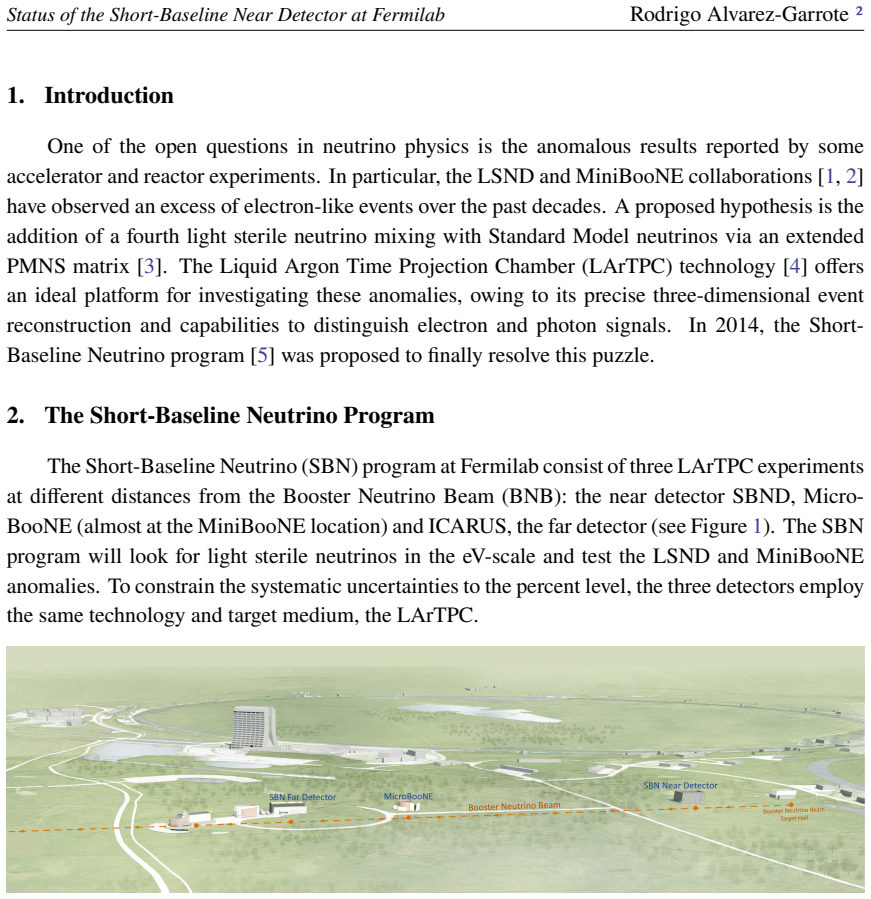
The Short-Baseline Near Detector (SBND) is one of three Liquid Argon Time Projection Chamber (LArTPC) neutrino detectors positioned along the axis of the Booster Neutrino Beam (BNB) at Fermilab, as part of the Short-Baseline Neutrino (SBN) Program. The detector is currently being commissioned and is expected to take neutrino data this year. SBND is characterized by superb imaging capabilities and will record over a million neutrino interactions per year. Thanks to its unique combination of measurement resolution and statistics, SBND will carry out a rich program of neutrino interaction measurements and novel searches for physics beyond the Standard Model (BSM). It will enable the potential of the overall SBN sterile neutrino program by performing a precise characterization of the unoscillated event rate, and constraining BNB flux and neutrino-argon cross-section systematic uncertainties. In this proceedings, the physics reach, current status, and future prospects of SBND are discussed and early data is presented.
Figures


Figures from the paper (2 more)


Forward citations
Cited by 1 Pith paper
-
Muon Bremsstrahlung as a New Probe of Dark Sector at Neutrino Experiments
Muon bremsstrahlung from the focused muon beam at neutrino facilities can produce heavy neutral leptons up to ~1 GeV, opening new search territory for SBND and DUNE Near Detector.
Reference graph
Works this paper leans on
-
[10]
A.A. Machado, E. Segreto, D. Warner, A. Fauth, B. Gelli, R. Maximo et al., The X-ARAPUCA: An improvement of the ARAPUCA device , 4, 2018, DOI https://doi.org/10.1088/1748-0221/13/04/C04026 [ https://arxiv.org/abs/1804.01407 1804.01407 ]
arXiv 2018
-
[1]
write newline
" write newline "" before.all 'output.state := FUNCTION blank.sep after.quote 'output.state := FUNCTION fin.entry output.state after.quoted.block = 'skip 'add.period if write newline FUNCTION new.block output.state before.all = 'skip output.state after.quote = after.quoted.block 'output.state := after.block 'output.state := if if FUNCTION new.sentence out...
-
[2]
LSND collaboration, Evidence for neutrino oscillations from the observation of _e appearance in a _ beam , https://doi.org/10.1103/PhysRevD.64.112007 Phys. Rev. D 64 (2001) 112007 [ https://arxiv.org/abs/hep-ex/0104049 hep-ex/0104049 ]
arXiv 2001
-
[3]
MiniBooNE collaboration, Significant Excess of ElectronLike Events in the MiniBooNE Short-Baseline Neutrino Experiment , https://doi.org/10.1103/PhysRevLett.121.221801 Phys. Rev. Lett. 121 (2018) 221801 [ https://arxiv.org/abs/1805.12028 1805.12028 ]
arXiv 2018
-
[4]
B. Dasgupta and J. Kopp, Sterile neutrinos, Physics Reports 928 (2021) 1
work page 2021
-
[5]
Rubbia, The liquid-argon time projection chamber: a new concept for neutrino detectors , Tech
C. Rubbia, The liquid-argon time projection chamber: a new concept for neutrino detectors , Tech. Rep. CERN, Geneva (1977)
work page 1977
-
[6]
MicroBooNE, LAr1-ND, ICARUS-WA104 collaboration, A Proposal for a Three Detector Short-Baseline Neutrino Oscillation Program in the Fermilab Booster Neutrino Beam , https://arxiv.org/abs/1503.01520 1503.01520
-
[7]
MicroBooNE collaboration, Design and Construction of the MicroBooNE Detector , https://doi.org/10.1088/1748-0221/12/02/P02017 JINST 12 (2017) P02017 [ https://arxiv.org/abs/1612.05824 1612.05824 ]
arXiv 2017
Show all 11 references
-
[8]
ICARUS collaboration, ICARUS at the Fermilab Short-Baseline Neutrino program: initial operation , https://doi.org/10.1140/epjc/s10052-023-11610-y Eur. Phys. J. C 83 (2023) 467 [ https://arxiv.org/abs/2301.08634 2301.08634 ]
2023 arXiv
-
[9]
Balasubramanian, Beyond the standard model new physics searches with sbnd, in Physical Sciences Forum, vol
S. Balasubramanian, Beyond the standard model new physics searches with sbnd, in Physical Sciences Forum, vol. 8, MDPI, 2023
2023
-
[11]
SBND collaboration, Scintillation light in SBND : Simulation, Reconstruction, and Expected Performance of the Photon Detection System , arXiv preprint arXiv:2406.07514 (2024)
2024 arXiv
Reviewed August 10, 2026 · model on record in the stance chip above.
Discussion (0). Continue with ORCID to comment.