REVIEW 2 major objections 6 minor 2 cited by
Leptogenesis in a Majoron+Triplet model
T0 review · 2 major / 6 minor · reviewed 2026-08-10 · deepseek-v4-flash
Pith's one-line read Leptogenesis in the majoron+triplet model is controlled by the coupled out-of-equilibrium evolution of the neutrino, the scalar, the majoron, and the triplet, and neutrino-only Boltzmann equations can misestimate the efficiency by up to a…
desk verdict First coupled-Boltzmann treatment of leptogenesis in the majoron+triplet model; the factor-of-six claim holds up, but the Y_N^0 normalization is sloppy and must be fixed before absolute numbers are trusted. read the letter →
The pith
A machine-rendered reading of the paper's core claim, the machinery that carries it, and where it could break.
The reading
What carries the argument
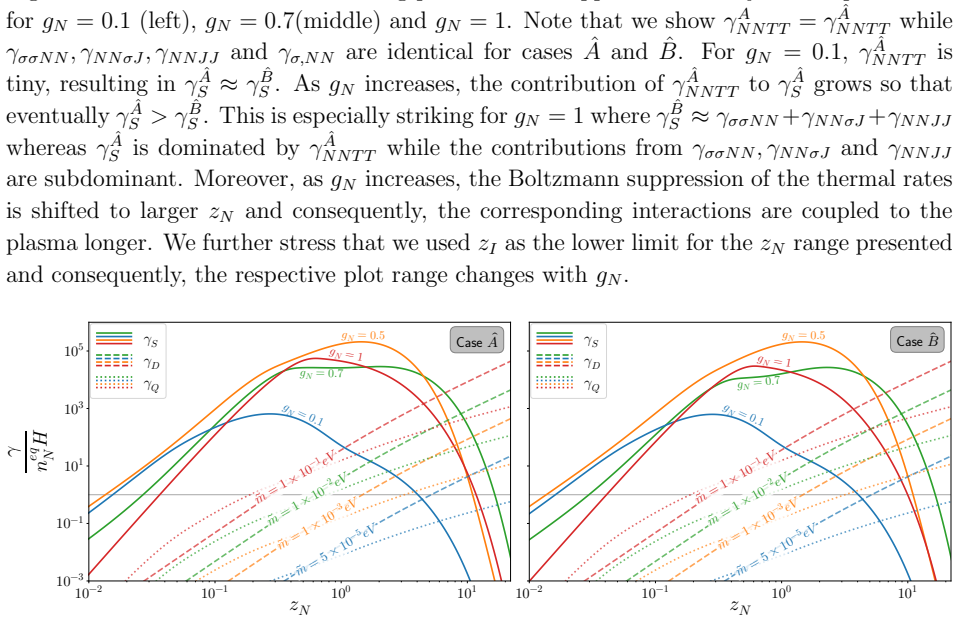
The load-bearing element is the coupled system of Boltzmann equations (3.12)–(3.15) for the abundances $Y_N$, $Y_T$, $Y_\sigma$, and $Y_J$, together with the efficiency equation (3.9). The summed scattering rate $\gamma_S$ collects the processes that change the neutrino abundance, and the $\rho$ term encodes how deviations of $\sigma$, $J$, and $T$ from thermal equilibrium feed back into neutrino production. The named diagnostic is the efficiency factor $\eta$, defined through $Y_L = \varepsilon Y_N^0 \eta$, whose final value $\eta(z_N\to\infty)$ is the quantity compared across scenarios. Cases $\hat{A}$ and $\hat{B}$ impose $\delta_T=\delta_\sigma=\delta_J=1$, reducing the system to a single neutrino equation; cases A and B solve the full system for $g_T=1$ and $g_T=10^{-7}$, respectively. The contrast between these two levels of treatment is what exposes the sixfold effect.
What would settle it
Re-run the numerical solution of the Boltzmann equations at $g_N \approx 0.7$ and $\tilde m \approx 10^{-3}$ eV with $\delta_\sigma=\delta_J=\delta_T\equiv 1$, keeping all scattering terms in $\gamma_S$; the paper predicts this simplified efficiency is roughly six times smaller than the full coupled result, so agreement within a few percent would refute the central claim. Independently, at $g_N = 0.1$ and $\tilde m = 5\times 10^{-5}$ eV with all initial abundances zero, the paper predicts a negative final efficiency in case $B_z$; a positive sign there would also falsify it.
Extended reading notes
Core claim
The central claim is that the new particles in the majoron+triplet model do not merely rescale the vanilla leptogenesis efficiency; they change how the heavy neutrino $N$ is populated and depleted. Scattering processes involving $\sigma$, $J$, and $T$ keep $N$ near thermal equilibrium early on and push its decays to later times, and in the simplified treatment with $\delta_T=\delta_\sigma=\delta_J=1$ this suppresses the efficiency. In the full coupled system the deviations of $\sigma$, $J$, and $T$ from equilibrium feed back into the neutrino abundance, producing a larger efficiency in cases A and B. The author further finds that the initial abundances of the new fields are irrelevant in most of parameter space but matter in a narrow region of small $g_N$ and small effective neutrino mass with vanishing initial abundances, where the final efficiency can be negative. The paper also derives a modified sphaleron conversion relation for the model and uses dark matter bounds to exclude the large-triplet-coupling case, leaving only the small-coupling case B as cosmologically viable.
Load-bearing premise
The calculation assumes that at the symmetry-breaking scale the new fields start either exactly thermal or exactly absent, with zero pre-existing lepton asymmetry; if the earlier universe left different abundances or an asymmetry, the final efficiency, especially its sign in the small-parameter region, could change.
Editorial extensions
If this is right
- For large parts of the $g_N$\u2013$\tilde m$ plane, efficiencies from neutrino-only Boltzmann equations are not reliable; quantitative leptogenesis predictions in this model require the coupled system.
- In the strong-washout limit, $\tilde m\to 10^{-1}$ eV, inverse neutrino decays dominate and the efficiencies converge to the vanilla-leptogenesis values, so the simplification is safe there.
- In the small $g_N$ and small $\tilde m$ region with zero initial abundances, the sign of the final lepton asymmetry is not fixed: the model permits a negative efficiency, which would translate into the wrong sign of the baryon asymmetry.
- Dark matter bounds force the triplet Yukawa coupling below about $2.9\times 10^{-7}$, excluding the large-coupling case A and leaving case B, where the triplet barely affects the efficiency, as the viable version.
- The triplet changes the sphaleron conversion from $Y_B = (28/79)Y_{B-L}$ to $Y_B = (76/679)Y_{B+3L}$; the numerical factor is similar, but the conserved combination is different.
Reading between the lines
- The sixfold sensitivity to spectator dynamics probably extends beyond this specific model: any leptogenesis setup in which additional fields scatter strongly with heavy neutrinos should be checked with the full coupled system, not just the neutrino equation.
- Including flavour effects or resonant CP enhancement, which the paper leaves out, could move the boundary of the negative-efficiency region; computing the same cases in a flavour-basis Boltzmann treatment would test how robust the initial-abundance dependence is.
- The paper's division of parameter space by $z_N^{\mathrm{eq}} = 1$ could serve as a practical diagnostic for when initial abundances matter in other multi-species leptogenesis models.
Signed reviews
Editorial analysis
A structured set of objections, weighed in public.
Referee Report
Summary. The manuscript studies leptogenesis in a singlet-majoron model extended by a Z2-odd right-handed SU(2)L triplet fermion. It derives the full set of coupled Boltzmann equations for the heavy neutrino N, the CP-even scalar σ, the majoron J, and the triplet T, including on-shell subtraction of σ-mediated scatterings. The equations are solved numerically for four parameter cases (full dynamics with gT=1 or gT=10^-7, and a simplified scenario where σ, J, T are pinned to equilibrium), with either thermal or vanishing initial abundances at the spontaneous-symmetry-breaking scale. The central finding is that the simplified neutrino-only treatment can misestimate the final efficiency by up to about a factor of six in parts of the scanned (gN, m-tilde) plane, and that initial abundances of the new fields matter only in a restricted 'IA' region of the small-gT scenario. The paper also derives the modified sphaleron conversion relation in this model, computes the CP violation required to match the observed baryon asymmetry, and discusses dark-matter constraints on the majoron and triplet.
Significance. If the numerical results are sound, the paper provides a concrete, fairly comprehensive demonstration that in a well-motivated majoron+triplet extension of type-I seesaw, the non-equilibrium dynamics of σ, J, and T can substantially change the efficiency of leptogenesis relative to the usual one-species treatment. The Boltzmann equations are written out explicitly, the on-shell subtraction is discussed, and several analytic approximations (e.g., Eqs. (4.15) and (4.25)) give physical insight that goes beyond a black-box numerical scan. The paper also quantifies the change in the sphaleron conversion factor and connects the analysis to dark-matter and baryon-asymmetry constraints. The author is explicit about the main assumptions (neglect of λmix, flavor effects, pre-existing asymmetries) and about the origin of the sphaleron relation [25]. Overall, this is a useful contribution to leptogenesis model-building, provided the normalization and robustness issues identified below are resolved.
major comments (2)
- [Sec. 3.2, Eqs. (3.8)–(3.9)] The efficiency normalization Y_N^0 is defined as Y_N(z→∞) in Eq. (3.8). For a decaying heavy neutrino, the asymptotic abundance is negligible and is not the standard normalization in leptogenesis, where Y_N^0 is normally the ultra-relativistic equilibrium abundance (or the initial abundance at z→0). Taken literally, the source term in Eq. (3.9) proportional to 1/Y_N^0 would be singular in a physically irrelevant limit. Since all reported absolute values of η in Figs. 4.1, 4.2, and the derived CP-violation requirements in Sec. 6 depend on this normalization, the definition must be corrected (e.g., to Y_N^eq(z→0) or Y_N(z_I)) and the numerical implementation must be checked to use a consistent constant normalization. If the intended quantity is indeed Y_N^eq(z→∞) in some limiting sense, that limit should be stated precisely.
- [Sec. 4.4.3.1, Eq. (4.28), and Fig. 4.19] The IA/IA boundary is defined by the explicit criterion z_N^eq(m-tilde^IA, g_N^IA)=1, and the text admits that there is no fundamental reason for this choice, arguing that the exact value is irrelevant because the thermalization transition is rapid. Since this boundary determines the location and extent of the region in which initial abundances are claimed to be relevant (including the negative-efficiency triangle in Fig. 4.2 and the discussion in Sec. 4.4.3.2), the paper should substantiate the claimed insensitivity with a concrete robustness check. For example, show how the IA/IA boundary and the |η_z^B/η_t^B| contours change when the criterion is varied to z_N^eq=2 and z_N^eq=0.5. This would also make clear whether the boundary is best thought of as a sharp transition or as a convenient contour.
minor comments (6)
- [Sec. 4.2.3 and Figs. 4.12, 4.16] The two regimes labeled 'WO' and 'WO' (with and without washout) are typographically indistinguishable in the typeset text and figure labels; the overline or other diacritic is lost. Please use distinct unambiguous labels, e.g., 'WO' and 'no-WO', and define them in the caption.
- [Sec. 4.1 and Fig. 4.4] The text says the efficiency is split into an 'IA (initial abundance) regime' and an 'IA regime' where initial abundances have no effect; both labels appear identical in the plain text. This makes the central dichotomy hard to follow. Please introduce distinct names (e.g., 'IA-sensitive' and 'IA-insensitive') and use them consistently.
- [Sec. 4.4.3.1, Eq. (4.28)] The notation (g_N^IA, m-tilde^IA) suggests a single point, but Eq. (4.28) defines a one-dimensional curve in the (g_N, m-tilde) plane. Please clarify that the pair denotes the boundary curve (e.g., by writing z_N^eq(m-tilde, g_N)=1 for the boundary) and that g_N^IA and m-tilde^IA refer to representative values along it, as used in Fig. 4.20.
- [Sec. 6.1, Eq. (6.10)] The factors 3×76/679 and 28/79 are correct only if the initial hypercharge and charge constraints are imposed as in [25]; the sign conventions for Y_L and Y_{B-L} should be stated explicitly so that the 'apart from the different signs' remark is unambiguous. A one-sentence derivation of the factor 3 would help the reader.
- [Abstract and Sec. 4.1] The abstract states that solving the coupled Boltzmann equations is essential 'for large parts of the considered parameter space,' but Fig. 4.3 shows that the ratio η_hat/η is close to unity over a sizable fraction of the scanned plane, with the largest deviations (factor ~6) concentrated near g_N~0.7 and small m-tilde. Consider softening the wording or adding a quantitative statement about the region where the difference exceeds, say, a factor of two.
- [Throughout] The manuscript contains numerous typographical and grammatical errors (e.g., 'condtions', 'seperate', 'dicuss', 'substraction', 'squablack' in App. A.3, 'inital', 'indentical'). A careful proofreading pass is needed before publication.
Circularity Check
No significant circularity: the central claim is a direct numerical comparison of two Boltzmann-equation setups, not a fit or a self-referential derivation.
full rationale
The paper's central result is the comparison between the simplified neutrino-only Boltzmann equation (3.18), obtained by setting delta_T,sigma,J = 1, and the full coupled system (3.12)-(3.15). The efficiency maps in Figs. 4.1-4.4 are numerical solutions of these equations for the parameter grid of Table 1; no parameter is fitted to the quantities being compared, and no 'prediction' is reconstructed from a fitted input. The IA/IA boundary in Sec. 4.4.3.1 is explicitly acknowledged as conventional: 'There is no fundamental reason to explicitly choose z_N^eq(tilde m_IA, g_N^IA) = 1', so it is a classification choice rather than a hidden fit. The initial-condition assumption in Sec. 3.3, 'that no other mechanisms generated an lepton asymmetry for z_N < z_I', is a stated cosmological assumption and not a circular use of the final asymmetry. The only same-author citation that is load-bearing in any section is [25] for the sphaleron conversion coefficient Y_B = (76/679) Y_(B+3L) (Eq. 6.8); this is a published parameter-free chemical-potential computation used only in Sec. 6.1, and it does not feed back into the coupled-Boltzmann efficiency claim that forms the paper's main conclusion. Hence there is no circular step that reduces a claimed prediction to its inputs.
Assumptions & free parameters
free parameters (6)
- f =
10^10 GeV
- lambda_sigma =
1
- g_T =
1 (case A) and 10^-7 (case B)
- m_J =
10^-3 GeV
- g_N =
range [0.1, 1]
- m_tilde =
range [5e-5, 0.1] eV
assumptions (8)
- standard math Maxwell-Boltzmann approximation for distribution functions and thermal rates (App. A.1).
- domain assumption Z2 symmetry forbids the triplet Yukawa coupling to SM leptons and Higgs (Sec. 2).
- domain assumption No additional CP violation beyond the standard neutrino decay loops; epsilon is given by the vanilla formula (Sec. 3.1).
- domain assumption Heavy neutrinos N2,3 are strongly hierarchical with MN1 much less than MN2,3 for the DI bound and epsilon formula (Sec. 3.1).
- domain assumption The sphaleron conversion relation Y_B = (76/679) Y_{B+3L} from [25] (Sec. 6.1).
- domain assumption The singlet-doublet mixing lambda_mix is neglected (Sec. 2).
- domain assumption No pre-existing lepton asymmetry for z_N < z_I (Sec. 3.3).
- standard math Radiation-dominated universe with g_* = 106.75 (App. A.1).
Cite this review
Pith. "Pith review of Leptogenesis in a Majoron+Triplet model." pith.science (2026). https://pith.science/paper/3IJAOMXC
@misc{pith2026250111529,
  author       = {Pith},
  title        = {Pith review of: Leptogenesis in a Majoron+Triplet model},
  year         = {2026},
  howpublished = {\url{https://pith.science/paper/3IJAOMXC}},
  note         = {Machine review of arXiv:2501.11529}
}
abstract
We discuss leptogenesis in a majoron model extended by a right-handed $SU(2)_L$ triplet fermion. We study several different parameter assignments and find that the interactions of neutrinos with the new particles in the majoron+triplet model can significantly alter the way leptogenesis proceeds. We show that for large parts of the considered parameter space, it is essential to solve the set of coupled Boltzmann equations for the evolution of the neutrinos and the additional particles rather than solving the Boltzmann equations for the neutrino evolution only.
Figures


Figures from the paper (27 more)




Forward citations
Cited by 2 Pith papers
-
Minimal Multi-Majoron Model
The minimal multi-Majoron model is a UV-complete seesaw framework in which two Majoron VEVs set hierarchical right-handed neutrino masses and generate a combined cosmic-string and first-order-transition gravitational ...
-
About electroweak domain walls in Majoron models
Electroweak instantons alone do not produce Majoron domain walls; a tiny instanton mass from B+L breaking is cosmologically negligible and can act as a bias or dark energy.
Reference graph
Works this paper leans on
-
[25]
Brune, Tim: Leptogenesis in majoron models without domain walls. In: Phys. Rev. D 107 (2023), Nr. 9, S. 096023. http://dx.doi.org/10.1103/PhysRevD.107.096023. – DOI 10.1103/PhysRevD.107.096023
-
[1]
Aghanim, N. u. a.: Planck 2018 results. VI. Cosmological parameters. In: Astron. Astrophys. 641 (2020), S. A6. http://dx.doi.org/10.1051/0004-6361/201833910. – DOI 10.1051/0004–6361/201833910. – [Erratum: Astron.Astrophys. 652, C4 (2021)]
-
[2]
Eguchi, K. u. a.: First results from KamLAND: Evidence for reactor anti-neutrino disappearance. In: Phys. Rev. Lett. 90 (2003), S. 021802. http://dx.doi.org/10. 1103/PhysRevLett.90.021802. – DOI 10.1103/PhysRevLett.90.021802
-
[3]
Ahmad, Q. R. u. a.: Direct evidence for neutrino flavor transformation from neutral cur- rent interactions in the Sudbury Neutrino Observatory. In: Phys. Rev. Lett.89 (2002), S. 011301. http://dx.doi.org/10.1103/PhysRevLett.89.011301. – DOI 10.1103/Phys- RevLett.89.011301
-
[4]
Fukuda, Y. u. a.: Evidence for oscillation of atmospheric neutrinos. In: Phys. Rev. Lett. 81 (1998), S. 1562–1567. http://dx.doi.org/10.1103/PhysRevLett.81.1562. – DOI 10.1103/PhysRevLett.81.1562
-
[5]
Minkowski, Peter: µ → eγ at a Rate of One Out of 10 9 Muon Decays? In: Phys. Lett. B 67 (1977), S. 421–428. http://dx.doi.org/10.1016/0370-2693(77)90435-X . – DOI 10.1016/0370–2693(77)90435–X
-
[6]
Yanagida, T.: Baryogenesis Without Grand Unification
Fukugita, M. ; Yanagida, T.: Baryogenesis Without Grand Unification. In: Phys. Lett. B 174 (1986), S. 45–47. http://dx.doi.org/10.1016/0370-2693(86)91126-3 . – DOI 10.1016/0370–2693(86)91126–3
-
[7]
Khlebnikov, S. Y. ; Shaposhnikov, M. E.: The Statistical Theory of Anomalous Fermion Number Nonconservation. In: Nucl. Phys. B 308 (1988), S. 885–912. http: //dx.doi.org/10.1016/0550-3213(88)90133-2 . – DOI 10.1016/0550–3213(88)90133– 2
Show all 45 references
-
[8]
Mohapatra, Rabindra N
Chikashige, Y. ; Mohapatra, Rabindra N. ; Peccei, R. D.: Are There Real Gold- stone Bosons Associated with Broken Lepton Number? In: Phys. Lett. B98 (1981), S. 265–268. http://dx.doi.org/10.1016/0370-2693(81)90011-3 . – DOI 10.1016/0370– 2693(81)90011–3
1981 doi
-
[9]
V alle, J
Schechter, J. ; V alle, J. W. F.: Neutrino Decay and Spontaneous Violation of Lepton Number. In: Phys. Rev. D25 (1982), S. 774. http://dx.doi.org/10.1103/PhysRevD. 25.774. – DOI 10.1103/PhysRevD.25.774
1982 doi
-
[10]
Glashow, Sheldon L
Georgi, Howard M. ; Glashow, Sheldon L. ; Nussinov, Shmuel: Unconventional Model of Neutrino Masses. In: Nucl. Phys. B193 (1981), S. 297–316. http://dx.doi. org/10.1016/0550-3213(81)90336-9 . – DOI 10.1016/0550–3213(81)90336–9 59
1981 doi
-
[11]
In: Phys
Brune, Tim ; P¨as, Heinrich: Massive majorons and constraints on the majoron-neutrino coupling. In: Phys. Rev. D99 (2019), Nr. 9, S. 096005. http://dx.doi.org/10.1103/ PhysRevD.99.096005. – DOI 10.1103/PhysRevD.99.096005
2019 doi
-
[12]
In: Phys
Frigerio, Michele ; Hambye, Thomas ; Masso, Eduard: Sub-GeV dark matter as pseudo-Goldstone from the seesaw scale. In: Phys. Rev. X 1 (2011), S. 021026. http: //dx.doi.org/10.1103/PhysRevX.1.021026. – DOI 10.1103/PhysRevX.1.021026
2011 doi
-
[13]
Jedamzik, Karsten ; March-Russell, John ; West, Stephen M.: Freeze-In Production of FIMP Dark Matter
Hall, Lawrence J. ; Jedamzik, Karsten ; March-Russell, John ; West, Stephen M.: Freeze-In Production of FIMP Dark Matter. In: JHEP 03 (2010), S. 080. http://dx. doi.org/10.1007/JHEP03(2010)080. – DOI 10.1007/JHEP03(2010)080
2010 doi
-
[15]
V alle, J
Berezinsky, V. ; V alle, J. W. F.: The KeV majoron as a dark matter particle. In: Phys. Lett. B 318 (1993), S. 360–366. http://dx.doi.org/10.1016/0370-2693(93) 90140-D. – DOI 10.1016/0370–2693(93)90140–D
1993 doi
-
[16]
In: Phys
Pilaftsis, Apostolos: Electroweak Resonant leptogenesis in the Singlet majoron Model. In: Phys. Rev. D 78 (2008), S. 013008. http://dx.doi.org/10.1103/PhysRevD.78. 013008. – DOI 10.1103/PhysRevD.78.013008
2008 doi
-
[17]
Gu, Pei-Hong ; Sarkar, Utpal: Leptogenesis Bound on Spontaneous Symmetry Breaking of Global Lepton Number. In: Eur. Phys. J. C 71 (2011), S. 1560. http: //dx.doi.org/10.1140/epjc/s10052-011-1560-2 . – DOI 10.1140/epjc/s10052–011– 1560–2
2011 doi
-
[18]
V alle, J
Aristizabal Sierra , Diego ; Tortola, M. ; V alle, J. W. F. ; Vicente, A.: Lep- togenesis with a dynamical seesaw scale. In: JCAP 07 (2014), S. 052. http://dx.doi. org/10.1088/1475-7516/2014/07/052. – DOI 10.1088/1475–7516/2014/07/052
2014 doi
-
[19]
F.: Spontaneous Breaking of Lepton Number and the Cosmological Domain Wall Problem
Lazarides, George ; Reig, Mario ; Shafi, Qaisar ; Srivastava, Rahul ; V alle, Jos´ e W. F.: Spontaneous Breaking of Lepton Number and the Cosmological Domain Wall Problem. In: Phys. Rev. Lett.122 (2019), Nr. 15, S. 151301. http://dx.doi.org/10. 1103/PhysRevLett.122.151301. – D...
2019 doi
-
[20]
In: Phys
Heeck, Julian ; Patel, Hiren H.: Majoron at two loops. In: Phys. Rev. D 100 (2019), Nr. 9, S. 095015. http://dx.doi.org/10.1103/PhysRevD.100.095015. – DOI 10.1103/PhysRevD.100.095015
2019 doi
-
[21]
In: Phys
Fileviez Perez, Pavel ; Patel, Hiren H.: The Electroweak Vacuum Angle. In: Phys. Lett. B 732 (2014), S. 241–243. http://dx.doi.org/10.1016/j.physletb.2014.03
2014 doi
-
[22]
Anselm, A. A. ; Johansen, A. A.: Baryon nonconservation in standard model and Yukawa interaction. In: Nucl. Phys. B 407 (1993), S. 313–330. http://dx.doi.org/ 10.1016/0550-3213(93)90060-3. – DOI 10.1016/0550–3213(93)90060–3
1993 doi
-
[23]
Anselm, A. A. ; Johansen, A. A.: Can electroweak theta term be observable? In: Nucl. Phys. B412 (1994), S. 553–573. http://dx.doi.org/10.1016/0550-3213(94)90392-1 . – DOI 10.1016/0550–3213(94)90392–1
1994 doi
-
[24]
Kuflik, Eric ; Ruhdorfer, Maximilian: Instanton NDA and applications to axion models
Cs´aki, Csaba ; D’Agnolo, Raffaele T. ; Kuflik, Eric ; Ruhdorfer, Maximilian: Instanton NDA and applications to axion models. In: JHEP 04 (2024), S. 074. http: //dx.doi.org/10.1007/JHEP04(2024)074. – DOI 10.1007/JHEP04(2024)074
2024 doi
-
[26]
Pl¨umacher, Michael: Baryogenesis and lepton number violation. In: Z. Phys. C 74 (1997), S. 549–559. http://dx.doi.org/10.1007/s002880050418. – DOI 10.1007/s002880050418
1997 doi
-
[27]
Wolfram, Stephen: Baryon Number Generation in the Early Universe
Kolb, Edward W. ; Wolfram, Stephen: Baryon Number Generation in the Early Universe. In: Nucl. Phys. B 172 (1980), S. 224. http://dx.doi.org/10. 1016/0550-3213(82)90012-8. – DOI 10.1016/0550–3213(82)90012–8. – [Erratum: Nucl.Phys.B 195, 542 (1982)]
1980 doi
-
[28]
In: Phys
Covi, Laura ; Roulet, Esteban ; Vissani, Francesco: CP violating decays in leptogen- esis scenarios. In: Phys. Lett. B384 (1996), S. 169–174. http://dx.doi.org/10.1016/ 0370-2693(96)00817-9. – DOI 10.1016/0370–2693(96)00817–9
1996 doi
-
[29]
In: Phys
Davidson, Sacha ; Ibarra, Alejandro: A Lower bound on the right-handed neutrino mass from leptogenesis. In: Phys. Lett. B 535 (2002), S. 25–32. http://dx.doi.org/ 10.1016/S0370-2693(02)01735-5 . – DOI 10.1016/S0370–2693(02)01735–5
2002 doi
-
[30]
Forero, Danna ; Gariazzo, S
Salas, P. ; Forero, Danna ; Gariazzo, S. ; Mart´ınez-Mirav´e, P. ; Mena, O. ; Ternes, C. ; T´ortola, Mariam ; V alle, Jose: 2020 global reassessment of the neutrino oscillation picture. In: Journal of High Energy Physics2021 (2021), 02. http: //dx.doi.org/10.1007/JHEP02(2021)0...
2021 doi
-
[31]
In: Nucl
Barbieri, Riccardo ; Creminelli, Paolo ; Strumia, Alessandro ; Tetradis, Nikolaos: Baryogenesis through leptogenesis. In: Nucl. Phys. B575 (2000), S. 61–77. http://dx. doi.org/10.1016/S0550-3213(00)00011-0 . – DOI 10.1016/S0550–3213(00)00011–0
2000 doi
-
[32]
Kamenik, Jernej F
Aristizabal Sierra , D. ; Kamenik, Jernej F. ; Nemevsek, Miha: Implications of Flavor Dynamics for Fermion Triplet leptogenesis. In: JHEP 10 (2010), S. 036. http://dx.doi.org/10.1007/JHEP10(2010)036. – DOI 10.1007/JHEP10(2010)036 61
2010 doi
-
[33]
In: New J
Hambye, Thomas: Leptogenesis: beyond the minimal type I seesaw scenario. In: New J. Phys. 14 (2012), S. 125014. http://dx.doi.org/10.1088/1367-2630/14/12/125014. – DOI 10.1088/1367–2630/14/12/125014
2012 doi
-
[34]
In: Nucl
Hambye, Thomas ; Lin, Yin ; Notari, Alessio ; Papucci, Michele ; Strumia, Alessan- dro: Constraints on neutrino masses from leptogenesis models. In: Nucl. Phys. B 695 (2004), S. 169–191. http://dx.doi.org/10.1016/j.nuclphysb.2004.06.027. – DOI 10.1016/j.nuclphysb.2004.06.027
2004 doi
-
[35]
In: Nucl
Strumia, Alessandro: Sommerfeld corrections to type-II and III leptogenesis. In: Nucl. Phys. B 809 (2009), S. 308–317. http://dx.doi.org/10.1016/j.nuclphysb.2008.10
2009 doi
-
[36]
Zhuridov, Dmitry V.: Neutrino Masses and leptogenesis from Extra Fermions. In: Int. J. Mod. Phys. A 28 (2013), S. 1350104. http://dx.doi.org/10.1142/ S0217751X13501042. – DOI 10.1142/S0217751X13501042
2013 doi
-
[37]
– DOI 10.1016/j.nuclphysb.2008.10.007
2008 doi
-
[38]
Di Bari , P
Buchm¨uller, W. ; Di Bari , P. ; Pl¨umacher, M.: The Neutrino mass window for baryogenesis. In: Nucl. Phys. B665 (2003), S. 445–468. http://dx.doi.org/10.1016/ S0550-3213(03)00449-8. – DOI 10.1016/S0550–3213(03)00449–8
2003 doi
-
[39]
Medeiros V arzielas, I
Aristizabal Sierra , D. ; Medeiros V arzielas, I. de: The role of lepton flavor symmetries in leptogenesis. In: Fortsch. Phys. 61 (2013), S. 645–665. http://dx.doi. org/10.1002/prop.201200122. – DOI 10.1002/prop.201200122
2013 doi
-
[40]
a.: Search for type-III seesaw heavy leptons in leptonic final states in pp collisions at √s = 13 TeV with the ATLAS detector
Aad, Georges u. a.: Search for type-III seesaw heavy leptons in leptonic final states in pp collisions at √s = 13 TeV with the ATLAS detector. In: Eur. Phys. J. C 82 (2022), Nr. 11, S. 988. http://dx.doi.org/10.1140/epjc/s10052-022-10785-0 . – DOI 10.1140/epjc/s10052–022–10785–0
2022 doi
-
[41]
Di Bari, P
Buchm¨uller, W. ; Di Bari, P. ; Pl¨umacher, M.: Leptogenesis for pedestrians. In: Annals Phys. 315 (2005), S. 305–351. http://dx.doi.org/10.1016/j.aop.2004.02
2005 doi
-
[42]
– DOI 10.1016/j.aop.2004.02.003
2004 doi
-
[43]
In: Nucl
Cirelli, Marco ; Strumia, Alessandro ; Tamburini, Matteo: Cosmology and Astro- physics of Minimal Dark Matter. In: Nucl. Phys. B787 (2007), S. 152–175. http://dx. doi.org/10.1016/j.nuclphysb.2007.07.023. – DOI 10.1016/j.nuclphysb.2007.07.023 63
2007 doi
-
[44]
Sirunyan, Albert M. u. a.: Search for Evidence of the Type-III Seesaw Mechanism in Multilepton Final States in Proton-Proton Collisions at √s = 13 TeV. In: Phys. Rev. Lett. 119 (2017), Nr. 22, S. 221802. http://dx.doi.org/10.1103/PhysRevLett.119. 221802. – DOI 10.1103/PhysRevL...
2017 doi
-
[45]
Giudice, G. F. ; Notari, A. ; Raidal, M. ; Riotto, A. ; Strumia, A.: Towards a complete theory of thermal leptogenesis in the SM and MSSM. In: Nucl. Phys. B 685 (2004), S. 89–149. http://dx.doi.org/10.1016/j.nuclphysb.2004.02.019. – DOI 10.1016/j.nuclphysb.2004.02.019 62
2004 doi
-
[64]
– DOI 10.1016/j.physletb.2014.03.064 60
2014 doi
Reviewed August 10, 2026 · model on record in the stance chip above.
Discussion (0). Continue with ORCID to comment.