REVIEW 4 minor 1 cited by
Modular evolutions and causality in two-dimensional conformal field theory
T0 review · 0 major / 4 minor · reviewed 2026-08-10 · deepseek-v4-flash
Pith's one-line read The paper shows that in 1+1D CFT modular evolutions of a single interval preserve relativistic causality inside the causal diamond, while for two disjoint intervals and the massless Dirac field the bilocal modular flow produces spacelike…
desk verdict Solid analytic study that separates causal ordering from local commutativity in modular flow; the two-interval Dirac result is new and convincing, and the paper deserves refereeing. read the letter →
The pith
A machine-rendered reading of the paper's core claim, the machinery that carries it, and where it could break.
The reading
What carries the argument
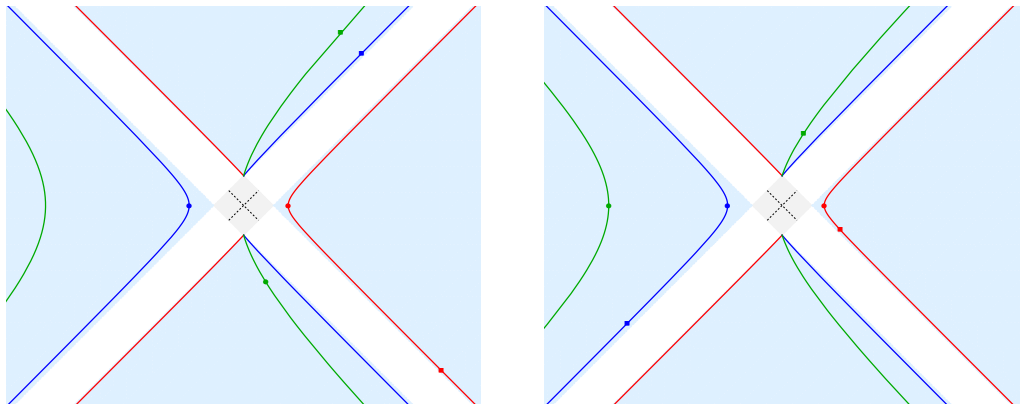
The carrying object is the modular Hamiltonian $K=\int V(u)\,T(u)\,du$, whose weight function is $V(u)=1/w'(u)$; for two disjoint intervals the weight splits into a local part $V_{\rm loc}$ and a bilocal part $V_{\rm biloc}$ tied to the conjugate point map $u_c=C(u)=q_0-r_0^2/(u-q_0)$. The modular flow is governed by $\xi(\tau,u)$, solving $\partial_\tau \xi = V_{\rm loc}(\xi)\,\partial_u\xi/V_{\rm loc}(u)$, and for the Dirac field it mixes $\psi(\xi)$ with $\psi(\xi_c)$ through coefficients built from the harmonic ratio $\eta(u_1,u_2)$. Applied to the modular two-point functions, this machinery puts the (anti-)commutators into sums of Dirac deltas supported at $u_2=\xi_k(\pm\tau_{12},u_1)$ and at its conjugate point $C(\xi_k(\pm\tau_{12},u_1))$, producing equations (4.49)-(4.54).
What would settle it
Perform an exact free-fermion lattice computation of the reduced density matrix for two disjoint intervals in the massless Dirac chain, extract the continuum modular Hamiltonian and flow, and check whether the anti-commutator of the flowed field with the initial field develops a delta peak at $u_2 = C(\xi_k(\pm\tau_{12},u_1))$ when the initial points are spacelike separated; finding no peak at the predicted conjugate location, or a different bilocal weight, would refute the central claim.
Extended reading notes
Core claim
The central claim is that modular evolutions in these models separate causal ordering from local commutativity. For connected subsystems the spacetime distance factorizes as $d(P_1(\tau),P_2(\tau)) = \omega(\tau;P_1,P_2)\, d(P_1,P_2)$ with a strictly positive prefactor inside the diamond, which fixes the sign of the distance for all modular time. For the union of two disjoint intervals the same sign preservation holds, but the bilocal term in the modular Hamiltonian (4.1)-(4.8) makes the chiral modular flow a superposition of the field at $\xi(\tau,u)$ and at the conjugate point $\xi_c \equiv C(\xi)$, and the anti-commutator (4.54) develops Dirac deltas whose support lies at spacelike separation, including initial points in different intervals. The paper concludes that the modular evolution generated by the entanglement Hamiltonian can violate the usual locality condition for fermionic fields while preserving relativistic causal ordering.
Load-bearing premise
The two-interval analysis takes as input the modular Hamiltonian (4.1) with weights (4.7) given in reference [18]; the paper re-derives the flow and correlators from it but does not derive the Hamiltonian itself, and if that input were wrong the spacelike Dirac delta claim would collapse.
Editorial extensions
If this is right
- For a single interval, any two initial points inside the causal diamond keep their timelike, spacelike, or lightlike relation for all equal modular times because the prefactor $\omega(\tau;P_1,P_2)$ is strictly positive there.
- At finite temperatures with different left/right inverse temperatures $\beta_+ \neq \beta_-$, the equal-time modular trajectories still preserve the sign of the spacetime distance inside the diamond, while independent evolution times change the sign at $\tau_{\beta,<}$ and $\tau_{\beta,>}$.
- For two disjoint intervals and the massless Dirac field, the anti-commutator of modular-flowed fields is a sum of two Dirac deltas; one rides on the flow image of the initial point and the other on the image of its conjugate point, so it fires even when the initial points are spacelike separated.
- The chiral density commutator contains both a $\delta'$ term and a nonvanishing contact term $G(u,v)$, in contrast with the single-interval case where that contact term vanishes identically.
- The modular conjugation map sends a trajectory inside the diamond to one in its complement, and the union of the two trajectories is a hyperbola of Apollonius whose distance ratio from the two entangling points is independent of modular time.
Reading between the lines
- Editorial inference: if this bilocal delta structure is a general feature of non-local modular Hamiltonians, the same spacelike delta contributions should appear in other exactly solvable cases with bilocal terms, such as the half-line Dirac field with a boundary and the defective line, and checking those models would test whether the effect depends only on the inversion map $C(u)$ or on bilocalit
- Editorial inference: because sign changes of the spacetime distance and the delta support of commutators are both controlled by the same function $R(\tau;u_1,u_2)$, the paper implicitly offers a dictionary between geometric causal shadows and operator-localization violations that could be used to engineer modular flows with targeted nonlocal couplings in synthetic quantum matter.
- Editorial inference: on a lattice realization of the two-interval entanglement Hamiltonian, one could look for the nonlocal fermionic mode that evolves out of the initial interval and measure its equal-time anti-commutator with the original mode; a nonzero value at a finite distance would be a concrete, testable signature of the effect.
Editorial analysis
A structured set of objections, weighed in public.
Referee Report
Summary. The paper studies the relationship between modular evolution and relativistic causality in two-dimensional CFT in Minkowski spacetime. For a single spatial interval in the vacuum, it proves that modular trajectories preserve the sign of the Lorentzian spacetime distance when both initial points lie inside the associated causal diamond, with explicit formulas (2.63)-(2.64); the analysis is extended to thermal states with different left/right temperatures in Sec. 3. For the massless Dirac field and the bipartition given by two disjoint intervals, the paper uses the Casini-Huerta modular Hamiltonian to derive the bilocal modular flow, the chiral-distance identity (4.68), and the field anti-commutator (4.54), which contains Dirac-delta contributions even for initial points in different, spacelike-separated intervals. The paper argues carefully that these delta supports correspond to lightlike-related evolved points, so relativistic causality is preserved while local commutativity of the modular-evolved fields fails. Long appendices provide technical derivations.
Significance. The paper is parameter-free and analytic. Its central claims are concrete and falsifiable: sign preservation of spacetime distances along modular trajectories and explicit delta-function positions in the fermionic anti-commutator. The new result for two disjoint intervals clarifies the distinction between locality of the modular flow and relativistic causality, and it builds cleanly on established work (Bisognano-Wichmann, Hislop-Longo, Casini-Huerta, Longo-Martinetti-Rehren). The main external input, the two-interval modular Hamiltonian (4.1), is clearly identified and is an established result; the paper derives all subsequent consequences from it consistently. The manuscript is detailed, self-contained in its derivations, and will be of interest to researchers working on modular theory and entanglement in QFT.
minor comments (4)
- [Sec. 4.5, around Eq. (4.70)] The statement that for u1 and u2 in different intervals the sign of ξ(τ1, u1) − ξ(τ2, u2) coincides with the sign of u1 − u2 and never vanishes is not immediate from (4.70) alone, because (4.68) also contains the factor R(τ12; u1, u2). The claim is correct, but the proof should explicitly show the cancellation between the sign of R(τ12; u1, u2) and the sign of the ratio ˜η(ξ1, ξ2)/˜η(u1, u2): since w(u1,c) = w(u1), one has R(τ; u1, u2) = R(τ; u1,c, u2), and applying (4.68) to the same-interval pair (u1,c, u2) gives sign(ξ(τ1, u1,c) − ξ(τ2, u2)) = sign(R) sign(u1,c − u2), which yields sign(ξ2 − ξ1,c) = sign(R) sign(u2 − u1,c); combining this with (4.70) gives the product +1. Adding this argument would make the derivation fully self-contained.
- [Sec. 4.4, around Eq. (4.40)] The computation of the anti-commutator from the modular two-point functions assumes that the anti-commutator is a c-number ('Since this quantity is a complex number'). This is true for the quasi-free Dirac field, but it should be stated explicitly, as was done in Sec. 2.3 for the current commutator, so that the derivation is self-contained.
- [Sec. 2.7, first paragraph] The sentence 'Consider the Given two points' contains a typo; it should read 'Consider two points'.
- [Abstract and Conclusions] The phrase 'local commutativity fails' may be misread as implying a violation of relativistic causality. Since the body of the paper carefully shows that the points at the Dirac-delta support are lightlike rather than spacelike, I suggest rephrasing to something like 'the modular evolution of the Dirac field is not local' or 'local commutativity of the modular-evolved fields fails'.
Circularity Check
No significant circularity; central results are re-derived from external modular-Hamiltonian inputs, and self-citations are not load-bearing.
full rationale
No circular step is identified. The single-interval causality result (2.63)-(2.64) is derived directly from q(τ,u)>0 for u∈A, where q is defined in (2.10), so the sign of the spacetime distance is preserved by an explicit inequality rather than by assumption. The two-interval analysis takes the modular Hamiltonian (4.1) from Casini and Huerta [18] as an external input, but the paper does not stop there: Appendix D.1 re-derives the modular flow (4.15), and Appendix D.2 re-derives the modular correlators (4.31) from that flow, with the KMS structure following from [20]. The anti-commutator (4.54) is then computed from these correlators, so the spacelike Dirac-delta contributions are a derived consequence of the bilocal term (4.4)-(4.5), not an input. The same holds for the density commutator (4.65). There are no fitted parameters renamed as predictions and no external benchmark is used as its own output. The self-citations to [15] and [33] are present, but they are used for the geometric modular-conjugation picture and as a derivation template, respectively; they do not carry the load of the central claims, which rest on [18] and [20] and on the explicit re-derivations in the appendices. The paper also reports a failed ansatz in Appendix D.3 and an open problem in Sec. 2.6, which further supports that the derivation chain is not being forced to reproduce its conclusions.
Assumptions & free parameters
assumptions (5)
- domain assumption The modular Hamiltonian for a single interval in a 2D CFT vacuum is given by (2.2) with weight function (2.3).
- domain assumption The modular Hamiltonian for the massless Dirac field on two disjoint intervals is the sum of local and bilocal terms in (4.1)-(4.5).
- standard math The two-point function of chiral primary fields is given by (2.16).
- domain assumption The modular two-point functions satisfy the KMS condition, fixing the i epsilon prescriptions in (2.21), (3.9), (4.31).
- standard math The distribution identity (2.31)/(C.1) for the derivative of the Dirac delta holds.
Cite this review
Pith. "Pith review of Modular evolutions and causality in two-dimensional conformal field theory." pith.science (2026). https://pith.science/paper/74UICTMV
@misc{pith2026250111567,
  author       = {Pith},
  title        = {Pith review of: Modular evolutions and causality in two-dimensional conformal field theory},
  year         = {2026},
  howpublished = {\url{https://pith.science/paper/74UICTMV}},
  note         = {Machine review of arXiv:2501.11567}
}
read the original abstract
In two-dimensional conformal field theories (CFT) in Minkowski spacetime, we study the spacetime distance between two events along two distinct modular trajectories. When the spatial line is bipartite by a single interval, we consider both the ground state and the state at finite different temperatures for the left and right moving excitations. For the free massless Dirac field in the ground state, the bipartition of the line given by the union of two disjoint intervals is also investigated. The modular flows corresponding to connected subsystems preserve relativistic causality. Locality along the modular flows of some fields is explored by evaluating their (anti-)commutators. In particular, the bilocal nature of the modular Hamiltonian of two disjoint intervals for the massless Dirac field provide multiple trajectories leading to Dirac delta contributions in the (anti-)commutators even when the initial points belong to different intervals, thus being spacelike separated.
Figures


Figures from the paper (15 more)



Forward citations
Cited by 1 Pith paper
-
Geometric modular flows in 2d CFT and beyond
In 2d CFTs, every suitably regular Unruh flow on the Rindler wedge is the modular flow of a state obtained by a conformal unitary acting on the vacuum or thermal state, and local entropy and stress-tensor formulas follow.
Reference graph
Works this paper leans on
-
[1]
Tomita’s Theory of Modular Hilbert Algebras and its Applications
M. Takesaki, “Tomita’s Theory of Modular Hilbert Algebras and its Applications” , Springer-Verlag (1970)
1970
-
[2]
Local quantum physics: Fields, particles, algebras
R. Haag, “Local quantum physics: Fields, particles, algebras” , Springer-Verlag (1996)
work page 1996
-
[3]
O. Bratteli and D. W. Robinson, “Operator algebras and quantum statistical mechanics 2: Equilibrium states. Models in quantum statistical mechanics” , Springer-Verlag (1996)
work page 1996
-
[4]
On revolutionizing quantum field theory with Tomita’s modular theory
H. J. Borchers, “On revolutionizing quantum field theory with Tomita’s modular theory” , J. Math. Phys. 41, 3604 (2000)
work page 2000
-
[5]
Theory of Operator Algebras II
M. Takesaki, “Theory of Operator Algebras II” , Springer (2003)
work page 2003
-
[6]
On the Duality Condition for a Hermitian Scalar Field
J. Bisognano and E. Wichmann, “On the Duality Condition for a Hermitian Scalar Field” , J. Math. Phys. 16, 985 (1975)
work page 1975
-
[7]
On the Duality Condition for Quantum Fields
J. Bisognano and E. Wichmann, “On the Duality Condition for Quantum Fields” , J. Math. Phys. 17, 303 (1976)
work page 1976
-
[8]
Global Conformal Invariance in Quantum Field Theory
M. Luscher and G. Mack, “Global Conformal Invariance in Quantum Field Theory” , Commun. Math. Phys. 41, 203 (1975)
work page 1975
Show all 81 references
-
[9]
Conformal Invariance in Quantum Field Theory
I. T. Todorov, M. C. Mintchev and V. B. Petkova, “Conformal Invariance in Quantum Field Theory”, Scuola Normale Superiore (1978)
1978
-
[10]
Infinite Conformal Symmetry in Two-Dimensional Quantum Field Theory
A. A. Belavin, A. M. Polyakov and A. B. Zamolodchikov, “Infinite Conformal Symmetry in Two-Dimensional Quantum Field Theory” , Nucl. Phys. B 241, 333 (1984)
1984
-
[11]
Modular Structure of the Local Algebras Associated With the Free Massless Scalar Field Theory
P. D. Hislop and R. Longo, “Modular Structure of the Local Algebras Associated With the Free Massless Scalar Field Theory” , Commun. Math. Phys. 84, 71 (1982)
1982
-
[12]
Modular structure and duality in conformal quantum field theory
R. Brunetti, D. Guido and R. Longo, “Modular structure and duality in conformal quantum field theory”, Commun. Math. Phys. 156, 201 (1993)
1993
-
[13]
Towards a derivation of holographic entanglement entropy
H. Casini, M. Huerta and R. C. Myers, “Towards a derivation of holographic entanglement entropy”, JHEP 1105, 036 (2011)
2011
-
[14]
On the Modular Structure of Local Algebras of Observables
K. Fredenhagen, “On the Modular Structure of Local Algebras of Observables” , Commun. Math. Phys. 97, 79 (1985)
1985
-
[15]
Modular conjugations in 2D conformal field theory and holographic bit threads
M. Mintchev and E. Tonni, “Modular conjugations in 2D conformal field theory and holographic bit threads”, JHEP 2212, 149 (2022), arxiv:2209.03242
2022 arXiv
-
[16]
Entanglement Temperature and Entanglement Entropy of Excited States
G. Wong, I. Klich, L. A. Pando Zayas and D. Vaman, “Entanglement Temperature and Entanglement Entropy of Excited States” , JHEP 1312, 020 (2013), arxiv:1305.3291
2013 arXiv
-
[17]
Entanglement hamiltonians in two-dimensional conformal field theory
J. Cardy and E. Tonni, “Entanglement hamiltonians in two-dimensional conformal field theory” , J. Stat. Mech. 1612, 123103 (2016), arxiv:1608.01283
2016 arXiv
-
[18]
Reduced density matrix and internal dynamics for multicomponent regions
H. Casini and M. Huerta, “Reduced density matrix and internal dynamics for multicomponent regions”, Class. Quant. Grav. 26, 185005 (2009), arxiv:0903.5284. 70
2009 arXiv
-
[19]
Calculation of reduced density matrices from correlation functions
I. Peschel, “Calculation of reduced density matrices from correlation functions” , J. Phys. A 36, L205 (2003), cond-mat/0212631
2003 arXiv
-
[20]
Geometric modular action for disjoint intervals and boundary conformal field theory
R. Longo, P. Martinetti and K.-H. Rehren, “Geometric modular action for disjoint intervals and boundary conformal field theory” , Rev. Math. Phys. 22, 331 (2010)
2010
-
[21]
On the modular operator of mutli-component regions in chiral CFT
S. Hollands, “On the modular operator of mutli-component regions in chiral CFT” , Commun. Math. Phys. 384, 785 (2021), arxiv:1904.08201
2021 arXiv
-
[22]
Causally oriented manifolds and groups
I. Segal, “Causally oriented manifolds and groups” , Bull. Amer. Math. Soc. 77, 958 (1971)
1971
-
[23]
Mathematical Cosmology and Extragalactic Astronomy
I. Segal, “Mathematical Cosmology and Extragalactic Astronomy” , Academic Press (1976)
1976
-
[24]
How to derive the Virasoro algebra from dilation invariance
M. Luscher, “How to derive the Virasoro algebra from dilation invariance” , unpublished notes (1988)
1988
-
[25]
Modular conjugation for multicomponent regions
N. Abate, D. Blanco, M. Koifman and G. P´ erez-Nadal, “Modular conjugation for multicomponent regions”, Phys. Rev. D 107, 045015 (2023), arxiv:2209.10711
2023 arXiv
-
[26]
Wedge reflection positivity
H. Casini, “Wedge reflection positivity”, J. Phys. A 44, 435202 (2011), arxiv:1009.3832
2011 arXiv
-
[27]
Quasiprimary Fields: An Approach to Positivity of 2- D Conformal Quantum Field Theory
K.-H. Rehren and B. Schroer, “Quasiprimary Fields: An Approach to Positivity of 2- D Conformal Quantum Field Theory” , Nucl. Phys. B 295, 229 (1988)
1988
-
[28]
Generalized Functions Vol. 1: Properties and Operations
I. M. Gel’fand and G. E. Shilov, “Generalized Functions Vol. 1: Properties and Operations” , Academic Press (1964)
1964
-
[29]
Anyonic Entanglement and Topological Entanglement Entropy
P. Bonderson, C. Knapp and K. Patel, “Anyonic Entanglement and Topological Entanglement Entropy”, Annals Phys. 385, 399 (2017), arxiv:1706.09420
2017 arXiv
-
[30]
Characterizing the entanglement of anyonic systems using the anyonic partial transpose
N. Kirchner, W. Choi and F. Pollmann, “Characterizing the entanglement of anyonic systems using the anyonic partial transpose” , Phys. Rev. B 110, 085143 (2024), arxiv:2403.12121
2024 arXiv
-
[31]
A characterization for isometries and conformal mappings of pseudo-Riemannian manifolds
J. Peleska, “A characterization for isometries and conformal mappings of pseudo-Riemannian manifolds”, aequationes mathematicae 27, 20 (1984)
1984
-
[32]
Analyticity and the Unruh effect: a study of local modular flow
J. Sorce, “Analyticity and the Unruh effect: a study of local modular flow” , JHEP 2424, 040 (2024), arxiv:2403.18937
2024 arXiv
-
[33]
Modular Hamiltonians for the massless Dirac field in the presence of a boundary
M. Mintchev and E. Tonni, “Modular Hamiltonians for the massless Dirac field in the presence of a boundary” , JHEP 2103, 204 (2021), arxiv:2012.00703
2021 arXiv
-
[34]
Modular groups of quantum fields in thermal states
H. J. Borchers and J. Yngvason, “Modular groups of quantum fields in thermal states” , J. Math. Phys. 40, 601 (1999), math-ph/9805013
1999 arXiv
-
[35]
Modular Hamiltonians for the massless Dirac field in the presence of a defect
M. Mintchev and E. Tonni, “Modular Hamiltonians for the massless Dirac field in the presence of a defect” , JHEP 2103, 205 (2021), arxiv:2012.01366
2021 arXiv
-
[36]
Modular Hamiltonian of a chiral fermion on the torus
D. Blanco and G. P´ erez-Nadal,“Modular Hamiltonian of a chiral fermion on the torus” , Phys. Rev. D 100, 025003 (2019), arxiv:1905.05210
2019 arXiv
-
[37]
Entanglement Spectrum of Chiral Fermions on the Torus
P. Fries and I. A. Reyes, “Entanglement Spectrum of Chiral Fermions on the Torus” , Phys. Rev. Lett. 123, 211603 (2019), arxiv:1905.05768. 71
2019 arXiv
-
[38]
Entropy and modular Hamiltonian for a free chiral scalar in two intervals
R. E. Arias, H. Casini, M. Huerta and D. Pontello, “Entropy and modular Hamiltonian for a free chiral scalar in two intervals” , Phys. Rev. D 98, 125008 (2018), arxiv:1809.00026
2018 arXiv
-
[39]
Entanglement hamiltonian and entanglement contour in inhomogeneous 1D critical systems
E. Tonni, J. Rodr ´ ıguez-Laguna and G. Sierra,“Entanglement hamiltonian and entanglement contour in inhomogeneous 1D critical systems” , J. Stat. Mech. 1804, 043105 (2018)
2018
-
[40]
Mutual Information and Compactification Radius in a c=1 Critical Phase in One Dimension
S. Furukawa, V. Pasquier and J. Shiraishi, “Mutual Information and Compactification Radius in a c=1 Critical Phase in One Dimension” , Phys. Rev. Lett. 102, 170602 (2009), arxiv:0809.5113
2009 arXiv
-
[41]
Entanglement Entropy and Twist Fields
M. Caraglio and F. Gliozzi, “Entanglement Entropy and Twist Fields” , JHEP 0811, 076 (2008), arxiv:0808.4094
2008 arXiv
-
[42]
Entanglement entropy of two disjoint intervals in conformal field theory
P. Calabrese, J. Cardy and E. Tonni, “Entanglement entropy of two disjoint intervals in conformal field theory” , J. Stat. Mech. 0911, P11001 (2009), arxiv:0905.2069
2009 arXiv
-
[43]
Entanglement entropy of two disjoint intervals in conformal field theory II
P. Calabrese, J. Cardy and E. Tonni, “Entanglement entropy of two disjoint intervals in conformal field theory II” , J. Stat. Mech. 1101, P01021 (2011), arxiv:1011.5482
2011 arXiv
-
[44]
On R´ enyi entropies of disjoint intervals in conformal field theory
A. Coser, L. Tagliacozzo and E. Tonni, “On R´ enyi entropies of disjoint intervals in conformal field theory”, J. Stat. Mech. 1401, P01008 (2014), arxiv:1309.2189
2014 arXiv
-
[45]
Entanglement of Two Disjoint Intervals in Conformal Field Theory and the 2D Coulomb Gas on a Lattice
T. Grava, A. P. Kels and E. Tonni, “Entanglement of Two Disjoint Intervals in Conformal Field Theory and the 2D Coulomb Gas on a Lattice” , Phys. Rev. Lett. 127, 141605 (2021), arxiv:2104.06994
2021 arXiv
-
[46]
Entanglement entropy and negativity of disjoint intervals in CFT: Some numerical extrapolations
C. De Nobili, A. Coser and E. Tonni, “Entanglement entropy and negativity of disjoint intervals in CFT: Some numerical extrapolations” , J. Stat. Mech. 1506, P06021 (2015), arxiv:1501.04311
2015 arXiv
-
[47]
Spin structures and entanglement of two disjoint intervals in conformal field theories
A. Coser, E. Tonni and P. Calabrese, “Spin structures and entanglement of two disjoint intervals in conformal field theories” , J. Stat. Mech. 1605, 053109 (2016), arxiv:1511.08328
2016 arXiv
-
[48]
Holographic derivation of entanglement entropy from AdS/CFT
S. Ryu and T. Takayanagi, “Holographic derivation of entanglement entropy from AdS/CFT” , Phys. Rev. Lett. 96, 181602 (2006), hep-th/0603001
2006 arXiv
-
[49]
Aspects of Holographic Entanglement Entropy
S. Ryu and T. Takayanagi, “Aspects of Holographic Entanglement Entropy” , JHEP 0608, 045 (2006), hep-th/0605073
2006 arXiv
-
[50]
A Covariant holographic entanglement entropy proposal
V. E. Hubeny, M. Rangamani and T. Takayanagi, “A Covariant holographic entanglement entropy proposal”, JHEP 0707, 062 (2007), arxiv:0705.0016
2007 arXiv
-
[51]
Causality & holographic entanglement entropy
M. Headrick, V. E. Hubeny, A. Lawrence and M. Rangamani, “Causality & holographic entanglement entropy”, JHEP 1412, 162 (2014), arxiv:1408.6300
2014 arXiv
-
[52]
Entanglement Renyi entropies in holographic theories
M. Headrick, “Entanglement Renyi entropies in holographic theories” , Phys. Rev. D 82, 126010 (2010), arxiv:1006.0047
2010 arXiv
-
[53]
Holographic entanglement entropy: near horizon geometry and disconnected regions
E. Tonni, “Holographic entanglement entropy: near horizon geometry and disconnected regions” , JHEP 1105, 004 (2011), arxiv:1011.0166
2011 arXiv
-
[54]
On shape dependence of holographic mutual information in AdS 4
P. Fonda, L. Giomi, A. Salvio and E. Tonni, “On shape dependence of holographic mutual information in AdS 4”, JHEP 1502, 005 (2015), arxiv:1411.3608. 72
2015 arXiv
-
[55]
Causal connectability between quantum systems and the black hole interior in holographic duality
S. Leutheusser and H. Liu, “Causal connectability between quantum systems and the black hole interior in holographic duality” , Phys. Rev. D 108, 086019 (2023), arxiv:2110.05497
2023 arXiv
-
[56]
Emergent Times in Holographic Duality
S. A. W. Leutheusser and H. Liu, “Emergent Times in Holographic Duality” , Phys. Rev. D 108, 086020 (2023), arxiv:2112.12156
2023 arXiv
-
[57]
Subalgebra-subregion duality: emergence of space and time in holography
S. Leutheusser and H. Liu, “Subalgebra-subregion duality: emergence of space and time in holography”, arxiv:2212.13266
-
[58]
Bit threads and holographic entanglement
M. Freedman and M. Headrick, “Bit threads and holographic entanglement” , Commun. Math. Phys. 352, 407 (2017), arxiv:1604.00354
2017 arXiv
-
[59]
Geometric Aspects of Holographic Bit Threads
C. A. Ag´ on, J. De Boer and J. F. Pedraza, “Geometric Aspects of Holographic Bit Threads” , JHEP 1905, 075 (2019), arxiv:1811.08879
2019 arXiv
-
[60]
Holographic thermal entropy from geodesic bit threads
S. Caggioli, F. Gentile, D. Seminara and E. Tonni, “Holographic thermal entropy from geodesic bit threads”, JHEP 2407, 088 (2024), arxiv:2403.03930
2024 arXiv
-
[61]
Entanglement entropies of an interval in the free Schr¨ odinger field theory at finite density
M. Mintchev, D. Pontello, A. Sartori and E. Tonni, “Entanglement entropies of an interval in the free Schr¨ odinger field theory at finite density”, JHEP 2207, 120 (2022), arxiv:2201.04522
2022 arXiv
-
[62]
Entanglement entropies of an interval in the free Schr¨ odinger field theory on the half line
M. Mintchev, D. Pontello and E. Tonni, “Entanglement entropies of an interval in the free Schr¨ odinger field theory on the half line”, JHEP 2209, 090 (2022), arxiv:2206.06187
2022 arXiv
-
[63]
Entanglement Hamiltonian of a nonrelativistic Fermi gas
V. Eisler, “Entanglement Hamiltonian of a nonrelativistic Fermi gas” , Phys. Rev. B 109, L201113 (2024), arxiv:2311.16348
2024 arXiv
-
[64]
Reduced density matrices and entanglement entropy in free lattice models
V. Eisler and I. Peschel, “Reduced density matrices and entanglement entropy in free lattice models”, J. Phys. A 42, 504003 (2009), arxiv:0906.1663
2009 arXiv
-
[65]
Entanglement entropy in free quantum field theory
H. Casini and M. Huerta, “Entanglement entropy in free quantum field theory” , J. Phys. A 42, 504007 (2009), arxiv:0905.2562
2009 arXiv
-
[66]
Operator content of real-space entanglement spectra at conformal critical points
A. M. L¨ auchli,“Operator content of real-space entanglement spectra at conformal critical points”, arxiv:1303.0741
-
[67]
Analytical results for the entanglement Hamiltonian of a free-fermion chain
V. Eisler and I. Peschel, “Analytical results for the entanglement Hamiltonian of a free-fermion chain”, J. Phys. A 50, 284003 (2017), arxiv:1703.08126
2017 arXiv
-
[68]
Properties of the entanglement Hamiltonian for finite free-fermion chains
V. Eisler and I. Peschel, “Properties of the entanglement Hamiltonian for finite free-fermion chains”, J. Stat. Mech. 1810, 104001 (2018), arxiv:1805.00078
2018 arXiv
-
[69]
On the continuum limit of the entanglement Hamiltonian
V. Eisler, E. Tonni and I. Peschel, “On the continuum limit of the entanglement Hamiltonian” , J. Stat. Mech. 1907, 073101 (2019), arxiv:1902.04474
2019 arXiv
-
[70]
On entanglement hamiltonians of an interval in massless harmonic chains
G. Di Giulio and E. Tonni, “On entanglement hamiltonians of an interval in massless harmonic chains”, J. Stat. Mech. 2003, 033102 (2020), arxiv:1911.07188
2020 arXiv
-
[71]
Operator content of entanglement spectra in the transverse field Ising chain after global quenches
J. Surace, L. Tagliacozzo and E. Tonni, “Operator content of entanglement spectra in the transverse field Ising chain after global quenches” , Phys. Rev. B 101, 241107(R) (2020), arxiv:1909.07381
2020 arXiv
-
[72]
Local and non-local properties of the entanglement Hamiltonian for two disjoint intervals
V. Eisler, E. Tonni and I. Peschel, “Local and non-local properties of the entanglement Hamiltonian for two disjoint intervals” , J. Stat. Mech. 2208, 083101 (2022), arxiv:2204.03966. 73
2022 arXiv
-
[73]
Applied Conformal Field Theory
P. H. Ginsparg, “Applied Conformal Field Theory” , hep-th/9108028, in: “Les Houches Summer School in Theoretical Physics: Fields, Strings, Critical Phenomena”
-
[74]
Pulling Out the Island with Modular Flow
Y. Chen, “Pulling Out the Island with Modular Flow” , JHEP 2003, 033 (2020), arxiv:1912.02210
2020 arXiv
-
[75]
Negativity Hamiltonian: An Operator Characterization of Mixed-State Entanglement
S. Murciano, V. Vitale, M. Dalmonte and P. Calabrese, “Negativity Hamiltonian: An Operator Characterization of Mixed-State Entanglement” , Phys. Rev. Lett. 128, 140502 (2022), arxiv:2201.03989
2022 arXiv
-
[76]
Entanglement and negativity Hamiltonians for the massless Dirac field on the half line
F. Rottoli, S. Murciano, E. Tonni and P. Calabrese, “Entanglement and negativity Hamiltonians for the massless Dirac field on the half line” , J. Stat. Mech. 2301, 013103 (2023), arxiv:2210.12109
2023 arXiv
-
[77]
Entanglement negativity in quantum field theory
P. Calabrese, J. Cardy and E. Tonni, “Entanglement negativity in quantum field theory” , Phys. Rev. Lett. 109, 130502 (2012), arxiv:1206.3092
2012 arXiv
-
[78]
Entanglement negativity in extended systems: A field theoretical approach
P. Calabrese, J. Cardy and E. Tonni, “Entanglement negativity in extended systems: A field theoretical approach”, J. Stat. Mech. 1302, P02008 (2013), arxiv:1210.5359
2013 arXiv
-
[79]
Finite temperature entanglement negativity in conformal field theory
P. Calabrese, J. Cardy and E. Tonni, “Finite temperature entanglement negativity in conformal field theory”, J. Phys. A 48, 015006 (2015), arxiv:1408.3043
2015 arXiv
-
[80]
Entanglement negativity in the critical Ising chain
P. Calabrese, L. Tagliacozzo and E. Tonni, “Entanglement negativity in the critical Ising chain” , J. Stat. Mech. 1305, P05002 (2013), arxiv:1302.1113
2013 arXiv
-
[81]
Towards the entanglement negativity of two disjoint intervals for a one dimensional free fermion
A. Coser, E. Tonni and P. Calabrese, “Towards the entanglement negativity of two disjoint intervals for a one dimensional free fermion” , J. Stat. Mech. 1603, 033116 (2016), arxiv:1508.00811. 74
2016 arXiv
Reviewed August 10, 2026 · model on record in the stance chip above.
Discussion (0). Continue with ORCID to comment.