REVIEW 3 major objections 3 minor 36 references
Initial data for a black string and a Kaluza-Klein bubble: Space-dependent compactification radius
T0 review · 3 major / 3 minor · reviewed 2026-08-10 · deepseek-v4-flash
Pith's one-line read This paper constructs time-symmetric initial data for five-dimensional Kaluza-Klein spacetimes in which the compactification radius varies in space, including a black string and a KK bubble at different positions, all satisfying the…
desk verdict A genuinely new family of KK initial data with varying radius, clean analytic parts, but the numerical section needs a sensitivity study before the collision-simulation claim is sold. read the letter →
The pith
A machine-rendered reading of the paper's core claim, the machinery that carries it, and where it could break.
The reading
What carries the argument
The central objects are the conformal metric ansatz $ds^2 = \Psi^4(dx^2+dy^2+dz^2)+\Phi^2 d\chi^2$ and the reduced Hamiltonian constraint $\Psi\nabla^2\Phi+2\nabla\Phi\cdot\nabla\Psi+4\Phi\nabla^2\Psi=0$ for time-symmetric data, with the equivalent $F$-$\Omega$ form used in the SO(3) section. The argument is carried by exact ansätze that turn this elliptic equation into solvable form: the closed forms $F=1+a_1/r+a_2/r^2$ and $\Omega=1+b_1/r+b_2/r^2$ obeying $2(a_2+b_2)=a_1b_1$, and the reduction $\Phi=C+D/\Psi$ that collapses the constraint to Laplace's equation. The numerical construction uses a split at radius $r_1$ with $\Phi=1$ outside and a smooth transition profile $\Phi=1-\exp\left(\frac{r-r_0}{r-r_1}S(\theta)\right)$ inside, with $S(\theta)$ solved so that the $\chi$-period is constant and the bubble is free of a conical singularity.
What would settle it
Repeat the Section V construction with $r_1/R_\infty = 2, 3, 4, 5$ and outer boundaries $x_{\rm out} = 5, 10, 20, 40$ for the same physical parameters, and check whether $\Delta\Psi$, $M_{\rm ADM}$, the bubble shape where $\Phi=0$, and the apparent-horizon area converge to common values; if they drift, the data are slicing artifacts rather than genuine two-object initial data.
Extended reading notes
Core claim
The central claim is that such slices exist and can be written down or computed explicitly. With the metric ansatz $ds^2 = \Psi^4(dx^2+dy^2+dz^2)+\Phi^2 d\chi^2$, the Hamiltonian constraint ${}^{(4)}R=0$ reduces to the elliptic equation $\Psi\nabla^2\Phi+2\nabla\Phi\cdot\nabla\Psi+4\Phi\nabla^2\Psi=0$. The SO(3)-symmetric ansatz $F=1+a_1/r+a_2/r^2$, $\Omega=1+b_1/r+b_2/r^2$ satisfies the analogous constraint under the single algebraic relation $2(a_2+b_2)=a_1b_1$, producing black-string and bubble data parameterized by mass, minimal-sphere radius, and either the central or bubble compactification radius. The multi-black-string data follow from the substitution $\Phi=C+D/\Psi$, which reduces the constraint to Laplace's equation $\nabla^2\Psi=0$, exactly as in the Brill-Lindquist case. For a black string and a bubble at separate locations, the paper solves the constraint numerically by splitting the domain at a radius $r_1$, taking $\Phi=1$ outside and a smooth transition profile inside with an auxiliary function $S(\theta)$ that enforces a constant $\chi$-period, and reports convergence of the solution with grid resolution.
Load-bearing premise
The numerical construction for a black string and a bubble at separate locations fixes the junction radius $r_1$ and outer boundary $r_{\rm out}$ by hand, and the paper does not test whether physical quantities such as the ADM mass, bubble shape, or apparent horizon depend on these choices.
Editorial extensions
If this is right
- The SO(3) data without a bubble give a two-parameter family of black-string slices whose ADM mass is always larger than $M/2$, and whose apparent-horizon area never exceeds that of the equal-mass Schwarzschild string.
- The bubble data include naked bubbles with negative ADM mass; when the bubble is trapped, the horizon area can exceed the Schwarzschild-string value, a regime the paper connects to black-string instability and possible naked-singularity formation under evolution.
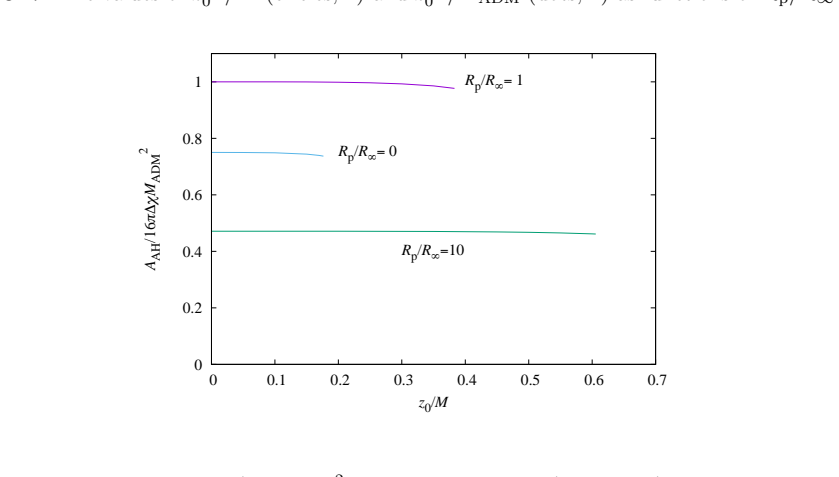
- The Brill-Lindquist-type data show that the condition for a common horizon around two equal black strings depends strongly on the ratio $R_p/R_\infty$ of the compactification radius at the puncture to that at infinity, with the largest critical separation (measured in ADM mass) at $R_p/R_\infty=1$.
- The numerical data for a separated black string and KK bubble satisfy the constraint to the achieved convergence, yield a common apparent horizon around the black string, and give total ADM mass $M_{\rm ADM}=M+\Delta M$ with $\Delta M<0$.
- Together, these slices are the input layer for evolving the nonlinear dynamics of a varying extra dimension, including bubble-black-string collisions.
Reading between the lines
- The paper fixes the junction radius $r_1/R_\infty=3$ and outer boundary $x_{\rm out}=10$ without varying them; a natural next check is whether the ADM mass, bubble shape, and horizon geometry are stable under changes of these numerical boundaries.
- The same split-domain construction should extend to non-axisymmetric or unequal-mass black-string/bubble systems, and to non-time-symmetric slices with nonzero extrinsic curvature, where the momentum constraint would also have to be solved.
- If the naked-bubble slices with negative ADM mass are evolved, they offer a concrete arena to test cosmic censorship in five dimensions, since the paper's horizon-area comparison suggests a naked singularity may form.
- A useful by-product of the analytic families is that they provide closed-form calibration cases for code tests of constraint solvers with position-dependent compactification radius.
Editorial analysis
A structured set of objections, weighed in public.
Referee Report
Summary. The paper constructs time-symmetric vacuum initial data for five-dimensional Kaluza-Klein spacetimes with a space-dependent compactification radius. Three classes are presented: analytic SO(3)-symmetric data (black string without a bubble, black string hiding a KK bubble, naked KK bubble), analytic multi-black-string data generalizing Brill-Lindquist, and numerical axisymmetric data for a black string and a KK bubble at separated locations. The constraint equation (4)R=0 is solved using conformally flat ansätze; the analytic solutions are explicit, and the numerical part solves an elliptic problem for ΔΨ and S(θ) with a prescribed transition profile for the compactification radius.
Significance. If the results hold, these are useful first-step initial data for numerical relativity studies of extra-dimensional dynamics, and the analytic families are interesting in their own right. Strengths include the absence of any fitting to target quantities, the explicit reduction to the Einstein-Rosen bridge and Brill-Lindquist data in the uniform-radius limits, and the closed-form ADM mass and horizon formulas. The numerical section demonstrates grid convergence for ΔΨ, but as detailed below, the physical robustness of the numerical data is not yet established. The analytic sections are largely checkable algebraically, though one formula in Sec. III B needs correction.
major comments (3)
- [V.B, Eq. (51), Figs. 11-14] The numerical initial data are constructed with a hand-chosen transition radius r1/R∞=3 and outer boundary xout=10, and no sensitivity study is reported. Since the profile (51) sets Φ=1 for r≥r1 and varies in r0≤r<r1, the radius r1 is part of the physical compactification profile rather than a numerical gauge parameter; changing r1 generically changes the physical configuration. The reported ADM mass, S(θ), and apparent-horizon shapes (Figs. 11-14) could therefore depend strongly on this choice. The paper should either demonstrate that these quantities are insensitive to r1 and xout over a range, or clearly characterize the intended physical regime selected by the chosen values.
- [V.B, Eq. (9), Fig. 10] The only numerical accuracy check is the grid-convergence plot of ΔΨ in Fig. 10; no residual of the Hamiltonian constraint (9) is reported. Convergence of ΔΨ on one parameter set does not by itself establish that the discrete solution satisfies the continuum constraint, particularly near the bubble surface r=r0 where the equation is singular unless the boundary condition (58) is enforced. The authors should report the L2 or maximum residual of Eq. (9) on the numerical grid and check its convergence, including the behavior of S(θ).
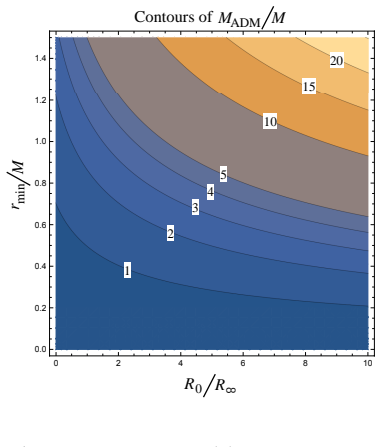
- [III.B, Eq. (33), Fig. 3] The displayed expression for Δχ in Eq. (33) appears inverted. From the no-conical-singularity condition Δχ=2πΩ²(rB)/F'(rB) and Eqs. (29)-(30), one obtains Δχ=2π(rB²+M rB+rmin²)(rB+M/2)/rB², not the reciprocal printed in the paper. As written, Eq. (33) has dimensions of inverse length and contradicts the statement immediately below it that Δχ/2πM is always greater than 1/2. This affects Fig. 3 and the quantitative discussion of the bubble data; the formula and figure should be corrected.
minor comments (3)
- [V.B, parameter list] The text says there are five parameters, but then lists six: Δχ, r0, r1, rout, M, and z0; the count should be corrected.
- [V.B, Fig. 10] The convergence study in Fig. 10 reports errors only in ΔΨ; an analogous error measure for S(θ) would make the numerical convergence statement more complete.
- [V.B, resolution] For the results in Figs. 11-14 the resolution is stated as (Imax,Jmax)=(200,45), but it would be helpful to also state how this resolution relates to the convergence study in Fig. 10 and whether the reported physical quantities are those of the converged solution.
Circularity Check
No significant circularity: all reported quantities are derived from the Hamiltonian constraint and freely chosen input parameters, with no fitted targets or load-bearing self-citation.
full rationale
The paper's derivation chain is self-contained. In Sec. II, time-symmetric initial data reduce the Hamiltonian constraint to (4)R=0, Eq. (5). Each subsequent construction solves this constraint for a stated ansatz rather than fitting a target quantity. For the SO(3) class, substituting F and Omega into Eq. (7) yields the single algebraic relation 2(a2+b2)=a1b1, Eq. (16); the parameters M, rmin, and R0/R_infinity (or rB) are chosen input specifications, and quantities such as MADM, the apparent-horizon radius, and the bubble period are evaluated afterward from the metric and regularity conditions. No quantity that appears as an output is used to define an input. For the Brill-Lindquist-type data, the paper proves that the ansatz Phi = C + D/Psi converts Eq. (9) into (4C Psi + 3D) grad^2 Psi = 0, Eq. (37), so any harmonic Psi solves the constraint; the reported horizon properties are derived, not fitted. In Sec. V, the numerical scheme solves the elliptic system for Delta Psi and S(theta) with boundary conditions (58), (60), and (62); the only numerical check reported is grid convergence of Delta Psi, which supports, rather than presupposes, the solution. The choices r1/R_infinity = 3 and xout = 10 are freely selected input parameters, and while the absence of a sensitivity study is a robustness concern, it is not circularity: varying r1 would define a different initial-data configuration, not a fitted prediction. The self-citations [35,36] are mentioned only as future tools for time evolution and are not used to justify the initial-data construction. No load-bearing argument reduces to a self-citation, and no predicted quantity is equivalent by construction to an input. The manuscript's own limitation statements about needing evolution methods for bubbles reinforce that the paper is an initial-data construction, not a claim that rests on its own outputs.
Assumptions & free parameters
free parameters (8)
- M in SO(3) data (b1)
- rmin (sqrt(b2))
- R0/R_infinity (no-bubble SO(3) data)
- rB (bubble position)
- M_i and positions r_i (multi-black-string)
- Rp/R_infinity (puncture compactification ratio)
- z0/M (two-black-string separation)
- r0, r1, z0, M, xout (numerical Sec. V) =
r0/R_inf=1, r1/R_inf=3, z0/R_inf=5, M/R_inf=1..5, xout=10
assumptions (5)
- standard math Time-symmetric initial data: Kab=0, so the momentum constraint is trivial and the Hamiltonian constraint is (4)R=0.
- domain assumption The 4D spatial metric is conformally flat in the three base dimensions, with a circular extra dimension of coordinate period Delta chi.
- ad hoc to paper The ansatz Phi=C+D/Psi in Sec. IV reduces the constraint to (4C Psi+3D) nabla^2 Psi=0.
- ad hoc to paper In Sec. V, Phi=1 for r>=r1 and Phi=1-exp((r-r0)/(r-r1) S(theta)) for r0<=r<r1, with r1 arbitrary.
- domain assumption A regular numerical solution (Delta Psi, S) exists for the chosen parameters and is found by SOR iteration.
Cite this review
Pith. "Pith review of Initial data for a black string and a Kaluza-Klein bubble: Space-dependent compactification radius." pith.science (2026). https://pith.science/paper/LP43LMQD
@misc{pith2026250111642,
  author       = {Pith},
  title        = {Pith review of: Initial data for a black string and a Kaluza-Klein bubble: Space-dependent compactification radius},
  year         = {2026},
  howpublished = {\url{https://pith.science/paper/LP43LMQD}},
  note         = {Machine review of arXiv:2501.11642}
}
read the original abstract
As the first step to explore the nonlinear dynamics of an extra dimension in the Kaluza-Klein (KK) spacetime with black objects through numerical relativity, we generate time-symmetric initial data of a black string and/or a KK bubble with space-dependent compactification radius. The initial data developed in this paper are classified into three types. First, we present analytic initial data with SO(3) symmetry whose three-dimensional section is spherically symmetric. These initial data include a black string without a KK bubble, a black string trapping a KK bubble, and a naked KK bubble. Second, we present analytic initial data for multiple black strings with varying compactification radius, which is a natural generalization of the Brill-Lindquist initial data for four-dimensional general relativity. Finally, we develop a numerical method for generating the initial data with a black string and a KK bubble located at different positions, which would be useful in simulating what happens when an expanding KK bubble meets black objects in dynamical context.
Figures


Figures from the paper (11 more)




Reference graph
Works this paper leans on
-
[1]
J. M. Overduin and P. S. Wesson, Phys. Rept. 283, 303-380 (1997) [arXiv:gr-qc/9805018 [gr-qc]]
arXiv 1997
- [2]
-
[3]
A bound on Universal Extra Dimension Models from up to 2fb^{-1} of LHC Data at 7TeV
K. Nishiwaki, K. y. Oda, N. Okuda and R. Watanabe, Phys. Lett. B 707, 506-511 (2012) [arXiv:1108.1764 [hep-ph]]
work page Pith review arXiv 2012
-
[4]
Bounds on Universal Extra Dimension from LHC Run I and II data
D. Choudhury and K. Ghosh, Phys. Lett. B 763, 155-160 (2016) [arXiv:1606.04084 [hep-ph]]
work page Pith review arXiv 2016
-
[5]
S. Hou, B. Harms and M. Cavaglia, JHEP 11, 185 (2015) [arXiv:1507.01632 [hep-ph]]
work page Pith review arXiv 2015
- [6]
-
[7]
J. Murata and S. Tanaka, Class. Quant. Grav. 32, no.3, 033001 (2015) [arXiv:1408.3588 [hep- ex]]
arXiv 2015
-
[8]
T. Westphal, H. Hepach, J. Pfaff and M. Aspelmeyer, Nature 591, no.7849, 225-228 (2021) 26 [arXiv:2009.09546 [gr-qc]]
arXiv 2021
Show all 36 references
-
[9]
Witten, Nucl
E. Witten, Nucl. Phys. B 195, 481-492 (1982)
1982
-
[10]
Brill and H
D. Brill and H. Pfister, Phys. Lett. B 228, 359-362 (1989)
1989
-
[11]
Brill and G
D. Brill and G. T. Horowitz, Phys. Lett. B 262, 437-443 (1991)
1991
-
[12]
H. a. Shinkai and T. Shiromizu, Phys. Rev. D 62, 024010 (2000) [arXiv:hep-th/0003066 [hep- th]]
2000 arXiv
-
[13]
Sarbach and L
O. Sarbach and L. Lehner, Phys. Rev. D 69, 021901 (2004) [arXiv:hep-th/0308116 [hep-th]]
2004 arXiv
-
[14]
Sarbach and L
O. Sarbach and L. Lehner, Phys. Rev. D 71, 026002 (2005) [arXiv:hep-th/0407265 [hep-th]]
2005 arXiv
-
[15]
Corley and T
S. Corley and T. Jacobson, Phys. Rev. D 49, R6261-R6263 (1994) [arXiv:gr-qc/9403017 [gr- qc]]
1994 arXiv
-
[16]
Chamblin and R
A. Chamblin and R. Emparan, Phys. Rev. D 55, 754-765 (1997) [arXiv:hep-th/9607236 [hep- th]]
1997 arXiv
-
[17]
G. T. Horowitz and K. Maeda, Class. Quant. Grav. 19, 5543-5556 (2002) [arXiv:hep- th/0207270 [hep-th]]
2002
-
[18]
Emparan and H
R. Emparan and H. S. Reall, Phys. Rev. D 65, 084025 (2002) [arXiv:hep-th/0110258 [hep-th]]
2002 arXiv
-
[19]
Elvang and G
H. Elvang and G. T. Horowitz, Phys. Rev. D 67, 044015 (2003) [arXiv:hep-th/0210303 [hep- th]]
2003 arXiv
-
[20]
Iguchi, T
H. Iguchi, T. Mishima and S. Tomizawa, Phys. Rev. D 76, 124019 (2007) [erratum: Phys. Rev. D 78, 109903 (2008)] [arXiv:0705.2520 [hep-th]]
2007 arXiv
-
[21]
Tomizawa, H
S. Tomizawa, H. Iguchi and T. Mishima, Phys. Rev. D 78, 084001 (2008) [arXiv:hep- th/0702207 [hep-th]]
2008
-
[22]
Kunz and S
J. Kunz and S. Yazadjiev, Phys. Rev. D 79, 024010 (2009) [arXiv:0811.0730 [hep-th]]
2009 arXiv
-
[23]
S. S. Yazadjiev and P. G. Nedkova, Phys. Rev. D80, 024005 (2009) [arXiv:0904.3605 [hep-th]]
2009 arXiv
-
[24]
S. S. Yazadjiev and P. G. Nedkova, JHEP 01, 048 (2010) [arXiv:0910.0938 [hep-th]]
2010 arXiv
-
[25]
P. G. Nedkova and S. S. Yazadjiev, Phys. Rev. D82, 044010 (2010) [arXiv:1005.5051 [hep-th]]
2010 arXiv
-
[26]
J. Kunz, P. G. Nedkova and C. Stelea, Nucl. Phys. B 874, 773-791 (2013) [arXiv:1304.7020 [gr-qc]]
2013 arXiv
-
[27]
Astorino, R
M. Astorino, R. Emparan and A. Vigan` o, JHEP 07, 007 (2022) [arXiv:2204.09690 [hep-th]]
2022 arXiv
-
[28]
Suzuki and S
R. Suzuki and S. Tomizawa, Phys. Rev. D 109, no.12, L121503 (2024) [arXiv:2311.11653 [hep-th]]
2024 arXiv
-
[29]
Tomizawa and R
S. Tomizawa and R. Suzuki, Phys. Rev. D 109, no.10, 104067 (2024) [arXiv:2403.16723 [hep- 27 th]]
2024 arXiv
-
[30]
Copsey, JHEP 12, 007 (2007) [arXiv:hep-th/0610058 [hep-th]]
K. Copsey, JHEP 12, 007 (2007) [arXiv:hep-th/0610058 [hep-th]]
2007 arXiv
-
[31]
Copsey, JHEP 10, 095 (2007) [arXiv:0706.3677 [hep-th]]
K. Copsey, JHEP 10, 095 (2007) [arXiv:0706.3677 [hep-th]]
2007 arXiv
-
[32]
D. R. Brill and R. W. Lindquist, Phys. Rev. 131, 471-476 (1963)
1963
-
[33]
Lehner and F
L. Lehner and F. Pretorius, Phys. Rev. Lett. 105, 101102 (2010) [arXiv:1006.5960 [hep-th]]
2010 arXiv
-
[34]
Figueras, T
P. Figueras, T. Fran¸ ca, C. Gu and T. Andrade, Phys. Rev. D 107, no.4, 044028 (2023) [arXiv:2210.13501 [hep-th]]
2023 arXiv
-
[35]
Yoshino and M
H. Yoshino and M. Shibata, Phys. Rev. D 80, 084025 (2009) [arXiv:0907.2760 [gr-qc]]
2009 arXiv
-
[36]
Shibata and H
M. Shibata and H. Yoshino, Phys. Rev. D 81, 104035 (2010) [arXiv:1004.4970 [gr-qc]]. 28
2010 arXiv
Reviewed August 10, 2026 · model on record in the stance chip above.
Discussion (0). Continue with ORCID to comment.