REVIEW 4 major objections 4 minor 1 cited by
Cosmic Large-Scale Structure Formation from Newtonian Particle Dynamics
T0 review · 4 major / 4 minor · reviewed 2026-08-10 · deepseek-v4-flash
Pith's one-line read A Newtonian particle-dynamics field theory reproduces the cosmic power spectrum on large scales and shows where the loop expansion fails.
desk verdict First full one-loop power spectrum in this configuration-space particle field theory, honestly presented but with an unestablished loop-expansion control that the authors themselves undermine. read the letter →
The pith
A machine-rendered reading of the paper's core claim, the machinery that carries it, and where it could break.
The reading
What carries the argument
The engine of the paper is a macroscopic phase-space density field theory obtained from the classical N-particle path integral by a Hubbard-Stratonovich transformation (a Gaussian integral identity that introduces macroscopic auxiliary fields). All microscopic statistics is packed into free cumulants $G^{(0)}_{f\cdots fB\cdots B}$, which become the vertices, and into the propagators $\Delta_{fB}$, $\Delta_{Bf}$, and $\Delta_{ff}$. The causal propagator $\Delta_{fB}$ resums an arbitrary number of interactions with the particle background, the statistical propagator $\Delta_{ff}$ carries the initial two-point correlations, and the one-loop density power spectrum is assembled from thirteen self-energy diagrams inserted into the Dyson equation. The mapping from cumulants to observables is completed by subtracting the Poisson shot-noise contribution contained in the free two-point cumulant, so that the power spectrum is the connected irreducible part of the two-point phase-space density cumulant.
What would settle it
Compute the two-loop correction to the density power spectrum with the same initial conditions and cosmological parameters and compare the result with a high-resolution N-body simulation at $k \approx 0.5\,h\,\mathrm{Mpc}^{-1}$: if the two-loop sum does not move the prediction toward the simulation, the paper's claim that loop perturbation theory is unsuitable at intermediate scales is supported, while a clear improvement would refute it.
Extended reading notes
Core claim
The central claim is that a macroscopic field theory derived from Newtonian particle dynamics can describe cosmic large-scale structure and that its one-loop power spectrum—the first full one-loop computation in this framework—is a genuine prediction of the theory. At tree level the theory resums all single-interaction deflections of the one-particle phase-space density, and in the large-scale limit it reproduces the linear growth factor known from standard perturbation theory. At one loop, the full set of thirteen self-energy diagrams is inserted into the Dyson equation, and the resulting power spectrum matches N-body simulations to high precision for $k \leq 0.2\,h\,\mathrm{Mpc}^{-1}$, with deviations of order 10 to 20 percent at larger wave numbers. The authors identify the three dominant loop diagrams and argue that the strong cancellations between the one-loop contributions indicate a breakdown of the loop expansion; they conclude that improvement requires restructuring the perturbation theory through non-perturbative resummation rather than adding more loops.
Load-bearing premise
The load-bearing premise is that the one-loop truncation of the macroscopic field theory is a controlled approximation at the scales where the power spectrum is compared with simulations; if the loop expansion is not valid there, the reported 10–20 percent deviations are not a reliable physical prediction of the framework.
Editorial extensions
If this is right
- The tree-level theory already reproduces the linear large-scale power spectrum without fluid approximations, showing that large-scale structure growth is fully captured by resumming single-particle deflections.
- The one-loop result provides the first full loop-level prediction of the particle-based field theory, giving a direct analytical benchmark for comparison with N-body simulations on weakly nonlinear scales.
- The 10–20 percent deviations for $k > 0.2\,h\,\mathrm{Mpc}^{-1}$, together with the strong cancellations among one-loop diagrams, indicate that simply adding higher loops is unlikely to cure the intermediate-scale mismatch.
- Because the two-point phase-space cumulant retains full velocity information, the same machinery yields momentum-density power spectra as well as density power spectra, as demonstrated at tree level.
- The identification of three dominant loop diagrams points toward a physically-motivated resummation strategy: processes that repeatedly deflect single-particle phase-space densities dominate over processes that deform higher-order correlation functions.
Reading between the lines
- If the authors' interpretation is right, a two-loop calculation should not systematically close the gap to simulations at intermediate scales; this is a sharp, testable prediction that the paper does not carry out.
- The 10–20 percent deviations could in principle be affected by systematic errors in the simulation baseline; testing the same calculation against independent N-body codes with different box sizes and resolutions would separate the framework's intrinsic error from numerical artifacts.
- Because the formalism keeps full phase-space information, it is a natural candidate for predicting velocity statistics and one-particle momentum distributions on scales where fluid-based perturbation theory is known to be fragile, although the paper computes only two-point density and momentum statistics.
- The paper's argument that higher loops will not improve the intermediate-scale regime relies on a scale-hierarchy assumption typical of perturbative expansions; a partial two-loop computation of the dominant diagram class could test whether that assumption holds.
Editorial analysis
A structured set of objections, weighed in public.
Referee Report
Summary. The paper presents a field-theoretic computation of the cosmic density-fluctuation power spectrum based on the macroscopic field theory of classical Newtonian particle ensembles developed in the companion paper [1]. After summarizing the path-integral construction, the Hubbard-Stratonovich transformation, and the resulting propagator/vertex structure, the authors specialize to a homogeneous and isotropic cosmological system, specify Gaussian initial conditions from CAMB, and compute the tree-level and one-loop contributions to the power spectrum. The tree-level result reproduces the known linear growth factor in the large-scale limit, and the one-loop result is compared with the CosmicEmu emulator. The authors report agreement on large scales k ≤ 0.2 h/Mpc and deviations of order 10–20% on intermediate and small scales, and they argue that these deviations motivate non-perturbative resummations such as 2PI, Dyson-Schwinger, or FRG methods.
Significance. If the one-loop computation is correct and controlled, it would be a new analytical result: the first full one-loop density power spectrum in the resummed kinetic field-theory framework, extending the tree-level result of [15]. The paper is commendably transparent about its limitations, explicitly discussing diagram cancellations and the questionable validity of the loop expansion at intermediate scales. It also includes a nontrivial external check, since the large-scale limit recovers the known linear growth factor. However, the significance of the result as a physical prediction depends critically on the control of the loop expansion, which the paper does not establish.
major comments (4)
- [Sec. VI.C, Eq. (94)] The central result is the one-loop power spectrum obtained from Eq. (94), but the paper provides no convergence check and no dimensionless parameter that controls the loop expansion. The tree-level causal propagator in Eq. (74) already resums an infinite Neumann series in the interaction, so the one-loop expansion is not an expansion in the gravitational coupling or in the amplitude of the initial power spectrum; it is an expansion in closed macroscopic loops. Without a small parameter or a comparison of successive loop orders, the one-loop truncation is not a controlled approximation, and the 10–20% deviations from CosmicEmu cannot be attributed to the framework's physics.
- [Sec. VI.C, Fig. 3] The comparison with CosmicEmu in Fig. 3 lacks error bars or an uncertainty band for the emulator predictions, and there is no convergence test for the numerical time and momentum integrations that enter the thirteen loop diagrams. Since the quantitative claim of 10–20% deviations rests on this comparison, the reader cannot assess whether the reported deviations are significant relative to numerical uncertainties.
- [Sec. VI.C, Eqs. (180)–(181)] Only one of the thirteen one-loop diagrams, D1, is written out in full; the remaining twelve diagrams are not displayed. The free cumulants are listed in Appendix B, but the derivation of the specific cosmological expressions used for the loop integrals is deferred to the companion paper [1]. Given that the main novelty is the one-loop result, the full set of diagram expressions should be provided or made available so that the calculation can be verified.
- [Sec. VI.C, points (a) and (b)] The argument that higher-loop corrections will not improve the intermediate-scale k ≈ 0.5 h/Mpc region assumes that the loop expansion is 'well-behaved' in the sense that successive orders affect increasingly small scales. This is precisely the property that needs to be demonstrated. If the expansion is divergent or non-perturbative, higher orders could in principle alter the intermediate-scale result substantially. Thus the conclusion that restructuring the perturbation theory is required rests on an unverified assumption about the very expansion whose validity is in question.
minor comments (4)
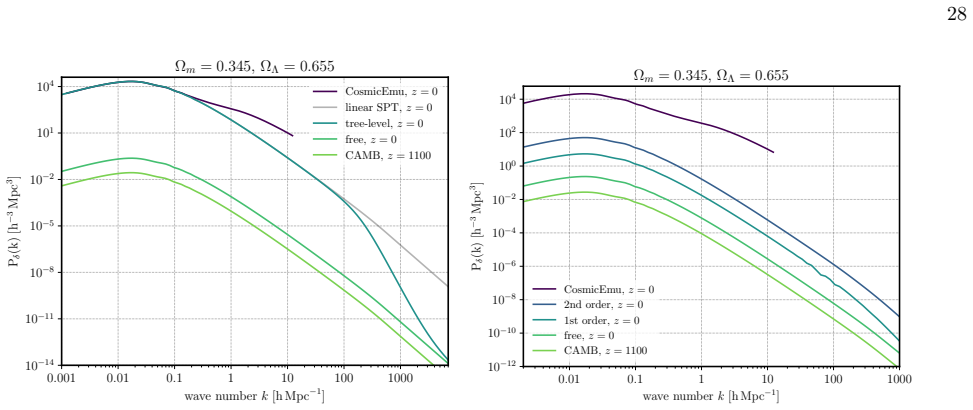
- [Fig. 2 caption] The right panel refers to 'canonical PT' without defining this term; the text later calls it 'canonical microscopic PT', so the caption should be consistent with the terminology used in Sec. III.B.
- [Sec. VI.A, Eq. (157)] The notation eT_a (used for τ_u) is easily confused with the exponential function; define ~T_a explicitly next to Eq. (159) and consider a different symbol such as T̃_a.
- [Sec. VII] There is a typo in the phrase 'finely-tuned cancellation between contributions from different one-loop digrams'; 'digrams' should be 'diagrams'.
- [Introduction, Sec. VI] The introduction states that the paper presents 'the first full result for the one-loop power spectrum', while footnote 1 notes that a first one-loop result appeared in [19]. The wording should be clarified to distinguish the present full result from the earlier partial or approximate result.
Circularity Check
No significant circularity: the one-loop power spectrum is computed from the stated initial conditions and compared against an external emulator without fitting.
full rationale
The derivation chain is self-contained in the relevant sense: the initial power spectrum from CAMB and the stated cosmological parameters are inputs, and the tree-level and one-loop power spectra are computed from the microscopic Hamiltonian, the initial phase-space density, and the explicit free cumulants and self-energy diagrams. No parameter is fitted to the CosmicEmu results; the comparison to the emulator is an external benchmark. The tree-level Einstein-de Sitter limit reproducing the known linear growth factor D_+^2 P_i is a consistency check rather than a circular input, because the growth factor is not assumed in the construction but emerges from the solved causal propagator. The one-loop result given by Eq. (94) with the self-energies of Eqs. (91)-(92) is an explicit functional of the initial spectrum and cosmological parameters, not a renaming of a fitted quantity. Although the paper relies on the framework of [1] by the same authors, that citation supplies the general formalism, not the target one-loop power spectrum, and the target result is externally falsifiable against CosmicEmu; this is therefore a normal self-citation rather than load-bearing circularity. The authors' own Sec. VI.C caveat that the loop expansion may be uncontrolled is a convergence and correctness risk, not a circular step: it weakens the interpretive claim but does not make the computation equivalent to its inputs. No prediction in the paper reduces by construction to a fitted parameter or to a self-citation chain.
Assumptions & free parameters
assumptions (6)
- domain assumption The initial density and velocity fields are Gaussian random fields, related to a single velocity potential
- domain assumption The universe is homogeneous and isotropic (cosmological principle)
- domain assumption Dark matter can be described as an ensemble of classical point particles interacting via Newtonian gravity on an expanding background
- domain assumption The continuum limit rho -> infinity is taken, so shot-noise contributions are discarded
- standard math The functional integral and Hubbard-Stratonovich transformation from [1] are valid
- ad hoc to paper The loop expansion of the macroscopic field theory converges or is meaningful at the scales considered
Cite this review
Pith. "Pith review of Cosmic Large-Scale Structure Formation from Newtonian Particle Dynamics." pith.science (2026). https://pith.science/paper/A7ZSUJ6A
@misc{pith2026250111676,
  author       = {Pith},
  title        = {Pith review of: Cosmic Large-Scale Structure Formation from Newtonian Particle Dynamics},
  year         = {2026},
  howpublished = {\url{https://pith.science/paper/A7ZSUJ6A}},
  note         = {Machine review of arXiv:2501.11676}
}
abstract
We present results for the cosmic non-linear density-fluctuation power spectrum based on the analytical formalism developed in [1] which allows us to study cosmic structure formation based on Newtonian particle dynamics in phase-space. This framework provides a field-theory approach to a perturbative solution of the BBGKY-hierarchy where the resulting loop-expansion of the theory introduces a natural truncation criterion. We show that we are able to reproduce structure growth on large scales $k \leq 0.2 \mathrm{h}\,\mathrm{Mpc}^{-1}$ to very high precision while on small and intermediate scales we find deviations of the order of $10\%$ from current numerical simulations. The results strongly suggest that a significant improvement may be achieved by restructuring the perturbation theory.
Figures


Forward citations
Cited by 1 Pith paper
-
Koopman-von Neumann Field Theory
The classical N-body problem is rewritten as a unitary bosonic quantum field theory, with the Vlasov equation derived from a quantum operator identity and from coherent-state variational dynamics.
Reference graph
Works this paper leans on
-
[1]
∆Bρ(−⃗k1, η′ 1, η2) (180) 17 See the end of Sec.III B and [1, 27, 28] for technical details and cosmological application. 29 0.001 0.01 0.1 1 10 wave number k [h Mpc−1] 10−2 10−1 100 101 102 103 104 105 Pδ(k) [h−3 Mpc3] Ωm = 0.345, Ω Λ = 0.655 CosmicEmu tree-level 1-loop tree-level + 1-loop 0.001 0.01 0.1 1 10 100 1000 wave number k [h Mpc−1] 10−4 10−3 10...
-
[15]
J. J. M. Carrasco, S. Foreman, D. Green, and L. Senatore, The effective field theory of large scale structures at two loops, Journal of Cosmology and Astroparticle Physics 2014 (07), 057
work page 2014
-
[2]
= 1 2 Z d¯η2d¯η3dη′ 2dη′ 3 Z d3⃗k′ (2 π)3 G(0) ρBB(⃗k, −⃗k′, ¯η1, ¯η2, ¯η3) ∆ρρ(⃗k′, ¯η2, η′ 2) × ∆ρρ(⃗k − ⃗k′, η3, η′
-
[3]
G(0) ρBB(−⃗k, ⃗k′, η′ 1, η′ 2, η′
-
[4]
(181) In analogy to quantum field theory, all loop diagrams represent convolutions of the propagators, which, in the above case, are of ∆ ρρ-type and carry initial two-point correlation. Thus, we see, that the above diagram convolves struc- ture on small scales with structure on larger scales, and hence, introduce information beyond the linear scaling of ...
-
[5]
T. Daus and E. Kozlikin, Field Theory Approach to Classical N -Particle Systems In and Out of Equilibrium, (2024), arXiv:2406.03425 [cond-mat.stat-mech]
arXiv 2024
-
[6]
Euclid Collaboration, Euclid. I. Overview of the Euclid mission, arXiv e-prints , arXiv:2405.13491 (2024), arXiv:2405.13491 [astro-ph.CO]
arXiv 2024
-
[7]
Z. Ivezi´ c et al., LSST: From Science Drivers to Reference Design and Anticipated Data Products, Astrophys. J. 873, 111 (2019), arXiv:0805.2366 [astro-ph]
arXiv 2019
Show all 41 references
-
[8]
M. J. Chapman et al., The completed SDSS-IV extended Baryon Oscillation Spectroscopic Survey: measurement of the growth rate of structure from the small-scale clustering of the luminous red galaxy sample, Monthly Notices of the Royal Astronomical Society 516, 617 (2022), arXiv...
2022 arXiv
-
[9]
Bernardeau, S
F. Bernardeau, S. Colombi, E. Gaztanaga, and R. Scoccimarro, Large scale structure of the universe and cosmological perturbation theory, Phys. Rept. 367, 1 (2002), arXiv:astro-ph/0112551
2002 arXiv
-
[10]
Crocce and R
M. Crocce and R. Scoccimarro, Renormalized cosmological perturbation theory, Phys. Rev. D 73, 063519 (2006)
2006
-
[11]
Matarrese and M
S. Matarrese and M. Pietroni, Resumming cosmic perturbations, Journal of Cosmology and Astroparticle Physics 2007 (06), 026
2007
-
[12]
Pietroni, G
M. Pietroni, G. Mangano, N. Saviano, and M. Viel, Coarse-grained cosmological perturbation theory, Journal of Cosmology and Astroparticle Physics 2012 (1), 019, arXiv:1108.5203 [astro-ph.CO]
2012 arXiv
-
[13]
Baumann, A
D. Baumann, A. Nicolis, L. Senatore, and M. Zaldarriaga, Cosmological non-linearities as an effective fluid, Journal of Cosmology and Astroparticle Physics 2012 (07), 051
2012
-
[14]
M. P. Hertzberg, Effective field theory of dark matter and structure formation: Semianalytical results, Phys. Rev. D 89, 043521 (2014)
2014
-
[16]
Konstandin, R
T. Konstandin, R. A. Porto, and H. Rubira, The effective field theory of large scale structure at three loops, Journal of Cosmology and Astroparticle Physics 2019 (11), 027
2019
-
[17]
Bartelmann, F
M. Bartelmann, F. Fabis, D. Berg, E. Kozlikin, R. Lilow, and C. Viermann, A microscopic, non-equilibrium, statistical field theory for cosmic structure formation, New J. Phys. 18, 043020 (2016), arXiv:1411.0806 [cond-mat.stat-mech]
2016 arXiv
-
[18]
Fabis, E
F. Fabis, E. Kozlikin, R. Lilow, and M. Bartelmann, Kinetic Field Theory: Exact free evolution of Gaussian phase-space correlations, J. Stat. Mech. 1804, 043214 (2018), arXiv:1710.01611 [cond-mat.stat-mech]
2018 arXiv
-
[19]
Lilow, F
R. Lilow, F. Fabis, E. Kozlikin, C. Viermann, and M. Bartelmann, Resummed kinetic field theory: general formalism and linear structure growth from newtonian particle dynamics, Journal of Cosmology and Astroparticle Physics 2019 (04), 001
2019
-
[20]
Pixius, S
C. Pixius, S. Celik, and M. Bartelmann, Kinetic field theory: perturbation theory beyond first order, Journal of Cosmology and Astroparticle Physics 2022 (12), 030
2022
-
[21]
Viermann, F
C. Viermann, F. Fabis, E. Kozlikin, R. Lilow, and M. Bartelmann, Nonequilibrium statistical field theory for classical particles: Basic kinetic theory, Phys. Rev. E 91, 062120 (2015), arXiv:1411.2809 [cond-mat.stat-mech]
2015 arXiv
-
[22]
Kozlikin, R
E. Kozlikin, R. Lilow, F. Fabis, and M. Bartelmann, A first comparison of Kinetic Field Theory with Eulerian Standard Perturbation Theory, JCAP 06, 035, arXiv:2012.05812 [astro-ph.CO]
2012 arXiv
-
[23]
Lilow, Structure Formation in Dark and Baryonic Matter within Resummed Kinetic Field Theory., Ph.D
R. Lilow, Structure Formation in Dark and Baryonic Matter within Resummed Kinetic Field Theory., Ph.D. thesis, U. Heidelberg (main) (2018)
2018
-
[24]
Mauro, On Koopman-von Neumann waves, Int
D. Mauro, On Koopman-von Neumann waves, Int. J. Mod. Phys. A 17, 1301 (2002), arXiv:quant-ph/0105112
2002 arXiv
-
[25]
J. v. Neumann, Zur operatorenmethode in der klassischen mechanik, Annals of Mathematics 33, 587 (1932)
1932
-
[26]
B. O. Koopman, Hamiltonian Systems and Transformations in Hilbert Space, Proceedings of the National Academy of Science 17, 315 (1931)
1931
-
[27]
A. A. Abrikosov, E. Gozzi, and D. Mauro, Geometric dequantization, Annals Phys. 317, 24 (2005), arXiv:quant- ph/0406028
2005
-
[28]
Gozzi and M
E. Gozzi and M. Reuter, Lyapunov exponents, path integrals and forms, Chaos Solitons Fractals 4, 1117 (1994)
1994
-
[29]
Kleinert, Path Integrals in Quantum Mechanics, Statistics, Polymer Physics, and Financial Markets, EBL-Schweitzer (World Scientific, 2009)
H. Kleinert, Path Integrals in Quantum Mechanics, Statistics, Polymer Physics, and Financial Markets, EBL-Schweitzer (World Scientific, 2009)
2009
-
[30]
Gozzi, M
E. Gozzi, M. Reuter, and W. D. Thacker, Hidden brs invariance in classical mechanics. ii, Phys. Rev. D 40, 3363 (1989)
1989
-
[31]
Pixius, S
C. Pixius, S. Celik, and M. Bartelmann, Kinetic field theory: perturbation theory beyond first order, Journal of Cosmology and Astroparticle Physics 12, 030, arXiv:2207.06852 [astro-ph.CO]. 36
-
[32]
Heisenberg, S
L. Heisenberg, S. Hemmatyar, and S. Zentarra, Kinetic field theory: Higher-order perturbation theory, Phys. Rev. D 106, 063513 (2022), arXiv:2207.10504 [hep-th]
2022 arXiv
-
[33]
G. F. Mazenko, Fundamental theory of statistical particle dynamics, Phys. Rev. E 81, 061102 (2010)
2010
-
[34]
G. F. Mazenko, Smoluchowski dynamics and the ergodic-nonergodic transition, Phys. Rev. E 83, 041125 (2011)
2011
-
[35]
S. P. Das and G. F. Mazenko, Field theoretic formulation of kinetic theory: Basic development, Journal of Statistical Physics 149, 643 (2012)
2012
-
[36]
Cattaruzza, E
E. Cattaruzza, E. Gozzi, and A. Francisco Neto, Diagrammar In Classical Scalar Field Theory, Annals Phys. 326, 2377 (2011), arXiv:1010.0818 [hep-th]
2011 arXiv
-
[37]
Lynden-Bell and R
D. Lynden-Bell and R. Wood, The gravo-thermal catastrophe in isothermal spheres and the onset of red-giant structure for stellar systems, Monthly Notices of the Royal Astronomical Society 138, 495 (1968)
1968
-
[38]
Hertel and W
P. Hertel and W. Thirring, A soluble model for a system with negative specific heat, Annals of Physics 63, 520 (1971)
1971
-
[39]
D. Lynden-Bell, Negative Specific Heat in Astronomy, Physics and Chemistry, Physica A Statistical Mechanics and its Applications 263, 293 (1999), arXiv:cond-mat/9812172 [cond-mat.stat-mech]
1999 arXiv
-
[40]
Lewis, A
A. Lewis, A. Challinor, and A. Lasenby, Efficient Computation of Cosmic Microwave Background Anisotropies in Closed Friedmann-Robertson-Walker Models, Astrophys. J. 538, 473 (2000), arXiv:astro-ph/9911177 [astro-ph]
2000 arXiv
-
[41]
Lawrence, K
E. Lawrence, K. Heitmann, M. White, D. Higdon, C. Wagner, S. Habib, and B. Williams, The Coyote Universe. III. Simulation Suite and Precision Emulator for the Nonlinear Matter Power Spectrum, Astrophys. J. 713, 1322 (2010), arXiv:0912.4490 [astro-ph.CO]
2010 arXiv
Reviewed August 10, 2026 · model on record in the stance chip above.
Discussion (0). Continue with ORCID to comment.