REVIEW 4 major objections 4 minor 79 references
Investigating Evolving Wormholes in $f(R,T)$ Gravity
T0 review · 4 major / 4 minor · reviewed 2026-08-10 · deepseek-v4-flash
Pith's one-line read This paper claims that in f(R,T) modified gravity, evolving wormholes can be supported by ordinary matter, not exotic matter, with all standard energy conditions satisfied at the throat for the specific models and parameter values…
desk verdict A legitimate but algebraically under-verified extension of static wormhole results to evolving f(R,T) spacetimes; the central existence claim is plausible but the printed formulas need checking before the energy-condition plots can be trusted. read the letter →
The pith
A machine-rendered reading of the paper's core claim, the machinery that carries it, and where it could break.
The reading
What carries the argument
The construction rests on the decoupled power-law form f(R,T)=αR^m+βT and the evolving wormhole metric $ds^{2}$ = -$e^{{Φ(r,t)}}$ $dt^{2}$ + $a^{2}$(t)[$dr^{2}$/(1-b(r)/r) + $r^{2}$ $dΩ^{2}$], with Φ=0 chosen to avoid horizons and simplify the field equations. The field equations are reduced to explicit expressions for the energy density ρ and the pressures p_r and p_t (Eqs. (20)-(22)); substituting the two shape functions and the two scale factors into these expressions and selecting parameters gives the plotted combinations ρ+p_r, ρ+p_t, ρ, ρ+p_r+2p_t, and ρ-|p_r|, ρ-|p_t| that define the energy conditions. The mechanism that makes ordinary matter possible is the βT term: for β=0 the NEC is violated, while for the chosen β values the geometric contribution shifts the inequalities so the matter fluid obeys all standard conditions.
What would settle it
Re-derive Eqs. (20)-(22) directly from the field equations (16)-(18) for f(R,T)=αR^m+βT and evaluate ρ+p_r at the throat r0=0.5 for the power-law case (α=1, β=-32, a0=2.5, n=0.66, m=2). If an independent symbolic computation yields a negative value at the throat, the central claim that all energy conditions are satisfied fails. Alternatively, check whether a(t)=a0+$e^{{μ t^n}}$ with n=0.3 is real-valued for negative t; if it is complex, the emergent-universe conclusion needs a different scale-factor definition.
Extended reading notes
Core claim
The central claim is that in f(R,T) gravity, specifically with f(R,T)=αR^m+βT, redshift function set to zero, and the inhomogeneous FLRW-type evolving wormhole metric of Bhattacharya and Chakraborty, there exist evolving wormhole solutions supported by non-exotic matter. For each of two shape functions, b(r)=r/($e^{{r-r0}}$) and b(r)=r/(1+r-r0), and each of two scale factors, a(t)=a0 t^n and a(t)=a0+$e^{{μ t^n}}$, the authors find parameter values (power law: α=1, β=-32, a0=2.5, n=0.66, m=2, r0=0.5; exponential: α=1, β=50, a0=2.3, n=0.3, μ=0.2, m=2, r0=0.5) for which the energy density, radial pressure, and transverse pressure combinations entering the NEC, WEC, SEC, and DEC are non-negative over the plotted ranges and in particular at the throat. Setting β=0 destroys this behavior, showing that the trace coupling βT is what allows ordinary matter to thread the throat. The paper concludes that the exotic nature required in general relativity is provided by the geometric sector of the modified theory, not by the matter fluid.
Load-bearing premise
The energy-condition results rest on the correctness of the displayed formulas for density and pressures, which are given without derivation and contain apparent typographical errors; if these formulas are wrong, the plotted inequalities do not follow.
Editorial extensions
If this is right
- If the claim holds, traversable evolving wormholes can be constructed in f(R,T) gravity without invoking exotic matter, so the throat fluid can satisfy all four energy conditions.
- The βT coupling is essential: with β=0 the NEC is violated, so the matter-geometry coupling, not the fluid, supplies the exotic behavior.
- The solutions are obtained without assuming an equation of state, which could make them easier to connect to observational constraints once wormhole detections constrain the matter content.
- The exponential scale-factor solution is singularity-free at early times and connects to the emergent universe scenario, implying the wormhole could have existed in a static Einstein-era before inflation.
Reading between the lines
- The parameter choices look tuned (β=-32 for power law, β=50 for exponential, with m=2 fixed); a systematic scan of the (α, β, m, n) parameter space would show whether the energy-condition-satisfying region is large or a narrow slice, and we suspect the latter given the sign flip in β.
- The same construction could be applied to other shape functions (e.g., Ellis-Bronnikov) to test whether the result is a generic feature of f(R,T) evolving wormholes or specific to the two models chosen.
- The emergent-universe limit relies on interpreting t^n with n=0.3 for negative t; since this is not real-valued as written, the early-time claim needs a regularized scale factor (like a0+e^{μ|t|^n}) to be well-defined.
- The energy conditions are verified graphically over a plotted range, not analytically for all r≥r0 and all t; an analytic proof would be needed to claim the result holds globally, not just for the showcased parameters.
Editorial analysis
A structured set of objections, weighed in public.
Referee Report
Summary. The manuscript constructs evolving wormhole solutions in f(R,T) gravity with f(R,T)=αR^m+βT, zero redshift function, and the dynamical metric (11). It studies two shape functions (Models I and II) and two scale factors (power law a=a0 t^n and exponential-like a=a0+e^{μ t^n}). The authors state closed-form expressions for ρ, p_r, and p_t (Eqs. (20)-(22)), plot the NEC, WEC, SEC, and DEC inequalities for four model combinations at selected parameter values, and conclude in Sec. V that evolving wormholes in f(R,T) can be supported without exotic matter, with the exponential scale factor yielding an emergent universe in the infinite past.
Significance. If the algebraic results in Eqs. (20)-(22) are correct, the paper would provide explicit time-dependent generalizations of static non-exotic wormhole solutions in f(R,T) gravity, with the attractive feature that no equation of state is imposed. The use of two shape functions and two scale factors is a reasonable exploratory strategy. However, the current evidence is not yet conclusive: the central formulas are unverified and contain apparent typos, the energy-condition results are shown only for single tuned values of β over unspecified domains, and the emergent-universe limit is not well defined for the chosen parameters. A symbolic re-derivation, analytic inequalities or a parameter-space scan, and a corrected scale factor would substantially strengthen the claim.
major comments (4)
- [Section III, Eqs. (20)-(22)] The expressions for ρ, p_r, and p_t are presented without derivation from Eqs. (16)-(18), and Eq. (21) contains the manifest typo "32(3 ̇H^2 + ̇H^2)π", repeated in Eq. (22), where the first term should presumably involve H^2 rather than ̇H^2. Similar dot/undot inconsistencies appear in Eq. (20), e.g., "6 ̇H^2 β" and "48 ̇H^2(2π+β)". Because the sign structure of the β-dependent terms controls whether the energy-condition inequalities hold, and β is later tuned to make ρ+p_r positive at the throat, the central existence claim cannot be checked without a corrected symbolic derivation. Please provide the derivation or an independent verification (e.g., substitution back into the field equations) and correct all such typographical errors.
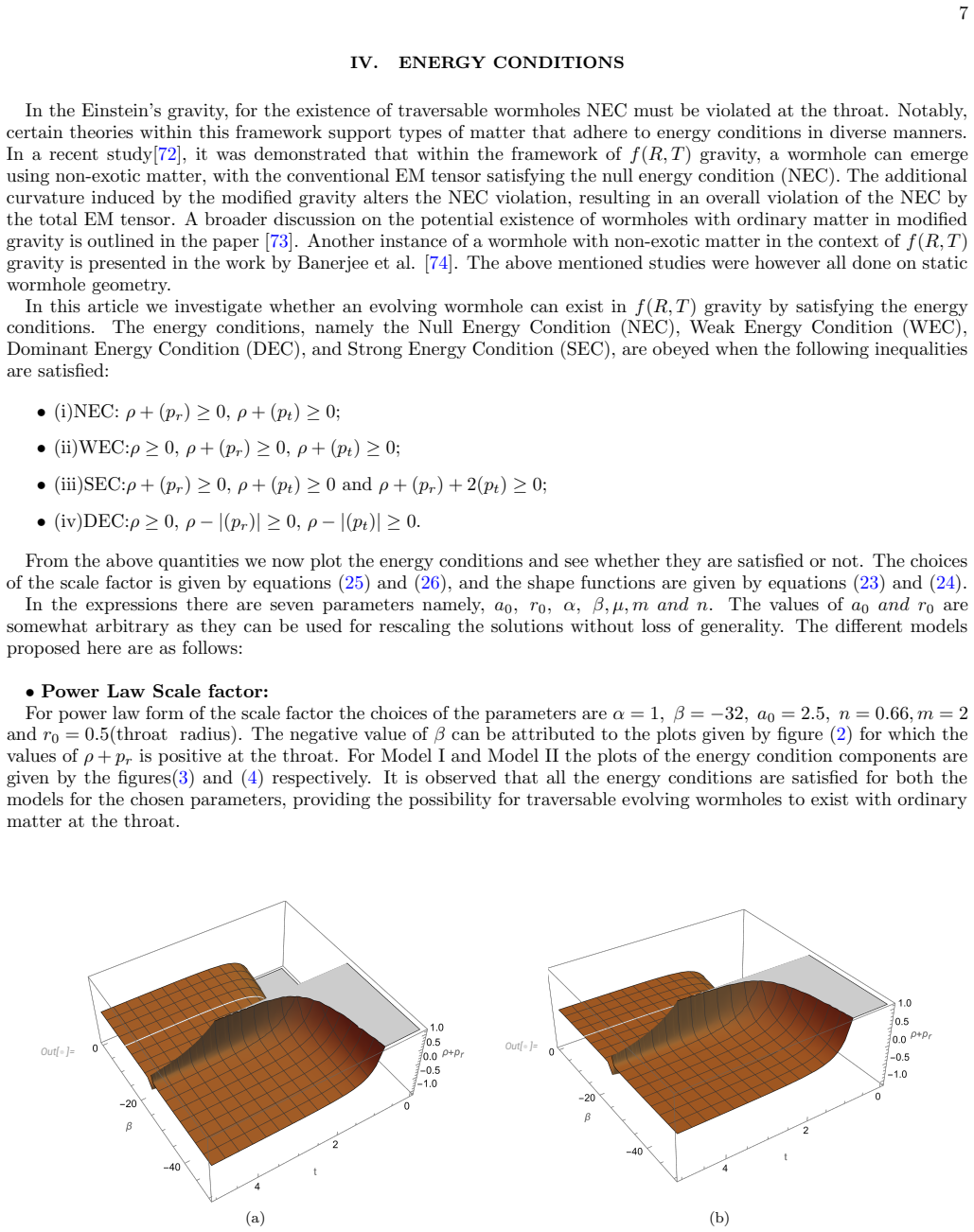
- [Section IV, Figs. 2 and 5] The parameter values β=-32 (power-law scale factor) and β=50 (exponential scale factor) are explicitly selected because they make ρ+p_r positive at the throat, as stated in the text and shown in Figs. 2 and 5. Thus the energy-condition plots are existence examples at tuned points rather than a robust prediction of the model. The paper should either provide analytic inequalities valid over a parameter region or a systematic scan showing where all four energy conditions hold, and it should state clearly that the conclusion is an existence proof at the chosen parameter values, not a general property of the models.
- [Section IV, Eq. (26), emergent universe] The emergent-universe conclusion uses a(t)=a0+e^{μ t^n} with n=0.3. For real negative t, t^{0.3} is not real, so the limits a→a0 and H→0 as t→-∞ are not well defined. This is not a minor presentational issue, because the claim of a singularity-free emergent configuration rests on this limit. Please replace the scale factor with a function that is real for all real t (for example e^{μ t}, or a rational-power form chosen so that t^n is real for t<0) and re-evaluate the limits.
- [Section IV, Figs. 3, 4, 6, and 7] The conclusion that "all the energy conditions are satisfied for both the models" is based on plots over finite, unspecified ranges of r and t. In particular, the DEC requires ρ-|p_r|≥0 and ρ-|p_t|≥0, and the SEC requires ρ+p_r+2p_t≥0; these combinations should be displayed or their domains stated explicitly. Without a domain statement and either analytic inequalities or a well-specified numerical grid, the phrase "all the energy conditions" is stronger than the plotted evidence.
minor comments (4)
- [Section IV, text vs. figure captions] The text lists a0=2.5 for the exponential scale factor, while the captions of Figs. 6 and 7 state a0=2.3; please reconcile the inconsistency.
- [Fig. 8 caption] The caption mixes "NEC" and "DEC" and does not clearly identify which of the four panels shows which quantity for which model; please rewrite it so each panel is specified.
- [Section III, displayed equations] Several displayed equations contain ambiguous or unbalanced notation, for example Eq. (9) and the arguments of f_R in Eqs. (16)-(18); please clean up the notation and check all displayed equations for internal consistency.
- [Section IV, power-law scale factor] For the power-law scale factor a=a0 t^n with n=0.66, t^{0.66} is not real for t<0; if the plots are restricted to t>0, this domain should be stated explicitly.
Circularity Check
beta is tuned to make rho+pr positive at the throat, so the central 'no exotic matter' claim is parameter-forced rather than independently predicted.
-
fitted input called prediction
[Section IV, power-law and exponential scale-factor paragraphs]
"The negative value of beta can be attributed to the plots given by figure (2) for which the values of rho + pr is positive at the throat. ... The value of beta can be attributed to the plots given by figure (5) for which the values of rho + pr is positive at the throat."
beta is not fixed by the theory or by external data; it is selected by inspecting rho+pr at the throat so that the NEC inequality holds. The paper then reports that 'all the energy conditions are satisfied' for the chosen beta and concludes that an evolving wormhole can exist without exotic matter. The NEC part of that conclusion is identical to the selection criterion used to pick beta: it is a fitted input presented as an observed outcome. The circularity is partial because rho>=0, rho+pt>=0, SEC, and DEC must still be checked and are not guaranteed by the beta choice, but the headline 'no exotic matter' is constructed rather than independently predicted.
full rationale
The derivation from the f(R,T) action to the field equations (16)-(18) and to the matter components (20)-(22) is structurally self-contained; no step in that algebra imports the conclusion. The main circularity is in the parameter selection: beta is explicitly chosen from Figures 2 and 5 to make rho+pr positive at the throat, and the subsequent plots are then used to claim that all energy conditions hold. This is a fitted-input-called-prediction pattern: the NEC result is forced by the selection of beta, not discovered. However, the circularity is partial because the remaining inequalities are independent checks, and an existence proof by parameter scan is a legitimate method when presented as such; the paper's wording ('it is observed', 'providing the possibility') overstates the independence. Self-citations are numerous but not load-bearing: the metric ansatz [40], the shape functions [49,50], and the emergent-universe conditions [66]-[69] come from co-authored papers, but they are standard inputs and the energy-condition result does not rest on their truth. The unverified algebra in Eqs. (20)-(22), with the typo '32(3 Hdot^2 + Hdot^2)pi' in Eq. (21), and the non-real t^n for n=0.3 at negative t are correctness risks, not circularity. Overall the central existence claim is partly parameter-forced, so a score of 6 is warranted.
Assumptions & free parameters
free parameters (7)
- β =
-32 (power law), 50 (exponential)
- m =
2
- n =
0.66 (power law), 0.3 (exponential)
- μ =
0.2
- a0 =
2.5 (power law), 2.5 or 2.3 (exponential, text vs caption)
- r0 =
0.5
- α =
1
assumptions (6)
- domain assumption The matter Lagrangian is chosen as L_m = ρ, giving Θ_{μν} = -2T_{μν} + T g_{μν}.
- ad hoc to paper f(R,T) = αR^m + βT with α=1, m=2 and β a free constant.
- domain assumption Evolving wormhole metric ansatz (11) with Φ=0 after Eq. (15).
- domain assumption Energy-momentum tensor for an anisotropic fluid (6).
- standard math Morris-Thorne conditions b(r0)=r0, b'(r0)<1, and b(r)-r b'(r)>0.
- domain assumption Scale factors a(t)=a0 t^n and a(t)=a0+e^{μt^n} correspond to power-law and exponential expansion; n and μ are free.
Cite this review
Pith. "Pith review of Investigating Evolving Wormholes in $f(R,T)$ Gravity." pith.science (2026). https://pith.science/paper/VMCEE3FB
@misc{pith2026250112237,
  author       = {Pith},
  title        = {Pith review of: Investigating Evolving Wormholes in $f(R,T)$ Gravity},
  year         = {2026},
  howpublished = {\url{https://pith.science/paper/VMCEE3FB}},
  note         = {Machine review of arXiv:2501.12237}
}
abstract
The present work examines whether evolving wormhole solution is possible or not in $f(R,T)$ modified gravity theory. In the background of inhomogeneous FLRW type wormhole configuration the field equations are investigated for different choices of scale factors and shape functions. For the power law and exponential choice of the scale factor from cosmological context and decoupled power law of $f(R,T)$ in each variable, wormhole configuration has been examined for two viable choices of shape function. Energy conditions are examined graphically for a range of values of the parameters involved. Finally, the possibility of emergent scenario at early cosmic evolution has been examined.
Figures


Figures from the paper (5 more)


Reference graph
Works this paper leans on
- [1]
-
[2]
C. W. Misner and J. A. Wheeler, Annals Phys. 2, 525-603 (1957)
work page 1957
-
[3]
M. S. Morris and K. S. Thorne, Am. J. Phys. 56, 395-412 (1988)
1988
-
[4]
H. G. Ellis, J. Math. Phys. 14, 104-118 (1973)
work page 1973
-
[5]
H. G. Ellis, Gen. Rel. Grav. 10, 105-123 (1979)
work page 1979
-
[6]
Lorentzian wormholes: From Einstein to Hawking,
M. Visser, “Lorentzian wormholes: From Einstein to Hawking,”
-
[7]
R. R. Caldwell, M. Kamionkowski and N. N. Weinberg, Phys. Rev. Lett. 91, 071301 (2003) doi:10.1103/PhysRevLett.91.071301 [arXiv:astro-ph/0302506 [astro-ph]]
arXiv 2003
- [8]
Show all 79 references
-
[9]
Chakraborty, Gen
S. Chakraborty, Gen. Rel. Grav. 45, 2039-2052 (2013) doi:10.1007/s10714-013-1577-y [arXiv:1212.3050 [physics.gen-ph]]
2013 arXiv
-
[10]
F. S. N. Lobo and M. A. Oliveira, Phys. Rev. D 80, 104012 (2009)
2009
-
[11]
Mishra, A
B. Mishra, A. S. Agrawal, S. K. Tripathy and S. Ray, Int. J. Mod. Phys. A 37, no.05, 2250010 (2022)
2022
-
[12]
Chakraborty and T
S. Chakraborty and T. Bandyopadhyay, Int. J. Mod. Phys. D 18, 463-476 (2009)
2009
-
[13]
S. D. Forghani, S. H. Mazharimousavi and M. Halilsoy, Phys. Lett. B 804, 135374 (2020)
2020
-
[14]
Maeda and M
H. Maeda and M. Nozawa, Phys. Rev. D 78, 024005 (2008) doi:10.1103/PhysRevD.78.024005
2008 doi
-
[15]
Dotti, J
G. Dotti, J. Oliva and R. Troncoso, Int. J. Mod. Phys. A 24, 1690 (2009);G. Dotti, J. Oliva and R. Troncoso, Phys. Rev. D 76, 064038 (2007); G. Dotti, J. Oliva and R. Troncoso, Phys. Rev. D 75, 024002 (2007)
2009
-
[16]
P. H. R. S. Moraes and P. K. Sahoo, Phys. Rev. D 96, no.4, 044038 (2017)
2017
-
[17]
Yousaf, M
Z. Yousaf, M. Ilyas and M. Zaeem-ul-Haq Bhatti, Eur. Phys. J. Plus 132, no.6, 268 (2017)
2017
-
[18]
Elizalde and M
E. Elizalde and M. Khurshudyan, Phys. Rev. D 98, no.12, 123525 (2018)
2018
-
[19]
Dutta, D
A. Dutta, D. Roy, N. J. Pullisseri and S. Chakraborty, Eur. Phys. J. C 83, no.6, 500 (2023) doi:10.1140/epjc/s10052-023- 11681-x [arXiv:2306.06911 [gr-qc]]
2023 arXiv
-
[20]
P. K. Sahoo, P. H. R. S. Moraes and P. Sahoo, Eur. Phys. J. C 78, no.1, 46 (2018) doi:10.1140/epjc/s10052-018-5538-1 [arXiv:1709.07774 [gr-qc]]
2018 arXiv
-
[21]
Azizi, Int
T. Azizi, Int. J. Theor. Phys. 52, 3486-3493 (2013) doi:10.1007/s10773-013-1650-z [arXiv:1205.6957 [gr-qc]]
2013 arXiv
-
[22]
Zubair, S
M. Zubair, S. Waheed and Y. Ahmad, Eur. Phys. J. C 76, no.8, 444 (2016) doi:10.1140/epjc/s10052-016-4288-1 [arXiv:1607.05998 [gr-qc]]
2016 arXiv
-
[23]
P. H. R. S. Moraes, W. de Paula and R. A. C. Correa, Int. J. Mod. Phys. D 28, no.08, 1950098 (2019) doi:10.1142/S0218271819500986 [arXiv:1710.07680 [gr-qc]]
2019 arXiv
-
[24]
Sahoo, A
P. Sahoo, A. Kirschner and P. K. Sahoo, Mod. Phys. Lett. A 34, no.37, 1950303 (2019) doi:10.1142/S0217732319503036 [arXiv:1906.04048 [gr-qc]]
2019 arXiv
-
[25]
Elizalde and M
E. Elizalde and M. Khurshudyan, Int. J. Mod. Phys. D 28, no.15, 1950172 (2019) doi:10.1142/S0218271819501724 [arXiv:1909.11037 [gr-qc]]
2019 arXiv
-
[26]
Zubair, Q
M. Zubair, Q. Muneer and S. Waheed, Eur. Phys. J. Plus 137, no.6, 755 (2022) doi:10.1140/epjp/s13360-022-02946-7 [arXiv:2208.08854 [gr-qc]]
2022 arXiv
-
[28]
Visser, Nucl
M. Visser, Nucl. Phys. B 328, 203-212 (1989)
1989
-
[29]
Hochberg, Phys
D. Hochberg, Phys. Lett. B 251, 349-354 (1990)
1990
-
[30]
Hochberg and T
D. Hochberg and T. W. Kephart, Phys. Rev. Lett. 70, 2665-2668 (1993)
1993
-
[31]
T. A. Roman, Phys. Rev. D 47, 1370-1379 (1993)
1993
-
[32]
M. S. Morris, K. S. Thorne and U. Yurtsever, Phys. Rev. Lett. 61, 1446-1449 (1988)
1988
-
[33]
Kar, Phys
S. Kar, Phys. Rev. D 49, 862-865 (1994)
1994
-
[34]
Kar and D
S. Kar and D. Sahdev, Phys. Rev. D 53, 722-730 (1996)
1996
-
[35]
Hochberg and M
D. Hochberg and M. Visser, Phys. Rev. Lett. 81, 746-749 (1998)
1998
-
[36]
S. A. Hayward, Int. J. Mod. Phys. D 8, 373-382 (1999)
1999
-
[37]
T. Naz, A. Malik, M. K. Asif and I. Fayyaz, Phys. Dark Univ. 42, 101301 (2023) doi:10.1016/j.dark.2023.101301 15
2023
-
[38]
Saiedi, Gen
H. Saiedi, Gen. Rel. Grav. 53, no.1, 4 (2021) doi:10.1007/s10714-020-02773-0 [arXiv:2101.06372 [gr-qc]]
2021 arXiv
-
[39]
Zubair, F
M. Zubair, F. Kousar and R. Saleem, Chin. J. Phys. 65, 355-366 (2020) doi:10.1016/j.cjph.2020.03.020
2020 doi
-
[40]
Bhattacharya and S
S. Bhattacharya and S. Chakraborty, Eur. Phys. J. C 77, no.8, 558 (2017) doi:10.1140/epjc/s10052-017-5131-z [arXiv:1506.03968 [gr-qc]]
2017 arXiv
-
[41]
M. R. Mehdizadeh and A. H. Ziaie, Phys. Rev. D 104, no.10, 104050 (2021) doi:10.1103/PhysRevD.104.104050 [arXiv:2111.14828 [gr-qc]]
2021 arXiv
-
[42]
Bhattacharya and T
S. Bhattacharya and T. Bandyopadhyay, Gen. Rel. Grav. 53, no.11, 104 (2021) doi:10.1007/s10714-021-02878-0 [arXiv:2108.11339 [gr-qc]]
2021 arXiv
-
[43]
Kord Zangeneh and F
M. Kord Zangeneh and F. S. N. Lobo, Eur. Phys. J. C 81, no.4, 285 (2021) doi:10.1140/epjc/s10052-021-09059-y [arXiv:2011.01745 [gr-qc]]
2021 arXiv
-
[44]
Kord Zangeneh, F
M. Kord Zangeneh, F. S. N. Lobo and H. Moradpour, Phys. Dark Univ. 31, 100779 (2021) doi:10.1016/j.dark.2021.100779 [arXiv:2008.04013 [gr-qc]]
2021
-
[45]
F. S. N. Lobo, A. Simpson and M. Visser, Phys. Rev. D 101, no.12, 124035 (2020) doi:10.1103/PhysRevD.101.124035 [arXiv:2003.09419 [gr-qc]]
2020 arXiv
-
[46]
M. R. Mehdizadeh and A. H. Ziaie, Phys. Rev. D 96, no.12, 124017 (2017) doi:10.1103/PhysRevD.96.124017 [arXiv:1709.09028 [gr-qc]]
2017 arXiv
-
[47]
M. R. Mehdizadeh and N. Riazi, Phys. Rev. D 85, 124022 (2012) doi:10.1103/PhysRevD.85.124022
2012 doi
-
[48]
Sebastian Bahamonde, Mubasher Jamil, Petar Pavlovic, Marko Sossich arXiv:1606.05295 [gr-qc]
-
[49]
Ghosh and S
B. Ghosh and S. Mitra, Int. J. Mod. Phys. A 37, no.34, 2250207 (2022) doi:10.1142/S0217751X22502074 [arXiv:2211.12932 [gr-qc]]
2022 arXiv
-
[50]
Ghosh and S
B. Ghosh and S. Mitra, Mod. Phys. Lett. A 36, no.23, 23 (2021) doi:10.1142/S0217732321501674 [arXiv:2109.03885 [gr-qc]]
2021 arXiv
-
[51]
Yousaf, A
Z. Yousaf, A. Ikram, M. Ilyas and M. Z. Bhatti, Can. J. Phys. 98, no.5, 474-483 (2020) doi:10.1139/cjp-2019-0360
2020 doi
-
[52]
A. S. Sefiedgar and M. Mirzazadeh, Mod. Phys. Lett. A 35, no.04, 1950360 (2019) doi:10.1142/S0217732319503607
2019 doi
-
[53]
Cataldo, P
M. Cataldo, P. Labrana, S. del Campo, J. Crisostomo and P. Salgado, Phys. Rev. D 78, 104006 (2008)
2008
-
[54]
Cataldo, S
M. Cataldo, S. del Campo, P. Minning and P. Salgado, Phys. Rev. D 79, 024005 (2009)
2009
-
[55]
Cataldo and S
M. Cataldo and S. del Campo, Phys. Rev. D 85, 104010 (2012)
2012
-
[56]
Cataldo and P
M. Cataldo and P. Meza, Phys. Rev. D 87, no.6, 064012 (2013)
2013
-
[57]
Maeda, T
H. Maeda, T. Harada and B. J. Carr, Phys. Rev. D 79, 044034 (2009)
2009
-
[58]
Pan and S
S. Pan and S. Chakraborty, Eur. Phys. J. C 75, no.1, 21 (2015)
2015
-
[59]
G. F. R. Ellis and R. Maartens, Class. Quant. Grav. 21, 223-232 (2004)
2004
-
[60]
S. H. Shekh, A. Bouali, A. Pradhan and A. Beesham, JHEAp 39, 53-69 (2023)
2023
-
[61]
Sengupta, S
R. Sengupta, S. Ghosh, B. C. Paul and M. Kalam, Class. Quant. Grav. 40, no.9, 095009 (2023)
2023
-
[62]
S. H. Shekh, A. Bouali, G. Mustafa, A. Pradhan and F. Javed, Class. Quant. Grav. 40, no.5, 055011 (2023)
2023
-
[63]
G. F. R. Ellis, J. Murugan and C. G. Tsagas, Class. Quant. Grav. 21, no.1, 233-250 (2004)
2004
-
[64]
Mukherjee, B
S. Mukherjee, B. C. Paul, S. D. Maharaj and A. Beesham, [arXiv:gr-qc/0505103 [gr-qc]]
-
[65]
Mukherjee, B
S. Mukherjee, B. C. Paul, N. K. Dadhich, S. D. Maharaj and A. Beesham, Class. Quant. Grav. 23, 6927-6934 (2006)
2006
-
[66]
Chakraborty, Phys
S. Chakraborty, Phys. Lett. B 732, 81-84 (2014)
2014
-
[67]
Bose and S
A. Bose and S. Chakraborty, Phys. Dark Univ. 30, 100740 (2020)
2020
-
[68]
Bhattacharya and S
S. Bhattacharya and S. Chakraborty, Class. Quant. Grav. 33, no.3, 035013 (2016)
2016
- [69]
-
[70]
J. L. Rosa and P. M. Kull, Eur. Phys. J. C 82, no.12, 1154 (2022) doi:10.1140/epjc/s10052-022-11135-w [arXiv:2209.12701 [gr-qc]]
2022 arXiv
-
[71]
Debnath, A
U. Debnath, A. Banerjee and S. Chakraborty, Class. Quant. Grav. 21, 5609-5618 (2004)
2004
-
[72]
Ilyas and A
M. Ilyas and A. R. Athar, Phys. Scripta 97, no.4, 045003 (2022) doi:10.1088/1402-4896/ac55bd
2022 doi
-
[73]
D. Roy, A. Dutta and S. Chakraborty, EPL 140, no.1, 19002 (2022) doi:10.1209/0295-5075/ac969d
2022 doi
-
[74]
Banerjee, M
A. Banerjee, M. K. Jasim and S. G. Ghosh, Annals Phys. 433, 168575 (2021) doi:10.1016/j.aop.2021.168575 [arXiv:2003.01545 [gr-qc]]
2021
-
[75]
J. Lu, M. Xu, J. Guo and R. Li, Gen. Rel. Grav. 56, no.3, 37 (2024) doi:10.1007/s10714-024-03223-x [arXiv:2403.01828 [gr-qc]]
2024 arXiv
-
[76]
Hinshaw et al.[WMAP], Astrophys
G. Hinshaw et al.[WMAP], Astrophys. J. Suppl. 208, 19 (2013) doi:10.1088/0067-0049/208/2/19 [arXiv:1212.5226 [astro- ph.CO]]
2013 arXiv
-
[77]
A. A. Starobinsky, JETP Lett. 86, 157-163 (2007) doi:10.1134/S0021364007150027 [arXiv:0706.2041 [astro-ph]]
2007 arXiv
-
[78]
Demorest, T
P. Demorest, T. Pennucci, S. Ransom, M. Roberts and J. Hessels, Nature 467, 1081-1083 (2010) doi:10.1038/nature09466 [arXiv:1010.5788 [astro-ph.HE]]
2010 arXiv
-
[79]
P. H. R. S. Moraes, J. D. V. Arba˜ nil and M. Malheiro, JCAP 06, 005 (2016) doi:10.1088/1475-7516/2016/06/005 [arXiv:1511.06282 [gr-qc]]
2016 arXiv
-
[80]
Fortin, J
M. Fortin, J. L. Zdunik, P. Haensel and M. Bejger, Astron. Astrophys. 576, A68 (2015) doi:10.1051/0004-6361/201424800 [arXiv:1408.3052 [astro-ph.SR]]
2015 arXiv
Reviewed August 10, 2026 · model on record in the stance chip above.
Discussion (0). Continue with ORCID to comment.