REVIEW 2 major objections 4 minor 37 references
Constraint on Neutrino Statistics from Cosmological Data
T0 review · 2 major / 4 minor · reviewed 2026-08-10 · deepseek-v4-flash
Pith's one-line read Cosmological data can now exclude purely bosonic neutrinos at 95% confidence.
desk verdict A solid, honest update of the de Salas et al. neutrino-statistics analysis with newer data, but the headline exclusion of bosonic neutrinos rests on Planck's H0 and evaporates if H0 shifts upward by ~1 km/s/Mpc. read the letter →
The pith
A machine-rendered reading of the paper's core claim, the machinery that carries it, and where it could break.
The reading
What carries the argument
The load-bearing object is the statistical parameter $\kappa_\nu$ entering the neutrino phase-space distribution $f = 1/(e^{E/T} + \kappa_\nu)$, which controls the neutrino energy density at every epoch: Bose-Einstein neutrinos carry $8/7$ times the photon-scaled energy density of Fermi-Dirac neutrinos when relativistic and $4/3$ times when non-relativistic. The argument runs through the angular scale of the sound horizon at recombination, $\theta_s = r_s/D_A$, because increasing $\kappa_\nu$, increasing the neutrino mass sum, and increasing the Hubble constant all move $\theta_s$ in the same direction. That near-degeneracy is the machinery: the CMB's sharp measurement of $\theta_s$ and of $H_0$ converts into a lower bound on $\kappa_\nu$, especially once small masses and BAO shrink the other degeneracy directions.
What would settle it
Fix the Hubble constant at values 2, 5, and 8 km s$^{-1}$ Mpc$^{-1}$ above the CMB-inferred one and rerun the same fit; if the 95% lower bound on $\kappa_\nu$ crosses $-1$ for any of these shifts, the exclusion claim fails as stated. The authors' CMB+BAO+SNe fit, which effectively includes such a shift, already produces a bound of $-1$, so this comparison is directly checkable with published chains.
Extended reading notes
Core claim
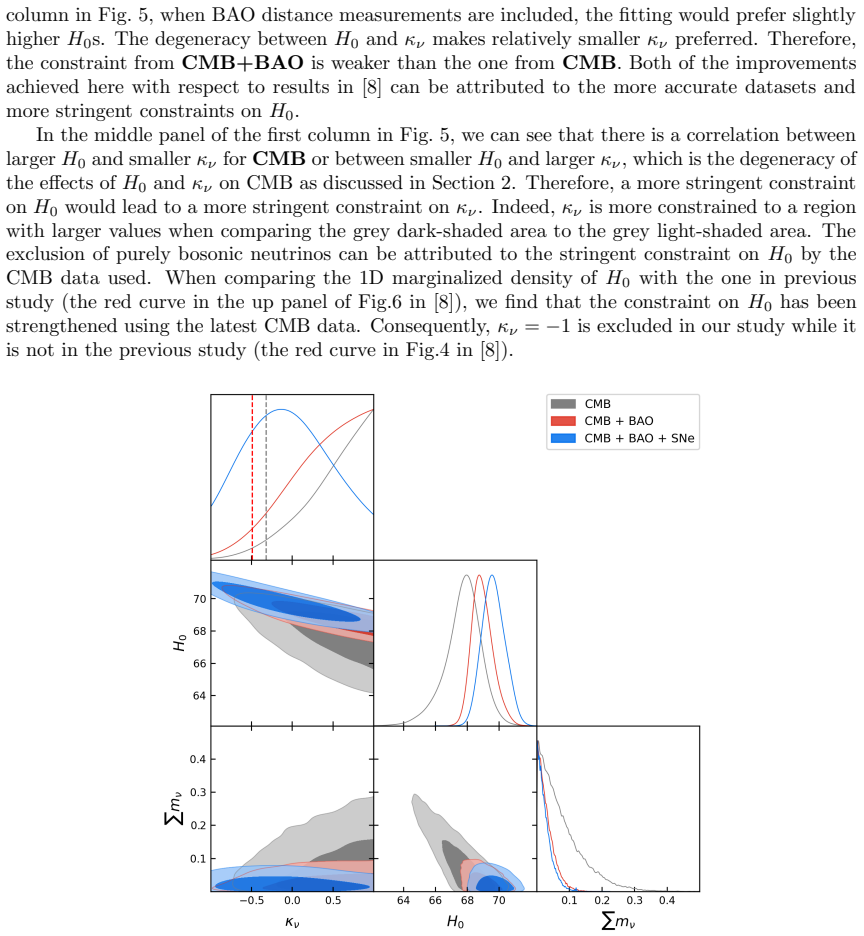
On the paper's own terms, the discovery is that current CMB data alone, and CMB combined with BAO distances, rule out the possibility that neutrinos obey Bose-Einstein rather than Fermi-Dirac statistics. In the authors' fit, the 95% lower bounds on the statistical parameter are $\kappa_\nu > -0.317$ for CMB only and $\kappa_\nu > -0.489$ for CMB+BAO, both excluding the purely bosonic value $\kappa_\nu=-1$. Adding supernova and local-$H_0$ information reverses this exclusion, but the paper treats that combination as statistically compromised by the Hubble tension and reports it only for comparison. The fits also favor small neutrino masses, and allowing mixed statistics raises the BAO-based neutrino-mass upper limit slightly, from 0.072 eV to 0.078 eV, which modestly eases the tension with oscillation lower bounds. The second conclusion is that the data prefer fermionic or nearly fermionic statistics, with mixed statistics still open below the 95% boundary.
Load-bearing premise
The load-bearing premise is that the Hubble constant derived from CMB data is accurate; if the true value is instead closer to the higher number favored by local distance measurements, the degeneracy could let purely bosonic neutrinos survive.
Editorial extensions
If this is right
- Purely bosonic neutrinos are excluded at the 95% confidence level by both CMB-only and CMB+BAO fits, so any particle-physics model that predicts $\kappa_\nu=-1$ is now in tension with cosmology.
- Mixed-statistics neutrinos with $\kappa_\nu \gtrsim -0.5$ at 2$\sigma$ remain allowed, meaning the observationally viable distributions are closer to fermionic than bosonic.
- Allowing $\kappa_\nu$ to vary relaxes the BAO-based upper bound on the neutrino mass sum from 0.072 eV to 0.078 eV, making the cosmology-oscillation mass tension slightly smaller.
- Tighter future measurements of the Hubble constant and of BAO distances should sharpen the bound on $\kappa_\nu$ and could eventually distinguish fermionic from mixed statistics.
Reading between the lines
- As an editorial extension, the same degeneracy implies that if the Hubble tension is eventually resolved toward the higher local value, the $\kappa_\nu$ bound would probably cross $-1$ on its own; the paper's own CMB+BAO+SNe fit is a preview of that regime and is why the authors discount it.
- Because the degeneracy runs through the sound-horizon scale, any early-universe mechanism that changes the sound horizon (extra relativistic species, early dark energy) could mimic part of the neutrino-statistics signal, so the bound is model-dependent rather than pure spin-statistics evidence.
- A direct quantitative test: refit with a Gaussian prior on $H_0$ whose central value is varied from 67 to 73 km s$^{-1}$ Mpc$^{-1}$ and map the 95% lower bound on $\kappa_\nu$; the curve would identify exactly which future $H_0$ measurement would flip the exclusion.
Editorial analysis
A structured set of objections, weighed in public.
Referee Report
Summary. The paper extends ΛCDM by a neutrino statistics parameter κν, interpolating between Fermi-Dirac (κν=1) and Bose-Einstein (κν=-1) occupation, and fits the model to CMB-only (Planck PR3 + ACT/PR4 lensing) and CMB+BAO (DESI DR1/DR2) datasets. The headline finding, stated in the abstract and Table II, is that purely bosonic neutrinos are excluded at 95% confidence for the CMB and CMB+BAO analyses, with lower bounds κν > -0.317 and κν > -0.489, respectively. The CMB+BAO+SNe combination, which includes a local H0 constraint via the supernova absolute magnitude, shifts the lower bound to -1 and no longer excludes bosonic neutrinos; the paper attributes this reversal to the Hubble tension and cautions that this combination is not statistically well-founded. A secondary conclusion is that CMB+BAO data prefer fermionic statistics, while mixed statistics remain possible.
Significance. If the central claim holds, the paper would provide a novel cosmological constraint on a fundamental property of neutrinos, going beyond earlier bounds that allowed bosonic statistics at 95% CL. The paper is transparent about the CMB+BAO+SNe reversal, gives a clear physical discussion of the κν–Σmν–H0 degeneracy, and includes a post-submission check with DESI DR2. These are genuine strengths. However, as argued below, the headline exclusion is conditional on the assumed H0 scale and on an unverified implementation of the modified statistics in the Boltzmann code, so the significance is currently provisional.
major comments (2)
- [Sec. 4, Fig. 5, Tables II and III] The paper's central claim that purely bosonic neutrinos are ruled out at 95% CL is not robust to the assumed H0 scale. The text itself states that the exclusion 'can be attributed to the stringent constraint on H0 by the CMB data,' and Table II shows that the CMB+BAO+SNe fit, which adds the local H0 information, shifts the 95% lower bound from -0.489 to -1, i.e., bosonic neutrinos become allowed. The paper dismisses this dataset as 'not statistically well-founded' because of the Hubble tension, but no calculation is given to show how the κν lower bound varies with the H0 prior. Because the Hubble tension is an unresolved systematic, the exclusion claim is conditional on the Planck H0 scale. The authors should quantify the prior dependence, for example by re-running the fits with a wide H0 prior or with a Gaussian prior centered on the local value, and should report the Δχ2 between κν=-1 and the best-fit for the CMB and CMB+BAO analyses. Without such a test, the abstract's unconditional statement is not supported.
- [Sec. 3 and Sec. 2, Eqs. (3)–(8)] The analysis uses a modified version of CLASS, but the paper neither provides the code nor describes how κν enters the perturbation equations. The CMB constraints come from the full angular power spectra, which depend on the neutrino perturbation hierarchy (density, velocity, anisotropic stress, free-streaming), not only on the background energy density computed in Eqs. (3)–(8). If the modification changes only the background cosmology, the resulting CMB spectra may be inconsistent with the assumed statistics. The authors should release the code or provide a complete derivation of the perturbation equations for the modified distribution, and validate the implementation, for instance by reproducing standard results for κν=1 and showing the response of the CMB spectra to κν in a test case. This is load-bearing because the exclusion claim relies on the CMB power spectra.
minor comments (4)
- [Throughout] There are several typos and notation errors: 'appoaches' in Sec. 2, 'unlablled' in Fig. 3 captions, 'adpoted' in Table I, and 'kν' in the Fig. 3 captions where κν is meant. These should be corrected.
- [References] Reference [35] is given the same arXiv number (2211.04492) as reference [20]; the Herold & Kamionkowski entry appears to have the wrong identifier.
- [Sec. 3 and Fig. 5] The label CMB+BAO+SNe is used for a dataset that includes a Gaussian constraint on the supernova absolute magnitude from [14], which effectively incorporates the local H0 measurement. The caption of Fig. 5 calls this 'local H0 measurement'; the terminology should be unified so readers can clearly see that the local H0 prior is included in the CMB+BAO+SNe combination.
- [Table III] Table III reports χ2 values 'obtained from the MCMC chains'; for best-fit comparisons, a proper χ2 minimization would be more reliable than values read off from MCMC chains.
Circularity Check
No significant circularity: the κν constraint is a posterior bound from external datasets, not a prediction defined by its inputs.
full rationale
The paper's central claim is that Planck CMB and CMB+BAO data exclude purely bosonic neutrinos (κν = -1) at 95% CL. This is a parameter-estimation result: κν is introduced as a free parameter in Eq. (3), the Boltzmann code CLASS is modified to include it, and the posterior is obtained by MCMC fits to external likelihoods (Planck PR3, ACT/Planck lensing, DESI BAO, Pantheon SNe). The quoted exclusion bound, κν > -0.317 (CMB) and κν > -0.489 (CMB+BAO) in Table II, is a data-driven constraint, not a quantity that is defined in terms of the fitted value. The paper's own analysis of the κν–H0 degeneracy is a physical explanation of the correlation, not a circular reduction: the degeneracy is computed from the model's effect on the sound horizon and angular diameter distance, and the exclusion is read off the posterior. The CMB+BAO+SNe result, which allows κν = -1 at 95% CL, is explicitly flagged as statistically ill-founded because of the Hubble tension, and the paper does not hide this qualification. There is no self-citation chain carrying the central premise: the comparison with de Salas et al. 2018 [8] concerns previous weaker bounds and is not load-bearing. The H0-dependence concern raised in the skeptic note is a robustness or prior-dependence issue, not circularity: the constraint could shift with different H0 assumptions, but that does not make the derivation equivalent to its inputs by construction. No equation is fitted and then renamed as a prediction, and no known result is repackaged under new coordinates. The analysis is self-contained against external benchmarks, so the appropriate finding is no significant circularity.
Assumptions & free parameters
free parameters (3)
- κν (neutrino statistics parameter) =
0.60 (CMB), 0.93 (CMB+BAO), -0.04 (CMB+BAO+SNe) best-fit; lower bound -0.317 (CMB), -0.489 (CMB+BAO) at 95%
- Σmν (sum of degenerate neutrino masses) =
0.082 eV (CMB), 0.010 eV (CMB+BAO), 0.034 eV (CMB+BAO+SNe) best-fit; upper bound 0.2114 eV (CMB), 0.0784 eV (CMB+BAO)…
- H0 (present Hubble expansion rate) =
67.92 (CMB), 68.36 (CMB+BAO), 69.40 (CMB+BAO+SNe) km/s/Mpc best-fit
assumptions (5)
- domain assumption Flat ΛCDM universe
- ad hoc to paper Neutrino distribution f = 1/(e^{E/T}+κν) interpolating between FD and BE
- domain assumption Tν/T = (4/11)^{1/3} remains valid for κν ≠ 1
- domain assumption Degenerate neutrino masses
- domain assumption The modified CLASS code correctly propagates κν into perturbation equations
Cite this review
Pith. "Pith review of Constraint on Neutrino Statistics from Cosmological Data." pith.science (2026). https://pith.science/paper/ARMNINOO
@misc{pith2026250112264,
  author       = {Pith},
  title        = {Pith review of: Constraint on Neutrino Statistics from Cosmological Data},
  year         = {2026},
  howpublished = {\url{https://pith.science/paper/ARMNINOO}},
  note         = {Machine review of arXiv:2501.12264}
}
read the original abstract
We investigate the impact of neutrino statistical property on cosmology and the constraints imposed by cosmological data on neutrino statistics. Cosmological data from probes such as Cosmic Microwave Background(CMB) radiation and Baryon Acoustic Oscillation(BAO) are used to constrain the statistical parameter of neutrino. This constraint is closely related to the degeneracy effects among neutrino statistical property, the sum of neutrino masses, and the Hubble constant. Our results show that purely bosonic neutrinos can be ruled out at 95\% confidence level and purely fermionic neutrinos are preferred.
Figures


Figures from the paper (5 more)



Reference graph
Works this paper leans on
-
[8]
Cosmological bounds on neutrino statistics
P. F. de Salas, S. Gariazzo, M. Laveder, S. Pastor, O. Pisanti, and N. Truong, “Cosmological bounds on neutrino statistics”, JCAP 03(2018) 050. 12
work page 2018
-
[1]
Updated fit to three neutrino mixing: exploring the accelerator-reactor complementarity
I. Esteban, M. C. Gonzalez-Garcia, M. Maltoni, et al., “Updated fit to three neutrino mixing: exploring the accelerator-reactor complementarity”, JHEP 01(2017) 087
work page 2017
-
[2]
NuFIT: Three-Flavour Global Analyses of Neutrino Oscillation Experiments
M. Concepcion Gonzalez-Garcia, M. Maltoni, and T. Schwetz, “NuFIT: Three-Flavour Global Analyses of Neutrino Oscillation Experiments”, Universe 07(2021) 459
work page 2021
-
[3]
Neutrino physics from the cosmic microwave back- ground and large scale structure
K.N. Abazajian and K. Arnold, et al., “Neutrino physics from the cosmic microwave back- ground and large scale structure”, Astropart. Phys.63(2015) 66
work page 2015
-
[4]
Planck 2013 results. XVI. Cosmological parameters
Planck Collaboration and P. A. R. Ade and N. Aghanim, et al., “Planck 2013 results. XVI. Cosmological parameters”, A&A 571(2014) A16
work page 2014
-
[5]
DESI 2024 VI: Cosmological Constraints from the Measurements of Baryon Acoustic Oscillations
A. G. Adame and others, “DESI 2024 VI: Cosmological Constraints from the Measurements of Baryon Acoustic Oscillations”, arXiv: 2404.03002, astro-ph.CO
arXiv 2024
-
[6]
Neutrino statistics and big bang nucleosyn- thesis
A.D. Dolgov, S.H. Hansen and A. Yu. Smirnov, “Neutrino statistics and big bang nucleosyn- thesis”, JCAP 06(2005) 004
work page 2005
-
[7]
Statistics of neutrinos and the double beta decay
A.S. Barabash, A.D. Dolgov, R. Dvornick´ y, F. ˇSimkovic, and A.Yu. Smirnov, “Statistics of neutrinos and the double beta decay”, Nucl. Phys. B783(2007) 90
work page 2007
Show all 37 references
-
[9]
Spin-statistics connexion, neutrinos, and big bang nucleosynthesis
L. Cucurull, J. Grifols and R. Toldra, “Spin-statistics connexion, neutrinos, and big bang nucleosynthesis”, Astropart. Phys.04(1996) 391
1996
-
[10]
Possible violation of the spin-statistics relation for neutri- nos: Cosmological and astrophysical consequences
A.D. Dolgov, and A.Yu. Smirnov, “Possible violation of the spin-statistics relation for neutri- nos: Cosmological and astrophysical consequences”, Phys. Lett. B621(2005) 1
2005
-
[11]
How massless neutrinos affect the cosmic microwave background damping tail
Z. Hou, R. Keisler, L. Knox, M. Millea, and C. Reichardt, “How massless neutrinos affect the cosmic microwave background damping tail”, Phys. Rev. D87(2013) 11
2013
-
[12]
Neutrinos in the cosmic microwave background epoch
J. Lesgourgues, G. Mangano, G. Miele, and S. Pastor, “Neutrinos in the cosmic microwave background epoch”, in Neutrino Cosmology (2013) 198-272
2013
-
[13]
The Cosmic Linear Anisotropy Solving System (CLASS). Part II: Approximation schemes
D. Blas, J. Lesgourgues, and T. Tram, “The Cosmic Linear Anisotropy Solving System (CLASS). Part II: Approximation schemes”, JCAP 07(2011) 034
2011
-
[14]
Cosmic Distances Calibrated to 1% Precision with Gaia EDR3 Parallaxes and Hubble Space Telescope Photometry of 75 Milky Way Cepheids Confirm Tension with ΛCDM
A. G. Riess, S. Casertano, et al. “Cosmic Distances Calibrated to 1% Precision with Gaia EDR3 Parallaxes and Hubble Space Telescope Photometry of 75 Milky Way Cepheids Confirm Tension with ΛCDM”, ApJL 908(2021) L6
2021
-
[15]
Planck2018 results: VI. Cosmological parameters
N. Aghanim, Y. Akrami, M. Ashdown, J. Aumont, C. Baccigalupi, M. Ballardini, A. J. Banday, R. B. Barreiro, N. Bartolo, S. Basak, et al., “Planck2018 results: VI. Cosmological parameters”, Astron. Astrophys.641(2020) 067
2020
-
[16]
The Atacama Cosmology Telescope: DR6 Power Spectra, Likelihoods and ΛCDM Parameters
T. Louis, A. L. Posta, Z. Atkins, H. T. Jense, et al., “The Atacama Cosmology Telescope: DR6 Power Spectra, Likelihoods and ΛCDM Parameters”, eprint: arXiv: 2503.14452 [astro- ph.CO], 2025
2025 arXiv
-
[17]
A 3% SOLUTION: DETERMINATION OF THE HUBBLE CONSTANT WITH THE HUBBLE SPACE TELESCOPE AND WIDE FIELD CAMERA 3
A. G. Riess, L. Macri, et al., “A 3% SOLUTION: DETERMINATION OF THE HUBBLE CONSTANT WITH THE HUBBLE SPACE TELESCOPE AND WIDE FIELD CAMERA 3”, ApJ 730(2011) 119
2011
-
[18]
A 2.4% DETERMINATION OF THE LOCAL V ALUE OF THE HUBBLE CONSTANT
A. G. Riess, L. Macri, et al., “A 2.4% DETERMINATION OF THE LOCAL V ALUE OF THE HUBBLE CONSTANT”, ApJ 826(2016) 56
2016
-
[19]
A Comprehensive Measurement of the Local Value of the Hubble Constant with 1 km s−1 Mpc−1 Uncertainty from the Hubble Space Telescope and the SH0ES Team
A. G. Riess, W. Yuan, et al., “A Comprehensive Measurement of the Local Value of the Hubble Constant with 1 km s−1 Mpc−1 Uncertainty from the Hubble Space Telescope and the SH0ES Team”, ApJL 934(2022) L7
2022
-
[21]
The Atacama Cosmology Telescope: DR6 Gravitational Lensing Map and Cosmological Parameters
M. S. Madhavacheril, F. J. Qu, B. D. Sherwin, N. MacCrann, Y. Li, I. Abril-Cabezas, et al., “The Atacama Cosmology Telescope: DR6 Gravitational Lensing Map and Cosmological Parameters”, ApJ 962(2024) 113
2024
-
[22]
F. J. Qu, B. D. Sherwin, M. S. Madhavacheril, D. Han, K. T. Crowley, I. Abril-Cabezas, et al., ApJ 962(2024) 112
2024
-
[23]
CMB lensing from Planck PR4 maps
J. Carron, M. Mirmelstein, A. Lewis, “CMB lensing from Planck PR4 maps”, JCAP 09(2022) 039
2022
-
[24]
DESI 2024 III: Baryon Acoustic Oscil- lations from Galaxies and Quasars
DESI Collaboration, A. G. Adame, J. Aguilar, et al. “DESI 2024 III: Baryon Acoustic Oscil- lations from Galaxies and Quasars”, arXiv: 2404.03000, astro-ph.CO,2024
2024 arXiv
-
[25]
DESI 2024 IV: Baryon Acoustic Oscil- lations from the Lyman Alpha Forest
DESI Collaboration, A. G. Adame, J. Aguilar, et al. “DESI 2024 IV: Baryon Acoustic Oscil- lations from the Lyman Alpha Forest”, arXiv: 2404.03001, astro-ph.CO, 2024
2024 arXiv
-
[26]
No νs is Good News
N. Craig, D. Green, J. Meyers, and S. Rajendran, “No νs is Good News”, eprint: arXiv:2405.00836 [astro-ph.CO], 2024
2024 arXiv
-
[27]
The Pantheon+ Analysis: Cosmological Constraints
D. Brout, D. Scolnic, B. Popovic, et al. “The Pantheon+ Analysis: Cosmological Constraints”, ApJ 938(2022) 110
2022
-
[28]
Cobaya: code for Bayesian analysis of hierarchical physical models
J. Torrado and A. Lewis, “Cobaya: code for Bayesian analysis of hierarchical physical models”, JCAP 05(2021) 057
2021
-
[29]
Cobaya: Bayesian analysis in cosmology
J. Torrado and A. Lewis, “Cobaya: Bayesian analysis in cosmology”, Astrophysics Source Code Library, record ascl:1910.019, October 2019. 13
1910
-
[30]
Cosmological parameters from CMB and other data: A Monte Carlo approach
A. Lewis and S. Bridle, “Cosmological parameters from CMB and other data: A Monte Carlo approach”, Phys.Rev.D 66(2002) 103511
2002
-
[31]
Efficient sampling of fast and slow cosmological parameters
A. Lewis, “Efficient sampling of fast and slow cosmological parameters”, Phys.Rev.D 87(2013) 103529
2013
-
[32]
Taking Bigger Metropolis Steps by Dragging Fast Variables
R. M. Neal, “Taking Bigger Metropolis Steps by Dragging Fast Variables”, eprint: arXiv: math/0502099 [math.ST], 2005
2005 arXiv
-
[33]
Inference from Iterative Simulation Using Multiple Sequences
A. Gelman and D. B. Rubin, “Inference from Iterative Simulation Using Multiple Sequences”, Statist. Sci. 07(1992) 457
1992
-
[34]
GetDist: a Python package for analysing Monte Carlo samples
A. Lewis, “GetDist: a Python package for analysing Monte Carlo samples”, eprint: arXiv: 1910.13970 [astro-ph.IM], 2019
1910 arXiv
-
[35]
Revisiting the impact of neutrino mass hierarchies on neutrino mass constraints in light of recent DESI data
L. Herold and M. Kamionkowski, “Revisiting the impact of neutrino mass hierarchies on neutrino mass constraints in light of recent DESI data”, arXiv: 2211.04492 [astro-ph.CO], 2024
2024 arXiv
-
[36]
Constraining cosmological parameters using the pairwise kinematic Sunyaev-Zel’dovich effect with CMB-S4 and future galaxy cluster surveys
E. Schiappucci, S. Raghunathan, C. To, “Constraining cosmological parameters using the pairwise kinematic Sunyaev-Zel’dovich effect with CMB-S4 and future galaxy cluster surveys”, eprint: arXiv: 2409.18368 [astro-ph.CO], 2024
2024 arXiv
-
[37]
Euclid. I. Overview of the Euclid mis- sion
Euclid Collaboration, Y. Mellier, Abdurro’uf, et al., “Euclid. I. Overview of the Euclid mis- sion”, eprint: arXiv: 2405.13491 [astro-ph.CO], 2024
2024
-
[38]
DESI DR2 Results II: Measurements of Baryon Acoustic Oscillations and Cosmological Constraints
DESI Collaboration, M. Abdul-Karim, J. Aguilar, et al., “DESI DR2 Results II: Measurements of Baryon Acoustic Oscillations and Cosmological Constraints”, eprint: arXiv: 2503.14738 [astro-ph.CO], 2025. 14
2025 arXiv
Reviewed August 10, 2026 · model on record in the stance chip above.
Discussion (0). Continue with ORCID to comment.