REVIEW 4 major objections 3 minor 2 cited by
Observation of Higher-order Topological Bound States in the Continuum using Ultracold Atoms
T0 review · 4 major / 3 minor · reviewed 2026-08-10 · deepseek-v4-flash
Pith's one-line read Ultracold rubidium atoms in a 2D momentum lattice realize higher-order topological bound states in the continuum.
desk verdict Genuine first: a 2D momentum lattice in cold atoms with a plausible higher-order topological BIC, but the adiabatic preparation evidence is weaker than the abstract suggests. read the letter →
The pith
A machine-rendered reading of the paper's core claim, the machinery that carries it, and where it could break.
The reading
What carries the argument
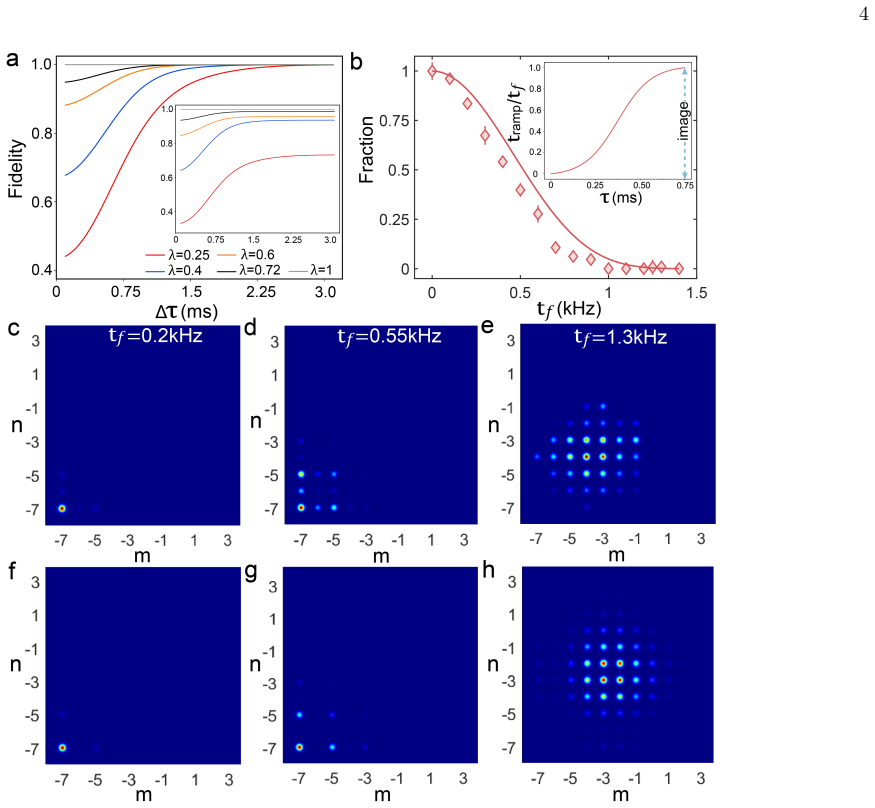
The central object is the two-dimensional Su-Schrieffer-Heeger model on a synthetic momentum lattice: a tight-binding model with alternating intra- and inter-cell hopping amplitudes $t_1 = t(1-\lambda)$ and $t_2 = t(1+\lambda)$ per direction, whose zero-energy corner states are protected by $C_{4v}$ and chiral (sublattice) symmetries. The load-bearing mechanism is the symmetry protection that keeps a corner state decoupled from the bulk continuum even at zero energy, which the paper probes through a time-averaged mean chiral displacement that extracts the 2D winding number, and through an adiabatic ramp from a single populated corner that tests whether the BIC can be prepared deterministically.
What would settle it
Measure the corner-site population for evolution times well beyond the 0.9 ms window at $\lambda=0.5$: a true BIC should keep a localized population plateau, whereas any residual coupling to the bulk continuum would spread the population across the lattice on a characteristic diffusion timescale.
Extended reading notes
Core claim
The central claim is that the zero-dimensional corner states of the two-dimensional Su-Schrieffer-Heeger model, realized in a synthetic momentum lattice of ultracold 87Rb atoms, are higher-order topological bound states in the continuum. Unlike ordinary corner states that sit inside a band gap, these corner states are degenerate with the bulk energy bands, yet they remain localized because the $C_{4v}$ and chiral symmetries forbid hybridization with the bulk continuum. The paper supports this by showing corner- and edge-localized dynamics, by adiabatically preparing the corner state through a ramp that turns on the intracell hopping $t_1$ from zero, and by measuring the 2D Zak phase, which takes value $(\pi,\pi)$ in the nontrivial phase and matches the appearance of the corner BIC.
Load-bearing premise
The claim that the prepared corner state is a true topological bound state in the continuum assumes that the $C_{4v}$ and chiral symmetries keep the zero-energy corner state decoupled from the degenerate bulk continuum even though the experimental lattice is finite and the initial single-corner state breaks the $C_4$ symmetry.
Editorial extensions
If this is right
- The 2D momentum lattice can be extended to more complicated geometries and internal-state configurations, opening higher synthetic dimensions to cold-atom topological simulation.
- The adiabatic preparation scheme can prepare a higher-order topological BIC on demand, providing a controllable initial state for studies of dynamics and of the interplay between topology and interactions.
- The bulk measurement of the 2D Zak phase via mean chiral displacement offers a boundary-free probe of the higher-order topological phase transition.
- The tunable long-range interactions of the momentum lattice allow the fate of these BICs to be studied in the strongly correlated regime.
Reading between the lines
- Because the experiment initializes a single corner and thereby breaks the $C_4$ symmetry, the measured preparation fidelity should be compared with the paper's odd-lattice simulation; a systematic scan of final corner population versus ramp time and $\lambda$ could separate genuine symmetry protection from finite-size confinement.
- The same time-averaged chiral displacement observable could be used to detect higher-order topology in other symmetry classes, such as models with time-reversal or particle-hole symmetry, without requiring edge spectroscopy.
- Introducing interactions on the momentum lattice could test whether the corner BIC remains decoupled from the continuum or acquires a finite lifetime, connecting to the strongly correlated regime the paper identifies as a future direction.
Signed reviews
Editorial analysis
A structured set of objections, weighed in public.
Referee Report
Summary. The manuscript reports a cold-atom experiment that realizes a two-dimensional (2D) momentum lattice for ultracold 87Rb atoms and uses it to implement the 2D Su-Schrieffer-Heeger (SSH) model. The authors observe corner- and edge-localized dynamics, identify the zero-energy corner states as higher-order topological bound states in the continuum (BICs), demonstrate an adiabatic preparation protocol for these states, and probe the higher-order topological phase transition by measuring a 2D mean chiral displacement as well as boundary dynamics. The central claim is that the observed corner-localized states are symmetry-protected higher-order topological BICs, as stated in the section 'Implementing two-dimensional momentum lattice'.
Significance. If the claims are substantiated, this would be a significant experimental advance: a 2D momentum lattice platform for ultracold atoms, and the first cold-atom realization of higher-order topological bound states in the continuum. The paper has several strengths. The topological classification is not fitted to the data: the 2D Zak phase and phase diagram come from external literature (Liu and Wakabayashi, Ref. [59]), and the hopping amplitudes are experimentally calibrated rather than optimized to reproduce corner states. The authors provide numerical simulations of the quench dynamics and of the adiabatic preparation fidelity, and they compare the observed phase transition with theoretical predictions. The 2D momentum lattice itself is a new capability for synthetic quantum matter. However, as detailed below, the evidence for the specific BIC character of the prepared state and for the adiabatic preparation fidelity is not yet conclusive, and the experimental data lack statistical uncertainties throughout.
major comments (4)
- [Symmetry-protected adiabatic preparation of BICs, Eq. (2) and Fig. 3] The adiabatic preparation claim relies on C4 symmetry protection, but the experiment starts from a single-corner initial state that itself breaks C4 symmetry. The authors acknowledge this in the text: 'the actual adiabatic preparation process closely resembles the odd-L case' (Fig. 3a inset), and for odd L the fidelity converges to a value below unity unless λ is close to 1. For the experimental parameters, e.g., tf = 0.55 kHz corresponds to λ ≈ 0.39, so the expected fidelity is not near unity. The experimental evidence in Figs. 3c–3e is a localized population distribution, not a measured overlap with the target BIC eigenstate. A localized final distribution could also arise from the slow ramp freezing the initial corner occupation or from finite-size decoupling, without the state being the symmetry-protected topological BIC. To support the claim, the authors should provide a quantitative comparison between the measured final state (e.g., the full site-resolved population) and the simulated odd-L adiabatic preparation, including the expected fidelity for the ramps used, and ideally a direct or indirect measurement of the overlap with the target zero-energy corner state.
- [Observing bound-states dynamics, Fig. 2(d)–2(f)] The identification of the corner states as BICs embedded in the zero-energy bulk continuum is based on the computed spectrum and the D2 participation parameter. The experimental corner-injection dynamics in Fig. 2(e) show local population retention, but such a result is also consistent with a conventional corner-localized bound state in a finite lattice or with slow spreading due to finite evolution time. The authors do not provide an experimental measure of the bulk population or of the overlap of the time-evolved state with the candidate BIC eigenstate. A more direct test would be to measure the time-resolved population spread and compare it quantitatively with the simulated spreading for the BIC, and to contrast this with the trivial-phase corner dynamics at the same hopping parameters.
- [Measuring higher-order topological phase transition, Eq. (3) and Fig. 4(b)] The experimental determination of the 2D winding number from the mean chiral displacement in Fig. 4(b) is presented without error bars, without a clear statement of statistical uncertainty, and without a quantitative measure of agreement with the numerical simulation (solid lines). The claim that v2d 'oscillates around 0' in the trivial phase and 'around 1' in the nontrivial phase needs a quantitative analysis, especially because finite evolution time (τ = 0.6 ms) and finite lattice size can shift the time-averaged value away from the ideal integer. The authors should provide the standard deviation or confidence intervals for each data point and a test of whether the observed values are statistically distinguishable from 0 and 1.
- [Discussion of BIC nature, Fig. 2(d) and Supplementary Material [58]] The paper asserts that the zero-energy corner states are BICs because they lie within the zero-energy bulk continuum while remaining localized. However, no experimental observable directly establishes coexistence with the continuum or the symmetry-protected decoupling. The argument that nearby bulk states have 'vanishingly small overlap' with the corner state is relegated to the Supplementary Material, but the main text does not show how this protection survives the experimental single-corner initial condition that breaks C4 symmetry. The authors should either provide the relevant supplementary proof in the main text or clearly delineate the symmetry assumptions under which the experimental preparation protocol still produces the target BIC, and explain how the data distinguish a BIC from a merely localized corner state.
minor comments (3)
- [Throughout] There are several typographical errors, including 'Figiure 3(a)' in the section on adiabatic preparation, 'programable' in the Discussion, and inconsistent notation such as λx/y versus λ. These should be corrected.
- [Fig. 2(d)] The D2 values used to classify eigenstates as extended or localized are not quantified in the figure or the text; the reader cannot tell from Eq. (1) or the figure what threshold separates D2 ~ 1 from D2 ~ 0. Please provide the actual D2 values for the corner states and for representative bulk states.
- [Experimental methods] The main text gives only limited experimental details and refers to the Supplementary Material for calibration procedures. I recommend stating the typical atom number, temperature, and any loss or heating rates in the main text, because these affect the interpretation of the residual condensate fraction in Fig. 3(b).
Circularity Check
No significant circularity: the topological invariant and phase diagram are imported from external literature, and the experimental observables are compared with independent simulations of the engineered Hamiltonian.
full rationale
I find no circular step in the paper's derivation chain. The 2D SSH model (Eq. 1) is a standard tight-binding model, and the topological classification (2D Zak phase, phase diagram, corner-state existence) is explicitly taken from external work [59], not derived from the present experiment's data. The measured mean chiral displacement (Eq. 3) is a standard bulk probe, and the comparison with numerical simulations using Heff is a consistency check rather than a fit: the hopping parameters are quoted with uncertainties from experimental calibration and are not optimized to reproduce the corner-state or winding-number observables. The identification of the corner state as a higher-order topological BIC is a spectral classification of Heff (Fig. 2d), not a definition that presupposes the experimental observation. The paper's acknowledged limitation that the single-corner initial state breaks C4 symmetry and reduces adiabatic fidelity (Fig. 3a inset and text: 'the actual adiabatic preparation process closely resembles the odd-L case') is a robustness concern about the adiabatic argument, not a circularity: the target state is still defined independently by the Hamiltonian, and the observed localization is compared with that target rather than fitted. Self-citations to the group's previous momentum-lattice techniques are references to the platform's established experimental capabilities, not load-bearing support for the topological result. No equation is equivalent to another by construction, and no fitted parameter is renamed as a prediction.
Assumptions & free parameters
free parameters (2)
- Global hopping amplitude t =
h x 0.98(2) kHz (phase transition); t2 = h x 1.25(2) kHz (adiabatic prep)
- Dimerization parameter lambda =
-0.5 to +0.5
assumptions (5)
- domain assumption The two perpendicular Bragg couplings realize exactly the nearest-neighbor tight-binding Hamiltonian Heff of Eq. (1) with uniform hopping rates t1 and t2 and negligible longer-range or cross-coupling terms.
- domain assumption The zero-energy corner states are protected by C4 and chiral symmetries of the lattice, so they do not hybridize with the zero-energy bulk continuum.
- standard math The time-averaged mean chiral displacement v2d of Eq. (3), with C = x Gamma_x + y Gamma_y, converges to the 2D winding number extracted from the 2D Zak phases for sufficiently long evolution.
- domain assumption Interactions between 87Rb atoms in the BEC are negligible on the experimental timescale, and the dynamics is governed by the single-particle Hamiltonian Heff.
- ad hoc to paper The adiabatic theorem applies to the BIC preparation even though the zero-energy corner state lies inside the bulk continuum, because nearby bulk states have vanishing overlap with the corner state.
Cite this review
Pith. "Pith review of Observation of Higher-order Topological Bound States in the Continuum using Ultracold Atoms." pith.science (2026). https://pith.science/paper/OOOHMFQH
@misc{pith2026250113499,
  author       = {Pith},
  title        = {Pith review of: Observation of Higher-order Topological Bound States in the Continuum using Ultracold Atoms},
  year         = {2026},
  howpublished = {\url{https://pith.science/paper/OOOHMFQH}},
  note         = {Machine review of arXiv:2501.13499}
}
read the original abstract
Simulating higher-order topological materials in synthetic quantum matter is an active research frontier for its theoretical significance in fundamental physics and promising applications in quantum technologies. Here we experimentally implement two-dimensional (2D) momentum lattices with highly programmable ability using ultracold 87Rb atoms. Through precise control of experimental parameters, we simulate a 2D Su-Schrieffer-Heeger model with this technique, and observe the characteristic dynamics of corner and edge-bound states, where the corner state is identified as a higher-order topological bound state in the continuum. We further study the adiabatic preparation of the corner state by engineering evolutions with time-dependent Hamiltonians. We also demonstrate the higher-order topological phase transition by measuring both the bulk topological invariant and the topological corner state. Our new platform opens the avenue for exploring the exotic dynamics and topology in higher synthetic dimensions, making use of the rich degrees of freedom of cold atoms systems.
Figures


Figures from the paper (1 more)

Forward citations
Cited by 2 Pith papers
-
Quantum-Optical Bound States in the Continuum
A few-degree-of-freedom driven multi-level JC model hosts a quantum-optical BIC formed by destructive interference of two FSL-SSH topological zero modes, with a chiral-operator Fourier signature and trapped-ion proposal.
-
Non-Hermitian second-order topological insulator with point gap
For a 2D non-Hermitian SSH model, the number of stable zero singular values of H (or of U(T)−I and U(T)+I) equals the number of topological corner states in the thermodynamic limit, restoring bulk-boundary correspondence.
Reference graph
Works this paper leans on
-
[59]
Liu and K
F. Liu and K. Wakabayashi, Phys. Rev. Lett.118, 076803 (2017)
2017
-
[1]
K. v. Klitzing, G. Dorda, and M. Pepper, Phys. Rev. Lett. 45, 494 (1980)
1980
-
[2]
M. Z. Hasan and C. L. Kane, Rev. Mod. Phys. 82, 3045 (2010)
2010
-
[3]
Qi and S.-C
X.-L. Qi and S.-C. Zhang, Rev. Mod. Phys. 83, 1057 (2011)
2011
-
[4]
L. Lu, J. D. Joannopoulos, and M. Soljaˇ ci´ c, Nature Pho- tonics 8, 821 (2014)
work page 2014
-
[5]
Ozawa, H
T. Ozawa, H. M. Price, A. Amo, N. Goldman, M. Hafezi, L. Lu, M. C. Rechtsman, D. Schuster, J. Simon, O. Zil- berberg, and I. Carusotto, Rev. Mod. Phys. 91, 015006 (2019)
2019
-
[6]
N. R. Cooper, J. Dalibard, and I. B. Spielman, Rev. Mod. Phys. 91, 015005 (2019)
2019
-
[7]
W. A. Benalcazar, B. A. Bernevig, and T. L. Hughes, Science 357, 61 (2017), https://www.science.org/doi/pdf/10.1126/science.aah6442
Show all 64 references
-
[8]
W. A. Benalcazar, B. A. Bernevig, and T. L. Hughes, Phys. Rev. B 96, 245115 (2017)
2017
-
[9]
Ezawa, Phys
M. Ezawa, Phys. Rev. Lett. 120, 026801 (2018)
2018
-
[10]
Xie, H.-F
B.-Y. Xie, H.-F. Wang, H.-X. Wang, X.-Y. Zhu, J.-H. Jiang, M.-H. Lu, and Y.-F. Chen, Phys. Rev. B 98, 205147 (2018)
2018
-
[11]
Z. Song, Z. Fang, and C. Fang, Phys. Rev. Lett. 119, 246402 (2017)
2017
-
[12]
Langbehn, Y
J. Langbehn, Y. Peng, L. Trifunovic, F. von Oppen, and P. W. Brouwer, Phys. Rev. Lett. 119, 246401 (2017)
2017
-
[13]
Schindler, A
F. Schindler, A. M. Cook, M. G. Vergniory, Z. Wang, S. S. P. Parkin, B. A. Bernevig, and T. Neupert, Science Advances 4, eaat0346 (2018), https://www.science.org/doi/pdf/10.1126/sciadv.aat0346
2018 doi
-
[14]
W. A. Benalcazar, T. Li, and T. L. Hughes, Phys. Rev. B 99, 245151 (2019)
2019
-
[15]
Sheng, C
X.-L. Sheng, C. Chen, H. Liu, Z. Chen, Z.-M. Yu, Y. X. Zhao, and S. A. Yang, Phys. Rev. Lett. 123, 256402 (2019)
2019
-
[16]
C. W. Peterson, W. A. Benalcazar, T. L. Hughes, and G. Bahl, Nature 555, 346 (2018)
2018
-
[17]
Chen, W.-M
X.-D. Chen, W.-M. Deng, F.-L. Shi, F.-L. Zhao, M. Chen, and J.-W. Dong, Phys. Rev. Lett. 122, 233902 (2019)
2019
-
[18]
Xie, G.-X
B.-Y. Xie, G.-X. Su, H.-F. Wang, H. Su, X.-P. Shen, P. Zhan, M.-H. Lu, Z.-L. Wang, and Y.-F. Chen, Phys. Rev. Lett. 122, 233903 (2019)
2019
-
[19]
J. Noh, W. A. Benalcazar, S. Huang, M. J. Collins, K. P. Chen, T. L. Hughes, and M. C. Rechtsman, Nature Pho- tonics 12, 408 (2018)
2018
-
[20]
Mittal, V
S. Mittal, V. V. Orre, G. Zhu, M. A. Gorlach, A. Pod- dubny, and M. Hafezi, Nature Photonics 13, 692 (2019)
2019
-
[21]
Y. Ota, F. Liu, R. Katsumi, K. Watanabe, K. Wak- abayashi, Y. Arakawa, and S. Iwamoto, Optica 6, 786 (2019)
2019
-
[22]
M. Li, D. Zhirihin, M. Gorlach, X. Ni, D. Filonov, A. Slobozhanyuk, A. Al` u, and A. B. Khanikaev, Nature Photonics 14, 89 (2020)
2020
-
[23]
Zhang, X
W. Zhang, X. Xie, H. Hao, J. Dang, S. Xiao, S. Shi, H. Ni, Z. Niu, C. Wang, K. Jin, X. Zhang, and X. Xu, Light: Science & Applications 9, 109 (2020)
2020
-
[24]
Serra-Garcia, V
M. Serra-Garcia, V. Peri, R. S¨ usstrunk, O. R. Bilal, T. Larsen, L. G. Villanueva, and S. D. Huber, Nature 555, 342 (2018)
2018
-
[25]
X. Ni, M. Weiner, A. Al` u, and A. B. Khanikaev, Nature Materials 18, 113 (2019)
2019
-
[26]
H. Xue, Y. Yang, F. Gao, Y. Chong, and B. Zhang, Na- ture Materials 18, 108 (2019)
2019
-
[27]
H. Xue, Y. Yang, G. Liu, F. Gao, Y. Chong, and B. Zhang, Phys. Rev. Lett. 122, 244301 (2019)
2019
-
[28]
X. Ni, M. Li, M. Weiner, A. Al` u, and A. B. Khanikaev, Nature Communications 11, 2108 (2020)
2020
-
[29]
Zhang, H.-X
X. Zhang, H.-X. Wang, Z.-K. Lin, Y. Tian, B. Xie, M.-H. Lu, Y.-F. Chen, and J.-H. Jiang, Nature Physics 15, 582 (2019)
2019
-
[30]
Zhang, B.-Y
X. Zhang, B.-Y. Xie, H.-F. Wang, X. Xu, Y. Tian, J.-H. Jiang, M.-H. Lu, and Y.-F. Chen, Nature Communica- tions 10, 5331 (2019)
2019
-
[31]
H. Xue, Y. Ge, H.-X. Sun, Q. Wang, D. Jia, Y.-J. Guan, S.-Q. Yuan, Y. Chong, and B. Zhang, Nature Communi- cations 11, 2442 (2020)
2020
-
[32]
Zhang, Z.-K
X. Zhang, Z.-K. Lin, H.-X. Wang, Z. Xiong, Y. Tian, M.-H. Lu, Y.-F. Chen, and J.-H. Jiang, Nature Commu- nications 11, 65 (2020)
2020
-
[33]
Imhof, C
S. Imhof, C. Berger, F. Bayer, J. Brehm, L. W. Molenkamp, T. Kiessling, F. Schindler, C. H. Lee, M. Greiter, T. Neupert, and R. Thomale, Nature Physics 14, 925 (2018)
2018
-
[34]
J. Bao, D. Zou, W. Zhang, W. He, H. Sun, and X. Zhang, Phys. Rev. B 100, 201406 (2019)
2019
-
[35]
S. N. Kempkes, M. R. Slot, J. J. van den Broeke, P. Capiod, W. A. Benalcazar, D. Vanmaekelbergh, D. Bercioux, I. Swart, and C. Morais Smith, Nature Ma- terials 18, 1292 (2019)
2019
-
[36]
C. W. Hsu, B. Zhen, A. D. Stone, J. D. Joannopou- los, and M. Soljaˇ ci´ c, Nature Reviews Materials1, 16048 (2016)
2016
-
[37]
Z.-G. Chen, C. Xu, R. Al Jahdali, J. Mei, and Y. Wu, Phys. Rev. B 100, 075120 (2019)
2019
-
[38]
W. A. Benalcazar and A. Cerjan, Phys. Rev. B 101, 161116 (2020)
2020
-
[39]
Cerjan, M
A. Cerjan, M. J¨ urgensen, W. A. Benalcazar, S. Mukher- jee, and M. C. Rechtsman, Phys. Rev. Lett. 125, 213901 (2020)
2020
-
[40]
Wang, B.-Y
Y. Wang, B.-Y. Xie, Y.-H. Lu, Y.-J. Chang, H.-F. Wang, J. Gao, Z.-Q. Jiao, Z. Feng, X.-Y. Xu, F. Mei, S. Jia, M.- H. Lu, and X.-M. Jin, Light: Science & Applications 10, 173 (2021)
2021
-
[41]
L. Qian, W. Zhang, H. Sun, and X. Zhang, Phys. Rev. Lett. 132, 046601 (2024)
2024
-
[42]
E. J. Meier, F. A. An, and B. Gadway, Nat. Commun. 7, 13986 (2016)
2016
-
[43]
E. J. Meier, F. A. An, A. Dauphin, M. Maffei, P. Massig- nan, T. L. Hughes, and B. Gadway, Science 362, 929 (2018)
2018
-
[44]
D. Xie, W. Gou, T. Xiao, B. Gadway, and B. Yan, npj Quan. Inf. 5, 55 (2019)
2019
-
[45]
H. Li, Q. Liang, Z. Dong, H. Wang, W. Yi, J.-S. Pan, and B. Yan, arXiv:2401.03611 (2024)
2024 arXiv
-
[46]
W. Gou, T. Chen, D. Xie, T. Xiao, T.-S. Deng, B. Gad- way, W. Yi, and B. Yan, Phys. Rev. Lett. 124, 070402 (2020)
2020
-
[47]
Liang, D
Q. Liang, D. Xie, Z. Dong, H. Li, H. Li, B. Gadway, W. Yi, and B. Yan, Phys. Rev. Lett. 129, 070401 (2022)
2022
-
[48]
F. A. An, E. J. Meier, and B. Gadway, Phys. Rev. X 8, 7 031045 (2018)
2018
-
[49]
F. A. An, K. Padavi´ c, E. J. Meier, S. Hegde, S. Ganeshan, J. H. Pixley, S. Vishveshwara, and B. Gadway, Phys. Rev. Lett. 126, 040603 (2021)
2021
-
[50]
Wang, J.-H
Y. Wang, J.-H. Zhang, Y. Li, J. Wu, W. Liu, F. Mei, Y. Hu, L. Xiao, J. Ma, C. Chin, and S. Jia, Phys. Rev. Lett. 129, 103401 (2022)
2022
-
[51]
H. Li, Z. Dong, S. Longhi, Q. Liang, D. Xie, and B. Yan, Phys. Rev. Lett. 129, 220403 (2022)
2022
-
[52]
Y. Li, H. Du, Y. Wang, J. Liang, L. Xiao, W. Yi, J. Ma, and S. Jia, Nat. Commun. 14, 7560 (2023)
2023
-
[53]
Zhang, H
W. Zhang, H. Wang, H. Sun, and X. Zhang, Phys. Rev. Lett. 130, 206401 (2023)
2023
-
[54]
D. Xie, D. Wang, W. Gou, W. Bu, and B. Yan, J Opt. Soc. Am. B 35, 500 (2018)
2018
-
[55]
T. Chen, W. Gou, D. Z. Xie, T. Xiao, W. Yi, J. Jing, and B. Yan, NPJ Quantum Inf. 7, 78 (2021)
2021
-
[56]
Z. Dong, H. Li, T. Wan, Q. Liang, Z. Yang, and B. Yan, Nature Photonics 18, 68 (2024)
2024
-
[57]
Liang, Z
Q. Liang, Z. Dong, J.-S. Pan, H. Wang, H. Li, Z. Yang, W. Yi, and B. Yan, Nature Physics 20, 1738 (2024)
2024
-
[58]
See Supplemental Information for details
-
[60]
Agrawal, S
S. Agrawal, S. N. M. Paladugu, and B. Gadway, PRX Quantum 5, 010310 (2024)
2024
-
[61]
F. A. An, B. Sundar, J. Hou, X.-W. Luo, E. J. Meier, C. Zhang, K. R. A. Hazzard, and B. Gadway, Phys. Rev. Lett. 127, 130401 (2021)
2021
-
[62]
T. Xiao, D. Z. Xie, Z. L. Dong, T. Chen, W. Yi, and B. Yan, Sci. Bull. 66, 2175 (2021)
2021
-
[63]
Tokura, Nature Materials 21, 971 (2022)
Y. Tokura, Nature Materials 21, 971 (2022)
2022
-
[64]
Z. Meng, L. Wang, W. Han, F. Liu, K. Wen, C. Gao, P. Wang, C. Chin, and J. Zhang, Nature615, 231 (2023)
2023
Reviewed August 10, 2026 · model on record in the stance chip above.
Discussion (0). Continue with ORCID to comment.