REVIEW 3 major objections 3 minor 35 references
Polarization-Analyzed Small-Angle Neutron Scattering with an $\textit{in-situ}$ $^{3}$He neutron spin filter at the China Spallation Neutron Source
T0 review · 3 major / 3 minor · reviewed 2026-08-10 · deepseek-v4-flash
Pith's one-line read The paper demonstrates the first working polarization-analyzed small-angle neutron scattering (PASANS) capability in China, built around a stable in-situ 3He spin filter on the VSANS instrument at CSNS.
desk verdict First PASANS at CSNS, a sound commissioning paper that needs error bars and a check on calibration transfer before the quantitative claims are fully supported. read the letter →
The pith
A machine-rendered reading of the paper's core claim, the machinery that carries it, and where it could break.
The reading
What carries the argument
The central mechanism is the in-situ $^{3}$He neutron spin filter: an optically pumped $^{3}$He cell (72 mm inner diameter, 80 mm long, figure of merit 11.01 bar·cm) whose polarization is maintained continuously during the measurement, removing the time-decay and re-calibration burden of ex-situ filters. It is the analyzer that makes the 4.8° acceptance possible, and the correction matrix in Eq. (12) — expressed through $A_1\ldots A_4$, $B_1\ldots B_4$ and $C$ defined in Eq. (13) — is what converts the four imperfectly separated measured intensities into true spin-flip and non-spin-flip cross sections. Supporting machinery includes the double-V cavity supermirror (polarization $P_{\mathrm{sm}} > 95\%$ above 2.6 Å), the RF flipper (efficiency $P_f > 98\%$), and FID/EPR monitoring of the $^{3}$He polarization.
What would settle it
Scan a small pinhole across the analyzer acceptance to map $P_{\mathrm{cell}}(x,y)$ as a function of detector position; if the variation exceeds a few percent, the uniform-efficiency correction is invalid. Alternatively, measure a magnetic sample with known magnetization and check that the recovered spin-flip and non-spin-flip magnetic terms match the expected $M_{\perp\parallel}/M_{\perp\perp}$ ratio.
Extended reading notes
Core claim
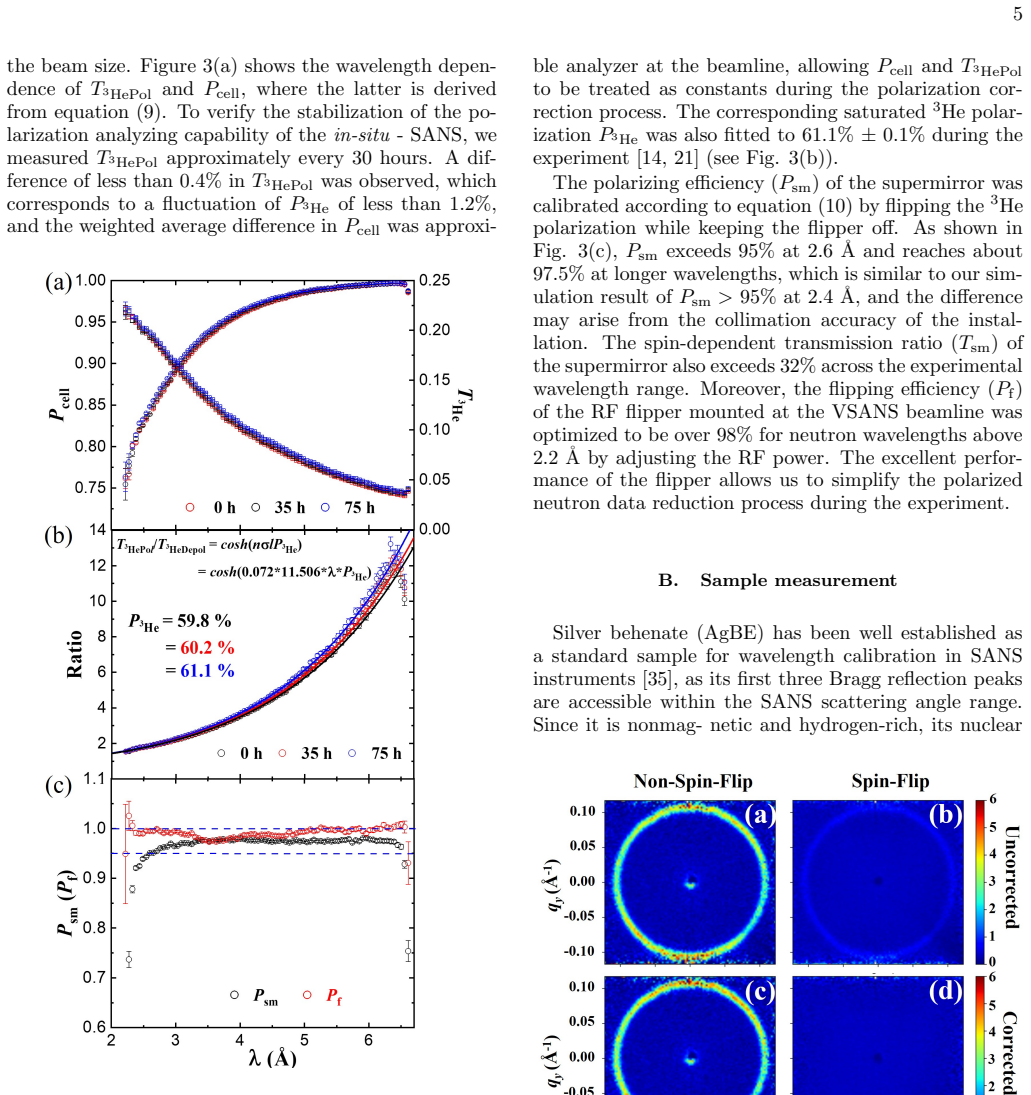
The paper establishes that PASANS is now operational at the newly commissioned VSANS instrument of the China Spallation Neutron Source. The instrument chain is a double-V cavity supermirror polarizer, an RF spin flipper, and a purpose-built in-situ $^{3}$He spin filter that sits 37 cm from the sample and accepts a symmetric 4.8° scattering cone. The in-situ cell reaches a $^{3}$He polarization of 61.1% by neutron transmission (62.3% by EPR) and is stable to within 1.2% over 75 hours, so its efficiency need not be re-measured for every dataset. A correction matrix built from supermirror polarization $P_{\mathrm{sm}}$, flipper efficiency $P_f$, and cell polarization $P_{\mathrm{cell}}$ re-assigns the measured intensities to the four spin channels $\sigma_{++}$, $\sigma_{--}$, $\sigma_{+-}$, $\sigma_{-+}$. On silver behenate, the corrected non-spin-flip channel retains the nuclear coherent Bragg rings while the spin-flip channel becomes flat, giving a clean separation of coherent from spin-incoherent scattering up to $q \approx 0.25\,\mathrm{\AA}^{-1}$.
Load-bearing premise
The whole correction assumes that the polarizing and flipping efficiencies measured with a narrow 2 mm pinhole beam are the same at every point of the 4.8° analyzer cone and across the detector; if they vary with position, the separated spin-flip and non-spin-flip maps are systematically wrong.
Editorial extensions
If this is right
- VSANS users at CSNS can now request spin-resolved small-angle scattering with a symmetric acceptance cone of about 4.8° and momentum transfers up to roughly $0.25\,\mathrm{\AA}^{-1}$ on a pulsed beam.
- The pulsed-beam correction procedure, validated on a standard sample, separates nuclear coherent from nuclear spin-incoherent scattering on an absolute scale, including a multiple-scattering weight ($m = 0.569$ for the measured silver behenate sample).
- Because the in-situ analyzer keeps $^{3}$He polarization stable within about 1.2% over 75 hours, a single calibration per experimental cycle suffices, avoiding the repeated cell changes and re-calibration of ex-situ filters.
- Magnetic samples measured in this mode will show spin-flip scattering from magnetization components perpendicular to the scattering vector, enabling studies of magnetic correlations, domains, and skyrmion-type textures without full three-dimensional polarimetry.
Reading between the lines
- If the spatial-uniformity assumption is verified, moving the $^{3}$He cell closer to the sample would extend the $q$ range beyond 0.25 Å⁻¹, at the cost of angular acceptance and background.
- A direct cross-check would be measuring magnetic nanoparticles with known magnetization: the recovered ratio of perpendicular magnetic spin-flip to non-spin-flip scattering should match magnetometry data.
- The time-of-flight correction scheme is written generically for pulsed beams and could be ported to other spallation-source SANS instruments that adopt an in-situ $^{3}$He analyzer.
- The fitted multiple-scattering weight $m$ implies that hydrogen-rich samples need thickness-dependent corrections; modeling $m$ as a function of sample thickness could improve incoherent-background subtraction in biological and polymer samples.
Signed reviews
Editorial analysis
A structured set of objections, weighed in public.
Referee Report
Summary. The paper reports the first implementation of polarization-analyzed small-angle neutron scattering (PASANS) at the Very Small Angle Neutron Scattering (VSANS) instrument at the China Spallation Neutron Source (CSNS). The setup combines a double-V supermirror polarizer, an RF spin flipper, and a newly developed in-situ optically pumped 3He neutron spin filter that covers approximately 4.8 degrees of scattering angle. The authors derive a data-reduction formalism for pulsed neutron beams, calibrate the polarizing and analyzing efficiencies, and validate the method with a silver behenate powder sample, separating non-spin-flip and spin-flip scattering and extracting nuclear coherent and spin-incoherent components up to about 0.25 Å-1. The central claim is that a stable PASANS capability is now available at CSNS for magnetic and incoherent-background-limited SANS studies.
Significance. If the calibration and correction procedure are quantitatively reliable, this is a valuable instrumental milestone: it makes PASANS available at a spallation source in China and demonstrates a capability that is currently available at only a few facilities worldwide. Strengths of the paper include the long-term stability characterization of the in-situ 3He cell (differences of less than 0.4% in T3HePol over 75 hours), the explicit pulsed-beam data-reduction formalism in Section III, and the use of silver behenate as a well-understood standard sample. The demonstration that the corrected spin-flip scattering is approximately flat while the non-spin-flip scattering retains the expected AgBE Bragg peaks is a physically appropriate validation. The paper does not ship code or machine-checked proofs, but the analytical derivations are transparent and follow established polarized-neutron formalism.
major comments (3)
- [Section IV.A and Eq. (12)] The polarization parameters Pcell, Psm, and Pf were calibrated with a 2 mm pinhole on the beam axis, but Eq. (12) applies these as scalar corrections to every detector pixel over the full 4.8-degree analyzer acceptance. If the 3He polarization or the supermirror efficiency varies across the beam footprint, the correction matrix will misestimate the leakage between spin-flip and non-spin-flip channels in a q-dependent way. The manuscript provides no spatial map of Pcell or Psm and no cross-check such as comparing the sum of corrected NSF+SF intensities with an unpolarized SANS measurement of the same sample. This is load-bearing because the quantitative separation of nuclear coherent and spin-incoherent scattering, including the claimed flatness of the corrected spin-flip signal, depends on the validity of this assumption.
- [Section IV.B and Fig. 5] The corrected spin-flip and non-spin-flip curves in Fig. 5 are presented without error bars or uncertainty propagation from the counting statistics and the correction matrix. The claim that the corrected spin-flip scattering is flat and q-independent cannot be assessed without uncertainties, and no fit or residual analysis is provided to quantify the flatness. Adding propagated uncertainties and a quantitative test of flatness is necessary to support the validation of the data-reduction method.
- [Section III, Eq. (12) and (13)] The notation for the coefficients B1 to B4 is stated as 'replacing the Psm with Psmf in A1 to A4', but the denominator C in Eq. (13) contains Psm and (Pf+1) rather than Psmf. It would be helpful to state explicitly whether the wavelength-dependent Psm, Pcell, Pf, and T3HePol values are applied bin-by-bin in λ before the q rebinning, and to define the exact form of B1-B4. As written, a reader cannot fully reproduce the correction without inferring these details.
minor comments (3)
- [Section II.B / Fig. 2 caption] The text says the 3He cell facilitates a scattering angle of about 4.8 degrees, while the Fig. 2 caption says the red θ denotes twice the neutron scattering angle (θ 4.8 degrees); the two conventions should be reconciled to avoid ambiguity about whether 4.8 degrees is the full cone angle or half-angle.
- [Throughout] There are several typographical errors, including 'clarfiy' in the Introduction, 'poalrizing' near Eq. (9), 'CONSLUSION' in the Section V heading, and 'spin-incohernet' near Eq. (15). These should be corrected.
- [Section IV.B] The multiple-scattering weight m is introduced and fitted as m = 0.569, but no uncertainty or goodness-of-fit information is given for this parameter. Reporting the fit range, uncertainty, and sensitivity would strengthen the interpretation of Eqs. (14)-(15).
Circularity Check
No significant circularity: the instrument calibrations and the polarization correction are independent of the silver behenate demonstration, and the PASANS capability is established by direct measurement rather than by self-referential fitting.
full rationale
The paper's central claim is an experimental commissioning result, and the derivation chain that supports it is self-contained. The polarization correction matrix in Eqs. (1)-(13) is written explicitly in terms of instrument efficiencies Pcell, Psm, and Pf, which are independently calibrated by neutron transmission measurements in Sec. IV.A (Eqs. 9-11); the correction is therefore not fitted to the silver behenate scattering data. The AgBE measurement in Sec. IV.B is a standard-sample demonstration, not a prediction: the NonSF and SF patterns are measured, corrected with the pre-calibrated parameters, and then compared with the expected Bragg scattering. The multiple-scattering parameter m in Eqs. (14)-(15) is fitted from the measured low-q intensity ratio as a characterization of the sample, and it is used only to separate N and I after the polarization correction; it does not generate the corrected spin-flip or non-spin-flip curves. The self-citations to earlier in-situ 3He NSF work document hardware provenance, polarization stability, and prior deployment, but the key quantities (Pcell, T3HePol stability, Psm, Pf) are measured and reported here, so no load-bearing argument reduces to an unverified self-citation. The reviewer-identified concern that pinhole-calibrated scalar efficiencies may not transfer across the full 4.8-degree analyzer acceptance is a possible systematic uncertainty in the data reduction, not a circularity: it is a spatial-uniformity assumption, not an input that defines the output. There is no step in which a predicted quantity is identical by construction to a fitted parameter or to a self-cited result.
Assumptions & free parameters
free parameters (1)
- m (multiple scattering weight) =
0.569
assumptions (6)
- standard math Blume-Maleyev spin decomposition: total scattering splits into NonSF (N + 1/3 I + M_perp_parallel) and SF (2/3 I + M_perp_perp).
- domain assumption AgBE is nonmagnetic and hydrogen-rich, so magnetic terms vanish and spin-incoherent scattering follows the approximate 2:1 SF/NonSF ratio.
- domain assumption 3He spin filter transmission follows Pcell = sqrt(1 - (Tdepol/Tpol)^2) with the cell polarization constant during the measurement.
- domain assumption Calibration of Psm, Pf, and Pcell with a 2 mm pinhole beam applies to the full-field scattering configuration.
- domain assumption Sample holder scattering is spin-independent and can be reduced assuming Pf=1.
- ad hoc to paper Multiple scattering in the 2 mm AgBE sample can be described by a q-independent weight m.
Cite this review
Pith. "Pith review of Polarization-Analyzed Small-Angle Neutron Scattering with an $\textit{in-situ}$ $^{3}$He neutron spin filter at the China Spallation Neutron Source." pith.science (2026). https://pith.science/paper/LJDB56BL
@misc{pith2026250113647,
  author       = {Pith},
  title        = {Pith review of: Polarization-Analyzed Small-Angle Neutron Scattering with an $\textitin-situ$ $^3$He neutron spin filter at the China Spallation Neutron Source},
  year         = {2026},
  howpublished = {\url{https://pith.science/paper/LJDB56BL}},
  note         = {Machine review of arXiv:2501.13647}
}
abstract
Polarization-analyzed small-angle neutron scattering (PASANS) is an advanced technique that enables the selective investigation of magnetic scattering phenomena in magnetic materials and distinguishes coherent scattering obscured by incoherent backgrounds, making it particularly valuable for cutting-edge research. The successful implementation of PASANS in China was achieved for the first time at the newly commissioned Very Small Angle Neutron Scattering (VSANS) instrument at the China Spallation Neutron Source (CSNS). This technique employs a combination of a double-V cavity supermirror polarizer and a radio frequency (RF) neutron spin flipper to manipulate the polarization of the incident neutrons. The scattered neutron polarization is stably analyzed by a specially designed $\textit{in-situ}$ optical pumping $^{3}$He neutron spin filter, which covers a spatially symmetric scattering angle coverage of about 4.8 $^{\circ}$. A comprehensive PASANS data reduction method, aimed at pulsed neutron beams, has been established and validated with a silver behenate powder sample, indicating a maximum momentum transfer coverage of approximately 0.25 {\AA} $^{-1}$.
Figures


Figures from the paper (1 more)

Reference graph
Works this paper leans on
-
[1]
X. H. Guo, N. M. Zhao, S. H. Chen, and J. Teixeira, Biopolymers 29, 2 (1990)
work page 1990
-
[2]
G. A. Baker, and W. T. Heller, Chem. Eng. J. 147, 1 (2009)
work page 2009
-
[3]
B. McCulloch, V. Ho, M. Hoarfrost, C. Stanley, C. Do, W. T. Heller, and R. A. Segalman, Macromolecules 46, 5 (2013)
work page 2013
- [4]
-
[5]
F. Jonietz, S. M¨ uhlbauer, C. Pfleiderer , A. Neubauer, W. M¨ unzer, A. Bauer, T. Adams, R. Georgii, P. B¨ oni, R. A. Duine, K. Everschor, M. Garst, and A. Rosch, Science 330, 6011 (2010)
work page 2010
-
[6]
R. M. Moon, T. Riste, and W. C. Koehler, Phys. Rev. 181, 920 (1969)
work page 1969
-
[7]
O. Sch¨ arpf, and H. Capellmann, Phys. Status Solidi A 135, 359 (1993)
work page 1993
-
[8]
G. L. Squires, Introduction to the Theory of Ther- mal Neutron Scattering(Dover Publications, New York, 1978), p. 171
work page 1978
Show all 35 references
-
[9]
K. L. Krycka, J. A. Borchers, R. A. Booth, Y. Ijiri, K. Hasz, J. J. Rhyne, and S. A. Majetich, Phys. Rev. Lett. 113, 147203 (2014)
2014
-
[10]
K. L. Krycka, R. A. Booth, C. R. Hogg, Y. Ijiri, J. A. Borchers, W. C. Chen, S. M. Watson, M. Laver, T. R. Gentile, L. R. Dedon, S. Harris, J. J. Rhyne, and S. A. Majetich Phys. Rev. Lett., 104, 207203 (2010)
2010
-
[11]
B. Das, J. T. Batley, K. L. Krycka, J. A. Borchers, P. Quarterman, C. Korostynski, M. Nguyen, I. Kamboj, E. S. Aydil, and C. Leighton, ACS Appl. Mater. Interfaces 14, 33491-33504 (2022)
2022
-
[12]
A. M. Gaspar, S. Busch, M.-S. Appavou, W. Haeussler, R. Georgii, Y. Su, and W. Doster, Biochim. Biophys. Acta, Proteins Proteomics 1804, 76-82 (2010)
2010
-
[13]
Z. Qin, C. Huang, Z. N. Buck, W. Kreuzpaintner, S. M. Amir, A. Salman, F. Ye, J. Zhang, C. Jiang, T. Wang, and X. Tong, Chin. Phys. Lett. 38, 052801 (2021)
2021
-
[14]
Huang, J
C. Huang, J. Zhang, F. Ye, Z. Qin, S. M. Amir, Z. N. Buck, A. Salman, W. Kreuzpaintner, X. Qi, T. Wang, and X. Tong, Chin. Phys. Lett. 38, 092801 (2021)
2021
-
[15]
Parnell, E
S.R. Parnell, E. Babcock, K. N¨ unighoff, M. W. A. Skoda, S. Boag, S. Masalovich, W.C. Chen, R. Georgii, J.M. Wild, and C.D. Frost, Nucl. Instr. and Meth. A 598, 774- 778 (2009)
2009
-
[16]
Coulter, T.E
K.P. Coulter, T.E. Chupp, A. B. McDonald, C. D. Bow- man, J. D. Bowman, J. J. Szymanski, V. Yuan, G. D. Cates, D. R. Benton, and E. D. Earle, Nucl. Instr. and Meth. A 288, 463-466 (1990)
1990
-
[17]
C. Y. Jiang, X. Tong, D. R. Brown, W. T. Lee, H. Am- baye, J. W. Craig, L. Crow, H. Culbertson, R. Goyette, M. K. Graves-Brook, M. E. Hagen, B. Kadron, V. Lauter, L. W. McCollum, J. L. Robertson, B. Winn, A. E. Van- degrift, Physics Procedia 42, 191-199 (2013)
2013
-
[18]
W. C. Chen, K. L. Krycka, S. M. Watson, J. G. Barker, J. Gaudet, H. Burrall, and J. A. Borchers, J. Phys.: Conf. Ser. 2481, 012006 (2023)
2023
-
[19]
A. V. Feoktystov, H. Frielinghaus, Z. Di, S. Jaksch, V. Pipich, M.-S. Appavou, E. Babcock, R. Hanslik, R. En- gels, G. Kemmerling, H. Kleines, A. Ioffe, D. Richterd, and T. Br¨ uckel, J. Appl. Cryst. 48, 61-70 (2015)
2015
-
[20]
C. D. Dewhurst, I. Grillo, D. Honecker, M. Bonnaud, M. Jacques, C. Amrouni, A. Perillo-Marcone, G. Manzin, and R. Cubitt, J. Appl. Cryst. 49, 1-14 (2016)
2016
-
[21]
Zhang, C
J. Zhang, C. Huang, Z. Qin, F. Ye, S. M. Amir, A. Salman, Y. Dong, L. Tian, Z. N. Buck, W. Kreuzpaint- ner, M. Musgrave, X. Qi, T. Wang, and X. Tong, Sci. China-Phys. Mech. Astron. 65, 4:241011 (2022)
2022
-
[22]
C. Y. Jiang, X. Tong, D. R. Brown, S. Chi, A. D. Chris- tianson, B. J. Kadron, J. L. Robertson, and B. L. Winn, Rev. Sci. Instrum. 85, 075112 (2014)
2014
-
[23]
Hayashida, K
H. Hayashida, K. Hiroi, T. Oku, H. Kira, K. Sakai, T. Shinohara, T. Kai, J.D. Parker, Y. Matsumoto, S.Y. Zhang, T. Ino, M. Ohkawara, and K. Kakurai, Phys. Pro- cedia 88, 231 (2017)
2017
-
[24]
Okudaira, T
T. Okudaira, T. Oku, T. Ino, H. Hayashida, H. Kira, K. Sakai, K. Hiroi, S. Takahashi, K. Aizawa, H. Endo, S. Endo, M. Hino, K. Hirota, T. Honda, K. Ikeda, K. Kaku- rai, W. Kambara, M. Kitaguchi, T. Oda, H. Ohshita, T. Otomo, H. M. Shimizu, T. Shinohara, J. Suzuki, and T. Yamam...
2020
-
[25]
Salhi, E
Z. Salhi, E. Babcock, K. Bing¨ ol, K. Bussmann, H. Kam- merling, V. Ossovyi, A. Heynen, H. Deng, V. Hutanu, S. Masalovich, J. Voigt, and A. Ioffe, J. Phys.-Conf. Ser. 1316, 012009 (2019)
2019
-
[26]
T. Zuo, Z. Han, C. Ma, S. Xiao, X. Lin, Y. Li, F. Wang, Y. He, Z. He, J. Zhang, G. Wang, and H. Cheng, J. Appl. Cryst. 57, 380-391 (2024)
2024
-
[27]
L. Tian, A. Salman, C. Huang, Y. Dong, F. Ye, Z. Qin, W. Kreuzpaintner, J. Zhang, T. Wang and X. Tong, Nucl. Sci. Tech. 34, 146 (2023)
2023
-
[28]
Salman, J
A. Salman, J. Rong, J. Yang, J. Zhang, C. Huang, F. Ye, 8 Z. Qin, X. Jiang, S. M. Amir, W. Kreuzpaintner, Z. Sun, T. Wang, and X. Tong, Chinese Phys. Lett. 39 062901 (2022)
2022
-
[29]
J. Tang, B. Wang, C. Huang, H. Gao, Q. Zheng, R. Liu, F. Ye, Z. Qin, T. Wang, A. Salman, Y. Dong, L. Tian, C. Deng, J. Li, L. Liu, X. Qi, J. Zhang, and X. Tong, Chinese Phys. Lett.. Accepted
-
[30]
Blume, Phys
M. Blume, Phys. Rev. 130, 1670 (1963)
1963
-
[31]
S. V. Maleyev, V. G. Baryakhtar, and A. Suris, Sov. Phys. Solid State 4, 2533 (1963)
1963
-
[32]
Krycka, W
K. Krycka, W. Chen, J. Borchers, B. Maranvillea, and S. Watson, J. Appl. Cryst. 45, 546-553 (2012)
2012
-
[33]
Nambu, M
Y. Nambu, M. Enderle, T. Weber, and K. Kakurai, J. Phys.: Conf. Ser. 2481, 012004 (2023)
2023
-
[34]
A. R. Wildes, Rev. Sci. Instrum. 70, 11 (1999)
1999
-
[35]
Gilles, U
R. Gilles, U. Keiderling and A. Wiedenmann, J. Appl. Cryst. 31, 957-959 (1998)
1998
Reviewed August 10, 2026 · model on record in the stance chip above.
Discussion (0). Continue with ORCID to comment.