REVIEW 3 major objections 4 minor 37 references
Hierarchies of quantum non-Gaussian coherences for bosonic systems: A theoretical study
T0 review · 3 major / 4 minor · reviewed 2026-08-10 · deepseek-v4-flash
Pith's one-line read A single Fock-basis coherence element can certify quantum non-Gaussian coherence, provided it beats hierarchy-specific thresholds defined by what Gaussian squeezing and displacement can generate from restricted core states.
desk verdict Genuine extension of the non-Gaussianity hierarchy program to off-diagonal Fock coherences, but the certification thresholds rest on an unproved conjecture and random sampling, so the numbers are provisional. read the letter →
The pith
A machine-rendered reading of the paper's core claim, the machinery that carries it, and where it could break.
The reading
What carries the argument
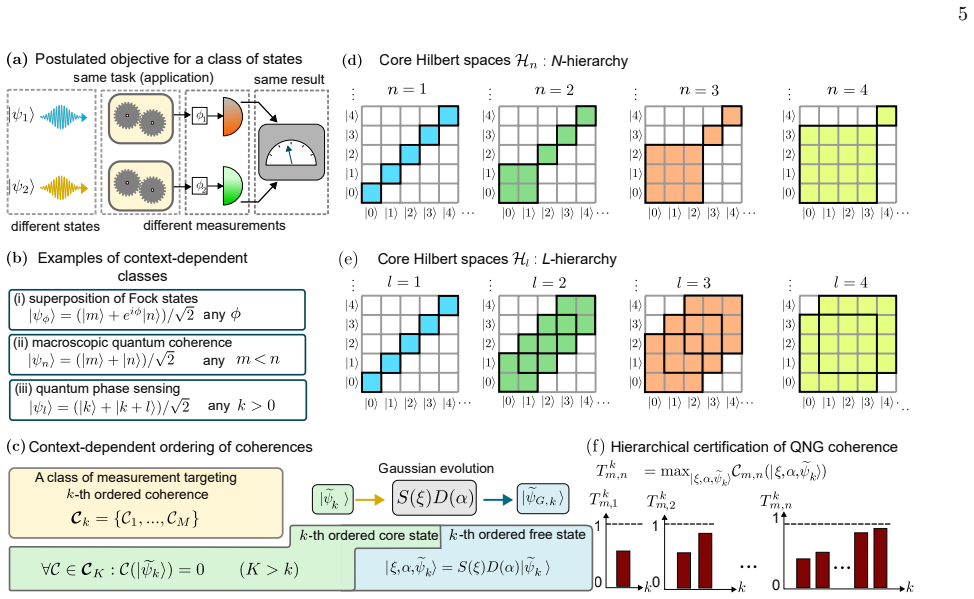
The load-bearing object is the coherence measure $C_{m,n}(\rho)=\tfrac12\left[\max_\phi \mathrm{Tr}[\rho X_{m,n}(\phi)]-\min_\phi \mathrm{Tr}[\rho X_{m,n}(\phi)]\right]$ with $X_{m,n}(\phi)=e^{i\phi}|m\rangle\langle n|+e^{-i\phi}|n\rangle\langle m|$, which isolates $|\langle m|\rho|n\rangle|$. Around it the paper builds core Hilbert spaces $H_k$ of Fock states below a given order; free states are Gaussian images $S(\xi)D(\alpha)|\tilde\psi_k\rangle$ of core states. The thresholds $T^{N,k}_{m,n}$ and $T^{L,r}_{k,l}$ are suprema of $C_{m,n}$ over these free states, computed via an eigenvector method for optimizing over core states and polynomial root-finding for the displacement parameter. Relative criteria replace the single threshold with $\min_\lambda[F_{m,n}(\lambda)-\lambda P]$, where $F_{m,n}(\lambda)$ is the maximum of $C_{m,n}+\lambda P$ over free states and $P$ is a diagonal probability; this is the mechanism that relaxes experimental requirements.
What would settle it
Find any core state in the allowed Hilbert space and any squeezing and displacement parameters $\xi,\alpha$ such that $C_{m,n}(S(\xi)D(\alpha)|\tilde\psi\rangle)$ exceeds the quoted $T^{N,k}_{m,n}$ or $T^{L,r}_{k,l}$ for a small case such as $C_{0,4}$; a global numerical optimization producing such a counterexample would refute the claimed bounds.
Extended reading notes
Core claim
The central claim is that individual Fock-basis coherence elements carry enough information to certify quantum non-Gaussian coherence in a hierarchically ordered way. For each target superposition $(|m\rangle+|n\rangle)/\sqrt{2}$, the paper defines thresholds $T^{N,k}_{m,n}$ and $T^{L,r}_{k,l}$ as the maximum of $C_{m,n}$ over states $S(\xi)D(\alpha)|\tilde\psi\rangle$ obtained by applying Gaussian squeezing and displacement to a core state of order $k$ or $r$—states whose coherence is restricted to lower Fock levels or shorter Fock separations. A measured coherence exceeding such a threshold proves the state is not a Gaussian-transformed core state of that order. The paper derives thresholds for representative cases such as $C_{0,4}$, $C_{3,4}$ and $C_{1,2}$, shows that the two hierarchies give different orderings of the same coherences, and introduces relative criteria that combine $C_{m,n}$ with diagonal probabilities to lower the experimental bar while preserving the hierarchy.
Load-bearing premise
The thresholds are computed by assuming that the maximum coherence occurs for a specific narrow family of core states and Gaussian parameters; if a state outside that family achieves more coherence, every threshold in the paper is too low.
Editorial extensions
If this is right
- A measured coherence above $T^{N,k}_{m,n}$ certifies that the state is not reachable by squeezing and displacing any order-$k$ core state whose coherence is confined to Fock levels below $n$.
- The two hierarchies classify the same coherence differently: for $C_{3,4}$ the $N$-hierarchy supports thresholds up to third order while the $L$-hierarchy admits only first order, whereas for $C_{0,4}$ the $L$-hierarchy's second-order threshold is stricter than the $N$-hierarchy's.
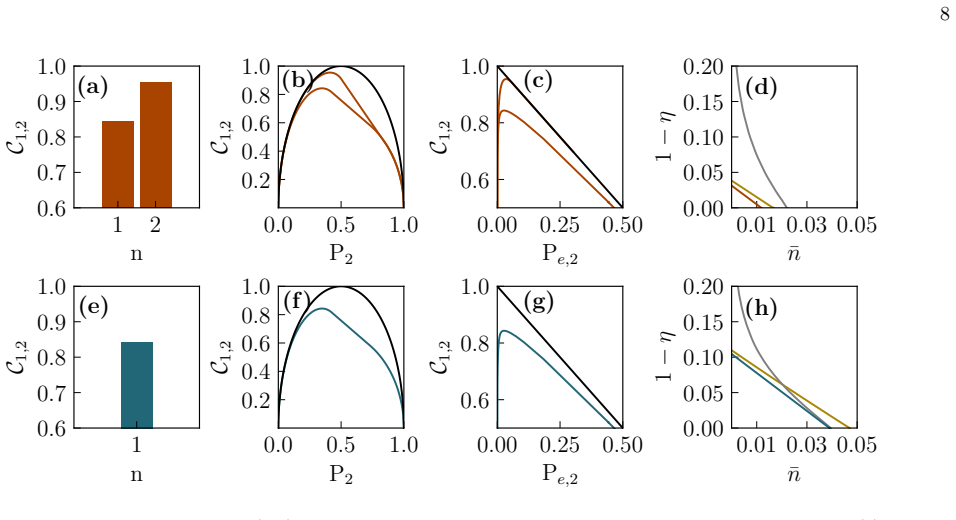
- Adding diagonal probabilities such as $P_n$ or the multi-photon error probability $P_{e,n}$ lowers the coherence value needed for certification while keeping the hierarchical ordering intact.
- Loss and thermal depths quantify how much imperfection each threshold tolerates; for $C_{3,4}$ the highest $N$-hierarchy threshold permits about seven times smaller loss and thermal noise than the highest $L$-hierarchy threshold.
- The same construction extends to unbalanced superpositions, multi-state coherences, and multi-mode coherences, which the authors link to dual-rail binomial codes and sensing protocols.
Reading between the lines
- Because the thresholds rest on an unproved conjecture about where the global maximum occurs, the numerical values should be treated as certified bounds only under that conjecture; a broader optimization could raise them and would make current certifications stricter rather than looser.
- The context-dependent ordering suggests an application-driven choice: experiments aimed at bosonic error correction or phase sensing should use the $L$-hierarchy, while experiments targeting macroscopic superpositions should use the $N$-hierarchy, and the two should not be compared as if they ranked the same resource.
- The relative criterion involving $P_{e,n}$ tolerates arbitrarily large loss in the noiseless limit, which implies that photon-number-resolving detection of high-Fock errors can substitute for high transmission in practical certification.
- A direct falsification test would be to run a global numerical optimizer over core states and Gaussian parameters for a small case such as $C_{0,4}$ and check whether any free state exceeds the quoted $T^{N,k}_{m,n}$ or $T^{L,r}_{k,l}$.
Signed reviews
Editorial analysis
A structured set of objections, weighed in public.
Referee Report
Summary. The paper introduces a framework for certifying quantum non-Gaussian (QNG) coherence in the Fock-state basis by comparing individual off-diagonal coherence elements C_{m,n}(ρ) against thresholds derived from Gaussian dynamics acting on restricted 'core states.' Two context-dependent hierarchies are constructed: an N-hierarchy ordered by the larger Fock index n, and an L-hierarchy ordered by the Fock-number difference l = n−m. The paper further develops 'relative criteria' that combine C_{m,n} with diagonal probabilities to relax experimental requirements, and it analyzes the robustness of these criteria under loss and thermal noise using a first-order perturbative model. The central claim is that exceeding a hierarchy-dependent threshold certifies that the tested coherence cannot be produced by any free state of the corresponding order, yielding a structured, application-oriented classification of QNG coherence.
Significance. If the numerical thresholds are valid, the framework is a useful and operational complement to global coherence measures and to stellar-rank classification: it isolates individual off-diagonal elements accessible via interferometric measurements, provides two distinct orderings with clear operational interpretations (macroscopic Fock number versus Fock separation for sensing and error correction), and offers relaxed relative criteria that are experimentally attractive. The paper is clearly written and builds on established techniques such as the Fiurášek eigenvector method. Its main quantitative predictions, however, depend on global maxima of nonconvex functions that are not rigorously established; this makes the thresholds, and every hierarchy comparison and depth estimate built on them, conditional on an unverified conjecture.
major comments (3)
- [Sec. IV B, Eqs. (6)–(7); Appendix A] The thresholds T^{N,k}_{m,n} and T^{L,r}_{k,l} are defined as global maxima over all Gaussian evolutions S(ξ)D(α) of all core states in a specified family. The paper explicitly states in Sec. IV B: 'we guess for which parameters the maximum occurs and, then, we use random sampling of the parameters ξ, α, φ, l and θ to verify the estimated maximum,' and Appendix A states that the maximum over ξ and α is obtained 'by random sampling and taking the maximal attempt.' This does not establish a global maximum. Because each threshold is used as an upper bound on all free states, any missed global maximum makes the threshold too low and would cause a Gaussian-generated free state to be falsely certified as having QNG coherence. This is not a peripheral numerical issue: the hierarchy comparisons, the relative criteria in Eqs. (10)–(16), and the depth analyses all inherit these threshold values. The authors should either provide a rigorous global-optimization certificate (e.g., an analytic bound, interval/branch-and-bound method, or a convex relaxation) for each reported threshold, or clearly state the maximizing-family conjecture as such and provide a systematic, dense numerical search with convergence evidence. As written, the central certification claim is conditional on an unverified maximization.
- [Sec. III A, Eq. (4); Appendix A, Fig. 6] The claim that thresholds T^{(N)}_{m,n} tend to unity for large N is supported only by selected numerical examples, primarily for m=0 and m=n−1, with N up to 20. This convergence is used to justify the argument that employing thresholds with N≫1 imposes the unattainable condition C_{m,n}=1, which in turn motivates the finite-order hierarchies. Since no proof of generic convergence is given, and the numerical evidence covers a restricted set of (m,n) pairs, the assertion 'we numerically verified this tendency' does not establish the general behavior. If for some (m,n) the limit is below 1, the statement that 'employing the thresholds T^{(N)}_{m,n} with N≫1 for benchmarking implies the condition C_{m,n}=1' would be false, affecting the conceptual foundation of the hierarchy construction. The authors should either provide a proof or clearly state this as a conjecture and delineate the numerical evidence for it.
- [Sec. IV B–C, Eqs. (10)–(16)] The relative criteria are derived by computing F_{m,n}(λ) = max_{ξ,α,|ψ̃_k⟩} [C_{m,n} + λ P] and then forming the Legendre-type expression min_λ [F_{m,n}(λ) − λ P]. The validity of the resulting witness requires F_{m,n}(λ) to be the exact global maximum over the entire free-state family. Because the maximization is the same unverified one criticized above, the relative criteria inherit the same false-positive risk. Additionally, the final minimization over λ (and λ1,λ2 in Sec. IV C) is performed numerically without reporting error bars or convergence tests, so the relaxed thresholds in Figs. 4 and 5 are as conditional as the absolute thresholds. The authors should clarify how the numerical minimization is certified and, ideally, provide a rigorous bounding argument for F_{m,n}(λ) before presenting the relative criteria as definitive witnesses.
minor comments (4)
- [Eq. (8) and Figs. 3, 4] The model in Eq. (8) is stated to be valid only in the limits 1−η ≪ 1 and n̄ ≪ 1, but the plots in Figs. 3(e)–(h) and 4(d) display parameter ranges extending to 1−η = 0.5. Please clarify whether the reported depth values remain within the model's validity regime or whether some curves are extrapolations beyond it.
- [Sec. III D and Fig. 3 caption] There are several apparent typos: in Sec. III D, 'T^{L,1}_{3,1}=0.8' should presumably read 'T^{L,1}_{3,4}=0.8'; the Fig. 3 caption contains 'repectively' and 'T^{l,k}_{3,4}' which should likely be 'T^{L,k}_{3,4}'; and Appendix A's title has 'Hibert space' instead of 'Hilbert space.'
- [Sec. II B] The sentence 'As basis states, no Fock state can obey this criterion despite their non-Gaussian nature [6]' is confusing: Fock states have zero coherence C_{m,n}=0, so they trivially fail any positive threshold. Please rephrase to clarify that the statement concerns the inadequacy of using Fock states alone as reference states.
- [General notation] The notation for thresholds (t̃_{m,n}, t_{m,n}, T̃_{m,n}, T^{(N)}_{m,n}, T^{N,k}_{m,n}, T^{L,r}_{k,l}) is introduced quickly and used in multiple places. A table summarizing each quantity, its defining free-state family, and its role in the hierarchies would significantly improve readability.
Circularity Check
No circularity found: the thresholds are defined as maxima over explicitly stated free-state families, and the unproved global-maximum conjecture is a rigor gap, not a circular reduction.
full rationale
We find no circular reduction in the derivation chain. The central thresholds in Eqs. (4)-(7) are defined as genuine maximizations over explicitly enumerated free-state families, namely Gaussian dynamics acting on core states, and the reported threshold values are numerical evaluations of those maxima rather than fitted parameters or renamed inputs. The relative criteria in Eqs. (9)-(16) are constructed via a convex Legendre-type optimization over the same free-state sets, so they inherit the free-state definition without importing the target conclusion. The optimization procedure of Ref. [24] is external to the present authors and is used as a computational tool; the authors' own prior hierarchy, Ref. [6], serves as conceptual motivation and not as a premise that forces the numerical thresholds. The paper's main weakness, which the authors explicitly disclose in Section IV B, is that they conjecture where the global maximum occurs, restrict the search to phi = 0, theta in {0, pi}, and two specific core-state families, and verify only by random sampling. Similarly, Appendix A obtains maxima over xi and alpha by random sampling and taking the maximal attempt. If the true global maxima lie outside the searched families, the thresholds would be too low and free states could be falsely certified. This is a numerical validation and rigor gap, not a circularity, because the definitions do not assume the target answer. The score of 2 reflects the presence of several self-citations that are not load-bearing; the central derivation remains self-contained.
Assumptions & free parameters
free parameters (2)
- λ, λ1, λ2 in relative criteria =
scanned over real values; not fitted to data
- Hilbert-space truncation N for convergence tests =
N = 10 and N = 20 in Appendix A
assumptions (4)
- domain assumption Gaussian operations S(ξ)D(α) and Fock states are treated as free states and free operations in the resource hierarchy.
- ad hoc to paper The maximizing states for relative criteria lie in the conjectured family: φ=0, θ∈{0,π}, and core states restricted to two specific superpositions.
- ad hoc to paper The thresholds T_{m,n}^{(N)} converge to 1 for large N, inferred from selected numerical examples.
- domain assumption The noise model in Eq. (8) accurately describes loss and thermalization even when depth analysis considers larger deviations than the stated validity 1-η≪1 and nbar≪1.
Cite this review
Pith. "Pith review of Hierarchies of quantum non-Gaussian coherences for bosonic systems: A theoretical study." pith.science (2026). https://pith.science/paper/JK36MYFC
@misc{pith2026250114033,
  author       = {Pith},
  title        = {Pith review of: Hierarchies of quantum non-Gaussian coherences for bosonic systems: A theoretical study},
  year         = {2026},
  howpublished = {\url{https://pith.science/paper/JK36MYFC}},
  note         = {Machine review of arXiv:2501.14033}
}
read the original abstract
Quantum coherence in bosonic systems is a fundamental resource for quantum technology applications. In this work, we introduce a framework for analyzing coherence in the Fock-state basis, utilizing context-dependent certification to reveal the quantum non-Gaussian nature of the tested coherence. Rather than relying on global coherence measures, our approach targets specific aspects of coherence, enabling a tailored hierarchical classification. We derive and compare two distinct hierarchies, each representing a different context for coherence in bosonic systems. Motivated by current advancements in optical quantum state engineering, we assess the feasibility and depth of these hierarchies under conditions of loss and thermal noise. The methodology introduced here is versatile and can be extended to multi-state and multi-mode coherences, making it adaptable to a wide range of experimental scenarios and platforms.
Figures


Figures from the paper (3 more)


Reference graph
Works this paper leans on
-
[1]
Walschaers, Non-Gaussian Quantum States and Where to Find Them, PRX Quantum 2, 030204 (2021)
M. Walschaers, Non-Gaussian Quantum States and Where to Find Them, PRX Quantum 2, 030204 (2021)
2021
-
[2]
R. Filip and L. Miˇ sta, Detecting Quantum States with a Positive Wigner Function beyond Mixtures of Gaussian States, Phys. Rev. Lett. 106, 200401 (2011)
work page 2011
-
[3]
M. Jeˇ zek, A. Tipsmark, R. Dong, J. Fiur´ asˇ ek, L. Miˇ sta, R. Filip, and U. L. Andersen, Experimental test of the strongly nonclassical character of a noisy squeezed single- photon state, Phys. Rev. A 86, 043813 (2012)
work page 2012
- [4]
- [5]
-
[6]
L. Lachman, I. Straka, J. Hlouˇ sek, M. Jeˇ zek, and R. Filip, Faithful Hierarchy of Genuine n-Photon Quantum Non- Gaussian Light, Phys. Rev. Lett. 123, 043601 (2019)
work page 2019
-
[7]
L. Podhora, L. Lachman, T. Pham, A. Leˇ sund´ ak, O.ˇC ´ ıp, L. Slodiˇ cka, and R. Filip, Quantum Non-Gaussianity of Multiphonon States of a Single Atom, Phys. Rev. Lett. 129, 013602 (2022)
work page 2022
-
[8]
Chabaud, D
U. Chabaud, D. Markham, and F. Grosshans, Stellar Representation of Non-Gaussian Quantum States, Phys. Rev. Lett. 124, 063605 (2020)
2020
Show all 37 references
-
[9]
Wolf and L
E. Wolf and L. Mandel, Optical coherence and quantum optics (Cambridge University Press, 1995)
1995
-
[10]
Streltsov, G
A. Streltsov, G. Adesso, and M. B. Plenio, Colloquium: Quantum coherence as a resource, Rev. Mod. Phys. 89, 041003 (2017)
2017
-
[11]
B. E. Asenbeck, L. Lachman, A. Boyer, P. Giri, A. Urvoy, R. Filip, and J. Laurat, Hierarchical Verification of Non- Gaussian Coherence in Bosonic Quantum States, Phys. Rev. Lett. 134, 233604 (2025)
2025
-
[12]
Baumgratz, M
T. Baumgratz, M. Cramer, and M. B. Plenio, Quantify- ing Coherence, Phys. Rev. Lett. 113, 140401 (2014)
2014
-
[13]
B. Q. Baragiola, G. Pantaleoni, R. N. Alexander, A. Karanjai, and N. C. Menicucci, All-Gaussian Universality and Fault Tolerance with the Gottesman-Kitaev-Preskill Code, Phys. Rev. Lett. 123, 200502 (2019)
2019
-
[14]
Campagne-Ibarcq, A
P. Campagne-Ibarcq, A. Eickbusch, S. Touzard, E. Zalys- Geller, N. E. Frattini, V. V. Sivak, P. Reinhold, S. Puri, S. Shankar, R. J. Schoelkopf et al. , Quantum error cor- rection of a qubit encoded in grid states of an oscillator, Nature 584, 368–372 (2020)
2020
-
[15]
Giovannetti, S
V. Giovannetti, S. Lloyd, and L. Maccone, Quantum Metrology, Phys. Rev. Lett. 96, 010401 (2006)
2006
-
[16]
K. C. McCormick, J. Keller, S. C. Burd, D. J. Wineland, A. C. Wilson, and D. Leibfried, Quantum-enhanced sens- ing of a single-ion mechanical oscillator, Nature 572, 86– 90 (2019)
2019
-
[17]
M. H. Michael, M. Silveri, R. T. Brierley, V. V. Albert, J. Salmilehto, L. Jiang, and S. M. Girvin, New Class of Quantum Error-Correcting Codes for a Bosonic Mode, Phys. Rev. X 6, 031006 (2016). 11
2016
-
[18]
Q. A. Turchette, C. J. Myatt, B. E. King, C. A. Sackett, D. Kielpinski, W. Itano, C. Monroe, and D. J. Wineland, Decoherence and decay of motional quantum states of a trapped atom coupled to engineered reservoirs, Phys. Rev. A 62, 053807 (2000)
2000
-
[19]
C. J. Myatt, B. E. King, Q. A. Turchette, C. A. Sack- ett, D. Kielpinski, W. M. Itano, C. Monroe, and D. J. Wineland, Decoherence of quantum superpositions through coupling to engineered reservoirs, Nature 403, 269–273 (2000)
2000
-
[20]
Y. Chu, P. Kharel, T. Yoon, L. Frunzio, P. Rakich, and R. J. Schoelkopf, Creation and control of multi-phonon Fock states in a bulk acoustic-wave resonator, Nature 563, 666–670 (2018)
2018
-
[21]
W. Wang, L. Hu, Y. Xu, K. Liu, Y. Ma, S.-B. Zheng, R. Vijay, Y. Song, L.-M. Duan, and L. Sun, Converting Quasiclassical States into Arbitrary Fock State Superpo- sitions in a Superconducting Circuit, Phys. Rev. Lett. 118, 223604 (2017)
2017
-
[22]
Y. Lu, I. Strandberg, F. Quijandr ´ ıa, G. Johansson, S. Gasparinetti, and P. Delsing, Propagating Wigner- Negative States Generated from the Steady-State Emis- sion of a Superconducting Qubit, Phys. Rev. Lett. 126, 253602 (2021)
2021
-
[23]
Loudon, The quantum theory of light (Oxford Uni- versity Press, 2000)
R. Loudon, The quantum theory of light (Oxford Uni- versity Press, 2000)
2000
-
[24]
Fiur´ aˇ sek, Efficient construction of witnesses of the stel- lar rank of nonclassical states of light, Opt
J. Fiur´ aˇ sek, Efficient construction of witnesses of the stel- lar rank of nonclassical states of light, Opt. Express 30, 30630 (2022)
2022
-
[25]
Ourjoumtsev, R
A. Ourjoumtsev, R. Tualle-Brouri, J. Laurat, and P. Grangier, Generating Optical Schr¨ odinger Kittens for Quantum Information Processing, Science 312, 83–86 (2006)
2006
-
[26]
Huang, H
K. Huang, H. Le, J. Ruaudel, V. B. Verma, M. D. Shaw, F. Marsili, S. W. Nam, E. Wu, H. Zeng, Y. Jeong et al. , Optical Synthesis of Large-Amplitude Squeezed Coherent-State Superpositions with Minimal Resources, Phys. Rev. Lett. 115, 023602 (2015)
2015
-
[27]
Cotte, H
V. Cotte, H. Simon, B. Pointard, and R. Tualle-Brouri, Experimental generation of coherent-state superpositions with a quantum memory, Phys. Rev. Res. 4, 043170 (2022)
2022
-
[28]
Darras, B
T. Darras, B. E. Asenbeck, G. Guccione, A. Cavaill` es, H. Le Jeannic, J. Laurat, A quantum-bit encoding con- verter, Nat. Photonics 17, 165–170 (2022)
2022
-
[29]
Konno, W
S. Konno, W. Asavanant, F. Hanamura, H. Nagayoshi, K. Fukui, A. Sakaguchi, R. Ide, F. China, M. Yabuno, S. Miki, et al. , Logical states for fault-tolerant quantum computation with propagating light, Science 383, 289– 293 (2024)
2024
-
[30]
T. P. Harty, D. T. C. Allcock, C. J. Ballance, L. Guidoni, H. A. Janacek, N. M. Linke, D. N. Stacey, and D. M. Lucas, High-Fidelity Preparation, Gates, Memory, and Readout of a Trapped-Ion Quantum Bit, Phys. Rev. Lett. 113, 220501 (2014)
2014
-
[31]
Fl¨ uhmann, T
C. Fl¨ uhmann, T. L. Nguyen, M. Marinelli, V. Negnevit- sky, K. Mehta, and J. P. Home, Encoding a qubit in a trapped-ion mechanical oscillator, Nature 566, 513–517 (2019)
2019
-
[32]
Magro, J
V. Magro, J. Vaneecloo, S. Garcia, and A. Ourjoumtsev, Deterministic freely propagating photonic qubits with negative Wigner functions, Nat. Photonics 17, 688–693 (2023)
2023
-
[33]
W. Wang, Y. Wu, Y. Ma, W. Cai, L. Hu, X. Mu, Y. Xu, Z.-J. Chen, H. Wang, Y. Song et al. , Heisenberg- limited single-mode quantum metrology in a supercon- ducting circuit, Nat. Commun. 10, 4382 (2019)
2019
-
[34]
Innocenti, L
L. Innocenti, L. Lachman, and R. Filip, Nonclassicality detection from few Fock-state probabilities, Npj Quan- tum Inf. 8, 30 (2022)
2022
-
[35]
Innocenti, L
L. Innocenti, L. Lachman, and R. Filip, Coherence-Based Operational Nonclassicality Criteria, Phys. Rev. Lett. 131, 160201 (2023)
2023
-
[36]
Lachman, and R
L. Lachman, and R. Filip, Quantum Non-Gaussian Pho- ton Coincidences, Phys. Rev. Lett. 126, 213604 (2021)
2021
-
[37]
Liu, Y.-K
R.-Z. Liu, Y.-K. Qiao, L. Lachman, Z.-X. Ge, T.-H. Chung, J.-Y. Zhao, H. Li, L. You, R. Filip, and Y. Huo, Experimental Quantum Non-Gaussian Coincidences of Entangled Photons, Phys. Rev. Lett.132, 083601 (2024)
2024
Reviewed August 10, 2026 · model on record in the stance chip above.
Discussion (0). Continue with ORCID to comment.