REVIEW 4 major objections 6 minor 44 references
Classical and Quantum Phase Transitions in Multiscale Media: Universality and Critical Exponents in the Fractional Ising Model
T0 review · 4 major / 6 minor · reviewed 2026-08-10 · deepseek-v4-flash
Pith's one-line read A fractional Ising model ties the Hausdorff dimension directly to the fractional order q, with η = 2 − q in the classical 1D case.
desk verdict The paper's headline H_D = q is an undeclared inference from an unvalidated gauge-theory relation, not a measurement, and the numerical support is absent from the text. read the letter →
The pith
A machine-rendered reading of the paper's core claim, the machinery that carries it, and where it could break.
The reading
What carries the argument
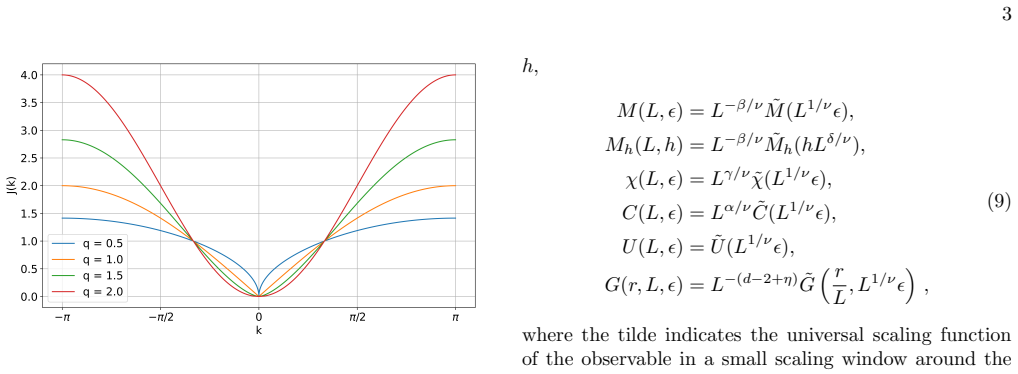
The central object is the Riesz fractional derivative discretized on a lattice through Ortigueira's centered finite-difference operator, giving spin-spin couplings J(r) = (−1)^{r+1} binomial(q, q/2 + r) that decay asymptotically as $r^{{−(1+q)}}$ + $r^{{−(3+q)}}$. In momentum space the coupling becomes |2 sin(k/2)|^q, reducing to |k|^q at long wavelengths, which is the regime governing critical behavior. This machinery carries the argument by feeding into finite-size scaling analyses that extract six critical exponents; the dual relation η + H_D = 2 then converts the measured anomalous dimension into a Hausdorff dimension, yielding the geometric identification H_D = q.
What would settle it
Compute the connected correlation function G(r) at the critical point of the 1D classical fractional Ising model for several q values and fit G(r) ~ $r^{{−(d−2+η)}}$; if the fitted η disagrees with 2 − q beyond statistical error, the central claim H_D = q fails. Alternatively, measure the Hausdorff dimension of critical spin clusters directly by box counting and compare it with q.
Extended reading notes
Core claim
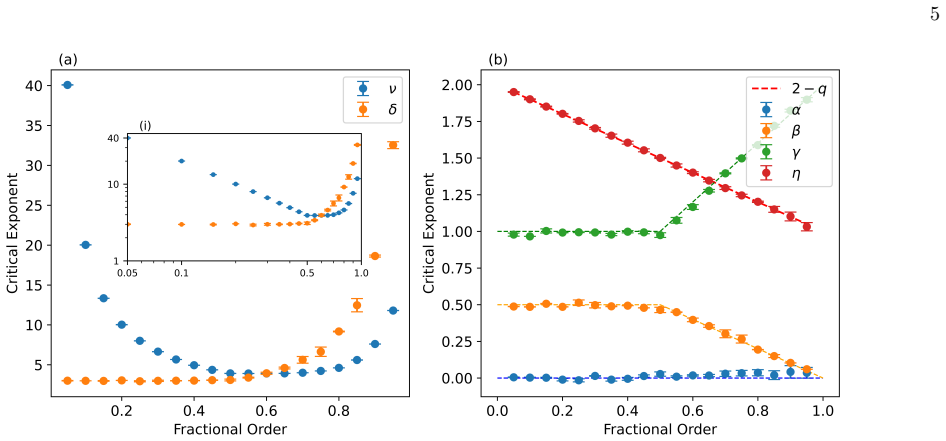
For the 1D classical fractional Ising model, the paper claims the anomalous dimension is η(q) = 2 − q, and together with the dual relation η + H_D = 2 (attributed to Hove et al. [43]) this implies H_D = q. The authors report a claimed 3.8σ confidence in this result based on bootstrapped variance. For the quantum transverse-field fractional Ising model in 1D, the same correspondence yields a covariance of approximately 0.75 between H_D and q instead of the classical unit covariance, which they attribute to the additional degrees of freedom introduced by quantum fluctuations. The paper further claims that below q < d/2 the exponents β and γ freeze at mean-field values while ν and η continue to vary, and that the fractional order acts as a marginal parameter that continuously changes the universality class of the system.
Load-bearing premise
The paper's geometric conclusion rests on applying the relation η + H_D = 2, originally derived for Abelian gauge theories, to the fractional Ising model; if that duality does not hold here, then H_D = q does not follow from η = 2 − q.
Editorial extensions
If this is right
- The fractional order q directly sets the Hausdorff dimension of critical fluctuations in the classical model, so a system with fractional interactions at order q should display fractal clusters of dimension q.
- Critical exponents vary continuously with q, meaning the universality class is not fixed but can be dialed across a family of critical points.
- Phase transitions become possible in 1D for q < 1 (classical) and q < 2 (quantum), bypassing the usual lower-critical-dimension restriction.
- For q < d/2, local exponents freeze to mean-field values while global exponents keep varying, providing a regime where some universal scalings are insensitive to the fractional order.
- In the quantum model the fractional order remains tunable over the wider range 0 < q ≤ 2, which may be relevant for engineered quantum simulators and materials.
Reading between the lines
- A direct test of H_D = q would be to measure the box-counting dimension of critical spin clusters in Monte Carlo snapshots of the 1D fractional Ising model and compare it with q, independent of the η-based route.
- Because the couplings asymptote to a power law r^{−(1+q)}, the fractional Ising model may belong to the same universality class as a power-law long-range Ising model with a specific decay exponent; comparing their critical exponents would clarify whether fractional derivatives introduce genuinely new scaling or merely emulate a known long-range interaction.
- The quantum covariance of about 0.75, if confirmed, suggests the effective Hausdorff dimension in the d+1 dimensional critical system is not simply q but a q-dependent fraction; a renormalization-group calculation could predict that factor analytically.
- The prediction that β and γ freeze below q < d/2 could be tested on quantum simulators with tunable fractional interactions, since tuning the fractional order through d/2 should sharply switch the dependence of magnetization and susceptibility exponents on q.
Editorial analysis
A structured set of objections, weighed in public.
Referee Report
Summary. The manuscript introduces a 'Lévy crystal' fractional Ising model in which the spatial derivative is replaced by a Riesz fractional derivative of order q, giving power-law interactions J(r) ~ r^{-(1+q)} plus subleading corrections. Using finite-size scaling for the classical and quantum (transverse-field) versions, the authors claim that critical exponents vary continuously with q, that the anomalous dimension satisfies η(q) = 2 - q, and that, via the Hove relation η + H_D = 2, the Hausdorff dimension of the classical system is H_D = q; for the quantum model they claim a reduced covariance of about 0.75 between H_D and q. They further claim that fractional interactions allow phase transitions in one dimension for q < 1 (classical) and q < 2 (quantum). The paper is Letter-length and presents no numerical data, algorithms, system sizes, error bars, or tabulated exponents.
Significance. If fully supported, the model would be a valuable tunable family of long-range Ising systems in which a fractional order continuously controls critical exponents and provides a geometric interpretation through H_D. The model definition in Eqs. (4)-(5) and the momentum-space kernel are concrete and potentially transferable, and the predicted phase transitions for q < 1 and q < 2 are falsifiable in principle. However, the central geometric claim is not independently measured: it is derived by combining an underdocumented numerical fit for η(q) with an external relation imported from Abelian gauge theory. The significance of the paper is therefore prospective rather than demonstrated in the present form.
major comments (4)
- [Classical Phase Transition (Eqs. 12-13)] Equation (13), H_D = q, is not an independent result. The text derives it by combining the fitted law η(q) = 2 - q with Eq. (12), η + H_D = 2, which is attributed to Hove et al. [43] for Abelian gauge theories. No derivation, universality argument, or numerical test of Eq. (12) for the Ising universality class is provided, and no direct measurement of the Hausdorff dimension of the critical spin configurations is reported anywhere. Consequently, even if η(q) = 2 - q were exactly correct, the central geometric claim would not follow unless Eq. (12) is shown to hold for this model.
- [Finite Size Scaling and Fig. 4] The numerical evidence for η(q) = 2 - q is not reported. The manuscript gives no system sizes, no algorithm (e.g., Monte Carlo update scheme or tensor-network method), no error bars on the exponents, and no tabulated values; the claimed 3.8σ bootstrap confidence cannot be checked from the text. Figure 4 shows only smooth curves without data points or fit residuals. This is not a presentation issue but a missing evidentiary basis for the first premise of the paper's central derivation.
- [Quantum Phase Transition] The statement that 'the covariance for H_D varying with respect to the fractional order is approximately 0.75' is undefined and unsupported. No formula for the covariance, no underlying data, and no uncertainty estimate are given, and H_D is never directly measured for the quantum model. This claim therefore cannot be evaluated and should not be used to conclude that quantum fluctuations modify the geometric relation.
- [Finite Size Scaling (Eq. 11)] The finite-size scaling above the upper critical dimension is imported from Flores et al. [42] without evidence that it applies to the fractional interaction kernel, and the surrounding text is internally inconsistent: it says 'when below the upper critical dimension,' while Eq. (11) activates the modified scaling for d_u < d, i.e., above the upper critical dimension. Since this regime (q < 0.5) is used in the classical exponents, the scaling protocol must be specified precisely if the results are to be reproducible.
minor comments (6)
- [Introduction] The name 'Reisz' should be 'Riesz' in the sentence introducing the Riesz formulation.
- [Levy Crystal (Eqs. 2-3)] The typesetting around the finite-difference spacing a is garbled, with a stray duplicated 'a' after Eq. (3); please correct the notation so that a is defined once and used consistently.
- [Fig. 3 caption] The caption refers to '1D quantum and 2D classical Ising models,' while the text discusses a 1D classical fractional Ising model; clarify the relationship between the classical dimension d and the quantum-to-classical d+1 correspondence.
- [Fig. 5 caption] The caption mentions 'Kosterlitz-Thouless (KT) behavior,' but the text does not define or justify a KT interpretation of the divergence of ν; either add a supporting argument or remove the terminology.
- [Quantum Phase Transition] The term 'covariance' is used without a mathematical definition; if it is a statistical covariance of fitted exponents or of H_D values, the definition and the data set should be stated explicitly.
- [References] Reference [27] lists 'A. Kundu' twice as authors; please verify the author list of the cited paper.
Circularity Check
The headline result H_D = q is not an independent geometric prediction: it is the fitted relation η(q) = 2 − q restated through the imported relation η + H_D = 2.
-
self definitional
[Classical Phase Transition, Eqs. (12)-(13)]
"Hove et al. [43] demonstrated that the anomalous dimension critical exponent η and the Hausdorff dimension HD share a dual relationship, η + HD = 2 . (12) We now establish our scaling hypothesis developed from the data found in Fig. 4 that η(q) = 2 − q, implying, HD = q . (13)"
H_D is never measured independently; the paper introduces it only through Eq. (12), which fixes H_D = 2 − η. The fit η(q) = 2 − q is then substituted into Eq. (12) to obtain H_D = q identically. So the headline "discovery" is exactly the fitted input relabeled through an imported duality; the reported 3.8σ confidence attaches to the fit of η, not to any geometric observable. A genuine prediction would require an independent measurement of H_D or a derivation of Eq. (12) for the Ising universality class, and neither appears in the text.
-
fitted input called prediction
[Quantum Phase Transition, paragraph after Fig. 5]
"For the quantum phase transition, the relation in Eq. (13) requires a corrective factor to account for the shifting balance between entropic disorder effects and the ordering induced by the fractional derivative in the higher-dimensional model. We find that in this quantum model, the covariance for HD varying with respect to the fractional order is approximately 0.75, compared to the unit covariance observed for the classical phase transition."
With H_D defined as 2 − η, the covariance of H_D with q is the negative of the covariance of η with q from the same fitted exponent curves. No independent determination of the Hausdorff dimension of the quantum spin configurations is reported anywhere. The stated value 0.75 is therefore a summary statistic of the fitted η(q) data, not a separate geometric result, so the quantum claim has the same fitted-input status as the classical one.
full rationale
The central classical result H_D = q reduces, by the paper's own equations, to the fitted quantity η(q) = 2 − q: Eq. (12) defines H_D = 2 − η, so substituting the fit gives Eq. (13) identically. The quantum covariance 0.75 is likewise a transform of the same fitted η(q) curve, not an independent measurement of fractal geometry. No independent measurement of the Hausdorff dimension of the spin configurations is reported. This is the core of the paper's claimed geometric unification, so the circularity is material rather than cosmetic. The numerical relation η = 2 − q is not itself shown to be wrong, and the model's kernel is a standard long-range power-law form; the issue is that presenting H_D = q as a new geometric prediction, rather than as a restatement of the fitted η under an imported duality, overstates what the data establish. The use of Hove et al.'s Abelian-gauge duality for an Ising model is an additional unvalidated premise and a correctness risk, but it is not itself a circularity. Because the reduction is algebraic and the paper does contain independent numerical estimates of several critical exponents, a score of 6 is appropriate rather than a higher self-citation-based score.
Assumptions & free parameters
free parameters (2)
- η(q) = 2 − q linear law =
slope -1, intercept 2
- quantum covariance between H_D and q =
≈ 0.75
assumptions (4)
- domain assumption The Ortigueira finite-difference discretization of the Riesz derivative (Eqs. 2-4) yields a lattice model whose critical behavior is governed by the small-k limit |k|^q.
- domain assumption The Hove et al. relation η + H_D = 2 applies to the fractional Ising model.
- domain assumption The upper critical dimension is d_u = 2q, and the Flores et al. scaling hypothesis (κ = d/d_u for d_u < d) applies for q < 1/2.
- standard math Constants in the dispersive term can be set to unity without changing critical exponents.
Cite this review
Pith. "Pith review of Classical and Quantum Phase Transitions in Multiscale Media: Universality and Critical Exponents in the Fractional Ising Model." pith.science (2026). https://pith.science/paper/7EVAY5OD
@misc{pith2026250114134,
  author       = {Pith},
  title        = {Pith review of: Classical and Quantum Phase Transitions in Multiscale Media: Universality and Critical Exponents in the Fractional Ising Model},
  year         = {2026},
  howpublished = {\url{https://pith.science/paper/7EVAY5OD}},
  note         = {Machine review of arXiv:2501.14134}
}
abstract
Until now multiscale quantum problems have appeared to be out of reach at the many-body level relevant to strongly correlated materials and current quantum information devices. In fact, they can be modeled with $q$-th order fractional derivatives, as we demonstrate in this work, treating classical and quantum phase transitions in a fractional Ising model for $0 < q \leq 2$ ($q = 2$ is the usual Ising model). We show that fractional derivatives not only enable continuous tuning of critical exponents such as $\nu$, $\delta$, and $\eta$, but also define the Hausdorff dimension $H_D$ of the system tied geometrically to the anomalous dimension $\eta$. We discover that for classical systems, $H_D$ is precisely equal to the fractional order $q$. In contrast, for quantum systems, $H_D$ deviates from this direct equivalence, scaling more gradually, driven by additional degrees of freedom introduced by quantum fluctuations. These results reveal how fractional derivatives fundamentally modify the fractal geometry of many-body interactions, directly influencing the universal symmetries of the system and overcoming traditional dimensional restrictions on phase transitions. Specifically, we find that for $q < 1$ in the classical regime and $q < 2$ in the quantum regime, fractional interactions allow phase transitions in one dimension. This work establishes fractional derivatives as a powerful tool for engineering critical behavior, offering new insights into the geometry of multiscale systems and opening avenues for exploring tunable quantum materials on NISQ devices.
Figures


Figures from the paper (3 more)


Reference graph
Works this paper leans on
-
[43]
J. Hove, S. Mo, and A. Sudbø, Hausdorff dimension of critical fluctuations in abelian gauge theories, Physical Review Letters 85, 2368 (2000)
work page 2000
-
[42]
E. J. Flores-Sola, B. Berche, R. Kenna, and M. Weigel, Finite-size scaling above the upper critical dimension in ising models with long-range interactions, The European Physical Journal B 88, 1 (2015)
work page 2015
-
[1]
W. Lenz, Beitr¨ age zum verst¨ andnis der magnetischen eigenschaften in festen k¨ orpern, Physikalische Zeitschrift 21, 613 (1920)
work page 1920
-
[2]
Ising, Beitrag zur theorie des ferromagnetismus, Zeitschrift f¨ ur Physik31, 253 (1925)
E. Ising, Beitrag zur theorie des ferromagnetismus, Zeitschrift f¨ ur Physik31, 253 (1925)
1925
-
[3]
H. E. Stanley, Introduction to Phase Transitions and Critical Phenomena (Oxford University Press, 1971)
work page 1971
-
[4]
Chandler, Introduction to Modern Statistical Mechan- ics (Oxford University Press, 1987)
D. Chandler, Introduction to Modern Statistical Mechan- ics (Oxford University Press, 1987)
work page 1987
-
[5]
R. J. Adler, An Introduction to Continuity, Extrema, and Related Topics for General Gaussian Processes, Lecture Notes–Monograph Series, Vol. 12 (Institute of Mathe- matical Statistics, 1990)
work page 1990
-
[6]
D. Jaschke, K. Maeda, J. D. Whalen, M. L. Wall, and L. D. Carr, Critical phenomena and kibble–zurek scaling in the long-range quantum ising chain, New Journal of Physics 19, 033032 (2017). 6
work page 2017
Show all 44 references
-
[7]
M. K. Joshi, A. Elben, B. Vermersch, T. Brydges, C. Maier, P. Zoller, R. Blatt, and C. F. Roos, Quantum information scrambling in a trapped-ion quantum sim- ulator with tunable range interactions, Physical Review Letters 124, 240505 (2020)
2020
-
[8]
F. M. Gambetta, C. Zhang, M. Hennrich, I. Lesanovsky, and W. Li, Long-range multibody interactions and three- body antiblockade in a trapped rydberg ion chain, Phys- ical Review Letters 125, 133602 (2020)
2020
-
[9]
Z.-X. Gong, M. Foss-Feig, F. G. Brand˜ ao, and A. V. Gor- shkov, Entanglement area laws for long-range interacting systems, Physical review letters 119, 050501 (2017)
2017
-
[10]
M. C. Angelini, G. Parisi, and F. Ricci-Tersenghi, Rela- tions between short-range and long-range ising models, Physical Review E 89, 062120 (2014)
2014
-
[11]
Gonzalez Lazo, M
E. Gonzalez Lazo, M. Heyl, M. Dalmonte, and A. An- gelone, Finite-temperature critical behavior of long-range quantum ising models, SciPost Physics 11, 076 (2021)
2021
-
[12]
Graß and M
T. Graß and M. Lewenstein, Trapped-ion quantum simu- lation of tunable-range heisenberg chains, EPJ Quantum Technology 1, 1 (2014)
2014
-
[13]
Stute, B
A. Stute, B. Casabone, P. Schindler, T. Monz, P. O. Schmidt, B. Brandst¨ atter, T. E. Northup, and R. Blatt, Tunable ion–photon entanglement in an optical cavity, Nature 485, 482 (2012)
2012
-
[14]
Secker, R
T. Secker, R. Gerritsma, A. W. Glaetzle, and A. Ne- gretti, Controlled long-range interactions between ryd- berg atoms and ions, Physical Review A 94, 013420 (2016)
2016
-
[15]
Zhang, H
Y. Zhang, H. Sun, H. H. Stowell, M. Zayernouri, and S. E. Hansen, A review of applications of fractional calculus in earth system dynamics, Chaos, Solitons & Fractals 102, 29 (2017)
2017
-
[16]
Chen, An intuitive study of fractional derivative mod- eling and fractional quantum in soft matter, Journal of Vibration and Control 14, 1651 (2008)
W. Chen, An intuitive study of fractional derivative mod- eling and fractional quantum in soft matter, Journal of Vibration and Control 14, 1651 (2008)
2008
-
[17]
T. F. Nonnenmacher and R. Metzler, Applications of fractional calculus techniques to problems in biophysics, Applications of fractional calculus in physics , 377 (2000)
2000
-
[18]
Laskin, Fractional quantum mechanics and l´ evy path integrals, Physics Letters A 268, 298 (2000)
N. Laskin, Fractional quantum mechanics and l´ evy path integrals, Physics Letters A 268, 298 (2000)
2000
-
[19]
Laskin, Fractional quantum mechanics, Physical Re- view E 62, 3135 (2000)
N. Laskin, Fractional quantum mechanics, Physical Re- view E 62, 3135 (2000)
2000
-
[20]
Laskin, Fractional schr¨ odinger equation, Physical Re- view E 66, 056108 (2002)
N. Laskin, Fractional schr¨ odinger equation, Physical Re- view E 66, 056108 (2002)
2002
-
[21]
Stickler, Potential condensed-matter realization of space-fractional quantum mechanics: The one- dimensional l´ evy crystal, Physical Review E88, 012120 (2013)
B. Stickler, Potential condensed-matter realization of space-fractional quantum mechanics: The one- dimensional l´ evy crystal, Physical Review E88, 012120 (2013)
2013
-
[22]
Hasan and B
M. Hasan and B. P. Mandal, Tunneling time in space fractional quantum mechanics, Physics Letters A 382, 248 (2018)
2018
-
[23]
Zhang, X
Y. Zhang, X. Liu, M. R. Beli´ c, W. Zhong, Y. Zhang, M. Xiao, et al., Propagation dynamics of a light beam in a fractional schr¨ odinger equation, Physical review letters 115, 180403 (2015)
2015
-
[24]
C. B. Mendl and H. Spohn, Current fluctuations for anharmonic chains in thermal equilibrium, Journal of Statistical Mechanics: Theory and Experiment 2015, P03007 (2015)
2015
-
[25]
Van Beijeren, Exact results for anomalous transport in one-dimensional hamiltonian systems, Physical review letters 108, 180601 (2012)
H. Van Beijeren, Exact results for anomalous transport in one-dimensional hamiltonian systems, Physical review letters 108, 180601 (2012)
2012
-
[26]
A. Dhar, K. Saito, and B. Derrida, Exact solution of a l´ evy walk model for anomalous heat transport, Physical Review E 87, 010103 (2013)
2013
-
[27]
Kundu, C
A. Kundu, C. Bernardin, K. Saito, A. Kundu, and A. Dhar, Fractional equation description of an open anomalous heat conduction set-up, Journal of Statisti- cal Mechanics: Theory and Experiment 2019, 013205 (2019)
2019
-
[28]
Solomon, E
T. Solomon, E. R. Weeks, and H. L. Swinney, Obser- vation of anomalous diffusion and l´ evy flights in a two- dimensional rotating flow, Physical Review Letters 71, 3975 (1993)
1993
-
[29]
Pandey and S
V. Pandey and S. Holm, Linking the fractional derivative and the lomnitz creep law to non-newtonian time-varying viscosity, Physical Review E 94, 032606 (2016)
2016
-
[30]
Brockmann, L
D. Brockmann, L. Hufnagel, and T. Geisel, The scaling laws of human travel, Nature 439, 462 (2006)
2006
-
[31]
Benhamou, How many animals really do the l´ evy walk?, Ecology 88, 1962 (2007)
S. Benhamou, How many animals really do the l´ evy walk?, Ecology 88, 1962 (2007)
2007
-
[32]
Murakami, C
H. Murakami, C. Feliciani, and K. Nishinari, L´ evy walk process in self-organization of pedestrian crowds, Journal of The Royal Society Interface 16, 20180939 (2019)
2019
-
[33]
Y. Liu, X. Long, P. R. Martin, S. G. Solomon, and P. Gong, L´ evy walk dynamics explain gamma burst pat- terns in primate cerebral cortex, Communications Biol- ogy 4, 739 (2021)
2021
-
[34]
Yarahmadi and A
H. Yarahmadi and A. A. Saberi, A 2d l´ evy-flight model for the complex dynamics of real-life financial markets, Chaos: An Interdisciplinary Journal of Nonlinear Science 32 (2022)
2022
-
[35]
Iomin, Fractional schr¨ odinger equation in gravita- tional optics, Modern Physics Letters A 36, 2140003 (2021)
A. Iomin, Fractional schr¨ odinger equation in gravita- tional optics, Modern Physics Letters A 36, 2140003 (2021)
2021
-
[36]
Zeng and J
L. Zeng and J. Zeng, One-dimensional solitons in frac- tional schr¨ odinger equation with a spatially periodical modulated nonlinearity: nonlinear lattice, Optics Letters 44, 2661 (2019)
2019
-
[37]
W. Xin, L. Song, and L. Li, Propagation of gaussian beam based on two-dimensional fractional schr¨ odinger equation, Optics Communications 480, 126483 (2021)
2021
-
[38]
S. He, B. A. Malomed, D. Mihalache, X. Peng, Y. He, and D. Deng, Propagation dynamics of radially polar- ized symmetric airy beams in the fractional schr¨ odinger equation, Physics Letters A 404, 127403 (2021)
2021
-
[39]
S. Liu, Y. Zhang, B. A. Malomed, and E. Karimi, Experi- mental realisations of the fractional schr¨ odinger equation in the temporal domain, Nature Communications14, 222 (2023)
2023
-
[40]
M. D. Ortigueira, Riesz potential operators and inverses via fractional centred derivatives, International Journal of Mathematics and Mathematical Sciences2006, 048391 (2006)
2006
-
[41]
Privman, Finite size scaling and numerical simulation of statistical systems(World Scientific, 1990)
V. Privman, Finite size scaling and numerical simulation of statistical systems(World Scientific, 1990)
1990
-
[44]
Vojta, Quantum phase transitions, Reports on Progress in Physics 66, 2069 (2003)
M. Vojta, Quantum phase transitions, Reports on Progress in Physics 66, 2069 (2003)
2003
Reviewed August 10, 2026 · model on record in the stance chip above.
Discussion (0). Continue with ORCID to comment.