REVIEW 4 major objections 5 minor 59 references
Adaptive Progressive Attention Graph Neural Network for EEG Emotion Recognition
T0 review · 4 major / 5 minor · reviewed 2026-08-10 · deepseek-v4-flash
Pith's one-line read Three progressively focused graph experts set new accuracy marks for EEG emotion recognition on SEED, SEED-IV, and MPED.
desk verdict Plausible progressive-attention GNN for EEG emotion recognition, but an unspecified label source in the attention computation leaves the headline accuracies unverifiable. read the letter →
The pith
A machine-rendered reading of the paper's core claim, the machinery that carries it, and where it could break.
The reading
What carries the argument
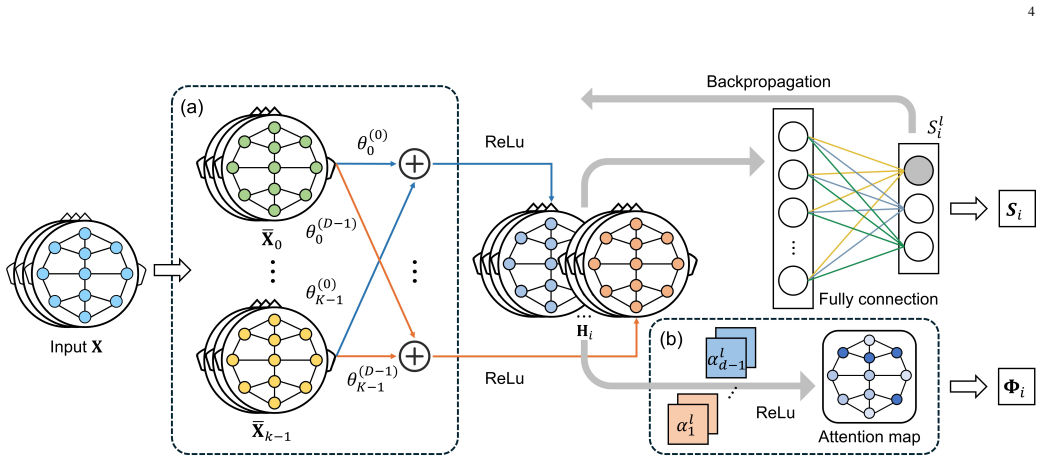
The progressive attention mechanism is the load-bearing component. Expert $i$ computes a channel-importance map $I_i$ by combining the feature representation $H_i$ with pooled gradients of the predicted probability for a target class, then normalizes and thresholds it at $\eta$ to prune weakly relevant electrode nodes and edges before the next expert. This lets later experts operate on a subgraph of the original electrode topology. The diversity-preserving loss maximizes the Jensen-Shannon divergence between the first two experts' normalized attention maps, and the dynamic fusion weight generator learns coefficients $\xi_1, \xi_2, \xi_3$ to combine the three experts' representations into the final prediction.
What would settle it
Re-run the SEED and SEED-IV experiments while logging which label is used to compute Eq. (5) at inference. If the true label is used on test samples, the 96.38% and 86.64% accuracies are not a valid measure of how the model would perform on unlabeled data; if the predicted label is used and the accuracies hold, the protocol concern is resolved.
Extended reading notes
Core claim
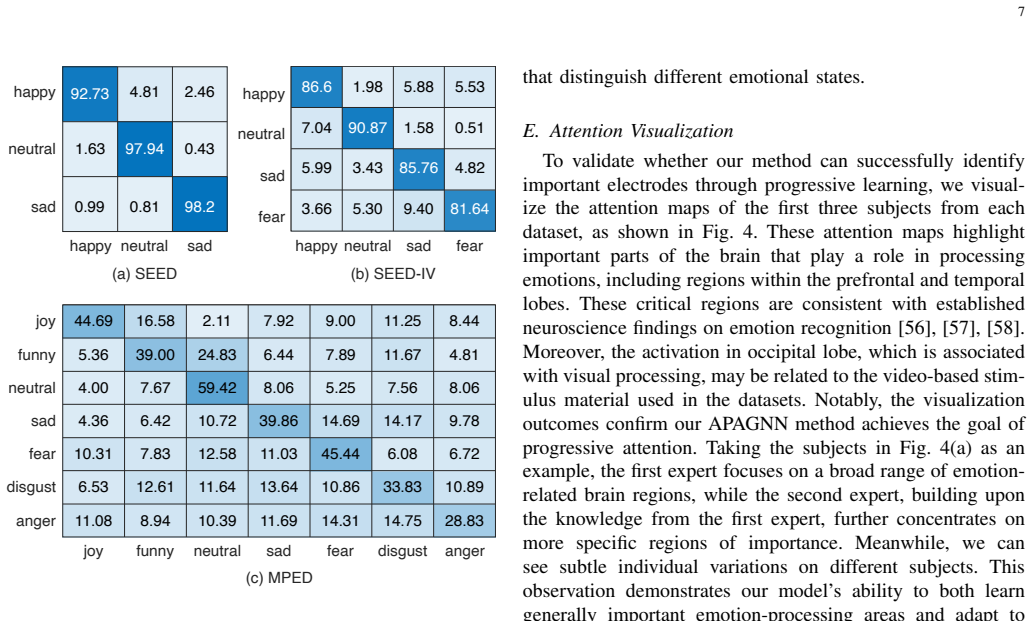
APAGNN's central claim is that progressive attention, not the graph convolution backbone alone, drives the performance gain. The model chains three experts: the first reads the full electrode graph, the second focuses on emotion-relevant regions selected by the first expert's attention map, and the third concentrates on the most informative electrodes. Each expert is a Chebyshev graph convolutional network on differential-entropy features, and the attention maps are computed with a Grad-CAM-style gradient of the predicted class score with respect to the feature map. A Jensen-Shannon divergence term forces the first two experts to attend to different channels, and a dynamic weight generator fuses the three experts' representations. On the subject-dependent splits of SEED, SEED-IV, and MPED, the model reports accuracies of 96.38%, 86.64%, and 41.58%, surpassing the previous best methods and achieving the lowest standard deviations.
Load-bearing premise
The reported accuracies depend on an unspecified detail in the attention computation: whether the class used to generate each test-time attention map is the true emotion label or the model's own prediction, and the paper never states which one is used.
Editorial extensions
If this is right
- If the central claim holds, progressively refined attention maps are a viable way to handle inter-subject variability in emotion-related brain topology.
- The three-expert setup outperforms the two-expert variant by roughly 2.5 to 3 percentage points, suggesting additional refinement stages can keep adding accuracy.
- Dynamic attention, which learns which channels matter per sample, beats static channel sets from prior neuroscience work by about 3 to 4 points on SEED and SEED-IV.
- The attention maps highlight prefrontal and temporal regions consistent with emotion neuroscience, giving the model an interpretable output.
Reading between the lines
- The paper never states whether the attention map at test time uses the true emotion label or the model's own predicted label; if the true label is used, the reported accuracies are not a valid estimate of deployment performance. This is an inference from the missing protocol detail, not a paper claim.
- The subject-dependent protocol, where training and test trials come from the same subjects, means the method's advantage over subject-independent approaches remains untested; one could extend the comparison to leave-one-subject-out evaluation.
- The fixed pruning threshold $\eta=0.5$ is a hyperparameter that could be learned or annealed, which might further improve the progressive refinement.
- The dynamic weight generator effectively learns a soft mixture-of-experts, yet the paper does not analyze how the fusion weights vary across subjects or emotions.
Editorial analysis
A structured set of objections, weighed in public.
Referee Report
Summary. The paper proposes APAGNN, a multi-expert graph neural network for EEG emotion recognition. Three experts process the EEG graph at progressively finer granularity: the first captures global topology, the second region-level patterns, and the third electrode-level features; the first two experts generate gradient-based attention maps (Eqs. 5-6) that prune channels for the next expert. A Jensen-Shannon diversity loss encourages the experts to focus on different patterns, and a learned weight generator fuses their representations. Experiments on SEED, SEED-IV, and MPED report accuracies of 96.38%, 86.64%, and 41.58%, respectively, together with ablations on the number of experts, the diversity loss, static versus adaptive attention, confusion matrices, attention visualizations, and t-SNE plots.
Significance. If the reported results are trustworthy, the paper makes a useful empirical contribution: adaptive, subject-specific channel selection through progressive attention is a plausible and interpretable way to improve EEG emotion classification, and the comparison against static channel sets (Table IV) speaks directly to that design choice. The paper also includes several complementary analyses (confusion matrices, attention visualizations, t-SNE) that go beyond a single accuracy number. However, the central empirical claim is currently gated by an unresolved test-time protocol issue involving the class index in Eq. (5), and the headline comparison is partially undercut by missing baseline entries in Table I and by non-matched ablations. The paper ships no code, so the protocol ambiguity cannot be resolved by inspection.
major comments (4)
- [Section III-A, Eqs. (5)-(6)] The attention maps used to prune nodes for experts 2 and 3 require a target emotion class index l in Eq. (5), but the manuscript never states what l is at inference time. If l is the ground-truth label during testing, then the graph seen by the later experts is constructed using the answer key, which is a direct label leak and would invalidate every accuracy in Table I. If l is the model's predicted label (for example, argmax of S_i), the procedure is legitimate but must be stated, and the fact that training (Eq. (4)) uses true labels while inference would use predicted labels must be discussed and tested. This is the most load-bearing unresolved detail in the paper; please specify the protocol and, if necessary, rerun the experiments under the stated protocol.
- [Table I and Section IV-C] The text claims APAGNN 'achieves superior performance compared to the existing methods on all three datasets,' but Table I has missing entries: SEED-IV is blank for both RGNN and IAG, and MPED is blank for RGNN. The subsequent sentence comparing with 'the previous best method, IAG' is also inconsistent with the table, since V-IAG reports higher accuracy than IAG on both SEED (95.64 vs 95.44) and MPED (40.40 vs 40.38). Complete the baseline table or revise the claim.
- [Table II and Section IV-C] The ablation APAGNN-2E versus APAGNN-3E does not equalize parameter count, computational cost, or training objective complexity; the two architectures differ in the number of expert branches and in the number of attention-transfer stages. The observed 2.54-3.05 percentage point gains are therefore not a controlled test of the 'progressive attention' mechanism, and the causal attribution to progressive attention is weaker than the text suggests. A parameter-matched control, or a discussion of this confound, is needed.
- [Tables I-III and Section IV-C] No significance tests or repeated-run statistics are reported. For example, the SEED gap between APAGNN and V-IAG is 0.74 percentage points (96.38±4.19 versus 95.64±5.08), which is much smaller than the reported standard deviations, and it is unclear whether the per-subject or per-trial comparisons are paired. Without significance testing, the claim of 'superior performance' is not statistically supported even setting aside the protocol issue.
minor comments (5)
- [Section IV-A] There is a typo: 'we conducte extensive experiments' should be 'we conducted extensive experiments.'
- [Fig. 4 caption] The caption states that 'only the first two are implemented in the APAGNN,' which conflicts with Section III-A and Fig. 2, where each expert is described as performing attention-map generation. Please clarify whether the third expert generates an attention map or not.
- [Section IV-C and Table III] The text says the diversity loss is important 'across datasets,' but Table III reports results only for SEED and SEED-IV; MPED is omitted. Either add the MPED result or qualify the claim.
- [Section IV-B] Several placeholders remain in the table of contents, e.g., 'Y .' in references has an extra space; please run a copyediting pass.
- [General] No code or data availability statement is provided. Given the ambiguity in Eq. (5), releasing code (or at least a precise pseudocode for inference) would substantially strengthen the paper.
Circularity Check
No load-bearing circularity: headline accuracies are held-out benchmark evaluations; the only self-citation is a non-essential graph-construction reference.
full rationale
The paper is primarily an empirical architecture paper. Table I reports accuracies on SEED, SEED-IV, and MPED, evaluated with held-out trials against external baselines; no parameter is fitted to the target numbers, so the headline claim does not reduce to the model's own equations. The attention-guided pruning of Eqs. (5)-(7) is intentionally self-referential as a mechanism: the model uses its own gradients to define channel importance and then masks the graph for the next expert. This is a design loop, not a circular derivation, because the reported accuracies come from held-out labels and the ablations in Tables II-IV are architectural comparisons rather than predictions derived from fitted constants. The only self-citation that enters the method is [48], used to build the electrode adjacency matrix from physical electrode arrangement; this is a minor input-construction reference and does not by itself force the reported gains. A separate protocol ambiguity exists (the target class index l in Eq. (5) is not specified at inference), but that affects experimental validity rather than circularity of the derivation, so it is not scored here. Score 2 reflects the non-load-bearing self-citation and the mildly self-referential attention-validation narrative, not a reduction of the central result.
Assumptions & free parameters
free parameters (5)
- Pruning threshold eta =
0.5
- Chebyshev kernel size K =
3
- Number of convolution filters D =
32
- Expert loss weight lambda =
not stated
- Diversity loss weight beta =
not stated
assumptions (4)
- domain assumption Differential entropy and STFT features from five frequency bands are a sufficient representation of emotion-related EEG content.
- domain assumption The electrode adjacency matrix built from physical arrangement (referencing [48]) correctly encodes functional spatial relationships.
- domain assumption Grad-CAM-style gradients of the classifier score with respect to feature maps identify emotion-relevant electrodes.
- standard math Chebyshev polynomial graph convolution and Jensen-Shannon divergence are used according to their standard mathematical definitions.
Cite this review
Pith. "Pith review of Adaptive Progressive Attention Graph Neural Network for EEG Emotion Recognition." pith.science (2026). https://pith.science/paper/WRZVTRPD
@misc{pith2026250114246,
  author       = {Pith},
  title        = {Pith review of: Adaptive Progressive Attention Graph Neural Network for EEG Emotion Recognition},
  year         = {2026},
  howpublished = {\url{https://pith.science/paper/WRZVTRPD}},
  note         = {Machine review of arXiv:2501.14246}
}
read the original abstract
In recent years, numerous neuroscientific studies demonstrate that specific areas of the brain are connected to human emotional responses, with these regions exhibiting variability across individuals and emotional states. To fully leverage these neural patterns, we propose an Adaptive Progressive Attention Graph Neural Network (APAGNN), which dynamically captures the spatial relationships among brain regions during emotional processing. The APAGNN employs three specialized experts that progressively analyze brain topology. The first expert captures global brain patterns, the second focuses on region-specific features, and the third examines emotion-related channels. This hierarchical approach enables increasingly refined analysis of neural activity. Additionally, a weight generator integrates the outputs of all three experts, balancing their contributions to produce the final predictive label. Extensive experiments conducted on SEED, SEED-IV and MPED datasets indicate that our method enhances EEG emotion recognition performance, achieving superior results compared to baseline methods.
Figures

Figures from the paper (2 more)


Reference graph
Works this paper leans on
-
[1]
Explicit and implicit emotion regulation: A dual-process framework,
A. Gyurak, J. J. Gross, and A. Etkin, “Explicit and implicit emotion regulation: A dual-process framework,” COGNITION AND EMOTION, vol. 25, pp. 400–412, 4 2011. [Online]. Available: https://www.tandfonline.com/doi/abs/10.1080/02699931.2010.544160
arXiv 2011
-
[2]
The emotion process: Event appraisal and component differentiation,
K. R. Scherer and A. Moors, “The emotion process: Event appraisal and component differentiation,” Annual Review of Psychology , vol. 70, pp. 719–745, 1 2019. [Online]. Available: https://www.annualreviews. org/content/journals/10.1146/annurev-psych-122216-011854
-
[3]
Self- supervised eeg emotion recognition models based on cnn,
X. Wang, Y . Ma, J. Cammon, F. Fang, Y . Gao, and Y . Zhang, “Self- supervised eeg emotion recognition models based on cnn,” IEEE Trans- actions on Neural Systems and Rehabilitation Engineering , vol. 31, pp. 1952–1962, 2023
work page 1952
-
[4]
D. Pan, H. Zheng, F. Xu, Y . Ouyang, Z. Jia, C. Wang, and H. Zeng, “Msfr-gcn: A multi-scale feature reconstruction graph convolutional network for eeg emotion and cognition recognition,” IEEE Transactions on Neural Systems and Rehabilitation Engineering , vol. 31, pp. 3245– 3254, 2023
work page 2023
-
[5]
B. Liu, J. Guo, C. L. Chen, X. Wu, and T. Zhang, “Fine-grained interpretability for eeg emotion recognition: Concat-aided grad-cam and systematic brain functional network,” IEEE Transactions on Affective Computing, 2023
work page 2023
-
[6]
R. Zhou, Z. Zhang, H. Fu, L. Zhang, L. Li, G. Huang, F. Li, X. Yang, Y . Dong, Y . T. Zhang, and Z. Liang, “Pr-pl: A novel prototypical rep- resentation based pairwise learning framework for emotion recognition using eeg signals,” IEEE Transactions on Affective Computing , 2023
work page 2023
-
[7]
Emotion recognition through facial expression analysis based on a neurofuzzy network,
S. V . Ioannou, A. T. Raouzaiou, V . A. Tzouvaras, T. P. Mailis, K. C. Karpouzis, and S. D. Kollias, “Emotion recognition through facial expression analysis based on a neurofuzzy network,” Neural Networks, vol. 18, no. 4, pp. 423–435, 2005, emotion and Brain. [Online]. Available: https://www.sciencedirect.com/science/article/pii/ S0893608005000377
work page 2005
-
[8]
Emotion recognition by speech signals,
O.-W. Kwon, K. Chan, J. Hao, and T.-W. Lee, “Emotion recognition by speech signals,” in Eighth European Conference on Speech Communi- cation and Technology, 2003
work page 2003
Show all 59 references
-
[9]
Dia- loguegcn: A graph convolutional neural network for emotion recognition in conversation,
D. Ghosal, N. Majumder, S. Poria, N. Chhaya, and A. Gelbukh, “Dia- loguegcn: A graph convolutional neural network for emotion recognition in conversation,” arXiv preprint arXiv:1908.11540 , 2019
1908 arXiv
-
[10]
Emotion recognition from surface emg signal using wavelet transform and neural network,
B. Cheng and G. Liu, “Emotion recognition from surface emg signal using wavelet transform and neural network,” in Proceedings of the 2nd international conference on bioinformatics and biomedical engineering (ICBBE), 2008, pp. 1363–1366
2008
-
[11]
Ecg pattern analysis for emotion detection,
F. Agrafioti, D. Hatzinakos, and A. K. Anderson, “Ecg pattern analysis for emotion detection,” IEEE Transactions on affective computing , vol. 3, no. 1, pp. 102–115, 2011
2011
-
[12]
Multichannel eeg-based emotion recognition via group sparse canonical correlation analysis,
W. Zheng, “Multichannel eeg-based emotion recognition via group sparse canonical correlation analysis,” IEEE Transactions on Cognitive and Developmental Systems , vol. 9, no. 3, pp. 281–290, 2016
2016
-
[13]
Eeg-based emotion recognition using regularized graph neural networks,
P. Zhong, D. Wang, and C. Miao, “Eeg-based emotion recognition using regularized graph neural networks,” IEEE Transactions on Affective Computing, 2020
2020
-
[14]
Affective brain–computer interfaces (abcis): A tutorial,
D. Wu, B. L. Lu, B. Hu, and Z. Zeng, “Affective brain–computer interfaces (abcis): A tutorial,” Proceedings of the IEEE , 10 2023
2023
-
[15]
A progressive learning classifier based on dynamic differential weighted network for feature identification of brain network series,
W. Xue and H. He, “A progressive learning classifier based on dynamic differential weighted network for feature identification of brain network series,” Knowledge-Based Systems, vol. 274, p. 110661, 8 2023
2023
-
[16]
Dual- encoder vae-gan with spatiotemporal features for emotional eeg data augmentation,
C. Tian, Y . Ma, J. Cammon, F. Fang, Y . Zhang, and M. Meng, “Dual- encoder vae-gan with spatiotemporal features for emotional eeg data augmentation,” IEEE Transactions on Neural Systems and Rehabilitation Engineering, vol. 31, pp. 2018–2027, 2023
2018
-
[17]
Cross-cultural emotion recognition with eeg and eye movement signals based on multiple stacked broad learning system,
X. Gong, C. L. Chen, and T. Zhang, “Cross-cultural emotion recognition with eeg and eye movement signals based on multiple stacked broad learning system,” IEEE Transactions on Computational Social Systems , 2023
2023
-
[18]
Fine-grained emotion recognition from eeg signal using fast fourier transformation and cnn,
M. Hasan, Rokhshana-Nishat-Anzum, S. Yasmin, and T. S. Pias, “Fine-grained emotion recognition from eeg signal using fast fourier transformation and cnn,” in 2021 IEEE International Conference on Intelligent Vision and Computing (ICIEVic) , 2021, pp. 1–6. [Online]. Available: ...
2021
-
[19]
Eeg emotion signal of artificial neural network by using capsule network,
U. Ali, H. Li, R. Yao, Q. Wang, W. Hussain, S. Duja, and M. Amjad, “Eeg emotion signal of artificial neural network by using capsule network,” International Journal of Advanced Computer Science and Applications (IJACSA) , vol. 11, no. 1, pp. 456–463, 2020. [Online]. Available:...
2020
-
[20]
Deep learning based on cnn for emotion recognition using eeg signal,
I. S. Ahmad, S. Zhang, S. Saminu, L. Wang, A. E. K. Isselmou, Z. Cai, I. Javaid, S. Kamhi, and U. Kulsum, “Deep learning based on cnn for emotion recognition using eeg signal,” WSEAS Transactions on Systems and Control , vol. 17, pp. 34–40, 2021. [Online]. Available: https://d...
2021
-
[21]
Hmt: An eeg signal classification method based on cnn architecture,
M. He, Y . Wu, Z. Li, S. Wang, W. Li, W. Zhou, H. Rong, and J. Wang, “Hmt: An eeg signal classification method based on cnn architecture,” in 2023 IEEE International Conference on Multimedia Signal Processing (ICMSP) , 2023. [Online]. Available: https://dx.doi.org/10.1109/ICMS...
2023
-
[22]
Optimizing 1d- cnn-based emotion recognition process through channel and feature selection from eeg signals,
H. Aldawsari, S. Al-ahmadi, and F. Muhammad, “Optimizing 1d- cnn-based emotion recognition process through channel and feature selection from eeg signals,” Diagnostics, vol. 13, no. 16, p. 2624, 2023. [Online]. Available: https://dx.doi.org/10.3390/diagnostics13162624
2023 doi
-
[23]
Eeg-based emotion recognition using hybrid cnn and lstm 10 classification,
L. Ali, G. Li, B. Chakravarthi, S.-C. Ng, M. R. Ezilarasan, and M.-F. Leung, “Eeg-based emotion recognition using hybrid cnn and lstm 10 classification,” Frontiers in Computational Neuroscience, vol. 16, 2022. [Online]. Available: https://dx.doi.org/10.3389/fncom.2022.1019776
2022
-
[24]
Emotion recognition from spatio-temporal representation of eeg signals via 3d-cnn with ensemble learning techniques,
R. Yuvaraj, A. Baranwal, A. Prince, M. Murugappan, and J. Shaikh Mohammed, “Emotion recognition from spatio-temporal representation of eeg signals via 3d-cnn with ensemble learning techniques,” Brain Sciences , vol. 13, no. 4, 2023. [Online]. Available: https://dx.doi.org/10.3...
2023 doi
-
[25]
A novel de-cnn-bilstm multi-fusion model for eeg emotion recognition,
F. Cui, R. Wang, W. Ding, Y . Chen, and L. Huang, “A novel de-cnn-bilstm multi-fusion model for eeg emotion recognition,” Mathematics, vol. 10, no. 4, p. 582, 2022. [Online]. Available: https://dx.doi.org/10.3390/math10040582
2022 doi
- [26]
-
[27]
A model for eeg-based emotion recognition: Cnn-bi-lstm with attention mechanism,
Z. Huang, Y . Ma, R. Wang, W. Li, and Y . Dai, “A model for eeg-based emotion recognition: Cnn-bi-lstm with attention mechanism,” Electronics, vol. 12, no. 14, p. 3188, 2023. [Online]. Available: https://dx.doi.org/10.3390/electronics12143188
2023 doi
-
[28]
Automatic emotion recognition from eeg signal utilizing wavelet packet node reconstruction and a cnn classifier,
O. Saha, M. S. Mahmud, and S. Fattah, “Automatic emotion recognition from eeg signal utilizing wavelet packet node reconstruction and a cnn classifier,” in 2023 International Conference on Computer and Information Technology (ICCIT) , 2023. [Online]. Available: https://dx.doi....
2023
-
[29]
Eeg-based emotion recognition using spatial-temporal-connective features via multi-scale cnn,
T. Li, B. Fu, Z. Wu, and Y . Liu, “Eeg-based emotion recognition using spatial-temporal-connective features via multi-scale cnn,” IEEE Access, 2023. [Online]. Available: https://dx.doi.org/10.1109/ACCESS. 2023.3270317
2023
-
[30]
Eeg-based emotion recognition via channel-wise attention and self attention,
W. Tao, C. Li, R. Song, J. Cheng, Y . Liu, F. Wan, and X. Chen, “Eeg-based emotion recognition via channel-wise attention and self attention,” IEEE Transactions on Affective Computing , 2023. [Online]. Available: https://dx.doi.org/10.1109/TAFFC.2020.3025777
2023
-
[31]
Research on emotion recognition method of cerebral blood oxygen signal based on cnn-transformer network,
Z. Jin, Z. Xing, Y . Wang, S. Fang, X. Gao, and X. Dong, “Research on emotion recognition method of cerebral blood oxygen signal based on cnn-transformer network,” Sensors, vol. 23, no. 20, 2023. [Online]. Available: https://dx.doi.org/10.3390/s23208643
2023 doi
-
[32]
Simplified 2d cnn architecture with channel selection for emotion recognition using eeg spectrogram,
L. Farokhah, R. Sarno, and C. Fatichah, “Simplified 2d cnn architecture with channel selection for emotion recognition using eeg spectrogram,” IEEE Access , 2023. [Online]. Available: https: //dx.doi.org/10.1109/ACCESS.2023.3275565
2023
-
[33]
Inter subject emotion recognition using spatio-temporal features from eeg signal,
M. Asif, D. Srivastava, A. Gupta, and U. Tiwary, “Inter subject emotion recognition using spatio-temporal features from eeg signal,” in 2023 International Conference on Software Engineering and Computer Systems (ICSECS) , 2023. [Online]. Available: https: //dx.doi.org/10.1109/...
2023
-
[34]
Eeg emotion recognition based on hierarchy graph convolution network,
F. Zheng, B. Hu, S. Zhang, Y . Li, and X. Zheng, “Eeg emotion recognition based on hierarchy graph convolution network,” in 2021 IEEE International Conference on Bioinformatics and Biomedicine (BIBM), 2021, pp. 1705–1712. [Online]. Available: https://dx.doi.org/ 10.1109/BIBM52...
2021
-
[35]
Eeg-based emotion classification using graph signal processing,
S. S. Saboksayr, G. Mateos, and M. C ¸ etin, “Eeg-based emotion classification using graph signal processing,” in 2021 IEEE International Conference on Acoustics, Speech and Signal Processing (ICASSP) , 2021, pp. 1100–1104. [Online]. Available: https://dx.doi.org/10.1109/ ICAS...
2021
-
[36]
A graph neural network for eeg-based emotion recognition with contrastive learning and generative adversarial neural network data augmentation,
S. S. Gilakjani and H. A. Osman, “A graph neural network for eeg-based emotion recognition with contrastive learning and generative adversarial neural network data augmentation,” IEEE Access , 2023. [Online]. Available: https://dx.doi.org/10.1109/ACCESS.2023.3344476
2023
-
[37]
Graph neural network-based eeg classification: A survey,
D. Klepl, M. Wu, and F. He, “Graph neural network-based eeg classification: A survey,” IEEE Transactions on Neural Systems and Rehabilitation Engineering , 2024. [Online]. Available: https: //dx.doi.org/10.1109/TNSRE.2024.3355750
2024
-
[38]
A novel approach for emotion recognition based on eeg signal using deep learning,
A. Abdulrahman, M. Baykara, and T. B. Alakus ¸, “A novel approach for emotion recognition based on eeg signal using deep learning,” Applied Sciences , vol. 12, no. 19, 2022. [Online]. Available: https://dx.doi.org/10.3390/app121910028
2022 doi
-
[39]
Eeg emotion recognition using dynamical graph convolutional neural networks,
T. Song, W. Zheng, P. Song, and Z. Cui, “Eeg emotion recognition using dynamical graph convolutional neural networks,” IEEE Transactions on Affective Computing, vol. 11, no. 3, pp. 532–541, 2018
2018
-
[40]
Instance-adaptive graph for eeg emotion recognition,
T. Song, S. Liu, W. Zheng, Y . Zong, and Z. Cui, “Instance-adaptive graph for eeg emotion recognition,” in Proceedings of the AAAI Conference on Artificial Intelligence , vol. 34, no. 03, 2020, pp. 2701–2708
2020
-
[41]
Convolutional neural networks on graphs with fast localized spectral filtering,
M. Defferrard, X. Bresson, and P. Vandergheynst, “Convolutional neural networks on graphs with fast localized spectral filtering,” Advances in neural information processing systems , vol. 29, 2016
2016
-
[42]
Show, attend and tell: Neural image caption generation with visual attention,
K. Xu, J. Ba, R. Kiros, K. Cho, A. Courville, R. Salakhudinov, R. Zemel, and Y . Bengio, “Show, attend and tell: Neural image caption generation with visual attention,” in International conference on machine learning . PMLR, 2015, pp. 2048–2057
2015
-
[43]
Grad-cam guided channel-spatial attention module for fine-grained visual classification,
S. Xu, D. Chang, J. Xie, and Z. Ma, “Grad-cam guided channel-spatial attention module for fine-grained visual classification,” in 2021 IEEE 31st International Workshop on Machine Learning for Signal Processing (MLSP). IEEE, 2021, pp. 1–6
2021
-
[44]
Sharpen focus: Learning with attention separability and consistency,
L. Wang, Z. Wu, S. Karanam, K.-C. Peng, R. V . Singh, B. Liu, and D. N. Metaxas, “Sharpen focus: Learning with attention separability and consistency,” in Proceedings of the IEEE/CVF International Conference on Computer Vision , 2019, pp. 512–521
2019
-
[45]
Ts-cam: Token semantic coupled attention map for weakly supervised object localization,
W. Gao, F. Wan, X. Pan, Z. Peng, Q. Tian, Z. Han, B. Zhou, and Q. Ye, “Ts-cam: Token semantic coupled attention map for weakly supervised object localization,” in Proceedings of the IEEE/CVF International Conference on Computer Vision , 2021, pp. 2886–2895
2021
-
[46]
Learning a mixture of granularity-specific experts for fine-grained categorization,
L. Zhang, S. Huang, W. Liu, and D. Tao, “Learning a mixture of granularity-specific experts for fine-grained categorization,” in Proceed- ings of the IEEE/CVF International Conference on Computer Vision , 2019, pp. 8331–8340
2019
-
[47]
Grad-cam: Visual explanations from deep networks via gradient-based localization,
R. R. Selvaraju, M. Cogswell, A. Das, R. Vedantam, D. Parikh, and D. Batra, “Grad-cam: Visual explanations from deep networks via gradient-based localization,” in Proceedings of the IEEE international conference on computer vision , 2017, pp. 618–626
2017
-
[48]
Gmss: Graph-based multi-task self-supervised learning for eeg emotion recognition,
Y . Li, J. Chen, F. Li, B. Fu, H. Wu, Y . Ji, Y . Zhou, Y . Niu, G. Shi, and W. Zheng, “Gmss: Graph-based multi-task self-supervised learning for eeg emotion recognition,” IEEE Transactions on Affective Computing , vol. 14, no. 3, pp. 2512–2525, 2022
2022
-
[49]
Investigating critical frequency bands and channels for eeg-based emotion recognition with deep neural networks,
W.-L. Zheng and B.-L. Lu, “Investigating critical frequency bands and channels for eeg-based emotion recognition with deep neural networks,” IEEE Transactions on Autonomous Mental Development , vol. 7, no. 3, pp. 162–175, 2015
2015
-
[50]
Emotionmeter: A multimodal framework for recognizing human emotions,
W.-L. Zheng, W. Liu, Y . Lu, B.-L. Lu, and A. Cichocki, “Emotionmeter: A multimodal framework for recognizing human emotions,” IEEE transactions on cybernetics , vol. 49, no. 3, pp. 1110–1122, 2018
2018
-
[51]
Mped: A multi-modal physiological emotion database for discrete emotion recognition,
T. Song, W. Zheng, C. Lu, Y . Zong, X. Zhang, and Z. Cui, “Mped: A multi-modal physiological emotion database for discrete emotion recognition,” IEEE Access, vol. 7, pp. 12 177–12 191, 2019
2019
-
[52]
Variational instance-adaptive graph for eeg emotion recognition,
T. Song, S. Liu, W. Zheng, Y . Zong, Z. Cui, Y . Li, and X. Zhou, “Variational instance-adaptive graph for eeg emotion recognition,” IEEE Transactions on Affective Computing, vol. 14, no. 1, pp. 343–356, 2023
2023
-
[53]
A novel neural network model based on cerebral hemispheric asymmetry for eeg emotion recognition
Y . Li, W. Zheng, Z. Cui, T. Zhang, and Y . Zong, “A novel neural network model based on cerebral hemispheric asymmetry for eeg emotion recognition.” in IJCAI, 2018, pp. 1561–1567
2018
-
[54]
A novel bi-hemispheric discrepancy model for eeg emotion recognition,
Y . Li, L. Wang, W. Zheng, Y . Zong, L. Qi, Z. Cui, T. Zhang, and T. Song, “A novel bi-hemispheric discrepancy model for eeg emotion recognition,” IEEE Transactions on Cognitive and Developmental Sys- tems, vol. 13, no. 2, pp. 354–367, 2020
2020
-
[55]
Least squares support vector machine classifiers: a large scale algorithm,
J. Suykens, L. Lukas, P. Van Dooren, B. De Moor, J. Vandewalle et al. , “Least squares support vector machine classifiers: a large scale algorithm,” in European Conference on Circuit Theory and Design, ECCTD, vol. 99. Citeseer, 1999, pp. 839–842
1999
-
[56]
Frontal eeg asymmetry as a moderator and mediator of emotion,
J. A. Coan and J. J. Allen, “Frontal eeg asymmetry as a moderator and mediator of emotion,” Biological psychology, vol. 67, no. 1-2, pp. 7–50, 2004
2004
-
[57]
The amygdala: vigilance and emotion,
M. Davis and P. J. Whalen, “The amygdala: vigilance and emotion,” Molecular psychiatry, vol. 6, no. 1, pp. 13–34, 2001
2001
-
[58]
Emotions recognition using eeg signals: A survey,
S. M. Alarcao and M. J. Fonseca, “Emotions recognition using eeg signals: A survey,” IEEE Transactions on Affective Computing , vol. 10, no. 3, pp. 374–393, 2017
2017
-
[59]
Visualizing data using t-sne
L. Van der Maaten and G. Hinton, “Visualizing data using t-sne.” Journal of machine learning research , vol. 9, no. 11, 2008
2008
Reviewed August 10, 2026 · model on record in the stance chip above.
Discussion (0). Continue with ORCID to comment.