REVIEW 4 major objections 5 minor 38 references
Blob velocities and sizes in the Alcator C-Mod scrape-off layer for ohmic and high confinement mode plasmas
T0 review · 4 major / 5 minor · reviewed 2026-08-10 · deepseek-v4-flash
Pith's one-line read Blob filaments in Alcator C-Mod move radially outward at 400-1000 m/s in ohmic and H-mode plasmas alike.
desk verdict A careful TDE study of C-Mod blob velocities that plausibly shows similar blob motion across ohmic and H-mode, but one discharge per mode and missing error bars keep the similarity from being quantitative. read the letter →
The pith
A machine-rendered reading of the paper's core claim, the machinery that carries it, and where it could break.
The reading
What carries the argument
The key machinery is an improved time-delay estimation (TDE) method for coarse-grained two-dimensional imaging data, which uses three non-aligned measurement points to recover both radial and poloidal components of a blob's velocity from cross-conditional averaged time delays. Each accepted velocity vector must satisfy five criteria concerning data availability, unimodal pulse shape, resolvable time lag, absence of strong electric field interference, and consistency with blob-like fluctuation statistics. The interpretation is anchored by a stochastic model describing the fluctuations as a superposition of uncorrelated two-sided-exponential pulses, which yields Gamma-distributed amplitudes, Lorentzian frequency spectra, and an exponential mean radial profile whose scale length is the product of blob velocity and parallel transit time.
What would settle it
A synthetic imaging benchmark would settle the method: generate mock gas-puff-imaging data with blobs of known velocities and controlled shape evolution, run the time-delay estimation, and check whether the recovered velocities match the inputs; if mild distortion produces large velocity errors, the reported 400-1000 m/s range would not be robust.
Extended reading notes
Core claim
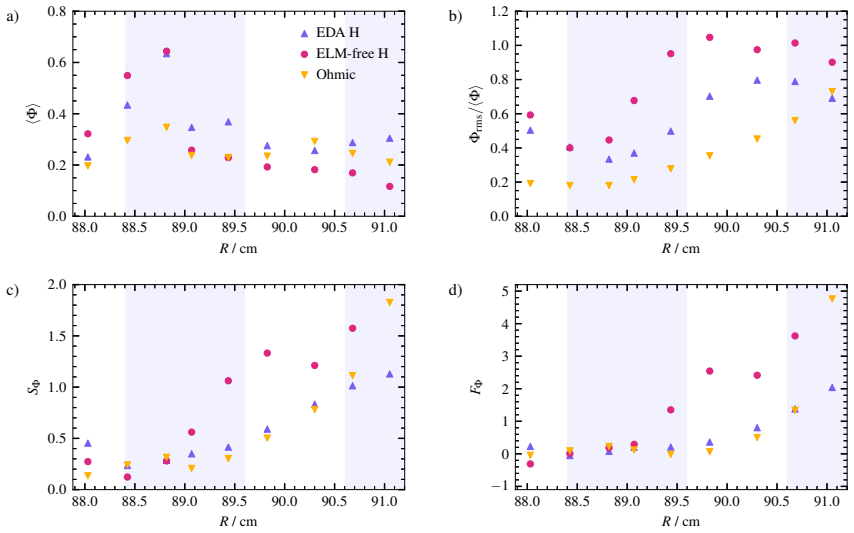
The paper's central claim is that the scrape-off layer of Alcator C-Mod is dominated by large-amplitude, blob-like filaments moving radially outward, and that their velocities and sizes are essentially the same in ohmic, ELM-free H-mode, and EDA H-mode plasmas. The radial velocity component increases from about 400 m/s near the separatrix to about 1000 m/s in the limiter shadow, with scrape-off-layer-averaged values of 703 m/s (ohmic), 644 m/s (ELM-free H-mode), and 632 m/s (EDA H-mode). Vertical blob sizes are comparable across the modes, with full widths at half maximum between 0.62 and 0.81 cm. These similarities line up with the close agreement of conditionally averaged burst shapes and frequency power spectra, and are consistent with the stochastic model of a superposition of uncorrelated pulses, strengthening the case that blob-driven cross-field transport is a universal feature of tokamak scrape-off layers.
Load-bearing premise
The load-bearing premise is that each measured velocity truly represents a coherent blob: time delays between neighboring imaging channels are treated as rigid advection of a structure whose brightness pattern is preserved, and if blobs distort, decorrelate, or are mis-sampled by the viewing geometry, the estimated 400-1000 m/s velocities could be biased.
Editorial extensions
If this is right
- Blob velocities and sizes are similar across ohmic, ELM-free H-mode, and EDA H-mode, so the radial transit time of blobs, $\tau_\perp = \ell/v$, is also similar in these regimes.
- The scrape-off-layer-averaged radial blob velocities (703, 644, and 632 m/s) imply that confinement mode mainly changes how often blobs are born, not how fast they travel.
- The stochastic model's prediction of an exponential density profile with e-folding length given by blob velocity times parallel transit time is supported by the measured profiles.
- The measured similarities across modes add to the evidence that blob-driven cross-field transport is universal in tokamaks, matching observations on other devices.
- The radial velocity profile rises from about 400 m/s at the separatrix to about 1000 m/s in the limiter shadow, although the authors note this need not imply that individual blobs accelerate.
Reading between the lines
- A natural extension is to measure the Gamma shape parameter across a wider parameter space; if blob speed and size stay fixed while the waiting time changes, the shape parameter alone would track the confinement-mode differences.
- The TDE method could be ported to synthetic turbulence simulations, where the exact blob velocities are known, to test whether the 400-1000 m/s range and its radial growth are genuine or an artifact of the estimation geometry.
- If these velocities hold for future high-duty-cycle reactors, wall erosion in the far scrape-off layer may be largely independent of the operating regime, making blob generation rate the key control knob.
- A direct measurement of the poloidal velocity component would test the assumption used here that radial motion dominates, which underlies the vertical size estimates.
Editorial analysis
A structured set of objections, weighed in public.
Referee Report
Summary. The manuscript presents gas puff imaging (GPI) measurements from three Alcator C-Mod discharges (ohmic, ELM-free H-mode, and EDA H-mode) and applies an improved time-delay estimation (TDE) method to infer blob velocities. The authors report radially outward blob velocities of 400–1000 m/s in all three confinement modes, similar vertical blob sizes from conditional averaging, and similar conditional burst shapes and power spectra. They interpret the results within a stochastic pulse model and conclude that blob properties are similar across ohmic and H-mode plasmas, supporting universality of blob-driven transport in the scrape-off layer.
Significance. If the central claim holds, the results extend earlier statistical comparisons of PDFs and PSDs to direct measurements of blob velocities and sizes, strengthening the case for universal blob-driven transport in tokamak scrape-off layers. The paper's strengths are the detailed description of the TDE method, the use of cross-conditional averaging with a reproducibility metric, and the connection to an established stochastic model. However, the evidence base is limited to three single discharges and no uncertainty quantification is provided for the headline velocity and size comparisons, so the strength of the claim currently exceeds the support.
major comments (4)
- [Section 4, Fig. 9] The central claim of similar velocities across modes rests on average radial velocity profiles presented without error bars, confidence intervals, or any measure of scatter (for example, the standard deviation over the vertical diode positions or over independent time segments). Since each confinement mode is represented by a single discharge (Table 1), the reader cannot determine whether the differences among the SOL-averaged velocities (703, 644, and 632 m/s) are significant or whether the 400–1000 m/s range is a robust feature. The manuscript should provide uncertainty estimates, ideally from multiple time windows or multiple discharges, to support the cross-mode comparison.
- [Section 4, criteria (i)–(v), Fig. 8] The TDE velocities are assigned only when all five criteria are met, but the paper does not report the fraction of diode positions or events satisfying these criteria, nor does it quantify the conditional reproducibility values beyond the color scale in Fig. 8. If the acceptance rate or the delay bias differs systematically between modes—for example because the Gamma shape parameter differs strongly (6.2 for ohmic, 1.4 for ELM-free H-mode, and 4.2 for EDA H-mode, as reported in Section 3)—the observed similarity of mean velocities could be a selection artifact rather than a shared physical property. Please report the acceptance statistics and, if possible, the distribution of velocity estimates for each mode.
- [Section 3, Fig. 7, and Section 5] The vertical blob sizes are reported as single FWHM values (0.62, 0.81, and 0.69 cm for the three modes) without uncertainties, and the finite spatial resolution (3.8 mm spot size) and possible line-of-sight integration effects are not discussed. Since the transit-time argument in Section 5 uses the product of size and velocity to infer similar radial transit times, the absence of uncertainty on the sizes undermines the quantitative comparison across modes. At minimum, include an estimate of the measurement uncertainty on each FWHM and discuss the resolution correction.
- [Section 4] The TDE method assumes that large-amplitude fluctuations correspond to coherent structures whose brightness pattern is approximately preserved between neighboring view points, as stated implicitly by criteria (i)–(v). The manuscript does not test this assumption directly for the present data, nor does it compare with an independent blob-tracking or synthetic-data test. A systematic validation (for example, using the three-point estimator on synthetic GPI data as in Ref. [38]) would substantially strengthen the claim that the derived velocities are unbiased measures of blob motion.
minor comments (5)
- [Section 5] There are two typos in the text: 'confiment' should be 'confinement' and 'Lorentizan' should be 'Lorentzian'.
- [Section 2] The phrase 'gas pu ff' appears in the body text and in some references; it should be 'gas puff'.
- [Figure 8 caption] The caption states 'The color coding gives conditional reproducibility' but the quantity shown is 1 − CV; please define CV (conditional variance) either in the caption or in the text near the figure.
- [Section 1] The introduction says 'an improved time-delay estimation method' but does not specify what is improved relative to the previous method in Refs. [37,38]; please clarify whether the improvement is in the application, the algorithm, or the analysis procedure.
- [References] Reference [38] is listed as 'submitted'; if it has been accepted by the time of publication, please update the reference with the journal and DOI.
Circularity Check
No significant circularity: the velocity and size measurements are empirical, and the stochastic model is used only for interpretation.
full rationale
The central quantities—blob velocities (Figs. 8–9) and blob sizes (Fig. 7)—are obtained directly from GPI data via time-delay estimation and conditional averaging, not from the stochastic model. The stochastic model enters only to interpret the measured fluctuation statistics: Gamma shape parameters are fitted to PDF tails, a pulse duration is fitted to the PSD, and the transit-time relation τ⊥=ℓ/v is applied as a consistency argument. Criterion (v) of the TDE analysis preselects diode positions with Lorentzian-shaped spectra, which is a sample-selection filter; it does not feed any velocity value into the TDE computation. Self-citations to the TDE method [37,38] and to the stochastic model [19–26] provide methodological background and are not used as evidence in place of the measurements. No equation or fitted parameter is renamed as a prediction, and no uniqueness claim is imported from the authors' prior work. The paper is therefore self-contained against the C-Mod data for its main empirical claims.
Assumptions & free parameters
free parameters (4)
- Gamma distribution shape parameter gamma =
gamma = 6.2 (ohmic), 1.4 (ELM-free H), 4.2 (EDA H)
- Pulse duration tau_d =
20 microseconds
- Pulse asymmetry parameter =
1/10
- Conditional averaging threshold =
2.5 times RMS fluctuation level
assumptions (5)
- domain assumption GPI He I emission fluctuations are caused by local plasma density and temperature fluctuations.
- domain assumption The scrape-off layer fluctuations are a superposition of uncorrelated, exponentially distributed pulses.
- domain assumption The three-point time-delay estimation method of references [37,38] yields unbiased velocity estimates for the C-Mod GPI data.
- domain assumption Large-amplitude events selected by the 2.5 RMS threshold are coherent blob-like structures.
- domain assumption The selected H-mode discharges are not influenced by ICRF antenna electric fields.
Cite this review
Pith. "Pith review of Blob velocities and sizes in the Alcator C-Mod scrape-off layer for ohmic and high confinement mode plasmas." pith.science (2026). https://pith.science/paper/JDJDGILV
@misc{pith2026250114558,
  author       = {Pith},
  title        = {Pith review of: Blob velocities and sizes in the Alcator C-Mod scrape-off layer for ohmic and high confinement mode plasmas},
  year         = {2026},
  howpublished = {\url{https://pith.science/paper/JDJDGILV}},
  note         = {Machine review of arXiv:2501.14558}
}
read the original abstract
An improved time delay estimation method is used to calculate the velocity of cross-field blob motion in the scrape-off layer of Alcator C-Mod for an ohmic and two high confinement (H-mode) plasmas; an edge localized mode free and an enhanced D-alpha H-mode. The gas puff imaging data analysis results are interpreted in the framework of a stochastic model that describes the fluctuations as a super-position of uncorrelated blob-like structures. In all confinement modes investigated, the scrape-off layer is dominated by large amplitude, blob-like filaments moving radially outwards with velocities in the range from 400 to 1000 m/s. Blobs in high confinement mode plasmas have similar velocities and sizes as in ohmic plasma, which is consistent with the close similarity of conditionally averaged burst shapes and frequency spectra for the confinement modes investigated.
Figures


Figures from the paper (6 more)


Reference graph
Works this paper leans on
-
[38]
J. M. Losada, O. E. Garcia, Time delay estimation of coherent structure velocities from a super-position of localized pulses, submitted to Review of Scientific Instruments (2024) arXiv:2411.06544. 9
work page Pith review arXiv 2024
-
[1]
D. A. D’Ippolito, J. R. Myra, S. J. Zweben, Convective transport by intermittent blob-filaments: Comparison of theory and experiment, Physics of Plasmas 18 (2011) 060501
work page 2011
-
[2]
B. LaBombard, R. L. Boivin, M. Greenwald, J. Hughes, B. Lipschultz, D. Mossessian, C. S. Pitcher, J. L. Terry, S. J. Zweben, Particle transport in the scrape-off layer and its relationship to discharge density limit in Alcator C-Mod, Physics of Plasmas 8 (2001) 2107
work page 2001
-
[3]
J. L. Terry, B. LaBombard, B. Lipschultz, M. J. Greenwald, J. E. Rice, S. J. Zweben, The scrape-o ff layer in alcator C-Mod: Transport, turbulence, and flows, Fusion Science and Technology 51 (2007) 342
work page 2007
-
[4]
R. A. Pitts, J. P. Coad, D. P. Coster, G. Federici, W. Fundamenski, J. Horacek, K. Krieger, A. Kukushkin, J. Likonen, G. F. Matthews, M. Rubel, J. D. Strachan, Material erosion and migration in tokamaks, Plasma Physics and Controlled Fusion 47 (2005) B303
work page 2005
-
[5]
B. Lipschultz, X. Bonnin, G. Counsell, Plasma-surface interaction, scrape-o ff layer and divertor physics: Implications for ITER, Nuclear Fusion 47 (2007) 1189
work page 2007
-
[6]
J. L. Terry, N. P. Basse, I. Cziegler, M. Greenwald, O. Grulke, B. LaBombard, S. J. Zweben, E. M. Edlund, J. W. Hughes, L. Lin, Y . Lin, M. Porkolab, M. Sampsell, B. Veto, S. J. Wukitch, Transport phenomena in the edge of Alcator C-Mod plasmas, Nuclear Fusion 45 (2005) 1321
work page 2005
-
[7]
B. LaBombard, T. Golfinopoulos, J. L. Terry, D. Brunner, E. Davis, M. Greenwald, J. W. Hughes, New insights on boundary plasma turbulence and the quasi-coherent mode in Alcator C-Mod using a Mirror Langmuir Probe, Physics of Plasmas 21 (2014) 056108
work page 2014
Show all 38 references
-
[8]
R. Kube, A. Theodorsen, O. E. Garcia, B. LaBombard, J. L. Terry, Fluctuation statistics in the scrape-o ff layer of Alcator C-Mod, Plasma Physics and Controlled Fusion 58 (2016) 054001
2016
-
[9]
O. E. Garcia, I. Cziegler, R. Kube, B. LaBombard, J. L. Terry, Burst statistics in Alcator C-Mod SOL turbulence, Journal of Nuclear Materials 438 (2013) S180
2013
-
[10]
O. E. Garcia, S. M. Fritzner, R. Kube, I. Cziegler, B. LaBombard, J. L. Terry, Intermittent fluctuations in the Alcator C-Mod scrape-off layer, Physics of Plasmas 20 (2013) 055901
2013
-
[11]
O. E. Garcia, R. Kube, A. Theodorsen, B. LaBombard, J. L. Terry, Intermittent fluctuations in the Alcator C-Mod scrape-o ff layer for ohmic and high confinement mode plasmas, Physics of Plasmas 25 (2018) 056103
2018
-
[12]
Theodorsen, O
A. Theodorsen, O. E. Garcia, R. Kube, B. LaBombard, J. L. Terry, Universality of Poisson-driven plasma fluctuations in the Alcator C-Mod scrape-off layer, Physics of Plasmas 25 (2018) 122309
2018
-
[13]
R. Kube, O. E. Garcia, A. Theodorsen, D. Brunner, A. Q. Kuang, B. LaBombard, J. L. Terry, Intermittent electron density and temperature fluctuations and associated fluxes in the Alcator C-Mod scrape-off layer, Plasma Physics and Controlled Fusion 60 (2018) 065002
2018
-
[14]
R. Kube, A. Theodorsen, O. E. Garcia, D. Brunner, B. LaBombard, J. L. Terry, Comparison between mirror Langmuir probe and gas-pu ff imaging measurements of intermittent fluctuations in the Alcator C-Mod scrape-off layer, Journal of Plasma Physics 86 (2020) 905860519
2020
-
[15]
Ahmed, O
S. Ahmed, O. E. Garcia, A. Q. Kuang, B. LaBombard, J. L. Terry, A. Theodorsen, Strongly intermittent far scrape-o ff layer fluctuations in Alcator C-Mod plasmas close to the empirical discharge density limit, Plasma Physics and Controlled Fusion 65 (2023) 105008
2023
-
[16]
Theodorsen, O
A. Theodorsen, O. E. Garcia, R. Kube, B. LaBombard, J. L. Terry, Relationship between frequency power spectra and intermittent, large- amplitude bursts in the Alcator C-Mod scrape-off layer, Nuclear Fusion 57 (2017) 114004
2017
-
[17]
R. Kube, O. E. Garcia, A. Theodorsen, A. Q. Kuang, B. LaBombard, J. L. Terry, D. Brunner, Statistical properties of the plasma fluctuations and turbulent cross-field fluxes in the outboard mid-plane scrape-off layer of Alcator C-Mod, Nuclear Materials and Energy 18 (2019) 193
2019
-
[18]
A. Q. Kuang, B. LaBombard, D. Brunner, O. E. Garcia, R. Kube, A. Theodorsen, Plasma fluctuations in the scrape-o ff layer and at the divertor target in Alcator C-Mod and their relationship to divertor collisionality and density shoulder formation, Nuclear Materials and Energy ...
2019
-
[19]
O. E. Garcia, Stochastic modeling of intermittent scrape-o ff layer plasma fluctuations, Physical Review Letters 108 (2012) 265001
2012
-
[20]
Theodorsen, O
A. Theodorsen, O. E. Garcia, Probability distribution functions for intermittent scrape-o ff layer plasma fluctuations, Plasma Physics and Controlled Fusion 60 (2018) 034006
2018
-
[21]
O. E. Garcia, R. Kube, A. Theodorsen, H. L. P ´ecseli, Stochastic modelling of intermittent fluctuations in the scrape-o ff layer: Correlations, distributions, level crossings, and moment estimation, Physics of Plasmas 23 (2016) 052308. 8
2016
-
[22]
Militello, J
F. Militello, J. T. Omotani, Scrape o ff layer profiles interpreted with filament dynamics, Nuclear Fusion 56 (2016) 104004
2016
-
[23]
Militello, J
F. Militello, J. T. Omotani, On the relation between non-exponential scrape o ff layer profiles and the dynamics of filaments, Plasma Physics and Controlled Fusion 58 (2016) 125004
2016
-
[24]
J. M. Losada, A. Theodorsen, O. E. Garcia, Stochastic modeling of blob-like plasma filaments in the scrape-off layer: Theoretical foundation, Physics of Plasmas 30 (2023) 042518
2023
-
[25]
J. M. Losada, O. Paikina, O. E. Garcia, Stochastic modeling of blob-like plasma filaments in the scrape-o ff layer: Correlated amplitudes and velocities, Physics of Plasmas 31 (2024) 042514
2024
-
[26]
O. E. Garcia, A. Theodorsen, Auto-correlation function and frequency spectrum due to a super-position of uncorrelated exponential pulses, Physics of Plasmas 24 (2017) 032309
2017
-
[27]
G. Y . Antar, M. Tsalas, E. Wolfrum, V . Rohde, Turbulence during H- and L-mode plasmas in the scrape-o ff layer of the ASDEX Upgrade tokamak, Plasma Physics and Controlled Fusion 50 (2008) 095012
2008
-
[28]
Ionita, V
C. Ionita, V . Naulin, F. Mehlmann, J. J. Rasmussen, H. W. M¨uller, R. Schrittwieser, V . Rohde, A. H. Nielsen, C. Maszl, P. Balan, A. Herrmann, Radial transport in the far scrape-off layer of ASDEX upgrade during L-mode and ELMy H-mode, Nuclear Fusion 53 (2013) 043021
2013
-
[29]
Fuchert, G
G. Fuchert, G. Birkenmeier, D. Carralero, T. Lunt, P. Manz, H. W. M ¨uller, B. Nold, M. Ramisch, V . Rohde, U. Stroth, Blob properties in L- And H-mode from gas-puff imaging in ASDEX upgrade, Plasma Physics and Controlled Fusion 56 (12) (2014) 125001
2014
-
[30]
S. J. Zweben, J. R. Myra, W. M. Davis, D. A. D’Ippolito, T. K. Gray, S. M. Kaye, B. P. Leblanc, R. J. Maqueda, D. A. Russell, D. P. Stotler, Blob structure and motion in the edge and SOL of NSTX, Plasma Physics and Controlled Fusion 58 (2016) 44007
2016
-
[31]
Greenwald, A
M. Greenwald, A. Bader, S. Baek, M. Bakhtiari, H. Barnard, W. Beck, W. Bergerson, I. Bespamyatnov, P. Bonoli, D. Brower, D. Brunner, W. Burke, J. Candy, M. Churchill, I. Cziegler, A. Diallo, A. Dominguez, B. Duval, E. Edlund, P. Ennever, D. Ernst, I. Faust, C. Fiore, T. Fredia...
2014
-
[32]
Cziegler, J
I. Cziegler, J. L. Terry, J. W. Hughes, B. LaBombard, Experimental studies of edge turbulence and confinement in Alcator C-Mod, Physics of Plasmas 17 (2010) 056120
2010
-
[33]
Cziegler, J
I. Cziegler, J. L. Terry, S. J. Wukitch, M. L. Garrett, C. Lau, Y . Lin, Ion-cyclotron range of frequencies in the scrape-off-layer: Fine structure radial electric fields, Plasma Physics and Controlled Fusion 54 (2012) 105019
2012
-
[34]
S. J. Zweben, J. L. Terry, D. P. Stotler, R. J. Maqueda, Invited Review Article: Gas pu ff imaging diagnostics of edge plasma turbulence in magnetic fusion devices, Review of Scientific Instruments 88 (2017) 041101
2017
-
[35]
Greenwald, Density limits in toroidal plasmas, Plasma Physics and Controlled Fusion 44 (2002) R27
M. Greenwald, Density limits in toroidal plasmas, Plasma Physics and Controlled Fusion 44 (2002) R27
2002
-
[36]
LaBombard, J
B. LaBombard, J. W. Hughes, D. Mossessian, M. Greenwald, B. Lipschultz, J. L. Terry, Evidence for electromagnetic fluid drift turbulence controlling the edge plasma state in the Alcator C-Mod tokamak, Nuclear Fusion 45 (2005) 1658
2005
-
[37]
J. M. Losada, A. D. Helgeland, J. L. Terry, O. E. Garcia, A three-point velocity estimation method for two-dimensional coarse-grained imaging data, AIP Advances 14 (2024) 095102
2024
Reviewed August 10, 2026 · model on record in the stance chip above.
Discussion (0). Continue with ORCID to comment.