REVIEW 3 major objections 5 minor 2 cited by
JWST COMPASS: NIRSpec/G395H Transmission Observations of the Super-Earth TOI-776b
T0 review · 3 major / 5 minor · reviewed 2026-08-10 · deepseek-v4-flash
Pith's one-line read The paper reports that two JWST transits of the super-Earth TOI-776b rule out any clear, low-metallicity hydrogen atmosphere at the 1-millibar level.
desk verdict New TOI-776b spectrum with careful dual-reduction analysis, but the abstract reverses the visit limits and the Visit 2 detector offset is fit to the same data, leaving the headline 3σ bound a bit softer than the prose claims. read the letter →
The pith
A machine-rendered reading of the paper's core claim, the machinery that carries it, and where it could break.
The reading
What carries the argument
The central machinery is a grid of PICASO forward transmission models spanning 1–1000× solar metallicity in 20 logarithmically spaced steps and opaque pressure levels from 1 to $10^{-4}$ bar, where the opaque pressure plays the role of an agnostic, wavelength-independent cloud deck or the planetary surface. PICASO is a radiative-transfer code that computes transmission spectra from chemical-equilibrium abundances supplied by photochem, on temperature-pressure profiles parameterized following Guillot (2010), using the Resampled Opacities database (Batalha et al. 2022) with CH4, CO, CO2, H2O, NH3, Na, K, and dozens of minor species. Each model is rebinned to the data resolution and scored by reduced chi-squared, and the 3σ exclusion contours are obtained by 2D cubic interpolation in the metallicity–opaque-pressure plane. A second piece of machinery is the set of non-physical fits (zero-slope, sloped, step offset between NRS1 and NRS2, and Gaussian features) that establishes the spectral shape preferred by each visit and supplies the offset applied before the physical-model comparison.
What would settle it
A decisive check would be a third transit of TOI-776b observed at a different telescope roll angle, or with NIRSpec PRISM, so that no NRS1/NRS2 step correction is needed; if a methane band at ~3.3 µm or a CO2 band at ~4.3 µm then appears with an amplitude consistent with a <100× solar atmosphere, the paper's exclusion is wrong. A cheaper test is available now: re-fit the Visit 2 spectrum allowing the NRS1/NRS2 offset to be wavelength-dependent and see whether the 3σ excluded-metallicity boundary shifts by more than the stated visit-to-visit spread.
Extended reading notes
Core claim
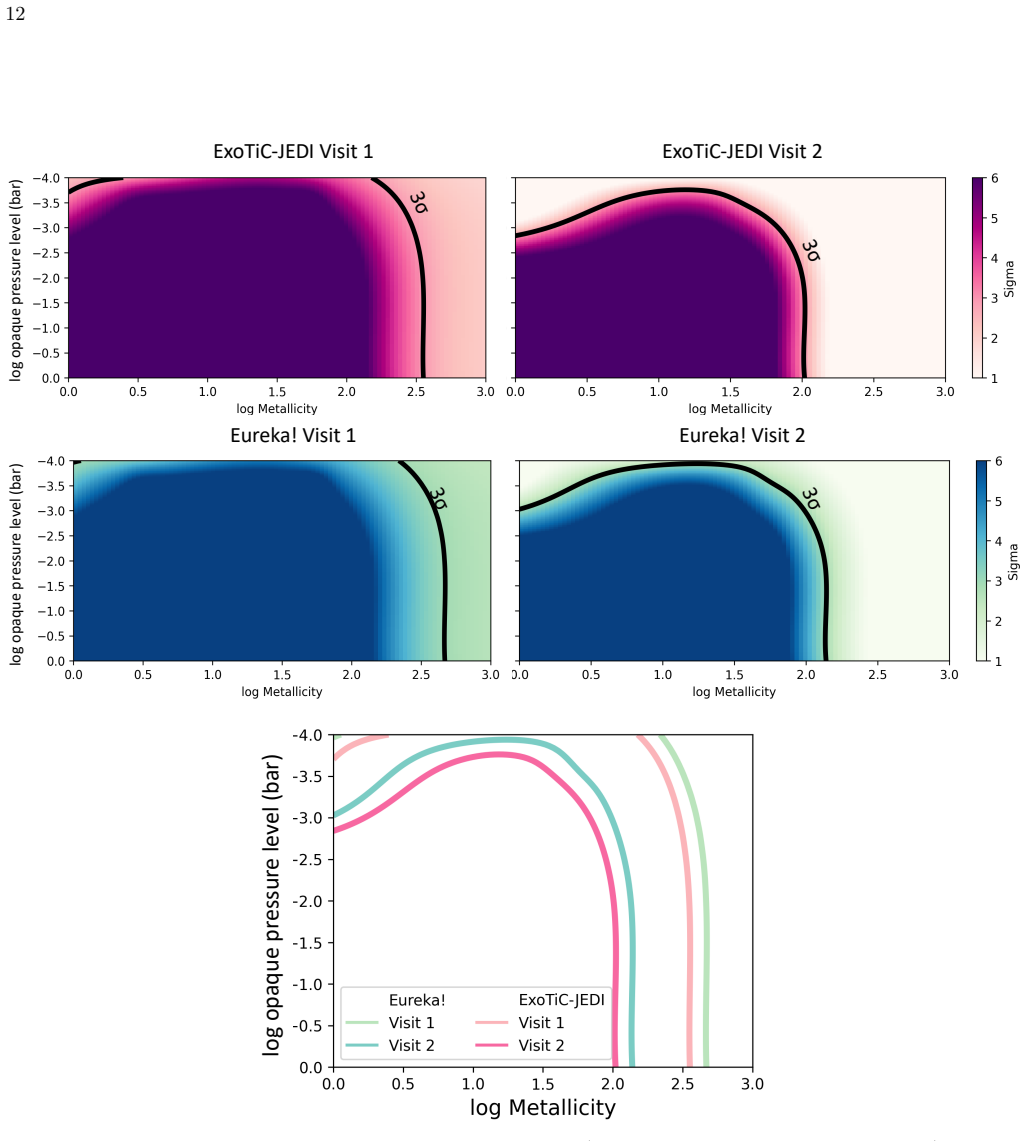
TOI-776b's transmission spectrum is featureless at the achieved precision, and the paper's central claim is a conservative exclusion: using chemical-equilibrium PICASO forward models in which an opaque pressure level represents either a cloud deck or the surface, the authors rule out atmospheres below 100× solar metallicity at $10^{-3}$ bar to ≥3σ across both visits and both reductions. At 1 bar, the exclusion is much stronger, with 10× solar and below rejected by more than 8σ and 100× solar rejected at 7σ for Visit 1. After subtracting the NRS1/NRS2 offset in Visit 2, the 3σ boundary at $10^{-3}$ bar spans ~350× solar (ExoTiC-JEDI) and ~470× solar (Eureka!) for Visit 1, and ~100× and ~130× solar for Visit 2. The atmospheres that survive are a very thin layer (opaque pressure at or below $10^{-4}$ bar), a high-metallicity atmosphere near ~1000× solar at 1 bar, or any of these with a wavelength-independent cloud deck; a bare rock is disfavoured because the planet's density and radius-valley position require some low-density material.
Load-bearing premise
The argument assumes that the ~65 ppm offset between the NRS1 and NRS2 detectors in Visit 2 is a fixed instrumental artifact that a single step function can remove before comparing the spectrum to physical models: if this offset actually changes with wavelength or time, the derived metallicity exclusion contours would be biased.
Editorial extensions
If this is right
- If the central claim is correct, TOI-776b cannot host a clear, hydrogen-dominated, low-metallicity atmosphere down to the 1-millibar level, so any atmosphere it retains must be metal-rich, very thin, or hidden by an opaque cloud or haze deck.
- The conservative 100× solar exclusion at 10^-3 bar extends the COMPASS sample's growing pattern that JWST super-Earth transmission spectra are featureless and point to high mean molecular weights or clouds rather than detectable molecular bands.
- Visit- and reduction-dependent limits (roughly 100× to 470× solar at 10^-3 bar) imply that comparing single quoted metallicities across planets or programs without accounting for these systematics could produce misleading population-level conclusions.
- The paper's identification of allowed low-metallicity, low-pressure parameter space shows that a non-detection of molecular features does not by itself distinguish a bare rock from an extremely thin atmosphere, since a 10^-10 mass-fraction hydrogen layer is photoevaporation-equivalent to a bare rock.
Reading between the lines
- An implication the authors leave implicit is that the unexcluded 1× solar, 10^-4 bar corner is unlikely to be a physically persistent atmosphere, so future observing time is better spent distinguishing a bare rock from a thin but stable high-metallicity or cloudy atmosphere than refining the high-metallicity boundary.
- If the Visit 2 NRS1/NRS2 offset is actually wavelength-dependent or time-varying, a scalar step correction could be hiding real spectral structure; a third transit at a different roll angle or with NIRSpec PRISM would test whether the 100× solar exclusion survives without the offset correction.
- A joint analysis of both visits with a shared systematic model for the detector offset might either sharpen the combined 3σ contour or reveal that the visit-to-visit spread is larger than the photon noise, which would argue for treating multi-visit super-Earth spectra as correlated measurements rather than independent confirmations.
- Applying the same metallicity-pressure grid approach to other COMPASS targets could separate cloudy high-metallicity atmospheres from genuinely bare-rock planets, a distinction that density and radius-valley arguments alone cannot make.
Editorial analysis
A structured set of objections, weighed in public.
Referee Report
Summary. This paper presents two JWST NIRSpec/G395H transit observations of the super-Earth TOI-776b, reduced independently with the ExoTiC-JEDI and Eureka! pipelines. The resulting 2.8–5.2 micron transmission spectra have a median precision of 34 ppm per 0.02 micron bin. The two reductions agree well for each visit, but the two visits show different overall structure: Visit 1 is consistent with a flat line, while Visit 2 requires a step offset between NRS1 and NRS2. After correcting for that offset, the authors compare the spectra to PICASO forward models over a grid of metallicity and opaque pressure. They conclude that atmospheres below 100x solar metallicity at an opaque pressure of 10^-3 bar are ruled out at >=3 sigma in all visits and reductions, with stronger visit- and reduction-dependent limits reaching 350–470x solar for Visit 1 and 100–130x solar for Visit 2.
Significance. If the central claim holds, this is a useful addition to the growing JWST sample of super-Earth atmospheric constraints, and it strengthens the COMPASS program's statistical approach. The paper's strengths include the use of two independent reduction pipelines, the public release of data products on Zenodo, the explicit discussion of visit-to-visit and reduction-to-reduction differences, and the framing of a conservative lower metallicity limit rather than a claimed detection. The conclusion that TOI-776b likely has a very thin, very cloudy, or highly metal-rich atmosphere is credible and informative for future population-level interpretations.
major comments (3)
- [Abstract and Section 6] The abstract reverses the visit-specific metallicity limits. The abstract states "Visit 1 ruling out ≲100× solar while the lower limits for Visit 2 extend beyond ∼350× solar," but Section 6 and Figure 6 report the opposite: at 10^-3 bar, Visit 1 excludes 350× solar (ExoTiC-JEDI) and 470× solar (Eureka!) while Visit 2 excludes only 100× solar (ExoTiC-JEDI) and 130× solar (Eureka!). Since the visit comparison is a key result and the conservative 100× solar floor is the headline, the abstract must be corrected to match the body of the paper.
- [Section 5.2, Table 3, Figure 6] The Visit 2 NRS1/NRS2 offset is fitted to the binned transmission spectrum in Section 5.1 and then treated as a fixed correction when computing chi-square/N and sigma for the PICASO models. The offset uncertainties (7.2 ppm for ExoTiC-JEDI, 6.2 ppm for Eureka!) are comparable to the 5–7 ppm differences between adjacent high-metallicity models quoted in Section 6, yet the significance contours in Figure 6 do not propagate this uncertainty or test whether the offset is wavelength-dependent or time-varying. Because the weakest case (ExoTiC-JEDI Visit 2) places the 3-sigma boundary at exactly 100× solar, the headline claim rests on the stability of this single-step correction. Please propagate the offset uncertainty into the model comparison, or demonstrate that a wavelength-dependent or time-varying offset moves the 10^-3 bar exclusion boundary by less than the metallicity grid spacing.
- [Section 5.1, Table 3] For Visit 2, the step-offset model and the five-parameter Gaussian-in-NRS1 model have Delta lnZ <= 1 for both reductions, so the step function is not statistically preferred over a narrow spectral feature. The paper argues that the Gaussian is not consistent between visits or reductions, but that does not rule out the possibility that the step offset is partially astrophysical in origin, especially given that the Gaussian central wavelength (3.43–3.45 um) lies in the methane band. If the step subtraction removes a real spectral feature, the flatness of the corrected data would be artificially enhanced and the metallicity exclusion contours biased. Please quantify the amplitude and width of the best-fit Gaussian and re-run the physical model comparison treating the offset as a free parameter (or allowing a wavelength-dependent offset) to verify that the 100× solar exclusion at 10^-3 bar is not an artifact of the chosen step correction.
minor comments (5)
- [Section 5.2] The term "reduced-χ2" is an unusual construction; consider using "reduced χ²" or simply "χ²/N" throughout for consistency with standard terminology.
- [Table 4] Table 4 reports chi-square/N and sigma values at 1 bar opaque pressure, while the headline claim concerns 10^-3 bar. Since the 100× solar row for Visit 2 ExoTiC-JEDI shows sigma = 2.6 at 1 bar, a footnote clarifying that the table is for 1 bar only would prevent readers from interpreting these entries as contradicting the abstract.
- [Figure 6] In the bottom panel of Figure 6, the four 3-sigma contours are hard to distinguish because of small labels and overlapping line styles; direct labels on each contour would improve readability.
- [Section 3.1] The sentence describing removal of 15 integrations around the HGA move would benefit from clarifying whether this removal was performed before or after the iterative 4-sigma outlier rejection, and whether the alternative of retaining those integrations was tested.
- [Section 1, references] The citation "May & MacDonald et al. 2023" is inconsistent with the author-list style used elsewhere; it should be "May, MacDonald, et al. 2023" (or similar) to match the other multi-author citations.
Circularity Check
No circularity: metallicity exclusions come from comparing TOI-776b data to pre-computed PICASO forward models, with no atmospheric parameter fitted to the target data.
full rationale
The central claim (Section 6: ruling out atmospheres less than 100x solar metallicity at 10^-3 bar) is produced by comparing each reduction's transmission spectrum to a pre-computed grid of PICASO chemical-equilibrium forward models over metallicity and opaque pressure; none of the atmospheric model parameters are fitted to the TOI-776b data. The only fitted inputs relevant to the physical-model step are standard light-curve/systematics parameters and the Visit 2 NRS1/NRS2 detector offset (Section 5.1), which is used as a nuisance correction and does not by construction determine metallicity. The offset-correction approach cites Moran & Stevenson et al. (2023), a co-authored prior paper, but the present paper independently fits the offset with two pipelines and obtains consistent values, so the self-citation is not load-bearing. Potential limitations, including the unpropagated offset uncertainty, possible wavelength dependence of the offset, and the marginal 3-sigma boundary for Visit 2 ExoTiC-JEDI, are statistical robustness concerns rather than circular reasoning. No equation, fitted parameter, or definition in the paper reduces the metallicity exclusion to its own inputs.
Assumptions & free parameters
free parameters (6)
- NRS1/NRS2 step offset (Visit 2) =
60-70 ppm depending on reduction (ExoTiC-JEDI: 70.7±7.2, Eureka!: 60.2±6.2)
- Per-point error scaling or jitter =
Not stated explicitly; Eureka! fits an additive per-point error term, ExoTiC-JEDI rescales errors with beta.
- Baseline intercept in non-physical fits =
Approximately 915-944 ppm depending on visit and reduction
- Metallicity grid =
1 to 1000x solar in 20 logarithmic steps
- Opaque pressure grid =
1 to 1e-4 bar (with 1e-3 bar emphasized)
- C/O ratio =
0.55 (1x solar)
assumptions (6)
- domain assumption Guillot (2010) analytic T-P profiles are representative for TOI-776b at Teq=514 K.
- domain assumption Chemical equilibrium (photochem) with Asplund solar abundances describes the atmospheric composition.
- domain assumption A wavelength-independent opaque deck with tau=10 at a chosen pressure captures possible clouds.
- domain assumption Stellar and orbital parameters from Luque et al. (2021) are accurate enough to fix P, e, omega, and stellar properties.
- ad hoc to paper The Visit 2 NRS1/NRS2 offset is purely instrumental and can be removed with a step function.
- domain assumption Limb darkening coefficients from model atmospheres (Phoenix, MPS-ATLAS) are correct and fixed.
Cite this review
Pith. "Pith review of JWST COMPASS: NIRSpec/G395H Transmission Observations of the Super-Earth TOI-776b." pith.science (2026). https://pith.science/paper/FY3ZTTZQ
@misc{pith2026250114596,
  author       = {Pith},
  title        = {Pith review of: JWST COMPASS: NIRSpec/G395H Transmission Observations of the Super-Earth TOI-776b},
  year         = {2026},
  howpublished = {\url{https://pith.science/paper/FY3ZTTZQ}},
  note         = {Machine review of arXiv:2501.14596}
}
abstract
We present two transit observations of the $\sim$520K, 1.85R$_\oplus$, 4.0M$_\oplus$ super-Earth TOI-776b with JWST NIRSpec/G395H, resulting in a 2.8-5.2$\mu$m transmission spectrum. Producing reductions using the ExoTiC-JEDI and Eureka! pipelines, we obtain a median transit depth precision of 34ppm for both visits and both reductions in spectroscopic channels 30 pixels wide ($\sim$0.02$\mu$m). We find that our independent reductions produce consistent transmission spectra, however, each visit shows differing overall structure. For both reductions, a flat line is preferred for Visit 1 while a flat line with an offset between the NRS1 and NRS2 detectors is preferred for Visit 2; however, we are able to correct for this offset during our modeling analysis following methods outlined in previous literature. Using picaso forward models, we can rule out metallicities up to at least 100$\times$ solar with an opaque pressure of 10$^{-3}$ bar to $\geq$3$\sigma$ in all cases, however, the exact lower limit varies between the visits, with Visit 1 ruling out $\lesssim$100$\times$ solar while the lower limits for Visit 2 extend beyond $\sim$350$\times$ solar. Our results add to the growing list of super-Earth atmospheric constraints by JWST, which provide critical insight into the diversity and challenges of characterizing terrestrial planets.
Figures


Figures from the paper (4 more)


Forward citations
Cited by 2 Pith papers
-
A parameterised approach to disequilibrium retrievals in the JWST era: Application to NIRCam observations of HD 189733b
A quench-pressure parameterisation with two free parameters recovers unbiased C/O and [M/H] from synthetic JWST spectra with vertical mixing, and tentatively detects quenching and photochemical H2S depletion in HD 189...
-
JWST COMPASS: A NIRSpec G395H Transmission Spectrum of the Super-Earth GJ 357 b
The first NIRSpec G395H transmission spectrum of GJ 357 b is featureless, ruling out low mean molecular weight atmospheres at 3-sigma and pointing to a bare rock or a high molecular weight secondary atmosphere.
Reference graph
Works this paper leans on
-
[1]
K., Gao, P., Adams Redai, J., et al
Alam, M. K., Gao, P., Adams Redai, J., et al. 2024, arXiv e-prints, arXiv:2411.03154, doi: 10.48550/arXiv.2411.03154
-
[2]
2022a, Exo-TiC/ExoTiC-JEDI: v0.1-beta-release, v0.1, Zenodo, Zenodo, doi: 10.5281/zenodo.7185855
Alderson, L., Grant, D., & Wakeford, H. 2022a, Exo-TiC/ExoTiC-JEDI: v0.1-beta-release, v0.1, Zenodo, Zenodo, doi: 10.5281/zenodo.7185855
-
[3]
Alderson, L., Wakeford, H. R., MacDonald, R. J., et al. 2022b, MNRAS, 512, 4185, doi: 10.1093/mnras/stac661
-
[4]
Alderson, L., Wakeford, H. R., Alam, M. K., et al. 2023, Nature, 614, 664, doi: 10.1038/s41586-022-05591-3
-
[5]
Alderson, L., Batalha, N. E., Wakeford, H. R., et al. 2024, AJ, 167, 216, doi: 10.3847/1538-3881/ad32c9
-
[6]
Asplund, M., Grevesse, N., Sauval, A. J., & Scott, P. 2009, ARA&A, 47, 481, doi: 10.1146/annurev.astro.46.060407.145222 Astropy Collaboration, Robitaille, T. P., Tollerud, E. J., et al. 2013, A&A, 558, A33, doi: 10.1051/0004-6361/201322068 Astropy Collaboration, Price-Whelan, A. M., Sip˝ ocz, B. M., et al. 2018, AJ, 156, 123, doi: 10.3847/1538-3881/aabc4f...
arXiv 2009
-
[7]
Banerjee, A., Barstow, J. K., Gressier, A., et al. 2024, ApJL, 975, L11, doi: 10.3847/2041-8213/ad73d0
-
[8]
2022, Resampled Opacity Database for PICASO, 2.0, Zenodo, doi: 10.5281/zenodo.6928501
Batalha, N., Freedman, R., Gharib-Nezhad, E., & Lupu, R. 2022, Resampled Opacity Database for PICASO, 2.0, Zenodo, doi: 10.5281/zenodo.6928501
Show all 64 references
-
[9]
2018, ApJL, 856, L34, doi: 10.3847/2041-8213/aab896
Stevenson, K. 2018, ApJL, 856, L34, doi: 10.3847/2041-8213/aab896
2018 doi
-
[10]
E., Marley, M
Batalha, N. E., Marley, M. S., Lewis, N. K., & Fortney, J. J. 2019, ApJ, 878, 70, doi: 10.3847/1538-4357/ab1b51
2019 doi
-
[11]
E., Wolfgang, A., Teske, J., et al
Batalha, N. E., Wolfgang, A., Teske, J., et al. 2023, AJ, 165, 14, doi: 10.3847/1538-3881/ac9f45
2023 doi
-
[12]
E., Mandell, A., Pontoppidan, K., et al
Batalha, N. E., Mandell, A., Pontoppidan, K., et al. 2017, PASP, 129, 064501, doi: 10.1088/1538-3873/aa65b0
2017 doi
-
[13]
2022, The Journal of Open Source Software, 7, 4503, doi: 10.21105/joss.04503
Bell, T., Ahrer, E.-M., Brande, J., et al. 2022, The Journal of Open Source Software, 7, 4503, doi: 10.21105/joss.04503
2022 doi
-
[14]
2017, ApJ, 850, 93, doi: 10.3847/1538-4357/aa965a
Brugger, B., Mousis, O., Deleuil, M., & Deschamps, F. 2017, ApJ, 850, 93, doi: 10.3847/1538-4357/aa965a
2017 doi
-
[15]
2016, Statistics and Computing, 26, 383, doi: 10.1007/s11222-014-9512-y —
Buchner, J. 2016, Statistics and Computing, 26, 383, doi: 10.1007/s11222-014-9512-y —. 2019, PASP, 131, 108005, doi: 10.1088/1538-3873/aae7fc —. 2021, The Journal of Open Source Software, 6, 3001, doi: 10.21105/joss.03001
2016 doi
-
[16]
2022, JWST Calibration Pipeline, 1.8.2, Zenodo, Zenodo, doi: 10.5281/zenodo.7229890
Bushouse, H., Eisenhamer, J., Dencheva, N., et al. 2022, JWST Calibration Pipeline, 1.8.2, Zenodo, Zenodo, doi: 10.5281/zenodo.7229890
2022 doi
-
[17]
J., et al
Cadieux, C., Doyon, R., MacDonald, R. J., et al. 2024, ApJL, 970, L2, doi: 10.3847/2041-8213/ad5afa
2024 doi
-
[18]
A., Droettboom, M., Hunter, J., et al
Caswell, T. A., Droettboom, M., Hunter, J., et al. 2019, matplotlib/matplotlib v3.1.0, v3.1.0, Zenodo, doi: 10.5281/zenodo.2893252
2019 doi
-
[19]
2000, A&A, 363, 1081
Claret, A. 2000, A&A, 363, 1081
2000
-
[20]
H., Meadows, V
Currie, M. H., Meadows, V. S., & Rasmussen, K. C. 2023, PSJ, 4, 83, doi: 10.3847/PSJ/accf86
2023 doi
-
[21]
2024, ApJL, 968, L22, doi: 10.3847/2041-8213/ad5204
Damiano, M., Bello-Arufe, A., Yang, J., & Hu, R. 2024, ApJL, 968, L22, doi: 10.3847/2041-8213/ad5204
2024 doi
-
[22]
2015, A&A, 577, A83, doi: 10.1051/0004-6361/201424915
Dorn, C., Khan, A., Heng, K., et al. 2015, A&A, 577, A83, doi: 10.1051/0004-6361/201424915
2015 doi
-
[23]
D., & Charbonneau, D
Dressing, C. D., & Charbonneau, D. 2015, ApJ, 807, 45, doi: 10.1088/0004-637X/807/1/45
2015 doi
-
[24]
W., Lang, D., & Goodman, J
Foreman-Mackey, D., Hogg, D. W., Lang, D., & Goodman, J. 2013, PASP, 125, 306
2013
-
[25]
Y., Bonfanti, A., et al
Fridlund, M., Georgieva, I. Y., Bonfanti, A., et al. 2024, A&A, 684, A12, doi: 10.1051/0004-6361/202243838
2024 doi
-
[26]
P., Lee, G
Gao, P., Thorngren, D. P., Lee, G. K. H., et al. 2020, Nature Astronomy, 4, 951, doi: 10.1038/s41550-020-1114-3
2020 doi
-
[27]
E., & Sari, R
Ginzburg, S., Schlichting, H. E., & Sari, R. 2018, MNRAS, 476, 759, doi: 10.1093/mnras/sty290
2018 doi
-
[28]
Weber, B. W. 2022, Cantera: An Object-oriented Software Toolkit for Chemical Kinetics, Thermodynamics, and Transport Processes, 2.6.0, Zenodo, doi: 10.5281/zenodo.6387882 16
2022 doi
-
[29]
2024, The Journal of Open Source Software, 9, 6816, doi: 10.21105/joss.06816
Grant, D., & Wakeford, H. 2024, The Journal of Open Source Software, 9, 6816, doi: 10.21105/joss.06816
2024 doi
-
[30]
Grant, D., & Wakeford, H. R. 2022, Exo-TiC/ExoTiC-LD: ExoTiC-LD v3.0.0, v3.0.0, Zenodo, Zenodo, doi: 10.5281/zenodo.7437681
2022 doi
-
[31]
H., et al
Gressier, A., Espinoza, N., Allen, N. H., et al. 2024, ApJL, 975, L10, doi: 10.3847/2041-8213/ad73d1
2024 doi
-
[32]
2010, A&A, 520, A27, doi: 10.1051/0004-6361/200913396
Guillot, T. 2010, A&A, 520, A27, doi: 10.1051/0004-6361/200913396
2010 doi
-
[33]
2012, ApJ, 754, 60, doi: 10.1088/0004-637X/754/1/60
Heng, K., & Kopparla, P. 2012, ApJ, 754, 60, doi: 10.1088/0004-637X/754/1/60
2012 doi
-
[34]
2017, Journal of Open Research Software, 5
Hoyer, S., & Hamman, J. 2017, Journal of Open Research Software, 5
2017
-
[35]
2013, A&A, 553, A6, doi: 10.1051/0004-6361/201219058
Husser, T.-O., Wende-von Berg, S., Dreizler, S., et al. 2013, A&A, 553, A6, doi: 10.1051/0004-6361/201219058
2013 doi
-
[36]
P., Dannert, F., & LIFE Collaboration
Kammerer, J., Quanz, S. P., Dannert, F., & LIFE Collaboration. 2022, A&A, 668, A52, doi: 10.1051/0004-6361/202243846
2022 doi
-
[37]
B., Fu, G., et al
Kirk, J., Stevenson, K. B., Fu, G., et al. 2024, AJ, 167, 90, doi: 10.3847/1538-3881/ad19df
2024 doi
-
[38]
2022, arXiv preprint arXiv:2206.06641
Kostogryz, N., Witzke, V., Shapiro, A., et al. 2022, arXiv preprint arXiv:2206.06641
2022 arXiv
-
[39]
2015, PASP, 127, 1161, doi: 10.1086/683602
Kreidberg, L. 2015, PASP, 127, 1161, doi: 10.1086/683602
2015 doi
-
[40]
2025, Treatise on Geochemistry, 7, 51, doi: 10.1016/B978-0-323-99762-1.00122-4
Lichtenberg, T., & Miguel, Y. 2025, Treatise on Geochemistry, 7, 51, doi: 10.1016/B978-0-323-99762-1.00122-4
2025 doi
-
[41]
Lodders, K., Palme, H., & Gail, H. P. 2009, Landolt Börnstein, 4B, 712, doi: 10.1007/978-3-540-88055-4 34
2009 doi
-
[42]
M., Molaverdikhani, K., et al
Luque, R., Serrano, L. M., Molaverdikhani, K., et al. 2021, A&A, 645, A41, doi: 10.1051/0004-6361/202039455
2021 doi
- [43]
- [44]
-
[45]
2011, Python for high performance and scientific computing, 14, 1
McKinney, W., et al. 2011, Python for high performance and scientific computing, 14, 1
2011
-
[46]
Wakeford, H. R. 2018, AJ, 156, 252, doi: 10.3847/1538-3881/aae83a
2018 doi
-
[47]
E., Stevenson, K
Moran, S. E., Stevenson, K. B., Sing, D. K., et al. 2023, ApJL, 948, L11, doi: 10.3847/2041-8213/accb9c
2023 doi
-
[48]
E., Fortney, J
Mukherjee, S., Batalha, N. E., Fortney, J. J., & Marley, M. S. 2023, ApJ, 942, 71, doi: 10.3847/1538-4357/ac9f48
2023 doi
-
[49]
2006, NumPy: A guide to NumPy, USA: Trelgol Publishing
Oliphant, T. 2006, NumPy: A guide to NumPy, USA: Trelgol Publishing. http://www.numpy.org/
2006
- [50]
-
[51]
2006, MNRAS, 373, 231, doi: 10.1111/j.1365-2966.2006.11012.x
Pont, F., Zucker, S., & Queloz, D. 2006, MNRAS, 373, 231, doi: 10.1111/j.1365-2966.2006.11012.x
2006
- [52]
-
[53]
G., & Owen, J
Rogers, J. G., & Owen, J. E. 2021a, MNRAS, 503, 1526, doi: 10.1093/mnras/stab529 —. 2021b, MNRAS, 503, 1526, doi: 10.1093/mnras/stab529
- [54]
-
[55]
W., et al
Schlawin, E., Leisenring, J., McElwain, M. W., et al. 2021, AJ, 161, 115, doi: 10.3847/1538-3881/abd8d4
2021 doi
-
[56]
L., St¨ urmer, J., et al
Seifahrt, A., Bean, J. L., St¨ urmer, J., et al. 2020, in Society of Photo-Optical Instrumentation Engineers (SPIE) Conference Series, Vol. 11447, Ground-based and Airborne Instrumentation for Astronomy VIII, ed. C. J
2020
-
[57]
Evans, J. J. Bryant, & K. Motohara, 114471F, doi: 10.1117/12.2561564
-
[58]
X., Wolfgang, A., et al
Teske, J., Wang, S. X., Wolfgang, A., et al. 2021, ApJS, 256, 33, doi: 10.3847/1538-4365/ac0f0a
2021 doi
-
[59]
2019, scipy/scipy: SciPy 1.2.1, v1.2.1, Zenodo, doi: 10.5281/zenodo.2560881
Virtanen, P., Gommers, R., Burovski, E., et al. 2019, scipy/scipy: SciPy 1.2.1, v1.2.1, Zenodo, doi: 10.5281/zenodo.2560881
2019 doi
-
[60]
L., Batalha, N
Wallack, N. L., Batalha, N. E., Alderson, L., et al. 2024, AJ, 168, 77, doi: 10.3847/1538-3881/ad3917
2024 doi
-
[61]
F., Catling, D
Wogan, N. F., Catling, D. C., Zahnle, K. J., & Lupu, R. 2023, PSJ, 4, 169, doi: 10.3847/PSJ/aced83
2023 doi
-
[62]
J., & Catling, D
Zahnle, K. J., & Catling, D. C. 2017, ApJ, 843, 122, doi: 10.3847/1538-4357/aa7846
2017 doi
-
[63]
Zeng, L., & Jacobsen, S. B. 2016, ApJ, 829, 18, doi: 10.3847/0004-637X/829/1/18
2016 doi
-
[64]
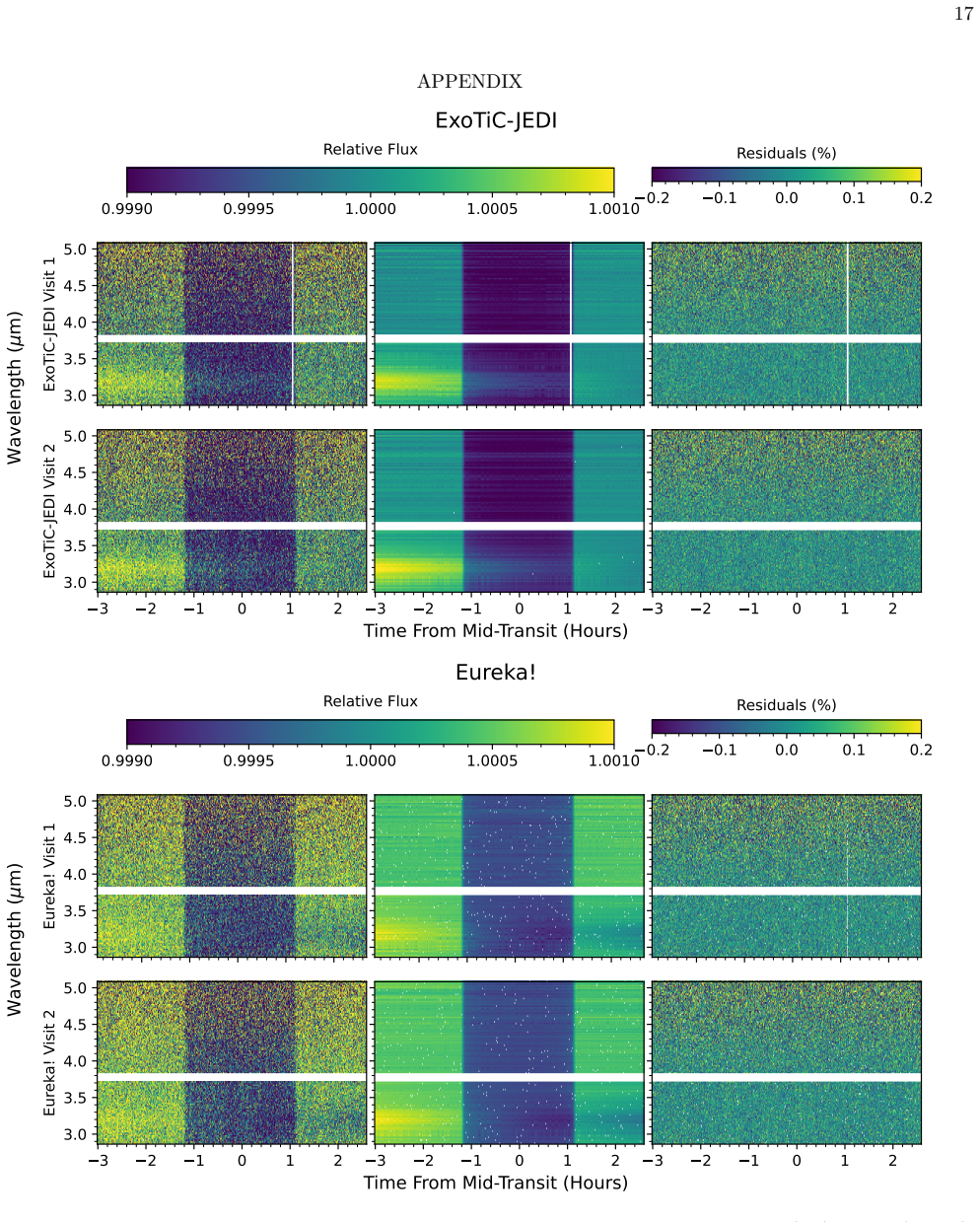
Zhang, H., Wang, J., & Plummer, M. K. 2024, AJ, 167, 37, doi: 10.3847/1538-3881/ad109e 17 APPENDIX 3.0 3.5 4.0 4.5 5.0ExoTiC-JEDI Visit 1 3 2 1 0 1 2 3.0 3.5 4.0 4.5 5.0ExoTiC-JEDI Visit 2 3 2 1 0 1 2 3 2 1 0 1 2 0.9990 0.9995 1.0000 1.0005 1.0010 Relative Flux 0.2 0.1 0.0 0.1...
2024 doi
Reviewed August 10, 2026 · model on record in the stance chip above.
Discussion (0). Continue with ORCID to comment.