REVIEW 3 major objections 4 minor 3 cited by
Proposal of the KOTO II experiment
T0 review · 3 major / 4 minor · reviewed 2026-08-10 · deepseek-v4-flash
Pith's one-line read A proposed J-PARC experiment, KOTO II, would reach 5.6 sigma sensitivity on the ultra-rare kaon decay K_L to pi0 nu nubar, enough to observe it for the first time.
desk verdict Honest, detailed KOTO II proposal with a transparent 5.6σ projection, but the central background rejection factors—especially 1% halo KL→2γ—are not yet demonstrated and are contradicted by the paper's own prototype data. read the letter →
The pith
A machine-rendered reading of the paper's core claim, the machinery that carries it, and where it could break.
The reading
What carries the argument
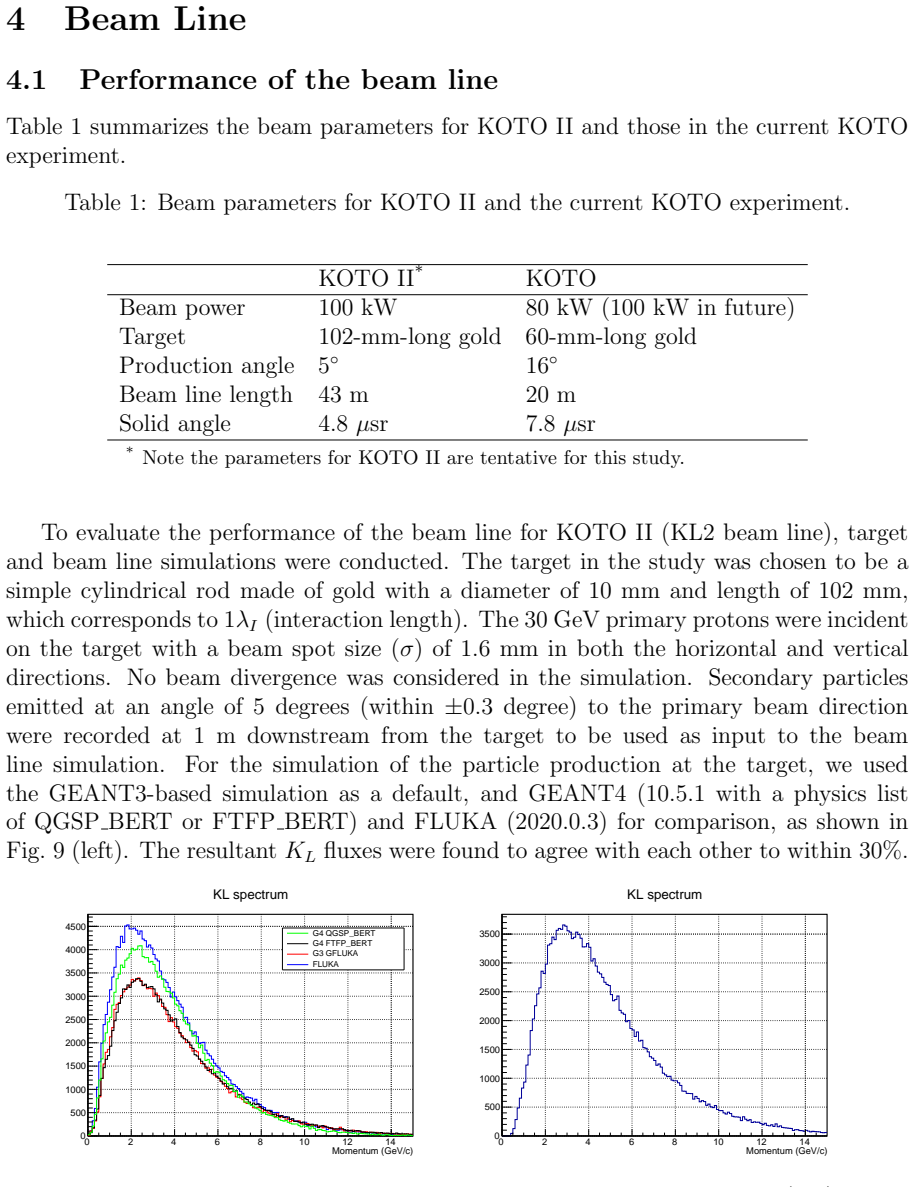
The argument is carried by the 5-degree production angle and the new beamline geometry: a T2 target near the beam dump produces $K_L$ with a harder momentum spectrum peaking near 3 GeV/c rather than 1.4 GeV/c, raising the $K_L$ flux by a factor of 2.6 per proton on target while the forward boost keeps the two photons from $\pi^0$ decay inside the 20-meter decay volume and the 3-meter calorimeter. The detector uses the same reconstruction concept as KOTO: two photon clusters in the calorimeter, a vertex on the beam axis from the nominal $\pi^0$ mass hypothesis, and a transverse-momentum requirement that selects the signal. Backgrounds are controlled by hermetic photon and charged-particle vetoes, plus three assumed suppression factors: halo $K_L\to2\gamma$ reduced to 1 percent of its original level by photon angle-of-incidence information, hadron-cluster backgrounds reduced by $10^{-7}$ using cluster-shape, pulse-shape, and shower-depth information, and charged kaons reduced to 10 percent of their original flux by a second sweeping magnet.
What would settle it
Measure the charged-kaon-to-$K_L$ flux ratio at the end of the proposed K_L2 beamline with the second sweeping magnet operating; if the ratio exceeds roughly $1.1\times10^{-6}$ rather than the assumed 10 percent of the pre-magnet value, the $K^\pm\to\pi^0 e^\pm\nu$ background alone would grow from 4.0 events to well above 10 events, eroding the $5.6\sigma$ claim.
Extended reading notes
Core claim
The paper's central claim is that a new beamline extracting long-lived neutral kaons at 5 degrees from a production target, combined with a larger 3-meter-diameter calorimeter and hermetic veto system, gives KOTO II a single-event sensitivity of $8.5\times10^{-13}$. For the Standard Model branching ratio of about $3\times10^{-11}$, the experiment expects $35.3\pm0.4$ signal events and $40\pm2.7$ background events, corresponding to a signal-to-background ratio of 0.89 and an observation significance of $5.6\sigma$. The proposal also claims this measurement would determine the branching ratio to about 25 percent precision, the CP-violating CKM parameter $\eta$ to 12 percent, and would indicate new physics at 90-percent confidence if the branching ratio deviates by 40 percent from the Standard Model prediction.
Load-bearing premise
The background count of 40 events rests on three assumed suppression factors: halo $K_L\to2\gamma$ reduced to 1 percent of its original level, hadron-cluster backgrounds reduced by $10^{-7}$, and charged kaons cut to 10 percent by a second sweeping magnet; if any of these is several times worse, the projected $5.6\sigma$ significance drops below $5\sigma$.
Editorial extensions
If this is right
- KOTO II would provide the first observation of the Standard Model decay $K_L\to\pi^0\nu\bar{\nu}$ with a significance exceeding $5\sigma$.
- The measurement would determine the branching ratio to roughly 25 percent and the CKM parameter $\eta$ to 12 percent, sharpening tests of the Standard Model flavor sector.
- A 40-percent deviation of the branching ratio from the Standard Model prediction would be visible at 90-percent confidence, providing a model-independent probe of new physics at mass scales beyond direct LHC reach.
- Combined with the charged-mode $K^+\to\pi^+\nu\bar{\nu}$ measurement and the proposed second phase measuring $K_L\to\pi^0\ell^+\ell^-$, KOTO II would give a comprehensive test of flavor dynamics and lepton-flavor universality.
- The same detector and beamline would enable searches for dark photons, axion-like particles, and other rare $K_L$ decays, extending the physics reach beyond the golden channel.
Reading between the lines
- If the 5-degree beamline is built, the facility could also be operated in a beam-dump mode to search for feebly interacting particles; the proposal mentions dark photons and axion-like particles but does not quantify the beam-dump sensitivity, so that reach is an open extension of the design.
- The 1-percent residual halo-$K_L$ background relies on a photon angle resolution near 1.3 degrees at 1 GeV from a finely segmented pre-shower; the paper reports a prototype whose data are 30 to 40 percent worse than simulation, so the viability of that suppression factor hinges on the ongoing prototype analysis.
- The background budget is dominated by $K_L\to\pi^0\pi^0$ at 16.9 events, a component that the paper shows is nearly unchanged when the calorimeter is replaced by KLOE- or KOPIO-style sampling calorimeters; this suggests the discovery reach is less sensitive to calorimeter technology than to the three assumed suppression factors.
- A direct measurement of the charged-kaon-to-$K_L$ ratio at the end of the beamline with the second sweeping magnet would provide an early, decisive check on the $K^\pm\to\pi^0 e^\pm\nu$ background estimate.
Editorial analysis
A structured set of objections, weighed in public.
Referee Report
Summary. This proposal presents the physics case, beamline design, detector concept, and a complete sensitivity/background estimate for KOTO II, a next-generation experiment at J-PARC to measure K_L → π0 ν νbar. With a 5-degree production angle, a 43-m beamline, a 3-m-diameter calorimeter, and a 20-m decay region, the authors project a single-event sensitivity of 8.5×10^-13, 35 expected signal events for the SM branching ratio of 3×10^-11, and 40 background events after 3×10^7 s at 100 kW, corresponding to a 5.6σ significance (Section 6.6, Table 8). The paper also outlines a second phase for K_L → π0 ℓ+ℓ- and searches for dark photons and axion-like particles.
Significance. If the projected sensitivity is realistic, KOTO II would be the first experiment capable of discovering K_L → π0 ν νbar at the SM rate and would provide a powerful probe of new physics in the kaon sector. The strength of the manuscript is its transparent, forward Monte Carlo approach: every selection cut, veto window, detector inefficiency, and accidental-loss model is specified, and the signal yield in Section 6.4.5 follows arithmetically from the stated inputs. The use of measured KOTO detector performances as calibration is appropriate and not circular. However, the central 5.6σ claim rests on several assumed suppression factors that are not yet validated; most critically, the halo-K_L→2γ rejection factor of 1% (Section 6.5.4) is contradicted by the prototype measurement in Section 7.1, which shows angular resolution worse than simulation by 30–40%. A 10× worse halo-K_L rejection would lower the expected significance to ~3.8σ, so the headline sensitivity is not yet robust.
major comments (3)
- [6.5.4 and 7.1] The halo-K_L→2γ background estimate of 4.8 events in Section 6.5.4 assumes a rejection factor of 1%, while the text states that KOTO achieves only a 10% reduction with 90% signal efficiency, and the justification relies on better angular resolution for higher-energy photons. The feasibility study in Section 7.1 reports that the PAScal pre-shower prototype measures an angular resolution 30–40% worse than simulation, with the reason still under study. Because the 5.6σ significance in Section 6.6 scales as S/√B with B = 40, a 10% rejection factor would increase this background to roughly 48 events and reduce the significance to about 3.8σ; even a 3% rejection gives B ≈ 50 and Z ≈ 5.0. The discovery claim therefore rests on an unvalidated order-of-magnitude improvement that the paper's own prototype data currently contradict. Please provide a quantitative relation between angular resolution and the rejection factor, or present the sensitivity projection as a function of the achievable rejection.
- [6.5.5 and 4.1.1] The K± → π0e±ν background of 4.0 events in Section 6.5.5 assumes that the second sweeping magnet reduces the charged-kaon flux to 10% of its original value. However, Section 4.1.1 reports that the simulation with a 2-T, 1.5-m sweeping magnet yields R(K±/KL) < 1.1×10^-6 starting from 4.1×10^-6, i.e., a reduction to about 27% (an upper limit limited by simulation statistics). Using 27% rather than 10% would increase this background to roughly 10.8 events, further lowering the expected significance. The 10% assumption should be justified with a dedicated simulation or by quoting a sensitivity with a range for the residual charged-kaon flux.
- [6.5.6] The hadron-cluster background of 3.0 events assumes a total reduction factor of 10^-7, obtained by multiplying the KOTO-measured factors (2.5±0.01)×10^-6 and 2.1×10^-2. While the multiplication is plausible if the correlations are small, the combined rejection is an extrapolation to the new 50-cm CsI calorimeter and has not been demonstrated in a prototype. The paper notes that 'This reduction power is one of the requirements on the calorimeter design,' but does not quantify the systematic uncertainty arising from the correlation or from the extrapolation. Please either provide supporting evidence for the 10^-7 factor or treat it as a central value with an assigned uncertainty in the background budget and in the significance.
minor comments (4)
- [5.4.1] The energy and position resolution formulas contain a garbled 'p' symbol; they should read σE/E = 1% ⊕ 2%/√E and σx = 5 mm/√E to be consistent with the text and Figure 19.
- [6.3 and 6.4.2] The notation '0.93 = 0.73' in cut 10 of Section 6.3 and '0.94 = 66%' in Section 6.4.2 should be written as 0.9^3 ≈ 0.73 and 0.9^4 ≈ 0.66, respectively.
- [6.5.9 and 6.5.8] In Table 7 the row labelled 'η at downstream' is inconsistent with the text of Section 6.5.8, which describes 'η production at the Charged Veto Counter'; the table label should match the section title.
- [6.2] In Section 6.2, 'the the π0 transverse momentum' contains a duplicate article; please correct the typo.
Circularity Check
No significant circularity: the projected sensitivity is a forward Monte Carlo calculation using measured KOTO detector performance and explicitly stated design assumptions.
full rationale
The central sensitivity estimate is a forward simulation, not a fit to the target branching ratio. The expected signal yield S=35 is computed from the assumed beam power and running time, the simulated KL flux, decay probability, geometrical and cut acceptances, accidental and backsplash losses, and the Standard Model branching fraction of 3e-11. The background total B=40 is the sum of independently simulated channels, each using measured KOTO detector inefficiencies, veto counter performances, and beam-line Monte Carlo samples. The suppression factors that the skeptical reader identifies as weak assumptions, such as the 1% halo-KL->2gamma reduction, the 1e-7 hadron cluster reduction, and the 10% charged-kaon flux after the second sweeping magnet, are presented in the text as assumptions or design requirements, explicitly flagged with phrases like 'Further studies are in progress' and 'This reduction power is one of the requirements on the calorimeter design.' They are not parameters adjusted to make the 5.6-sigma claim come out; the paper quotes them before presenting the final significance, and it reports prototype measurements showing a 30-40% worse angular resolution as a feasibility concern rather than hiding it. The cited KOTO measurements are independent experimental calibrations of detector performance, not the conclusion of the proposal. No equation in the paper defines the predicted significance in terms of itself, and no fitted parameter is relabeled as a prediction. The derivation chain is therefore self-contained in the relevant sense: the 5.6-sigma projection could fail if the assumed background suppression proves unachievable, but that is a sensitivity risk, not circular reasoning.
Assumptions & free parameters
free parameters (6)
- Halo KL to 2 gamma background rejection factor =
1e-2
- Hadron cluster background rejection factor =
1e-7
- Charged kaon flux reduction by second sweeping magnet =
0.10
- Running time and beam power =
3e7 s at 100 kW
- Beam hole photon veto threshold =
5.5 photoelectrons
- Veto window widths =
40/30/6/20 ns
assumptions (4)
- domain assumption SM branching ratio BR(K_L to pi0 nu nu) = (2.94±0.15)e-11 taken from literature (Ref [4])
- domain assumption The GEANT3-based target/beam simulation is conservative; G4 and FLUKA agree within 30%
- domain assumption KOTO-measured detector performances (charged veto inefficiency 1e-5, TGC 5e-3, BHPV design) transfer to the new larger detector
- standard math Standard Model and isospin relations (Grossman-Nir bound) as physics motivation
Cite this review
Pith. "Pith review of Proposal of the KOTO II experiment." pith.science (2026). https://pith.science/paper/S4W5U3SO
@misc{pith2026250114827,
  author       = {Pith},
  title        = {Pith review of: Proposal of the KOTO II experiment},
  year         = {2026},
  howpublished = {\url{https://pith.science/paper/S4W5U3SO}},
  note         = {Machine review of arXiv:2501.14827}
}
abstract
The KOTO II experiment is proposed to measure the branching ratio of the decay $K_L\to\pi^0\nu\bar{\nu}$ at J-PARC. With a beamline to extract long-lived neutral kaons at 5 degrees from a production target, the single event sensitivity of the decay is $8.5\times 10^{-13}$, which is much smaller than the Standard Model prediction $3\times 10^{-11}$. This allows searches for new physics beyond the Standard Model and the first discovery of the decay with a significance exceeding $5\sigma$. As the only experiment proposed in the world dedicated to rare kaon decays, KOTO II will be indispensable in the quest for a complete understanding of flavor dynamics in the quark sector. Moreover, by combining efforts from the kaon community worldwide, we plan to develop the KOTO II detector further and expand the physics reach of the experiment to include measurements of the branching ratio of the $K_L\to\pi^0\ell^+\ell^-$ decays, studies of other $K_L$ decays, and searches for dark photons, axions, and axion-like particles. KOTO II will therefore obtain a comprehensive understanding of $K_L$ decays, providing further constraints on new physics scenarios with existing $K^+$ results.
Figures


Figures from the paper (60 more)







Forward citations
Cited by 3 Pith papers
-
Physics-Constrained Generative Inference of Sub-Crystal Electromagnetic Shower Structure in a Segmented Calorimeter
A moment-constrained generative super-resolution model recovers sub-crystal electromagnetic shower structure from coarsely segmented calorimeter readout and improves downstream photon-angle and π0-vertex reconstructio...
-
Challenging Majorana neutrino effects in $B\to K^{(\ast)}\nu\nu$ and $K\to \pi\nu\nu$ decays
Belle-II's B→Kνν excess cannot be explained by dimension-7 lepton-number-violating SMEFT operators without fine-tuning neutrino masses, while a light sterile-neutrino extension can, with testable decay spectra.
-
A CKM blind spot: probing $b$-column rescaling with kaons
A uniform rescaling of the CKM b-column is invisible to B-physics-only fits, and kaon data already bound it to −4%…+4% (2σ), with projections reaching ~2%.
Reference graph
Works this paper leans on
-
[1]
Can we reach the Zeptouniverse with rare K and Bs,d decays?,
A. J. Buras, D. Buttazzo, J. Girrbach-Noe, and R. Knegjens, “Can we reach the Zeptouniverse with rare K and Bs,d decays?,” JHEP 11 (2014) 121, arXiv:1408.0728 [hep-ph]
arXiv 2014
-
[2]
Updated Standard Model Prediction for K → πν ¯ν and ϵK,
J. Brod, M. Gorbahn, and E. Stamou, “Updated Standard Model Prediction for K → πν ¯ν and ϵK,” PoS BEAUTY2020 (2021) 056, arXiv:2105.02868 [hep-ph]
arXiv 2021
-
[3]
Anatomy of kaon decays and prospects for lepton flavour universality violation,
G. D’Ambrosio, A. M. Iyer, F. Mahmoudi, and S. Neshatpour, “Anatomy of kaon decays and prospects for lepton flavour universality violation,” JHEP 09 (2022) 148, arXiv:2206.14748 [hep-ph]
arXiv 2022
-
[4]
Standard Model predictions for rare K and B decays without new physics infection,
A. J. Buras, “Standard Model predictions for rare K and B decays without new physics infection,” Eur. Phys. J. C83 no. 1, (2023) 66, arXiv:2209.03968 [hep-ph]
arXiv 2023
-
[5]
KL → π0νν beyond the standard model,
Y. Grossman and Y. Nir, “ KL → π0νν beyond the standard model,” Phys. Lett. B 398 (1997) 163–168, arXiv:hep-ph/9701313
arXiv 1997
-
[6]
K → πν ν and ε’/ε in simplified new physics models,
A. J. Buras, D. Buttazzo, and R. Knegjens, “ K → πν ν and ε’/ε in simplified new physics models,” JHEP 11 (2015) 166, arXiv:1507.08672 [hep-ph]
arXiv 2015
-
[7]
From B-meson anomalies to Kaon physics with scalar leptoquarks,
D. Marzocca, S. Trifinopoulos, and E. Venturini, “From B-meson anomalies to Kaon physics with scalar leptoquarks,” Eur. Phys. J. C82 no. 4, (2022) 320, arXiv:2106.15630 [hep-ph]
arXiv 2022
-
[8]
Theoretical implications for a new measurement of $K_L\to \pi^0 \ell\ell$
G. D’Ambrosio, A. M. Iyer, F. Mahmoudi, and S. Neshatpour, “Theoretical implications for a new measurement of KL → π0ℓℓ,” arXiv:2409.06545 [hep-ph]
Show all 67 references
-
[9]
Probing third-generation New Physics with K → πν ¯ν and B → K (∗)ν ¯ν,
L. Allwicher, M. Bordone, G. Isidori, G. Piazza, and A. Stanzione, “Probing third-generation New Physics with K → πν ¯ν and B → K (∗)ν ¯ν,” arXiv:2410.21444 [hep-ph]
-
[10]
The decays K → πℓ+ℓ− beyond leading order in the chiral expansion,
G. D’Ambrosio, G. Ecker, G. Isidori, and J. Portoles, “The decays K → πℓ+ℓ− beyond leading order in the chiral expansion,” JHEP 08 (1998) 004, arXiv:hep-ph/9808289
1998 arXiv
-
[11]
The Rare decay KL → π0µ+µ− within the SM,
G. Isidori, C. Smith, and R. Unterdorfer, “The Rare decay KL → π0µ+µ− within the SM,” Eur. Phys. J. C36 (2004) 57–66, arXiv:hep-ph/0404127
2004 arXiv
-
[12]
KL → π0e+e− and KL → π0µ+µ−: A binary star on the stage of flavor physics,
F. Mescia, C. Smith, and S. Trine, “ KL → π0e+e− and KL → π0µ+µ−: A binary star on the stage of flavor physics,” JHEP 08 (2006) 088, arXiv:hep-ph/0606081
2006 arXiv
-
[13]
Observation of the rare decay KS → π0e+e−,
NA48/1 Collaboration, J. R. Batley et al., “Observation of the rare decay KS → π0e+e−,” Phys. Lett. B576 (2003) 43–54, arXiv:hep-ex/0309075
2003 arXiv
-
[14]
Observation of the rare decay KS → π0µ+µ−,
NA48/1 Collaboration, J. R. Batley et al., “Observation of the rare decay KS → π0µ+µ−,” Phys. Lett. B599 (2004) 197–211, arXiv:hep-ex/0409011
2004 arXiv
-
[15]
Prospects for Measurements with Strange Hadrons at LHCb,
A. A. Alves Junior et al., “Prospects for Measurements with Strange Hadrons at LHCb,” JHEP 05 (2019) 048, arXiv:1808.03477 [hep-ex]. 71
2019 arXiv
-
[16]
On the Importance of Rare Kaon Decays: A Snowmass 2021 White Paper,
J. Aebischer, A. J. Buras, and J. Kumar, “On the Importance of Rare Kaon Decays: A Snowmass 2021 White Paper,” in Snowmass 2021. 3, 2022. arXiv:2203.09524 [hep-ph]
2021 arXiv
-
[17]
Decoding flavour hierarchies: an essential key to physics beyond the SM
G. Isidori, “Decoding flavour hierarchies: an essential key to physics beyond the SM.” CERN Theory Colloquia, 2013
2013
-
[18]
Search for the rare decay KL → π0e+e−,
KTeV Collaboration, A. Alavi-Harati et al., “Search for the rare decay KL → π0e+e−,” Phys. Rev. Lett.93 (2004) 021805, arXiv:hep-ex/0309072
2004 arXiv
-
[19]
Search for the Decay KL → π0µ+µ−,
KTEV Collaboration, A. Alavi-Harati et al., “Search for the Decay KL → π0µ+µ−,” Phys. Rev. Lett.84 (2000) 5279–5282, arXiv:hep-ex/0001006
2000 arXiv
-
[20]
Feebly-interacting particles: FIPs 2022 Workshop Report,
C. Antel et al., “Feebly-interacting particles: FIPs 2022 Workshop Report,” Eur. Phys. J. C83 no. 12, (2023) 1122, arXiv:2305.01715 [hep-ph]
2023 arXiv
-
[21]
Probing long-lived axions at the KOTO experiment,
Y. Afik, B. D¨ obrich, J. Jerhot, Y. Soreq, and K. Tobioka, “Probing long-lived axions at the KOTO experiment,” Phys. Rev. D108 no. 5, (2023) 055007, arXiv:2303.01521 [hep-ph]
2023 arXiv
-
[22]
CP-Violating decay K 0 L → π0νν,
L. S. Littenberg, “CP-Violating decay K 0 L → π0νν,” Phys. Rev. D39 (1989) 3322–3324
1989
-
[23]
Search for the Decay KL → π0νν,
G. E. Graham et al., “Search for the Decay KL → π0νν,” Phys. Lett. B295 (1992) 169–173
1992
-
[24]
Limit on the branching ratio of KL → π0νν,
E799 Collaboration, M. Weaver et al., “Limit on the branching ratio of KL → π0νν,” Phys. Rev. Lett.72 (1994) 3758–3761
1994
-
[25]
Search for the decay KL → π0νν,
KTeV Collaboration, J. Adams et al., “Search for the decay KL → π0νν,” Phys. Lett. B447 (1999) 240–245, arXiv:hep-ex/9806007
1999 arXiv
-
[26]
Search for the decay KL → π0νν using π0 → e+e−γ,
E799-II/KTeV Collaboration, A. Alavi-Harati et al., “Search for the decay KL → π0νν using π0 → e+e−γ,” Phys. Rev. D61 (2000) 072006, arXiv:hep-ex/9907014
2000 arXiv
-
[27]
New limit on the K 0 L → π0νν decay rate,
E391a Collaboration, J. K. Ahn et al., “New limit on the K 0 L → π0νν decay rate,” Phys. Rev. D74 (2006) 051105, arXiv:hep-ex/0607016. [Erratum: Phys.Rev.D 74, 079901 (2006)]
2006 arXiv
-
[28]
Search for the Decay K 0 L → π0νν,
E391a Collaboration, J. K. Ahn et al., “Search for the Decay K 0 L → π0νν,” Phys. Rev. Lett.100 (2008) 201802, arXiv:0712.4164 [hep-ex]
2008 arXiv
-
[29]
Experimental study of the decay K 0 L → π0νν,
E391a Collaboration, J. K. Ahn et al., “Experimental study of the decay K 0 L → π0νν,” Phys. Rev. D81 (2010) 072004, arXiv:0911.4789 [hep-ex]
2010 arXiv
-
[30]
A new search for the KL → π0νν and KL → π0X 0 decays,
KOTO Collaboration, J. K. Ahn et al., “A new search for the KL → π0νν and KL → π0X 0 decays,” PTEP 2017 no. 2, (2017) 021C01, arXiv:1609.03637 [hep-ex]
2017 arXiv
-
[31]
Search for the KL → π0νν and KL → π0X 0 decays at the J-PARC KOTO experiment,
KOTO Collaboration, J. K. Ahn et al., “Search for the KL → π0νν and KL → π0X 0 decays at the J-PARC KOTO experiment,” Phys. Rev. Lett.122 no. 2, (2019) 021802, arXiv:1810.09655 [hep-ex]. 72
2019 arXiv
-
[32]
Study of the KL → π0νν Decay at the J-PARC KOTO Experiment,
KOTO Collaboration, J. K. Ahn et al., “Study of the KL → π0νν Decay at the J-PARC KOTO Experiment,” Phys. Rev. Lett.126 no. 12, (2021) 121801, arXiv:2012.07571 [hep-ex]
2021 arXiv
-
[33]
Search for the KL → π0νν Decay at the J-PARC KOTO Experiment,
KOTO Collaboration, J. K. Ahn et al., “Search for the KL → π0νν Decay at the J-PARC KOTO Experiment,” arXiv:2411.11237 [hep-ex]
-
[34]
Measurement of the very rare K + → π+νν decay,
NA62 Collaboration, E. Cortina Gil et al., “Measurement of the very rare K + → π+νν decay,” JHEP 06 (2021) 093, arXiv:2103.15389 [hep-ex]
2021 arXiv
-
[35]
Proposal for KL → π0νν Experiment at J-PARC
J-PARC E14 Collaboration, J. Comfort et al., “Proposal for KL → π0νν Experiment at J-PARC.” https://j-parc.jp/researcher/Hadron/en/pac_0606/pdf/p14-Yamanaka.pdf , 2006
2006
-
[36]
A future K 0 L → π0νν experiment at J-PARC,
T. Nomura, “A future K 0 L → π0νν experiment at J-PARC,” J. Phys. Conf. Ser. 1526 (2020) 012027
2020
-
[37]
Design of the neutral K0(L) beamline for the KOTO experiment,
KOTO Collaboration, T. Shimogawa, “Design of the neutral K0(L) beamline for the KOTO experiment,” Nucl. Instrum. Meth. A623 (2010) 585–587
2010
-
[38]
e+e− Pair Creation by 40-GeV to 150-GeV Photons Incident Near the ⟨110⟩ Axis in a Germanium Crystal,
J. F. Bak et al., “e+e− Pair Creation by 40-GeV to 150-GeV Photons Incident Near the ⟨110⟩ Axis in a Germanium Crystal,” Phys. Lett.B202 (1988) 615–619
1988
-
[39]
QUANTUM ELECTRODYNAMICS AND CHANNELING IN CRYSTALS,
J. C. Kimball and N. Cue, “QUANTUM ELECTRODYNAMICS AND CHANNELING IN CRYSTALS,” Phys. Rept.125 (1985) 69–101
1985
-
[40]
Synchrotron type radiation processes in crystals and polarization phenomena accompanying them,
V. G. Baryshevsky and V. V. Tikhomirov, “Synchrotron type radiation processes in crystals and polarization phenomena accompanying them,” Sov. Phys. Usp.32 (1989) 1013–1032. [Usp. Fiz. Nauk159,529(1989)]
1989
-
[41]
Strong enhancement of electromagnetic shower development induced by high-energy photons in a thick oriented tungsten crystal,
M. Soldani et al., “Strong enhancement of electromagnetic shower development induced by high-energy photons in a thick oriented tungsten crystal,” Eur. Phys. J. C 83 no. 1, (2023) 101, arXiv:2203.07163 [hep-ex]
2023 arXiv
-
[42]
Measurement of muon flux behind the beam dump of the J-PARC Hadron Experimental Facility,
T. Matsumura, Y. Hirayama, G. Y. Lim, H. Nanjo, T. Nomura, K. Shiomi, and H. Watanabe, “Measurement of muon flux behind the beam dump of the J-PARC Hadron Experimental Facility,” Nucl. Instrum. Meth. A1069 (2024) 169990, arXiv:2407.17868 [physics.ins-det]
2024 arXiv
-
[43]
CsI calorimeter for the J-PARC KOTO experiment,
K. Sato et al., “CsI calorimeter for the J-PARC KOTO experiment,” Nucl. Instrum. Meth. A982 (2020) 164527
2020
-
[44]
Development of a low-mass and high-efficiency charged particle detector,
D. Naito et al., “Development of a low-mass and high-efficiency charged particle detector,” PTEP 2016 no. 2, (2016) 023C01, arXiv:1512.04524 [physics.ins-det]
2016 arXiv
-
[45]
Upgrade of In-Beam Charged Particle Detector for the KOTO Experiment,
I. Kamiji and K. Nakagiri, “Upgrade of In-Beam Charged Particle Detector for the KOTO Experiment,” J. Phys. Conf. Ser.800 no. 1, (2017) 012041
2017
-
[46]
An aerogel Cherenkov detector for multi-GeV photon detection with low sensitivity to neutrons,
Y. Maeda et al., “An aerogel Cherenkov detector for multi-GeV photon detection with low sensitivity to neutrons,” PTEP 2015 no. 6, (2015) 063H01, arXiv:1412.6880 [physics.ins-det]. 73
2015 arXiv
-
[47]
A new cylindrical photon-veto detector for the KL → π0ν ¯ν experiment,
R. Murayama et al., “A new cylindrical photon-veto detector for the KL → π0ν ¯ν experiment,” Nucl. Instrum. Meth. A953 (2020) 163255
2020
-
[48]
Simulation of angular resolution of a new electromagnetic sampling calorimeter,
J. Kim et al., “Simulation of angular resolution of a new electromagnetic sampling calorimeter,” Nucl. Instrum. Meth. A1052 (2023) 168261
2023
-
[49]
Review of Particle Physics,
Particle Data Group Collaboration, P. A. Zyla et al., “Review of Particle Physics,” PTEP 2020 no. 8, (2020) 083C01
2020
-
[50]
KOPIO Conceptual Design Report,
KOPIO Project Collaboration, “KOPIO Conceptual Design Report,” April, 2005
2005
-
[51]
Electromagnetic calorimetry,
R. M. Brown and D. J. A. Cockerill, “Electromagnetic calorimetry,” Nucl. Instrum. Meth. A666 (2012) 47–79
2012
-
[52]
Performance study of a prototype pure CsI calorimeter for the KOTO experiment,
E. Iwai et al., “Performance study of a prototype pure CsI calorimeter for the KOTO experiment,” Nucl. Instrum. Meth. A786 (2015) 135–141
2015
-
[53]
Effect of low-energy neutrons on accidental counting rate in the koto experiment,
T. Matsumura, “Effect of low-energy neutrons on accidental counting rate in the koto experiment,” Journal of Physics: Conference Series2446 no. 1, (Feb, 2023) 012044. https://dx.doi.org/10.1088/1742-6596/2446/1/012044
2023 doi
-
[54]
High Intensity Kaon Experiments (HIKE) at the CERN SPS Proposal for Phases 1 and 2,
HIKE Collaboration, M. U. Ashraf et al., “High Intensity Kaon Experiments (HIKE) at the CERN SPS Proposal for Phases 1 and 2,” arXiv:2311.08231 [hep-ex]
-
[55]
Crilin: A CRystal calorImeter with Longitudinal InformatioN for a future Muon Collider,
S. Ceravolo et al., “Crilin: A CRystal calorImeter with Longitudinal InformatioN for a future Muon Collider,” JINST 17 no. 09, (2022) P09033, arXiv:2206.05838 [physics.ins-det]
2022 arXiv
-
[56]
Beam test, simulation, and performance evaluation of PbF2 and PWO-UF crystals with SiPM readout for a semi-homogeneous calorimeter prototype with longitudinal segmentation,
C. Cantone et al., “Beam test, simulation, and performance evaluation of PbF2 and PWO-UF crystals with SiPM readout for a semi-homogeneous calorimeter prototype with longitudinal segmentation,” Front. in Phys.11 (2023) 1223183, arXiv:2308.01148 [physics.ins-det]
2023 arXiv
-
[57]
Research and Development Status for an Innovative Crystal Calorimeter for the Future Muon Collider,
C. Cantone et al., “Research and Development Status for an Innovative Crystal Calorimeter for the Future Muon Collider,” IEEE Trans. Nucl. Sci.71 no. 5, (2024) 1116–1123
2024
-
[58]
Developing an alternative calorimeter solution for the future Muon Collider: The Crilin design,
C. Cantone et al., “Developing an alternative calorimeter solution for the future Muon Collider: The Crilin design,” Nucl. Instrum. Meth. A1069 (2024) 169973
2024
-
[59]
Ultrafast PWO scintillator for future high energy physics instrumentation,
M. Korzhik et al., “Ultrafast PWO scintillator for future high energy physics instrumentation,” Nucl. Instrum. Meth. A1034 (2022) 166781
2022
-
[60]
The CRILIN calorimeter: gamma radiation resistance of crystals and SiPMs,
A. Cemmi, B. D’Orsi, E. Di Meco, I. Di Sarcina, E. Diociaiuti, M. Moulson, D. Paesani, I. Sarra, J. Scifo, and A. Verna, “The CRILIN calorimeter: gamma radiation resistance of crystals and SiPMs,” JINST 19 no. 10, (2024) P10016, arXiv:2410.18731 [physics.ins-det]
2024 arXiv
-
[61]
Letter of Intent: the NA60+ experiment,
NA60+ Collaboration, C. Ahdida et al., “Letter of Intent: the NA60+ experiment,” arXiv:2212.14452 [nucl-ex]. 74
-
[62]
Technical Design report for the ALICE Inner Tracking System 3 - ITS3 ; A bent wafer-scale monolithic pixel detector,
ALICE Collaboration, “Technical Design report for the ALICE Inner Tracking System 3 - ITS3 ; A bent wafer-scale monolithic pixel detector,” tech. rep., CERN, Geneva, 2024. https://cds.cern.ch/record/2890181. Co-project Manager: Magnus Mager, magnus.mager@cern.chds
2024
-
[63]
A MIP Timing Detector for the CMS Phase-2 Upgrade,
CMS Collaboration, J. N. Butler and T. Tabarelli de Fatis, “A MIP Timing Detector for the CMS Phase-2 Upgrade,”
-
[64]
Technical Design Report: A High-Granularity Timing Detector for the ATLAS Phase-II Upgrade,
ATLAS Collaboration, “Technical Design Report: A High-Granularity Timing Detector for the ATLAS Phase-II Upgrade,” tech. rep., CERN, Geneva, 2020. https://cds.cern.ch/record/2719855
2020
-
[65]
The Beam and detector of the NA62 experiment at CERN,
NA62 Collaboration, E. C. G. et al., “The Beam and detector of the NA62 experiment at CERN,” JINST 12 no. 05, (2017) P05025, arXiv:1703.08501 [physics.ins-det]
2017 arXiv
-
[66]
Mighty Tracker – Performance Studies of the MightyPix for LHCb,
LHCb Collaboration, H. Schmitz, L. Dittmann, K. Padeken, and S. Neubert, “Mighty Tracker – Performance Studies of the MightyPix for LHCb,” arXiv:2402.08428 [physics.ins-det]
-
[67]
A Pointing Electromagnetic Calorimeter for FIP Experiments leveraging X → γγ decays,
S. Ritter et al., “A Pointing Electromagnetic Calorimeter for FIP Experiments leveraging X → γγ decays,” in Proc. of CALOR 2024 (Tsukuba, Japan). 2024. 75
2024
Reviewed August 10, 2026 · model on record in the stance chip above.
Discussion (0). Continue with ORCID to comment.