REVIEW 4 major objections 5 minor 2 cited by
Astrophysical properties of static black holes embedded in a Dehnen type dark matter halo with the presence of quintessential field
T0 review · 4 major / 5 minor · reviewed 2026-08-10 · deepseek-v4-flash
Pith's one-line read A Schwarzschild black hole embedded in a Dehnen-type dark matter halo with a quintessence field should show larger shadows, shifted horizons, and lower-frequency gravitational-wave ringdown than a vacuum black hole.
desk verdict Useful combination of two known building blocks, but the QNM baseline is wrong and the photon-sphere equation has sign errors—send to referees only after major revision. read the letter →
The pith
A machine-rendered reading of the paper's core claim, the machinery that carries it, and where it could break.
The reading
What carries the argument
The load-bearing object is the effective metric function $f(r)$ above, assembled in two steps: the Dehnen halo factor is derived from the tangential-velocity relation and then linearly approximated, $e^{-x}\approx 1-x$, and the quintessence term $-\gamma/r^{3\epsilon+1}$ is added to the resulting Schwarzschild-plus-halo function. All later results are generated from this single function: the horizons are roots of $f(r)=0$, the photon sphere solves $r_{ps}f'(r_{ps})-2f(r_{ps})=0$, the shadow radius is $R_s=r_{ps}/\sqrt{f(r_{ps})}$, the Gauss-Bonnet deflection angle is built from the optical metric of $f(r)$, and the quasinormal-mode potentials are constructed from $f(r)$ and its derivative. The paper fixes the quintessence exponent to $\epsilon=-2/3$ for the numerical work.
What would settle it
Solve the coupled Einstein equations for the combined Dehnen halo and quintessence stress-energy and compare the exact metric function to Eq. (9); if the horizons, photon sphere, or quasinormal modes predicted from the exact solution differ from the values in Tables I-V, the paper's numbers shift. Observationally, a sub-percent measurement of the Sgr A* shadow diameter combined with an independent mass determination would show whether the shadow is enlarged relative to vacuum Schwarzschild by the amount Eq. (17) predicts for the fitted $\rho_s$ and $\gamma$.
Extended reading notes
Core claim
The central claim is that the metric function $$f(r)=1-\frac{2M}{r}-\frac{4\pi\rho_s $r_s^{3}$(2r+r_s)}{3(r+r_s)^2}-\frac{\gamma}{$r^{{3\epsilon+1}}$}$$ describes a Schwarzschild black hole embedded in a Dehnen-(1,4,0) dark matter halo with a quintessence background, and that every astrophysical observable derived from this metric responds to the dark sector parameters $\rho_s$, $r_s$, and $\gamma$ in the same direction: the event horizon $r_h$ grows, the cosmological horizon $r_c$ shrinks, the shadow radius $R_s$ grows beyond the vacuum Schwarzschild value, the weak deflection angle increases at fixed impact parameter, and the real and imaginary parts of the scalar and electromagnetic quasinormal frequencies both decrease. The numerical support is concentrated in the horizon table, the photon-sphere and shadow tables, and the quasinormal-mode tables. The authors further claim that EHT data for M87* and Sgr A* bound the halo density and quintessence parameter, with larger allowed values from M87* than from Sgr A*.
Load-bearing premise
The load-bearing premise is that the effective metric obtained by linearly expanding the Dehnen halo factor and adding the quintessence term to Schwarzschild faithfully describes the real spacetime, even though the Einstein equations for the combined dark-matter-plus-quintessence energy-momentum tensor are not solved.
Editorial extensions
If this is right
- A black hole sitting in a Dehnen-type dark matter halo with a quintessence background should have its event horizon pushed outward and its cosmological horizon pulled inward compared with the vacuum Schwarzschild case.
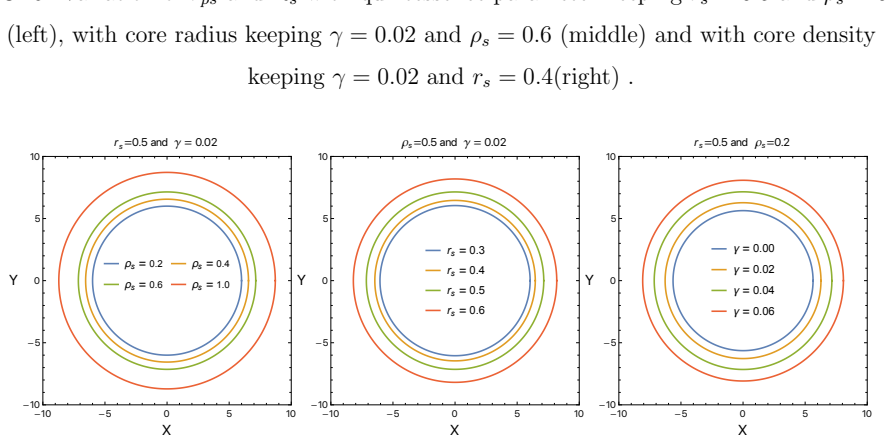
- The shadow cast by such a black hole should be larger than the Schwarzschild shadow, with the size growing roughly linearly in halo density and more strongly in halo core radius and quintessence strength.
- Weak gravitational lensing should be stronger: at fixed impact parameter, the deflection angle increases as $\rho_s$, $r_s$, or $\gamma$ increases, which the paper interprets as the dark sector acting like a repulsive gravitational charge.
- Scalar and electromagnetic perturbations should ring at lower frequency and decay more slowly, so gravitational waves from a black hole surrounded by dark matter and quintessence should be redshifted and longer-lived than those from a vacuum black hole.
- The EHT shadow diameters for M87* and Sgr A* translate into upper bounds on the halo density and quintessence parameter, namely $\rho_s<0.48$ and $\gamma<0.035$ for M87*, and $\rho_s<0.12$ and $\gamma<0.01$ for Sgr A*.
Reading between the lines
- I would expect the same effective metric to predict correlated deviations in photon-ring and time-delay observables, not just shadows, because all of them are fixed by the same photon-sphere radius.
- The additive form of the deflection angle suggests an observational degeneracy: different combinations of $\rho_s$, $r_s$, and $\gamma$ can produce the same lensing signal, so lensing alone may not separate dark matter from quintessence without a mass and distance prior.
- I would expect the linearization $e^{-x}\approx 1-x$ to be the main source of quantitative uncertainty; checking it would require solving the full Einstein equations for the combined dark-matter-plus-quintessence stress-energy and comparing the exact and linearized metric functions.
- The claim that gravitational waves from these black holes are slower and longer-lived could be tested directly with ringdown templates that include $\rho_s$ and $\gamma$ as fit parameters in current and next-generation gravitational-wave catalogs.
Editorial analysis
A structured set of objections, weighed in public.
Referee Report
Summary. The paper proposes an effective static, spherically symmetric black hole solution by combining a Schwarzschild metric with a Dehnen-type dark matter halo and a Kiselev quintessence term, yielding the metric function f(r) in Eq. (9). It computes event and cosmological horizons, photon sphere and shadow radii, weak deflection angle via the Gauss-Bonnet theorem, and scalar/electromagnetic quasinormal modes via 6th-order WKB. The central qualitative claims are that all dark-sector parameters (ρ_s, r_s, γ) increase the event horizon, decrease the cosmological horizon, enlarge the shadow, increase the deflection angle, and lower the QNM oscillation frequency and damping rate compared with a vacuum Schwarzschild black hole. The authors also use EHT observations of Sgr A* and M87* to place upper bounds on ρ_s and γ.
Significance. If correct, this would be a straightforward phenomenological study of how a dark-matter halo and quintessence affect observable black hole signatures; the qualitative trends are physically plausible and the EHT comparison provides a useful constraint. The paper includes many numerical tables and figures, and the shadow/horizon results are internally consistent with the assumed metric. However, several load-bearing equations contain algebraic and conceptual errors—most importantly the perturbation potentials in Sec. V, the photon-sphere equation in Sec. III, and the deflection-angle formula in Sec. IV—so the quantitative results as printed cannot be relied upon without correction.
major comments (4)
- [Sec. V, Eqs. (34)-(35)] The effective potentials for scalar and electromagnetic perturbations use the angular coefficient (1/2 + l). For a static, spherically symmetric metric the standard potentials are V_S = f[l(l+1)/r^2 + f'/r] and V_EM = f l(l+1)/r^2. For l=2 the paper's coefficient is 2.5 instead of 6. Consequently the vacuum entries in Tables III-V (e.g., scalar 0.436613 - 0.085241i and EM 0.415851 - 0.083537i) are not Schwarzschild QNMs; the standard values are approximately 0.4836 - 0.0968i and 0.4576 - 0.0950i. Because the abstract's final claim—that gravitational waves from dark-sector black holes have lower frequency and decay rate than in vacuum—is a comparison against this incorrect baseline, the QNM analysis must be redone with the correct l(l+1) potentials.
- [Sec. III, Eq. (18)] Equation (18) does not follow from Eq. (16) with the metric function (9). For ϵ = -2/3, substituting f(r) into r f'(r) - 2f(r) = 0 and multiplying by r(r+r_s)^3 gives (6M - 2r + γ r^2)(r+r_s)^3 + (8πρ_s r_s^3/3) r (3r^2 + 3r r_s + r_s^2) = 0. The printed Eq. (18) has the wrong sign and a missing factor of r in the dark-matter term, and a spurious overall factor of 3 in the first term. Since Table II and the EHT parameter constraints in Sec. III are computed from this equation, the quoted shadow radii and upper limits (ρ_s < 0.48, 0.12 and γ < 0.035, 0.01) are not supported as printed.
- [Sec. IV, Eq. (32)] The claimed weak deflection angle in Eq. (32) is dimensionally inconsistent. In geometrized units with M as a length, the term 4M/b is dimensionless, but terms such as 4πγ r_s^4 ρ_s/b and 3γ M^2/b have dimensions of inverse length (and πγM/2 is also dimensionful). The derivation from Eq. (28) is not shown in detail, and Eq. (28) itself contains the undefined symbol ρ in several places (instead of ρ_s) and appears to have internal inconsistencies. Therefore the deflection-angle results and the conclusions drawn from Fig. 9 are not established.
- [Sec. II, Eqs. (7)-(9)] The metric is constructed by truncating exp(-x) ≈ 1 - x in Eq. (7) and adding the Kiselev quintessence term directly to the resulting function, without solving the combined Einstein equations for the dark-matter plus quintessence energy-momentum tensor. For the parameter values used in the tables (e.g., ρ_s = 1, r_s = 0.6 near the horizon), the argument x = 4πρ_s r_s^3(2r+r_s)/[3(r+r_s)^2] is not small (x is order one or larger), so the linearization error is uncontrolled. This does not invalidate the phenomenological approach per se, but the numerical results in Tables I-V should be restricted to parameter ranges where the truncation is valid, or the full exponential form should be used and the resulting equations solved consistently.
minor comments (5)
- [Sec. V, text after Eq. (35)] The sentence 'In comparison with the scalar (35) and EM (34) potentials' reverses the equation labels; the scalar potential is Eq. (34) and the electromagnetic potential is Eq. (35).
- [Sec. III, Eqs. (19)-(20)] The angular diameters in Eq. (19) are missing units (they should be μas), and the distance to Sgr A* is mistakenly written with the label D_{M87*}; the observational inputs need to be edited for consistency.
- [Sec. IV, Eq. (28)] The symbol 'ρ' appears without a subscript in several places in Eq. (28) and in the surrounding derivation; it should be 'ρ_s' (the central halo density).
- [Sec. VI, Conclusion] The phrase 'stretch type DM' appears to be a typo for 'Dehnen type DM'; please correct it.
- [Abstract and Sec. V] The abstract states that 'gravitational waves emitted from BHs with a dark sector have a lower frequency and decay rate,' but the QNM analysis in Sec. V is for scalar and electromagnetic test fields, not for tensor gravitational perturbations. Please rephrase or add a caveat to avoid overclaiming.
Circularity Check
No significant circularity: observables follow from an explicitly assumed metric; self-citations are contextual only.
full rationale
The paper's derivation chain is: adopt the Dehnen density profile (Eq. 2), compute the DM mass and tangential velocity (Eqs. 3-4), integrate for F(r) (Eq. 7), and then assemble the metric function f(r)=1-2M/r - 4πρs rs^3(2r+rs)/(3(r+rs)^2) - γ/r^{3ε+1} (Eq. 9) using Xu et al.'s formalism (Ref. [74]). All subsequent quantities—horizons, shadow radius, deflection angle, and WKB quasinormal modes—are computed from this explicitly assumed metric and standard geodesic/perturbation equations. No dark-sector parameter is tuned to reproduce the reported observables; the EHT comparison is an inverse constraint exercise giving upper limits on ρs and γ, not a fitted parameter renamed as a prediction. The paper does cite several papers by the same authors (e.g., Refs. [53,54,89,90]), but these are contextual references for methods and earlier shadow/deflection calculations, not load-bearing justifications for the present metric or results. The metric ansatz is a modeling assumption rather than a first-principles derivation, which is a limitation but not circularity. For completeness, the QNM potentials in Eqs. (34)-(35) use the coefficient (1/2+l) instead of l(l+1), and Eq. (18) does not follow from r f'(r)-2f(r)=0; these are correctness/typo concerns outside the circularity rubric. Overall circularity score: 2, reflecting minor non-load-bearing self-citations.
Assumptions & free parameters
free parameters (4)
- rho_s (central halo density) =
constrained: <0.48 (M87*), <0.12 (Sgr A*) at r_s=0.5, M=1
- r_s (halo core radius) =
set to 0.5 in EHT constraints; varied in tables
- gamma (quintessence parameter) =
constrained: <0.035 (M87*), <0.01 (Sgr A*)
- epsilon (quintessence exponent) =
-2/3
assumptions (6)
- domain assumption Dehnen density profile with (alpha,beta,sigma)=(1,4,0)
- domain assumption Tangential velocity relation v_D^2 = M_D(r)/r and metric function via Eq. (6)
- ad hoc to paper Effective metric obtained by adding the Kiselev quintessence term to the DM-modified Schwarzschild metric
- ad hoc to paper Linear approximation exp(-x) approximately 1-x in Eq. (7)
- standard math Sixth-order WKB approximation is accurate for n=0, l=2
- domain assumption Gauss-Bonnet deflection limit R to infinity is valid despite the linearly growing quintessence term
Cite this review
Pith. "Pith review of Astrophysical properties of static black holes embedded in a Dehnen type dark matter halo with the presence of quintessential field." pith.science (2026). https://pith.science/paper/POJYW6XU
@misc{pith2026250115397,
  author       = {Pith},
  title        = {Pith review of: Astrophysical properties of static black holes embedded in a Dehnen type dark matter halo with the presence of quintessential field},
  year         = {2026},
  howpublished = {\url{https://pith.science/paper/POJYW6XU}},
  note         = {Machine review of arXiv:2501.15397}
}
read the original abstract
From an astrophysical perspective, the composition of black holes (BHs), dark matter (DM), and dark energy can be an intriguing physical system. In this study, we consider Schwarzschild BHs embedded in a Dehnen-type DM halo exhibiting a quintessential field. This study examines the horizons, shadows, deflection angle, and quasinormal modes (QNMs) of the effective BH spacetime and how they are affected by the dark sector. The Schwarzschild BH embodied in a Dehnen-type DM halo exhibiting a quintessential field possesses two horizons: the event horizon and the cosmological horizon. We demonstrate that all dark sector parameters increase the event horizon while decreasing the cosmological horizon. We analyze the BH shadow and emphasize the impact of DM and quintessence parameters on them. We show that the dark sector casts larger shadows than a Schwarzschild BH in a vacuum. Further, we delve into the weak gravitational lensing deflection angle using the Gauss-Bonnet theorem (GBT). We then investigate QNMs using the 6th order WKB approach. To visually underscore the dark sector parameters, we present figures that illustrate the impact of varying the parameters of the Dehnen-type DM halo as well as quintessence. Our findings show that the gravitational waves emitted from BHs with a dark sector have a lower frequency and decay rate compared to those emitted from BHs in a vacuum.
Figures


Figures from the paper (11 more)




Forward citations
Cited by 2 Pith papers
-
Plasma effects on gravitational lensing and shadow observables of a Kerr-like black hole in a dark matter halo
Homogeneous plasma enlarges Kerr-like black-hole shadows and emission rates while inhomogeneous plasma shrinks them; astrophysical dark-matter densities leave photon orbits essentially unchanged.
-
Chaotic imprints of dark matter in extreme mass-ratio inspirals
A toy model shows that adding a hand-made angle-dependent force to dark-matter spacetimes produces visual chaos and irregular numerical-Kludge waveforms, but the force is not a realistic dark-matter perturbation.
Reference graph
Works this paper leans on
-
[1]
For large values of core density, there is no horizon that indicates a naked singularity
The graphic indicates that there are two horizons for the conjunction of the Dehnen type DM halo and the quintessence field. For large values of core density, there is no horizon that indicates a naked singularity. In addition to event horizons, cosmological horizons become apparent when the quintessence term is taken into account. Spacetime horizons can ...
-
[2]
A. Borde and A. Vilenkin, Phys. Rev. Lett. 72, 3305 (1994), arXiv:gr-qc/9312022 [gr-qc]
arXiv 1994
- [3]
-
[4]
B. P. Abbott and et al. (Virgo and LIGO Scientific Collaborations), Phys. Rev. Lett. 116, 241102 (2016), arXiv:1602.03840 [gr-qc]
arXiv 2016
-
[5]
B. P. Abbott and et al. (Virgo and LIGO Scientific Collaborations), Phys. Rev. Lett. 116, 061102 (2016), arXiv:1602.03837 [gr-qc]
arXiv 2016
-
[6]
K. Akiyama and et al. (Event Horizon Telescope Collaboration), Astrophys. J. 875, L6 (2019), arXiv:1906.11243 [astro-ph.GA]
arXiv 2019
-
[7]
K. Akiyama and et al. (Event Horizon Telescope Collaboration), Astrophys. J. 875, L1 (2019), arXiv:1906.11238 [astro-ph.GA]
arXiv 2019
-
[8]
D. N. Spergel, R. Bean, and et al. (WMAP), Astro-phys. J. Suppl. 170, 377 (2007), arXiv:astro- ph/0603449
arXiv 2007
Show all 97 references
-
[9]
P. J. Peebles and B. Ratra, Reviews of Modern Physics 75, 559 (2003), astro-ph/0207347
2003 arXiv
-
[10]
N. Cruz, M. Olivares, and J. R. Villanueva, Class. Quantum Grav. 22, 1167 (2005), gr- qc/0408016
2005
- [11]
- [12]
-
[13]
Stuchl ´ık and J
Z. Stuchl ´ık and J. Schee, J. Cosmol. Astropart. Phys. 9, 018 (2011)
2011
-
[14]
Arraut, Int
I. Arraut, Int. J. Mod. Phys. D 24, 1550022 (2015)
2015
-
[15]
Rezzolla, O
L. Rezzolla, O. Zanotti, and J. A. Font, Astron. Astrophys. 412, 603 (2003), gr-qc/0310045
2003 arXiv
-
[16]
Shaymatov, B
S. Shaymatov, B. Ahmedov, Z. Stuchlik, and A. Abdujabbarov, Int. J. Mod. Phys. D 27, 1850088 (2018)
2018
-
[17]
Faraoni, ed., Lecture Notes in Physics, Berlin Springer Verlag Vol
V. Faraoni, ed., Lecture Notes in Physics, Berlin Springer Verlag Vol. 907 (2015). 22
2015
-
[18]
Wetterich, Nucl
C. Wetterich, Nucl. Phys. B 302, 668 (1988)
1988
-
[19]
V. V. Kiselev, Class. Quantum Grav. 20, 1187 (2003), gr-qc/0210040
2003 arXiv
-
[20]
Hellerman, N
S. Hellerman, N. Kaloper, and L. Susskind, J. High Energy Phys. 2001, 003 (2001), arXiv:hep- th/0104180
2001
-
[21]
Caldwell and M
R. Caldwell and M. Kamionkowski, Nature 458, 587 (2009)
2009
-
[22]
In this line, there has been an extensive analysis in various situations since then (see, e.g., [23–29])
presented a BH solution with a DM distribution using a phantom scalar field without a cosmological role. In this line, there has been an extensive analysis in various situations since then (see, e.g., [23–29]). There have also been models developed for a DM halo solution (see,...
-
[23]
Persic, P
M. Persic, P. Salucci, and F. Stel, Mon. Not. R. Astron. Soc. 281, 27 (1996), arXiv:astro- ph/9506004 [astro-ph]
1996
-
[24]
Li and K.-C
M.-H. Li and K.-C. Yang, Phys. Rev. D 86, 123015 (2012), arXiv:1204.3178 [astro-ph.CO]
2012 arXiv
-
[25]
S. H. Hendi, A. Nemati, K. Lin, and M. Jamil, Eur. Phys. J. C 80, 296 (2020), arXiv:2001.01591 [gr-qc]
2020 arXiv
-
[26]
Rizwan, M
M. Rizwan, M. Jamil, and K. Jusufi, Phys. Rev. D 99, 024050 (2019), arXiv:1812.01331 [gr-qc]
2019 arXiv
-
[27]
Narzilloev, J
B. Narzilloev, J. Rayimbaev, S. Shaymatov, A. Abdujabbarov, B. Ahmedov, and C. Bambi, Phys. Rev. D 102, 104062 (2020), arXiv:2011.06148 [gr-qc]
2020 arXiv
-
[28]
Shaymatov, B
S. Shaymatov, B. Ahmedov, and M. Jamil, Eur. Phys. J. C 81, 588 (2021)
2021
-
[29]
Rayimbaev, S
J. Rayimbaev, S. Shaymatov, and M. Jamil, Eur. Phys. J. C 81, 699 (2021), arXiv:2107.13436 [gr-qc]
2021 arXiv
-
[30]
Shaymatov, D
S. Shaymatov, D. Malafarina, and B. Ahmedov, Phys. Dark Universe 34, 100891 (2021), arXiv:2004.06811 [gr-qc]
2021 arXiv
-
[31]
Shaymatov, P
S. Shaymatov, P. Sheoran, and S. Siwach, Phys. Rev. D 105, 104059 (2022), arXiv:2110.10610 [gr-qc]
2022 arXiv
-
[32]
Cardoso, K
V. Cardoso, K. Destounis, F. Duque, R. P. Macedo, A. Maselli, Phys. Rev. D105, L061501 (2022), arXiv:2109.00005 [gr-qc]
2022 arXiv
-
[33]
Z. Shen, A. Wang, Y. Gong, Sh. Yin, Phys. Lett. B 855 138797 (2024), arXiv:2311.12259 [gr-qc]
2024 arXiv
-
[34]
X. Hou, Z. Xu, M. Zhou, and J. Wang, J. Cosmol. Astropart. Phys. 2018, 015 (2018), arXiv:1804.08110 [gr-qc]
2018 arXiv
-
[35]
Dehnen, Mon
W. Dehnen, Mon. Not. R. Astron. Soc. 265, 250 (1993)
1993
-
[36]
Gohain, Prabwal Phukon and Kalyan Bhuyan
Mrinnoy M. Gohain, Prabwal Phukon and Kalyan Bhuyan. arXiv:2407.02872 (2024)
2024 arXiv
-
[37]
Akiyama and et al
K. Akiyama and et al. Astrophys. J. Lett. 930(2):L12, 2022. 23
2022
-
[38]
Akiyama and et al
K. Akiyama and et al. Astrophys. J. Lett. 930(2):L14, 2022
2022
-
[39]
Akiyama and et al
K. Akiyama and et al. Astrophys. J. Lett. 930(2):L15, 2022
2022
-
[40]
Akiyama and et al
K. Akiyama and et al. Astrophys. J. Lett. 930(2):L17, 2022
2022
-
[41]
J. L. Synge, Mon. Not. R. Astron. Soc. 131, 463 (1966)
1966
-
[42]
Luminet, Astron
J.-P. Luminet, Astron. Astrophys. 75, 228 (1979)
1979
-
[43]
Amarilla and E
L. Amarilla and E. F. Eiroa, Phys. Rev. D 87, 044057 (2013)
2013
-
[44]
R. A. Konoplya, Phys. Lett. B 795, 1 (2019)
2019
-
[45]
Vagnozzi and L
S. Vagnozzi and L. Visinelli, Phys. Rev. D 100, 024020 (2019)
2019
-
[46]
Afrin, R
M. Afrin, R. Kumar, and S. G. Ghosh, Mon. Not. R. Astron. Soc. 504, 5927 (2021), arXiv:2103.11417 [gr-qc]
2021 arXiv
-
[47]
Atamurotov, S
F. Atamurotov, S. G. Ghosh, and B. Ahmedov, Eur. Phys. J. C 76, 273 (2016), arXiv:1506.03690 [gr-qc]
2016 arXiv
-
[48]
R. A. Konoplya and A. Zhidenko, Phys. Rev. D 100, 044015 (2019)
2019
-
[49]
Atamurotov, S
F. Atamurotov, S. Shaymatov, P. Sheoran, and S. Siwach, J. Cosmol. Astropart. Phys. 2021 (8), 045, arXiv:2105.02214 [grqc]
2021 arXiv
-
[50]
Mustafa, F
G. Mustafa, F. Atamurotov, I. Hussain, S. Shaymatov, and A. Ovgun, Chin. Phys. C 46, 125107 (2022), arXiv:2207.07608 [gr-qc]
2022 arXiv
-
[51]
Tsukamoto, Phys
N. Tsukamoto, Phys. Rev. D 97, 064021 (2018)
2018
-
[52]
Asukula, S
H. Asukula, S. Bahamonde, M. Hohmann, V. Karanasou, C. Pfeifer, and J. L. Rosa, Phys. Rev. D 109, 064027 (2024), arXiv:2311.17999 [gr-qc]
2024 arXiv
-
[53]
J. L. Rosa, Phys. Rev. D 107, 084048 (2023)
2023
-
[54]
J. W. Moffat and V. T. Toth, Phys. Rev. D 101, 024014 (2020), arXiv:1904.04142 [gr-qc]
2020 arXiv
-
[55]
Al-Badawi, S
A. Al-Badawi, S. Shaymatov, M. Alloqulov, A. Wang, Commun. Theor. Phys. 76, 085401 (2024)
2024
-
[56]
Al-Badawi, M
A. Al-Badawi, M. Alloqulov, S. Shaymatov, B. Ahmedov, Chin. Phys. C 48, 095105 (2024)
2024
-
[57]
Hendi, K
S. Hendi, K. Jafarzade, and B. Eslam Panah, J. Cosmol. Astropart. Phys. 2023 (02), 022 (2023)
2023
-
[58]
Yan, Z., Zhang, X., Wan, M. et al. Shadows and quasinormal modes of a charged non- commutative black hole by different methods. Eur. Phys. J. Plus 138, 377 (2023)
2023
-
[59]
A. S. Eddington, The Observatory 42, 119 (1919)
1919
-
[60]
G. S. Bisnovatyi-Kogan and O. Y. Tsupko, Mon. Not. R. Astron. Soc. 404, 1790 (2010). 24
2010
-
[61]
O. Y. Tsupko and G. S. Bisnovatyi-Kogan, Gravitation and Cosmology 18, 117 (2012)
2012
-
[62]
P. V. P. Cunha, N. A. Eiro, C. A. R. Herdeiro, and J. P. S. Lemos, J. Cosmol. A. P 2020, 035 (2020), arXiv:1912.08833 [gr-qc]
2020 arXiv
-
[63]
G. Z. Babar, F. Atamurotov, and A. Z. Babar, Phys. Dark Universe 32, 100798 (2021)
2021
-
[64]
Javed, M
W. Javed, M. Atique, and A. ¨Ovg¨ un, Gen. Relativ. Gravit. 54, 135 (2022), arXiv:2210.17277 [gr-qc]
2022 arXiv
-
[65]
Jafarzade, M
K. Jafarzade, M. Kord Zangeneh, and F. S. N. Lobo, J. Cosmol. Astropart. Phys. Phys. 2021, 008 (2021), arXiv:2010.05755 [gr-qc]
2021 arXiv
-
[66]
Atamurotov, D
F. Atamurotov, D. Ortiqboev, A. Abdujabbarov, and G. Mustafa, Eur. Phys. J. C 82, 659 (2022)
2022
-
[67]
Atamurotov, S
F. Atamurotov, S. Shaymatov, and B. Ahmedov, Galaxies 9, 54 (2021)
2021
-
[68]
Kumaran and A
Y. Kumaran and A. ¨Ovg¨ un, Eur. Phys. J. C 83 812 (2023)
2023
-
[69]
Mizuno, Z
Y. Mizuno, Z. Younsi, C. M. Fromm, O. Porth, M. De Laurentis, H. Olivares, H. Falcke, M. Kramer, and L. Rezzolla, Nature Astronomy 2, 585–590 (2018)
2018
-
[70]
Rahvar and J
S. Rahvar and J. W. Moffat, MNRAS 482, 4514 (2019), arXiv:1807.07424 [gr-qc]
2019 arXiv
-
[71]
R. N. Izmailov, R. K. Karimov, E. R. Zhdanov, and K. K. Nandi, MNRAS 483, 3754 (2019), arXiv:1905.01900 [gr-qc]
2019 arXiv
-
[72]
Chen Wu, Int.J.Mod.Phys.D 26 (2017) 10, 1750111
2017
-
[73]
Zening Yan, Chen Wu, Wenjun Guo, Nucl.Phys.B 973 (2021) 115595
2021
-
[74]
H. Mo, F. van den Bosch, and S. White, Galaxy Formation and Evolution (Cambridge Uni- versity Press, Cambridge, England, UK, 2010)
2010
-
[75]
J. R. Shakeshaft, The Formation and Dynamics of Galaxies (Dordrecht, The Netherlands, 2012)
2012
-
[76]
Z. Xu, X. Hou, X. Gong, et al., J. Cosmol. Astropart. Phys. 2018, 038 (2018)
2018
-
[77]
Azreg-A ¨ ınou, Phys
M. Azreg-A ¨ ınou, Phys. Rev. D - Part. Fields, Gravit. Cosmol. 90 (2014)
2014
-
[78]
Jusufi, J
K. Jusufi, J. Mubasher, and Z. Tao, Eur. Phys. J. C. 80, 354 (2020)
2020
-
[79]
X. Hou, Z. Xu, M. Zhou, et al., J. Cosmol. Astropart. Phys. 2018, 015 (2018)
2018
-
[80]
Z. Xu, J. Wang, and M. Tang, J. Cosmol. Astropart. Phys. 2021, 007 (2021)
2021
-
[81]
G. W. Gibbons and M. C. Werner, Class. Quant. Grav. 25, 235009 (2008)
2008
-
[82]
M. C. Werner, Gen. Relativ. Gravit. 44, 3047 (2012)
2012
-
[83]
T. Ono, A. Ishihara, and H. Asada, Phys. Rev. D 96, 104037 (2017). 25
2017
-
[84]
Ishihara et al, Phys
A. Ishihara et al, Phys. Rev. D 94, 084015 (2016)
2016
-
[85]
Ishihara, Y
A. Ishihara, Y. Suzuki, T. Ono, and H. Asada, Phys. Rev. D 95, 044017 (2017)
2017
-
[86]
Jusufi, A
K. Jusufi, A. Ovgun, J. Saavedra, Y. Vasquez, and P. A. Gonzalez, Phys. Rev. D 97, 124024 (2018)
2018
-
[87]
Li and A
Z. Li and A. Ovg¨ un, Phys. Rev. D 101, 024040 (2020)
2020
-
[88]
Zhang, Class
Z. Zhang, Class. Quant. Grav. 39, 015003 (2022)
2022
-
[89]
I. D. D. Carvalho, G. Alencar, W. M. Mendes, and R. R. Landim, EPL 134, 51001 (2021)
2021
-
[91]
Albadawi, S
A. Albadawi, S. Shaymatov, and ˙I. Sakallı, Eur. Phys. J. C 84, 825 (2024)
2024
-
[92]
Albadawi, S
A. Albadawi, S. Shaymatov, S. K. Jha, and A. Rahaman, Eur. Phys. J. C 84, 722 (2024)
2024
-
[93]
R. M. Wald, General Relativity (Chicago Univ. Pr., Chicago, 1984)
1984
-
[94]
Mandal, Phys
S. Mandal, Phys. Dark Univ. 42, 101374 (2023)
2023
-
[95]
Chandrasekhar, The Mathematical Theory of Black Holes(Chicago Univ
S. Chandrasekhar, The Mathematical Theory of Black Holes(Chicago Univ. Pr., Chicago, 1985)
1985
-
[96]
Sakalli and A
I. Sakalli and A. Ovgun, J. Astrophys. Astron. 37, 21 (2016)
2016
-
[97]
Iyer, C.M
S. Iyer, C.M. Will, Phys. Rev. D 35, 3621 (1987)
1987
-
[98]
Konoplya, Phys
R.A. Konoplya, Phys. Rev. D 68 024018 (2003). 26
2003
Reviewed August 10, 2026 · model on record in the stance chip above.
Discussion (0). Continue with ORCID to comment.