REVIEW 2 major objections 5 minor 2 cited by
Characterization of of (98943) 2001 CC$_{21}$, the target of Hayabusa2$\#$
T0 review · 2 major / 5 minor · reviewed 2026-08-10 · deepseek-v4-flash
Pith's one-line read Ground-based observations build a full portrait of the asteroid Hayabusa2# will fly past in 2026: a 0.44-km, space-weathered, ordinary-chondrite-like rock spinning every 5.02 hours.
desk verdict Solid, mission-relevant characterization of Torifune; the b-axis derivation in Section 3.5 needs clarification because it may bias the reported size. read the letter →
The pith
A machine-rendered reading of the paper's core claim, the machinery that carries it, and where it could break.
The reading
What carries the argument
The load-bearing machinery is a combined photometric-geometric model: a convex lightcurve inversion of 21 lightcurves over a 100-day arc that solves for period, pole, and shape, joined to an occultation-determined long axis and a lightcurve amplitude used for the intermediate axis. The amplitude-to-axis relation $b/a = 10^{-A/2.5}$ converts the 0.96 mag lightcurve amplitude into the $b$ axis once the occultation fixes $a$ and $c/a$. On the spectral side, the analysis uses the two silicate absorption bands near 1 and 2 $\mu$m, whose centers, band-area ratio, and temperature corrections are fed through calibrations that yield the olivine/pyroxene ratio and Fa/Fs contents.
What would settle it
A resolved image from the 2026 flyby, or a stellar occultation that crosses the short axis, would directly measure the b-axis; if the recovered b is significantly smaller than 0.16 km, the lightcurve-amplitude interpretation is wrong. A more immediate test is to fit the whole lightcurve set with a fixed pole and let the equatorial amplitude be a free parameter; if the best-fit equatorial amplitude differs from 0.96 mag, the axis ratios and $D_{\rm eq}$ shift accordingly.
Extended reading notes
Core claim
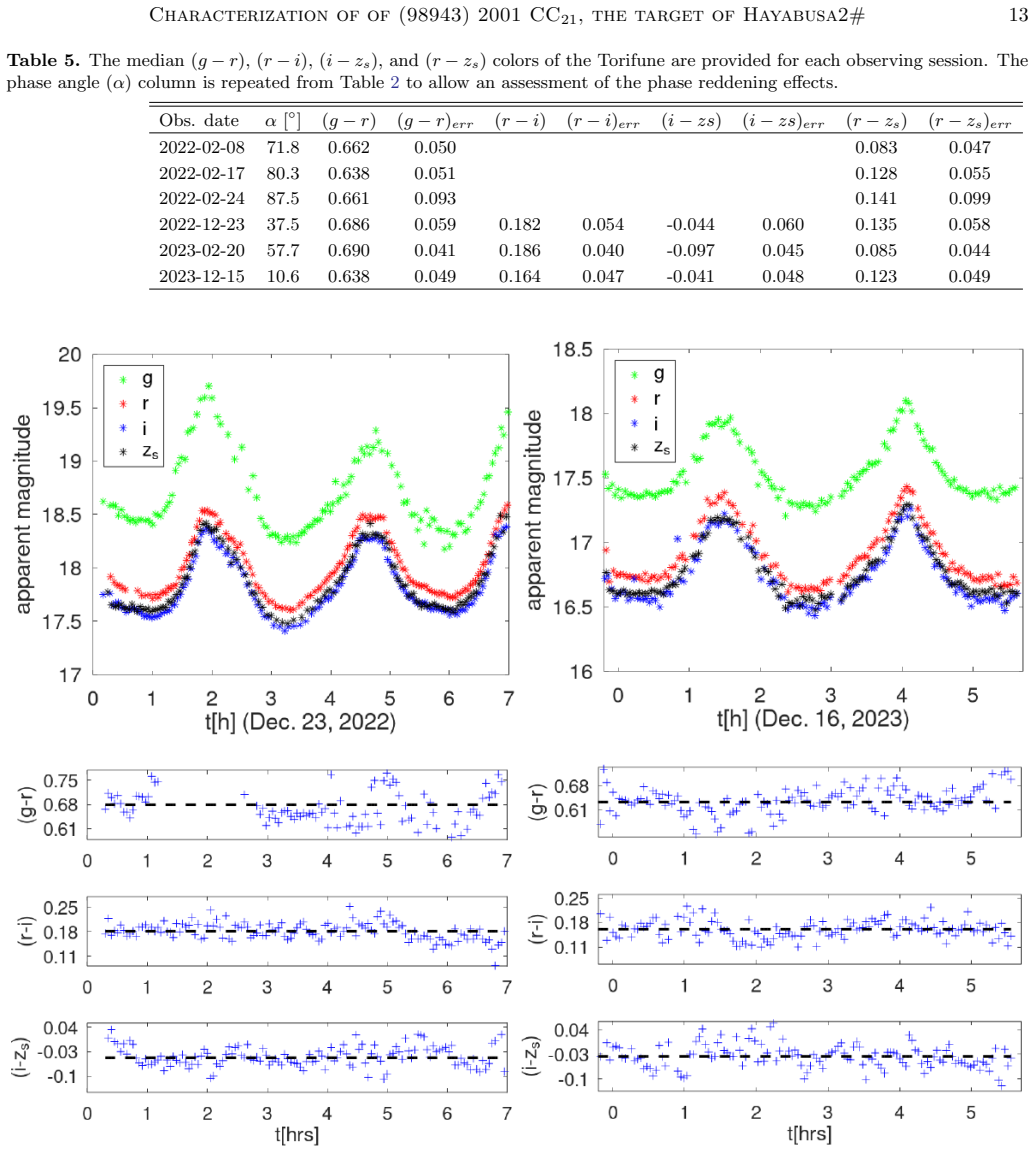
Torifune is a small, oblate, prograde-rotating near-Earth asteroid. The lightcurve data spanning 100 days pin its sidereal period to $5.021516 \pm 0.000106$ h, and the convex shape model places the pole near the ecliptic north pole ($\lambda = 301^\circ \pm 35^\circ$, $\beta = 89^{+1}_{-6}^\circ$) with obliquity $\epsilon = 5^\circ \pm 3^\circ$. Combining the model shape with a stellar-occultation measurement of the long axis gives an equivalent ellipsoid $a = 0.42^{+0.08}_{-0.06}$ km, $b = 0.16^{+0.05}_{-0.04}$ km, $c = 0.17 \pm 0.03$ km and $D_{\rm eq} = 0.44 \pm 0.06$ km. The visible-to-near-infrared spectrum is best matched by the Sq class in the Bus-DeMeo system, and the band centers and band-area ratio point to an LL/L ordinary chondrite composition ($\mathrm{ol/(ol+px)}=0.60$, Fa $28.5$ mol%, Fs $23.4$ mol%) with moderate space weathering, consistent with laboratory spectra of pulse-laser-irradiated L6/LL6 meteorites. Simultaneous four-filter colors show no variation over a rotation cycle, indicating a surface without large-scale heterogeneity.
Load-bearing premise
The reported size depends on treating a 0.96-magnitude brightness variation as the asteroid's full end-to-end variation; if that measurement was taken at a viewing angle that foreshortens the variation, the asteroid would be more elongated and smaller than this paper estimates.
Editorial extensions
If this is right
- Mission planning can use the sidereal period and pole to predict which longitudes are visible at closest approach, letting the flyby sequence target the same hemisphere that the ground-based lightcurves sampled.
- If the object is as homogeneous as the colors suggest, spacecraft images of different terrain will be expected to show little compositional contrast, and any strong spectral variation would point to small fresh craters or boulders rather than global heterogeneity.
- The measured size and albedo set expectations for the spacecraft's thermal-infrared observations; agreement would validate the ground-based $H$ and albedo, while a discrepancy would indicate that one of the two is biased.
- If the LL/L ordinary chondrite interpretation is correct, Torifune can be compared directly with the returned-sample body Itokawa, and the flyby will test whether the difference in spectral slope is indeed a difference in space-weathering degree.
- The prograde, low-obliquity pole implies that the asteroid's rotation axis is nearly perpendicular to its orbital plane, which shapes how solar illumination and thermal behavior will appear during the encounter.
Reading between the lines
- A testable extension the authors do not pursue: correct the 0.96 mag amplitude to an equator-on value using the reported pole and aspect angle, and check how much the implied $b$ axis and $D_{\rm eq}$ move; the flyby will provide the ground truth.
- The claim of no large-scale heterogeneity is based on disk-integrated colors; resolved imaging could still reveal small-scale fresh spots, as seen on Itokawa, so the ground-based result sets an upper limit on the area fraction of fresh material rather than ruling it out.
- If Torifune's surface is more weathered than Itokawa's, then among small near-Earth asteroids the residence time or regolith turnover rate, not just composition, must differ; comparing the band-depth ratio measured at the flyby with laboratory laser-irradiation series would test this.
Editorial analysis
A structured set of objections, weighed in public.
Referee Report
Summary. This paper presents a ground-based physical characterization of the near-Earth asteroid (98943) Torifune (2001 CC21), the flyby target of Hayabusa2#. Using photometry from 51 nights between 2022 and 2024, the authors determine the sidereal rotation period P = 5.021516 ± 0.000106 h, the absolute magnitude H = 18.78 ± 0.14, and a DAMIT convex-shape/pole solution with λ = 301° ± 35°, β = 89+1/-6°, and prograde rotation. Combining the shape model with the Arimatsu et al. (2024) occultation chords and a lightcurve amplitude, they estimate ellipsoid axes a = 0.42+0.08/-0.06 km, b = 0.16/0.17 km, c = 0.17/0.16 km, and Deq = 0.44 ± 0.06 km. Simultaneous multi-band photometry yields colors consistent with an S-complex object and no large-scale heterogeneity, and the merged GTC+IRTF spectrum is classified as Sq type with LL/L ordinary-chondrite mineralogy (ol/(ol+px) = 0.60, Fa = 28.5 mol%, Fs = 23.4 mol%) and moderate space weathering.
Significance. If the results hold, this is a valuable pre-encounter reference for Hayabusa2#: it gives the mission a period, pole, approximate shape, size, spectral type, and compositional context before the 2026 flyby, and it helps resolve the earlier L-type versus S-type ambiguity. The observational basis is strong: 31,637 exposures over 51 nights, a standard DAMIT inversion with 100 bootstrap resamples for the uncertainties, an independent occultation-based anchor for the absolute scale, two independent taxonomic classifiers, cross-checks between colors and spectroscopy, and comparisons against the RELAB meteorite library. The central weak point is the derivation of the intermediate axis in Section 3.5, which directly controls the reported b and Deq; this is fixable but currently undermines the headline size.
major comments (2)
- [Section 3.5] The derivation of the intermediate axis b is ambiguous in a load-bearing way. The text states 'The third semi-axis can be estimated from the light-curve amplitude which is 0.96 mag. resulting in b/a = 0.41' and applies the equator-on triaxial relation b/a = 10^(-A/2.5), but it does not state whether 0.96 mag is the observed peak-to-peak amplitude or the maximum amplitude of the DAMIT convex shape model when viewed equator-on. The March 2023 lightcurves were obtained at aspect angles Θ ≈ 51° (Table 8), where a triaxial ellipsoid's amplitude is reduced relative to equator-on viewing. If 0.96 mag is the observed amplitude at Θ ≈ 51°, then with a = 0.42 km and c = 0.16 km the implied b is about 0.13 km, not 0.17 km; conversely, the reported b = 0.17 km predicts only about 0.76 mag at Θ = 51°, so the values are internally inconsistent unless 0.96 mag is the model's equatorial maximum. Because b and Deq = 0.44 ± 0.06 km are headline results for the Hayabusa2# flyby, the text must specify which amplitude is used and recompute b (and Deq) accordingly.
- [Abstract and Section 3.5 / Conclusions] The labeling of the b and c semi-axes is inconsistent across the paper. The abstract and the conclusions report b = 0.16+0.05/-0.04 km and c = 0.17 ± 0.03 km, while Section 3.5 derives c = 0.16+0.05/-0.04 km from the occultation c/a ratio and then estimates b = 0.17 ± 0.03 km from the lightcurve amplitude. The two orderings assign the intermediate axis differently and change the oblateness parameter R = c(a+b)/(2ab) by a small but nonzero amount. The authors should choose one convention and apply it consistently in the abstract, Section 3.5, and the conclusions.
minor comments (5)
- [Title and header] The title and the draft header contain 'Characterization of of (98943)' and 'T orifune'; these typographical errors should be corrected.
- [Section 2.1] The text says the photometric observations were acquired during 51 different nights and then immediately says they were acquired during 52 different nights; the observing log in Table 7 should be checked and the number made consistent.
- [Section 2.1] The phrase 'The errors introduced by this transformation are negligible gracefully to the large number of points' should read 'negligible due to' or similar.
- [Section 2.1] The sentence 'The observations were performed using the broadband filters, the Luminance covers the 0.4 to 0.7 µm wavelength interval, and the standard Sloan g, r, i, and zs filter' has a grammatical issue ('filter' should be 'filters'), and similar typos such as 'Tabel', 'the the Two-meter Twin Telescope', and 'miss-match' appear in several places.
- [Figure 12] The caption cites '2024PASJ..tmp...71A' rather than the published Arimatsu et al. (2024) reference; the published journal reference should be used.
Circularity Check
No circular derivation: the period, pole, size, taxonomy, and mineralogy results are anchored to independent external data and standard calibrations; the only weak point is an ambiguity in the Section 3.5 amplitude input, which is a correctness issue rather than a circular reduction.
full rationale
The derivation chain is self-contained and does not reduce any headline result to its own inputs. The rotation period is found by an independent chi-square search over 21 lightcurves, seeded by the external periods of Fatka et al. (2023) and Warner (2023), and the final value is not forced by those seeds. The pole and convex shape come from the publicly available DAMIT inversion code applied to the authors' own photometry, with no imported uniqueness theorem. The ellipsoid axes use the external Arimatsu et al. (2024) occultation radii for a and c/a, and the intermediate axis b is estimated from the standard triaxial-ellipsoid amplitude relation b/a = 10^(-A/2.5). The stated 0.96 mag amplitude is not identified as observed at aspect angle ~51 deg or as the model's equatorial maximum, which is a genuine ambiguity in input specification; however, the relation itself is an external geometric formula, not a restatement of the fitted shape model, so this is a correctness/robustness concern rather than circularity. The absolute magnitude H is obtained from standard H,G and H,G1,G2 phase-function fits with external photometric conversions (Tonry et al. 2012) and an external albedo from Fornasier et al. (2024) for the diameter estimate. The taxonomic classification is cross-checked between the M4AST tool and the external SMASS classifier, with the training set including external MITHNEOS classifications; the mineralogy uses the external Dunn et al. (2010) calibrations, and the space-weathering inference is based on matching to externally measured RELAB meteorite spectra. No quoted equation reduces to a fitted parameter renamed as a prediction, and no load-bearing claim rests on a self-citation chain.
Assumptions & free parameters
free parameters (2)
- G (H,G slope parameter) =
0.283 ± 0.025
- G1, G2 (three-parameter phase function) =
G1 = 0.259, G2 = 0.372
assumptions (6)
- domain assumption The IAU H-G and H-G1-G2 photometric phase function models describe the brightness-phase behavior (Muinonen et al. 2010)
- domain assumption The convex lightcurve inversion model in DAMIT (Kaasalainen/Durech) with its scattering law and convexity constraint recovers the true shape and pole
- ad hoc to paper The peak-to-peak lightcurve amplitude maps directly to the axis ratio via b/a = 10^(-A/2.5) with no aspect-angle correction
- domain assumption The geometric albedo pV = 0.216 ± 0.016 from Fornasier et al. (2024) is applicable to Torifune
- domain assumption The Dunn et al. (2010) calibrations (with Sanchez et al. 2012 temperature corrections) relate band area ratio and band I center to ol/(ol+px), Fa, and Fs for this NEA
- domain assumption Torifune's surface is homogeneous, so Luminance and g magnitudes can be transformed to V using fixed color offsets
Cite this review
Pith. "Pith review of Characterization of of (98943) 2001 CC$_{21}$, the target of Hayabusa2$\#$." pith.science (2026). https://pith.science/paper/AA3LLXH6
@misc{pith2026250115644,
  author       = {Pith},
  title        = {Pith review of: Characterization of of (98943) 2001 CC$_21$, the target of Hayabusa2$\#$},
  year         = {2026},
  howpublished = {\url{https://pith.science/paper/AA3LLXH6}},
  note         = {Machine review of arXiv:2501.15644}
}
abstract
The near-Earth asteroid (98943) Torifune, previously designated 2001 CC$_{21}$, is the flyby target of the Hayabusa2 extended mission, nicknamed Hayabusa2$\#$ (SHARP: Small Hazardous Asteroid Reconnaissance Probe). The ground-based telescope observations offer a key science input for the mission's scientific investigation. During 2022 - 2024 this asteroid was at visible apparent magnitudes brighter than 18.5, allowing for a detailed characterization using ground-based telescope observations. We determined its rotation period $P~=~5.021516\pm0.000106$ h and its absolute magnitude H = 18.78 $\pm$ 0.14 and. The large number of lightcurves allows to estimate its axes ratio, its convex shape and its pole orientation $\lambda = 301^{\circ} \pm 35^{\circ}$, $\beta = {89^{+1}_{-6}}^{\circ}$ and $\epsilon = 5^{\circ} \pm 3^{\circ}$ which indicate a prograde rotation. We report the semi-axis of the equivalent ellipsoid, $a$ = 0.42$^{+0.08}_{0.06}$ km, $b$ = 0.16$^{+0.05}_{0.04}$ km, and $c$ = $0.17\pm0.03$ km. Consequently, the volume equivalent diameter is $D_{eq}$ = $0.44 \pm 0.06$ km . Using observations conducted simultaneously with four broadband filters, we determined $(g-r) = 0.663 \pm 0.022$ mag, $(r-i) = 0.177 \pm 0.012$ mag, and $(i-z_s) = -0.061 \pm 0.032$ mag. Additionally, we found that Torifune exhibits no detectable large-scale heterogeneity. We classified the object using a high signal-to-noise ratio spectrum (over the visible and near-infrared region) as Sq-type in the Bus-DeMeo taxonomy. We estimate a mineralogy similar to LL/L ordinary chondrites, with an ol/(ol+px) = 0.60, a Fa content of 28.5 mol$\%$, and a Fs content of 23.4 mol$\%$. The spectral data indicate a surface affected by moderate space weathering effects.
Figures


Figures from the paper (14 more)




Forward citations
Cited by 2 Pith papers
-
Refined rotational state and shape model of (98943) Torifune ahead of the Hayabusa2# flyby
Torifune’s sidereal period is refined to 5.0215221 h with a prograde pole near the north ecliptic pole and a/b ≈ 1.66; polar flattening remains poorly constrained ahead of the Hayabusa2# flyby.
-
Thermal and Optical Characterization of Near-Earth Objects: Science Commissioning of the Recently Upgraded Mid-Infrared Camera MIRSI on the NASA Infrared Telescope Facility
First science results from the refurbished MIRSI mid-infrared camera on the NASA IRTF, yielding diameters and albedos for 31 near-Earth asteroids plus ejecta characterization for the DART impact.
Reference graph
Works this paper leans on
-
[1]
2019, arXiv e-prints, arXiv:1909.11230
Akhlaghi , M. 2019, arXiv e-prints, arXiv:1909.11230. 1909.11230
arXiv 2019
-
[2]
2015, ApJS, 220, 1, 10.1088/0067-0049/220/1/1
Akhlaghi , M., & Ichikawa , T. 2015, ApJS, 220, 1, 10.1088/0067-0049/220/1/1
-
[3]
R., Licandro , J., Serra-Ricart , M., et al
Alarcon , M. R., Licandro , J., Serra-Ricart , M., et al. 2023, , 135, 055001, 10.1088/1538-3873/acd04a
-
[4]
Arimatsu , K., Yoshida , F., Hayamizu , T., et al. 2024, , 10.1093/pasj/psae060
-
[6]
2013 b , , 558, A33, 10.1051/0004-6361/201322068
---. 2013 b , , 558, A33, 10.1051/0004-6361/201322068
-
[8]
2018 b , , 156, 123, 10.3847/1538-3881/aabc4f
---. 2018 b , , 156, 123, 10.3847/1538-3881/aabc4f
-
[9]
Astropy Collaboration , Price-Whelan , A. M., Lim , P. L., et al. 2022, , 935, 167, 10.3847/1538-4357/ac7c74
-
[10]
2006, in Astronomical Society of the Pacific Conference Series, Vol
Bertin , E. 2006, in Astronomical Society of the Pacific Conference Series, Vol. 351, Astronomical Data Analysis Software and Systems XV, ed. C. Gabriel , C. Arviset , D. Ponz , & S. Enrique , 112
2006
Show all 80 references
-
[11]
1996, , 117, 393, 10.1051/aas:1996164
Bertin , E., & Arnouts , S. 1996, , 117, 393, 10.1051/aas:1996164
1996 doi
-
[12]
2002, in Astronomical Society of the Pacific Conference Series, Vol
Bertin , E., Mellier , Y., Radovich , M., et al. 2002, in Astronomical Society of the Pacific Conference Series, Vol. 281, Astronomical Data Analysis Software and Systems XI, ed. D. A. Bohlender , D. Durand , & T. H. Handley , 228
2002
-
[13]
P., Perozzi , E., Rivkin , A
Binzel , R. P., Perozzi , E., Rivkin , A. S., et al. 2004, , 39, 351, 10.1111/j.1945-5100.2004.tb00098.x
2004
-
[15]
2001 b , , 36, 1167, 10.1111/j.1945-5100.2001.tb01950.x
---. 2001 b , , 36, 1167, 10.1111/j.1945-5100.2001.tb01950.x
2001
-
[16]
P., Morbidelli , A., Merouane , S., et al
Binzel , R. P., Morbidelli , A., Merouane , S., et al. 2010, , 463, 331, 10.1038/nature08709
2010 doi
-
[17]
P., DeMeo , F
Binzel , R. P., DeMeo , F. E., Turtelboom , E. V., et al. 2019, , 324, 41, 10.1016/j.icarus.2018.12.035
2019 doi
-
[18]
J., Nesvorn \'y , D., Sasaki , S., & Strazzulla , G
Brunetto , R., Loeffler , M. J., Nesvorn \'y , D., Sasaki , S., & Strazzulla , G. 2015, in Asteroids IV, ed. P. Michel , F. E. DeMeo , & W. F. Bottke , 597--616, 10.2458/azu_uapress_9780816532131-ch031
2015 doi
-
[19]
2006, , 184, 327, 10.1016/j.icarus.2006.05.019
Brunetto , R., Vernazza , P., Marchi , S., et al. 2006, , 184, 327, 10.1016/j.icarus.2006.05.019
2006 doi
-
[20]
2024, , 687, A38, 10.1051/0004-6361/202449789
Carry , B., Peloton , J., Le Montagner , R., Mahlke , M., & Berthier , J. 2024, , 687, A38, 10.1051/0004-6361/202449789
2024 doi
-
[21]
2010, in Astrophysics and Space Science Proceedings, Vol
Cepa , J. 2010, in Astrophysics and Space Science Proceedings, Vol. 14, Highlights of Spanish Astrophysics V, 15, 10.1007/978-3-642-11250-8\_2
2010 doi
-
[22]
G., et al
Cepa , J., Aguiar , M., Escalera , V. G., et al. 2000, in Society of Photo-Optical Instrumentation Engineers (SPIE) Conference Series, Vol. 4008, Optical and IR Telescope Instrumentation and Detectors, ed. M. Iye & A. F. Moorwood , 623--631, 10.1117/12.395520
2000 doi
- [23]
-
[24]
E., Hapke , B., Pieters , C., & Britt , D
Clark , B. E., Hapke , B., Pieters , C., & Britt , D. 2002, in Asteroids III, ed. J. Bottke , W. F., A. Cellino , P. Paolicchi , & R. P. Binzel , 585--599
2002
-
[25]
A., Gaffey , M
Cloutis , E. A., Gaffey , M. J., Jackowski , T. L., & Reed , K. L. 1986, , 91, 11,641, 10.1029/JB091iB11p11641
1986 doi
-
[26]
B., Chalela , M., & S \'a nchez , B
Colazo , M., Cabral , J. B., Chalela , M., & S \'a nchez , B. O. 2022, Astronomy and Computing, 38, 100533, 10.1016/j.ascom.2021.100533
2022
-
[27]
C., Vacca , W
Cushing , M. C., Vacca , W. D., & Rayner , J. T. 2004, , 116, 362, 10.1086/382907
2004 doi
-
[28]
E., Binzel , R
DeMeo , F. E., Binzel , R. P., Slivan , S. M., & Bus , S. J. 2009, , 202, 160, 10.1016/j.icarus.2009.02.005
2009 doi
-
[29]
2018, , 304, 31, 10.1016/j.icarus.2017.12.026
Devog \`e le , M., Tanga , P., Cellino , A., et al. 2018, , 304, 31, 10.1016/j.icarus.2017.12.026
2018 doi
-
[30]
L., McCoy , T
Dunn , T. L., McCoy , T. J., Sunshine , J. M., & McSween , H. Y. 2010, , 208, 789, 10.1016/j.icarus.2010.02.016
2010 doi
-
[31]
2010, , 513, A46, 10.1051/0004-6361/200912693
Durech , J., Sidorin , V., & Kaasalainen , M. 2010, , 513, A46, 10.1051/0004-6361/200912693
2010 doi
-
[32]
W., Bateman, D., Hauberg, S., & Wehbring, R
Eaton, J. W., Bateman, D., Hauberg, S., & Wehbring, R. 2021, GNU Octave version 6.3.0 manual: a high-level interactive language for numerical computations. https://www.gnu.org/software/octave/doc/v6.3.0/
2021
-
[33]
2023, 8th IAA Planetary Defense Conference
Fatka , P., Pravec , P., Ku s nir \' a k , P., et al. 2023, 8th IAA Planetary Defense Conference
2023
- [34]
-
[35]
2024, , 688, L7, 10.1051/0004-6361/202450447
Fornasier , S., Dotto , E., Panuzzo , P., et al. 2024, , 688, L7, 10.1051/0004-6361/202450447
2024 doi
-
[36]
K., et al
Fujiwara , A., Kawaguchi , J., Yeomans , D. K., et al. 2006, Science, 312, 1330, 10.1126/science.1125841
2006 doi
-
[37]
J., Bell , J
Gaffey , M. J., Bell , J. F., Brown , R. H., et al. 1993, , 106, 573, 10.1006/icar.1993.1194
1993
-
[38]
2018, VizieR Online Data Catalog: Gaia DR2 (Gaia Collaboration, 2018) , VizieR On-line Data Catalog: I/345
Gaia Collaboration . 2018, VizieR Online Data Catalog: Gaia DR2 (Gaia Collaboration, 2018) , VizieR On-line Data Catalog: I/345. Originally published in: 2018A&A...616A...1G; doi:10.5270/esa-ycs, 10.26093/cds/vizier.1345
2018 doi
-
[39]
Gaia Collaboration , Brown , A. G. A., Vallenari , A., et al. 2018, , 616, A1, 10.1051/0004-6361/201833051
2018 doi
-
[40]
2023, , 525, L17, 10.1093/mnrasl/slad073
Geem , J., Ishiguro , M., Granvik , M., et al. 2023, , 525, L17, 10.1093/mnrasl/slad073
2023 doi
-
[41]
W., & Harris , A
Harris , A. W., & Harris , A. W. 1997, , 126, 450, 10.1006/icar.1996.5664
1997
-
[42]
A., Templeton , M., Terrell , D., et al
Henden , A. A., Templeton , M., Terrell , D., et al. 2016, VizieR Online Data Catalog: AAVSO Photometric All Sky Survey (APASS) DR9 (Henden+, 2016) , VizieR On-line Data Catalog: II/336. Originally published in: 2015AAS...22533616H
2016
-
[43]
2021, Advances in Space Research, 68, 1533, 10.1016/j.asr.2021.03.030
Hirabayashi , M., Mimasu , Y., Sakatani , N., et al. 2021, Advances in Space Research, 68, 1533, 10.1016/j.asr.2021.03.030
2021 doi
-
[44]
2006, , 443, 56, 10.1038/nature05073
Hiroi , T., Abe , M., Kitazato , K., et al. 2006, , 443, 56, 10.1038/nature05073
2006 doi
-
[46]
Howell , S. B. 2000, Handbook of CCD Astronomy
2000
-
[47]
J., VanderPlas , J
Ivezi \'c , Z ., Connolly , A. J., VanderPlas , J. T., & Gray , A. 2014, Statistics, Data Mining, and Machine Learning in Astronomy: A Practical Python Guide for the Analysis of Survey Data , 10.1515/9781400848911
2014 doi
-
[48]
2017, , 208, 17, 10.1007/s11214-015-0227-y
Kameda , S., Suzuki , H., Takamatsu , T., et al. 2017, , 208, 17, 10.1007/s11214-015-0227-y
2017 doi
-
[49]
C., Sugita , S., Kamata , S., et al
Koga , S. C., Sugita , S., Kamata , S., et al. 2018, , 299, 386, 10.1016/j.icarus.2017.08.016
2018 doi
-
[50]
Landolt, A. U. 1992, The Astronomical Journal, 104, 340
1992
-
[51]
2005, , 359, 1575, 10.1111/j.1365-2966.2005.09006.x
Lazzarin , M., Marchi , S., Magrin , S., & Licandro , J. 2005, , 359, 1575, 10.1111/j.1365-2966.2005.09006.x
2005
-
[52]
M., Emery , J
MACLennan , E. M., Emery , J. P., Lucas , M. P., MCClure , L. M., & Lindsay , S. S. 2024, , 59, 1329, 10.1111/maps.14150
2024 doi
-
[53]
Mahlke , M., Carry , B., & Mattei , P. A. 2022, , 665, A26, 10.1051/0004-6361/202243587
2022 doi
-
[54]
2011, , 741, 90, 10.1088/0004-637X/741/2/90
Mainzer , A., Grav , T., Masiero , J., et al. 2011, , 741, 90, 10.1088/0004-637X/741/2/90
2011 doi
-
[55]
Marchi , S., Paolicchi , P., & Richardson , D. C. 2012, , 421, 2, 10.1111/j.1365-2966.2011.19952.x
2012
-
[56]
2017, Astronomy and Computing, 18, 47, 10.1016/j.ascom.2016.11.002
Mommert , M. 2017, Astronomy and Computing, 18, 47, 10.1016/j.ascom.2016.11.002
2017 doi
-
[57]
N., Cellino , A., et al
Muinonen , K., Belskaya , I. N., Cellino , A., et al. 2010, , 209, 542, 10.1016/j.icarus.2010.04.003
2010 doi
-
[58]
2019, Journal of Astronomical Telescopes, Instruments, and Systems, 5, 015001, 10.1117/1.JATIS.5.1.015001
Narita , N., Fukui , A., Kusakabe , N., et al. 2019, Journal of Astronomical Telescopes, Instruments, and Systems, 5, 015001, 10.1117/1.JATIS.5.1.015001
2019 doi
-
[59]
J., Pravec , P., Benner , L
Ostro , S. J., Pravec , P., Benner , L. A. M., et al. 1999, Science, 285, 557, 10.1126/science.285.5427.557
1999 doi
-
[60]
G., Wilkman , O., & Muinonen , K
Penttil \"a , A., Shevchenko , V. G., Wilkman , O., & Muinonen , K. 2016, , 123, 117, 10.1016/j.pss.2015.08.010
2016 doi
-
[61]
A., Fulchignoni , M., et al
Perna , D., Barucci , M. A., Fulchignoni , M., et al. 2018, , 157, 82, 10.1016/j.pss.2018.03.008
2018 doi
-
[62]
M., & Hiroi , T
Pieters , C. M., & Hiroi , T. 2004, in Lunar and Planetary Science Conference, ed. S. Mackwell & E. Stansbery , Lunar and Planetary Science Conference, 1720
2004
-
[63]
Popescu , M., Birlan , M., & Nedelcu , D. A. 2012, , 544, A130, 10.1051/0004-6361/201219584
2012 doi
-
[64]
2019, , 627, A124, 10.1051/0004-6361/201935006
Popescu , M., Vaduvescu , O., de Le \'o n , J., et al. 2019, , 627, A124, 10.1051/0004-6361/201935006
2019 doi
-
[65]
2021, in European Planetary Science Congress, EPSC2021--820, 10.5194/epsc2021-820
Popescu , M., de Le \'o n , J., Licandro , J., et al. 2021, in European Planetary Science Congress, EPSC2021--820, 10.5194/epsc2021-820
2021 doi
-
[66]
T., Toomey , D
Rayner , J. T., Toomey , D. W., Onaka , P. M., et al. 2003, , 115, 362, 10.1086/367745
2003 doi
-
[67]
L., Thomas , C
Reddy , V., Dunn , T. L., Thomas , C. A., Moskovitz , N. A., & Burbine , T. H. 2015, in Asteroids IV, 43--63, 10.2458/azu_uapress_9780816532131-ch003
2015 doi
-
[68]
2024, , 527, 6814, 10.1093/mnras/stad3488
Rodr \' guez Rodr \' guez , J., D \' ez Alonso , E., Iglesias \'A lvarez , S., et al. 2024, , 527, 6814, 10.1093/mnras/stad3488
2024 doi
-
[69]
A., Reddy , V., Nathues , A., et al
Sanchez , J. A., Reddy , V., Nathues , A., et al. 2012, , 220, 36, 10.1016/j.icarus.2012.04.008
2012 doi
-
[70]
2001, , 410, 555, 10.1038/35069013
Sasaki , S., Nakamura , K., Hamabe , Y., Kurahashi , E., & Hiroi , T. 2001, , 410, 555, 10.1038/35069013
2001 doi
-
[71]
2022, Science, 375, 1011, 10.1126/science.abj8624
Tachibana , S., Sawada , H., Okazaki , R., et al. 2022, Science, 375, 1011, 10.1126/science.abj8624
2022 doi
-
[72]
2019, , 325, 153, 10.1016/j.icarus.2019.01.015
Tatsumi , E., Kouyama , T., Suzuki , H., et al. 2019, , 325, 153, 10.1016/j.icarus.2019.01.015
2019 doi
-
[73]
2021, , 508, 2053, 10.1093/mnras/stab2548
Tatsumi , E., Popescu , M., Campins , H., et al. 2021, , 508, 2053, 10.1093/mnras/stab2548
2021 doi
-
[74]
A., Trilling , D
Thomas , C. A., Trilling , D. E., Emery , J. P., et al. 2011, , 142, 85, 10.1088/0004-6256/142/3/85
2011 doi
-
[75]
1986, in Society of Photo-Optical Instrumentation Engineers (SPIE) Conference Series, Vol
Tody , D. 1986, in Society of Photo-Optical Instrumentation Engineers (SPIE) Conference Series, Vol. 627, Instrumentation in astronomy VI, ed. D. L. Crawford , 733, 10.1117/12.968154
1986 doi
-
[76]
L., Stubbs , C
Tonry , J. L., Stubbs , C. W., Lykke , K. R., et al. 2012, , 750, 99, 10.1088/0004-637X/750/2/99
2012 doi
-
[77]
D., Cushing , M
Vacca , W. D., Cushing , M. C., & Rayner , J. T. 2003, , 115, 389, 10.1086/346193
2003 doi
- [78]
-
[79]
VanderPlas , J. T. 2018, , 236, 16, 10.3847/1538-4365/aab766
2018 doi
-
[80]
Warner , B. D. 2023, Minor Planet Bulletin, 50, 217
2023
-
[81]
, " * write output.state after.block = add.period write newline
ENTRY address archivePrefix author booktitle chapter doi edition editor eprint howpublished institution journal key month number organization pages publisher school series title misctitle type volume year version url label extra.label sort.label short.list INTEGERS output.stat...
-
[82]
write newline
" write newline "" before.all 'output.state := FUNCTION format.url url empty "" new.block "" url * "" * if FUNCTION format.eprint eprint empty "" archivePrefix empty "" archivePrefix "arXiv" = new.block " " eprint * " " * new.block " " eprint * " " * if if if FUNCTION format.d...
-
[83]
acknowledgments ... acknowledgments
thebibliography [1] 20pt to REFERENCES 6pt =0pt -12pt 10pt plus 3pt =0pt =0pt =1pt plus 1pt =0pt =0pt -12pt =13pt plus 1pt =20pt =13pt plus 1pt \@M =10000 =-1.0em =0pt =0pt 0pt =0pt =1.0em @enumiv\@empty 10000 10000 `\.\@m \@noitemerr \@latex@warning Empty `thebibliography' en...
2021
-
[84]
ݺu| +**2( Ǐ iӦ RBB ;lWWWtbgg իl˿ -t0k<j( I '|#7sĉ 1t ҤI
thebibliography [1] 20pt to REFERENCES 6pt =0pt -12pt 10pt plus 3pt =0pt =0pt =1pt plus 1pt =0pt =0pt -12pt =13pt plus 1pt =20pt =13pt plus 1pt \@M =10000 =-1.0em =0pt =0pt 0pt =0pt =1.0em @enumiv\@empty 10000 10000 `\.\@m \@noitemerr \@latex@warning Empty `thebibliography' en...
2021
Reviewed August 10, 2026 · model on record in the stance chip above.
Discussion (0). Continue with ORCID to comment.