REVIEW 4 major objections 5 minor 56 references
Random Walk Guided Hyperbolic Graph Distillation
T0 review · 4 major / 5 minor · reviewed 2026-08-10 · deepseek-v4-flash
Pith's one-line read HyDRO claims that distilling graphs in hyperbolic space while aligning the spectral gap of random walks yields condensed graphs that beat Euclidean baselines and retain dynamic behavior for continual learning.
desk verdict HyDRO is a plausible new hyperbolic graph distillation method whose headline claims run ahead of its own tables and whose random-walk mechanism is asserted rather than shown. read the letter →
The pith
A machine-rendered reading of the paper's core claim, the machinery that carries it, and where it could break.
The reading
What carries the argument
The load-bearing object is the spectral-gap alignment loss $L_{rw} = |g_{syn} - g_{sub}|$, where $g_{syn} = 1 - \lambda_{2,syn}$ and $g_{sub} = 1 - \lambda_{2,sub}$ are derived from the second-largest eigenvalues of the lazy random walk matrices of the condensed graph and a normalized, per-epoch sampled real subgraph ($\epsilon = 1/2$). The spectral gap controls mixing time ($t_{mix} \sim 1/\Delta$) and diffusion speed, so the paper uses this single scalar as the carrier of random-walk information. The second component is the Poincaré ball generator: hyperbolic neural networks with Möbius linear transformations and Riemannian gradient updates produce the synthetic adjacency matrix, motivated by the claim that hyperbolic space fits power-law, tree-like network geometry without the distortion Euclidean embeddings incur.
What would settle it
Run HyDRO on Cora, Citeseer, PubMed, and Flickr with the random-walk loss term removed, keeping the same hyperbolic generator, gradient matching, and hyperparameters. If node-classification, link-prediction, and continual-learning results stay within one standard deviation of the full model, the spectral-gap alignment is not responsible for the reported advantages.
Extended reading notes
Core claim
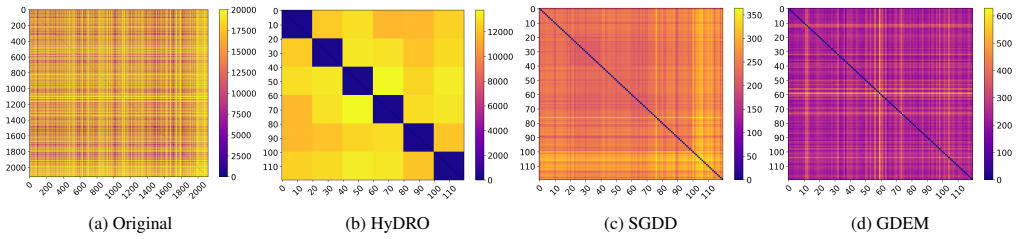
HyDRO's central claim is that a condensed graph should reproduce not only the original graph's task-relevant features but also its random-walk behavior, and that this can be done by generating the graph in hyperbolic space and aligning one spectral quantity. The method samples nodes, embeds their features in the Poincaré ball, builds edge embeddings by concatenation, maps them through Möbius linear layers, and reshapes the output into a symmetric adjacency matrix. Training minimizes $L_{total} = L_{gm} + L_{rw,norm} + \beta L_{reg}$, with $L_{rw} = |g_{syn} - g_{sub}|$ comparing the spectral gaps of the synthetic and per-epoch sampled real graphs. The paper reports that this procedure outperforms all benchmark methods on link prediction, ranks at or near the top on node classification and neural architecture search, and yields commute-time heatmaps closer to the original graph than those of spectral baselines such as SGDD and GDEM. It further reports stronger continual graph learning under the Condense-and-Train framework and a favorable privacy-utility balance under membership inference attacks.
Load-bearing premise
Everything rests on the assumption that matching one number—the spectral gap between the condensed graph and a randomly sampled piece of the real graph—is enough to preserve random-walk and commute-time behavior, and that this preservation is what drives the continual-learning gains.
Editorial extensions
If this is right
- Condensed graphs produced this way can serve as multi-task substitutes, transferring from node classification to link prediction without the accuracy drop seen in other methods.
- Preserving the spectral gap preserves diffusion efficiency, which means distilled graphs can simulate information spread and support continual graph learning on evolving networks.
- Hyperbolic generation changes the privacy and robustness profile of distillation, lowering membership-inference leakage relative to utility and degrading less under feature, structural, and adversarial structural noise.
- The approach remains competitive on standard node-classification benchmarks, so the dynamic-preservation gains do not come at the cost of core task performance.
- Because the spectral-gap term is dataset-agnostic, the pipeline extends to large inductive graphs such as Flickr and Reddit without changing the distillation objective.
Reading between the lines
- A natural next test is ablating $L_{rw}$ while keeping hyperbolic generation and gradient matching; if performance is unchanged, the reported gains come from the geometry rather than the random-walk alignment.
- Matching the full eigenvalue spectrum or the commute-time matrix directly might preserve diffusion behavior more completely than a single spectral-gap scalar, but the paper does not explore this.
- If spectral-gap alignment is indeed the causal mechanism, then Euclidean distillation methods could adopt the same loss and potentially narrow the gap with HyDRO, separating geometry effects from dynamics effects.
- The privacy and robustness benefits are plausibly tied to hyperbolic decision surfaces, but the results shown do not isolate this cause; a targeted study varying curvature while fixing the distillation setup would test it.
Editorial analysis
A structured set of objections, weighed in public.
Referee Report
Summary. The paper proposes HyDRO, a graph distillation method that generates condensed graphs by embedding node features in a Poincaré ball and aligning the spectral gap of the synthetic graph with a per-epoch sampled subgraph of the original graph, in addition to a gradient-matching loss. Experiments are reported for node classification, link prediction, neural architecture search, cross-architecture transferability, random-walk preservation via commute-time heatmaps, continual graph learning, membership-inference privacy, and denoising. The central claims are that HyDRO consistently outperforms state-of-the-art graph distillation methods on node classification and link prediction, and that spectral-gap alignment preserves random-walk dynamics, which in turn improves continual graph learning.
Significance. If the causal mechanism were established, using a spectral-gap alignment term in hyperbolic graph distillation would be a worthwhile contribution to graph condensation, since dynamic/random-walk properties are rarely targeted in this area. The breadth of evaluation is a strength: results are averaged over ten runs with standard deviations, and the benchmark suite spans many tasks. However, the node-classification claim overreaches relative to Table 1, and the paper provides no ablation or theory isolating the Lrw term, so the central mechanism remains assumed rather than demonstrated. The contribution is therefore conditional on a revision that recalibrates the claims and either proves or convincingly ablates the spectral-gap mechanism.
major comments (4)
- [Abstract and §5.1 (Table 1)] The abstract claims HyDRO "consistently outperforming state-of-the-art methods in both node classification and link prediction tasks," but Table 1 shows HyDRO ranks second or third on Cora, Citeseer, Ogbn-arxiv, Flickr, and Reddit across most reduction rates (e.g., Cora 1.30%: GEOM 82.5±0.4 vs HyDRO 81.5±0.4; Reddit 0.05%: GDEM 93.1±0.2 vs HyDRO 91.8±1.4; Flickr 0.10%: GDEM 49.9±0.8 vs HyDRO 47.3±0.5). The conclusion repeats this overstatement ("overall best performance on node classification tasks"). The claims should be corrected to state that HyDRO is competitive in node classification and leads in link prediction, or the abstract should be qualified accordingly.
- [§3.2 and Eq. (6)] The random-walk loss Lrw = |gsyn − gsub| matches only one scalar, the spectral gap (second eigenvalue) of a lazy walk matrix, between the synthetic graph and a per-epoch subgraph sample. Section 5.4 validates random-walk preservation with qualitative commute-time heatmaps, but commute time is governed by the full pseudoinverse of the Laplacian, not by λ2 alone; two graphs with identical spectral gap can have arbitrarily different pairwise commute times. No bound or theorem in the paper connects |gsyn − gsub| to any commute-time or diffusion error, and Lrw appears in Eq. (6) without an ablation that removes it. Consequently, the reported gains in continual graph learning and link prediction cannot be attributed to random-walk preservation; they could arise from the hyperbolic parameterization or the gradient-matching loss. Please add an ablation study with Lrw removed and include a quantitative commute-time error metric (e.g., mean or median relative error across node pairs) in addition to heatmaps.
- [§3.2, Asub sampling] The paper only states that Asub is "sampled from the real graph A at each epoch" without specifying the sampling procedure or any connectivity guarantee. If the sampled subgraph is disconnected, its lazy random walk spectral gap is exactly zero (since λ2 = 1), making the alignment target degenerate and potentially driving Lrw to push the synthetic graph toward a disconnected or trivial structure. Please specify how Asub is sampled (e.g., uniform node sampling with induced edges, random edge sampling, or a GraphSAINT-style sampler) and report whether the sampled subgraphs are connected in practice, or otherwise justify the choice.
- [§5.5 and Figure 2] The continual graph learning results are presented only as line plots without error bars or a table of means and standard deviations, making it impossible to judge whether HyDRO's apparent advantage over DM and GCDMX on Citeseer and Arxiv is statistically meaningful. Please provide numerical results with standard deviations for the CGL experiments, consistent with the reporting format used elsewhere in the paper.
minor comments (5)
- [§4, Datasets] DBLP is listed twice in the dataset enumeration ("DBLP ... and DBLP"); one occurrence appears to be an error, since Wiki-CS and Coauthor-Physics are introduced separately later in the same paragraph.
- [§5.5] The list of structure-based methods contains a duplicated method name "GCDM" in sequence; the intended second method is unclear and should be corrected.
- [Appendix G] The text refers to "HyRo" where "HyDRO" is clearly intended; please fix this typo.
- [Table 2] Several cells in Table 2 use inconsistent decimal formatting (e.g., "64.89±1.26" and "64.61±4.2"), and the dense layout makes mapping columns to methods difficult; please reformat the table for clarity.
- [§5.1 and §5.7] There are minor language issues: "denosing" should be "denoising," and "seminar papers" should be "seminal papers" in the experimental-settings description.
Circularity Check
No significant circularity: HyDRO's spectral-gap loss is optimized and then evaluated on independent downstream metrics.
full rationale
The paper's derivation chain is not circular. HyDRO optimizes a total loss (Eq. 6) containing gradient matching, a spectral-gap alignment term Lrw = |g_syn - g_sub|, and a regularization term; the condensed graph is then evaluated on node classification, link prediction, NAS, cross-architecture transfer, commute-time heatmaps, continual graph learning, privacy attacks, and denoising. None of these evaluation metrics is identical to the training loss or obtained by construction from it. The spectral-gap loss matches only a scalar (the second eigenvalue gap) per epoch against a sampled subgraph, while commute time is computed from the full Laplacian pseudoinverse in Section D.1; therefore the commute-time results are an independent empirical check, not a tautology. The paper's causal claim that spectral-gap alignment preserves random-walk properties is arguably under-supported (no ablation isolating Lrw, no quantitative commute-time error, and the Appendix A.4 formula for commute time in terms of the spectral gap is suspect), but that is a correctness or evidence concern, not circularity. There are no author self-citations: the reference list contains no works by Long, Xu, Schoepf, or Brintrup, and the load-bearing priors (hyperbolic neural networks from Ganea et al. 2018, graph condensation from Jin et al. 2021, etc.) are external. No fitted parameter is renamed as a prediction, no uniqueness theorem is imported from the authors' own prior work, and no known result is repackaged under new coordinates. Accordingly, the paper receives a circularity score of 0.
Assumptions & free parameters
free parameters (7)
- curvature kappa =
0.01 or 0.1
- regularization coefficient beta =
0.1
- momentum mu =
0 or 0.01
- number of hidden layers =
2, 3, or 4
- number of hidden units =
128 or 256
- learning rates for feature and structure =
0.1, 0.01, 0.001, 0.0001
- inner and outer loop iterations =
inner 1-15, outer 10-25
assumptions (5)
- standard math Poincare ball manifold operations such as distance, exponential/logarithmic maps, and Mobius transformations are valid and implemented as in Ganea et al. 2018.
- standard math The spectral gap of the lazy random walk controls mixing time, diffusion speed, and commute time via the relations stated in Appendix A.
- domain assumption Real-world graph datasets exhibit tree-like hierarchical structures and power-law degree distributions, making hyperbolic geometry appropriate.
- ad hoc to paper A per-epoch sampled adjacency matrix Asub represents the full graph well enough for spectral gap matching.
- ad hoc to paper Matching the spectral gap of the synthetic graph to the sampled real graph preserves random-walk and commute-time properties.
Cite this review
Pith. "Pith review of Random Walk Guided Hyperbolic Graph Distillation." pith.science (2026). https://pith.science/paper/XIJKM555
@misc{pith2026250115696,
  author       = {Pith},
  title        = {Pith review of: Random Walk Guided Hyperbolic Graph Distillation},
  year         = {2026},
  howpublished = {\url{https://pith.science/paper/XIJKM555}},
  note         = {Machine review of arXiv:2501.15696}
}
read the original abstract
Graph distillation (GD) is an effective approach to extract useful information from large-scale network structures. However, existing methods, which operate in Euclidean space to generate condensed graphs, struggle to capture the inherent tree-like geometry of real-world networks, resulting in distilled graphs with limited task-specific information for downstream tasks. Furthermore, these methods often fail to extract dynamic properties from graphs, which are crucial for understanding information flow and facilitating graph continual learning. This paper presents the Hyperbolic Graph Distillation with Random Walks Optimization (HyDRO), a novel graph distillation approach that leverages hyperbolic embeddings to capture complex geometric patterns and optimize the spectral gap in hyperbolic space. Experiments show that HyDRO demonstrates strong task generalization, consistently outperforming state-of-the-art methods in both node classification and link prediction tasks. HyDRO also effectively preserves graph random walk properties, producing condensed graphs that achieve enhanced performance in continual graph learning. Additionally, HyDRO achieves competitive results on mainstream graph distillation benchmarks, while maintaining a strong balance between privacy and utility, and exhibiting robust resistance to noises.
Figures


Figures from the paper (7 more)


Reference graph
Works this paper leans on
-
[1]
Multi-relational poincar´e graph em- beddings
[Balazevic et al., 2019] Ivana Balazevic, Carl Allen, and Timothy Hospedales. Multi-relational poincar´e graph em- beddings. Advances in Neural Information Processing Systems, 32,
work page 2019
-
[5]
It is apparent that GEOM and SGDD fail to capture sufficient information about the commute time from the original graphs. For GDEM, while it can capture the commute time for a few pairs of nodes, there remains a significant gap in capturing the overall distribution of values in the original graphs. In contrast, HyDRO consistently captures the main distrib...
work page 2017
-
[7]
A general framework for graph sparsification
[Fung et al., 2011] Wai Shing Fung, Ramesh Hariharan, Nicholas JA Harvey, and Debmalya Panigrahi. A general framework for graph sparsification. In Proceedings of the forty-third annual ACM symposium on Theory of comput- ing, pages 71–80,
work page 2011
-
[12]
Gc4nc: A benchmark framework for graph condensation on node classifica- tion with new insights
[Gong et al., 2024b] Shengbo Gong, Juntong Ni, Noveen Sachdeva, Carl Yang, and Wei Jin. Gc4nc: A benchmark framework for graph condensation on node classifica- tion with new insights. arXiv preprint arXiv:2406.16715,
-
[13]
The hidden flow structure and metric space of network embedding algorithms based on random walks
[Gu et al., 2017] Weiwei Gu, Li Gong, Xiaodan Lou, and Jiang Zhang. The hidden flow structure and metric space of network embedding algorithms based on random walks. Scientific reports, 7(1):13114,
work page 2017
-
[15]
A comprehensive survey on graph reduction: Sparsification, coarsening, and condensation
[Hashemi et al., 2024] Mohammad Hashemi, Shengbo Gong, Juntong Ni, Wenqi Fan, B Aditya Prakash, and Wei Jin. A comprehensive survey on graph reduction: Sparsification, coarsening, and condensation. arXiv preprint arXiv:2402.03358,
arXiv 2024
-
[16]
Spectral gaps of random graphs and applications
[Hoffman et al., 2021] Christopher Hoffman, Matthew Kahle, and Elliot Paquette. Spectral gaps of random graphs and applications. International Mathematics Research Notices, 2021(11):8353–8404,
work page 2021
-
[18]
Scaling up graph neu- ral networks via graph coarsening
[Huang et al., 2021] Zengfeng Huang, Shengzhong Zhang, Chong Xi, Tang Liu, and Min Zhou. Scaling up graph neu- ral networks via graph coarsening. In KDD 2021, pages 675–684,
work page 2021
Show all 56 references
-
[19]
Adversarial inter-group link injection degrades the fairness of graph neural networks
[Hussain et al., 2022] Hussain Hussain, Meng Cao, Sandi- pan Sikdar, Denis Helic, Elisabeth Lex, Markus Strohmaier, and Roman Kern. Adversarial inter-group link injection degrades the fairness of graph neural networks. In 2022 IEEE International Conference on Data Mining (ICDM...
2022
-
[21]
Condensing graphs via one-step gradient matching
[Jin et al., 2022] Wei Jin, Xianfeng Tang, Haoming Jiang, Zheng Li, Danqing Zhang, Jiliang Tang, and Bing Yin. Condensing graphs via one-step gradient matching. In KDD 2022, pages 720–730,
2022
-
[22]
Semi-supervised classification with graph convolutional networks
[Kipf and Welling, 2016] Thomas N Kipf and Max Welling. Semi-supervised classification with graph convolutional networks. arXiv preprint arXiv:1609.02907,
2016 arXiv
-
[23]
Predict then propa- gate: Graph neural networks meet personalized pagerank
[Klicpera et al., 2019] Johannes Klicpera, Aleksandar Bo- jchevski, and Stephan G ¨unnemann. Predict then propa- gate: Graph neural networks meet personalized pagerank. In ICLR 2019,
2019
-
[24]
Random walk: a modern introduction, volume
[Lawler and Limic, 2010] Gregory F Lawler and Vlada Limic. Random walk: a modern introduction, volume
2010
-
[26]
Survey of graph neural net- works and applications
[Liang et al., 2022] Fan Liang, Cheng Qian, Wei Yu, David Griffith, and Nada Golmie. Survey of graph neural net- works and applications. Wireless Communications and Mobile Computing, 2022(1):9261537,
2022
-
[27]
The geometry of graphs and some of its algo- rithmic applications
[Linial et al., 1995] Nathan Linial, Eran London, and Yuri Rabinovich. The geometry of graphs and some of its algo- rithmic applications. Combinatorica, 15:215–245,
1995
-
[29]
Graph condensation via eigenbasis matching
[Liu et al., 2023a] Yang Liu, Deyu Bo, and Chuan Shi. Graph condensation via eigenbasis matching. arXiv preprint arXiv:2310.09202,
-
[30]
Cat: Balanced continual graph learning with graph con- densation
[Liu et al., 2023b] Yilun Liu, Ruihong Qiu, and Zi Huang. Cat: Balanced continual graph learning with graph con- densation. In 2023 IEEE International Conference on Data Mining (ICDM), pages 1157–1162. IEEE,
2023
-
[31]
Gcondenser: Benchmarking graph condensation
[Liu et al., 2024] Yilun Liu, Ruihong Qiu, and Zi Huang. Gcondenser: Benchmarking graph condensation. arXiv preprint arXiv:2405.14246,
2024 arXiv
-
[32]
Spectrally approximating large graphs with smaller graphs
[Loukas and Vandergheynst, 2018] Andreas Loukas and Pierre Vandergheynst. Spectrally approximating large graphs with smaller graphs. In International conference on machine learning, pages 3237–3246. PMLR,
2018
-
[33]
Random walks on graphs
[Lov´asz, 1993] L´aszl´o Lov ´asz. Random walks on graphs. Combinatorics, Paul erdos is eighty, 2(1-46):4,
1993
-
[36]
Poincar ´e embeddings for learning hierarchical rep- resentations
[Nickel and Kiela, 2017] Maximillian Nickel and Douwe Kiela. Poincar ´e embeddings for learning hierarchical rep- resentations. Advances in neural information processing systems, 30,
2017
-
[37]
Deepwalk: Online learning of social rep- resentations
[Perozzi et al., 2014] Bryan Perozzi, Rami Al-Rfou, and Steven Skiena. Deepwalk: Online learning of social rep- resentations. In KDD 2014, pages 701–710,
2014
-
[40]
Pitfalls of graph neural network evaluation
[Shchur et al., 2018] Oleksandr Shchur, Maximil- ian Mumme, Aleksandar Bojchevski, and Stephan G¨unnemann. Pitfalls of graph neural network evaluation. arXiv preprint arXiv:1811.05868,
2018 arXiv
-
[41]
Gc-bench: An open and uni- fied benchmark for graph condensation
[Sun et al., 2024] Qingyun Sun, Ziying Chen, Beining Yang, Cheng Ji, Xingcheng Fu, Sheng Zhou, Hao Peng, Jianxin Li, and Philip S Yu. Gc-bench: An open and uni- fied benchmark for graph condensation. arXiv preprint arXiv:2407.00615,
2024 arXiv
-
[42]
Arnetminer: Extraction and mining of academic social networks
[Tang et al., 2008] Jie Tang, Jing Zhang, Limin Yao, Juanzi Li, Li Zhang, and Zhong Su. Arnetminer: Extraction and mining of academic social networks. In KDD 2008, pages 990–998,
2008
-
[44]
Hitting and commute times in large random neighborhood graphs
[V on Luxburget al., 2014] Ulrike V on Luxburg, Agnes Radl, and Matthias Hein. Hitting and commute times in large random neighborhood graphs. The Journal of Machine Learning Research, 15(1):1751–1798,
2014
-
[45]
Dataset distillation
[Wang et al., 2018] Tongzhou Wang, Jun-Yan Zhu, Antonio Torralba, and Alexei A Efros. Dataset distillation. arXiv preprint arXiv:1811.10959,
2018 arXiv
-
[46]
Fast graph condensation with structure- based neural tangent kernel
[Wang et al., 2024] Lin Wang, Wenqi Fan, Jiatong Li, Yao Ma, and Qing Li. Fast graph condensation with structure- based neural tangent kernel. In Proceedings of the ACM on Web Conference 2024, pages 4439–4448,
2024
-
[47]
Herding dynamical weights to learn
[Welling, 2009] Max Welling. Herding dynamical weights to learn. In Proceedings of the 26th annual international conference on machine learning, pages 1121–1128,
2009
-
[48]
[Wen et al., 2024] Lingfeng Wen, Xuan Tang, and Mingjie et al. Ouyang. Hyperbolic graph diffusion model. In AAAI Conference on Artificial Intelligence , volume 38, pages 15823–15831,
2024
-
[49]
Simpli- fying graph convolutional networks
[Wu et al., 2019] Felix Wu, Amauri Souza, Tianyi Zhang, Christopher Fifty, Tao Yu, and Kilian Weinberger. Simpli- fying graph convolutional networks. In International con- ference on machine learning , pages 6861–6871. PMLR,
2019
-
[50]
Simplifying and empowering transformers for large-graph representations
[Wu et al., 2024] Qitian Wu, Wentao Zhao, Chenxiao Yang, Hengrui Zhang, Fan Nie, Haitian Jiang, Yatao Bian, and Junchi Yan. Simplifying and empowering transformers for large-graph representations. Advances in Neural Informa- tion Processing Systems, 36,
2024
-
[51]
Random walks: A review of algorithms and applications
[Xia et al., 2019] Feng Xia, Jiaying Liu, Hansong Nie, Yonghao Fu, Liangtian Wan, and Xiangjie Kong. Random walks: A review of algorithms and applications. IEEE Transactions on Emerging Topics in Computational Intel- ligence, 4(2):95–107,
2019
-
[52]
Does graph distillation see like vision dataset counter- part? Advances in Neural Information Processing Sys- tems, 36,
[Yang et al., 2024] Beining Yang, Kai Wang, Qingyun Sun, Cheng Ji, Xingcheng Fu, Hao Tang, Yang You, and Jianxin Li. Does graph distillation see like vision dataset counter- part? Advances in Neural Information Processing Sys- tems, 36,
2024
-
[53]
Graph- saint: Graph sampling based inductive learning method
[Zeng et al., 2019] Hanqing Zeng, Hongkuan Zhou, Ajitesh Srivastava, Rajgopal Kannan, and Viktor Prasanna. Graph- saint: Graph sampling based inductive learning method. arXiv preprint arXiv:1907.04931,
2019 arXiv
-
[54]
Navigating complexity: Toward loss- less graph condensation via expanding window matching
[Zhang et al., 2024] Yuchen Zhang, Tianle Zhang, Kai Wang, Ziyao Guo, Yuxuan Liang, Xavier Bresson, Wei Jin, and Yang You. Navigating complexity: Toward loss- less graph condensation via expanding window matching. arXiv preprint arXiv:2402.05011,
2024 arXiv
-
[55]
Structure-free graph condensation: From large-scale graphs to condensed graph-free data
[Zheng et al., 2024] Xin Zheng, Miao Zhang, Chunyang Chen, Quoc Viet Hung Nguyen, Xingquan Zhu, and Shirui Pan. Structure-free graph condensation: From large-scale graphs to condensed graph-free data. Advances in Neural Information Processing Systems, 36,
2024
-
[56]
Once identified, these hyperparameters were applied consistently across all different reduction rates to ensure uniformity in the evaluation
For each dataset, we first identified the hyperparameters that resulted in the highest reduction rate. Once identified, these hyperparameters were applied consistently across all different reduction rates to ensure uniformity in the evaluation. For the special hyperparameters ...
2007
-
[1993]
M ¨obius transforma- tion and cauchy parameter estimation
[McCullagh, 1996] Peter McCullagh. M ¨obius transforma- tion and cauchy parameter estimation. The Annals of Statistics, 24(2):787–808,
1996
-
[1995]
Graph condensation via receptive field distribution matching
[Liu et al., 2022] Mengyang Liu, Shanchuan Li, Xinshi Chen, and Le Song. Graph condensation via receptive field distribution matching. arXiv preprint arXiv:2206.13697 ,
2022 arXiv
-
[1996]
Wiki-cs: A wikipedia-based benchmark for graph neural networks,
[Mernyei and Cangea, 2022] P´eter Mernyei and C ˘at˘alina Cangea. Wiki-cs: A wikipedia-based benchmark for graph neural networks,
2022
-
[1997]
The spectral gap of random graphs with given expected degrees
[Coja-Oghlan and Lanka, 2009] Amin Coja-Oghlan and Andr´e Lanka. The spectral gap of random graphs with given expected degrees. the electronic journal of combinatorics, pages R138–R138,
2009
-
[2007]
Active learning for convolutional neural networks: A core- set approach
[Sener and Savarese, 2017] Ozan Sener and Silvio Savarese. Active learning for convolutional neural networks: A core- set approach. arXiv preprint arXiv:1708.00489,
2017 arXiv
-
[2008]
Graph attention networks
[Velickovicet al., 2018] Petar Velickovic, Guillem Cucurull, Arantxa Casanova, Adriana Romero, Pietro Li `o, and Yoshua Bengio. Graph attention networks. In ICLR,
2018
-
[2009]
Convolutional neural networks on graphs with fast localized spectral filtering
[Defferrard et al., 2016] Micha¨el Defferrard, Xavier Bres- son, and Pierre Vandergheynst. Convolutional neural networks on graphs with fast localized spectral filtering. Advances in neural information processing systems , 29,
2016
-
[2010]
Lazy random walks and optimal transport on graphs
[L´eonard, 2016] Christian L´eonard. Lazy random walks and optimal transport on graphs
2016
-
[2011]
Hyperbolic neural networks
[Ganea et al., 2018] Octavian Ganea, Gary B ´ecigneul, and Thomas Hofmann. Hyperbolic neural networks. Advances in neural information processing systems, 31,
2018
-
[2014]
Graph simplification and matching using commute times
[Qiu and Hancock, 2007] Huaijun Qiu and Edwin R Han- cock. Graph simplification and matching using commute times. Pattern Recognition, 40(10):2874–2889,
2007
-
[2016]
Quantifying privacy leakage in graph em- bedding
[Duddu et al., 2020] Vasisht Duddu, Antoine Boutet, and Vi- rat Shejwalkar. Quantifying privacy leakage in graph em- bedding. In MobiQuitous 2020-17th EAI International Conference on Mobile and Ubiquitous Systems: Comput- ing, Networking and Services, pages 76–85,
2020
-
[2017]
Inductive representation learning on large graphs
[Hamilton et al., 2017] Will Hamilton, Zhitao Ying, and Jure Leskovec. Inductive representation learning on large graphs. Advances in neural information processing sys- tems, 30,
2017
-
[2018]
Multiple sparse graphs condensation
[Gao and Wu, 2023] Jian Gao and Jianshe Wu. Multiple sparse graphs condensation. Knowledge-Based Systems, 278:110904,
2023
-
[2019]
Static and dynamic path selection on expander graphs (preliminary version) a random walk approach
[Broder et al., 1997] Andrei Z Broder, Alan M Frieze, and Eli Upfal. Static and dynamic path selection on expander graphs (preliminary version) a random walk approach. In Proceedings of the twenty-ninth annual ACM symposium on Theory of computing, pages 531–539,
1997
-
[2020]
Graph neural networks for social recommendation
[Fan et al., 2019] Wenqi Fan, Yao Ma, Qing Li, Yuan He, Eric Zhao, Jiliang Tang, and Dawei Yin. Graph neural networks for social recommendation. In The world wide web conference, pages 417–426,
2019
-
[2021]
Open graph benchmark: Datasets for machine learning on graphs
[Hu et al., 2020] Weihua Hu, Matthias Fey, Marinka Zitnik, Yuxiao Dong, Hongyu Ren, Bowen Liu, Michele Catasta, and Jure Leskovec. Open graph benchmark: Datasets for machine learning on graphs. Advances in neural informa- tion processing systems, 33:22118–22133,
2020
-
[2022]
Graph con- densation for graph neural networks
[Jin et al., 2021] Wei Jin, Lingxiao Zhao, Shichang Zhang, Yozen Liu, Jiliang Tang, and Neil Shah. Graph con- densation for graph neural networks. arXiv preprint arXiv:2110.07580,
2021 arXiv
-
[2023]
Graph condensa- tion: A survey
[Gao et al., 2024] Xinyi Gao, Junliang Yu, Wei Jiang, Tong Chen, Wentao Zhang, and Hongzhi Yin. Graph condensa- tion: A survey. arXiv preprint arXiv:2401.11720,
2024 arXiv
Reviewed August 10, 2026 · model on record in the stance chip above.
Discussion (0). Continue with ORCID to comment.