REVIEW 1 major objections 6 minor 72 references
ScaDyG:A New Paradigm for Large-scale Dynamic Graph Learning
T0 review · 1 major / 6 minor · reviewed 2026-08-10 · deepseek-v4-flash
Pith's one-line read ScaDyG claims a decoupled, precompute-heavy design lets dynamic graph learning scale to million-edge graphs while matching or beating state-of-the-art accuracy.
desk verdict Solid empirical work undermined by a broken Proposition 1 and missing comparisons to the decoupled baselines the paper itself cites. read the letter →
The pith
A machine-rendered reading of the paper's core claim, the machinery that carries it, and where it could break.
The reading
What carries the argument
The central objects are Time-aware Topology Reformulation (TTR), which partitions history into equal time steps and decomposes propagation into intra-step and inter-step phases so that feature propagation becomes weight-free sparse matrix multiplication during preprocessing; Dynamic Temporal Encoding (DTE), a vector of fixed exponential functions T_e(Δt) = [$e^{{γ1Δt}}$, ..., $e^{{γdΔt}}$] whose multiplicative property makes the time split exact; and Hypernetwork-driven Message Aggregation, which uses a hypernetwork to scale a primary weight matrix W into node-specific matrices via an outer product with node messages. The load-bearing identity is Proposition 1, which asserts the equivalence between the factorized preprocessing expression and composite-exponential message passing, and the proof in Appendix A constructs the entries of the learned matrix as functions of the time interval Δt.
What would settle it
On a small synthetic example, fix x_v, choose distinct γ_i and nonzero coefficients a_i for a target composite exponential κ(Δt), and solve for a single matrix W1 that minimizes the approximation error of x_v ⊙ T_e(Δt) W1 versus x_v κ(Δt) W across a range of Δt values. If the minimal error is non-negligible, no fixed learned transformation can reproduce composite-exponential message passing, and the equivalence claim would require W1 to be time-dependent, exactly as the proof's construction implies.
Extended reading notes
Core claim
The central claim is that temporal message passing can be reformulated so that a message from a historical neighbor at time t' to the current time t is computed as x_v ⊙ T_e(Δt1) ⊙ T_e(Δt2) W1, where Δt1 is the delay to the end of its time step and Δt2 is the delay from that step boundary to the present, and that this equals a composite-exponential message passing x_v κ(Δt) W with κ a weighted sum of exponentials. Because the exponential time encoding satisfies T_e(Δt1 + Δt2) = T_e(Δt1) ⊙ T_e(Δt2), the split factorizes exactly, which permits intermediate messages to be precomputed per step without any learnable parameter. The paper further claims that a hypernetwork generating node-specific transformation matrices W_x overcomes the limitation of a single shared transformation, and that this design achieves the reported state-of-the-art or comparable results on link prediction and node affinity prediction.
Load-bearing premise
The proof of Proposition 1 requires the learned matrix to change its entries with the time interval Δt; if a single shared matrix must work for all intervals, the claimed equivalence between parameter-free preprocessing and composite-exponential message passing does not hold.
Editorial extensions
If this is right
- Training time on large dynamic graphs drops dramatically: the paper reports up to 60x faster training and up to 50x fewer parameters than strong baselines, with the preprocessing cost negligible relative to total training time.
- Neighborhood sampling becomes unnecessary for temporal message passing, removing the sampling-quality bottleneck that continuous-time methods face when historical neighborhoods grow large.
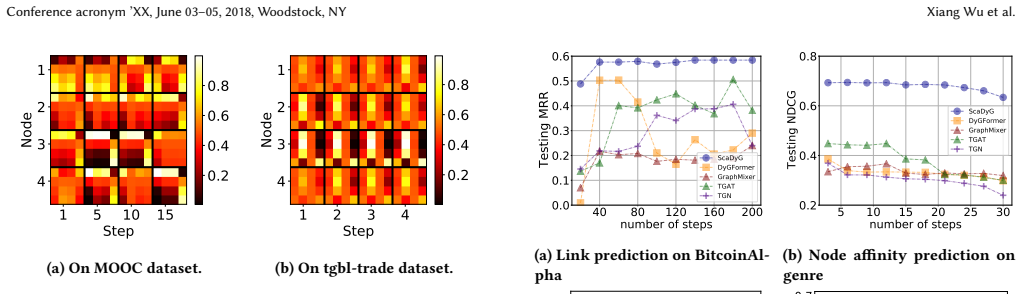
- The same framework serves both link-level and node-level tasks without task-specific architectural changes, achieving top or second-top results on 9 link prediction datasets and 4 node affinity datasets.
- Ablation results identify the combination of exponentials and the hypernetwork as the two components whose removal causes the largest performance drops, supporting the paper's claim that both are needed for node-wise temporal modeling.
- The hyperparameter study suggests the method is less sensitive to the number of historical time steps than sampling-based baselines, and that multi-hop propagation harms temporal tasks.
Reading between the lines
- The factorization in Proposition 1 suggests a general template: any temporal kernel that factorizes over a split time interval (exponentials satisfy this exactly, and other semigroup-like kernels approximately) can be moved into a parameter-free preprocessing stage, which may extend beyond the exponential family.
- The node-specific weight matrices generated by the hypernetwork may encode a per-node temporal profile; a testable extension would check whether these matrices correlate with node activity or transfer across datasets, evidence the paper does not provide.
- The complexity analysis excludes preprocessing from training time, so a fair end-to-end comparison on the largest datasets should measure total time-to-accuracy rather than per-epoch training time, especially for deployment scenarios.
- If the time-dependence of the learned matrix in Proposition 1 is made explicit (e.g., by parameterizing W(Δt)), the framework could become fully inductive, avoiding the need to store per-step intermediate messages at inference.
Editorial analysis
A structured set of objections, weighed in public.
Referee Report
Summary. The paper proposes ScaDyG, a decoupled paradigm for large-scale dynamic graph learning. It introduces Time-aware Topology Reformulation (TTR) to precompute weight-free temporal message propagation in intra- and inter-step phases, Dynamic Temporal Encoding (DTE) based on a combination of exponential functions, and a hypernetwork-driven message aggregation that generates node-specific transformation matrices. Experiments on 12 link- and node-level datasets, including million-scale graphs, show state-of-the-art or comparable prediction performance with substantially fewer parameters and lower training time than existing DGNN baselines. The central theoretical claim is that preprocessing with fixed exponentials followed by a single learnable linear transformation is equivalent to composite-exponential message passing, which justifies the 'no learnable parameters in preprocessing' design.
Significance. If the central equivalence were correct, the paper would offer a genuinely scalable and theoretically grounded alternative to sampling-based continuous-time DGNNs, with the preprocessing/propagation separation being the main novelty. The empirical study is extensive: 12 datasets, ablations for each component, scalability measurements, and hyperparameter sensitivity analyses. The method is simple, reproducible in principle, and the reported speedups (up to 60x) and parameter reductions (up to 50x) are striking. However, the theoretical foundation is load-bearing for the 'new paradigm' claim, and the proof of Proposition 1 is invalid as stated, making the proposed DTE's justification circular. The empirical results may remain valid as a heuristic, but the paper's central methodological contribution is not supported.
major comments (1)
- [Section 4.2, Proposition 1 and Appendix A] The proof of Proposition 1 defines the entries of the 'learnable' matrix W1 as w_ij = z_ij (a_1 e^{(γ_1−γ_j)Δt} + ... + a_d e^{(γ_d−γ_j)Δt}), where Δt = Δt_1 + Δt_2. This makes W1 explicitly depend on the time interval Δt and on the output coordinate j, so it is not a fixed parameter matrix as claimed. If W1 is held fixed after training, the equality x_v ⊙ T_e(Δt_1) ⊙ T_e(Δt_2) W1 = x_v κ(Δt) W for all Δt would require the coefficient sum ∑_k a_k e^{(γ_k−γ_j)Δt} to be constant for every j, which holds only in degenerate cases. Thus the claimed equivalence between fixed-exponential preprocessing plus a single learned transformation and composite-exponential message passing is not established; it is true only by allowing W1 to vary with Δt, which defeats the purpose of the proposition. This invalidates the theoretical justification for DTE as 'adaptive weight fusion' and leaves the 'no learnable parameter in preprocessing' claim without its supporting argument.
minor comments (6)
- [Section 5] The text says 'we introduce 13 benchmark datasets' but Table 1 lists 12 datasets (8 link + 4 node); the count should be corrected.
- [Section 2] There are typographical errors: 'Dynamic Grpah Neural Networks' and 'message massing-based methods' should be 'Dynamic Graph Neural Networks' and 'message passing-based methods', respectively.
- [Definition 2] The notation in the composite exponential dependency, e.g., 'a_1 e^{γ_1 Δt}_1', has unnecessary subscripts on the exponential terms; it should simply be a_i e^{γ_i Δt}.
- [Table 4] The definition of N is confusing: it is described as 'the number of historical steps in ScaDyG' in the caption, while the text in Section 5.3 separately refers to 'historical steps of length N' and 'total steps L'. The roles of N and L should be clarified to avoid ambiguity in the complexity expressions.
- [Appendix A] The proof uses the symbol x_e_v for the edge feature while the main text uses x_v for node features; the notation should be made consistent so that the derivation is easier to follow.
- [Section 5.5] The statement 'most methods perform best with a time step of 3' is unclear in context (the axis is 'number of steps', not 'time step') and should be reworded for precision.
Circularity Check
The DTE equivalence in Proposition 1 is defined into existence by making W1 depend on Δt, so the paper's central theoretical claim about adaptive composite-exponential fusion is circular.
-
self definitional
[Appendix A, final step of the proof of Proposition 1 (Proposition stated in Section 4.2)]
"Proposition 1. If Δ𝑡 = 𝑡−𝑡′ can be split by 𝑡𝑠 as Δ𝑡1 = 𝑡𝑠−𝑡′, Δ𝑡2 = 𝑡−𝑡𝑠, and W1 is a learnable parameter matrix, x𝑣⊙𝑇𝑒(Δ𝑡1)⊙𝑇𝑒(Δ𝑡2)W1 is equivalent to x𝑣𝜅(Δ𝑡)W. … By assigning 𝑤𝑖𝑗 = 𝑧𝑖𝑗(𝑎1𝑒^{(𝛾1−𝛾𝑗)Δ𝑡}+𝑎2𝑒^{(𝛾2−𝛾𝑗)Δ𝑡}+···+𝑎𝑑𝑒^{(𝛾𝑑−𝛾𝑗)Δ𝑡}), 𝑖,𝑗=1,2,...,𝑑 the proposition is proved."
The proof expands both sides and then 'assigns' the entries of W1 to be functions of Δt and of the target coefficients a_i, making the equality hold by construction rather than as a property of a fixed learned matrix. A learnable parameter matrix is fixed after training and cannot depend on the query-specific interval Δt = Δt1+Δt2; if W1 is held fixed, equality for all Δt would require ∑_i a_i e^{(γ_i−γ_j)Δt} to be constant in Δt for every j, which holds only in degenerate cases.
full rationale
The only significant circularity is in the theoretical justification of DTE. Proposition 1 is the load-bearing step for the claim that preprocessing with fixed exponentials plus one learnable transformation is equivalent to adaptive composite-exponential message passing, and its proof defines W1 as a Δt-dependent function of the very composite-exponential weights it is supposed to realize. That is a self-definitional reduction: the claimed equivalence is true only if the 'learnable parameter matrix' is allowed to see Δt, which contradicts the paper's 'no learnable parameter in preprocessing' conclusion and leaves the actual fixed-W model without the stated theoretical support. The empirical evaluation, by contrast, is self-contained: it compares against external baselines on standard datasets, and no load-bearing argument rests on a self-citation or an imported uniqueness theorem. Because the central methodological derivation reduces by construction while the experimental claims remain independent, a score of 8 is appropriate rather than 10.
Assumptions & free parameters
free parameters (4)
- γ0 (initial rate of exponential time encoding) =
around inverse of dataset's time range
- Number of time steps L =
searched from 1 to total time steps per dataset
- Number of propagation hops l =
1 in the main results; 1-3 explored
- Learning rate =
searched from 1e-5 to 1e-1
assumptions (4)
- domain assumption Exponential functions are an appropriate model for temporal influence decay in dynamic graphs.
- domain assumption All nodes use the same time step partition.
- domain assumption Summing edge features inside a step, rather than averaging, preserves repeated-interaction information.
- ad hoc to paper The proof of Proposition 1 may use a matrix W1 whose entries depend on Δt.
Cite this review
Pith. "Pith review of ScaDyG:A New Paradigm for Large-scale Dynamic Graph Learning." pith.science (2026). https://pith.science/paper/MRTNVIEZ
@misc{pith2026250116002,
  author       = {Pith},
  title        = {Pith review of: ScaDyG:A New Paradigm for Large-scale Dynamic Graph Learning},
  year         = {2026},
  howpublished = {\url{https://pith.science/paper/MRTNVIEZ}},
  note         = {Machine review of arXiv:2501.16002}
}
read the original abstract
Dynamic graphs (DGs), which capture time-evolving relationships between graph entities, have widespread real-world applications. To efficiently encode DGs for downstream tasks, most dynamic graph neural networks follow the traditional message-passing mechanism and extend it with time-based techniques. Despite their effectiveness, the growth of historical interactions introduces significant scalability issues, particularly in industry scenarios. To address this limitation, we propose ScaDyG, with the core idea of designing a time-aware scalable learning paradigm as follows: 1) Time-aware Topology Reformulation: ScaDyG first segments historical interactions into time steps (intra and inter) based on dynamic modeling, enabling weight-free and time-aware graph propagation within pre-processing. 2) Dynamic Temporal Encoding: To further achieve fine-grained graph propagation within time steps, ScaDyG integrates temporal encoding through a combination of exponential functions in a scalable manner. 3) Hypernetwork-driven Message Aggregation: After obtaining the propagated features (i.e., messages), ScaDyG utilizes hypernetwork to analyze historical dependencies, implementing node-wise representation by an adaptive temporal fusion. Extensive experiments on 12 datasets demonstrate that ScaDyG performs comparably well or even outperforms other SOTA methods in both node and link-level downstream tasks, with fewer learnable parameters and higher efficiency.
Figures


Figures from the paper (2 more)


Reference graph
Works this paper leans on
-
[1]
Sudhanshu Chanpuriya, Ryan A Rossi, Sungchul Kim, Tong Yu, Jane Hoffswell, Nedim Lipka, Shunan Guo, and Cameron N Musco. 2022. Direct embedding of temporal network edges via time-decayed line graphs. In The Eleventh Interna- tional Conference on Learning Representations
work page 2022
-
[2]
Jie Chen, Tengfei Ma, and Cao Xiao. 2018. Fastgcn: fast learning with graph convolutional networks via importance sampling. arXiv preprint arXiv:1801.10247 (2018)
arXiv 2018
-
[3]
Ming Chen, Zhewei Wei, Bolin Ding, Yaliang Li, Ye Yuan, Xiaoyong Du, and Ji-Rong Wen. 2020. Scalable graph neural networks via bidirectional propagation. Advances in neural information processing systems 33 (2020), 14556–14566
2020
-
[4]
Wei-Lin Chiang, Xuanqing Liu, Si Si, Yang Li, Samy Bengio, and Cho-Jui Hsieh
-
[5]
Weilin Cong, Si Zhang, Jian Kang, Baichuan Yuan, Hao Wu, Xin Zhou, Hanghang Tong, and Mehrdad Mahdavi. 2023. Do We Really Need Complicated Model Architectures For Temporal Networks? arXiv preprint arXiv:2302.11636 (2023)
arXiv 2023
-
[6]
Wenzheng Feng, Yuxiao Dong, Tinglin Huang, Ziqi Yin, Xu Cheng, Evgeny Kharlamov, and Jie Tang. 2022. Grand+: Scalable graph random neural networks. In Proceedings of the ACM Web Conference 2022 . 3248–3258
work page 2022
-
[7]
Fabrizio Frasca, Emanuele Rossi, Davide Eynard, Ben Chamberlain, Michael Bronstein, and Federico Monti. 2020. Sign: Scalable inception graph neural networks. arXiv preprint arXiv:2004.11198 (2020)
arXiv 2020
-
[8]
Johannes Gasteiger, Stefan Weißenberger, and Stephan Günnemann. 2019. Diffu- sion Improves Graph Learning. Advances in neural information processing systems, NeurIPS (2019)
work page 2019
Show all 72 references
-
[9]
David Ha, Andrew M Dai, and Quoc V Le. 2016. HyperNetworks. In International Conference on Learning Representations
2016
-
[10]
Ehsan Hajiramezanali, Arman Hasanzadeh, Krishna Narayanan, Nick Duffield, Mingyuan Zhou, and Xiaoning Qian. 2019. Variational graph recurrent neural networks. Advances in neural information processing systems 32 (2019)
2019
-
[11]
Will Hamilton, Zhitao Ying, and Jure Leskovec. 2017. Inductive representation learning on large graphs. Advances in neural information processing systems 30 (2017)
2017
-
[12]
Alan G Hawkes. 1971. Spectra of some self-exciting and mutually exciting point processes. Biometrika 58, 1 (1971), 83–90
1971
-
[13]
Xiangnan He, Kuan Deng, Xiang Wang, Yan Li, Yongdong Zhang, and Meng Wang. 2020. Lightgcn: Simplifying and powering graph convolution network for recommendation. In SIGIR
2020
-
[14]
Sepp Hochreiter and Jürgen Schmidhuber. 1997. Long short-term memory.Neural computation 9, 8 (1997), 1735–1780
1997
-
[15]
Keke Huang, Jing Tang, Juncheng Liu, Renchi Yang, and Xiaokui Xiao. 2023. Node-wise diffusion for scalable graph learning. In Proceedings of the ACM Web Conference 2023. 1723–1733
2023
-
[16]
Shenyang Huang, Farimah Poursafaei, Jacob Danovitch, Matthias Fey, Weihua Hu, Emanuele Rossi, Jure Leskovec, Michael Bronstein, Guillaume Rabusseau, and Reihaneh Rabbany. 2024. Temporal graph benchmark for machine learning on temporal graphs. Advances in Neural Information Pro...
2024
-
[17]
Wenbing Huang, Tong Zhang, Yu Rong, and Junzhou Huang. 2018. Adaptive sam- pling towards fast graph representation learning. Advances in neural information processing systems 31 (2018)
2018
-
[18]
Ming Jin, Yuan-Fang Li, and Shirui Pan. 2022. Neural Temporal Walks: Motif- Aware Representation Learning on Continuous-Time Dynamic Graphs. InAd- vances in Neural Information Processing Systems
2022
-
[19]
Srijan Kumar, William L Hamilton, Jure Leskovec, and Dan Jurafsky. 2018. Com- munity interaction and conflict on the web. In Proceedings of the 2018 world wide web conference. 933–943
2018
-
[20]
Srijan Kumar, Bryan Hooi, Disha Makhija, Mohit Kumar, Christos Faloutsos, and VS Subrahmanian. 2018. Rev2: Fraudulent user prediction in rating platforms. In Proceedings of the Eleventh ACM International Conference on Web Search and Data Mining. 333–341
2018
-
[21]
Srijan Kumar, Francesca Spezzano, VS Subrahmanian, and Christos Faloutsos
-
[22]
Srijan Kumar, Xikun Zhang, and Jure Leskovec. 2019. Predicting Dynamic Embedding Trajectory in Temporal Interaction Networks (KDD ’19) . Asso- ciation for Computing Machinery, New York, NY, USA, 1269–1278. https: //doi.org/10.1145/3292500.3330895
2019
-
[23]
Xunkai Li, Meihao Liao, Zhengyu Wu, Daohan Su, Wentao Zhang, Rong-Hua Li, and Guoren Wang. 2024. LightDiC: A Simple yet Effective Approach for Large-scale Digraph Representation Learning. arXiv preprint arXiv:2401.11772 (2024)
2024 arXiv
-
[24]
Xunkai Li, Jingyuan Ma, Zhengyu Wu, Daohan Su, Wentao Zhang, Rong-Hua Li, and Guoren Wang. 2024. Rethinking Node-wise Propagation for Large-scale Graph Learning. In Proceedings of the ACM Web Conference, WWW
2024
-
[25]
Yiming Li, Yanyan Shen, Lei Chen, and Mingxuan Yuan. 2023. Orca: Scalable Tem- poral Graph Neural Network Training with Theoretical Guarantees. Proceedings of the ACM on Management of Data 1, 1 (2023), 1–27
2023
-
[26]
Yiming Li, Yanyan Shen, Lei Chen, and Mingxuan Yuan. 2023. Zebra: When Temporal Graph Neural Networks Meet Temporal Personalized PageRank. Pro- ceedings of the VLDB Endowment 16, 6 (2023), 1332–1345
2023
-
[27]
Ningyi Liao, Dingheng Mo, Siqiang Luo, Xiang Li, and Pengcheng Yin. 2022. SCARA: scalable graph neural networks with feature-oriented optimization. arXiv preprint arXiv:2207.09179 (2022)
2022 arXiv
-
[28]
Yuanfu Lu, Xiao Wang, Chuan Shi, Philip S Yu, and Yanfang Ye. 2019. Temporal network embedding with micro-and macro-dynamics. In CIKM
2019
-
[29]
Yuhong Luo and Pan Li. 2022. Neighborhood-aware scalable temporal network representation learning. In Learning on Graphs Conference . PMLR, 1–1
2022
-
[30]
Pietro Panzarasa, Tore Opsahl, and Kathleen M Carley. 2009. Patterns and dynamics of users’ behavior and interaction: Network analysis of an online community. Journal of the American Society for Information Science and Technology 60, 5 (2009), 911–932
2009
-
[31]
Ashwin Paranjape, Austin R Benson, and Jure Leskovec. 2017. Motifs in temporal networks. In Proceedings of the tenth ACM international conference on web search and data mining. 601–610
2017
-
[32]
Aldo Pareja, Giacomo Domeniconi, Jie Chen, Tengfei Ma, Toyotaro Suzumura, Hiroki Kanezashi, Tim Kaler, Tao Schardl, and Charles Leiserson. 2020. Evolvegcn: Evolving graph convolutional networks for dynamic graphs. In Proceedings of the AAAI conference on artificial intelligenc...
2020
-
[33]
Hao Peng, Hongfei Wang, Bowen Du, Md Zakirul Alam Bhuiyan, Hongyuan Ma, Jianwei Liu, Lihong Wang, Zeyu Yang, Linfeng Du, Senzhang Wang, et al
-
[34]
Farimah Poursafaei, Shenyang Huang, Kellin Pelrine, and Reihaneh Rabbany
-
[35]
Emanuele Rossi, Ben Chamberlain, Fabrizio Frasca, Davide Eynard, Federico Monti, and Michael Bronstein. 2020. Temporal graph networks for deep learning on dynamic graphs. arXiv preprint arXiv:2006.10637 (2020)
2020 arXiv
-
[36]
Aravind Sankar, Yanhong Wu, Liang Gou, Wei Zhang, and Hao Yang. 2020. Dysat: Deep neural representation learning on dynamic graphs via self-attention networks. In Proceedings of the 13th international conference on web search and data mining. 519–527
2020
-
[37]
Youngjoo Seo, Michaël Defferrard, Pierre Vandergheynst, and Xavier Bresson
-
[38]
Li Sun, Zhongbao Zhang, Jiawei Zhang, Feiyang Wang, Hao Peng, Sen Su, and S Yu Philip. 2021. Hyperbolic variational graph neural network for modeling dynamic graphs. In Proceedings of the AAAI Conference on Artificial Intelligence , Vol. 35. 4375–4383
2021
-
[39]
Haoran Tang, Shiqing Wu, Guandong Xu, and Qing Li. 2023. Dynamic graph evolution learning for recommendation. In Proceedings of the 46th international acm sigir conference on research and development in information retrieval . 1589– 1598
2023
-
[40]
Yi Tay, Zhe Zhao, Dara Bahri, Donald Metzler, and Da-Cheng Juan. 2020. Hy- pergrid transformers: Towards a single model for multiple tasks. In International conference on learning representations
2020
-
[41]
Rakshit Trivedi, Mehrdad Farajtabar, Prasenjeet Biswal, and Hongyuan Zha. 2019. Dyrep: Learning representations over dynamic graphs. InInternational conference on learning representations
2019
-
[42]
Petar Velickovic, Guillem Cucurull, Arantxa Casanova, Adriana Romero, Pietro Liò, and Yoshua Bengio. 2018. Graph Attention Networks. In ICLR
2018
-
[43]
Yanbang Wang, Yen-Yu Chang, Yunyu Liu, Jure Leskovec, and Pan Li. 2021. Inductive representation learning in temporal networks via causal anonymous walks. arXiv preprint arXiv:2101.05974 (2021)
2021 arXiv
-
[44]
Zhihao Wen and Yuan Fang. 2022. TREND: TempoRal Event and Node Dynamics for Graph Representation Learning. In Proceedings of the ACM Web Conference
2022
-
[45]
Felix Wu, Amauri Souza, Tianyi Zhang, Christopher Fifty, Tao Yu, and Kilian Weinberger. 2019. Simplifying graph convolutional networks. In International conference on machine learning . PMLR, 6861–6871
2019
-
[46]
Yuxia Wu, Yuan Fang, and Lizi Liao. 2024. On the Feasibility of Simple Trans- former for Dynamic Graph Modeling. In Proceedings of the ACM on Web Confer- ence 2024. 870–880
2024
-
[47]
Sheng Xiang, Dawei Cheng, Chencheng Shang, Ying Zhang, and Yuqi Liang
-
[48]
Da Xu, Chuanwei Ruan, Evren Korpeoglu, Sushant Kumar, and Kannan Achan
-
[49]
Menglin Yang, Min Zhou, Marcus Kalander, Zengfeng Huang, and Irwin King
-
[50]
Xiaocheng Yang, Mingyu Yan, Shirui Pan, Xiaochun Ye, and Dongrui Fan. 2023. Simple and efficient heterogeneous graph neural network. In Proceedings of the AAAI Conference on Artificial Intelligence , Vol. 37. 10816–10824
2023
-
[51]
Jiaxuan You, Tianyu Du, and Jure Leskovec. 2022. ROLAND: graph learning framework for dynamic graphs. In Proceedings of the 28th ACM SIGKDD Confer- ence on Knowledge Discovery and Data Mining . 2358–2366
2022
-
[52]
Le Yu, Leilei Sun, Bowen Du, and Weifeng Lv. 2023. Towards better dynamic graph learning: New architecture and unified library. Advances in Neural Information Processing Systems 36 (2023), 67686–67700
2023
-
[53]
In Proceedings of the 31st ACM international conference on information & knowledge management
Temporal and heterogeneous graph neural network for financial time series prediction. In Proceedings of the 31st ACM international conference on information & knowledge management . 3584–3593. Conference acronym ’XX, June 03–05, 2018, Woodstock, NY Xiang Wu et al
2018
-
[54]
Chun-Yang Zhang, Zhi-Liang Yao, Hong-Yu Yao, Feng Huang, and CL Philip Chen
-
[55]
arXiv preprint arXiv:2002.07962 (2020)
Inductive representation learning on temporal graphs. arXiv preprint arXiv:2002.07962 (2020)
2020 arXiv
-
[56]
Wentao Zhang, Ziqi Yin, Zeang Sheng, Yang Li, Wen Ouyang, Xiaosen Li, Yangyu Tao, Zhi Yang, and Bin Cui. 2022. Graph attention multi-layer perceptron. In Proceedings of the 28th ACM SIGKDD Conference on Knowledge Discovery and Data Mining. 4560–4570
2022
-
[57]
Hongkuan Zhou, Da Zheng, Israt Nisa, Vasileios Ioannidis, Xiang Song, and George Karypis. 2022. TGL: a general framework for temporal GNN training on billion-scale graphs. Proceedings of the VLDB Endowment 15, 8 (2022), 1572–1580
2022
-
[58]
Ke Zhou, Hongyuan Zha, and Le Song. 2013. Learning social infectivity in sparse low-rank networks using multi-dimensional hawkes processes. InArtificial Intelligence and Statistics. PMLR, 641–649
2013
-
[59]
Hao Zhu and Piotr Koniusz. 2020. Simple spectral graph convolution. In Interna- tional conference on learning representations
2020
-
[60]
Yifan Zhu, Fangpeng Cong, Dan Zhang, Wenwen Gong, Qika Lin, Wenzheng Feng, Yuxiao Dong, and Jie Tang. 2023. WinGNN: dynamic graph neural networks with random gradient aggregation window. In Proceedings of the 29th ACM SIGKDD Conference on Knowledge Discovery and Data Mining . ...
2023
-
[61]
Hanqing Zeng, Hongkuan Zhou, Ajitesh Srivastava, Rajgopal Kannan, and Viktor Prasanna. 2019. Graphsaint: Graph sampling based inductive learning method. arXiv preprint arXiv:1907.04931 (2019)
2019 arXiv
-
[62]
Yuan Zuo, Guannan Liu, Hao Lin, Jia Guo, Xiaoqian Hu, and Junjie Wu. 2018. Embedding temporal network via neighborhood formation. In Proceedings of the 24th ACM SIGKDD international conference on knowledge discovery & data mining . 2857–2866. ScaDyG: A New Paradigm for Large-s...
2018
-
[63]
IEEE Transactions on Systems, Man, and Cybernetics: Systems (2022)
Dynamic Representation Learning via Recurrent Graph Neural Networks. IEEE Transactions on Systems, Man, and Cybernetics: Systems (2022)
2022
-
[64]
Wentao Zhang, Mingyu Yang, Zeang Sheng, Yang Li, Wen Ouyang, Yangyu Tao, Zhi Yang, and Bin Cui. 2021. Node dependent local smoothing for scalable graph learning. Advances in Neural Information Processing Systems 34 (2021), 20321–20332
2021
-
[70]
Difan Zou, Ziniu Hu, Yewen Wang, Song Jiang, Yizhou Sun, and Quanquan Gu
-
[71]
Advances in neural information processing systems 32 (2019)
Layer-dependent importance sampling for training deep and large graph convolutional networks. Advances in neural information processing systems 32 (2019)
2019
-
[2016]
In 2016 IEEE 16th international conference on data mining (ICDM)
Edge weight prediction in weighted signed networks. In 2016 IEEE 16th international conference on data mining (ICDM) . IEEE, 221–230
2016
-
[2018]
In International conference on neural information processing
Structured sequence modeling with graph convolutional recurrent net- works. In International conference on neural information processing . Springer, 362–373
-
[2019]
In Proceedings of the 25th ACM SIGKDD international conference on knowledge discovery & data mining
Cluster-gcn: An efficient algorithm for training deep and large graph convolutional networks. In Proceedings of the 25th ACM SIGKDD international conference on knowledge discovery & data mining . 257–266
-
[2020]
Information Sciences 521 (2020), 277–290
Spatial temporal incidence dynamic graph neural networks for traffic flow forecasting. Information Sciences 521 (2020), 277–290
2020
-
[2021]
In Proceedings of the 27th ACM SIGKDD Conference on Knowledge Discovery & Data Mining
Discrete-time temporal network embedding via implicit hierarchical learn- ing in hyperbolic space. In Proceedings of the 27th ACM SIGKDD Conference on Knowledge Discovery & Data Mining . 1975–1985
1975
-
[2022]
Advances in Neural Information Processing Systems 35 (2022), 32928–32941
Towards better evaluation for dynamic link prediction. Advances in Neural Information Processing Systems 35 (2022), 32928–32941
2022
Reviewed August 10, 2026 · model on record in the stance chip above.
Discussion (0). Continue with ORCID to comment.