REVIEW 4 major objections 6 minor 1 cited by
Two-body Hidden Charm Decays of $D$ Wave Charmonia
T0 review · 4 major / 6 minor · reviewed 2026-08-10 · deepseek-v4-flash
Pith's one-line read The paper predicts that psi2(3823) decays to J/psi eta with a partial width near 30 keV, about 10% of its radiative width.
desk verdict A competent meson-loop calculation with a testable ψ2(3823)→J/ψη width, but the η-η' mixing angle sign is stated inconsistently and needs fixing. read the letter →
The pith
A machine-rendered reading of the paper's core claim, the machinery that carries it, and where it could break.
The reading
What carries the argument
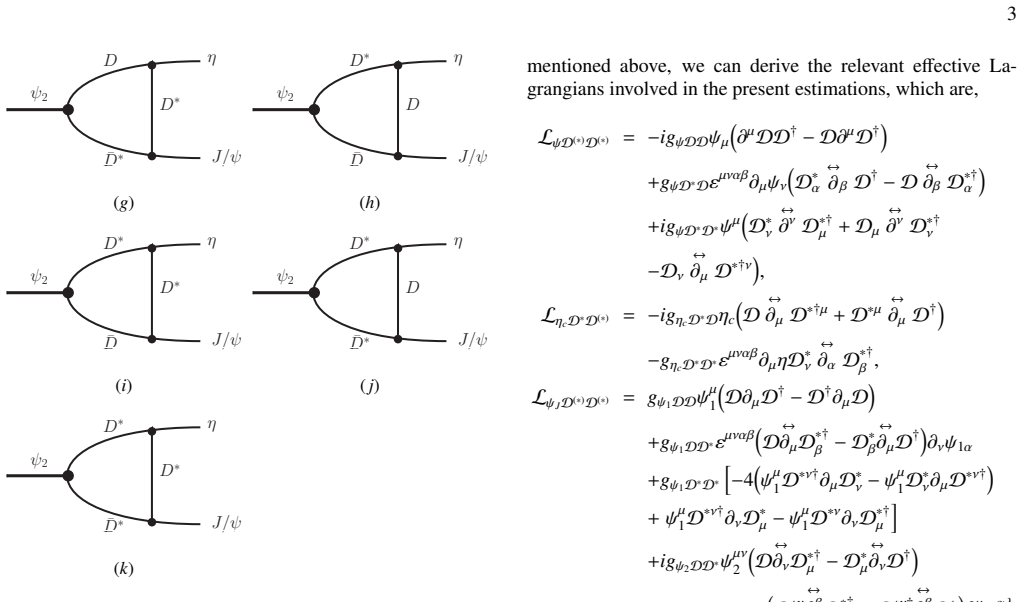
The machinery is the meson loop mechanism: the initial charmonium fluctuates into an $S$-wave charmed-meson pair ($D\bar D$, $D\bar D^*$, $D^*\bar D^*$) that rescatters into $J/\psi\eta$ or $\eta_c\omega$. The amplitudes are built from heavy-quark effective Lagrangians — the superfield $R$ for $S$-wave charmonia, the spin multiplet $J^{\mu\lambda}$ for $D$-wave charmonia, and the $H$ superfields for charmed mesons — so all couplings are fixed by symmetry up to the gauge couplings $g_1$ and $g_2$. Loop convergence and off-shell effects are controlled by the monopole form factor $F=(m_q^2-\Lambda^2)/(q^2-\Lambda^2)$ with $\Lambda=m+\alpha_\Lambda\Lambda_{\mathrm{QCD}}$; the single free parameter $\alpha_\Lambda$ is the load-bearing dial.
What would settle it
Measure the ratio $\mathcal{B}[\psi_2(3823)\to J/\psi\eta]/\mathcal{B}[\psi_2(3823)\to\gamma\chi_{c1}]$ with the next generation of charmonium data; a central value outside roughly $5\%$–$15\%$, or an absolute $\psi_2(3823)\to J/\psi\eta$ width far from $30$ keV, would falsify the $\alpha_\Lambda$ transfer assumption.
Extended reading notes
Core claim
The paper's central claim is that one meson-loop amplitude, regulated by a monopole form factor with a single fitted parameter, describes the hidden-charm decays of all three $D$-wave charmonia spin triplets. The fitted range $\alpha_\Lambda=(1.11^{+0.04}_{-0.05})$ reproduces $\mathcal{B}[\psi(3770)\to J/\psi\eta]=(8.7\pm1.2)\times10^{-4}$, and from it the paper obtains $\mathcal{B}[\psi(3770)\to\eta_c\omega]=(6.03^{+0.82}_{-0.92})\times10^{-5}$, $\Gamma[\psi_2(3823)\to J/\psi\eta]=(29.64^{+4.01}_{-4.63})$ keV, and $\Gamma[\psi_2(3823)\to\eta_c\omega]=(0.38^{+0.05}_{-0.06})$ keV. The ratio $\Gamma[\psi_2(3823)\to\eta_c\omega]/\Gamma[\psi_2(3823)\to J/\psi\eta]=0.127$ is essentially parameter-independent. For $\psi_3(3842)$, the widths are only $7.54$ eV and $1.12$ eV because its hidden-charm final states couple through an $F$ wave, so the paper concludes that hidden charm is negligible for that state.
Load-bearing premise
The prediction stands or falls on the assumption that the form-factor parameter $\alpha_\Lambda$ fitted to $\psi(3770)\to J/\psi\eta$ applies unchanged to $\psi_2(3823)$ and $\psi_3(3842)$ because the three $D$-wave states are similar; if the dressed meson-loop coupling or off-shell behavior differs with spin, the 30 keV width and the eV-scale $\psi_3(3842)$ widths would shift.
Editorial extensions
If this is right
- The $\psi_2(3823)\to J/\psi\eta$ partial width is $(29.64^{+4.01}_{-4.63})$ keV, making it the dominant hidden-charm strong decay of $\psi_2(3823)$.
- The ratio of this width to $\psi_2(3823)\to\gamma\chi_{c1}$ is about 10%, below the BESIII upper limit of 0.14 and consistent with the Belle and LHCb cascade measurements.
- The $\psi_2(3823)\to\eta_c\omega$ mode is predicted at $(0.38^{+0.05}_{-0.06})$ keV, with a parameter-independent ratio of $0.127$ to $J/\psi\eta$.
- $\psi(3770)\to\eta_c\omega$ has branching fraction $(6.03^{+0.82}_{-0.92})\times10^{-5}$, about an order of magnitude below $\psi(3770)\to J/\psi\eta$.
- $\psi_3(3842)$ hidden-charm widths are only $7.54$ eV and $1.12$ eV, so hidden charm does not contribute meaningfully to its total width.
Reading between the lines
- If the predicted 30 keV width is correct, the hidden-charm channels exhaust only a small part of $\psi_2(3823)$'s $<2.9$ MeV width, so its total width should be dominated by radiative transitions; a future width measurement would calibrate the E1-transition scale.
- The same fitted parameter predicts $\psi(3770)\to\eta_c\omega$ at $6\times10^{-5}$; measuring that mode would provide a direct test of whether $\alpha_\Lambda$ truly transfers across spin states.
- The framework leaves the $F$-wave coupling $\psi_3(3842)D\bar D$ out because it vanishes at leading order, so a sizable $\psi_3(3842)\to D\bar D$ contribution from on-shell loops could be the next place to look.
- Extending the same calculation to the spin-singlet $\eta_{c2}$ partner would fill in the missing piece of the $D$-wave multiplet's hidden-charm decays.
Editorial analysis
A structured set of objections, weighed in public.
Referee Report
Summary. The manuscript studies two-body hidden-charm decays of the D-wave charmonia ψ(3770), ψ2(3823), and ψ3(3842) in a hadronic meson-loop model. The model parameter αΛ is fixed by reproducing the measured branching fraction of ψ(3770)→J/ψη, and the same parameter range is then used to predict the partial widths of ψ(3770)→ηcω, ψ2(3823)→J/ψη/ηcω, and ψ3(3842)→J/ψη/ηcω. The central result is Γ[ψ2(3823)→J/ψη] = (29.64^{+4.01}_{-4.63}) keV, which corresponds to about a 10% ratio of ψ2(3823)→J/ψη to ψ2(3823)→γχc1 and is proposed as a testable observable for BESIII, Belle II, and LHCb.
Significance. If the predictions are reliable, the paper provides a useful quantitative estimate for a channel that is directly accessible to ongoing experiments, particularly the ψ2(3823)→J/ψη width and its ratio to the radiative width. The work is concrete and falsifiable, and the authors are explicit about the model, the amplitudes, and the parameter determination. The main strengths are the complete one-loop expressions and the use of an experimentally determined branching fraction to fix the cutoff parameter. However, the central numerical prediction depends sensitively on an η-η' mixing sign convention that is stated inconsistently, and the ψ3 predictions omit a vertex whose contribution the authors themselves acknowledge can be sizable. These issues must be resolved before the numerical results can be used as quantitative predictions.
major comments (4)
- [Section II, after Eq. (11); Section III.B] The η-η' mixing angle is stated inconsistently. The text says θ ranges from −10° to −20°, citing Refs. [46,47], but then sets θ = 19.1°, citing Refs. [48,49]. Because α(θ) = (cosθ − √2 sinθ)/√6 is linear in the amplitudes, α ≈ 0.58 at θ = −19.1° but α ≈ 0.20 at θ = +19.1°. Since αΛ is fitted to Br(ψ(3770)→J/ψη), a change in the sign convention shifts αΛ and does not simply rescale the predicted ψ2(3823)→J/ψη width, because the loop integrals have an αΛ dependence through the form factor. The authors must specify the mixing convention used for Refs. [48,49], repeat the fit with a consistent sign, and show how the headline value and its uncertainty change.
- [Eq. (19), Abstract, and Section IV] The quoted uncertainty of the central prediction is internally inconsistent: the abstract gives Γ[ψ2(3823)→J/ψη] = (29.64^{+4.01}_{-4.63}) keV, Eq. (19) gives (29.64^{+4.01}_{-4.43}) keV, and the summary gives (29.64^{+4.10}_{-4.43}) keV. Since the paper presents the asymmetric error as part of its quantitative claim, the authors should reconcile these numbers and explain how the error is propagated from the αΛ range, including whether the upper/lower asymmetry arises from the non-linear dependence of the loop integrals.
- [Section III.B, last paragraph; Appendix A, Eqs. (A3)-(A4)] The ψ3(3842)→J/ψη predictions omit the ψ3(3842)D Dbar vertex because it vanishes at leading order in the heavy-quark expansion, but the authors explicitly acknowledge that 'the meson loops relevant to ψ3(3842)D Dbar may have sizable contributions since the D Dbar in the meson loops could be on-shell.' Given that the predicted ψ3(3842) partial widths are only 7.54 eV and 1.12 eV, an omitted on-shell contribution is not negligible and could change the result by orders of magnitude. The authors should either estimate this contribution, or present the ψ3 predictions with a clear caveat that they are not complete quantitative predictions.
- [Section III.B] The extrapolation of αΛ from ψ(3770) to ψ2(3823) and ψ3(3842) is justified only by the statement 'Considering the similarity of the of the D-wave charmonia'. The initial states have different masses, different spin structures, and different allowed charmed-meson channels, so the off-shell form factor and the effective coupling strength need not be identical. Since the central ψ2 prediction depends on this transferability, the authors should provide a quantitative check, for example by showing the sensitivity of Γ[ψ2→J/ψη] to a state-dependent αΛ variation or by comparing the loop integrals for different J states.
minor comments (6)
- [Section II, Eq. (11)] The mixing angle θ appears with two different sign conventions in Refs. [46,47] and [48,49]. Please define the convention explicitly in the text so that the numerical value θ = 19.1° is unambiguous.
- [Section I and Section III.B] The measured branching fraction of ψ(3770)→J/ψη is quoted as (8.7±1.0±0.8)×10^-4 in the Introduction and as (8.7±1.2)×10^-4 in Section III.B. Please use one consistent experimental value with the full uncertainty breakdown.
- [Fig. 4 caption] The caption says 'lift panel' where 'left panel' is intended.
- [Section III.B] The sentence 'Considering the similarity of the of the D-wave charmonia' has a grammatical error and should be rewritten.
- [Eq. (8)] Several terms in the effective Lagrangian have index contractions that are hard to verify, for example the expressions involving pνϵα(p) and terms with pα1νgβμ−pβ2νgμα. Please check that all Lorentz indices are contracted consistently, since the reader needs to reproduce the amplitudes independently.
- [Section III.B, ψ3 discussion] The phrase 'which are much small comparing to widths' should read 'which are much smaller than the widths'.
Circularity Check
No significant circularity: the one-parameter fit to Br(ψ(3770)→J/ψη) is an input, and the ψ2/ψ3 and ηcω widths are computed from distinct loop amplitudes rather than being the fitted observable itself.
full rationale
The paper fixes the monopole form-factor parameter αΛ by reproducing the measured Br(ψ(3770)→J/ψη) (Sec. III.B, Fig. 4, αΛ=(1.11+0.04/−0.05)), then computes the widths Γ[ψ2(3823)→J/ψη], Γ[ψ2(3823)→ηcω], Γ[ψ3(3842)→J/ψη] and Γ[ψ3(3842)→ηcω] from the separate amplitudes in Eqs. (12), (A1)–(A4), and (B1)–(B6). These amplitudes involve different D-wave charmonium couplings (gψ2, gψ3 in Eq. (17)) and different loop integrals, so the predictions are not equal to the fitted input by construction. The D-wave coupling constant g2=1.39 is taken from the authors' earlier work [54] but is itself fixed by the external ψ(3770)→D Dbar width [15], an independent benchmark outside the predicted hidden-charm channels; the heavy-quark multiplet framework is standard (Refs. [34–36]), so the self-citation is not load-bearing. The quoted sign inconsistency for the η–η′ mixing angle (θ given as −10° to −20° and then set to 19.1°) and the admitted neglect of ψ3D Dbar meson loops are real consistency/completeness caveats, but they do not make any predicted quantity equivalent to the fitted data. No step in the derivation reduces by definition to the input observable, so there is no significant circularity.
Assumptions & free parameters
free parameters (3)
- alpha_Lambda (form factor parameter) =
1.11 (+0.04/-0.05)
- g2 (D-wave charmonium to charmed meson coupling) =
1.39
- eta-eta' mixing angle theta =
19.1 degrees (text likely intended -19.1)
assumptions (5)
- domain assumption Heavy quark limit effective Lagrangian describes charmed meson and charmonia couplings
- domain assumption Meson loops provide the dominant long-distance contribution to OZI-suppressed hidden charm decays
- domain assumption Only S-wave charmed mesons contribute to the loops
- ad hoc to paper A monopole form factor Lambda = m + alpha_Lambda Lambda_QCD regularizes the loop integrals
- ad hoc to paper The psi3(3842)-D Dbar vertex vanishes at leading order and can be omitted
Cite this review
Pith. "Pith review of Two-body Hidden Charm Decays of $D$ Wave Charmonia." pith.science (2026). https://pith.science/paper/7OD4C6VR
@misc{pith2026250116124,
  author       = {Pith},
  title        = {Pith review of: Two-body Hidden Charm Decays of $D$ Wave Charmonia},
  year         = {2026},
  howpublished = {\url{https://pith.science/paper/7OD4C6VR}},
  note         = {Machine review of arXiv:2501.16124}
}
abstract
The experimental observations of $\psi_2(3823)$ and $\psi_3(3842)$ make $D$ wave charmonia family abundant. In the present work, we investigate the hidden charm decay processes of spin triplets of the $D$-wave charmonia with the meson loop mechanism. The model parameter $\alpha_\Lambda$ is determined by reproducing the branching fraction of $\psi(3770)\to J/\psi \eta$. With this range of model parameter values, the branching fractions (partial widths) of $\psi(3770) \to \eta_c \omega$, $\psi_2(3823)/\psi_3(3842) \to J/\psi \eta$, $\psi_2(3823)/\psi_3(3842) \to \eta_c \omega$ are estimated. Our estimations find that the partial width of $\psi_2(3823) \to J/\psi \eta$ is $\left(29.64^{+4.01}_{-4.63}\right)\ \mathrm{keV}$, and the partial width ratio of $\psi_2(3823) \to J/\psi \eta$ relative to $\psi_2(3823)\to \gamma \chi_{c1}$ is about $10\%$, which could be tested by further precise measurements from the BESIII, Belle II and LHCb Collaborations.
Figures


Figures from the paper (5 more)


Forward citations
Cited by 1 Pith paper
-
Unquenched Charmonium and Beyond
This Lanzhou-group review argues that coupled-channel (unquenched) effects, not exotic constituents, are the common thread explaining charmonium anomalies from the rho-pi puzzle to the Y-problem states.
Reference graph
Works this paper leans on
-
[1]
J. E. Augustin et al. [SLAC-SP-017], Phys. Rev. Lett. 33 (1974), 1406-1408 doi:10.1103/PhysRevLett.33.1406
-
[2]
J. J. Aubert et al. [E598], Phys. Rev. Lett.33 (1974), 1404-1406 11 doi:10.1103/PhysRevLett.33.1404
-
[3]
E. Eichten, K. Gottfried, T. Kinoshita, J. B. Kogut, K. D. Lane and T. M. Yan, Phys. Rev. Lett. 34 (1975), 369-372 [erratum: Phys. Rev. Lett. 36 (1976), 1276] doi:10.1103/PhysRevLett.34.369
-
[4]
E. Eichten, K. Gottfried, T. Kinoshita, K. D. Lane and T. M. Yan, Phys. Rev. Lett. 36 (1976), 500 doi:10.1103/PhysRevLett.36.500
-
[5]
K. D. Lane and E. Eichten, Phys. Rev. Lett. 37 (1976), 477 [erratum: Phys. Rev. Lett. 37 (1976), 1105] doi:10.1103/PhysRevLett.37.477
-
[6]
P. A. Rapidis, B. Gobbi, D. Luke, A. Barbaro-Galtieri, J. Dor- fan, R. Ely, G. J. Feldman, J. M. Feller, A. Fong and G. Hanson, et al. Phys. Rev. Lett. 39 (1977), 526 [erratum: Phys. Rev. Lett. 39 (1977), 974] doi:10.1103/PhysRevLett.39.526
-
[7]
L. Antoniazzi et al. [E705], Phys. Rev. D50 (1994), 4258-4264 doi:10.1103/PhysRevD.50.4258
-
[8]
V . Bhardwaj et al. [Belle], Phys. Rev. Lett. 111 (2013) no.3, 032001 doi:10.1103 /PhysRevLett.111.032001 [arXiv:1304.3975 [hep-ex]]
arXiv 2013
Show all 57 references
-
[9]
Godfrey and N
S. Godfrey and N. Isgur, Phys. Rev. D 32 (1985), 189-231 doi:10.1103/PhysRevD.32.189
1985 doi
-
[11]
Ablikim et al
M. Ablikim et al. [BESIII], Phys. Rev. Lett. 115 (2015) no.1, 011803 doi:10.1103 /PhysRevLett.115.011803 [arXiv:1503.08203 [hep-ex]]
2015 arXiv
-
[12]
Ablikim et al
M. Ablikim et al. [BESIII], Phys. Rev. Lett. 129 (2022) no.10, 102003 doi:10.1103 /PhysRevLett.129.102003 [arXiv:2203.05815 [hep-ex]]
2022
-
[13]
Ablikim et al
M. Ablikim et al. [BESIII], JHEP 02 (2023), 171 doi:10.1007/JHEP02(2023)171 [arXiv:2209.14744 [hep-ex]]
2023
-
[14]
Aaij et al
R. Aaij et al. [LHCb], JHEP 08 (2020), 123 doi:10.1007/JHEP08(2020)123 [arXiv:2005.13422 [hep-ex]]
2020
-
[15]
Navas et al
S. Navas et al. [Particle Data Group], Phys. Rev. D 110 (2024) no.3, 030001 doi:10.1103/PhysRevD.110.030001
2024 doi
-
[16]
Ablikim et al
M. Ablikim et al. [BES], Phys. Rev. Lett. 97 (2006), 121801 doi:10.1103/PhysRevLett.97.121801 [arXiv:hep-ex /0605107 [hep-ex]]
2006 doi
-
[17]
Ablikim et al
M. Ablikim et al. [BES], Phys. Lett. B 641 (2006), 145-155 doi:10.1016/j.physletb.2006.08.049 [arXiv:hep-ex /0605105 [hep-ex]]
2006 doi
-
[18]
Ablikim et al
M. Ablikim et al. [BES], Phys. Lett. B 659 (2008), 74-79 doi:10.1016/j.physletb.2007.11.078
2008 doi
-
[19]
Y . J. Zhang, G. Li and Q. Zhao, Phys. Rev. Lett. 102 (2009), 172001 doi:10.1103 /PhysRevLett.102.172001 [arXiv:0902.1300 [hep-ph]]
2009 arXiv
-
[20]
X. Liu, B. Zhang and X. Q. Li, Phys. Lett. B 675 (2009), 441-445 doi:10.1016/j.physletb.2009.04.047 [arXiv:0902.0480 [hep-ph]]
2009 arXiv
-
[21]
G. Li, X. h. Liu, Q. Wang and Q. Zhao, Phys. Rev. D 88, no.1, 014010 (2013) doi:10.1103 /PhysRevD.88.014010 [arXiv:1302.1745 [hep-ph]]
2013 arXiv
-
[22]
F. K. Guo, C. Hanhart and U. G. Meissner, Phys. Rev. Lett.103 (2009), 082003 [erratum: Phys. Rev. Lett. 104 (2010), 109901] doi:10.1103/PhysRevLett.103.082003 [arXiv:0907.0521 [hep- ph]]
2009 arXiv
-
[23]
F. K. Guo, C. Hanhart, G. Li, U. G. Meissner and Q. Zhao, Phys. Rev. D 83 (2011), 034013 doi:10.1103 /PhysRevD.83.034013 [arXiv:1008.3632 [hep-ph]]
2011 arXiv
-
[24]
Li and Q
G. Li and Q. Zhao, Phys. Lett. B 670 (2008), 55- 60 doi:10.1016/j.physletb.2008.10.033 [arXiv:0709.4639 [hep- ph]]
2008 arXiv
-
[25]
X. G. He, X. Q. Li, X. Liu and X. Q. Zeng, Eur. Phys. J. C 51 (2007), 883-889 doi:10.1140 /epjc/s10052-007-0347-y [arXiv:hep-ph/0606015 [hep-ph]]
2007 arXiv
-
[26]
D. Y . Chen, J. He, X. Q. Li and X. Liu, Phys. Rev. D81 (2010), 074006 doi:10.1103 /PhysRevD.81.074006 [arXiv:0912.4860 [hep-ph]]
2010 arXiv
-
[27]
Liu, Phys
X. Liu, Phys. Lett. B 680 (2009), 137-140 doi:10.1016/j.physletb.2009.08.049 [arXiv:0904.0136 [hep- ph]]
2009 arXiv
-
[28]
D. Y . Chen, Y . B. Dong and X. Liu, Eur. Phys. J. C 70 (2010), 177-182 doi:10.1140 /epjc/s10052-010-1449-5 [arXiv:1005.0066 [hep-ph]]
2010 arXiv
-
[29]
D. Y . Chen, J. He, X. Q. Li and X. Liu, Phys. Rev. D84 (2011), 074006 doi:10.1103 /PhysRevD.84.074006 [arXiv:1105.1672 [hep-ph]]
2011 arXiv
-
[30]
D. Y . Chen, X. Liu and X. Q. Li, Eur. Phys. J. C71 (2011), 1808 doi:10.1140/epjc/s10052-011-1808-x [arXiv:1109.1406 [hep- ph]]
2011 arXiv
-
[31]
D. Y . Chen, X. Liu and T. Matsuki, Phys. Rev. D87 (2013) no.5, 054006 doi:10.1103 /PhysRevD.87.054006 [arXiv:1209.0064 [hep-ph]]
2013 arXiv
-
[32]
D. Y . Chen, X. Liu and T. Matsuki, Phys. Rev. D87 (2013) no.9, 094010 doi:10.1103 /PhysRevD.87.094010 [arXiv:1304.0372 [hep-ph]]
2013 arXiv
-
[33]
D. Y . Chen, X. Liu and T. Matsuki, PTEP 2015 (2015) no.4, 043B05 doi:10.1093/ptep/ptv038 [arXiv:1311.6274 [hep-ph]]
2015 arXiv
-
[34]
Mannel, Rept
T. Mannel, Rept. Prog. Phys. 60 (1997), 1113-1172 doi:10.1088/0034-4885/60/10/003
1997 doi
-
[35]
Brambilla, A
N. Brambilla, A. Pineda, J. Soto and A. Vairo, Rev. Mod. Phys. 77 (2005), 1423 doi:10.1103/RevModPhys.77.1423 [arXiv:hep-ph/0410047 [hep-ph]]
2005 arXiv
-
[36]
Colangelo, F
P. Colangelo, F. De Fazio and T. N. Pham, Phys. Rev. D 69 (2004), 054023 doi:10.1103/PhysRevD.69.054023 [arXiv:hep- ph/0310084 [hep-ph]]
2004
-
[37]
A. F. Falk and M. E. Luke, Phys. Lett. B 292 (1992), 119-127 doi:10.1016/0370-2693(92)90618-E [arXiv:hep-ph /9206241 [hep-ph]]
1992 doi
-
[38]
D. Y . Chen, X. Liu and T. Matsuki, Phys. Rev. D91 (2015) no.9, 094023 doi:10.1103 /PhysRevD.91.094023 [arXiv:1411.5136 [hep-ph]]
2015 arXiv
-
[39]
T. M. Yan, H. Y . Cheng, C. Y . Cheung, G. L. Lin, Y . C. Lin and H. L. Yu, Phys. Rev. D 46 (1992), 1148-1164 [erratum: Phys. Rev. D 55 (1997), 5851] doi:10.1103/PhysRevD.46.1148
1992 doi
-
[40]
H. Y . Cheng, C. Y . Cheung, G. L. Lin, Y . C. Lin, T. M. Yan and H. L. Yu, Phys. Rev. D 47 (1993), 1030-1042 doi:10.1103/PhysRevD.47.1030 [arXiv:hep-ph/9209262 [hep- ph]]
1993 arXiv
-
[41]
M. B. Wise, Phys. Rev. D 45 (1992) no.7, R2188 doi:10.1103/PhysRevD.45.R2188
1992 doi
-
[42]
Casalbuoni, A
R. Casalbuoni, A. Deandrea, N. Di Bartolomeo, R. Gatto, F. Feruglio and G. Nardulli, Phys. Rept. 281 (1997), 145-238 doi:10.1016/S0370-1573(96)00027-0 [arXiv:hep-ph /9605342 [hep-ph]]
1997 doi
-
[43]
Casalbuoni, A
R. Casalbuoni, A. Deandrea, N. Di Bartolomeo, R. Gatto, F. Feruglio and G. Nardulli, Phys. Lett. B 292 (1992), 371-376 doi:10.1016/0370-2693(92)91189-G [arXiv:hep-ph /9209248 [hep-ph]]
1992 doi
-
[44]
Casalbuoni, A
R. Casalbuoni, A. Deandrea, N. Di Bartolomeo, R. Gatto, F. Feruglio and G. Nardulli, Phys. Lett. B 299 (1993), 139-150 doi:10.1016/0370-2693(93)90895-O [arXiv:hep-ph /9211248 [hep-ph]]
1993 doi
-
[45]
F. J. Gilman and R. Kau ffman, Phys. Rev. D 36 (1987), 2761 [erratum: Phys. Rev. D 37 (1988), 3348] doi:10.1103/PhysRevD.37.3348 12
1987 doi
-
[46]
Feldmann, Int
T. Feldmann, Int. J. Mod. Phys. A 15 (2000), 159- 207 doi:10.1142/S0217751X00000082 [arXiv:hep-ph/9907491 [hep-ph]]
2000 arXiv
-
[47]
X. H. Mo, Phys. Rev. D 109 (2024) no.3, 036036 doi:10.1103/PhysRevD.109.036036 [arXiv:2401.01381 [hep- ph]]
2024 arXiv
-
[48]
Co ffman et al
D. Co ffman et al. [MARK-III], Phys. Rev. D 38 (1988), 2695 [erratum: Phys. Rev. D 40 (1989), 3788] doi:10.1103/PhysRevD.38.2695
1988 doi
-
[49]
Jousset et al
J. Jousset et al. [DM2], Phys. Rev. D 41 (1990), 1389 doi:10.1103/PhysRevD.41.1389
1990 doi
-
[50]
N. A. Tornqvist, Nuovo Cim. A 107 (1994), 2471-2476 doi:10.1007/BF02734018 [arXiv:hep-ph/9310225 [hep-ph]]
1994 arXiv
-
[51]
N. A. Tornqvist, Z. Phys. C 61 (1994), 525-537 doi:10.1007/BF01413192 [arXiv:hep-ph/9310247 [hep-ph]]
1994 arXiv
-
[52]
M. P. Locher, Y . Lu and B. S. Zou, Z. Phys. A347 (1994), 281- 284 doi:10.1007 /BF01289796 [arXiv:nucl-th /9311021 [nucl- th]]
1994
-
[53]
X. Q. Li, D. V . Bugg and B. S. Zou, Phys. Rev. D 55 (1997), 1421-1424 doi:10.1103/PhysRevD.55.1421
1997 doi
-
[54]
X. Y . Qi, Q. Wu and D. Y . Chen, Eur. Phys. J. C 83 (2023) no.11, 1006 doi:10.1140 /epjc/s10052-023-12151-0 [arXiv:2302.10050 [hep-ph]]
2023 arXiv
-
[55]
Ablikim et al
M. Ablikim et al. [BESIII], Phys. Rev. D 103 (2021) no.9, L091102 doi:10.1103 /PhysRevD.103.L091102 [arXiv:2102.10845 [hep-ex]]
2021
-
[56]
Aaij et al
R. Aaij et al. [LHCb], JHEP 04, 046 (2022) doi:10.1007/JHEP04(2022)046 [arXiv:2202.04045 [hep-ex]]
2022
-
[57]
Barnes, S
T. Barnes, S. Godfrey and E. S. Swanson, Phys. Rev. D 72 (2005), 054026 doi:10.1103/PhysRevD.72.054026 [arXiv:hep- ph/0505002 [hep-ph]]
2005
-
[58]
B. Q. Li and K. T. Chao, Phys. Rev. D 79 (2009), 094004 doi:10.1103 /PhysRevD.79.094004 [arXiv:0903.5506 [hep-ph]]
2009 arXiv
Reviewed August 10, 2026 · model on record in the stance chip above.
Discussion (0). Continue with ORCID to comment.