REVIEW 4 major objections 4 minor 15 references
$\bar{b}\bar{b}ud$ Tetraquarks with $I(J^P)=0(1^-)$ and $\bar{b}\bar{c}ud$ Tetraquarks with $I(J^P)=0(0^+)$ and $I(J^P)=0(1^+)$ from Lattice QCD Antistatic-Antistatic Potentials
T0 review · 4 major / 4 minor · reviewed 2026-08-10 · deepseek-v4-flash
Pith's one-line read Bottom-charm tetraquarks predicted as virtual states, not bound
desk verdict New BO prediction of bbar-c-ud virtual states is honest but fragile, since the authors themselves admit the controlling V5 potential may be underestimated. read the letter →
The pith
A machine-rendered reading of the paper's core claim, the machinery that carries it, and where it could break.
The reading
What carries the argument
The central objects are the two isospin-zero antistatic-antistatic potentials $V_5(r)$ and $V_j(r)$, computed with lattice QCD for a static heavy-antiquark pair in the presence of two light quarks, and parametrized as Gaussian-damped Coulomb wells $V_X(r)=(-\alpha_X/r)\exp(-(r/d_X)^2)$ with $\alpha_5=0.34$, $d_5=0.45$ fm and $\alpha_j=-0.10$, $d_j=0.28$ fm. These potentials encode the interaction of two pseudoscalar or vector static light mesons and are fed into coupled-channel Schrödinger equations for the heavy-quark separation. The paper's method is to solve those equations, read off the T matrix at large separation, and locate its poles in the complex energy plane on all Riemann sheets; the sheet on which a pole sits is what distinguishes a bound state, a virtual bound state, and a resonance.
What would settle it
A full lattice QCD scattering calculation for $\bar{b}\bar{c}ud$ with $I(J^P)=0(0^+)$ and $I(J^P)=0(1^+)$ that finds a pole on the physical Riemann sheet below the $BD$ or $B^*D$ threshold would contradict this paper's main conclusion. A cheaper check is to recompute the attractive potential $V_5(r)$ with the improved lattice setup the authors mention: if the new $V_5$ is significantly more attractive than the Gaussian fit used here, the virtual poles should move upward toward bound states.
Extended reading notes
Core claim
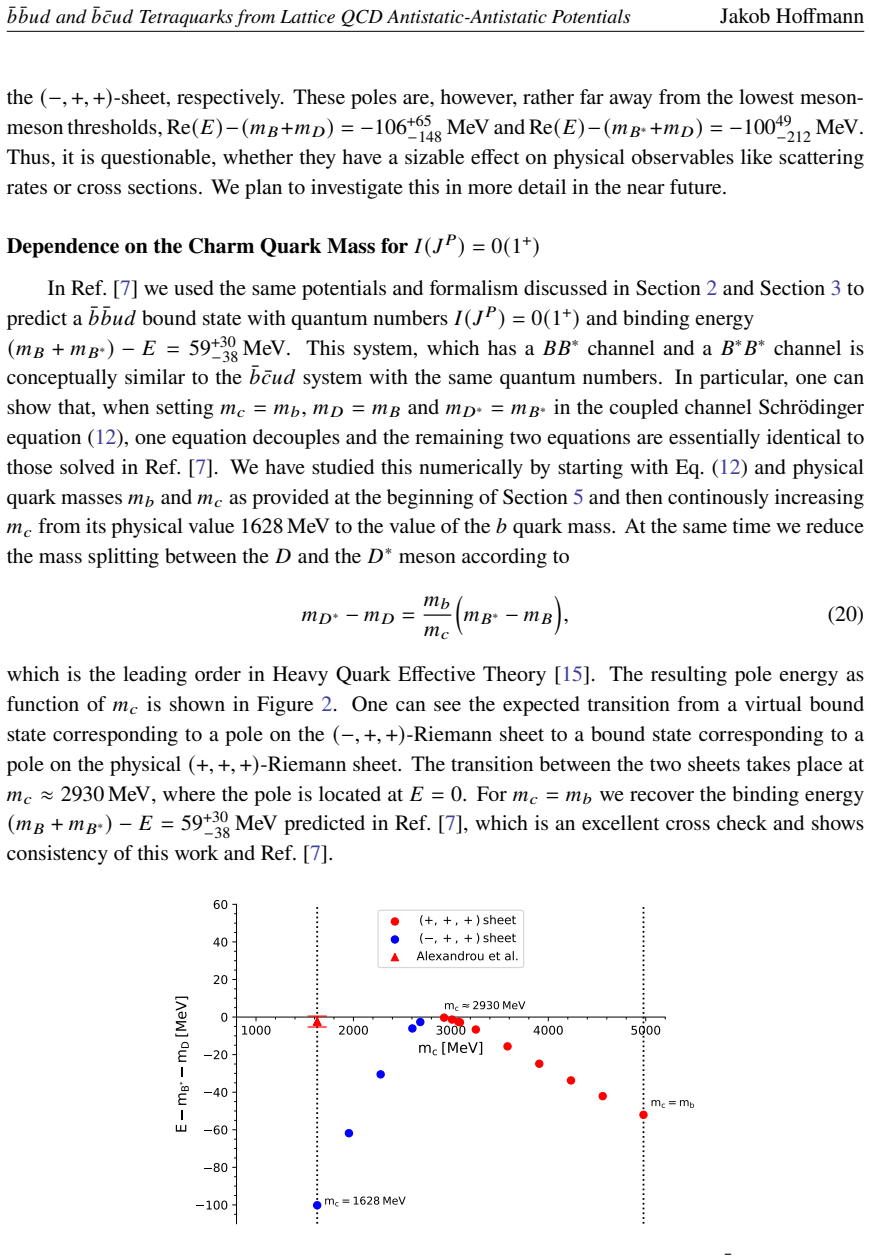
The central discovery is that the same lattice potentials that produce a resonance in $\bar{b}\bar{b}ud$ produce only virtual bound states in $\bar{b}\bar{c}ud$. In the two- and three-channel Schrödinger equations, the T-matrix poles for the $0(0^+)$ and $0(1^+)$ systems lie on the negative real axis of unphysical Riemann sheets, at $\mathrm{Re}(E)-(m_B+m_D)=-106^{+65}_{-148}$ MeV and $\mathrm{Re}(E)-(m_{B^*}+m_D)=-100^{+49}_{-212}$ MeV. The paper concludes that these are neither bound states nor resonances, and that their distance from threshold makes a sizable effect on physical observables questionable. It also shows, by dialing $m_c$ from its physical value up to $m_b$, that the $0(1^+)$ pole crosses onto the physical sheet at $m_c\approx 2930$ MeV and recovers the $\bar{b}\bar{b}ud$ bound state of [7] at $m_c=m_b$, a direct consistency check.
Load-bearing premise
Everything rests on the strength of the attractive potential between the two heavy antiquarks; the authors themselves note that it may have been underestimated, and a stronger attraction would shift their virtual states toward the shallow bound states seen in full lattice QCD.
Editorial extensions
If this is right
- For $\bar{b}\bar{b}ud$ with $I(J^P)=0(1^-)$, the paper predicts a tetraquark resonance at $2m_{B^*}+4.0^{+1.3}_{-5.4}$ MeV with width $140^{+86}_{-66}$ MeV, slightly above the $B^*B^*$ threshold.
- The resonance decays about three times more often to $B^*B^*$ than to $BB$, with branching ratios $\mathrm{BR}(BB)=26^{+9}_{-4}\%$ and $\mathrm{BR}(B^*B^*)=74^{+4}_{-9}\%$.
- For $\bar{b}\bar{c}ud$ with $I(J^P)=0(0^+)$ and $0(1^+)$, the T-matrix has virtual-state poles at $\mathrm{Re}(E)-(m_B+m_D)=-106^{+65}_{-148}$ MeV and $\mathrm{Re}(E)-(m_{B^*}+m_D)=-100^{+49}_{-212}$ MeV, so neither system is a genuine bound state or resonance.
- Dialing $m_c$ from its physical value to $m_b$ moves the $0(1^+)$ pole from the virtual sheet to the physical sheet at $m_c\approx 2930$ MeV, recovering at $m_c=m_b$ the known $\bar{b}\bar{b}ud$ bound-state binding energy.
- The paper concludes that the $\bar{b}\bar{c}ud$ virtual states may have little effect on physical scattering rates or cross sections, a question it plans to investigate further.
Reading between the lines
- Editorial inference: The virtual-state prediction makes a clear experimental prediction: there should be no narrow near-threshold peak in $\bar{b}\bar{c}ud$ scattering, so searches should also look for broad, threshold-sensitive effects.
- Editorial inference: If the potential $V_5$ is later found to be more attractive, the same Born-Oppenheimer machinery would move the $\bar{b}\bar{c}ud$ poles onto the physical sheet, reconciling this paper with the full lattice QCD bound-state results; the authors' planned recomputation is the direct test.
- Editorial inference: The $m_c$ scan suggests a general crossover pattern: systems with a heavier heavy quark tend to bind, while systems with a lighter charm quark stay virtual, so analogous $\bar{c}\bar{c}ud$ or $\bar{b}\bar{s}ud$ systems could be classified by the same criterion.
Editorial analysis
A structured set of objections, weighed in public.
Referee Report
Summary. This proceedings paper applies a Born-Oppenheimer framework to two heavy-antiquark–two-light-quark systems. Using the lattice-computed antistatic-antistatic potentials V5(r) and Vj(r), the authors study the bbar-bbar-ud system with I(J^P)=0(1^-), reproducing their earlier resonance prediction near the B*B* threshold, and extend the formalism to bbar-c-ud systems with I(J^P)=0(0^+) and I(J^P)=0(1^+). For the bbar-c-ud systems they find no genuine bound states or resonances, but rather virtual bound states on unphysical Riemann sheets, with pole positions Re(E)-(m_B+m_D) = -106(+65/-148) MeV and Re(E)-(m_B*+m_D) = -100(+49/-212) MeV. The paper also reports a consistency cross-check: increasing the charm quark mass to m_b and adjusting the D-D* splitting in the heavy-quark symmetry limit reproduces the bbar-bbar-ud bound state of Ref. [7]. The authors compare with full lattice QCD results from Refs. [9-11], which favor shallow bound states, and they concede that the V5 potential may have been underestimated.
Significance. If the virtual-state classification is robust, this is a valuable and nontrivial prediction that sharpens the contrast between the Born-Oppenheimer potential approach and full lattice QCD, and it provides a concrete target for future recomputations of the static-light potentials. The paper's strengths are that no parameter is fitted to the target tetraquark poles, the numerical implementation is cross-checked against Ref. [7] in the m_c to m_b limit, and the pole searches are carried out on all relevant Riemann sheets. The main risk, identified also by the authors, is that the central conclusion hinges on the poorly constrained attractive tail of V5(r); a modest increase of that attraction could convert the virtual poles into shallow bound states, matching recent full lattice QCD results. The paper would be significantly more convincing if it quantified this sensitivity.
major comments (4)
- [§5.2 (final paragraph)] The central claim that the bbar-c-ud systems are virtual bound states rather than genuine bound states rests on V5(r), whose parameters are alpha5=0.34±0.03 and d5=0.45(+0.12/-0.10) fm. In the final paragraph of §5.2 the authors state that 'a possible reason ... could be that the attraction of the potential V5(r) was underestimated in Refs. [1,2]'. Given the size of the quoted pole errors and the fact that a 1-sigma variation of V5 can move a pole from the (-,+) or (-,+,+) sheet onto the physical (+,+) or (+,+,+) sheet, the paper must provide a quantitative sensitivity study of the pole positions with respect to the V5 parameters. Without this, the virtual-versus-bound distinction is not yet established to the accuracy claimed.
- [§4.2] The T-matrix equations for the bbar-c-ud systems are omitted with the justification 'Because of the page limit, we refrain from providing the corresponding equations.' Since the virtual-state poles are extracted from these T matrices, the central numerical result cannot be reproduced or checked from the manuscript alone. The explicit 2x2 and 3x3 T-matrix definitions, or at least the determinant conditions whose roots are searched, should be included in an appendix or as supplementary material.
- [§3.2, Eq. (8)] The interaction Hamiltonian H_int = T V_diag T^{-1} is introduced with the phrase 'One can show' and the 16x16 matrix T is not displayed. The coupled-channel Hamiltonians in Eqs. (10) and (12)-(13) are load-bearing for the paper's conclusions, and their off-diagonal V5-Vj couplings follow from exactly this Fierz decomposition. Without providing the T matrix or a schematic derivation of its structure, a reader cannot verify the channel mixing used in the pole search. This is a derivational gap that should be filled.
- [§5.2] The quoted pole-position errors, e.g. Re(E)-(m_B+m_D) = -106(+65/-148) MeV, are not defined: it is not stated whether these errors come from the uncertainties of alpha5 and d5, from the quark masses, from the meson mass splittings, or from a combination. The errors are large on the scale of the binding energy, and a proper uncertainty propagation is essential for the virtual-state conclusion. The paper should explain how the quoted errors were obtained and, ideally, break them down by source.
minor comments (4)
- [§3.2] There is a typo in the sentence 'One has to add thethe potentials V5(r) and Vj(r)' — 'thethe' should be 'the'.
- [§5.1] The term 'Schrödiger equation' is a typo; it should be 'Schrödinger equation'.
- [Figure 2 caption] The notation for the Riemann sheets, e.g. '(+,+,+) sheet' and '(-,+,+) sheet', is used in the figure but is not explained in the caption; the reader must infer it from the text. The caption should briefly restate the convention, or refer explicitly to the definition in Section 5.1.
- [Reference [9]] The reference entry for Padmanath et al. contains a duplicated '20' in the volume/page field ('132, no. 20, 20 (2024)') and should be corrected.
Circularity Check
No significant circularity: the predicted tetraquark poles are derived from external lattice-QCD potentials and quark masses, not from quantities fitted to the target pole positions.
full rationale
The paper's derivation chain is self-contained with respect to its target results. The input potentials V5(r) and Vj(r) in Eq. (1) are taken from lattice QCD computations in Refs. [2] and [7], with parameters (alpha5, d5, alpha_j, d_j) fitted to independent lattice data. These potentials enter the coupled-channel Schrodinger equations, Eqs. (2), (10), and (12), through the interaction matrices in Eqs. (4), (8), and (13). The predicted quantities, the ar{b}ar{b}ud resonance pole and the ar{b}ar{c}ud virtual-state poles, are obtained by solving those equations and searching for T-matrix poles. No parameter in the paper is fitted to those pole positions, and the quark masses and meson mass splittings come from a quark model and the PDG, respectively, all external to the predicted poles. The cross-check in Section 5.2, recovering the Ref. [7] binding energy when m_c = m_b, is a consistency check using the same potential inputs rather than a circular re-introduction of the final claim. The paper's own caveat that V5(r) may have been underestimated in Refs. [1,2] is an acknowledged correctness risk: a changed input can change the conclusion, which is exactly what a genuine prediction should do. The heavy self-citation of Refs. [7,8] supplies method details and lattice potential data, but the cited results are independent numerical inputs with stated assumptions and not equivalent to the target virtual-state claims. The comparison with full lattice QCD results in Refs. [9-11] provides external, non-circular context. Therefore no circular step can be exhibited, and the paper earns a score of 0.
Assumptions & free parameters
free parameters (6)
- alpha5 =
0.34 +/- 0.03
- d5 =
0.45 (+0.12/-0.10) fm
- alphaj =
-0.10 +/- 0.07
- dj =
0.28 +/- 0.017 fm
- m_b =
4977 MeV
- m_c =
1628 MeV
assumptions (5)
- domain assumption Born-Oppenheimer approximation separates heavy antiquark motion from light-quark degrees of freedom, with V5 and Vj as effective potentials.
- domain assumption The same V5 and Vj potentials apply to bbar-c-ud as to bbar-bbar-ud.
- domain assumption The Gaussian parameterization V_X = -alpha_X/r exp(-(r/d_X)^2) captures the lattice potentials over the relevant r range.
- domain assumption Only two or three S-wave meson-meson channels are included in the coupled-channel equations.
- standard math Fierz identities correctly map the meson-pair basis to the static-antistatic-potential basis.
Cite this review
Pith. "Pith review of $\bar{b}\bar{b}ud$ Tetraquarks with $I(J^P)=0(1^-)$ and $\bar{b}\bar{c}ud$ Tetraquarks with $I(J^P)=0(0^+)$ and $I(J^P)=0(1^+)$ from Lattice QCD Antistatic-Antistatic Potentials." pith.science (2026). https://pith.science/paper/GCRRHEAI
@misc{pith2026250116188,
  author       = {Pith},
  title        = {Pith review of: $\barb\barbud$ Tetraquarks with $I(J^P)=0(1^-)$ and $\barb\barcud$ Tetraquarks with $I(J^P)=0(0^+)$ and $I(J^P)=0(1^+)$ from Lattice QCD Antistatic-Antistatic Potentials},
  year         = {2026},
  howpublished = {\url{https://pith.science/paper/GCRRHEAI}},
  note         = {Machine review of arXiv:2501.16188}
}
abstract
We study heavy spin effects in $\bar{b}\bar{b}ud$ and $\bar{b}\bar{c}ud$ four-quark systems using the Born-Oppenheimer approximation and existing antistatic-antistatic potentials computed with lattice QCD. We report about a recent refined investigation of the $\bar{b}\bar{b}ud$ system with $I(J^P)=0(1^-)$, where we predicted a tetraquark resonance slightly above the $B^{*}B^{*}$ threshold. Furthermore, we extend our Born-Oppenheimer approach to $\bar{b}\bar{c}ud$ four-quark systems. For quantum numbers $I(J^P)=0(0^+)$ as well as $I(J^P)=0(1^+)$ we find virtual bound states rather far away from the lowest meson-meson thresholds.
Figures

Reference graph
Works this paper leans on
- [7]
- [8]
-
[1]
Forces between static-light mesons
M. Wagner [ETM], PoS LATTICE2010, 162 (2010) doi:10.22323/1.105.0162 [arXiv:1008.1538 [hep-lat]]
work page Pith review arXiv 2010
- [2]
-
[3]
L.Mueller,P.Bicudo,M.KrsticMarinkovicandM.Wagner,PoS LATTICE2023,064(2024) doi:10.22323/1.453.0064 [arXiv:2312.17060 [hep-lat]]
arXiv 2024
-
[4]
P. Bicudo, M. Krstic Marinkovic, L. Müller and M. Wagner, [arXiv:2409.10786 [hep-lat]]
-
[5]
P. Boucaud et al. [ETM], Phys. Lett. B 650, 304-311 (2007) doi:10.1016/j.physletb.2007.04.054 [arXiv:hep-lat/0701012 [hep-lat]]
arXiv 2007
-
[6]
R.Baron et al.[ETM],JHEP 08,097(2010)doi:10.1007/JHEP08(2010)097[arXiv:0911.5061 [hep-lat]]
arXiv 2010
Show all 15 references
-
[9]
Padmanath, A
M. Padmanath, A. Radhakrishnan and N. Mathur, Phys. Rev. Lett.132, no. 20, 20 (2024) doi:10.1103/PhysRevLett.132.201902 [arXiv:2307.14128 [hep-lat]]
2024 arXiv
-
[10]
C.Alexandrou,J.Finkenrath,T.Leontiou,S.Meinel,M.PflaumerandM.Wagner,Phys.Rev. Lett. 132, no. 15, 151902 (2024) doi:10.1103/PhysRevLett.132.151902 [arXiv:2312.02925 [hep-lat]]
2024 arXiv
-
[11]
Radhakrishnan, M
A. Radhakrishnan, M. Padmanath and N. Mathur, Phys. Rev. D 110, no. 3, 3 (2024) doi:10.1103/PhysRevD.110.034506 [arXiv:2404.08109 [hep-lat]]
2024 arXiv
-
[12]
Godfrey and N
S. Godfrey and N. Isgur, Phys. Rev. D32, 189-231 (1985) doi:10.1103/PhysRevD.32.189
1985 doi
-
[13]
Navas et al
S. Navas et al. [Particle Data Group], Phys. Rev. D 110, no. 3, 030001 (2024) doi:10.1103/PhysRevD.110.030001
2024 doi
-
[14]
P.Bicudo,M.Cardoso,A.Peters,M.PflaumerandM.Wagner,Phys.Rev.D 96,no.5,054510 (2017) doi:10.1103/PhysRevD.96.054510 [arXiv:1704.02383 [hep-lat]]
2017 arXiv
-
[15]
245,259-396(1994)doi:10.1016/0370-1573(94)90091-4[arXiv:hep- ph/9306320 [hep-ph]]
M.Neubert,Phys.Rept. 245,259-396(1994)doi:10.1016/0370-1573(94)90091-4[arXiv:hep- ph/9306320 [hep-ph]]. 9
1994
Reviewed August 10, 2026 · model on record in the stance chip above.
Discussion (0). Continue with ORCID to comment.