REVIEW 2 major objections 4 minor 40 references
Correlations between nuclear incompressibility, liquid-gas critical point, and quarkyonic transition
T0 review · 2 major / 4 minor · reviewed 2026-08-10 · deepseek-v4-flash
Pith's one-line read Within the real-gas equation-of-state class, the incompressibility of nuclear matter at saturation determines the liquid-gas critical temperature and density and the density and sound-speed peak of the quarkyonic transition.
desk verdict A clean model study: the real-gas scan is new and the math is sound, but the quarkyonic anticorrelation rests on one unvaried Lambda and should be stress-tested before the abstract claims it. read the letter →
The pith
A machine-rendered reading of the paper's core claim, the machinery that carries it, and where it could break.
The reading
What carries the argument
The machinery is a family of classical real-gas equations of state—van der Waals, Redlich-Kwong-Soave, Peng-Robinson, Clausius, and a generalized Dieterici form—promoted to quantum statistics in the grand canonical ensemble. Repulsion enters as the excluded-volume factor $nT/(1-bn)$, and attraction as a density-dependent mean-field term whose form distinguishes the models. The parameters $a$ and $b$ are fixed by the nuclear ground state: saturation density $n_0=0.16$ fm$^{-3}$ and binding energy $-16$ MeV per nucleon, so the third parameter $\alpha$ or $c$ sweeps a one-parameter family in which $K_0$, $T_c$, and $n_c$ move together. For high density, a quarkyonic quasiparticle ansatz puts noninteracting quarks below momentum $k_{bu}$ and interacting nucleons in a shell above it; at each baryon density the energy density is minimized to set the quark fraction, and the speed of sound $v_s^2 = n\,\mu_B^{-1}\,d\mu_B/dn$ is computed from the resulting equation of state, with its peak defining $n_{\rm tr}$.
What would settle it
A concrete check would be to measure $K_0$ and the liquid-gas critical temperature independently: if heavy-ion multifragmentation data fixed $T_c\simeq19.7$ MeV while neutron-star tidal deformability pinned $K_0\simeq250$ MeV, the predicted monotonic $T_c(K_0)$ curve would be violated. For the quarkyonic part, a neutron-star observation that located the speed-of-sound peak at a density far from the predicted $n_{\rm tr}=A K_0^{-3/2}+B$ band, at a known $K_0$, would falsify the quasiparticle ansatz.
Extended reading notes
Core claim
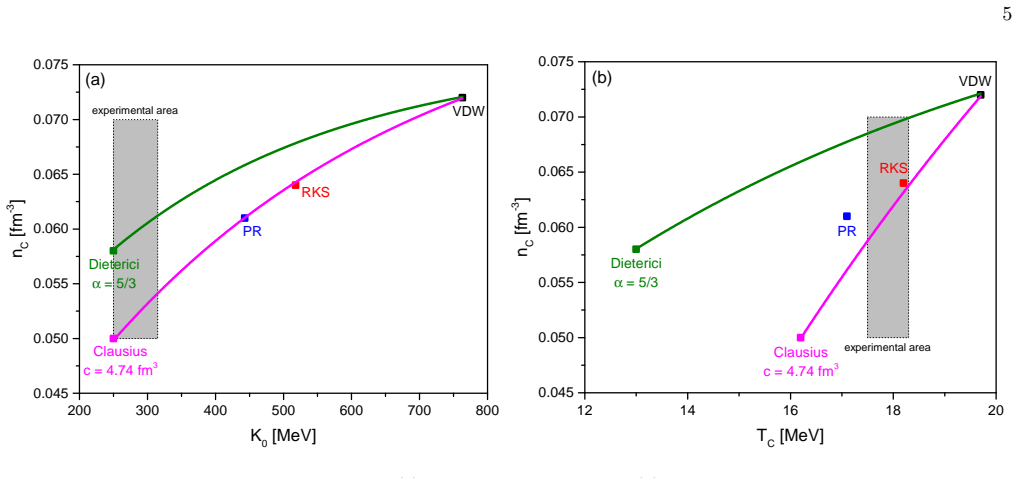
The central claim is a chain of monotonic correlations inside one model class. With the nuclear ground-state density and binding energy fixed, each real-gas equation of state has unique attraction and repulsion parameters, and varying the third parameter of the Clausius or Dieterici models interpolates smoothly to the van der Waals limit. Along this interpolation, larger incompressibility $K_0$ always brings larger critical temperature $T_c$ and critical density $n_c$, while the quarkyonic transition density $n_{\rm tr}$ and the peak speed of sound $v_{s,\max}^2$ both decrease. The quarkyonic phase is implemented as a quasiparticle mixture: quarks occupy momentum states up to $k_{bu}$, nucleons form a shell above it, and the quark fraction at each density minimizes the energy density; the transition is identified with the peak in $v_s^2$, which exceeds the conformal limit $1/3$ in every model. For the empirical band $K_0\simeq250$–$315$ MeV, the predicted transition sits near $n_{\rm tr}\approx(1.9$–$2.8)n_0$, lower for the Dieterici parametrization and higher for Clausius.
Load-bearing premise
The load-bearing premise is that quarkyonic matter at high density is accurately described by noninteracting quarks filling momentum states below a sharp Fermi momentum, with nucleons in a shell above and an infrared regulator set to $\Lambda=306$ MeV; if real high-density matter mixes quarks and nucleons differently or includes sizable quark interactions, the predicted correlations between $K_0$ and $n_{\rm tr}$, $v_{s,\max}^2$ would not follow.
Editorial extensions
If this is right
- For the empirical incompressibility band $K_0\simeq250$–$315$ MeV, the quarkyonic transition density is predicted near $n_{\rm tr}\approx(1.9$–$2.1)n_0$ in the Dieterici model and $(2.3$–$2.8)n_0$ in the Clausius model, with the speed-of-sound peak above the conformal limit and below the causality bound.
- Softer nuclear matter (smaller $K_0$) delays the appearance of quarks, produces a higher and broader peak in $v_s^2$, and shifts the liquid-gas critical point to lower $T_c$ and $n_c$.
- Because $T_c$, $n_c$, and $K_0$ are positively correlated in every model considered, a measurement of any one of them constrains the other two within this model class.
- Neither the two-parameter real-gas models nor the one-parameter Clausius and Dieterici families used here reproduce the empirical $K_0$ and $T_c$ simultaneously; the paper points to density-dependent excluded volume or mean-field attraction as the needed refinement.
- The quarkyonic transition retains its qualitative signature across all attractions: a sharp rise in $v_s^2$ above $1/3$, then a fall back below it.
Reading between the lines
- A consequence the authors leave implicit: if the correlations are generic, empirical $K_0$ from neutron-star or flow constraints immediately predicts where the liquid-gas critical point sits and where the quarkyonic transition begins, without fitting new constants.
- The pattern is driven by the simultaneous growth of attraction and repulsion under ground-state pinning; one test is to check whether relativistic mean-field families, which use different microscopic mechanisms, reproduce the same $T_c(K_0)$ and $n_{\rm tr}(K_0)$ slopes.
- A precision measurement of $K_0$ plus a determination of $n_{\rm tr}$ from neutron-star merger waveforms would directly test the quarkyonic ansatz: a mismatch with the predicted $K_0^{-3/2}$ trend would point to missing quark interactions or a different momentum-space structure.
- Extending the same real-gas attractions to asymmetric matter, as the paper proposes, would yield concrete predictions for neutron-star radii and tidal deformability that current and near-future observations can check.
Editorial analysis
A structured set of objections, weighed in public.
Referee Report
Summary. The paper constructs nuclear matter equations of state from five classical real-gas models (van der Waals, Redlich-Kwong-Soave, Peng-Robinson, Clausius, and a generalized Dieterici form), introduces Fermi statistics in the grand canonical ensemble, and fixes the attraction and excluded-volume parameters a and b to the empirical saturation density n0 and binding energy W0. The authors then compute the incompressibility K0 and the liquid-gas critical temperature and density (Tc, nc), finding monotonic correlations among these quantities. They extend the same hadronic EoS to a quasiparticle quarkyonic matter model with a sharp momentum-space separation between quarks and nucleons and an infrared regulator Lambda = 306 MeV, and define the quarkyonic transition density ntr as the density at which the speed of sound peaks. The central claim is that ntr and the peak speed of sound squared v_s,max^2 are negatively correlated with K0, nc, and Tc across this model family. Numerical results are collected in Tables I-III and Figures 1-4.
Significance. The liquid-gas part of the paper is a clean and honest phenomenological study: the GCE equations with Fermi statistics are standard, the fitting to n0 and W0 is explicit, the critical-point equations (18) are solved rather than approximated, and the tables contain all numbers needed for reproduction. This part provides a useful confirmation of earlier mean-field-based correlations among K0, Tc, and nc. The quarkyonic extension is more speculative: it relies on a particular momentum-shell ansatz and on a regulator Lambda taken from Ref. [40], so the reported anticorrelations are currently properties of one implementation rather than of the real-gas model class. If the robustness of these anticorrelations under variation of Lambda is established, the paper would offer a simple phenomenological link between nuclear saturation properties and the possible location and stiffness peak of quarkyonic matter. The authors are also transparent about the fact that none of the models simultaneously reproduces the empirical K0 and Tc values.
major comments (2)
- [Sec. IV, Eqs. (21)-(22)] The claimed anticorrelation between K0 and both ntr and v_s,max^2 is computed with a single fixed value of the infrared regulator Lambda = 306 MeV. Because Lambda enters the quark energy density and therefore controls the baryon density at which quark degrees of freedom become energetically favorable, the relative ordering of ntr across the five models is not established without a sensitivity analysis. I request a scan over a plausible range of Lambda (for example 250-400 MeV), or an argument from Ref. [40] showing that the ordering is Lambda-independent. Absent this, the abstract's strongest quantitative claim is a property of one unexamined implementation, not of the real-gas plus excluded-volume model class.
- [Sec. IV, Eqs. (19)-(26)] The text states that k_bu and k_F are determined at each density by minimizing the energy density, but the stationarity conditions are not written and the treatment of possible multiple minima is not described. Since the speed-of-sound peak that defines ntr depends on the resulting k_bu(n), and since Tables II and III report these quarkyonic quantities, providing the explicit minimization equations is necessary for independent reproduction and for assessing whether the reported correlations are robust.
minor comments (4)
- [Sec. II, Table II] The column header 'anα0' is unclear; it should be written as 'a n0^alpha (MeV fm^-3)' and the notation should be defined in the caption or text.
- [Sec. III and Sec. IV] The fitting formulas Tc = A sqrt(K0) + B and ntr = A K0^{-3/2} + B are presented with fit parameters; it would be helpful to state explicitly that these are empirical interpolations within the model family rather than derived scaling laws.
- [Sec. IV, Eqs. (21)-(22)] The phase-space measure in the quark integrals is unusual: for a noninteracting Fermi gas one would expect a factor of q^2 dq, but the displayed integrands contain q sqrt(q^2 + Lambda^2) dq and q sqrt(q^2 + (m/N_c)^2) sqrt(q^2 + Lambda^2) dq. Please clarify whether this is a known quarkyonic density of states and provide a citation for the derivation.
- [Sec. IV, Eq. (27)] The speed-of-sound formula v_s^2 = (n/mu_B) d^2 epsilon/dn^2 should be accompanied by a statement that it holds at T = 0 with mu_B = d epsilon/dn, and the evaluation of the derivative after the energy minimization should be described.
Circularity Check
No significant circularity: the model parameters are fitted only to nuclear ground-state saturation properties, and all reported correlations are derived outputs.
full rationale
The paper's derivation chain is self-contained. The interaction parameters a and b in each real-gas model are uniquely fixed by requiring the nuclear ground-state density n0 = 0.16 fm^-3 and binding energy W0 = -16 MeV (Eqs. 16-17). The incompressibility K0, critical temperature Tc, critical density nc, quarkyonic transition density ntr, and peak speed of sound v_s,max^2 are then computed from the resulting equations of state; none of these quantities is used as an input to determine any model parameter. The quarkyonic extension uses the quasiparticle momentum-shell construction from prior work, but the calculation is performed here with the infrared regulator Lambda = 306 MeV taken from the external Ref. [40], and no target value of ntr or v_s,max^2 is fitted. The self-citations to Refs. [14,15] establish the modeling framework but are not invoked as evidence for the correlations; the correlations follow from explicit minimization of the energy density (Eqs. 25-26) and the speed-of-sound formula (Eq. 27). Thus there is no step in which a claimed prediction is equivalent by construction to an input, and the observed correlations, while model-dependent, are genuine outputs of the calculation.
Assumptions & free parameters
free parameters (4)
- Attraction strength a =
vdW: 329 MeV fm^3, RKS: 374 MeV fm^3, PR: 408 MeV fm^3; Dieterici and Clausius: ranges in Tables II and III
- Excluded volume parameter b =
vdW: 3.41 fm^3, RKS: 2.94 fm^3, PR: 2.82 fm^3; Dieterici and Clausius: ranges in Tables II and III
- Dieterici exponent alpha =
scanned over [5/3, 2]
- Clausius parameter c =
scanned over [0, 4.74 fm^3]
assumptions (6)
- domain assumption Empirical nuclear ground state values n0 = 0.16 fm^-3 and W0 = -16 MeV (Eqs. 16-17)
- domain assumption Excluded volume repulsion with the van der Waals form (1 - bn) is the only repulsion mechanism (Eqs. 1-5)
- domain assumption Attraction is a mean-field term with the specific density dependence of each real gas model, transcribed to the GCE via u(n) in Eqs. (6)-(12)
- ad hoc to paper Quarkyonic matter is described by the quasiparticle picture with sharp momentum-space separation between quarks and nucleons (Sec. IV)
- domain assumption Infrared regulator Lambda = 306 MeV is fixed from Ref. [40]
- standard math Fermi statistics for nucleons and quarks are treated via ideal Fermi gas integrals, with degeneracy factors d = g = 4 and Nc = 3
Cite this review
Pith. "Pith review of Correlations between nuclear incompressibility, liquid-gas critical point, and quarkyonic transition." pith.science (2026). https://pith.science/paper/3W4DCCNH
@misc{pith2026250116225,
  author       = {Pith},
  title        = {Pith review of: Correlations between nuclear incompressibility, liquid-gas critical point, and quarkyonic transition},
  year         = {2026},
  howpublished = {\url{https://pith.science/paper/3W4DCCNH}},
  note         = {Machine review of arXiv:2501.16225}
}
abstract
We systematically probe different parametrizations of the attractive nuclear force based on real gas models to construct the nuclear matter equation of state. In each of the cases, the repulsion between nucleons is treated in the framework of excluded volume, and interaction parameters are fitted to the empirical properties of the nuclear ground state. We calculate the critical temperature $T_c$ and critical particle number density $n_c$, and find that they are strongly correlated. Both are also correlated with the incompressibility $K_0$ in the nuclear ground state. We also include a quarkyonic matter phase in the quasiparticle description and investigate the relationships among $K_0$, transition density to the quarkyonic phase, $n_{tr}$, and corresponding peak in the speed of sound, $v_{s, {\rm max}}^2$. At each density, the quark fraction is found by minimizing the energy density. We find that both $n_{tr}$ and $v_{s, {\rm max}}^2$ are negatively correlated with $K_0$, $n_c$, and $T_c$.
Figures


Figures from the paper (1 more)

Reference graph
Works this paper leans on
-
[40]
P. T. H. Pang, L. Sivertsen, R. Somasundaram, T. Di- etrich, S. Sen, I. Tews, M. W. Coughlin, and C. Van Den Broeck, Phys. Rev. C 109, 025807 (2024), arXiv:2308.15067 [nucl-th]
arXiv 2024
-
[1]
J. W. Negele and D. Vautherin, Nucl. Phys. A 207, 298 (1973)
1973
-
[2]
B. D. Serot and J. D. Walecka, Adv. Nucl. Phys. 16, 1 (1986)
1986
-
[3]
L. McLerran and R. D. Pisarski, Nucl. Phys. A 796, 83 (2007), arXiv:0706.2191 [hep-ph]
arXiv 2007
-
[4]
L. McLerran and S. Reddy, Phys. Rev. Lett. 122, 122701 (2019), arXiv:1811.12503 [nucl-th]
arXiv 2019
-
[5]
O. Philipsen and J. Scheunert, JHEP 11, 022 (2019), arXiv:1908.03136 [hep-lat]
arXiv 2019
-
[6]
N. Kovensky and A. Schmitt, JHEP 09, 112 (2020), arXiv:2006.13739 [hep-th]
arXiv 2020
-
[7]
L. D. Landau and E. M. Lifshitz, Statistical Physics, Part 1, Course of Theoretical Physics, Vol. 5 (Butterworth- Heinemann, Oxford, 1980)
work page 1980
Show all 40 references
-
[8]
Vovchenko, D
V. Vovchenko, D. V. Anchishkin, and M. I. Gorenstein, Phys. Rev. C 91, 064314 (2015), arXiv:1504.01363 [nucl- th]
2015 arXiv
- [9]
-
[10]
v. C. Dieterici, Annalen der Physik 305, 685 (1899)
-
[11]
Drischler, J
C. Drischler, J. W. Holt, and C. Wellenhofer, Ann. Rev. Nucl. Part. Sci. 71, 403 (2021), arXiv:2101.01709 [nucl- th]
2021 arXiv
-
[12]
Vovchenko, M
V. Vovchenko, M. I. Gorenstein, and H. Stoecker, Phys. Rev. Lett. 118, 182301 (2017), arXiv:1609.03975 [hep- ph]
2017 arXiv
-
[13]
Vovchenko, A
V. Vovchenko, A. Motornenko, P. Alba, M. I. Gorenstein, L. M. Satarov, and H. Stoecker, Phys. Rev. C 96, 045202 (2017), arXiv:1707.09215 [nucl-th]
2017 arXiv
-
[14]
R. V. Poberezhnyuk, H. Stoecker, and V. Vovchenko, Phys. Rev. C 108, 045202 (2023), arXiv:2307.13532 [nucl-th]
2023 arXiv
-
[15]
T. Moss, R. Poberezhniuk, and V. Vovchenko, (2024), arXiv:2411.11996 [nucl-th]
2024 arXiv
-
[16]
J. I. Kapusta, Phys. Rev. C 29, 1735 (1984)
1984
-
[17]
J. M. Lattimer and F. D. Swesty, Nucl. Phys. A 535, 331 (1991)
1991
-
[18]
J. B. Natowitz, K. Hagel, Y. Ma, M. Murray, L. Qin, R. Wada, and J. Wang, Phys. Rev. Lett. 89, 212701 (2002), arXiv:nucl-ex/0204015
2002 arXiv
- [19]
-
[20]
Louren¸ co, B
O. Louren¸ co, B. M. Santos, M. Dutra, and A. Delfino, Phys. Rev. C 94, 045207 (2016), arXiv:1610.01974 [nucl- th]
2016 arXiv
-
[21]
K. S. Jeong, L. McLerran, and S. Sen, Phys. Rev. C 101, 035201 (2020), arXiv:1908.04799 [nucl-th]
2020 arXiv
-
[22]
I. Tews, J. Carlson, S. Gandolfi, and S. Reddy, Astro- phys. J. 860, 149 (2018), arXiv:1801.01923 [nucl-th]
2018 arXiv
-
[23]
Fujimoto, K
Y. Fujimoto, K. Fukushima, and K. Murase, Phys. Rev. D 101, 054016 (2020), arXiv:1903.03400 [nucl-th]
2020 arXiv
-
[24]
H. Tan, J. Noronha-Hostler, and N. Yunes, Phys. Rev. Lett. 125, 261104 (2020), arXiv:2006.16296 [astro- ph.HE]
2020 arXiv
-
[25]
Altiparmak, C
S. Altiparmak, C. Ecker, and L. Rezzolla, Astrophys. J. Lett. 939, L34 (2022), arXiv:2203.14974 [astro-ph.HE]
2022 arXiv
-
[26]
R. J. Sadus, The Journal of Chemical Physics 115, 1460 (2001), https://pubs.aip.org/aip/jcp/article- pdf/115/3/1460/19184473/1460 1 online.pdf
2001
-
[27]
Vovchenko, A
V. Vovchenko, A. Motornenko, M. I. Gorenstein, and H. Stoecker, Phys. Rev. C 97, 035202 (2018), arXiv:1710.00693 [nucl-th]
2018 arXiv
-
[28]
R. B. Wiringa, V. G. J. Stoks, and R. Schiavilla, Phys. 9 Rev. C 51, 38 (1995), arXiv:nucl-th/9408016
1995 arXiv
-
[29]
C. J. Horowitz and A. Schwenk, Phys. Lett. B 638, 153 (2006), arXiv:nucl-th/0507064
2006 arXiv
-
[30]
H. A. Bethe, Annual Review of Nuclear and Particle Sci- ence 21, 93 (1971)
1971
-
[31]
J. R. Stone, N. J. Stone, and S. A. Moszkowski, Phys. Rev. C 89, 044316 (2014), arXiv:1404.0744 [nucl-th]
2014 arXiv
-
[32]
J. B. Elliott, P. T. Lake, L. G. Moretto, and L. Phair, Phys. Rev. C 87, 054622 (2013)
2013
-
[33]
Y. Wang, C. Guo, Q. Li, A. Le F` evre, Y. Leifels, and W. Trautmann, Phys. Lett. B 778, 207 (2018), arXiv:1804.04293 [nucl-th]
2018 arXiv
-
[34]
S. Huth, C. Wellenhofer, and A. Schwenk, Phys. Rev. C 103, 025803 (2021), arXiv:2009.08885 [nucl-th]
2021 arXiv
-
[35]
Sorensen et al., Prog
A. Sorensen et al., Prog. Part. Nucl. Phys. 134, 104080 (2024), arXiv:2301.13253 [nucl-th]
2024 arXiv
-
[36]
Louren¸ co, M
O. Louren¸ co, M. Dutra, C. H. Lenzi, M. Bhuyan, S. K. Biswal, and B. M. Santos, Astrophys. J. 882, 67 (2019), arXiv:1908.05114 [nucl-th]
2019 arXiv
-
[37]
R. V. Poberezhnyuk, V. Vovchenko, D. V. Anchishkin, and M. I. Gorenstein, Int. J. Mod. Phys. E 26, 1750061 (2017), arXiv:1708.05605 [nucl-th]
2017 arXiv
-
[38]
B. M. Santos, M. Dutra, O. Louren¸ co, and A. Delfino, Phys. Rev. C 90, 035203 (2014), arXiv:1409.4986 [nucl- th]
2014 arXiv
-
[39]
B. M. Santos, M. Dutra, O. Louren¸ co, and A. Delfino, Phys. Rev. C 92, 015210 (2015), arXiv:1507.05856 [nucl- th]
2015 arXiv
Reviewed August 10, 2026 · model on record in the stance chip above.
Discussion (0). Continue with ORCID to comment.