REVIEW 3 major objections 4 minor 1 cited by
Dynamic Neutrino Mass Ordering and Its Imprint on the Diffuse Supernova Neutrino Background
T0 review · 3 major / 4 minor · reviewed 2026-08-10 · deepseek-v4-flash
Pith's one-line read This paper argues that a redshift-dependent neutrino mass spectrum would imprint an energy-dependent distortion on the diffuse supernova neutrino background.
desk verdict A transparent toy-model extension of de Gouvêa et al. that generalizes to per-eigenstate mass evolution and can scramble the ordering, but the quantitative DSNB distortion relies on an unstated energy dependence in Pee. read the letter →
The pith
A machine-rendered reading of the paper's core claim, the machinery that carries it, and where it could break.
The reading
What carries the argument
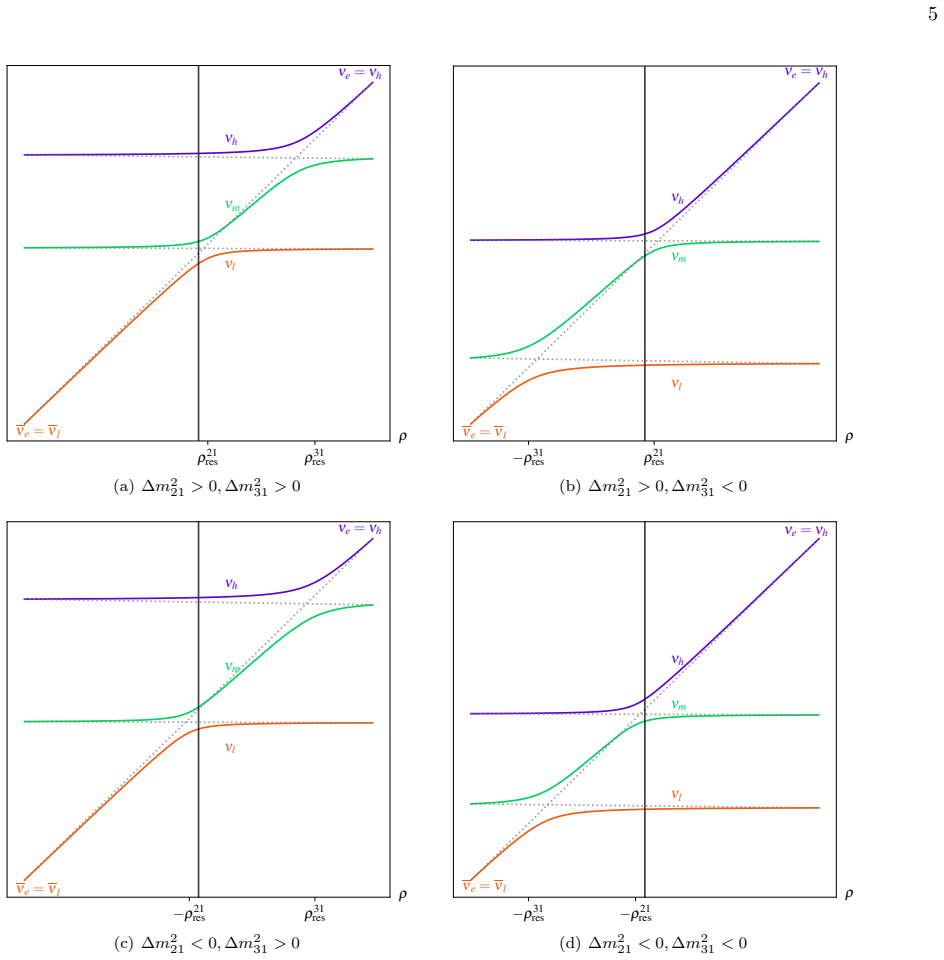
The central object is the electron-neutrino survival probability $P_{ee}(z)$ inside a supernova, set by the redshift-dependent mass-squared differences $\Delta m^2_{21}(z)$ and $\Delta m^2_{31}(z)$. The sign of each $\Delta m^2$ decides whether the MSW (Mikheyev-Smirnov-Wolfenstein) resonance occurs for neutrinos or antineutrinos, and its magnitude decides whether the crossing is adiabatic; both effects control which mass eigenstate leaves the star and hence the flux at Earth. The paper evaluates $P_{ee}$ by numerically solving the Schr\"odinger equation for neutrino propagation through a presupernova density profile at each redshift, then lets the masses evolve on the way to Earth. The parameterization $m_i(z)=m_i^\infty + (m_i^0 - m_i^\infty)/(1+(z/z_i)^{B_i})$ supplies the toy model for the redshift dependence.
What would settle it
Compute $P_{ee}(E,z)$ from the paper's three-flavor Schr\"odinger evolution at neutrino energies of 5, 10, and 25 MeV for a fixed redshift where a mass splitting changes sign, such as $z\simeq0.075$ in the normal-ordering benchmark; if the three values differ by more than a few percent, the $P_{ee}(z)$ simplification collapses and the predicted energy-dependent DSNB distortion would change shape.
Extended reading notes
Core claim
The central claim is that a redshift-dependent neutrino mass spectrum modifies the DSNB electron-neutrino flux not as a constant rescaling but through an energy-dependent change in shape. In their benchmark, at low energies ($E_\nu \lesssim 10$ MeV) the flux approaches the decoherence limit $\sum_i |U_{ei}|^4 \simeq 0.547$ times the unoscillated flux, because high-redshift neutrinos were nearly massless; at higher energies, where nearby supernovae dominate, the altered $P_{ee}$ changes the mixture of original $\nu_e$ and $\nu_x$ fluxes. The same physics produces a differently shaped modification depending on whether the ordering today is normal or inverted. The paper's conclusion is that such an energy-dependent feature is in principle separable from astrophysical uncertainties, but out of reach until those uncertainties are controlled.
Load-bearing premise
The argument assumes that at each redshift the electron-neutrino survival probability $P_{ee}$ depends only on that redshift, not on neutrino energy, even though the resonance density and adiabaticity condition in Eq. (5) both depend on $E_\nu$.
Editorial extensions
If this is right
- If a future DSNB measurement achieves sufficient spectral precision, the predicted energy-dependent shape could reveal that the neutrino mass ordering was different in the past, including sign changes in $\Delta m^2_{21}$ and $\Delta m^2_{31}$.
- Cosmological surveys that measure only the total neutrino mass density are not sensitive to this effect, so the DSNB would provide a complementary and direct probe of dynamic neutrino masses.
- The modification is not a pure normalization shift, so it is in principle distinguishable from astrophysical uncertainties that rescale the overall flux; reducing supernova-rate uncertainties is the key step.
- The paper finds that present and near-future experiments cannot reach the predicted signal, placing the observable in the regime of future DSNB searches.
- The same $P_{ee}(z)$ machinery could in principle be applied to other redshift-integrated neutrino sources, although the paper focuses on core-collapse supernovae.
Reading between the lines
- Beyond the paper, a future DSNB spectrum with fine energy resolution could be used to discriminate a dynamic mass ordering from other new-physics distortions, such as neutrino decay or sterile-neutrino mixing, which also alter the DSNB energy shape.
- A testable extension is to embed the toy $m_i(z)$ parameterization in a specific particle model, such as ultralight dark matter or a dark sector phase transition, and compute the model's predicted $P_{ee}(E,z)$ including energy-dependent adiabaticity; this would convert the demonstration into a quantitative prediction.
- The paper's energy-independent $P_{ee}(z)$ assumption is worth checking directly: solving the same Schr\"odinger equation at several neutrino energies for a fixed redshift where a mass splitting changes sign would show whether the sharp $P_{ee}$ steps are smoothed by partial adiabaticity.
Editorial analysis
A structured set of objections, weighed in public.
Referee Report
Summary. The paper proposes that neutrino masses may have evolved with redshift and studies the imprint of such a dynamical mass spectrum on the diffuse supernova neutrino background (DSNB). After giving the standard DSNB flux formulae, the authors introduce a toy parametrization in which each mass eigenstate transitions from its present-day value to a high-redshift value at a redshift z_i with width B_i. They compute electron-neutrino survival probabilities inside supernovae, both adiabatically and via numerical solution of the Schr\"odinger equation, and then evaluate the DSNB electron-neutrino flux for benchmark normal-ordering and inverted-ordering cases. They find energy-dependent modifications of the DSNB spectrum and argue that these modifications are distinguishable from astrophysical uncertainties, while also acknowledging that current experimental and astrophysical uncertainties prevent a definitive detection.
Significance. If established, the idea is timely and interesting: the DSNB could serve as a complementary probe of redshift-dependent neutrino properties, and the claim of a non-normalization energy-dependent signature is a concrete, falsifiable prediction. The paper is honest in presenting a toy model with hand-picked benchmark parameters and does not overclaim a connection to a specific fundamental theory. It also correctly emphasizes that cosmological mass-sum bounds are insensitive to the dynamical history envisaged here. However, the central quantitative claim rests on an energy-averaged or energy-independent survival probability in Eq. (3), and the paper does not yet demonstrate the energy dependence claimed in the abstract and conclusion. The qualitative idea is credible, but the quantitative shape of the predicted distortion is not established as written.
major comments (3)
- [Eq. (3) and Sec. III] The DSNB flux in Eq. (3) uses a survival probability Pee(z) that depends only on redshift, while the MSW resonance density in Eq. (5) and the adiabaticity of the resonance both depend on neutrino energy. For a supernova at redshift z contributing to the observed energy E, the emitted neutrino energy is E(1+z), so the relevant probability is Pee(E(1+z), z). The manuscript does not state that Pee is energy-independent, nor does it show that the numerical Schr\"odinger-equation solutions reported in Sec. III are averaged over energy or evaluated at a representative energy. Without this information, the sharp Pee(z) steps in Fig. 2 and the resulting flux ratios in Fig. 3 are not quantitatively justified.
- [Eq. (3b) and Eq. (3c)] The antineutrino flux in Eq. (3b) is written with the same Pee(z) as the neutrino flux, but Fig. 2 shows that the antineutrino survival probability differs from the neutrino one. The text elsewhere correctly distinguishes Pee and P_ee (e.g., Eq. (7)), so Eq. (3b) should use P_ee(z), and Eq. (3c) should contain the combination Pee(z)+P_ee(z) rather than Pee(z)+Pee(z). As written, the formalism is internally inconsistent and the numerical results cannot be reproduced.
- [Sec. IV, Fig. 3] The claim that the predicted features are distinguishable from astrophysical uncertainties is supported only by varying the CCSN rate within one orange band. Supernova neutrino spectral uncertainties, black-hole-failed-supernova fractions, and star-formation-rate uncertainties are not propagated. The authors themselves state in Sec. V that current spectral-shape uncertainty makes direct detection beyond reach, which weakens the abstract's statement that the features are distinguishable from significant astrophysical uncertainties. The paper should either soften that claim or present a quantitative comparison against the full set of state-of-the-art DSNB uncertainties.
minor comments (4)
- [Abstract] The summary abstract and the abstract printed at the beginning of the full text differ in the final claim: one says current spectral-shape uncertainty makes detection beyond reach, while the other says the features are distinguishable from astrophysical uncertainties. The authors should harmonize these statements in the published version.
- [Sec. III] The numerical calculation is described only as solving Schr\"odinger-like equations; the initial conditions, the specific supernova density profile used from Ref. [56], and the energy grid or averaging procedure are not specified. Providing these details would also help address the major concern about the energy dependence of Pee.
- [Sec. II, Eq. (1)] The Hubble parameter H(z) is used without specifying the assumed cosmology; a short statement of the cosmological parameters used for the DSNB integration would improve reproducibility.
- [Sec. V] The text contains a stray paragraph break after 'However,' and uses 'alluring' where 'alluding' is intended. These should be corrected in proof.
Circularity Check
No circularity: the DSNB flux changes are direct consequences of the adopted toy mass model, not fitted outputs or self-referential derivations.
full rationale
The paper's derivation chain is self-contained and non-circular. Equation (4) defines a toy redshift-dependent mass ansatz, Table I fixes benchmark parameters by hand, and Eqs. (6)-(8) together with the numerical Schrödinger-equation evolution produce the survival probabilities Pee(z) shown in Fig. 2. These probabilities are then inserted into the standard DSNB integral, Eq. (3), to obtain the fluxes in Fig. 3. No parameter is fitted to DSNB data and no predicted quantity is identical by construction to an input; the energy-dependent modification of the flux follows from convolving the assumed Pee(z) with the redshift-dependent neutrino spectra, which is a genuine consequence of the model rather than a restatement of the premise. The self-citation [42] is used to motivate the idea that a common-redshift mass variation can affect the DSNB and to explain why the antineutrino flux changes little, but the present paper performs its own numerical calculation of Pee(z), so the central result does not reduce to the cited work. The possible energy dependence of Pee(E,z), noted in the reader's take, is a physical modeling caveat (the MSW resonance density in Eq. (5) depends on neutrino energy), but it is not a circularity: it concerns whether the presented Pee(z) is a complete solution, not whether the output was assumed as an input. Overall, no load-bearing step is equivalent to its inputs, and no fitted quantity is relabeled as a prediction.
Assumptions & free parameters
free parameters (4)
- Lightest neutrino mass today m0 =
0.01 eV (assumed)
- Transition redshifts z_i per eigenstate =
NO: z1=0.50, z2=0.125, z3=0.05; IO: z1=0.125, z2=0.125, z3=0.50
- Transition widths B_i per eigenstate =
NO: B1=9, B2=6, B3=3; IO: B1=6, B2=3, B3=9
- High-redshift masses m_infinity_i =
not stated; effectively 0
assumptions (8)
- standard math Schrodinger equation governs neutrino flavor evolution in matter and vacuum.
- domain assumption MSW resonance condition of Eq. (5) applies at all redshifts.
- domain assumption Level-crossing diagrams with adiabatic or fully non-adiabatic transitions determine Pee.
- domain assumption Collective oscillations of neutrinos deep inside the supernova are negligible.
- ad hoc to paper Neutrino masses evolve as Eq. (4) with independent z_i and B_i per eigenstate.
- ad hoc to paper High-redshift masses m_infinity_i equal zero.
- domain assumption Uncertainty in the DSNB flux is dominated by the CCSN rate; other spectral uncertainties are ignored.
- domain assumption Survival probability Pee depends only on redshift, not on neutrino energy.
Cite this review
Pith. "Pith review of Dynamic Neutrino Mass Ordering and Its Imprint on the Diffuse Supernova Neutrino Background." pith.science (2026). https://pith.science/paper/WWMGZWVT
@misc{pith2026250116412,
  author       = {Pith},
  title        = {Pith review of: Dynamic Neutrino Mass Ordering and Its Imprint on the Diffuse Supernova Neutrino Background},
  year         = {2026},
  howpublished = {\url{https://pith.science/paper/WWMGZWVT}},
  note         = {Machine review of arXiv:2501.16412}
}
read the original abstract
Neutrino masses may have evolved dynamically throughout the history of the Universe, potentially leading to a mass spectrum distinct from the normal or inverted ordering observed today. While cosmological measurements constrain the total energy density of neutrinos, they are not directly sensitive to a dynamically changing mass ordering unless future surveys achieve exceptional precision in detecting the distinct imprints of each mass eigenstate on large-scale structures. In this work, we investigate the impact of a dynamic neutrino mass spectrum on the diffuse supernova neutrino background (DSNB), which is composed of neutrinos from all supernova explosions throughout cosmic history and is on the verge of experimental detection. The dynamic evolution of neutrino masses with redshift changes the propagation of neutrinos inside the supernova. Since neutrino oscillations are highly sensitive to the mass spectrum, we show that the electron neutrino survival probability carries distinct signatures of the evolving neutrino mass spectrum. Our results show that a dynamic neutrino mass spectrum can modify the DSNB flux in an energy-dependent way. However, we find that the current level of spectral shape uncertainty in DSNB modeling makes a direct detection beyond the reach of present and near-future experiments. Nonetheless, our study highlights the DSNB as a probe of redshift-dependent neutrino properties once the astrophysical systematics are brought under control.
Figures


Forward citations
Cited by 1 Pith paper
-
Probing long-range $L_e-L_\mu$ forces with supernova neutronization burst neutrinos
DUNE can use a nearby supernova neutronization burst to constrain ultralight Le−Lμ gauge forces via distortions of the electron-neutrino survival probability.
Reference graph
Works this paper leans on
-
[42]
A. de Gouvˆ ea, I. Martinez-Soler, Y. F. Perez-Gonzalez, and M. Sen, Phys. Rev. D 106, 103026 (2022), arXiv:2205.01102 [hep-ph]
arXiv 2022
-
[1]
Navas et al
S. Navas et al. (Particle Data Group), Phys. Rev. D 110, 030001 (2024)
2024
- [2]
-
[3]
N. Aghanim et al. (Planck), Astron. Astrophys. 641, A6 (2020), [Erratum: Astron.Astrophys. 652, C4 (2021)], arXiv:1807.06209 [astro-ph.CO]
arXiv 2020
-
[4]
A. G. Adame et al. (DESI), (2024), arXiv:2404.03002 [astro-ph.CO]
arXiv 2024
- [5]
- [6]
-
[7]
D. Naredo-Tuero, M. Escudero, E. Fern´ andez-Mart ´ ınez, X. Marcano, and V. Poulin, Phys. Rev. D 110, 123537 (2024), arXiv:2407.13831 [astro-ph.CO]
arXiv 2024
Show all 57 references
-
[8]
D. Wang, O. Mena, E. Di Valentino, and S. Gariazzo, Phys. Rev. D 110, 103536 (2024), arXiv:2405.03368 [astro-ph.CO]
2024 arXiv
-
[9]
Minkowski, Phys
P. Minkowski, Phys. Lett. B 67, 421 (1977)
1977
-
[10]
Gell-Mann, P
M. Gell-Mann, P. Ramond, and R. Slansky, Conf. Proc. C 790927, 315 (1979), arXiv:1306.4669 [hep-th]
1979 arXiv
-
[11]
Yanagida, Conf
T. Yanagida, Conf. Proc. C 7902131, 95 (1979)
1979
-
[12]
R. N. Mohapatra and G. Senjanovic, Phys. Rev. Lett. 44, 912 (1980)
1980
-
[13]
R. N. Mohapatra and G. Senjanovic, Phys. Rev. D 23, 165 (1981)
1981
-
[14]
Schechter and J
J. Schechter and J. W. F. Valle, Phys. Rev. D 22, 2227 (1980)
1980
-
[15]
S. F. King and C. Luhn, Rept. Prog. Phys. 76, 056201 (2013), arXiv:1301.1340 [hep-ph]
2013 arXiv
-
[16]
Fardon, A
R. Fardon, A. E. Nelson, and N. Weiner, JCAP 10, 005 (2004), arXiv:astro-ph/0309800
2004 arXiv
-
[17]
S. M. Koksbang and S. Hannestad, JCAP 09, 014 (2017), arXiv:1707.02579 [astro-ph.CO]
2017 arXiv
-
[18]
Dvali and L
G. Dvali and L. Funcke, Phys. Rev. D 93, 113002 (2016), arXiv:1602.03191 [hep-ph]
2016 arXiv
-
[19]
C. S. Lorenz, L. Funcke, E. Calabrese, and S. Hannestad, Phys. Rev. D 99, 023501 (2019), arXiv:1811.01991 [astro-ph.CO]
2019 arXiv
-
[20]
C. S. Lorenz, L. Funcke, M. L¨ offler, and E. Calabrese, Phys. Rev. D 104, 123518 (2021), arXiv:2102.13618 [astro-ph.CO]
2021 arXiv
- [21]
-
[22]
Krnjaic, P
G. Krnjaic, P. A. N. Machado, and L. Necib, Phys. Rev. D 97, 075017 (2018), arXiv:1705.06740 [hep-ph]
2018 arXiv
-
[23]
Brdar, J
V. Brdar, J. Kopp, J. Liu, P. Prass, and X.-P. Wang, Phys. Rev. D 97, 043001 (2018), arXiv:1705.09455 [hep-ph]
2018 arXiv
-
[24]
Capozzi, I
F. Capozzi, I. M. Shoemaker, and L. Vecchi, JCAP 07, 004 (2018), arXiv:1804.05117 [hep-ph]
2018 arXiv
-
[25]
K.-Y. Choi, E. J. Chun, and J. Kim, Phys. Dark Univ. 30, 100606 (2020), arXiv:1909.10478 [hep-ph]
2020 arXiv
-
[26]
A. Dev, P. A. N. Machado, and P. Mart ´ ınez-Mirav´ e, JHEP01, 094 (2021), arXiv:2007.03590 [hep-ph]
2021 arXiv
-
[27]
K.-Y. Choi, E. J. Chun, and J. Kim, (2020), arXiv:2012.09474 [hep-ph]
2020 arXiv
-
[28]
S.-F. Ge, J. Phys. Conf. Ser. 1468, 012125 (2020)
2020
-
[29]
Losada, Y
M. Losada, Y. Nir, G. Perez, and Y. Shpilman, JHEP 04, 030 (2022), arXiv:2107.10865 [hep-ph]
2022 arXiv
- [30]
-
[31]
E. J. Chun, (2021), arXiv:2112.05057 [hep-ph]
2021 arXiv
-
[32]
A. Dev, G. Krnjaic, P. Machado, and H. Ramani, Phys. Rev. D 107, 035006 (2023), arXiv:2205.06821 [hep-ph]
2023 arXiv
-
[33]
Huang, M
G.-y. Huang, M. Lindner, P. Mart ´ ınez-Mirav´ e, and M. Sen, Phys. Rev. D106, 033004 (2022), arXiv:2205.08431 [hep-ph]
2022 arXiv
- [34]
-
[35]
Losada, Y
M. Losada, Y. Nir, G. Perez, I. Savoray, and Y. Shpilman, (2023), arXiv:2302.00005 [hep-ph]
2023 arXiv
- [36]
- [37]
-
[38]
Mart ´ ınez-Mirav´ e, Y
P. Mart ´ ınez-Mirav´ e, Y. F. Perez-Gonzalez, and M. Sen, Phys. Rev. D110, 055005 (2024), arXiv:2406.01682 [hep-ph]
2024 arXiv
-
[39]
Lesgourgues and S
J. Lesgourgues and S. Pastor, Adv. High Energy Phys. 2012, 608515 (2012), arXiv:1212.6154 [hep-ph]
2012 arXiv
-
[40]
Lunardini, Astropart
C. Lunardini, Astropart. Phys. 26, 190 (2006), arXiv:astro-ph/0509233
2006 arXiv
-
[41]
J. F. Beacom, Ann. Rev. Nucl. Part. Sci. 60, 439 (2010), arXiv:1004.3311 [astro-ph.HE]
2010 arXiv
-
[43]
Review of diffuse sn neutrino background,
M. Harada, “Review of diffuse sn neutrino background,” (2024)
2024
-
[44]
De Gouvˆ ea, I
A. De Gouvˆ ea, I. Martinez-Soler, Y. F. Perez-Gonzalez, and M. Sen, Phys. Rev. D 102, 123012 (2020), arXiv:2007.13748 [hep-ph]
2020 arXiv
- [45]
-
[46]
Akita, S
K. Akita, S. H. Im, and M. Masud, JHEP 12, 050 (2022), arXiv:2206.06852 [hep-ph]
2022 arXiv
-
[47]
A. Das, T. Herbermann, M. Sen, and V. Takhistov, JCAP 07, 045 (2024), arXiv:2403.15367 [hep-ph]
2024 arXiv
-
[48]
Ivanez-Ballesteros and M
P. Ivanez-Ballesteros and M. C. Volpe, Phys. Rev. D 107, 023017 (2023), arXiv:2209.12465 [hep-ph]
2023
-
[49]
MacDonald, P
M. MacDonald, P. Mart ´ ınez-Mirav´ e, and I. Tamborra, JCAP01, 062 (2025), arXiv:2409.16367 [astro-ph.HE]
2025 arXiv
-
[50]
I. R. Wang, X.-J. Xu, and B. Zhou, (2025), arXiv:2501.07624 [hep-ph]
2025
-
[51]
A. M. Hopkins and J. F. Beacom, Astrophys. J. 651, 142 (2006), arXiv:astro-ph/0601463 [astro-ph]
2006 arXiv
-
[52]
Yuksel, M
H. Yuksel, M. D. Kistler, J. F. Beacom, and A. M. Hopkins, Astrophys. J. 683, L5 (2008), arXiv:0804.4008 [astro-ph]
2008 arXiv
-
[53]
Horiuchi, J
S. Horiuchi, J. F. Beacom, and E. Dwek, Phys. Rev. D79, 083013 (2009), arXiv:0812.3157 [astro-ph]
2009 arXiv
-
[54]
Kresse, T
D. Kresse, T. Ertl, and H.-T. Janka, Astrophys. J. 909, 169 (2021), arXiv:2010.04728 [astro-ph.HE]
2021 arXiv
-
[55]
Møller, A
K. Møller, A. M. Suliga, I. Tamborra, and P. B. Denton, JCAP 1805, 066 (2018), arXiv:1804.03157 [astro-ph.HE]
2018 arXiv
-
[56]
Results from an extended set of 1d core-collapse simulations for a variety of progenitors canbe found at,
“Results from an extended set of 1d core-collapse simulations for a variety of progenitors canbe found at,”https://wwwmpa. mpa-garching.mpg.de/ccsnarchive/, Accessed: 2010-09-30
2010
-
[57]
A. S. Dighe and A. Yu. Smirnov, Phys. Rev. D62, 033007 (2000), arXiv:hep-ph/9907423 [hep-ph]
2000 arXiv
Reviewed August 10, 2026 · model on record in the stance chip above.
Discussion (0). Continue with ORCID to comment.