REVIEW 4 major objections 4 minor 49 references
Simulating methylamine using symmetry adapted qubit-excitation-based variational quantum eigensolver
T0 review · 4 major / 4 minor · reviewed 2026-08-10 · deepseek-v4-flash
Pith's one-line read Combining symmetry filtering with qubit-excitation circuits cuts the two-qubit gate budget for a methylamine VQE from roughly 600,000 to about 12,000 on 26 qubits.
desk verdict Useful resource data and an honest negative result, but the headline number is the wrong column of Table II and the full 26-qubit claim is an extrapolation, not a demonstrated simulation. read the letter →
The pith
A machine-rendered reading of the paper's core claim, the machinery that carries it, and where it could break.
The reading
What carries the argument
The carrying object is the qubit-excitation circuit, a compact implementation of an excitation operator that uses a fixed, small number of CNOT gates by omitting the Pauli-Z strings that enforce fermionic anticommutation, combined with irreducible-representation filtering, which discards every excitation whose symmetry label differs from the Hartree-Fock state. Qubit tapering then removes qubits acting as conserved Z2 symmetries, and active-space truncation reduces the orbital count. The large-molecule estimates all flow through Eqs. (10)-(11), which multiply the numbers of single and double excitations by per-excitation gate-count coefficients supplied by the authors' in-house quantum chemistry library.
What would settle it
Recompile the UCCSDQs ansatz for full-active-space methylamine with any publicly available optimal qubit-excitation circuit decomposition and count the CNOTs; if the count is far from the paper's 4,130 or 12,000 figure, the reduction claim needs revision. Independently, run a noiseless VQE with UCCSDQs on the full methylamine active space and check whether the converged energy lands within 1.6 mHartree of the FCI energy.
Extended reading notes
Core claim
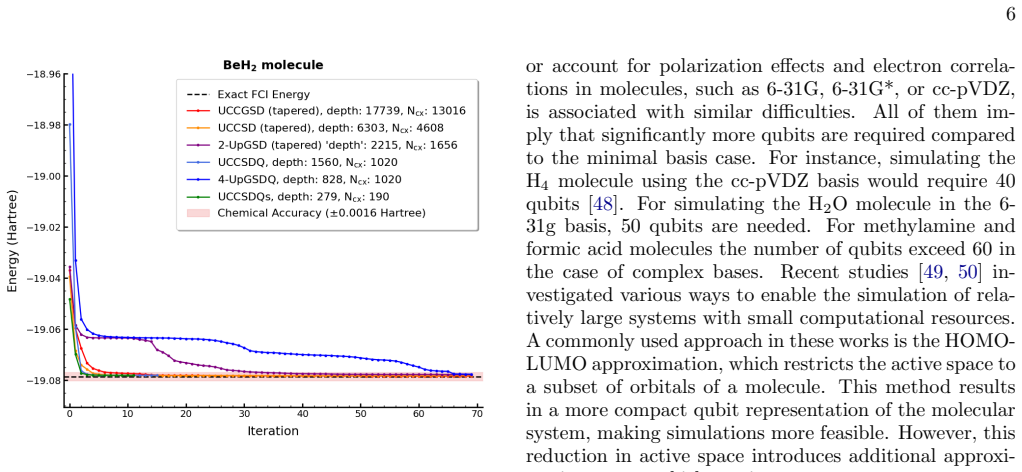
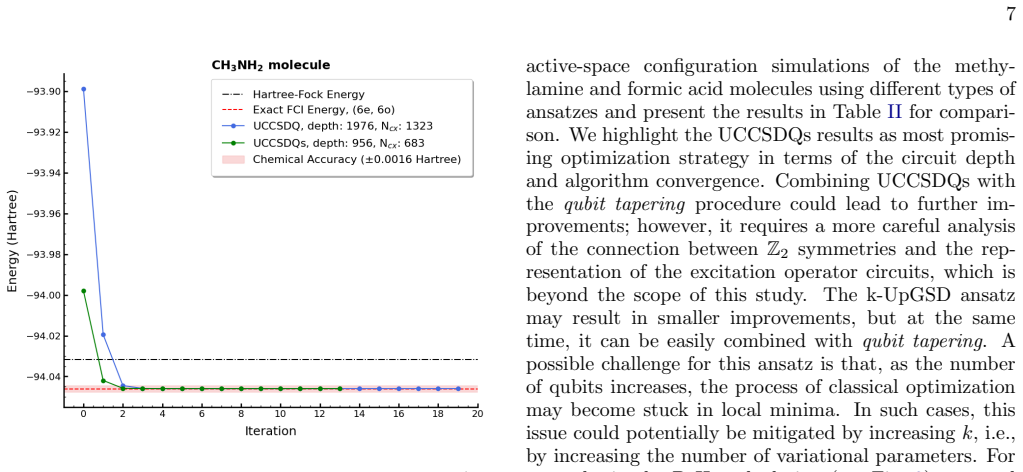
The central discovery is that a UCCSD ansatz built from qubit-excitation circuits and restricted to terms that preserve the irreducible-representation symmetry of the Hartree-Fock reference (UCCSDQs) can reproduce the correlation energy of small molecules with dramatically fewer gates than a naive implementation. For methylamine the authors estimate a reduction from roughly 600,000 to about 12,000 two-qubit operations using 26 qubits in the STO-3G basis, with circuit depth reduced by a similar factor. Converged noiseless VQE runs on LiH, BeH2, and methylamine in a (6e,6o) active space stay within chemical accuracy, which is the evidence that the gate savings do not come at the cost of the physics. For full active spaces the paper provides resource estimates, not converged energies, and it reports that the alternative k-UpGSDQ ansatz, though even cheaper, fails to converge for formic acid.
Load-bearing premise
The load-bearing premise is that the per-excitation gate-count coefficients underlying Table II are correct and representative, and that the qubit-excitation ansatz that converges on the (6e,6o) methylamine active space will also converge on the full active space; the formic acid result shows the same ansatz can fail on a comparable molecule.
Editorial extensions
If this is right
- A 26-qubit STO-3G methylamine VQE calculation drops from roughly 600,000 to about 12,000 two-qubit operations, bringing it closer to the error budget of current high-fidelity devices.
- Full active-space resource estimates for methylamine and formic acid fall near 10,000-15,000 two-qubit gates, with circuit depth reduced by nearly two orders of magnitude.
- The UCCSDQs ansatz reaches chemical accuracy in noiseless simulations of LiH, BeH2, and the methylamine (6e,6o) active space, showing symmetry-filtered qubit excitations can retain the correlation energy.
- Combining UCCSDQs with qubit tapering is identified as a further possible reduction, but the paper leaves it open because the interplay between Z2 symmetries and excitation circuit representations needs more analysis.
- The cheaper k-UpGSDQ ansatz does not converge for formic acid, so the optimal strategy depends on the correlation structure of the target molecule.
Reading between the lines
- An attentive reader will notice that the abstract's 'approximately 12,000' matches Table II's total-gate column, whereas the table's two-qubit column for the same ansatz is 4,130; the paper never reconciles the two presentations.
- If the gate counts survive independent compilation, a small organic molecule's ground-state VQE enters the regime of few-dozen-qubit experiments, though error mitigation and measurement overhead would still apply.
- The formic acid failure suggests a testable pattern: qubit-excitation circuits may lose accuracy exactly when static correlation is strong, so a practical recipe would switch to fermionic excitation circuits above some correlation-strength threshold.
- Because the estimates depend on a proprietary library, a natural next step is a public benchmark that compiles the same excitation lists with published CNOT-optimal circuits and checks whether the two-orders-of-magnitude savings persist.
Editorial analysis
A structured set of objections, weighed in public.
Referee Report
Summary. The paper proposes combining symmetry-adapted excitation filtering, qubit-excitation-based ansatze, restricted excitation sets, and qubit tapering to reduce the quantum resources required for VQE simulations of small molecules. The authors validate the combined strategies on LiH and BeH2, reporting convergence to FCI reference energies, and on a (6e,6o) active-space model of methylamine on 12 qubits. They then present resource estimates in Table II for full-active-space methylamine and formic acid, claiming a reduction from roughly 600,000 to roughly 12,000 operations on 26 qubits for methylamine using a UCCSDQs ansatz.
Significance. If the central resource-reduction claim were stated correctly and supported by reproducible data, the paper would be a useful contribution to near-term VQE practice: it tests a concrete combination of optimization techniques on nontrivial molecules, benchmarks against independent FCI references, and provides resource tables for chemically interesting organic molecules. The LiH/BeH2 and methylamine active-space calculations are genuine and non-circular validations of convergence behavior. However, the headline claim is weakened by an internal inconsistency between the abstract and Table II, by the absence of a full-active-space convergence demonstration, and by reliance on undisclosed per-excitation gate-count coefficients from an in-house library. These issues affect the central quantitative claim and need to be resolved before the paper can be accepted.
major comments (4)
- [Abstract / Table II] The central resource-reduction claim conflates two-qubit gates with total gates and uses a baseline that does not match the table. The abstract states that the number of two-qubit operations is reduced from about 600,000 to about 12,000 on 26 qubits. In Table II, the methylamine UCCSD row (with tapering) lists 457,800 two-qubit gates and 631,022 total gates on 23 qubits, while the UCCSDQs row lists 4,130 two-qubit gates and 11,558 total gates on 26 qubits. The '600,000' figure is close to the UCCSD total gate count, and the '12,000' figure matches the UCCSDQs total gate count, not its two-qubit count. The Introduction's statement of 'around 10,000–15,000 two-qubit gates' is similarly inconsistent with Table II. Please correct the metric used in the abstract and Introduction, recompute the reduction factor accordingly, and state the baseline and optimized counts consistently (two-qubit vs total gates).
- [Sec. IV (methylamine and formic acid discussion)] The full-active-space resource estimate is not backed by a converged VQE calculation. The only methylamine VQE calculation shown is the (6e,6o) 12-qubit active space (Fig. 4). The 26-qubit UCCSDQs row in Table II is an estimate from Eqs. (10)-(11), not a demonstrated energy convergence. The paper itself reports in Sec. IV that qubit-excitation circuits 'do not show good convergence' for formic acid, and Sec. III explicitly notes that qubit excitations ignore fermionic anticommutation by excluding Pauli-Z products. Thus, the abstract's phrasing that the method reduces operations 'for simulating the methylamine molecule' overstates what is established. Please either present the full-active-space numbers as conditional resource estimates that require validation of convergence, or provide evidence that UCCSDQs converges on the full active space.
- [Eqs. (10)-(11) and Table II] The gate-count and depth estimates depend on the per-excitation coefficients alpha_S, alpha_D, beta_S, beta_D, gamma_S, gamma_D, which are introduced as average values but never given numerically. They also rely on the undisclosed in-house library of Ref. [47]. Without either the numerical values of these coefficients or a description/implementation of the circuit constructions, Table II cannot be independently checked. Please provide the coefficient values used for each qubit count (23/26 and 25/28), or make the circuit-construction code publicly available.
- [Table II] The resource comparison in Table II is not apples-to-apples because the ansatz and tapering choices are confounded: UCCSD and k-UpGSD are reported with qubit tapering (23 and 25 qubits), whereas UCCSDQs and k-UpGSDQ are reported without tapering (26 and 28 qubits). The claimed reduction factor therefore mixes the effect of the ansatz change with the effect of tapering. Please report the comparisons in a consistent setting (e.g., all ansatze with tapering, or all without tapering) or discuss how this inconsistency affects the advertised reduction.
minor comments (4)
- [Fig. 4 caption and Sec. IV text] The caption and text refer to 'UCCSQs', which should be 'UCCSDQs'.
- [Eq. (12)] The phrase 'irreducible irreducible representation' is a typo, and the condition is written informally; please rephrase it more precisely.
- [Reference [36]] Reference [36] gives only 'arXiv (2017), arXiv: Quantum Physics'; please provide the complete bibliographic information for the qubit-tapering result so readers can locate the method.
- [Sec. IV and Table II] The table states that k-UpGSD and k-UpGSDQ estimates use k=1, yet the text reports that k=4 repetitions were needed for convergence in BeH2. Please state explicitly how the k=1 assumption affects the methylamine and formic acid resource estimates and whether higher k would alter the advertised reduction factor.
Circularity Check
Resource-reduction headline depends on self-cited in-house library coefficients; energy benchmarks are independent.
-
self citation load bearing
[Section III (resource estimates), Eqs. (10)-(11) and Table II, with coefficients from Ref. [47]]
"In all estimates, we use qubit-wise grouping of Pauli strings and an in-house quantum chemistry library specifically developed for the efficient implementation of variational quantum algorithms. [47]. ... The coefficients from Eqs. (10) and (11) depend on the actual definition of excitation sub-circuits in the ansatz, the fermionic transformation used, and the number of qubits."
The headline reduction to approximately 12,000 two-qubit gates for methylamine is obtained by evaluating Eq. (10), N2-qubit = beta_S N_S + beta_D N_D, with the per-excitation gate coefficients beta_S, beta_D and the circuit model taken from Ref. [47], written by the present authors. The coefficient values are not given and no independent derivation is supplied, so the resource estimate is not a standalone prediction: it is the self-cited in-house library's gate-count model applied to the paper's excitation counts. The energy-convergence claims are benchmarked to FCI and are not affected, which is why this is partial rather than total circularity.
full rationale
The derivation chain for the convergence claims is self-contained: LiH, BeH2, and the (6e,6o) methylamine active-space VQE runs are compared to exact FCI energies, an external reference, so 'chemical accuracy' is not defined in terms of the ansatz or the optimization. The active-space choice in Fig. 3 is a classical scan, not a fit of VQE parameters, and the subsequent VQE result is checked against FCI. The only load-bearing step that reduces to the authors' own prior work is the gate-count model: the ~12,000 two-qubit number in the abstract is Eq. (10) evaluated with beta coefficients from the in-house library of Ref. [47] (authors overlap with this paper), with no coefficient values or independent reproduction provided. That makes the resource-reduction claim dependent on a self-citation, but not definitionally circular; if the library constants were disclosed and independently validated, it would be ordinary arithmetic. Hence score 4 rather than 0 or 6.
Assumptions & free parameters
free parameters (3)
- Per-excitation gate-count coefficients (alpha_S, alpha_D, beta_S, beta_D, gamma_S, gamma_D) =
not disclosed (in-house library [47])
- Ansatz repetition count k =
1 for methylamine/formic acid estimates, 4 for BeH2
- Methylamine active space size =
6 electrons, 6 spin orbitals
assumptions (6)
- domain assumption Second-quantized molecular Hamiltonian under the Born-Oppenheimer approximation with the STO-3G basis set.
- domain assumption Frozen core approximation removes inner 1s orbitals without significantly changing the energies used.
- standard math Qubit tapering via Z2 symmetries preserves the spectrum of the Hamiltonian.
- domain assumption Symmetry filtering in Eq. (12) keeps only excitations that preserve the irreducible representation of the Hartree-Fock reference.
- domain assumption First-order Suzuki-Trotter decomposition of the UCC ansatz has negligible error for the reported energies.
- ad hoc to paper Qubit-excitation operators, which exclude Pauli-Z products and ignore fermionic anticommutation, can recover the correlation energy.
Cite this review
Pith. "Pith review of Simulating methylamine using symmetry adapted qubit-excitation-based variational quantum eigensolver." pith.science (2026). https://pith.science/paper/6H6WKRC3
@misc{pith2026250117035,
  author       = {Pith},
  title        = {Pith review of: Simulating methylamine using symmetry adapted qubit-excitation-based variational quantum eigensolver},
  year         = {2026},
  howpublished = {\url{https://pith.science/paper/6H6WKRC3}},
  note         = {Machine review of arXiv:2501.17035}
}
read the original abstract
In this work, we propose and analyze optimization strategies for the VQE algorithm that combine various methods, including molecular point group symmetries (symmetry adaptation), compact excitation circuits (qubit-excitation-based), different types of excitation sets, and qubit tapering. These strategies allow for a significant reduction in computational requirements while ensuring convergence to the correct energies. First, we apply these combinations to small molecules, such as LiH and BeH2, to evaluate their compatibility, accuracy, and potential applicability to larger problems. We then simulate the methylamine molecule within its restricted active space using the best-performing optimization strategies. Finally, we complete our analysis by estimating the resources required for full active-space simulations of the methylamine and formic acid molecules. Our best-performing optimization strategy reduces the number of two-qubit operations for simulating the methylamine molecule from 600,000 (in the STO-3G basis with a naive Unitary Coupled Cluster ansatz) to approximately 12,000, using 26 qubits. Thus, the proposed combination of optimization methods can reduce the number of two-qubit operations by nearly two orders of magnitude. Although, we present alternative approaches that are of interest in the context of the further optimization in the number of two-qubit operation, we note that these approaches do not perform well enough in terms of the convergence to required energies. While these challenges persist, our resource analysis represents a valuable step towards the practical use of quantum computers and the development of better methods for optimizing computing resources.
Figures


Figures from the paper (1 more)
Reference graph
Works this paper leans on
-
[47]
K. Makushin, M. Sapova, and A. Fedorov, in Journal of Physics: Conference Series, Vol. 2701 (IOP Publishing,
-
[1]
T. Helgaker, P. Jørgensen, and J. Olsen, Molecular Electronic-Structure Theory(Wiley, 2000)
work page 2000
- [2]
-
[3]
W. F. van Gunsteren and C. Oostenbrink, Journal of Chemical Information and Modeling 64, 6281 (2024)
work page 2024
-
[4]
Lloyd, Science 273, 1073 (1996)
S. Lloyd, Science 273, 1073 (1996)
1996
-
[5]
Y. Cao, J. Romero, J. P. Olson, M. Degroote, P. D. John- son, M. Kieferov´ a, I. D. Kivlichan, T. Menke, B. Per- opadre, N. P. D. Sawaya, S. Sim, L. Veis, and A. Aspuru- Guzik, Chemical Reviews 119, 10856 (2019)
2019
-
[6]
McArdle, S
S. McArdle, S. Endo, A. Aspuru-Guzik, S. C. Benjamin, and X. Yuan, Rev. Mod. Phys. 92, 015003 (2020)
2020
-
[7]
D. A. Fedorov, B. Peng, N. Govind, and Y. Alexeev, Materials Theory 6, 2 (2022)
2022
Show all 49 references
-
[8]
J. Huh, G. G. Guerreschi, B. Peropadre, J. R. McClean, and A. Aspuru-Guzik, Nature Photonics 9, 615 (2015)
2015
-
[9]
Arg¨ uello-Luengo, A
J. Arg¨ uello-Luengo, A. Gonz´ alez-Tudela, T. Shi, 8 P. Zoller, and J. I. Cirac, Nature 574, 215 (2019)
2019
-
[10]
Streif, F
M. Streif, F. Neukart, and M. Leib, in Quantum Tech- nology and Optimization Problems, edited by S. Feld and C. Linnhoff-Popien (Springer International Publishing, Cham, 2019) pp. 111–122
2019
-
[11]
R. Xia, T. Bian, and S. Kais, The Journal of Physical Chemistry B 122, 3384 (2018)
2018
-
[12]
Polynomial unconstrained binary optimisation inspired by optical simulation,
D. A. Chermoshentsev, A. O. Malyshev, M. Esencan, E. S. Tiunov, D. Mendoza, A. Aspuru-Guzik, A. K. Fe- dorov, and A. I. Lvovsky, “Polynomial unconstrained binary optimisation inspired by optical simulation,” (2022), arXiv:2106.13167 [quant-ph]
2022 arXiv
-
[13]
Peruzzo, J
A. Peruzzo, J. McClean, P. Shadbolt, M.-H. Yung, X.-Q. Zhou, P. J. Love, A. Aspuru-Guzik, and J. L. O’Brien, Nature Communications 5, 4213 (2014)
2014
-
[14]
J. R. McClean, J. Romero, R. Babbush, and A. Aspuru- Guzik, New Journal of Physics 18, 023023 (2016)
2016
-
[15]
Cerezo, A
M. Cerezo, A. Arrasmith, R. Babbush, S. C. Benjamin, S. Endo, K. Fujii, J. R. McClean, K. Mitarai, X. Yuan, L. Cincio, and P. J. Coles, Nature Reviews Physics 3, 625 (2021)
2021
-
[16]
Sapova and A
M. Sapova and A. Fedorov, Communications Physics 5, 199 (2022)
2022
-
[17]
Tilly, H
J. Tilly, H. Chen, S. Cao, D. Picozzi, K. Setia, Y. Li, E. Grant, L. Wossnig, I. Rungger, G. H. Booth, and J. Tennyson, Physics Reports 986, 1 (2022)
2022
-
[18]
Bentellis, A
A. Bentellis, A. Matic-Flierl, C. B. Mendl, and J. M. Lorenz, in 2023 IEEE International Conference on Quan- tum Computing and Engineering (QCE), Vol. 1 (IEEE,
2023
-
[19]
J. Hu, J. Li, Y. Lin, H. Long, X.-S. Xu, Z. Su, W. Zhang, Y. Zhu, and M.-H. Yung, arXiv preprint arXiv:2211.12775 (2022)
2022 arXiv
-
[20]
Sharc-vqe: Sim- plified hamiltonian approach with refinement and correc- tion enabled variational quantum eigensolver for molec- ular simulation,
H. Singh, S. Majumder, and S. Mishra, “Sharc-vqe: Sim- plified hamiltonian approach with refinement and correc- tion enabled variational quantum eigensolver for molec- ular simulation,” (2024), arXiv:2407.12305 [quant-ph]
2024 arXiv
-
[21]
Makushin and E
K. Makushin and E. Baibekov, Magnetic Resonance in Solids 25, 23204 (2023)
2023
-
[22]
Shang, L
H. Shang, L. Shen, Y. Fan, Z. Xu, C. Guo, J. Liu, W. Zhou, H. Ma, R. Lin, Y. Yang, et al., in SC22: Inter- national Conference for High Performance Computing, Networking, Storage and Analysis(IEEE, 2022)
2022
-
[23]
D. S. Steiger, T. H¨ aner, S. N. Genin, and H. G. Katz- graber, arXiv preprint arXiv:2404.10047 (2024)
2024 arXiv
-
[24]
Rocca, C
D. Rocca, C. L. Cortes, J. F. Gonthier, P. J. Ollitrault, R. M. Parrish, G.-L. Anselmetti, M. Degroote, N. Moll, R. Santagati, and M. Streif, Journal of Chemical Theory and Computation (2024)
2024
-
[26]
P. J. J. O’Malley, R. Babbush, I. D. Kivlichan, J. Romero, J. R. McClean, R. Barends, J. Kelly, P. Roushan, A. Tranter, N. Ding, B. Campbell, Y. Chen, Z. Chen, B. Chiaro, A. Dunsworth, A. G. Fowler, E. Jef- frey, E. Lucero, A. Megrant, J. Y. Mutus, M. Neeley, C. Neill, C. Quin...
2016
-
[27]
Hempel, C
C. Hempel, C. Maier, J. Romero, J. McClean, T. Monz, H. Shen, P. Jurcevic, B. P. Lanyon, P. Love, R. Babbush, A. Aspuru-Guzik, R. Blatt, and C. F. Roos, Phys. Rev. X 8, 031022 (2018)
2018
-
[28]
Nam, J.-S
Y. Nam, J.-S. Chen, N. C. Pisenti, K. Wright, C. Delaney, D. Maslov, K. R. Brown, S. Allen, J. M. Amini, J. Apis- dorf, K. M. Beck, A. Blinov, V. Chaplin, M. Chmielewski, C. Collins, S. Debnath, K. M. Hudek, A. M. Ducore, M. Keesan, S. M. Kreikemeier, J. Mizrahi, P. Solomon, M...
2020
-
[29]
Arute, K
F. Arute, K. Arya, R. Babbush, D. Bacon, J. C. Bardin, R. Barends, S. Boixo, M. Broughton, B. B. Buck- ley, D. A. Buell, B. Burkett, N. Bushnell, Y. Chen, Z. Chen, B. Chiaro, R. Collins, W. Courtney, S. Demura, A. Dunsworth, E. Farhi, A. Fowler, B. Foxen, C. Gid- ney, M. Giust...
2020
-
[30]
Y. Wu, Z. Jiang, Z. Lin, Y. Liang, and H. Wang, Nature Sustainability 4, 1 (2021)
2021
-
[31]
A. K. Fedorov and M. S. Gelfand, Nature Computational Science 1, 114 (2021)
2021
-
[32]
Kandala, A
A. Kandala, A. Mezzacapo, K. Temme, M. Takita, M. Brink, J. M. Chow, and J. M. Gambetta, Nature 549, 242 (2017)
2017
-
[33]
M. J. Powell, Mathematical Programming 97, 605 (2003)
2003
-
[34]
Bravyi, S
S. Bravyi, S. Sheldon, A. Kandala, D. C. Mckay, and J. M. Gambetta, PRX Quantum 2, 040326 (2021)
2021
-
[35]
Cerezo, A
M. Cerezo, A. Arrasmith, R. Babbush, S. C. Benjamin, S. Endo, K. Fujii, J. R. McClean, K. Mitarai, X. Yuan, L. Cincio, et al., Nature Reviews Physics 3, 625 (2021)
2021
-
[36]
Bravyi, J
S. Bravyi, J. Gambetta, A. Mezzacapo, and K. Temme, arXiv (2017), arXiv: Quantum Physics
2017
-
[37]
Nist computational chemistry compari- son and benchmark database,
R. D. J. III, “Nist computational chemistry compari- son and benchmark database,” NIST Standard Reference Database Number 101, Release 22 (2022), available on- line: http://cccbdb.nist.gov/
2022
-
[38]
Gokhale, O
P. Gokhale, O. Angiuli, Y. Ding, K. Gui, T. Tomesh, M. Suchara, M. Martonosi, and F. T. Chong, in 2020 IEEE International Conference on Quantum Computing and Engineering (QCE)(IEEE, 2020) pp. 379–390
2020
-
[39]
Y. S. Yordanov, D. R. Arvidsson-Shukur, and C. H. Barnes, Physical Review A 102, 062612 (2020)
2020
-
[40]
Y. S. Yordanov, V. Armaos, C. H. Barnes, and D. R. Arvidsson-Shukur, Communications Physics 4, 228 (2021)
2021
-
[41]
Magoulas and F
I. Magoulas and F. A. Evangelista, Journal of Chemical Theory and Computation 19, 4815 (2023)
2023
-
[42]
Grimsley, S
H. Grimsley, S. Economou, E. Barnes, and et al., Nat Commun 10, 3007 (2019)
2019
-
[43]
Mog-vqe: Multiobjec- tive genetic variational quantum eigensolver,
D. Chivilikhin, A. Samarin, V. Ulyantsev, I. Iorsh, R. Oganov, and O. Kyriienko, “Mog-vqe: Multiobjec- tive genetic variational quantum eigensolver,” (2020), arXiv: Quantum Physics. 9
2020
-
[44]
J. Lee, W. J. Huggins, M. Head-Gordon, and K. B. Whaley, J. Chem. Theory Comput. 15, 311 (2018)
2018
-
[45]
H. G. Burton, D. Marti-Dafcik, D. P. Tew, and D. J. Wales, npj Quantum Information 9, 75 (2023)
2023
-
[46]
C. Cao, J. Hu, W. Zhang, X. Xu, D. Chen, F. Yu, J. Li, H.-S. Hu, D. Lv, and M.-H. Yung, Physical Review A 105, 062452 (2022)
2022
-
[48]
C. Guo, Y. Fan, Z. Xu, and H. Shang, Quantum 7, 1192 (2023)
2023
-
[49]
W. Li, Z. Huang, C. Cao, Y. Huang, Z. Shuai, X. Sun, J. Sun, X. Yuan, and D. Lv, Chem. Sci. 13, 8953 (2022)
2022
-
[50]
Shang, Y
H. Shang, Y. Fan, and L. S. et al., npj Quantum Infor- mation 9 (2023)
2023
Reviewed August 10, 2026 · model on record in the stance chip above.
Discussion (0). Continue with ORCID to comment.