REVIEW 3 major objections 5 minor 1 cited by
Bridging statistical mechanics and thermodynamics away from equilibrium: a data-driven approach for learning internal variables and their dynamics
T0 review · 3 major / 5 minor · reviewed 2026-08-10 · deepseek-v4-flash
Pith's one-line read This paper proposes a machine-learning framework, IB-VONNs, aimed at automatically discovering internal variables and thermodynamically consistent evolution equations from stochastic microscopic particle data.
desk verdict A solid ML framework for learning internal variables with thermodynamic consistency, but the no-memory claim is backed by predictive accuracy, not a direct sufficiency test. read the letter →
The pith
A machine-rendered reading of the paper's core claim, the machinery that carries it, and where it could break.
The reading
What carries the argument
The carrying mechanism is the joint IB-VONNs training loop. An information bottleneck encoder of the form $\alpha=\rho(\langle h(x)\rangle)$ (with $h$ and $\rho$ neural networks, and the ensemble average over realizations ensuring permutation invariance) extracts internal variables, while a decoder represents the conditional microscopic distribution. VONNs, built on Onsager's variational principle, represent the free energy density by an integrable neural network and the dual dissipation potential by a partially input convex integrable neural network, which strongly enforces thermodynamic consistency. The three loss terms, reconstruction log-likelihood and $L^2$ trajectory errors for $\chi$ and $\alpha$, are trained together so that the state variables are sufficient to predict the future and to characterize the microscopic distribution at every time.
What would settle it
Measure the residual mutual information between the future microscopic state and the past history of the state variables, conditioned on the current $(\chi,\alpha)$; if this residual fails to vanish for any finite-dimensional internal variable set, the central Markovian sufficiency premise is false.
Extended reading notes
Core claim
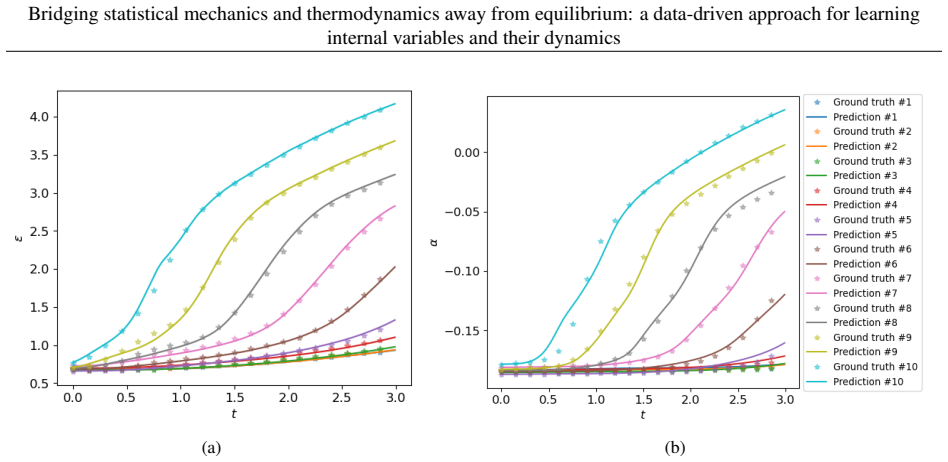
The central discovery is an architecture, IB-VONNs, that jointly learns an information-bottleneck encoder-decoder and a Variational Onsager Neural Network. The encoder maps an ensemble of microscopic configurations to internal variables $\alpha$ that are permutation-invariant, macroscopic descriptors; the decoder reconstructs the non-equilibrium microscopic distribution $q(x(t)|\chi(t),\alpha(t))$ using Gaussian, Gaussian-mixture, or conditional normalizing flow models; and VONNs learn free energy and dual dissipation potentials so that the evolution equations for $(\chi,\alpha)$ are Markovian and thermodynamically consistent. The paper reports that, for overdamped Langevin dynamics, the method discovers internal variables that capture salient features of the microscopic distribution, that the reconstructed distributions agree with direct simulations even when multimodal, and that predicted macroscopic observables such as external force and mean strain have relative $L^2$ errors of roughly one to a few percent on test protocols, including unseen sinusoidal loading.
Load-bearing premise
The framework assumes that the current state variables, including the learned internal variables, completely determine the microscopic probability distribution at every instant, so that no memory of the past is needed.
Editorial extensions
If this is right
- For inelastic materials, internal variables and their evolution equations could be learned directly from atomistic or particle simulations, replacing phenomenological choices such as the multiplicative kinematic decomposition of the deformation gradient.
- The learned decoder provides a non-equilibrium analogue of the Boltzmann distribution, allowing one to sample microscopic states consistent with a given macroscopic state, which could support the inverse problem of material design.
- Because the learned dynamics are constrained to be Markovian and thermodynamically consistent, the resulting continuum models are predictive beyond the training data, as demonstrated on unseen pulling protocols.
- Using conditional normalizing flows as the decoder removes the need for prior knowledge of the microscopic distribution family, making the approach applicable to strongly multimodal, far-from-equilibrium distributions.
- The framework naturally yields spatially non-local evolution equations through the Onsager structure, as shown in the phase-transforming chain, where the dynamics of one spring depend on its nearest neighbors.
Reading between the lines
- Beyond the paper, if the sufficiency assumption holds broadly, this method offers a general computational route from stochastic microdynamics to macroscale constitutive laws, potentially covering plasticity, damage, and active matter without modeler-chosen internal variables.
- The paper chooses $X=Y$ in the information bottleneck, so the encoder is not explicitly trained to predict the future microstate; a variant that sets $Y$ to a future microstate could sharpen the Markovianity guarantee and is a natural next step.
- The loss weights are hand-tuned and the paper notes this is crucial for success; automatic or Bayesian weighting would be needed before the framework becomes a black-box tool for general problems, which is an extension rather than a claim of the paper.
- Because conditional normalizing flows are universal approximators, the same decoder architecture should transfer to non-colloidal and inertial systems, provided Onsager's variational principle is replaced by an appropriate variational formulation for those dynamics.
Editorial analysis
A structured set of objections, weighed in public.
Referee Report
Summary. The paper proposes IB-VONNs, a framework that combines an information-bottleneck encoder--decoder with conditional normalizing flows and Variational Onsager Neural Networks to discover internal variables and thermodynamically consistent, Markovian evolution equations from microscopic stochastic dynamics. The encoder maps ensembles of microstates to permutation-invariant macroscopic state variables, the decoder reconstructs the conditional microscopic distribution, and VONNs learn free-energy and dual-dissipation potentials whose gradients drive the macroscopic dynamics. The method is tested on two overdamped Langevin systems: a single colloidal particle in an optical trap with an analytic Gaussian solution, and a one-dimensional double-well mass-spring chain with multimodal distributions, using both Gaussian-mixture and conditional-normalizing-flow decoders. Reported held-out errors are small for both state variables and external force, and predictions generalize to a sinusoidal protocol not used in training.
Significance. If the central claim is established, the paper offers a genuinely useful route from stochastic microstate data to thermodynamically consistent internal-variable models, a long-standing gap in non-equilibrium statistical mechanics and continuum mechanics. The methodology is principled: the set-invariant encoder respects statistical-mechanical indistinguishability of realizations, CNFs remove the need for a hand-chosen distribution family, and VONNs enforce thermodynamic consistency in the learned potentials. The use of an analytically solvable benchmark, held-out data, and an unseen protocol are strengths, as is the explicit reporting of quantitative errors. The main limitation is that the paper's two load-bearing assumptions -- that the learned state variables are sufficient for the full microscopic distribution and that the resulting coarse-grained dynamics are Markovian -- are not independently validated, only encoded in the model architecture and checked indirectly through predictive accuracy on the training family.
major comments (3)
- [Section 2.2, Eq. (2) and Section 2.4, Eqs. (14)--(15)] The IB target is set to the same-time microstate (X = Y) and the complexity term I(Z;X) is dropped, so the encoder is not explicitly trained to be predictive of the future. The VONN dynamics loss then fits a Markovian evolution from z(t) to z(t+Δt) using only current state variables. Because a sufficiently expressive Markovian ansatz can fit finite training data even when the true coarse-grained dynamics retain memory, the small training and test errors do not by themselves establish the paper's no-memory claim. I recommend adding explicit diagnostics for Markovianity, for example testing conditional independence p(z_{t+1}|z_t,z_{t-1}) = p(z_{t+1}|z_t) on held-out trajectories, or comparing the IB-VONN model against a history-dependent baseline with the same encoder and reporting the difference in generalization.
- [Example 2, Eq. (51) and Figures 16, 20] The decoder in Example 2 is a product of per-spring one-dimensional conditional models: the loss in Eq. (51) sums marginal log-likelihoods log q(ε_i|z_i) over springs, and Figures 16 and 20 validate only the marginal distributions. This does not establish that the state variables z characterize the microscopic probability distribution, which is one of the paper's central assumptions stated in Section 2. If the spring strains are correlated conditional on z, the learned internal variables may be sufficient for the marginals but not for the joint distribution, and the derived Markovian evolution would not be a consequence of the assumed sufficiency. The authors should either measure joint conditional correlations (e.g., compare residual covariance of pairs of strains given z) or replace the marginal decoder with a multivariate conditional model and report joint likelihoods.
- [Section 5 and abstract] The conclusions state that the state variables 'lead to Markovian dynamics' and that the framework can 'bridge statistical mechanics and thermodynamics' away from equilibrium. In the current paper this is a property of the model ansatz rather than a validated property of the learned representation. The theoretical link [28] requires the conditional distribution of the microstate given z to coincide with the true microscopic distribution, a condition that is assumed rather than tested. I recommend softening the claim to 'the learned dynamics are consistent with a Markovian, thermodynamically admissible representation' until the sufficiency of the latent state is directly verified or the assumption is stated as an explicit, justified approximation.
minor comments (5)
- [Section 3.3, last paragraph] The word 'famework' should be 'framework' in the sentence 'we also test the IB-VONNs famework on data generated by a smoothed linear pulling protocol.'
- [Section 4.4, first paragraph and Figure 13 caption] There are typos: 'miscroscopic' should be 'microscopic' in the first paragraph of Section 4.4, and 'mean stain' in the Figure 13 caption should be 'mean strain'.
- [Section 2.2, paragraph after Eq. (4)] The statement that the encoder is 'maximally predictive of the future state' is not justified by the IB formulation in this paper, because the target Y is the current microstate, not a future quantity; rephrasing this as a design goal rather than a property of the loss function would avoid overstating the role of the IB term.
- [Section 4.3, Eq. (54)] The GMM decoder uses the fixed peak-distance ε_h, which is a physics-informed assumption; this is worth stating more prominently as a modeling choice that is later removed by the CNF version, so that readers do not interpret it as part of the general IB-VONNs method.
- [General] The loss weights λ_pdf, λ_ε, and λ_α are hand-tuned, and the conclusion acknowledges this as an open issue; a brief discussion of sensitivity to these weights, or at least the observed ranges over which the reported errors are stable, would increase the reproducibility of the numerical results.
Circularity Check
No significant circularity: held-out predictions are validated against external benchmarks; self-citations are used as building blocks, not as the evidence for the predictions.
full rationale
The paper's central claims are supported by independent empirical checks rather than by construction. The optical-trap example is tested against the analytic solution of the Fokker-Planck equation, and both examples are evaluated on held-out pulling protocols and initial conditions that were not used in training; the reported relative L2 errors are for these held-out cases. The VONN dynamics losses (Eqs. 14-15) fit a Markovian evolution law in the learned latent variables, and the Markovian form is an architectural assumption rather than a quantity derived from data, but the held-out protocol predictions provide genuine evidence that the fitted dynamics generalize. The information-bottleneck part is weakened by the paper's own admission that X and Y are chosen identical and the I(Z;X) term is dropped, so it functions mainly as a reconstruction autoencoder; the paper even notes in Section 2.4 that setting the reconstruction weight to zero would not affect the discovery of internal variables, which further shows the predictive content comes from the dynamics fit, not from a circular IB objective. There are load-bearing self-citations, especially to the authors' prior VONNs paper [23] for thermodynamic consistency and to the authors' prior STIV paper [28] for the theorem that exact reproduction of the microscopic distribution implies Markovian evolution; however, these are published prior constructions used as components, and the paper does not rely solely on them for its empirical conclusions. The main limitation, which is a correctness risk rather than a circularity, is that sufficiency of the learned internal variables is not fully tested at the joint-distribution level in Example 2, where only marginal distributions are validated (Figs. 16 and 20). Overall, no derivation step reduces to its own inputs by construction, so the paper is not significantly circular; the minor self-citation usage justifies only the lowest non-zero score.
Assumptions & free parameters
free parameters (4)
- Loss weights lambda_pdf, lambda_epsilon/lambda_Fex, lambda_alpha =
Example 1: 1e-5, 1, 1; Example 2 GMM: 0.002, 1, 1; Example 2 CNF: 0.001, 1, 1
- Number of internal variables =
One (Example 1), one per spring (Example 2)
- Characteristic scales f* and phi* =
Ex1: f* = sigma_Fex * sigma_lambda, phi* = f*; Ex2: f* = sigma_Fex * sigma_epsilon * L0, phi* = f*
- Network architecture sizes and CNF hidden dimension d =
INN/PICINN 2 layers x 20; encoder 2x10; decoder 2x10; CNF d=2
assumptions (5)
- domain assumption Overdamped Langevin dynamics describe the microscale for both examples
- domain assumption The instantaneous state variables (chi, alpha) fully determine the microscopic probability distribution
- domain assumption Free energy and dissipation potentials exist as local densities, with no gradient term in Example 2
- ad hoc to paper The IB target Y is set equal to the same-time microstate X
- ad hoc to paper Per-spring marginal distributions suffice to characterize the microscopic distribution in Example 2
invented entities (1)
-
Learned internal variable alpha
independent evidence
Cite this review
Pith. "Pith review of Bridging statistical mechanics and thermodynamics away from equilibrium: a data-driven approach for learning internal variables and their dynamics." pith.science (2026). https://pith.science/paper/3KLH6N2M
@misc{pith2026250117993,
  author       = {Pith},
  title        = {Pith review of: Bridging statistical mechanics and thermodynamics away from equilibrium: a data-driven approach for learning internal variables and their dynamics},
  year         = {2026},
  howpublished = {\url{https://pith.science/paper/3KLH6N2M}},
  note         = {Machine review of arXiv:2501.17993}
}
read the original abstract
Thermodynamics with internal variables is a common approach in continuum mechanics to model inelastic (i.e., non-equilibrium) material behavior. While this approach is computationally and theoretically attractive, it currently lacks a well-established statistical mechanics foundation. As a result, internal variables are typically chosen phenomenologically and lack a direct link to the underlying physics which hinders the predictability of the theory. To address these challenges, we propose a machine learning approach that is consistent with the principles of statistical mechanics and thermodynamics. The proposed approach leverages the following techniques (i) the information bottleneck (IB) method to ensure that the learned internal variables are functions of the microstates and are capable of capturing the salient feature of the microscopic distribution; (ii) conditional normalizing flows to represent arbitrary probability distributions of the microscopic states as functions of the state variables; and (iii) Variational Onsager Neural Networks (VONNs) to guarantee thermodynamic consistency and Markovianity of the learned evolution equations. The resulting framework, called IB-VONNs, is tested on two problems of colloidal systems, governed at the microscale by overdamped Langevin dynamics. The first one is a prototypical model for a colloidal particle in an optical trap, which can be solved analytically, and thus ideal to verify the framework. The second problem is a one-dimensional phase-transforming system, whose macroscopic description still lacks a statistical mechanics foundation under general conditions. The results in both cases indicate that the proposed machine learning strategy can indeed bridge statistical mechanics and thermodynamics with internal variables away from equilibrium.
Figures


Figures from the paper (18 more)




Forward citations
Cited by 1 Pith paper
-
On a structure preserving closure of Langevin dynamics
A closure method that turns overdamped Langevin dynamics into gradient-flow macroscopic models for arbitrary approximate densities, automatically satisfying the second law.
Reference graph
Works this paper leans on
-
[28]
A statistical mechanics framework for constructing nonequilibrium thermodynamic models
Travis Leadbetter, Prashant K Purohit, and Celia Reina. “A statistical mechanics framework for constructing nonequilibrium thermodynamic models”. In: PNAS Nexus 2.12 (2023), pgad417
work page 2023
-
[1]
Deep variational information bottleneck
Alexander A Alemi et al. “Deep variational information bottleneck”. In: arXiv preprint arXiv:1612.00410 (2016)
arXiv 2016
-
[2]
Brandon Amos, Lei Xu, and J Zico Kolter. “Input convex neural networks”. In: International Conference on Machine Learning. PMLR. 2017, pp. 146–155
work page 2017
-
[3]
Statistical Mechanics for Chemistry and Materials Science
Biman Bagchi. Statistical Mechanics for Chemistry and Materials Science . CRC Press, 2018
work page 2018
-
[4]
Reaction coordinates and rates from transition paths
Robert B Best and Gerhard Hummer. “Reaction coordinates and rates from transition paths”. In: Proceedings of the National Academy of Sciences 102.19 (2005), pp. 6732–6737
work page 2005
-
[5]
Phase-field models for microstructure evolution
Long-Qing Chen. “Phase-field models for microstructure evolution”. In: Annual review of materials research 32.1 (2002), pp. 113–140
work page 2002
-
[6]
Ronald R Coifman and Stéphane Lafon. “Diffusion maps”. In: Applied and Computational Harmonic Analysis 21.1 (2006), pp. 5–30
work page 2006
-
[7]
Diffusion maps, reduction coordinates, and low dimensional representation of stochastic systems
Ronald R Coifman et al. “Diffusion maps, reduction coordinates, and low dimensional representation of stochastic systems”. In: Multiscale Modeling & Simulation 7.2 (2008), pp. 842–864
work page 2008
Show all 75 references
-
[8]
Thermodynamics with internal state variables
Bernard D Coleman and Morton E Gurtin. “Thermodynamics with internal state variables”. In: The journal of chemical physics 47.2 (1967), pp. 597–613
1967
-
[9]
An approximation theorem for functionals, with applications in continuum mechanics
Bernard D Coleman and Walter Noll. “An approximation theorem for functionals, with applications in continuum mechanics”. In: Archive for Rational Mechanics and Analysis 6.1 (1960), pp. 355–370
1960
-
[10]
Foundations of linear viscoelasticity
Bernard D Coleman and Walter Noll. “Foundations of linear viscoelasticity”. In: Reviews of modern physics 33.2 (1961), p. 239
1961
-
[11]
Elements of information theory
Thomas M Cover. Elements of information theory . John Wiley & Sons, 1999
1999
-
[12]
Identifying structural flow defects in disordered solids using machine-learning methods
Ekin D Cubuk et al. “Identifying structural flow defects in disordered solids using machine-learning methods”. In: Physical review letters 114.10 (2015), p. 108001
2015
-
[13]
Onsager’s variational principle in soft matter
Masao Doi. “Onsager’s variational principle in soft matter”. In: Journal of Physics: Condensed Matter 23.28 (2011), p. 284118
2011
-
[14]
Computing committors in collective variables via Mahalanobis diffusion maps
Luke Evans, Maria K Cameron, and Pratyush Tiwary. “Computing committors in collective variables via Mahalanobis diffusion maps”. In: Applied and Computational Harmonic Analysis (2023)
2023
-
[15]
Multiscale mass-spring models of carbon nanotube foams
F Fraternali et al. “Multiscale mass-spring models of carbon nanotube foams”. In: Journal of the Mechanics and Physics of Solids 59.1 (2011), pp. 89–102
2011
-
[16]
Machine learning force fields and coarse-grained variables in molecular dynamics: application to materials and biological systems
Paraskevi Gkeka et al. “Machine learning force fields and coarse-grained variables in molecular dynamics: application to materials and biological systems”. In: Journal of chemical theory and computation 16.8 (2020), pp. 4757–4775
2020
-
[17]
Deep convolutional recurrent autoencoders for learning low- dimensional feature dynamics of fluid systems
Francisco J Gonzalez and Maciej Balajewicz. “Deep convolutional recurrent autoencoders for learning low- dimensional feature dynamics of fluid systems”. In: arXiv preprint arXiv:1808.01346 (2018). 28 Bridging statistical mechanics and thermodynamics away from equilibrium: a da...
2018 arXiv
-
[18]
Deep learning
Ian Goodfellow et al. Deep learning. MIT press, 2016
2016
-
[19]
A presentation and comparison of two large deformation viscoelasticity models
S. Govindjee and S. Reese. “A presentation and comparison of two large deformation viscoelasticity models”. In: Journal of Engineering Materials and Technology 119.3 (1997), pp. 251–255
1997
-
[20]
Variational encoding of complex dynamics
Carlos X Hernández et al. “Variational encoding of complex dynamics”. In: Physical Review E 97.6 (2018), p. 062412
2018
-
[21]
On large strain viscoelasticity: continuum formulation and finite element applications to elastomeric structures
Gerhard A Holzapfel. “On large strain viscoelasticity: continuum formulation and finite element applications to elastomeric structures”. In: International Journal for Numerical Methods in Engineering 39.22 (1996), pp. 3903– 3926
1996
-
[22]
Neural autoregressive flows
Chin-Wei Huang et al. “Neural autoregressive flows”. In:International Conference on Machine Learning. PMLR. 2018, pp. 2078–2087
2018
-
[23]
Variational Onsager Neural Networks (VONNs): A thermodynamics-based variational learning strategy for non-equilibrium PDEs
Shenglin Huang, Zequn He, and Celia Reina. “Variational Onsager Neural Networks (VONNs): A thermodynamics-based variational learning strategy for non-equilibrium PDEs”. In: Journal of the Mechanics and Physics of Solids 163 (2022), p. 104856
2022
-
[24]
Principal components in regression analysis
Ian T Jolliffe. “Principal components in regression analysis”. In: Principal Component Analysis. Springer, 1986, pp. 129–155
1986
-
[25]
Principal component analysis: a review and recent developments
Ian T Jolliffe and Jorge Cadima. “Principal component analysis: a review and recent developments”. In: Philo- sophical transactions of the royal society A: Mathematical, Physical and Engineering Sciences 374.2065 (2016), p. 20150202
2016
-
[26]
Nonlinear elasto-plastic model for dense granular flow
Ken Kamrin. “Nonlinear elasto-plastic model for dense granular flow”. In: International Journal of Plasticity 26.2 (2010), pp. 167–188
2010
-
[27]
A statistical mechanics derivation and implementation of non-conservative phase field models for front propagation in elastic media
Travis Leadbetter, Prashant K Purohit, and Celia Reina. “A statistical mechanics derivation and implementation of non-conservative phase field models for front propagation in elastic media”. In: arXiv preprint arXiv:2412.17972 (2024)
2024 arXiv
-
[29]
Finite Strain Elastic-Plastic Theory with Application to Plane Wave Analysis
E. H. Lee and D. T. Liu. “Finite Strain Elastic-Plastic Theory with Application to Plane Wave Analysis”. In: Journal of Applied Physics 38 (1967), pp. 19–27
1967
-
[30]
Model reduction of dynamical systems on nonlinear manifolds using deep convolutional autoencoders
Kookjin Lee and Kevin T Carlberg. “Model reduction of dynamical systems on nonlinear manifolds using deep convolutional autoencoders”. In: Journal of Computational Physics 404 (2020), p. 108973
2020
-
[31]
Thermomechanical theory of martensitic phase transformations in inelastic materials
Valery I Levitas. “Thermomechanical theory of martensitic phase transformations in inelastic materials”. In: International Journal of Solids and Structures 35.9-10 (1998), pp. 889–940
1998
-
[32]
Learning macroscopic internal variables and history dependence from microscopic models
Burigede Liu et al. “Learning macroscopic internal variables and history dependence from microscopic models”. In: Journal of the Mechanics and Physics of Solids 178 (2023), p. 105329
2023
-
[33]
On the thermodynamic foundations of non-linear solid mechanics
Jacob Lubliner. “On the thermodynamic foundations of non-linear solid mechanics”. In: International Journal of Non-Linear Mechanics 7.3 (1972), pp. 237–254
1972
-
[34]
Plasticity theory
Jacob Lubliner. Plasticity theory. Courier Corporation, 2008
2008
-
[35]
Evolution TANN and the discovery of the internal variables and evolution equations in solid mechanics
Filippo Masi and Ioannis Stefanou. “Evolution TANN and the discovery of the internal variables and evolution equations in solid mechanics”. In: Journal of the Mechanics and Physics of Solids 174 (2023), p. 105245
2023
-
[36]
Multiscale modeling of inelastic materials with Thermodynamics-based Artificial Neural Networks (TANN)
Filippo Masi and Ioannis Stefanou. “Multiscale modeling of inelastic materials with Thermodynamics-based Artificial Neural Networks (TANN)”. In: Computer Methods in Applied Mechanics and Engineering 398 (2022), p. 115190
2022
-
[37]
The thermomechanics of nonlinear irreversible behaviours
Gérard A Maugin. The thermomechanics of nonlinear irreversible behaviours . V ol. 27. World scientific, 1999
1999
-
[38]
Thermodynamics with Internal Variables. Part I. General Concepts
Gérard A Maugin and Wolfgang Muschik. “Thermodynamics with Internal Variables. Part I. General Concepts”. In: Journal of Non Equilibrium Thermodynamics 19.3 (1994), pp. 217–249
1994
-
[39]
Thermodynamics with Internal Variables. Part II. Applications
Gérard A Maugin and Wolfgang Muschik. “Thermodynamics with Internal Variables. Part II. Applications”. In: Journal of Non Equilibrium Thermodynamics 19.3 (1994), pp. 250–289
1994
-
[40]
Continuum damage theory—application to concrete
Jacky Mazars and Gilles Pijaudier-Cabot. “Continuum damage theory—application to concrete”. In: Journal of engineering mechanics 115.2 (1989), pp. 345–365
1989
-
[41]
Self-adaptive physics-informed neural networks
Levi D McClenny and Ulisses M Braga-Neto. “Self-adaptive physics-informed neural networks”. In: Journal of Computational Physics 474 (2023), p. 111722
2023
-
[42]
Machine learning: a probabilistic perspective
Kevin P Murphy. Machine learning: a probabilistic perspective . MIT press, 2012
2012
-
[43]
Internal variables in non-equilibrium thermodynamics
W Muschik. “Internal variables in non-equilibrium thermodynamics”. In: Recent Developments in Micromechan- ics. Springer, 1991, pp. 18–34
1991
-
[44]
Beyond equilibrium thermodynamics
Hans Christian Öttinger. Beyond equilibrium thermodynamics. John Wiley & Sons, 2005. 29 Bridging statistical mechanics and thermodynamics away from equilibrium: a data-driven approach for learning internal variables and their dynamics
2005
-
[45]
Statistical Mechanics: International Series of Monographs in Natural Philosophy
RK Pathria. Statistical Mechanics: International Series of Monographs in Natural Philosophy . V ol. 45. Elsevier, 2017
2017
-
[46]
Reaction coordinates and mechanistic hypothesis tests
Baron Peters. “Reaction coordinates and mechanistic hypothesis tests”. In: Annual review of physical chemistry 67.1 (2016), pp. 669–690
2016
-
[47]
Thermodynamics of rate-independent plasticity
Giovanni Puglisi and Lev Truskinovsky. “Thermodynamics of rate-independent plasticity”. In:Journal of the Mechanics and Physics of Solids 53.3 (2005), pp. 655–679
2005
-
[48]
Incompressible inelasticity as an essential ingredient for the validity of the kinematic decomposition F= FeFi
Celia Reina and Sergio Conti. “Incompressible inelasticity as an essential ingredient for the validity of the kinematic decomposition F= FeFi”. In: Journal of the Mechanics and Physics of Solids 107 (2017), pp. 322–342
2017
-
[49]
Derivation of F= FeFp as the continuum limit of crystalline slip
Celia Reina, Anja Schlömerkemper, and Sergio Conti. “Derivation of F= FeFp as the continuum limit of crystalline slip”. In: Journal of the Mechanics and Physics of Solids 89 (2016), pp. 231–254
2016
-
[50]
Kinematics of elasto-plasticity: Validity and limits of applicability of F= FeFp for general three-dimensional deformations
Celia Reina et al. “Kinematics of elasto-plasticity: Validity and limits of applicability of F= FeFp for general three-dimensional deformations”. In: Journal of the Mechanics and Physics of Solids 121 (2018), pp. 99–113
2018
-
[51]
Inelastic constitutive relations for solids: an internal-variable theory and its application to metal plasticity
J. R. Rice. “Inelastic constitutive relations for solids: an internal-variable theory and its application to metal plasticity.” In: Journal of the Mechanics and Physics of Solids 19 (1971), pp. 433–455
1971
-
[52]
Inelastic constitutive relations for solids: an internal-variable theory and its application to metal plasticity
James R Rice. “Inelastic constitutive relations for solids: an internal-variable theory and its application to metal plasticity”. In: Journal of the Mechanics and Physics of Solids 19.6 (1971), pp. 433–455
1971
-
[53]
Stress-dependent finite growth in soft elastic tissues
E. K. Rodriguez, A. Hoger, and A. D. McCulloch. “Stress-dependent finite growth in soft elastic tissues.” In: Journal of Biomechanics 21 (1994), pp. 455–467
1994
-
[54]
Determination of reaction coordinates via locally scaled diffusion map
Mary A Rohrdanz et al. “Determination of reaction coordinates via locally scaled diffusion map”. In:The Journal of chemical physics 134.12 (2011), 03B624
2011
-
[55]
Scaffolds, levers, rods and springs: diverse cellular functions of long coiled-coil proteins
A Rose and I Meier. “Scaffolds, levers, rods and springs: diverse cellular functions of long coiled-coil proteins”. In: Cellular and Molecular Life Sciences CMLS 61 (2004), pp. 1996–2009
2004
-
[56]
Hyper-reduction of mechanical models involving internal variables
David Ryckelynck. “Hyper-reduction of mechanical models involving internal variables”. In: International Journal for numerical methods in engineering 77.1 (2009), pp. 75–89
2009
-
[57]
Second law, entropy production, and reversibility in thermodynamics of information
Takahiro Sagawa. “Second law, entropy production, and reversibility in thermodynamics of information”. In: Energy Limits in Computation: A Review of Landauer’s Principle, Theory and Experiments (2019), pp. 101–139
2019
-
[58]
Relationship between local structure and relaxation in out-of-equilibrium glassy systems
Samuel S Schoenholz et al. “Relationship between local structure and relaxation in out-of-equilibrium glassy systems”. In: Proceedings of the National Academy of Sciences 114.2 (2017), pp. 263–267
2017
-
[59]
Statistical mechanics: entropy, order parameters, and complexity
James Sethna. Statistical mechanics: entropy, order parameters, and complexity . V ol. 14. Oxford University Press, USA, 2021
2021
-
[60]
Elasto-viscoplastic phase field modelling of anisotropic cleavage fracture
Pratheek Shanthraj et al. “Elasto-viscoplastic phase field modelling of anisotropic cleavage fracture”. In: Journal of the Mechanics and Physics of Solids 99 (2017), pp. 19–34
2017
-
[61]
Information bottleneck approach to predictive inference
Susanne Still. “Information bottleneck approach to predictive inference”. In: Entropy 16.2 (2014), pp. 968–989
2014
-
[62]
Thermodynamics of prediction
Susanne Still et al. “Thermodynamics of prediction”. In: Physical review letters 109.12 (2012), p. 120604
2012
-
[63]
Machine learning materials physics: Integrable deep neural networks enable scale bridging by learning free energy functions
Gregory H Teichert et al. “Machine learning materials physics: Integrable deep neural networks enable scale bridging by learning free energy functions”. In: Computer Methods in Applied Mechanics and Engineering 353 (2019), pp. 201–216
2019
-
[64]
Scale bridging materials physics: Active learning workflows and integrable deep neural networks for free energy function representations in alloys
Gregory H Teichert et al. “Scale bridging materials physics: Active learning workflows and integrable deep neural networks for free energy function representations in alloys”. In: Computer Methods in Applied Mechanics and Engineering 371 (2020), p. 113281
2020
-
[65]
A thermomechanical constitutive model for cemented granular materials with quantifiable internal variables. Part I—Theory
Alessandro Tengattini et al. “A thermomechanical constitutive model for cemented granular materials with quantifiable internal variables. Part I—Theory”. In: Journal of the Mechanics and Physics of Solids 70 (2014), pp. 281–296
2014
-
[66]
The information bottleneck method
Naftali Tishby, Fernando C Pereira, and William Bialek. “The information bottleneck method”. In:arXiv preprint physics/0004057 (2000)
2000 arXiv
-
[67]
Combined molecular/continuum modeling reveals the role of friction during fast unfolding of coiled-coil proteins
Alejandro Torres-Sánchez et al. “Combined molecular/continuum modeling reveals the role of friction during fast unfolding of coiled-coil proteins”. In: Soft matter 15.24 (2019), pp. 4961–4975
2019
-
[68]
Roadmap on multiscale materials modeling
Erik Van Der Giessen et al. “Roadmap on multiscale materials modeling”. In: Modelling and Simulation in Materials Science and Engineering 28.4 (2020), p. 043001
2020
-
[69]
Interpretable embeddings from molecular simulations using Gaussian mixture variational autoencoders
Yasemin Bozkurt Varolgüne¸ s, Tristan Bereau, and Joseph F Rudzinski. “Interpretable embeddings from molecular simulations using Gaussian mixture variational autoencoders”. In: Machine Learning: Science and Technology 1.1 (2020), p. 015012
2020
-
[70]
Universal approximation of functions on sets
Edward Wagstaff et al. “Universal approximation of functions on sets”. In:The Journal of Machine Learning Research 23.1 (2022), pp. 6762–6817. 30 Bridging statistical mechanics and thermodynamics away from equilibrium: a data-driven approach for learning internal variables and...
2022
-
[71]
When and why PINNs fail to train: A neural tangent kernel perspective
Sifan Wang, Xinling Yu, and Paris Perdikaris. “When and why PINNs fail to train: A neural tangent kernel perspective”. In: Journal of Computational Physics 449 (2022), p. 110768
2022
-
[72]
Past–future information bottleneck for sampling molecular reaction coordinate simultaneously with thermodynamics and kinetics
Yihang Wang, João Marcelo Lamim Ribeiro, and Pratyush Tiwary. “Past–future information bottleneck for sampling molecular reaction coordinate simultaneously with thermodynamics and kinetics”. In: Nature commu- nications 10.1 (2019), pp. 1–8
2019
-
[73]
Time-lagged autoencoders: Deep learning of slow collective variables for molecular kinetics
Christoph Wehmeyer and Frank Noé. “Time-lagged autoencoders: Deep learning of slow collective variables for molecular kinetics”. In: The Journal of chemical physics 148.24 (2018), p. 241703
2018
-
[74]
Learning likelihoods with conditional normalizing flows
Christina Winkler et al. “Learning likelihoods with conditional normalizing flows”. In: arXiv preprint arXiv:1912.00042 (2019)
2019 arXiv
-
[75]
Deep sets
Manzil Zaheer et al. “Deep sets”. In: Advances in neural information processing systems 30 (2017). 31
2017
Reviewed August 10, 2026 · model on record in the stance chip above.
Discussion (0). Continue with ORCID to comment.