REVIEW 4 major objections 5 minor 1 cited by
Spacetime profile of electromagnetic fields in intermediate-energy heavy-ion collisions
T0 review · 4 major / 5 minor · reviewed 2026-08-10 · deepseek-v4-flash
Pith's one-line read Intermediate-energy gold-gold collisions create electromagnetic fields of order (50 MeV)^2 spread over a spacetime volume of order (10 fm)^4, with the electric field dominant and a nonzero E·B configuration.
desk verdict A useful first map of EM fields at intermediate energies, but the E·B claim needs the event-by-event correlator, not just the product of averages. read the letter →
The pith
A machine-rendered reading of the paper's core claim, the machinery that carries it, and where it could break.
The reading
What carries the argument
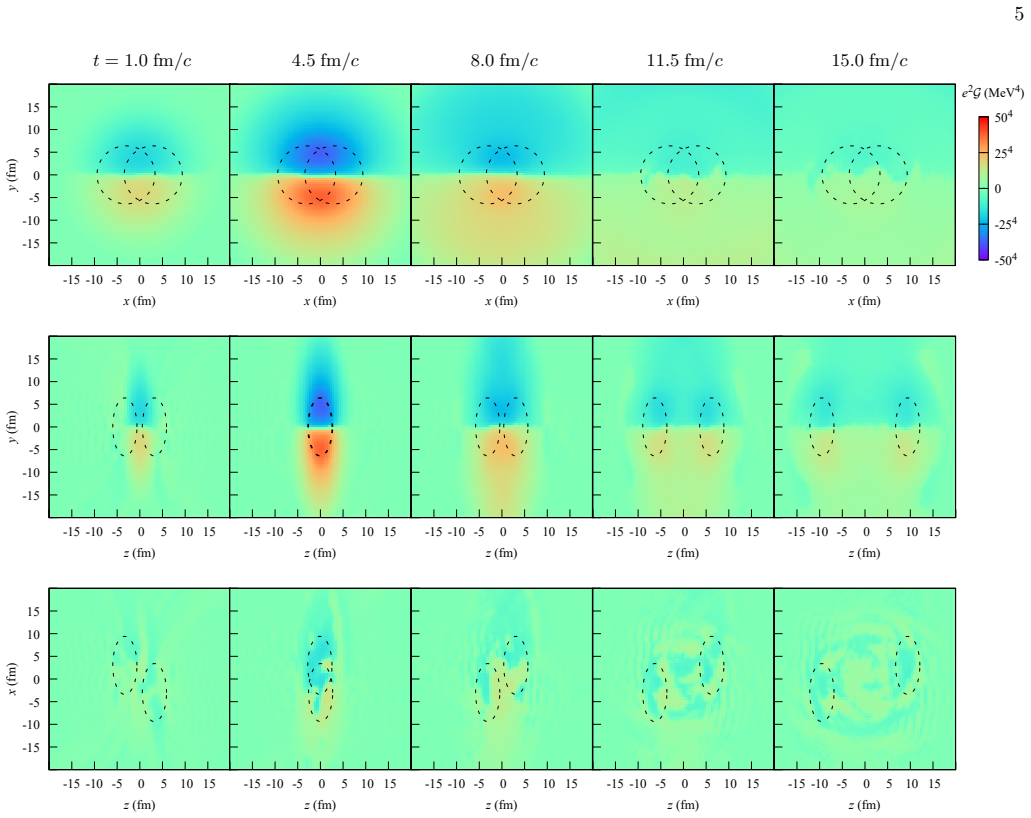
JAM (Jet AA Microscopic transport model), a hadronic cascade that tracks resonances, string excitation, and mini-jets, generates the charged-hadron phase-space distributions that define the source current $J^\mu$ through a relativistic Gaussian smearing function. From that current the fields are computed as the retarded (Liénard--Wiechert) fields of the charges, and the event average over $N=100$ events produces the smooth spacetime profile. The interpretive load is carried by the Lorentz invariants $F=E^2-B^2$ and $G=\boldsymbol{E}\cdot\boldsymbol{B}$: $F>0$ marks electric-dominated regions, $F<0$ marks magnetic-dominated ones, and a nonzero $G$ detects the topological configuration. Spacetime volumes $V_4$ defined by thresholds such as $F>\max F/4$ (roughly the half-maximum of the field strength) convert the profile into the headline numbers $(50\ {\rm MeV})^2$ and $(10\ {\rm fm})^4$.
What would settle it
Run the same JAM-generated currents through Maxwell's equations coupled to a conducting medium with $\boldsymbol{J}=\sigma(\boldsymbol{E}+\boldsymbol{v}\times\boldsymbol{B})$ and a realistic $\sigma$ for baryon-rich matter; if at $\sqrt{s_{\rm NN}}=4.5\ {\rm GeV}$ and $b=6\ {\rm fm}$ the electric field is screened within about $1\ {\rm fm}/c$, so that $V_4[F>\max F/4]$ falls well below $(10\ {\rm fm})^4$, then the paper's central quantitative claims are falsified.
Extended reading notes
Core claim
On the paper's own terms, the discovery is a complete spacetime portrait of the event-averaged electromagnetic field in non-central gold-gold collisions at intermediate energies. The field reaches $eE, eB = \mathcal{O}((50\ {\rm MeV})^2)$ at the moment of maximum overlap and decays on a timescale of $1$--$10\ {\rm fm}/c$, long enough to matter. The strong-field region has four-volume $V_4 = \mathcal{O}((10\ {\rm fm})^4)$, with $V_4[F>\max F/4]\gg V_4[F<\min F/4]$ at every impact parameter considered, so the electric field occupies most of the spacetime. The magnetic field, generated by the rotating charged matter via Ampère's law, dominates only in a small neighborhood of the collision point; its strength exceeds the electric field only for $b\gtrsim 6\ {\rm fm}$. Finally, because the radially directed Coulomb field is not orthogonal to the $-y$ magnetic field, $\boldsymbol{E}\cdot\boldsymbol{B}\neq 0$ with a sign that flips between $y>0$ and $y<0$ and survives event averaging. The paper presents this as the quantitative basis for assessing strong-field QED, chiral-anomaly, and electromagnetic-background effects in intermediate-energy collisions.
Load-bearing premise
The load-bearing premise, acknowledged in Sec. IV, is that the dense baryonic matter produced in the collision does not react back on the field: the simulation computes the vacuum retarded field of the JAM currents with no electric conductivity or screening, so if the medium shorts out the electric field on a sub-fm/c timescale, the claimed $(10\ {\rm fm})^4$ volume and electric dominance shrink.
Editorial extensions
If this is right
- Dilepton and photon predictions at beam-energy-scan energies should be recomputed with this full spacetime profile rather than a short-lived magnetic spike; the paper estimates that a naive Schwinger-formula excess of low-momentum dileptons would appear near the 50 MeV field scale.
- Charge-dependent directed flow at intermediate energies should carry the electric-field sign pattern (negative in forward rapidity for positive charge), opposite to the magnetic-field-driven pattern; the paper cites a 27 GeV STAR observation trending this way.
- The nonzero E·B provides a chirality-imbalance source through the ABJ anomaly that is not averaged away, so chiral magnetic and chiral vortical effects acquire a sign structure tied to the reaction plane.
- The electric field supplies energy to the system that a magnetic field cannot, and its energy density is comparable to the matter energy density, so if it is screened the field energy is transferred to the charged constituents and can produce charge-dependent flow.
- Spin-polarization observables such as Λ hyperon polarization gain new contributions from spin-orbit coupling to the electric field and from the chiral anomaly, making spin measurements a possible probe of the field structure.
Reading between the lines
- A natural next step is to feed the JAM field profile into a dynamical simulation with finite electric conductivity and Ohm's law J = σ(E + v × B); the paper's own order-of-magnitude argument implies the electric-field volume would shrink below (10 fm)^4 if σ is sizable, so this gives a sharp boundary for the central claims.
- Because the fields are strongly inhomogeneous in both space and time, the locally-constant-field approximation used in most Schwinger-pair estimates is questionable here; applying more sophisticated methods for inhomogeneous fields, such as worldline or exact-WKB techniques, to the JAM profile would yield a concrete prediction for the low-momentum dilepton excess the paper tentatively attributes t
- The sign-flipping E·B structure survives event averaging, unlike the randomly oriented chirality source invoked at high energies; if that alternation persists in individual events, reaction-plane-selected event samples could give a cleaner search for chiral effects.
- The paper's estimate of roughly 20 percent event-by-event baryon-density fluctuations suggests similar field fluctuations; a direct event-by-event computation of the spacetime volumes V4 would show whether the impact-parameter insensitivity seen for G survives averaging or is an artifact of it.
Editorial analysis
A structured set of objections, weighed in public.
Referee Report
Summary. The paper estimates the spacetime-dependent electromagnetic field produced in Au+Au collisions at sqrt(s_NN)=2.4-7.7 GeV and impact parameters b=0-9 fm, using the JAM hadronic cascade to construct the electric current and the vacuum retarded-potential formula to compute event-averaged E and B fields. The abstract and Sec. III advance four central claims: (1) field strengths eE and eB of order (50 MeV)^2; (2) a spacetime four-volume of order (10 fm)^4; (3) electric-field dominance over most of spacetime with magnetic-field localization near the collision zone; and (4) a topological configuration with E dot B nonzero in the event-averaged field. Section IV discusses implications for chiral-anomaly phenomena, electric screening, and event-by-event fluctuations. The numerical strategy is transparent, uses a publicly available transport code, and contains no fitted parameters in the field calculation itself; the scaling laws in Eqs. (8)-(14) are explicitly empirical fits.
Significance. If the central claims are correct, this would be a valuable first mapping of electromagnetic-field profiles in the intermediate-energy regime that is the focus of current and planned beam-energy-scan programs. The qualitative result that the electric field dominates in spacetime volume at these energies would shift emphasis away from the purely magnetic-field picture inherited from RHIC/LHC studies, and it has concrete consequences for dilepton, photon, flow, and spin observables. The use of realistic JAM currents and retarded fields, with a single smearing width and no physics parameters fitted to the final observables, is a strength, and the paper is reproducible in principle. However, the event-averaged E dot B used in the chiral-anomaly discussion is not the quantity that sources chirality in individual events, and the quantitative volume claims contain a dimensional inconsistency and lack statistical uncertainties. These issues need to be resolved before the strongest phenomenological conclusions can be accepted.
major comments (4)
- [Sec. III A, Eq. (5); Sec. IV, Event-by-event fluctuations] The quantity plotted in Fig. 3 and used for claim (4) is G = <E_n> dot <B_n>, the product of event-averaged fields. The ABJ anomaly sources chirality through E_n dot B_n separately in each event, so the physically relevant ensemble average is <E_n dot B_n> = <E_n> dot <B_n> + <delta E_n dot delta B_n>. The fluctuation term is never computed, and the paper itself states in Sec. IV that event-by-event fluctuations are 'not small in general'. A nonzero sign structure in the mean-field product therefore does not by itself establish that intermediate-energy collisions provide a nonzero topological source for chiral phenomena; the manuscript should compute <E_n dot B_n> directly from the JAM events and show that the covariance term is subdominant and has the same sign. This is a load-bearing internal mismatch between the computed quantity and the physical quantity claimed, and it can be resolved with the author's own simulation.
- [Eqs. (12)-(14), Figs. 6 and 7] The spacetime volume V4 is defined as a four-dimensional integral in Eq. (11), so its dimension is fm^4, yet Eqs. (12)-(14) present fits of the form V4 = (2.7 fm) + (27 fm) * (sqrt(s_NN)/1 GeV)^(-1), which is dimensionally inconsistent: one cannot add a length to a length. If the fit is actually for the fourth root of V4, or if the intended expression is (a fm)^4 + (b fm)^4 / sqrt(s_NN), the notation must be corrected and the resulting values reconciled with the abstract's V4 = O((10 fm)^4). As written, the quantitative support for claim (2) is not well defined.
- [Secs. III C and III D, Eqs. (8)-(14)] The paper reports empirical fits for the peak values of F and G and for the spacetime volumes without any statistical uncertainties or goodness-of-fit measures. Only N = 100 events are used, and Sec. IV estimates event-by-event fluctuations of order 20%. The coefficients in Eqs. (8)-(14) therefore cannot be taken as precise quantitative predictions, and comparisons with future calculations or experiments will require error bars or confidence bands. This is not a fatal flaw for the qualitative claims, but it is necessary for the scaling laws to be usable.
- [Sec. IV, Electric conductivity; abstract and Sec. III] The claim of electric-field dominance and the large electric-field spacetime volume is obtained with the produced field treated as propagating in vacuum, with back-reaction from the dense baryonic matter neglected. The paper acknowledges this in Sec. IV and explains that electric conductivity would tend to screen the electric field and shorten its lifetime. Because the abstract and Sec. III present the electric dominance and V4 = O((10 fm)^4) as demonstrated results, the discussion should either include a quantitative estimate of the screening timescale at the relevant baryon densities or explicitly present claims (2) and (3) as vacuum-field estimates whose medium sensitivity is an open question. As it stands, the central phenomenological emphasis on the electric field is stronger than the calculation alone supports.
minor comments (5)
- [Eq. (11)] The definitions of V4[G > max G/4] and V4[G < min G/4] use the threshold conditions G > max F/4 and G < min F/4; these appear to be typos for max G/4 and min G/4, respectively, and should be corrected for reproducibility.
- [Sec. III B] The statements 'max F is approximately max E^2' and 'min F is approximately -max B^2' should be used with care, since F = E^2 - B^2 does not separate into independent maxima and minima unless one field is negligible in the relevant region; a short clarifying sentence would help.
- [Sec. III A, Fig. 1] The figure captions indicate slices at z = 0, x = 0, and y = 0, but the color scale ranges and the black dashed circles are not fully described; adding a note that the dashed circles show the free-streaming spectator positions would make the plots easier to interpret.
- [Throughout] There are minor typographical issues, including 'organized as follow' in Sec. I and the use of 'Amp` ere' in the introduction and Sec. III; these should be cleaned up in revision.
- [Sec. IV] The paragraph on the starting time of the JAM simulation is useful, but the estimate t_coll = (1.5 + 12.8 m_N / sqrt(s_NN)) fm/c should be defined more explicitly so that readers can reproduce the conversion from the JAM initialization condition.
Circularity Check
No circularity: the field profiles are direct outputs of JAM plus retarded-potential simulation, and every scaling law is explicitly presented as a fit rather than a prediction.
full rationale
The paper's central claims (peak field strength, spacetime volume, electric versus magnetic dominance, and nonzero E·B) are direct numerical outputs of a transparent pipeline: JAM currents in Eq. (1), Gaussian smearing in Eq. (2), retarded potentials in Eqs. (3)-(4), and event averaging in Eq. (5). No parameter is fitted to the quantity that is later called a prediction. The scaling laws in Eqs. (8)-(14) are explicitly introduced as numerical fits ('I find numerically that maxF can be fit well with a simple function of the form...'), so they do not masquerade as independent predictions. The method is self-cited from the author's previous paper [36], but it is restated in Section II and rests on standard formulas and the externally maintained JAM code; the citation is not used to forbid alternatives or to import an unverified uniqueness theorem. The known physics concern that the physically relevant chiral-anomaly source is the per-event product E_n·B_n rather than ⟨E_n⟩·⟨B_n⟩ is a correctness or interpretation issue noted in the discussion of event-by-event fluctuations, not a circular reduction: the paper does not define the claimed quantity in terms of itself, nor does it fit an input and rename it as an output. Therefore no circular step is established by the quoted equations, and the paper is self-contained as a simulation study.
Assumptions & free parameters
free parameters (3)
- Gaussian smearing width σ =
1 fm
- Number of events N =
100
- Empirical fit coefficients in Eqs. (8) to (14) =
various (e.g., (23 MeV)^4, (2.7 fm)^4)
assumptions (4)
- domain assumption JAM with default settings (no mean field or hydro) provides a realistic spacetime distribution of charged hadrons in intermediate-energy heavy-ion collisions.
- domain assumption The electromagnetic field is the vacuum retarded field of the JAM current, with no back-reaction, screening, or conductivity effects.
- domain assumption Relativistic Gaussian smearing with width σ = 1 fm gives an adequate charge-density representation, and event averaging removes sensitivity to σ.
- domain assumption Event averaging over N = 100 events yields a smooth, representative field profile.
Cite this review
Pith. "Pith review of Spacetime profile of electromagnetic fields in intermediate-energy heavy-ion collisions." pith.science (2026). https://pith.science/paper/23LAJQII
@misc{pith2026250118171,
  author       = {Pith},
  title        = {Pith review of: Spacetime profile of electromagnetic fields in intermediate-energy heavy-ion collisions},
  year         = {2026},
  howpublished = {\url{https://pith.science/paper/23LAJQII}},
  note         = {Machine review of arXiv:2501.18171}
}
abstract
I numerically estimate the spacetime profile of the electromagnetic fields produced in intermediate-energy heavy-ion collisions at $\sqsNN=2.4\,\mathchar`-\,7.7\;{\rm GeV}$ for a wide range of impact parameters $b=0\,\mathchar`-\,9\;{\rm fm}$, using a hadronic cascade model, JAM (Jet AA Microscopic transport model). I demonstrate that (1) the produced electromagnetic fields are as strong as $eE, eB = {\mathcal O}((50\;{\rm MeV})^2)$; (2) that the produced fields extend in spacetime about $V_4 = {\mathcal O}((10\;{\rm fm})^4)$; (3) that the magnetic field dominates around the collision point, while the other broad regions of spacetime are dominated by the electric field; and (4) that a topological electromagnetic-field configuration such that ${\bm E}\cdot {\bm B} \neq 0$ is realized.
Figures


Figures from the paper (7 more)


Forward citations
Cited by 1 Pith paper
-
Fluid Acceleration in Heavy-Ion Collisions
In AMPT and UrQMD simulations, fluid acceleration in heavy-ion collisions reaches a few hundred MeV, peaks at fireball boundaries, and evolves from stopping-dominated deceleration at low energies to boundary/tilt puls...
Reference graph
Works this paper leans on
-
[1]
K. Hattori and X.-G. Huang, Novel quantum phenomena induced by strong magnetic fields in heavy-ion collisions, Nucl. Sci. Tech. 28, 26 (2017), arXiv:1609.00747 [nucl- th]
arXiv 2017
-
[2]
V. Voronyuk, V. D. Toneev, W. Cassing, E. L. Bratkovskaya, V. P. Konchakovski, and S. A. Voloshin, 12 t = 1.0 fm/c 4.5 fm/c 8.0 fm/c 11.5 fm/c 15.0 fm/c -15 -10 -5 0 5 10 15 x (fm) -15 -10 -5 0 5 10 15 y (fm) -502 -252 0 252 502 eEx (MeV2) t = 1.0 fm/c at z = 0.0 fm -15 -10 -5 0 5 10 15 x (fm) -15 -10 -5 0 5 10 15 y (fm) -502 -252 0 252 502 eEx (MeV2) t =...
arXiv 2011
-
[3]
A. Bzdak and V. Skokov, Event-by-event fluctuations of magnetic and electric fields in heavy ion collisions, Phys. Lett. B 710, 171 (2012), arXiv:1111.1949 [hep-ph]
arXiv 2012
-
[4]
W.-T. Deng and X.-G. Huang, Event-by-event generation of electromagnetic fields in heavy-ion collisions, Phys. 14 t = 1.0 fm/c 4.5 fm/c 8.0 fm/c 11.5 fm/c 15.0 fm/c -15 -10 -5 0 5 10 15 z (fm) -15 -10 -5 0 5 10 15 x (fm) -502 -252 0 252 502 eEx (MeV2) t = 1.0 fm/c at y = 0.0 fm -15 -10 -5 0 5 10 15 z (fm) -15 -10 -5 0 5 10 15 x (fm) -502 -252 0 252 502 eE...
arXiv 2012
-
[5]
Synchrotron radiation by fast fermions in heavy-ion collisions
K. Tuchin, Synchrotron radiation by fast fermions in heavy-ion collisions, Phys. Rev. C82, 034904 (2010), [Er- ratum: Phys.Rev.C 83, 039903 (2011)], arXiv:1006.3051 [nucl-th]. 15
work page Pith review arXiv 2010
-
[6]
L. McLerran and V. Skokov, Comments About the Elec- tromagnetic Field in Heavy-Ion Collisions, Nucl. Phys. A 929, 184 (2014), arXiv:1305.0774 [hep-ph]
arXiv 2014
- [7]
-
[8]
Tuchin, Initial value problem for magnetic fields in heavy ion collisions, Phys
K. Tuchin, Initial value problem for magnetic fields in heavy ion collisions, Phys. Rev. C 93, 014905 (2016), arXiv:1508.06925 [hep-ph]
arXiv 2016
Show all 82 references
-
[9]
Li, X.-l
H. Li, X.-l. Sheng, and Q. Wang, Electromagnetic fields with electric and chiral magnetic conductivities in heavy ion collisions, Phys. Rev. C 94, 044903 (2016), arXiv:1602.02223 [nucl-th]
2016 arXiv
-
[10]
Stewart and K
E. Stewart and K. Tuchin, Continuous evolution of elec- tromagnetic field in heavy-ion collisions, Nucl. Phys. A 1016, 122308 (2021), arXiv:2106.09124 [nucl-th]
2021 arXiv
-
[11]
N. J. Benoit, T. Miyoshi, C. Nonaka, and H. R. Taka- hashi, Investigating the effects of QCD matter’s electrical conductivity on charge dependent directed flow, (2025), arXiv:2502.04611 [nucl-th]
2025 arXiv
-
[12]
D. E. Kharzeev, L. D. McLerran, and H. J. Warringa, The Effects of topological charge change in heavy ion collisions: ’Event by event P and CP violation’, Nucl. Phys. A 803, 227 (2008), arXiv:0711.0950 [hep-ph]
2008 arXiv
-
[13]
Fukushima, D
K. Fukushima, D. E. Kharzeev, and H. J. Warringa, The Chiral Magnetic Effect, Phys. Rev. D 78, 074033 (2008), arXiv:0808.3382 [hep-ph]
2008 arXiv
-
[14]
J. O. Andersen, W. R. Naylor, and A. Tranberg, Phase diagram of QCD in a magnetic field: A review, Rev. Mod. Phys. 88, 025001 (2016), arXiv:1411.7176 [hep-ph]
2016 arXiv
-
[15]
D’Elia, L
M. D’Elia, L. Maio, F. Sanfilippo, and A. Stanzione, Phase diagram of QCD in a magnetic background, Phys. Rev. D 105, 034511 (2022), arXiv:2111.11237 [hep-lat]
2022 arXiv
-
[16]
Adhikari et al., Strongly interacting matter in extreme magnetic fields, (2024), arXiv:2412.18632 [nucl-th]
P. Adhikari et al., Strongly interacting matter in extreme magnetic fields, (2024), arXiv:2412.18632 [nucl-th]
2024 arXiv
-
[17]
Di Piazza, C
A. Di Piazza, C. Muller, K. Z. Hatsagortsyan, and C. H. Keitel, Extremely high-intensity laser interactions with fundamental quantum systems, Rev. Mod. Phys. 84, 1177 (2012), arXiv:1111.3886 [hep-ph]
2012 arXiv
-
[18]
Fedotov, A
A. Fedotov, A. Ilderton, F. Karbstein, B. King, D. Seipt, H. Taya, and G. Torgrimsson, Advances in QED with intense background fields, Phys. Rept. 1010, 1 (2023), arXiv:2203.00019 [hep-ph]
2023 arXiv
-
[19]
Aaboud et al
M. Aaboud et al. (ATLAS), Evidence for light-by- light scattering in heavy-ion collisions with the ATLAS detector at the LHC, Nature Phys. 13, 852 (2017), arXiv:1702.01625 [hep-ex]
2017 arXiv
-
[20]
Adam et al
J. Adam et al. (STAR), Measurement of e+e− Momen- tum and Angular Distributions from Linearly Polarized Photon Collisions, Phys. Rev. Lett. 127, 052302 (2021), arXiv:1910.12400 [nucl-ex]
2021
-
[21]
J. D. Brandenburg, J. Seger, Z. Xu, and W. Zha, Report on progress in physics: observation of the Breit–Wheeler process and vacuum birefringence in heavy-ion collisions, Rept. Prog. Phys. 86, 083901 (2023), arXiv:2208.14943 [hep-ph]
2023 arXiv
-
[22]
G¨ ursoy, D
U. G¨ ursoy, D. Kharzeev, E. Marcus, K. Rajagopal, and C. Shen, Charge-dependent Flow Induced by Magnetic and Electric Fields in Heavy Ion Collisions, Phys. Rev. C 98, 055201 (2018), arXiv:1806.05288 [hep-ph]
2018 arXiv
-
[23]
M. I. Abdulhamid et al. (STAR), Observation of the electromagnetic field effect via charge-dependent di- rected flow in heavy-ion collisions at the Relativistic Heavy Ion Collider, Phys. Rev. X 14, 011028 (2024), arXiv:2304.03430 [nucl-ex]
2024
-
[24]
A. P. Dash, Exploring Electromagnetic Field Effects and Constraining Transport Parameters of QGP using STAR BES-II data, (2024), arXiv:2401.04838 [nucl-ex]
2024 arXiv
-
[25]
H. Taya, A. Jinno, M. Kitazawa, and Y. Nara, Optimal collision energy for realizing macroscopic high baryon- density matter, (2024), arXiv:2409.07685 [hep-ph]
2024 arXiv
-
[26]
Aparin (STAR Collaboration), STAR Experiment Re- sults From Beam Energy Scan Program, Phys
A. Aparin (STAR Collaboration), STAR Experiment Re- sults From Beam Energy Scan Program, Phys. Atom. Nucl. 86, 758 (2023)
2023
-
[27]
https://shine.web.cern.ch/
-
[28]
https://nica.jinr.ru/
-
[29]
https://fair-center.de/
-
[30]
https://english.imp.cas.cn/research/facilities/ HIAF/
-
[31]
https://asrc.jaea.go.jp/soshiki/gr/hadron/ jparc-hi/index.html
-
[32]
Galatyuk, Future facilities for high µB physics, Nucl
T. Galatyuk, Future facilities for high µB physics, Nucl. Phys. A 982, 163 (2019)
2019
-
[33]
Ou and B.-A
L. Ou and B.-A. Li, Magnetic effects in heavy-ion colli- sions at intermediate energies, Phys. Rev. C 84, 064605 (2011), arXiv:1107.3192 [nucl-th]
2011 arXiv
-
[34]
Y. Sun, Y. Wang, Q. Li, and F. Wang, Effect of internal magnetic field on collective flow in heavy ion collisions at intermediate energies, Phys. Rev. C 99, 064607 (2019), arXiv:1905.12492 [nucl-th]
2019 arXiv
-
[35]
G.-F. Wei, C. Liu, X.-W. Cao, Q.-J. Zhi, W.-J. Xiao, C.-Y. Long, and Z.-W. Long, Necessity of self-consistent calculations for the electromagnetic field in probing the nuclear symmetry energy using pion observables in heavy-ion collisions, Phys. Rev. C 103, 054607 (2021), arXi...
2021 arXiv
-
[36]
H. Taya, T. Nishimura, and A. Ohnishi, Estimation of electric field in intermediate-energy heavy-ion collisions, Phys. Rev. C 110, 014901 (2024), arXiv:2402.17136 [hep- ph]
2024 arXiv
-
[37]
A. K. Panda, P. Bagchi, H. Mishra, and V. Roy, Electro- magnetic fields in low-energy heavy-ion collisions with baryon stopping, Phys. Rev. C 110, 024902 (2024), arXiv:2404.08431 [nucl-th]
2024 arXiv
-
[38]
Siddique, A
I. Siddique, A. Huang, M. Huang, and M. A. Wasaye, Dynamical Electromagnetic fields and Dynamical Elec- tromagnetic Anomaly in heavy ion collisions at interme- diate energies (2025), arXiv:2501.11328 [nucl-th]
2025 arXiv
-
[39]
Nishimura, M
T. Nishimura, M. Kitazawa, and T. Kunihiro, Anoma- lous enhancement of dilepton production as a precursor of color superconductivity, PTEP 2022, 093D02 (2022), arXiv:2201.01963 [hep-ph]
2022 arXiv
-
[40]
Savchuk, A
O. Savchuk, A. Motornenko, J. Steinheimer, V. Vovchenko, M. Bleicher, M. Gorenstein, and T. Galatyuk, Enhanced dilepton emission from a phase transition in dense matter, J. Phys. G 50, 125104 (2023), arXiv:2209.05267 [nucl-th]
2023 arXiv
-
[41]
Nishimura, M
T. Nishimura, M. Kitazawa, and T. Kunihiro, Enhance- ment of dilepton production rate and electric conductiv- ity around the QCD critical point, PTEP 2023, 053D01 (2023), arXiv:2302.03191 [hep-ph]
2023 arXiv
-
[42]
Nishimura, Y
T. Nishimura, Y. Nara, and J. Steinheimer, En- hanced Dilepton production near the color supercon- ducting phase and the QCD critical point, (2023), arXiv:2311.14135 [hep-ph]
2023 arXiv
-
[43]
J. W. Yoon, Y. G. Kim, I. W. Choi, J. H. Sung, H. W. Lee, S. K. Lee, and C. H. Nam, Realization of laser in- 16 tensity over 1023 w/cm2, Optica 8, 630 (2021)
2021
-
[44]
eli-np.ro/whitebook.php
The white paper of ELI can be find at https://www. eli-np.ro/whitebook.php
-
[45]
Y. Nara, N. Otuka, A. Ohnishi, K. Niita, and S. Chiba, Study of relativistic nuclear collisions at AGS energies from p + Be to Au + Au with hadronic cascade model, Phys. Rev. C 61, 024901 (2000), arXiv:nucl-th/9904059
2000 arXiv
-
[46]
The latest version of JAM (JAM2) is publically available at https://gitlab.com/transportmodel/jam2
-
[47]
Wolter et al
H. Wolter et al. (TMEP), Transport model comparison studies of intermediate-energy heavy-ion collisions, Prog. Part. Nucl. Phys. 125, 103962 (2022), arXiv:2202.06672 [nucl-th]
2022
-
[48]
Fuchs and H
C. Fuchs and H. H. Wolter, The Relativistic Landau- Vlasov method in heavy ion collisions, Nucl. Phys. A589, 732 (1995)
1995
-
[49]
Oliinychenko and H
D. Oliinychenko and H. Petersen, Deviations of the Energy-Momentum Tensor from Equilibrium in the Initial State for Hydrodynamics from Trans- port Approaches, Phys. Rev. C 93, 034905 (2016), arXiv:1508.04378 [nucl-th]
2016 arXiv
-
[50]
Deng, X.-G
X.-G. Deng, X.-G. Huang, Y.-G. Ma, and S. Zhang, Vor- ticity in low-energy heavy-ion collisions, Phys. Rev. C 101, 064908 (2020), arXiv:2001.01371 [nucl-th]
2020 arXiv
-
[51]
H. Taya, H. Fujii, and K. Itakura, Finite pulse effects on e+e− pair creation from strong electric fields, Phys. Rev. D 90, 014039 (2014), arXiv:1405.6182 [hep-ph]
2014 arXiv
-
[52]
S. L. Adler, Axial vector vertex in spinor electrodynam- ics, Phys. Rev. 177, 2426 (1969)
1969
-
[53]
J. S. Bell and R. Jackiw, A PCAC puzzle: π0 → γγ in the σ model, Nuovo Cim. A 60, 47 (1969)
1969
-
[54]
Fukushima, D
K. Fukushima, D. E. Kharzeev, and H. J. Warringa, Real- time dynamics of the Chiral Magnetic Effect, Phys. Rev. Lett. 104, 212001 (2010), arXiv:1002.2495 [hep-ph]
2010 arXiv
-
[55]
H. J. Warringa, Dynamics of the Chiral Magnetic Effect in a weak magnetic field, Phys. Rev. D86, 085029 (2012), arXiv:1205.5679 [hep-th]
2012 arXiv
-
[56]
Copinger, K
P. Copinger, K. Fukushima, and S. Pu, Axial Ward iden- tity and the Schwinger mechanism – Applications to the real-time chiral magnetic effect and condensates, Phys. Rev. Lett. 121, 261602 (2018), arXiv:1807.04416 [hep- th]
2018 arXiv
-
[57]
Taya, Dynamically assisted Schwinger mechanism and chirality production in parallel electromagnetic field, Phys
H. Taya, Dynamically assisted Schwinger mechanism and chirality production in parallel electromagnetic field, Phys. Rev. Res. 2, 023257 (2020), arXiv:2003.08948 [hep- ph]
2020 arXiv
-
[58]
Fukushima, Y
K. Fukushima, Y. Hidaka, T. Shimazaki, and H. Taya, Chiral anomaly in a (1+1)-dimensional Floquet system under high-frequency electric fields, Annals Phys. 458, 169494 (2023), arXiv:2305.11432 [hep-ph]
2023 arXiv
-
[59]
Akamatsu and N
Y. Akamatsu and N. Yamamoto, Chiral Plasma In- stabilities, Phys. Rev. Lett. 111, 052002 (2013), arXiv:1302.2125 [nucl-th]
2013 arXiv
-
[60]
D. E. Kharzeev, J. Liao, and P. Tribedy, Chiral magnetic effect in heavy ion collisions: The present and future, Int. J. Mod. Phys. E 33, 2430007 (2024), arXiv:2405.05427 [nucl-th]
2024 arXiv
-
[61]
Adamczyk et al
L. Adamczyk et al. (STAR), Beam-energy dependence of charge separation along the magnetic field in Au+Au collisions at RHIC, Phys. Rev. Lett. 113, 052302 (2014), arXiv:1404.1433 [nucl-ex]
2014 arXiv
-
[62]
Aboona et al.(STAR), Search for the Chiral Magnetic Effect in Au+Au collisions at √sNN = 27 GeV with the STAR forward Event Plane Detectors, Phys
B. Aboona et al.(STAR), Search for the Chiral Magnetic Effect in Au+Au collisions at √sNN = 27 GeV with the STAR forward Event Plane Detectors, Phys. Lett. B839, 137779 (2023), arXiv:2209.03467 [nucl-ex]
2023
-
[63]
Xu (STAR), Search for the chiral magnetic and vorti- cal effects using event shape approaches in Au+Au col- lisions at STAR, EPJ Web Conf
Z. Xu (STAR), Search for the chiral magnetic and vorti- cal effects using event shape approaches in Au+Au col- lisions at STAR, EPJ Web Conf. 296, 04010 (2024), arXiv:2401.00317 [nucl-ex]
2024 arXiv
-
[64]
Huang and J
X.-G. Huang and J. Liao, Axial Current Generation from Electric Field: Chiral Electric Separation Effect, Phys. Rev. Lett. 110, 232302 (2013), arXiv:1303.7192 [nucl-th]
2013 arXiv
-
[65]
Jiang, X.-G
Y. Jiang, X.-G. Huang, and J. Liao, Chiral electric sep- aration effect in the quark-gluon plasma, Phys. Rev. D 91, 045001 (2015), arXiv:1409.6395 [nucl-th]
2015 arXiv
-
[66]
Lappi and L
T. Lappi and L. McLerran, Some features of the glasma, Nucl. Phys. A 772, 200 (2006), arXiv:hep-ph/0602189
2006 arXiv
-
[67]
Sauter, Uber das Verhalten eines Elektrons im homo- genen elektrischen Feld nach der relativistischen Theorie Diracs, Z
F. Sauter, Uber das Verhalten eines Elektrons im homo- genen elektrischen Feld nach der relativistischen Theorie Diracs, Z. Phys. 69, 742 (1931)
1931
-
[68]
J. S. Schwinger, On gauge invariance and vacuum polar- ization, Phys. Rev. 82, 664 (1951)
1951
-
[69]
S. S. Bulanov, N. B. Narozhny, V. D. Mur, and V. S. Popov, On e+ e- pair production by a focused laser pulse in vacuum, Phys. Lett. A 330, 1 (2004), arXiv:hep- ph/0403163
2004
-
[70]
I. A. Aleksandrov, G. Plunien, and V. M. Shabaev, Locally-constant field approximation in studies of electron-positron pair production in strong external fields, Phys. Rev. D 99, 016020 (2019), arXiv:1811.01419 [hep-ph]
2019 arXiv
-
[71]
D. G. Sevostyanov, I. A. Aleksandrov, G. Plunien, and V. M. Shabaev, Total yield of electron-positron pairs pro- duced from vacuum in strong electromagnetic fields: Va- lidity of the locally constant field approximation, Phys. Rev. D 104, 076014 (2021), arXiv:2012.10751 [hep-ph]
2021 arXiv
-
[72]
Brezin and C
E. Brezin and C. Itzykson, Pair production in vacuum by an alternating field, Phys. Rev. D 2, 1191 (1970)
1970
-
[73]
G. V. Dunne and C. Schubert, Worldline instantons and pair production in inhomogeneous fields, Phys. Rev. D 72, 105004 (2005), arXiv:hep-th/0507174
2005 arXiv
-
[74]
H. Taya, T. Fujimori, T. Misumi, M. Nitta, and N. Sakai, Exact WKB analysis of the vacuum pair pro- duction by time-dependent electric fields, JHEP 03, 082, arXiv:2010.16080 [hep-th]
2010 arXiv
-
[75]
Niida and S
T. Niida and S. A. Voloshin, Polarization phenomenon in heavy-ion collisions, Int. J. Mod. Phys. E 33, 2430010 (2024), arXiv:2404.11042 [nucl-ex]
2024 arXiv
-
[76]
Huang, Electromagnetic fields and anomalous transports in heavy-ion collisions — A pedagogi- cal review, Rept
X.-G. Huang, Electromagnetic fields and anomalous transports in heavy-ion collisions — A pedagogi- cal review, Rept. Prog. Phys. 79, 076302 (2016), arXiv:1509.04073 [nucl-th]
2016 arXiv
-
[77]
Astrakhantsev, V
N. Astrakhantsev, V. V. Braguta, M. D’Elia, A. Y. Ko- tov, A. A. Nikolaev, and F. Sanfilippo, Lattice study of the electromagnetic conductivity of the quark-gluon plasma in an external magnetic field, Phys. Rev. D 102, 054516 (2020), arXiv:1910.08516 [hep-lat]
2020 arXiv
-
[78]
Aarts and A
G. Aarts and A. Nikolaev, Electrical conductivity of the quark-gluon plasma: perspective from lattice QCD, Eur. Phys. J. A 57, 118 (2021), arXiv:2008.12326 [hep-lat]
2021 arXiv
-
[79]
Almirante, N
G. Almirante, N. Astrakhantsev, V. V. Braguta, M. D’Elia, L. Maio, M. Naviglio, F. Sanfilippo, and A. Trunin, Electrical conductivity of the quark-gluon plasma in the presence of strong magnetic fields, Phys. Rev. D 111, 034505 (2025), arXiv:2406.18504 [hep-lat]
2025 arXiv
-
[80]
Taya and C
H. Taya and C. Ironside, Kramers-Kr¨ onig approach to the electric permittivity of the vacuum in a strong con- stant electric field, Phys. Rev. D 108, 096005 (2023), 17 arXiv:2308.11248 [hep-ph]
2023 arXiv
-
[81]
W. Li, S. Lin, and J. Mei, Conductivities of magnetic quark-gluon plasma at strong coupling, Phys. Rev. D 98, 114014 (2018), arXiv:1809.02178 [hep-th]
2018 arXiv
-
[82]
Ghosh and I
R. Ghosh and I. A. Shovkovy, Electrical conductivity of hot relativistic plasma in a strong magnetic field, Phys. Rev. D 110, 096009 (2024), arXiv:2404.01388 [hep-ph]
2024 arXiv
Reviewed August 10, 2026 · model on record in the stance chip above.
Discussion (0). Continue with ORCID to comment.