REVIEW 4 major objections 4 minor 1 cited by
Permuted Charged Lepton Correction in the Framework of Dirac Seesaw
T0 review · 4 major / 4 minor · reviewed 2026-08-10 · deepseek-v4-flash
Pith's one-line read This paper claims that a Dirac Type I seesaw with an A4 flavour symmetry and permuted charged-lepton rotations pins the solar mixing parameter sin^2 θ12 to a 0.001-wide band around 0.34 while enforcing one massless neutrino.
desk verdict A competent but derivative A4 Dirac seesaw exercise whose headline solar-angle prediction is not a prediction: it is a scan over a free parameter cut by the experimental upper bound, and the whole texture rests on an undefended VEV alignment. read the letter →
The pith
A machine-rendered reading of the paper's core claim, the machinery that carries it, and where it could break.
The reading
What carries the argument
The carrier of the argument is the hermitian combination H_ν = M_ν M_ν^†, which under the assumed VEV alignments (0, k1, k2) v_ϕ and (0, f1, f2) v_χ takes the block form H_ν = diag(a, [[b, $\sqrt$(bc) $e^{{-iρ}}$], [$\sqrt$(bc) $e^{{iρ}}$, c]]). This texture produces two viable diagonalizing matrices, U_ν1 (normal hierarchy) and U_ν3 (inverted hierarchy), each giving one zero mass eigenvalue. The charged lepton side supplies 18 permuted variants of U_L from row and column exchanges; the paper shows that 12 of the 18 combinations with each U_ν satisfy current data, and that the analytic expressions for the mixing angles then squeeze $sin^{2}$ θ12 into the 0.340–0.341 interval.
What would settle it
Measure $sin^{2}$ θ12 with uncertainty below 0.001 (for example from next-generation reactor or solar neutrino data); if the central value falls outside [0.340, 0.341], the surviving model set is excluded. A second decisive test would be a precise limit on the lightest neutrino mass, since the model requires m1 = 0 in normal ordering or m3 = 0 in inverted ordering, and any observation of a non-zero lightest mass would falsify the strict hierarchy prediction.
Extended reading notes
Core claim
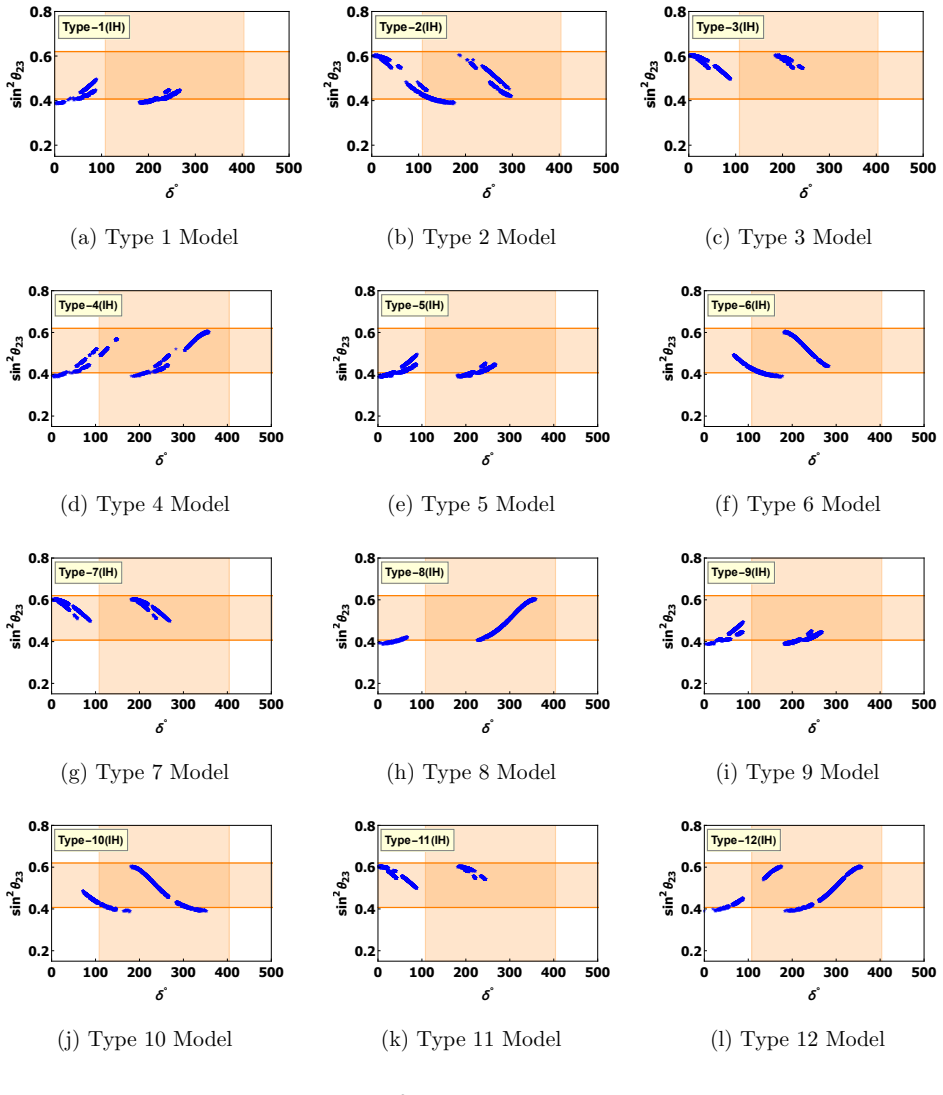
The central claim is that permuting rows and columns of the charged lepton diagonalizing matrix U_L—an operation allowed because the charged lepton masses are free parameters—materially changes the predictions of the neutrino sector, and that most permutations are excluded by data. On its own terms, the paper establishes that with the VEV alignment leading to H_ν = diag(a, [[b, $\sqrt$(bc) $e^{{-iρ}}$], [$\sqrt$(bc) $e^{{iρ}}$, c]]) and the two surviving neutrino rotations U_ν1 and U_ν3, the PMNS matrix built as U = U_L^† U_ν predicts $sin^{2}$ θ12 to lie between about 0.340 and 0.341 for every valid model, in both normal and inverted ordering. It also claims strict hierarchies with one massless neutrino (m_1 = 0 for NH, m_3 = 0 for IH) and absolute masses bounded near 0.0082–0.009 eV and 0.049–0.052 eV, with θ23 octant and δ patterns varying by permutation type.
Load-bearing premise
The entire predictive structure rests on the assumed vacuum alignments (0, k1, k2) for ϕ and (0, f1, f2) for χ; the paper does not derive these from a scalar potential, and other alignments fill the neutrino mass matrix completely, destroying the correlations and the massless neutrino.
Editorial extensions
If this is right
- sin^2 θ12 would be measured near 0.34 rather than the current best-fit value, making the solar angle the model's sharpest discriminator.
- One neutrino mass eigenvalue is exactly zero, so the mass ordering is strict and the sum of neutrino masses is bounded by the predicted m2 and m3 values.
- The θ23 octant is fixed by which U_L permutation is realized, so determining the octant would select among the 12 models.
- The Dirac CP phase δ is not free: it is determined by the input parameters and displays forbidden gaps in correlation plots with sin^2 θ23.
- CLFV branching ratios in this model are essentially independent of the charged-lepton permutation, so they test the Yukawa structure rather than the PCLC mechanism.
Reading between the lines
- If the sharp solar-angle prediction survives, next-generation reactor and solar neutrino experiments with sub-0.001 precision on sin^2 θ12 could confirm or exclude the model; this is the most direct test, though the paper does not perform that projection.
- The predictive power is concentrated in the assumed VEV alignments; a scalar-potential derivation of those alignments would be needed to decide whether the 0.340–0.341 band is a robust consequence or an artifact of the ansatz.
- The permutation technique is transferable: any discrete-flavour model with free mass parameters could enumerate permuted diagonalizing matrices to see whether data favour one basis ordering, effectively promoting a basis ambiguity into a phenomenological handle.
- A measured non-zero mass for the would-be massless state, or a cosmological sum constraint inconsistent with a zero eigenvalue, would falsify the strict hierarchy claim.
Editorial analysis
A structured set of objections, weighed in public.
Referee Report
Summary. The manuscript proposes a Dirac seesaw model based on SU(2)_L × U(1)_Y × A_4 × Z_3 × Z_10, with two additional scalars and a heavy singlet, and assumes specific vacuum alignments for the new scalars to obtain a neutrino mass texture H_ν = diag(a, [[b, √(bc)e^{-iρ}], [√(bc)e^{iρ}, c]]). It then enumerates 18 permuted variants of the charged-lepton diagonalizing matrix and 6 permuted variants of the neutrino diagonalizing matrix, selects those giving positive Δm^2_{21} and acceptable θ13, and presents analytical formulas for observables as functions of sin^2θ13, Δm^2_{21}, Δm^2_{31}, and ρ. The numerical analysis claims that the model predicts sin^2θ12 ≈ 0.340–0.341 for both mass hierarchies, together with specific θ23 octants, absolute masses around 0.0087 eV and 0.05 eV, and a massless neutrino. The final sections sketch charged-lepton flavour violation and dark matter applications.
Significance. The systematic enumeration of row and column permutations of U_L and U_ν is instructive, and the analytic Type-1 formulas are explicit enough to be checked. However, the advertised sharp solar-mixing prediction is not a genuine model prediction: the reported sin^2θ12 interval sits at the experimental 3σ upper bound and is obtained by scanning the free parameter cosρ and then discarding points outside the allowed region. The declared absolute-mass predictions also reduce to the input mass-squared differences. Finally, the entire predictive texture depends on vacuum alignments that are assumed without a scalar-potential analysis, as the paper itself acknowledges in Eq. (7). If the central claims were sound, this A_4-based Dirac seesaw would be of interest to the flavour model community, but the present manuscript does not establish them.
major comments (4)
- [II.A, Eq. (6)] The texture H_ν = diag(a, [[b, √(bc)e^{-iρ}], [√(bc)e^{iρ}, c]]) is obtained only for the specific VEV alignments (0,k1,k2)^T vϕ and (0,f1,f2)^T vχ, which are assumed without any scalar-potential minimization. The paper itself states that different alignments lead to a fully populated H_ν (Eq. (7)) and hence to different predictions. Since every quantitative result in Sec. III follows from this texture, the assumed alignment is load-bearing and must be justified by a symmetry or by explicit minimization of the scalar potential; otherwise the model's parameter space contains generic VEVs for which none of the reported predictions survive.
- [II.D, Eqs. (24)-(25)] The five 'standard parametrization conditions' in Eqs. (24) and (25) are stated without derivation. These conditions are used to fix the unphysical phases η_i and enter the extraction of δ and the mixing angles from Eqs. (22)–(23). To make the analysis reproducible, the paper should show that these conditions are necessary and sufficient for U_std to take the PDG form of Eq. (21), or at least derive them from the matching of matrix elements.
- [III, Eqs. (16)-(17) and (22)-(23)] The claimed predictions for the absolute neutrino masses are largely circular. For NH, Eq. (22) gives a = Δm^2_{21}, so m2 = √a is simply the input solar mass-squared difference, and m3 = √(b+c) is essentially the atmospheric mass-squared difference rescaled by the free parameter ρ. The analogous statement holds for IH. Reporting these as predictions of the model, rather than as reconstructions of the inputs, overstates what the framework determines.
- [III, first bullet and Figs. 1, 7] The reported interval 0.340 ≤ sin^2θ12 ≤ 0.341 is claimed to be a sharp prediction for all 12 model types, but it coincides with the current experimental 3σ upper bound. Since the procedure scans cosρ freely over [-1,1] and then excludes points for which sin^2θ12 lies outside the experimental range, the surviving points saturate the experimental boundary by construction. A genuine prediction would require a theoretical prior on ρ or a fixed value; without that, the sharp interval is an artifact of the data-cut, not a falsifiable model prediction.
minor comments (4)
- [II.A, Eq. (5)] The 33 entry of M_ν is typeset ambiguously: the phase and magnitude should be clearly separated, e.g., as [z1w1/s1] e^{i(z2+w2-s2)} rather than a single garbled fraction.
- [II.A] There is a typo in the sentence 'The groupZ3 prevents a Majarona mass term'; 'Majarona' should be 'Majorana', and spacing after 'group' and before 'Z3' should be fixed.
- [III] The correlation plots (e.g., Figs. 2 and 4) are extremely dense scatterplots with largely illegible axis labels and no quantitative error bands; the captions should clarify which points are retained after the experimental cuts, since those cuts are essential to the claimed sin^2θ12 range.
- [IV] The statement that PCLC has no significant effect on CLFV branching ratios is asserted after Eq. (30), but the invariance under the 18 U_L permutations is not demonstrated; a compact one-line argument for why the sum over i in Eq. (28) transforms covariantly would help.
Circularity Check
Mass predictions reduce by construction to the input mass-squared differences, and the sharp sin^2 theta12 range is obtained by cutting the scan with the experimental bound on sin^2 theta12 itself.
-
fitted input called prediction
[Sec. II.D Eqs. (16), (22); Sec. III Numerical Analysis, mass bullet]
"If we diagonalize Mν with Uν1, we get a strict normal hierarchy (NH) of neutrino masses, with the masses given below, m1 = 0, m2 = √a, m3 = √b + c. ... a = ∆m2 21 ... For NH, we have approximately 0.0082eV < m2 < 0.009eV, 0.049eV < m3 < 0.051eV."
The paper lists the three neutrino masses among its predictions, but the defining equations make them equal to the input mass-squared differences. Eq. (22) sets a = Δm^2_21, and b + c = Δm^2_31 from the definitions of b and c; Eq. (16) then gives m2 = √a = √(Δm^2_21) and m3 = √(b+c) = √(Δm^2_31). The quoted 'predicted absolute NH masses' are therefore just the square roots of the 3σ ranges for Δm^2_21 and Δm^2_31 that were fed into the scan. The IH case is identical: Eq. (17) gives m1 = √(b+c) = √(−Δm^2_31) and m2 = √a = √(Δm^2_21−Δm^2_31), again direct input conversions. No model-dependent relation is needed; the 'prediction' is the input by construction.
-
fitted input called prediction
[Sec. III Numerical Analysis, first bullet and Fig. 1 caption/text]
"For both NH and IH, our work predicts a very sharp range of values for sin^2 θ12. We have found, for all types of models under NH and IH, the minimum value at 0.340 approximately and the maximum value at 0.341 approximately. ... the data points corresponding to cos ρ that yield sin^2 θ12 outside the experimental range are excluded from subsequent plots."
The 'predicted' sin^2 θ12 interval is not an independent output of the model. The scan treats ρ as a free parameter over the full range cos ρ ∈ [−1,1], and the paper then discards every computed point whose sin^2 θ12 falls outside the experimental 3σ band. The surviving set is therefore cut at the experimental upper bound of sin^2 θ12, and the reported maximum, 0.341, coincides with that bound. Thus the sharp range is an artifact of imposing the experimental constraint on the very quantity presented as a prediction, rather than a model-derived restriction. The figure itself shows points with sin^2 θ12 spread over a wider interval before the experimental cut is applied.
full rationale
The central derivation chain is largely algebraic: the Hν texture in Eq. (6), the diagonalizing matrices Uν1/Uν3, and the standard-parametrization formulas in Eqs. (22)-(25) are self-contained given the assumed VEV alignments. However, two of the paper's explicit 'predictions' reduce to inputs by the paper's own equations. First, the predicted absolute masses are exactly the square roots of the input Δm^2_21 and Δm^2_31 values, because Eq. (16) sets m2 = √a and m3 = √(b+c) while Eq. (22) sets a = Δm^2_21 and b+c = Δm^2_31. Second, the touted sharp sin^2 θ12 range 0.340-0.341 is obtained after excluding all points that fall outside the experimental sin^2 θ12 band, so the maximum is inherited from the experimental upper bound rather than from the model. The VEV alignment assumption (0,k1,k2)vφ and (0,f1,f2)vχ is a genuine model assumption, not circularity, although it is load-bearing: the paper itself notes in Eq. (7) that other alignments give a fully populated Hν and hence different predictions. There is no self-citation chain or imported uniqueness theorem; the circularity is confined to the fitted-input-as-prediction steps.
Assumptions & free parameters
free parameters (4)
- rho (cos rho scan) =
scanned over [-1,1]
- neutrino sector parameters a, b, c =
functions of sin^2 theta13, Delta m^2_21, Delta m^2_31, rho
- charged lepton masses m_Li and phases kappa_i =
physical e, mu, tau masses; phases absorbed
- VEVs and mass scale m_N =
not specified numerically
assumptions (5)
- domain assumption VEV alignments (0,k1,k2) for phi and (0,f1,f2) for chi
- domain assumption Dirac seesaw formula M_nu = B M^{-1} D with m_N as the only heavy scale
- domain assumption Z3 and Z10 symmetries forbid unwanted tree-level mass terms and Majorana masses
- domain assumption The standard parametrization conditions (Eqs. 24-25) admit a solution for the unphysical phases eta_i
- standard math The five unphysical phases can always be removed by the PDG-standard rephasing
invented entities (3)
-
Heavy Dirac singlet fermion N (N_L, N_R)
-
Right-handed neutrinos nu_R
-
Scalar fields phi and chi
Cite this review
Pith. "Pith review of Permuted Charged Lepton Correction in the Framework of Dirac Seesaw." pith.science (2026). https://pith.science/paper/66J2N762
@misc{pith2026250118181,
  author       = {Pith},
  title        = {Pith review of: Permuted Charged Lepton Correction in the Framework of Dirac Seesaw},
  year         = {2026},
  howpublished = {\url{https://pith.science/paper/66J2N762}},
  note         = {Machine review of arXiv:2501.18181}
}
abstract
A Dirac neutrino mass model is proposed, based on an extended group structure of $SU(2)_L \otimes U(1)_Y \otimes A_4 \otimes Z_3 \otimes Z_{10}$ with the Type-I seesaw mechanism. This work explores the impact of parametrization and permutation in the charged lepton diagonalizing matrix, driven by free parameters in the charged lepton sector, on the predictions of observable parameters. Some interesting consequences on the neutrino mass hierarchies, mixing angles and the Dirac CP phase are observed. The framework also finds application in the study of charged lepton flavour violation and dark matter.
Figures


Figures from the paper (10 more)




Forward citations
Cited by 1 Pith paper
-
A Novel Neutrino Mass Matrix
A neutrino mass matrix texture with correlations m12=m13 and m33=2i m12 is claimed to fix the hierarchy, octant, and CP phases, but the supporting model and RG analysis are incomplete.
Reference graph
Works this paper leans on
-
[1]
Pontecorvo, Mesonium and anti-mesonium, Sov
B. Pontecorvo, Mesonium and anti-mesonium, Sov. Phys. JETP 6, 429 (1957). lxi
work page 1957
-
[2]
R. Davis, Jr., D. S. Harmer, and K. C. Hoffman, Search for neutrinos from the sun, Phys. Rev. Lett. 20, 1205 (1968)
work page 1968
-
[3]
Q. R. Ahmad et al. (SNO), Measurement of the rate of νe + d → p + p + e− interactions produced by 8B solar neutrinos at the Sudbury Neutrino Observatory, Phys. Rev. Lett. 87, 071301 (2001), arXiv:nucl-ex/0106015
arXiv 2001
-
[4]
S. Fukuda et al. (Super-Kamiokande), Solar B-8 and hep neutrino measurements from 1258 days of Super-Kamiokande data, Phys. Rev. Lett. 86, 5651 (2001), arXiv:hep-ex/0103032
arXiv 2001
-
[5]
Q. R. Ahmad et al. (SNO), Direct evidence for neutrino flavor transformation from neutral current interactions in the Sudbury Neutrino Observatory, Phys. Rev. Lett.89, 011301 (2002), arXiv:nucl-ex/0204008
arXiv 2002
-
[6]
R. M. Bionta et al., Observation of a Neutrino Burst in Coincidence with Supernova SN 1987a in the Large Magellanic Cloud, Phys. Rev. Lett. 58, 1494 (1987)
work page 1987
-
[7]
Fukuda et al.(Super-Kamiokande), Evidence for oscillation of atmospheric neutrinos, Phys
Y. Fukuda et al.(Super-Kamiokande), Evidence for oscillation of atmospheric neutrinos, Phys. Rev. Lett. 81, 1562 (1998), arXiv:hep-ex/9807003
arXiv 1998
-
[8]
K. Eguchi et al. (KamLAND), First results from KamLAND: Evidence for reactor anti- neutrino disappearance, Phys. Rev. Lett. 90, 021802 (2003), arXiv:hep-ex/0212021
arXiv 2003
Show all 49 references
-
[9]
F. P. An et al. (Daya Bay), Observation of electron-antineutrino disappearance at Daya Bay, Phys. Rev. Lett. 108, 171803 (2012), arXiv:1203.1669 [hep-ex]
2012 arXiv
-
[10]
M. H. Ahn et al. (K2K), Indications of neutrino oscillation in a 250 km long baseline experi- ment, Phys. Rev. Lett. 90, 041801 (2003), arXiv:hep-ex/0212007
2003 arXiv
-
[11]
Abe et al
K. Abe et al. (T2K), Indication of Electron Neutrino Appearance from an Accelerator- produced Off-axis Muon Neutrino Beam, Phys. Rev. Lett.107, 041801 (2011), arXiv:1106.2822 [hep-ex]
2011 arXiv
-
[12]
Abe et al.(T2K), Observation of Electron Neutrino Appearance in a Muon Neutrino Beam, Phys
K. Abe et al.(T2K), Observation of Electron Neutrino Appearance in a Muon Neutrino Beam, Phys. Rev. Lett. 112, 061802 (2014), arXiv:1311.4750 [hep-ex]
2014 arXiv
-
[13]
K. S. Hirata et al.(Kamiokande-II), Observation of B-8 Solar Neutrinos in the Kamiokande-II Detector, Phys. Rev. Lett. 63, 16 (1989)
1989
-
[14]
Xing, Flavor structures of charged fermions and massive neutrinos, Phys
Z.-z. Xing, Flavor structures of charged fermions and massive neutrinos, Phys. Rept. 854, 1 (2020), arXiv:1909.09610 [hep-ph]
2020 arXiv
-
[15]
Minkowski, µ → eγ at a Rate of One Out of 10 9 Muon Decays?, Phys
P. Minkowski, µ → eγ at a Rate of One Out of 10 9 Muon Decays?, Phys. Lett. B 67, 421 (1977). lxii
1977
-
[16]
Ramond, The Family Group in Grand Unified Theories, in International Symposium on Fundamentals of Quantum Theory and Quantum Field Theory(1979) arXiv:hep-ph/9809459
P. Ramond, The Family Group in Grand Unified Theories, in International Symposium on Fundamentals of Quantum Theory and Quantum Field Theory(1979) arXiv:hep-ph/9809459
1979 arXiv
-
[17]
Gell-Mann, P
M. Gell-Mann, P. Ramond, and R. Slansky, Complex Spinors and Unified Theories, Conf. Proc. C 790927, 315 (1979), arXiv:1306.4669 [hep-th]
1979 arXiv
-
[18]
Yanagida, Horizontal gauge symmetry and masses of neutrinos, Conf
T. Yanagida, Horizontal gauge symmetry and masses of neutrinos, Conf. Proc. C 7902131, 95 (1979)
1979
-
[19]
R. N. Mohapatra and G. Senjanovic, Neutrino Mass and Spontaneous Parity Nonconservation, Phys. Rev. Lett. 44, 912 (1980)
1980
-
[20]
Weinberg, Baryon and Lepton Nonconserving Processes, Phys
S. Weinberg, Baryon and Lepton Nonconserving Processes, Phys. Rev. Lett. 43, 1566 (1979)
1979
-
[21]
Y. Cai, J. Herrero-Garc ´ ıa, M. A. Schmidt, A. Vicente, and R. R. Volkas, From the trees to the forest: a review of radiative neutrino mass models, Front. in Phys. 5, 63 (2017), arXiv:1706.08524 [hep-ph]
2017 arXiv
-
[22]
Barabash, Double Beta Decay Experiments: Recent Achievements and Future Prospects, Universe 9, 290 (2023)
A. Barabash, Double Beta Decay Experiments: Recent Achievements and Future Prospects, Universe 9, 290 (2023)
2023
-
[23]
Roy and O
P. Roy and O. U. Shanker, Observable Neutrino Dirac Mass and Supergrand Unification, Phys. Rev. Lett. 52, 713 (1984), [Erratum: Phys.Rev.Lett. 52, 2190 (1984)]
1984
-
[24]
Centelles Chuli´ a, E
S. Centelles Chuli´ a, E. Ma, R. Srivastava, and J. W. F. Valle, Dirac Neutrinos and Dark Matter Stability from Lepton Quarticity, Phys. Lett. B 767, 209 (2017), arXiv:1606.04543 [hep-ph]
2017 arXiv
-
[25]
Centelles Chuli´ a, R
S. Centelles Chuli´ a, R. Srivastava, and J. W. F. Valle, Generalized Bottom-Tau unification, neutrino oscillations and dark matter: predictions from a lepton quarticity flavor approach, Phys. Lett. B 773, 26 (2017), arXiv:1706.00210 [hep-ph]
2017 arXiv
-
[26]
Bonilla, J
C. Bonilla, J. M. Lamprea, E. Peinado, and J. W. F. Valle, Flavour-symmetric type-II Dirac neutrino seesaw mechanism, Phys. Lett. B 779, 257 (2018), arXiv:1710.06498 [hep-ph]
2018 arXiv
-
[27]
Borah and B
D. Borah and B. Karmakar, Linear seesaw for Dirac neutrinos with A4 flavour symmetry, Phys. Lett. B 789, 59 (2019), arXiv:1806.10685 [hep-ph]
2019 arXiv
-
[28]
Chen and P.-H
S.-P. Chen and P.-H. Gu, Undemocratic Dirac seesaw, Nucl. Phys. B 985, 116028 (2022), arXiv:2210.05307 [hep-ph]
2022 arXiv
-
[29]
Borah and B
D. Borah and B. Karmakar, A4 flavour model for Dirac neutrinos: Type I and inverse seesaw, Phys. Lett. B 780, 461 (2018), arXiv:1712.06407 [hep-ph]
2018 arXiv
-
[30]
Mahapatra, S
S. Mahapatra, S. K. Sahoo, N. Sahu, and V. S. Thounaojam, Self-interacting dark matter and lxiii Dirac neutrinos via lepton quarticity, Phys. Rev. D 109, 055036 (2024), arXiv:2312.12322 [hep-ph]
2024 arXiv
-
[31]
Singh, M
L. Singh, M. Kashav, and S. Verma, Minimal type-I Dirac seesaw and leptogenesis under A4 modular invariance, Nucl. Phys. B 1007, 116666 (2024), arXiv:2405.07165 [hep-ph]
2024 arXiv
-
[32]
S. Dev, R. R. Gautam, and L. Singh, Charged Lepton Corrections to Scaling Neutrino Mixing, Phys. Rev. D 89, 013006 (2014), arXiv:1309.4219 [hep-ph]
2014 arXiv
-
[33]
Antusch and S
S. Antusch and S. F. King, Charged lepton corrections to neutrino mixing angles and CP phases revisited, Phys. Lett. B 631, 42 (2005), arXiv:hep-ph/0508044
2005 arXiv
-
[34]
Roy and N
S. Roy and N. N. Singh, Bi-Large neutrino mixing with charged lepton correction, Indian J. Phys. 88, 513 (2014), arXiv:1211.7207 [hep-ph]
2014 arXiv
-
[35]
S. Dev, S. Gupta, and R. Raman Gautam, Parametrizing the Lepton Mixing Matrix in terms of Charged Lepton Corrections, Phys. Lett. B 704, 527 (2011), arXiv:1107.1125 [hep-ph]
2011 arXiv
-
[36]
S. F. King, Unified Models of Neutrinos, Flavour and CP Violation, Prog. Part. Nucl. Phys. 94, 217 (2017), arXiv:1701.04413 [hep-ph]
2017 arXiv
-
[37]
Dey and S
M. Dey and S. Roy, Revisiting the Dirac Nature of Neutrinos in the Light of ∆(27) and Cyclic Symmetries 10.1088/1361-6471/ad9ec9 (2024), arXiv:2403.12461 [hep-ph]
2024 arXiv
-
[38]
Z. Maki, M. Nakagawa, and S. Sakata, Remarks on the unified model of elementary particles, Prog. Theor. Phys. 28, 870 (1962)
1962
-
[39]
Pontecorvo, Inverse beta processes and nonconservation of lepton charge, Zh
B. Pontecorvo, Inverse beta processes and nonconservation of lepton charge, Zh. Eksp. Teor. Fiz. 34, 247 (1957)
1957
-
[40]
Esteban, M
I. Esteban, M. C. Gonzalez-Garcia, M. Maltoni, T. Schwetz, and A. Zhou, The fate of hints: updated global analysis of three-flavor neutrino oscillations, JHEP 09, 178, arXiv:2007.14792 [hep-ph]
2007 arXiv
-
[41]
Esteban, M
I. Esteban, M. C. Gonzalez-Garcia, M. Maltoni, I. Martinez-Soler, J. a. P. Pinheiro, and T. Schwetz, NuFit-6.0: updated global analysis of three-flavor neutrino oscillations, JHEP 12, 216, arXiv:2410.05380 [hep-ph]
-
[42]
Navas et al
S. Navas et al. (Particle Data Group), Review of particle physics, Phys. Rev. D 110, 030001 (2024)
2024
-
[43]
Guo and Z.-L
S.-Y. Guo and Z.-L. Han, Observable Signatures of Scotogenic Dirac Model, JHEP 12, 062, arXiv:2005.08287 [hep-ph]
2005 arXiv
-
[44]
Abbasi et al.(IceCube), Search for neutrino lines from dark matter annihilation and decay lxiv with IceCube, Phys
R. Abbasi et al.(IceCube), Search for neutrino lines from dark matter annihilation and decay lxiv with IceCube, Phys. Rev. D 108, 102004 (2023), arXiv:2303.13663 [astro-ph.HE]
2023
-
[45]
Mori (MEG), Final Results of the MEG Experiment, Nuovo Cim
T. Mori (MEG), Final Results of the MEG Experiment, Nuovo Cim. C 39, 325 (2017), arXiv:1606.08168 [hep-ex]
2017 arXiv
-
[46]
Venturini (MEG II), The MEG II experiment: status and perspectives, PoS WIF AI2023, 016 (2024)
A. Venturini (MEG II), The MEG II experiment: status and perspectives, PoS WIF AI2023, 016 (2024)
2024
-
[47]
Venturini (MEG II), Status of the MEG II experiment: Searching for cLFV, Nuovo Cim
A. Venturini (MEG II), Status of the MEG II experiment: Searching for cLFV, Nuovo Cim. C 47, 287 (2024)
2024
-
[48]
Aubert et al
B. Aubert et al. (BaBar), Searches for Lepton Flavor Violation in the Decays tau+- — > e+- gamma and tau+- — > mu+- gamma, Phys. Rev. Lett. 104, 021802 (2010), arXiv:0908.2381 [hep-ex]
2010 arXiv
-
[49]
Ishimori, T
H. Ishimori, T. Kobayashi, H. Ohki, H. Okada, Y. Shimizu, and M. Tanimoto, An introduction to non-Abelian discrete symmetries for particle physicists, Vol. 858 (2012). lxv
2012
Reviewed August 10, 2026 · model on record in the stance chip above.
Discussion (0). Continue with ORCID to comment.