REVIEW 3 major objections 5 minor 15 references
Normalizing flows for SU($N$) gauge theories employing singular value decomposition
T0 review · 3 major / 5 minor · reviewed 2026-08-10 · deepseek-v4-flash
Pith's one-line read This paper proposes building gauge-equivariant normalizing flows for SU(N) lattice gauge theories by singular value decomposition of the staple sum around each link, so that the dressed link is exactly gauge invariant; a representative…
desk verdict SVD-of-staples is a real new idea for gauge-equivariant flows, but the equivariance proof has a typo and an unaddressed SVD-convention gap. read the letter →
The pith
A machine-rendered reading of the paper's core claim, the machinery that carries it, and where it could break.
The reading
What carries the argument
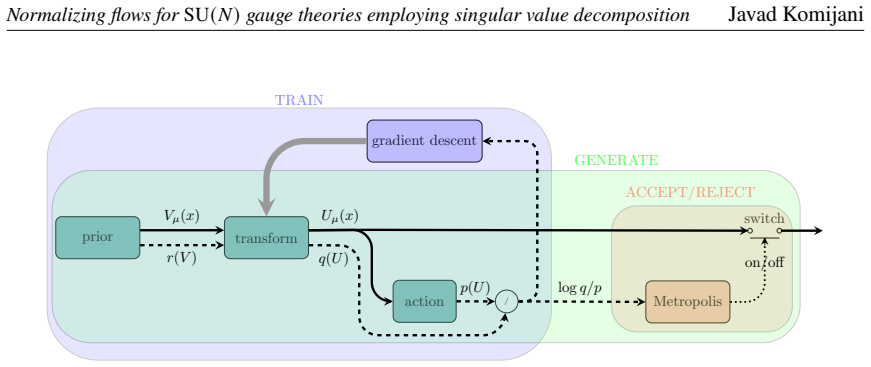
The central object is the SVD-based dressed link. The paper factorizes the staple sum Gamma_mu(x), the sum of all plaquette Wilson-loop staples adjacent to link U_mu(x), as W S V^dagger, and defines Utilde = V^dagger U W $e^{{-i phi}}$, with $e^{{i phi}}$ fixing SU(N). This object carries the argument because it packages the gauge-invariant combinations into a matrix that can itself be eigenvalue-decomposed; the flow then transforms the gauge-invariant spectral parameters ($\theta$, phi) and the modal matrix $\Omega$ with rational quadratic splines, leaving the gauge covariance of W and V untouched. Even/odd site masks in 2d sub-blocks make the transformation invertible.
What would settle it
Pick an SU(3) configuration, apply a nontrivial gauge transformation Q(x), and compare the dressed link Utilde computed from U with the dressed link computed from Q(x) U Q^dagger(x+mu): if they differ by more than the expected identity (or if the network output is not the gauge transform of the output on the original configuration), the SVD convention breaks equivariance. Testing this on configurations with degenerate singular values of Gamma will expose the phase ambiguity most sharply.
Extended reading notes
Core claim
The central discovery is that the singular values of the staple sum Gamma_mu(x) = W S V^dagger are gauge invariant, while the unitary factors W and V transform as W -> Q(x+mu)W and V -> VQ^dagger(x). Consequently the dressed link Utilde_mu(x) = V^dagger U_mu(x) W $e^{{-i phi}}$ is invariant under local gauge transformations. Expressing the Wilson action through this dressed link, as in Eqs. (17) and (18), leaves only gauge-invariant building blocks, so updating the eigenvalue phases Lambda and the modal matrix $\Omega$ and reconstructing the link through Eqs. (19) and (20) yields a gauge-equivariant map. Trained with the path-gradient estimator on SU(3), $\beta$ = 1, $4^{4}$, the representative 1288-parameter model surpasses the leading-order trivializing map after about 500 epochs, and stacking two blocks or prepending the trivializing map accelerates training.
Load-bearing premise
The construction assumes that the numerical SVD routine returns W and V with a fixed convention under which they transform as W -> Q W and V -> V Q^dagger for every gauge copy; SVD's phase and degenerate-subspace non-uniqueness must be pinned down, otherwise the dressed link is not actually gauge invariant and the equivariance guarantee collapses.
Editorial extensions
If this is right
- Any normalizing flow built from these blocks is gauge equivariant by construction, so the model cannot drift into gauge-fixed regions and does not need to learn the symmetry.
- Because each link update uses all adjacent staples simultaneously, no plaquette is passively updated; in d = 4 this removes five passive plaquette updates per link, which the paper identifies as the reason SVD-based flows outperform plaquette-based spectral flows in four dimensions.
- The construction is formulated for general SU(N) and simplifies for SU(2), where the phase e^{i phi} drops out and the singular-value matrix is proportional to the identity.
- Cascading transformation blocks, or using the leading-order trivializing map as a prior, increases the effective sample size and reduces the number of training epochs needed.
Reading between the lines
- Beyond the paper, the same dressing should apply whenever a link's action depends on a sum of gauge-covariant staples, for example anisotropic or improved actions, since only the covariance of Gamma under Q(x+mu)Gamma Q^dagger(x) was used.
- The gauge invariance of Utilde relies on the SVD factors following the transformation laws (13)-(15); the paper flags the non-uniqueness of W and V but does not specify how the convention is fixed, so a natural follow-up is to design a canonical SVD, with ordered singular values and a fixed phase convention, and test equivariance exactly.
- The comparison with plaquette-based spectral flow suggests the SVD construction will be progressively more advantageous in higher dimensions, where the number of passively updated plaquettes grows linearly with dimension; this scaling could be tested directly on 5D or 6D lattices.
- Because the flow gives an invertible, gauge-covariant map from Haar-random links toward the target action, it could also serve as a preconditioning map for Hybrid Monte Carlo proposals or as a generative sampler at larger beta without full retraining, though the paper does not address these uses.
Editorial analysis
A structured set of objections, weighed in public.
Referee Report
Summary. The manuscript is a LATTICE2024 proceedings contribution. It proposes a new class of gauge-equivariant normalizing-flow couplings for SU(N) lattice gauge theory based on the singular value decomposition of the staple sum Γμ(x). The flow dresses the link as Ũμ(x)=V†μ(x)Uμ(x)Wμ(x)e^{-iφμ(x)} and then transforms the spectral matrix Λ and modal matrix Ω of Ũ. Representative SU(3) models with one or two blocks and with a trivializing-map prior are trained on a 4^4 lattice at β=1; the reported effective sample sizes surpass the leading-order trivializing-map benchmark after roughly 500 epochs. The paper also contains a short discussion of trivializing maps and of the SU(2) and SU(3) spectral parametrizations.
Significance. If the construction were fully specified and its equivariance proven, the SVD-based layer would be a useful addition to the lattice normalizing-flow toolbox: unlike plaquette-based spectral flows, it updates a link using all adjacent staples, and the training curves in Fig. 4 indicate faster convergence than the parameter-free leading-order trivializing map. The paper is honest about the progress-report nature of the work and gives concrete training details such as the path-gradient estimator, batch sizes, and parameter count. However, the central equivariance proof is currently incomplete, and one of the two active components of the trained transformation (the modal-matrix map) is not specified, so the significance is conditional on those points being resolved.
major comments (3)
- [Section 3, Eq. (15)] The transformation law printed for V is inconsistent with the claimed gauge invariance of the dressed link. Under Eq. (6) the staple sum transforms as Γμ(x) → Q(x+μ̂)Γμ(x)Q†(x), so to obtain Ũ' = Ũ from Eq. (16) one needs Vμ(x) → Q(x)Vμ(x), not Vμ(x)Q†(x). With the printed law, V'†U'W' acquires an unwanted left factor Q(x), and Eq. (16) is not invariant. Please correct this equation.
- [Section 3, Eqs. (13)–(16)] Gauge invariance of Ũ is not guaranteed by the ordinary SVD because the decomposition Γ = W S V† is unique only up to right multiplication by a unitary D commuting with S. After a gauge transformation a numerical SVD routine will generally return W' = Q(x+μ̂)W D' and V' = Q(x)V D' with D' configuration-dependent; the dressed link then transforms as Ũ' = D'† Ũ D' (up to the phase φ), not as Ũ. The footnote in the manuscript acknowledges only the common-phase ambiguity, and no convention is specified or tested that would enforce D' = 1. Since the modal matrix Ω is extracted from Ũ, the subsequent equivariance of the transformations of Λ and Ω rests on an unproven assumption. Please either specify such a convention, prove that it exists, or recast the construction in terms of quantities that are genuinely invariant under the residual SVD ambiguity.
- [Section 3, after Eq. (18); Section 4] The transformation of the modal matrix Ω is a core component of the trained model, yet the text says only that its details will be discussed in follow-ups. Equations (19)–(20) and the ESS curves in Fig. 4 therefore describe an incompletely defined architecture: the reader cannot reproduce the runs or verify that the Ω update is equivariant. The final version should include a complete description of the Ω transformation used for the reported results, or else explicitly label the reported numbers as preliminary and remove the claim of a fully specified equivariant flow.
minor comments (5)
- [Abstract and Section 4] The abstract announces a comparison with the spectral flow of Wilson loops, but Fig. 4 compares only with the leading-order trivializing map; the statement in Section 4 that SVD-based models train better than plaquette-based spectral flows is not accompanied by a figure or a quantitative criterion. Please align the abstract with the results actually displayed.
- [Figure 4 caption] The batch size '16364' appears to be a typo for '16384'; please verify the value.
- [Reference [12]] The bibliographic entry for Ref. [12] is missing its title; please complete the reference.
- [Eq. (16) and surrounding text] The phase factor φμ(x) is not defined. Since det(V†μUμWμ) can be any phase for SU(N) with N>2, φ is fixed only up to a 2π/N branch choice, and this choice should be stated because it enters the action formula in Eq. (17).
- [Figure 1] The axis label 'log(p)' is ambiguous: with p ∝ e^{-S_W}, the plotted quantity should be −S_W up to a constant, not log p. Please relabel the axis or define the convention in the caption.
Circularity Check
No significant circularity: the SVD construction is an explicit equivariant parametrization, and the reported training results are benchmarked against a parameter-free trivializing map rather than fitted to the target.
full rationale
The paper's derivation chain is self-contained. The SVD building blocks are defined by Eqs. (11)-(16) directly from the staple sum; the claim that any transformation of the gauge-invariant spectral/modal components is gauge-equivariant follows from the displayed transformation laws (12)-(15), not from an assumed conclusion. The model is then trained by minimizing the KL divergence in Eq. (5) against the Wilson action, which is an external target, and the benchmark ('leading-order trivializing map... has no trainable parameters, and its ESS is approximately 1/2') is parameter-free and independent of the proposed model. The reported ESS improvements are empirical training results, not constants fitted to the target that are later called predictions. Self-citations appear only in peripheral contexts: Ref. [6] is cited for the general normalizing-flow block diagram ('See Ref. [6] for more information'), and Ref. [12] is cited as a comparable figure; neither carries the equivariance or performance argument. The footnote about non-uniqueness of W and V, and the footnote about non-uniqueness of the modal matrix, are limitations/correctness caveats about the SVD/EVD conventions, not circular reductions. The possible algebraic typo in Eq. (15) would be a mathematical consistency error, not a self-referential derivation, and therefore does not affect the circularity score.
Assumptions & free parameters
free parameters (1)
- trainable flow parameters (1288 weights) =
not disclosed
assumptions (4)
- standard math Every square matrix admits an SVD Γ = W S V† with W,V unitary and S diagonal with nonnegative entries.
- domain assumption The staple sum Γμ(x) transforms as Γμ(x) -> Q(x+μ) Γμ(x) Q†(x) under gauge transformations.
- ad hoc to paper A gauge-equivariant choice of SVD factors exists: W -> Q(x+μ) W, S -> S, V -> Q(x) V, including a consistent handling of phase and subspace ambiguities.
- ad hoc to paper The eigenvalue decomposition of the dressed link can be made gauge invariant and the modal matrix Ω can be transformed in a gauge-equivariant way.
Cite this review
Pith. "Pith review of Normalizing flows for SU($N$) gauge theories employing singular value decomposition." pith.science (2026). https://pith.science/paper/NB7WDFBO
@misc{pith2026250118288,
  author       = {Pith},
  title        = {Pith review of: Normalizing flows for SU($N$) gauge theories employing singular value decomposition},
  year         = {2026},
  howpublished = {\url{https://pith.science/paper/NB7WDFBO}},
  note         = {Machine review of arXiv:2501.18288}
}
abstract
We present a progress report on the use of normalizing flows for generating gauge field configurations in pure SU(N) gauge theories. We discuss how the singular value decomposition can be used to construct gauge-invariant quantities, which serve as the building blocks for designing gauge-equivariant transformations of SU(N) gauge links. Using this novel approach, we build representative models for the SU(3) Wilson action on a \( 4^4 \) lattice with \( \beta = 1 \). We train these models and provide an analysis of their performance, highlighting the effectiveness of the new technique for gauge-invariant transformations. We also provide a comparison between the efficiency of the proposed algorithm and the spectral flow of Wilson loops.
Figures


Figures from the paper (1 more)

Reference graph
Works this paper leans on
-
[1]
G.Kanwar,M.S.Albergo,D.Boyda,K.Cranmer,D.C.Hackett,S.Racanière,D.J.Rezende, and P. E. Shanahan, Phys. Rev. Lett.125, 121601 (2020), arXiv:2003.06413
arXiv 2020
-
[2]
D.Boyda,G.Kanwar,S.Racanière,D.J.Rezende,M.S.Albergo,K.Cranmer,D.C.Hackett, and P. E. Shanahan, Phys. Rev. D103, 074504 (2021), arXiv:2008.05456
arXiv 2021
-
[3]
G.Kanwar,in 40thInternationalSymposiumonLatticeFieldTheory (2024)arXiv:2401.01297 [hep-lat]
arXiv 2024
-
[4]
S. Bacchio, P. Kessel, S. Schaefer, and L. Vaitl, Phys. Rev. D 107, L051504 (2023), arXiv:2212.08469 [hep-lat]
arXiv 2023
-
[5]
M. Luscher, Commun. Math. Phys.293, 899 (2010), arXiv:0907.5491 [hep-lat]
arXiv 2010
-
[6]
J. Komijani and M. K. Marinkovic, PoSLATTICE2022, 019 (2023), arXiv:2301.01504 [hep-lat]
arXiv 2023
-
[7]
T. L. Curtright and C. K. Zachos, Reports on Mathematical Physics76, 401 (2015)
work page 2015
-
[8]
J. A. Gregory and R. Delbourgo, IMA Journal of Numerical Analysis 2, 123 (1982), https://academic.oup.com/imajna/article-pdf/2/2/123/2267745/2-2-123.pdf
work page 1982
Show all 15 references
-
[9]
Delbourgo and J
R. Delbourgo and J. A. Gregory, IMA Journal of Numerical Analysis 3, 141 (1983), https://academic.oup.com/imajna/article-pdf/3/2/141/1814220/3-2-141.pdf
1983
-
[10]
Durkan, A
C. Durkan, A. Bekasov, I. Murray, and G. Papamakarios, (2019), arXiv:1906.04032
2019 arXiv
-
[11]
Gradients should stay on path: Bet- ter estimators of the reverse- and forward kl divergence for normalizing flows,
L. Vaitl, K. A. Nicoli, S. Nakajima, and P. Kessel, “Gradients should stay on path: Bet- ter estimators of the reverse- and forward kl divergence for normalizing flows,” (2022), arXiv:2207.08219 [cs.LG]
2022 arXiv
-
[12]
Abbottet al., (2023), arXiv:2305.02402 [hep-lat]
R. Abbottet al., (2023), arXiv:2305.02402 [hep-lat]
2023 arXiv
-
[13]
Papamakarios, E
G. Papamakarios, E. Nalisnick, D. J. Rezende, S. Mohamed, and B. Lakshminarayanan, Journal of Machine Learning Research22, 1 (2021)
2021
-
[14]
M.S.Albergo,D.Boyda,D.C.Hackett,G.Kanwar,K.Cranmer,S.Racanière,D.J.Rezende, and P. E. Shanahan, (2021), arXiv:2101.08176 [hep-lat]
2021 arXiv
-
[15]
Del Debbio, J
L. Del Debbio, J. M. Rossney, and M. Wilson, Phys. Rev. D 104, 094507 (2021), arXiv:2105.12481 . 9
2021 arXiv
Reviewed August 10, 2026 · model on record in the stance chip above.
Discussion (0). Continue with ORCID to comment.