REVIEW 3 major objections 4 minor 68 references
Direct Implementation of High-Fidelity Three-Qubit Gates for Superconducting Processor with Tunable Couplers
T0 review · 3 major / 4 minor · reviewed 2026-08-09 · deepseek-v4-flash
Pith's one-line read A flip-chip superconducting processor can implement a three-qubit CCZ gate directly, reaching 97.94% state fidelity and 93.54% process fidelity.
desk verdict Solid flip-chip CCZ demonstration undercut by reporting that buries the more exhaustive 216-state QPT number (89.54% vs advertised 93.54%). read the letter →
The pith
A machine-rendered reading of the paper's core claim, the machinery that carries it, and where it could break.
The reading
What carries the argument
The central object is the engineered three-body interaction produced by the simultaneous Z pulses on the two couplers. During the first segment, the coupler frequencies are lowered with flat-top Gaussian pulses, bringing the $|111\rangle$ state into level repulsion with three-excitation states such as $|102\rangle$ and $|201\rangle$; this creates the effective three-body (ZZZ) coupling $\zeta_{123}$ while the pulse shape is chosen to suppress leakage. The load-bearing identity is $\varphi_{123}=\varphi_{12}+\varphi_{23}+\varphi_{13}+\varphi_{\rm CCZ}$, which lets the authors isolate the CCZ phase from the pairwise CPhase accumulations. The second segment applies two calibrated CPhase gates to cancel $\varphi_{12}$ and $\varphi_{23}$, and the operating point is chosen so that $\varphi_{\rm CCZ}=\pm\pi$ while the non-nearest-neighbor phase $\varphi_{13}$ is minimized. The calibration sequence—measuring leakage, CPhase, and CCPhase as functions of the two coupler pulse amplitudes—is what turns this identity into a working gate.
What would settle it
Perform three-qubit quantum process tomography on the first segment $U$ alone, before the compensation gates. If the diagonal phases of $U$ do not satisfy $\varphi_{123}=\varphi_{12}+\varphi_{23}+\varphi_{13}$ with $\varphi_{13}\approx0.0743$ rad (i.e., if there are non-additive cross terms or a substantially larger $\varphi_{13}$), then the second segment cannot cancel the unwanted pairwise phases and the calibrated operation is not the intended CCZ gate.
Extended reading notes
Core claim
The central claim is that the simultaneous, carefully calibrated excursion of two tunable couplers creates a genuine three-body interaction among three fixed-frequency transmons, and that this interaction is sufficient for a high-fidelity CCZ gate. In the first segment, flat-top Gaussian Z pulses move both couplers so that the $|111\rangle$ state undergoes level repulsion with other three-excitation states (chiefly $|102\rangle$), generating the three-body conditional phase while the pulse shape suppresses leakage. Because the measured total phase obeys $\varphi_{123}=\varphi_{12}+\varphi_{23}+\varphi_{13}+\varphi_{\rm CCZ}$, the unwanted pairwise phases $\varphi_{12}$ and $\varphi_{23}$ are removed by two subsequent CPhase gates, and the operating point is chosen so that the residual non-nearest-neighbor phase is only $\varphi_{13}\approx0.0743$ rad and the CCZ phase is $\pm\pi$. The experiment achieves an average final-state fidelity of 97.94%, a process fidelity of 93.54%, and a truth-table visibility of 96.52%, with decoherence identified as the main remaining error source.
Load-bearing premise
The scheme assumes that pulsing both couplers at once produces a total phase equal to the sum of the two pairwise phases and the three-body phase, with the non-nearest-neighbor phase small enough (about 0.0743 rad here) to ignore, so that two compensating CPhase gates leave a pure CCZ gate.
Editorial extensions
If this is right
- Three-qubit circuits on this architecture can be shortened to 256 ns per CCZ gate, versus roughly 640 ns for the eight-CNOT-plus-seven-T decomposition, reducing the time qubits spend decohering.
- Stacked or repeated CCZ gates (as in Grover iterations or multi-controlled operations) accumulate less leakage error when implemented directly, because the population stays in the computational subspace instead of cycling through the couplers.
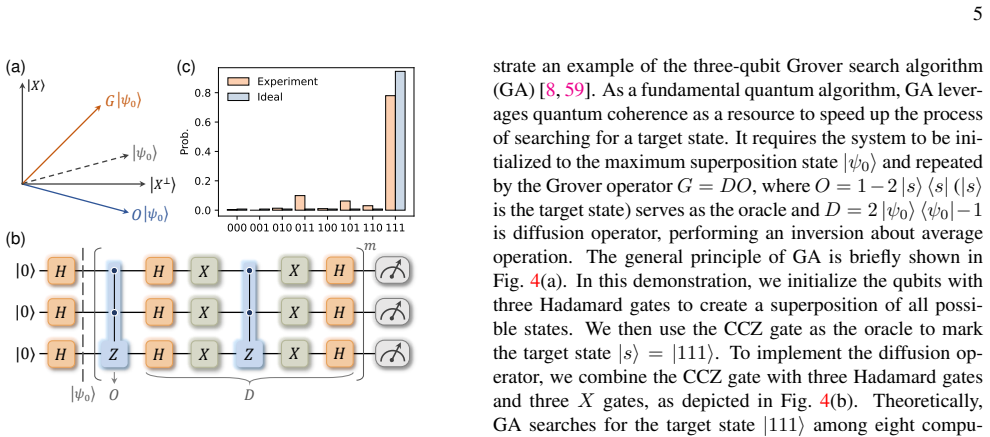
- The CCZ gate works as a native oracle for three-qubit Grover search, boosting the target-state probability above all others after two iterations, and it converts to a Toffoli gate with 92.83% truth-table visibility when flanked by Hadamards.
- If device coherence improves, the same pulse scheme should reach the simulated decoherence-free performance of 99.45% average state fidelity and 98.75% process fidelity, since the gap in the experiment is attributed to qubit decoherence.
Reading between the lines
- Testable extension: repeat the same two-coupler calibration on several triples across the 21-qubit chip; the architecture suggests the procedure is local and should transfer without redesign, but the paper only demonstrates one triple.
- Design inference: if $\varphi_{13}$ is actively nulled (by frequency arrangement or a small static-coupling compensation), the direct CCZ should approach the decoherence-free simulation value of 98.75% process fidelity without changing the pulse scheme.
- Algorithmic inference: because the gate is shorter and leaks less, it fits naturally into error-correction cycles that use three-qubit parity checks, where population loss out of the computational subspace is a dominant error channel; the paper does not test this application.
Editorial analysis
A structured set of objections, weighed in public.
Referee Report
Summary. The manuscript proposes and experimentally demonstrates a direct controlled-controlled-Z (CCZ) gate on a flip-chip superconducting processor with tunable couplers. The gate is implemented by simultaneously applying Z pulses to two couplers for 150 ns to generate a three-qubit conditional phase, followed by two CPhase gates that compensate the accumulated two-qubit conditional phases. The authors report an average final state fidelity of 97.94% and a process fidelity of 93.54% from QPT with 64 probe states, a truth-table visibility of 96.52%, lower leakage than a decomposed CNOT-based CCZ implementation, and a demonstration of the three-qubit Grover search algorithm using the CCZ gate as an oracle. The paper includes a time-dependent Hamiltonian simulation with Lindblad decoherence that reproduces the experimental χ-matrix with a maximum difference of 0.022.
Significance. If the central claims hold, the work is significant for the superconducting quantum computing community: it provides a direct three-qubit gate on a scalable flip-chip architecture with tunable couplers, a shorter gate duration than a standard decomposition, and a lower-leakage comparison. The paper's strengths include the machine-checked numerical simulation that closely matches the experimental process matrix, the use of independently characterized device parameters in the simulation, and the explicit perturbation-theory treatment of the effective two-body and three-body couplings. These elements make the demonstrated approach credible and reproducible. The main weaknesses are in the reporting and interpretation of the fidelity numbers, where the more exhaustive QPT results are omitted from the headline claims, and in the unsupported comparative statement about decomposed gates.
major comments (3)
- [Supplemental Sec. VI and Abstract/Conclusion] Supplemental Sec. VI reports a QPT using an overcomplete set of 216 probe states, yielding a process fidelity of 89.54% and an average state fidelity of 96.20%. The abstract and conclusion quote only the 64-state results (93.54% and 97.94%). Since the 216-state set is tomographically more exhaustive and therefore the more conservative estimate of the gate, the headline numbers overstate the actual performance. The authors should report both sets of numbers in the abstract and conclusion, discuss the 4% discrepancy in process fidelity, and either justify the choice of 64 states as the headline or adopt the more conservative 216-state values.
- [Fig. 3(b) and Fig. S8] The average final state fidelity of 97.94% repeated in the main text and abstract is not reproducible from the published truth-table data in Fig. S8: the average on-diagonal population of that matrix is approximately 96.6%. The authors should clarify the definition of this state fidelity, specify whether it includes phase information obtained from full state tomography of the computational basis states, and provide the underlying data in the same format as the truth table.
- [Main text, §3 and Supplemental Sec. VIII] The abstract's claim that this high fidelity 'cannot be achieved through a simple combination of single- and two-qubit gate sequences' is not substantiated by the reported comparison. For the decomposed CCZ gate, the authors provide only a truth-table visibility of 94.57% and an average state fidelity of 97.15% (Supplemental Sec. VIII); no process fidelity is reported. Given the interleaved randomized benchmarking fidelities of 99.46% for the q1q2 CZ gate and 99.59% for the q2q3 CZ gate, a simple multiplicative error estimate for eight CZ gates yields a process fidelity on the order of (0.995)^8 ≈ 96%, which is not obviously lower than the quoted 93.54% for the direct gate. The authors should measure or estimate the process fidelity of the decomposed gate and temper the comparative claim accordingly.
minor comments (4)
- [Supplemental Table S2] Supplemental Table S2 lists T1 = 28.15 µs for Q2 and T1 = 43.34 µs for Q3, whereas Table S1 gives T1 = 43.34 µs for Q2 and T1 = 59.13 µs for Q3; these inconsistencies should be resolved because the Lindblad simulation in Supplemental Sec. VII relies on these values.
- [Supplemental Eq. (S11) and Sec. II] The text should explicitly state that the residual phase φ13 ≈ 0.0743 rad is not compensated, so the implemented unitary is an approximate CCZ whose residual error is included in the reported fidelities; this will help readers interpret the fidelity numbers and the meaning of 'CCZ' in the headline claims.
- [Fig. 2(c) caption] The caption of Fig. 2(c) says the average final state fidelity is 97.06%, while the main text reports the same value for the 64-state QPT; the relationship between this number and the 97.94% in Fig. 3(b) should be clarified in the text.
- [Supplemental Sec. II] There is a typo 'repsectively' in the sentence following Eq. (S9) that should be corrected.
Circularity Check
No significant circularity: the direct CCZ gate is calibrated from measured conditional phases and independently benchmarked by QPT and truth tables; the central phase-additivity relation follows from the diagonal effective Hamiltonian rather than being fitted to the target result.
full rationale
The derivation chain is self-contained. The key phase-additivity relation φ123 = φ12 + φ23 + φ13 + φCCZ (Supplemental Eq. S9) follows directly from U = exp(-i∫V_ZZ^qq dt) with V_ZZ^qq composed of diagonal number-operator terms; it is not an ansatz fitted to the target gate. The coupler pulse amplitudes are calibrated using independently measured conditional phases and leakage, and the reported QPT and truth-table fidelities are measured outputs rather than inputs. The Nelder-Mead tuning of virtual-Z phases with the QPT χ-matrix as objective is in-sample calibration, but the reported fidelity is still a measured value over a fixed physical map and is not equal by construction to the target; at most it raises an overfitting caveat outside circularity. The only self-referential element is the citation of the group's own prior pulse-distortion calibration work (Ref. [50]) for a standard technical step, which is not load-bearing for the three-qubit interaction claim. The supplemental 216-state QPT (process fidelity 89.54%, average state fidelity 96.20%) is materially lower than the 64-state headline numbers, and the main text omits it; this is a reporting/completeness concern, not circularity. No equation or parameter reduces, by construction or by self-citation, to the result it is used to support.
Assumptions & free parameters
free parameters (5)
- Coupler Z-pulse amplitudes Vc1, Vc2 =
not listed numerically; chosen at the operating point with |φ13| ≈ 0.0743 rad
- Virtual Z phase corrections on q1, q2, q3 =
not listed
- Pulse duration τ of the CCPhase segment =
150 ns
- CPhase compensation durations τ12, τ23 =
62 ns and 44 ns
- Gaussian filter width σ =
50 ns
assumptions (5)
- domain assumption The effective dynamics of the three qubits during the first segment are governed by the diagonal ZZ/ZZZ Hamiltonian V_ZZ; the effective XY couplings are neglected because the qubits are strongly detuned.
- standard math The Schrieffer-Wolff transformation correctly decouples the two couplers, and perturbation theory up to 4th order (or exact diagonalization) gives the ZZ and ZZZ couplings.
- domain assumption In the three-excitation manifold, |102> is brought into resonance with |111> and the other three-excitation states couple only weakly; the resulting effective 7x7 Hamiltonian (Eq. S30) captures the population dynamics and the conditional phase.
- domain assumption The transmons can be truncated to three levels in numerical simulation, and Lindblad dissipation with measured T1 and T2 reproduces the experimental gate error.
- domain assumption Compensating φ12 and φ23 with two sequential CPhase gates does not affect the accumulated three-qubit phase, i.e., the phases add linearly as in Eq. S11.
Cite this review
Pith. "Pith review of Direct Implementation of High-Fidelity Three-Qubit Gates for Superconducting Processor with Tunable Couplers." pith.science (2026). https://pith.science/paper/OGAULTCS
@misc{pith2026250118319,
  author       = {Pith},
  title        = {Pith review of: Direct Implementation of High-Fidelity Three-Qubit Gates for Superconducting Processor with Tunable Couplers},
  year         = {2026},
  howpublished = {\url{https://pith.science/paper/OGAULTCS}},
  note         = {Machine review of arXiv:2501.18319}
}
abstract
Three-qubit gates can be constructed using combinations of single-qubit and two-qubit gates, making their independent realization unnecessary. However, direct implementation of three-qubit gates reduces the depth of quantum circuits, streamlines quantum programming, and facilitates efficient circuit optimization, thereby enhancing overall performance in quantum computation. In this work, we propose and experimentally demonstrate a high-fidelity scheme for implementing a three-qubit controlled-controlled-Z (CCZ) gate in a flip-chip superconducting quantum processor with tunable couplers. This direct CCZ gate is implemented by simultaneously leveraging two tunable couplers interspersed between three qubits to enable three-qubit interactions, achieving an average final state fidelity of $97.94\%$ and a process fidelity of $93.54\%$. This high fidelity cannot be achieved through a simple combination of single- and two-qubit gate sequences from processors with similar performance levels. Our experiments also verify that multilayer direct implementation of the CCZ gate exhibits lower leakage compared to decomposed gate approaches. As a showcase, we utilize the CCZ gate as an oracle to implement the Grover search algorithm on three qubits, demonstrating high performance with the target probability amplitude significantly enhanced after two iterations. These results highlight the advantage of our approach, and facilitate the implementation of complex quantum circuits.
Figures


Figures from the paper (1 more)
Reference graph
Works this paper leans on
-
[1]
A. Barenco, C. H. Bennett, R. Cleve, D. P . DiVincenzo, N. Mar- golus, P . Shor, T. Sleator, J. A. Smolin, and H. Weinfurter, El- ementary gates for quantum computation, Physical Review A 52, 3457 (1995)
work page 1995
-
[2]
M. A. Nielsen and I. L. Chuang, Quantum Computation and Quantum Information (Cambridge University Press, Cam- bridge, UK, 2000)
work page 2000
-
[3]
A. Y . Kitaev, Quantum computations: algorithms and error cor- rection, Russian Mathematical Surveys 52, 1191 (1997)
work page 1997
- [4]
-
[5]
D. Bluvstein, S. J. Evered, A. A. Geim, S. H. Li, H. Zhou, T. Manovitz, S. Ebadi, M. Cain, M. Kalinowski, D. Hangleiter, J. P . B. Ataides, N. Maskara, I. Cong, X. Gao, P . S. Rodriguez, T. Karolyshyn, G. Semeghini, M. J. Gullans, M. Greiner, V . Vuleti´c, and M. D. Lukin, Logical quantum processor based on reconfigurable atom arrays, Nature 626, 58 (2024)
work page 2024
-
[6]
L. B. Nguyen, Y . Kim, A. Hashim, N. Goss, B. Marinelli, B. Bhandari, D. Das, R. K. Naik, J. M. Kreikebaum, A. N. Jordan, D. I. Santiago, and I. Siddiqi, Programmable Heisen- berg interactions between Floquet qubits, Nature Physics 20, 240 (2024)
work page 2024
-
[7]
Preskill, Quantum computing in the nisq era and beyond, Quantum 2, 79 (2018)
J. Preskill, Quantum computing in the nisq era and beyond, Quantum 2, 79 (2018)
2018
-
[8]
L. K. Grover, Quantum Mechanics Helps in Searching for a Needle in a Haystack, Physical Review Letters 79, 325 (1997)
1997
Show all 68 references
-
[9]
T. Roy, S. Hazra, S. Kundu, M. Chand, M. P . Patankar, and R. Vijay, Programmable Superconducting Processor with Na- tive Three-Qubit Gates, Physical Review Applied 14, 014072 (2020)
2020
-
[10]
M. D. Reed, L. DiCarlo, S. E. Nigg, L. Sun, L. Frunzio, S. M. Girvin, and R. J. Schoelkopf, Realization of Three-Qubit Quan- tum Error Correction with Superconducting Circuits, Nature 482, 382 (2012)
2012
-
[11]
Paetznick and B
A. Paetznick and B. W. Reichardt, Universal Fault-Tolerant Quantum Computation with Only Transversal Gates and Error Correction, Physical Review Letters 111, 090505 (2013)
2013
-
[12]
T. J. Y oder, R. Takagi, and I. L. Chuang, Universal Fault- Tolerant Gates on Concatenated Stabilizer Codes, Phys. Rev. X 6, 031039 (2016)
2016
-
[13]
S. E. Rasmussen, K. Groenland, R. Gerritsma, K. Schoutens, and N. T. Zinner, Single-step implementation of high-fidelity n-bit toffoli gates, Physical Review A 101, 022308 (2020)
2020
-
[14]
A. J. Baker, G. B. P . Huber, N. J. Glaser, F. Roy, I. Tsitsilin, S. Filipp, and M. J. Hartmann, Single shot i-Toffoli gate in dis- persively coupled superconducting qubits, Applied Physics Let- ters 120, 054002 (2022)
2022
-
[15]
Bækkegaard, L
T. Bækkegaard, L. B. Kristensen, N. J. S. Loft, C. K. Andersen, D. Petrosyan, and N. T. Zinner, Realization of efficient quan- tum gates with a superconducting qubit-qutrit circuit, Scientific Reports 9, 13389 (2019)
2019
-
[16]
Y . Kim, A. Morvan, L. B. Nguyen, R. K. Naik, C. Jünger, L. Chen, J. M. Kreikebaum, D. I. Santiago, and I. Siddiqi, High- fidelity three-qubit iToffoli gate for fixed-frequency supercon- ducting qubits, Nature Physics 18, 783 (2022)
2022
-
[17]
C. W. Warren, J. Fernández-Pendás, S. Ahmed, T. Abad, A. Bengtsson, J. Biznárová, K. Debnath, X. Gu, C. Križan, A. Osman, A. F. Roudsari, P . Delsing, G. Johansson, A. F. Kockum, G. Tancredi, and J. Bylander, Extensive characteri- zation and implementation of a family of three...
2023
-
[18]
L. B. Nguyen, N. Goss, K. Siva, Y . Kim, E. Y ounis, B. Qing, A. Hashim, D. I. Santiago, and I. Siddiqi, Empowering a qudit- based quantum processor by traversing the dual bosonic ladder, Nature Communications 15, 7117 (2024)
2024
-
[19]
N. J. Glaser, F. Roy, and S. Filipp, Controlled-Controlled-Phase Gates for Superconducting Qubits Mediated by a Shared Tun- able Coupler, Physical Review Applied 19, 044001 (2023)
2023
-
[20]
Song, S.-B
C. Song, S.-B. Zheng, P . Zhang, K. Xu, L. Zhang, Q. Guo, W. Liu, D. Xu, H. Deng, K. Huang, D. Zheng, X. Zhu, and H. Wang, Continuous-variable geometric phase and its manip- ulation for quantum computation in a superconducting circuit, Nature Communications 8, 1061 (2017)
2017
-
[21]
B.-L. Fang, Z. Y ang, and L. Y e, Scheme for implementing an n- qubit controlled not gate with superconducting quantum inter- ference devices in cavity qed, International Journal of Quantum Information 08, 1337 (2010)
2010
-
[22]
T. Monz, K. Kim, W. Hänsel, M. Riebe, A. Villar, P . Schindler, M. Chwalla, M. Hennrich, and R. Blatt, Realization of the quan- tum Toffoli gate with trapped ions, Physical Review Letters 102, 040501 (2009)
2009
-
[23]
Q. Wang, D. Lyu, J. Liu, and J. Wang, Polarization and Orbital Angular Momentum Encoded Quantum Toffoli Gate Enabled by Diffractive Neural Networks, Physical Review Letters 133, 140601 (2024)
2024
-
[24]
C.-Y . Chen, M. Feng, and K.-L. Gao, Toffoli gate originating from a single resonant interaction with cavity QED, Physical Review A 73, 064304 (2006)
2006
-
[25]
Shi, Y .-F
H.-M. Shi, Y .-F. Y u, and Z.-M. Zhang, Three-qubit quantum- gate operation with an SQUID in a cavity, Chinese Physics B 21, 064205 (2012)
2012
-
[26]
Joshi and M
A. Joshi and M. Xiao, Three-qubit quantum-gate operation in a cavity QED system, Physical Review A 74, 052318 (2006)
2006
-
[27]
J. K. Moqadam, R. Portugal, N. F. Svaiter, and G. d. O. Corrêa, Analyzing the Toffoli gate in disordered circuit QED, Physical Review A 87, 042324 (2013)
2013
-
[28]
H. Wei, Y . Di, and Y . Wang, Synthesis of some three-qubit gates and their implementation in a three spins system coupled with Ising interaction, Science China Physics, Mechanics and As- tronomy 53, 664 (2010)
2010
-
[29]
Banchi, N
L. Banchi, N. Pancotti, and S. Bose, Quantum gate learning in qubit networks: Toffoli gate without time-dependent control, npj Quantum Information 2, 16019 (2016)
2016
-
[30]
M. J. Gullans and J. R. Petta, Protocol for a resonantly driven three-qubit Toffoli gate with silicon spin qubits, Physical Re- view B 100, 085419 (2019)
2019
-
[31]
S. P . Pedersen, K. S. Christensen, and N. T. Zinner, Native three-body interaction in superconducting circuits, Physical Re- view Research 1, 033123 (2019)
2019
-
[32]
Daraeizadeh, S
S. Daraeizadeh, S. P . Premaratne, N. Khammassi, X. Song, M. Perkowski, and A. Y . Matsuura, Machine-learning-based three-qubit gate design for the Toffoli gate and parity check in transmon systems, Physical Review A 102, 012601 (2020)
2020
-
[33]
S.-N. Sun, B. Marinelli, J. M. Koh, Y . Kim, L. B. Nguyen, L. Chen, J. M. Kreikebaum, D. I. Santiago, I. Siddiqi, and A. J. Minnich, Quantum computation of frequency-domain molec- ular response properties using a three-qubit iToffoli gate, npj Quantum Information 10, 55 (2024)
2024
-
[34]
N. Y u, R. Duan, and M. Ying, Five two-qubit gates are neces- sary for implementing the Toffoli gate, Physical Review A 88, 7 010304 (2013)
2013
-
[35]
Maslov, Advantages of using relative-phase Toffoli gates with an application to multiple control Toffoli optimization, Physical Review A 93, 022311 (2016)
D. Maslov, Advantages of using relative-phase Toffoli gates with an application to multiple control Toffoli optimization, Physical Review A 93, 022311 (2016)
2016
-
[36]
X. Gu, J. Fernández-Pendás, P . Vikstål, T. Abad, C. Warren, A. Bengtsson, G. Tancredi, V . Shumeiko, J. Bylander, G. Jo- hansson, and A. F. Kockum, Fast Multiqubit Gates through Si- multaneous Two-Qubit Gates, PRX Quantum 2, 040348 (2021)
2021
-
[37]
Menke, W
T. Menke, W. P . Banner, T. R. Bergamaschi, A. Di Paolo, A. V epsäläinen, S. J. Weber, R. Winik, A. Melville, B. M. Niedzielski, D. Rosenberg, K. Serniak, M. E. Schwartz, J. L. Y oder, A. Aspuru-Guzik, S. Gustavsson, J. A. Grover, C. F. Hirjibehedin, A. J. Kerman, and W. D. Ol...
2022
-
[38]
M. T. P . Nguyen, M. Rimbach-Russ, L. M. K. V andersypen, and S. Bosco, Single-step high-fidelity three-qubit gates by anisotropic chiral interactions, arXiv:2503.12182
-
[39]
Arute, K
F. Arute, K. Arya, R. Babbush, D. Bacon, J. C. Bardin, R. Barends, R. Biswas, S. Boixo, F. G. Brandao, D. A. Buell, B. Burkett, Y . Chen, Z. Chen, B. Chiaro, R. Collins, W. Court- ney, A. Dunsworth, E. Farhi, B. Foxen, A. Fowler, C. Gid- ney, M. Giustina, R. Graff, K. Guerin, ...
2019
-
[40]
Acharya, I
R. Acharya, I. Aleiner, R. Allen, T. I. Andersen, M. Ansmann, F. Arute, K. Arya, A. Asfaw, J. Atalaya, R. Babbush, D. Ba- con, J. C. Bardin, J. Basso, A. Bengtsson, S. Boixo, G. Bortoli, A. Bourassa, J. Bovaird, L. Brill, M. Broughton, B. B. Buck- ley, D. A. Buell, T. Burger, ...
2023
-
[41]
Acharya, D
R. Acharya, D. A. Abanin, L. Aghababaie-Beni, I. Aleiner, T. I. Andersen, M. Ansmann, F. Arute, K. Arya, A. Asfaw, N. Astrakhantsev, J. Atalaya, R. Babbush, D. Bacon, B. Ballard, J. C. Bardin, J. Bausch, A. Bengtsson, A. Bilmes, S. Black- well, S. Boixo, G. Bortoli, A. Bourass...
2024
-
[42]
M. C. Collodo, J. Herrmann, N. Lacroix, C. K. Andersen, A. Remm, S. Lazar, J.-C. Besse, T. Walter, A. Wallraff, and C. Eichler, Implementation of Conditional Phase Gates Based on Tunable ZZ Interactions, Physical Review Letters 125, 240502 (2020)
2020
-
[43]
Y . Xu, J. Chu, J. Y uan, J. Qiu, Y . Zhou, L. Zhang, X. Tan, Y . Y u, 8 S. Liu, J. Li, F. Y an, and D. Y u, High-Fidelity, High-Scalability Two-Qubit Gate Scheme for Superconducting Qubits, Physical Review Letters 125, 240503 (2020)
2020
-
[44]
H. Xu, W. Liu, Z. Li, J. Han, J. Zhang, K. Linghu, Y . Li, M. Chen, Z. Y ang, J. Wang, T. Ma, G. Xue, Y . Jin, and H. Y u, Realization of Adiabatic and Diabatic CZ Gates in Su- perconducting Qubits Coupled with a Tunable Coupler, Chinese Physics B 30, 044212 (2021)
2021
-
[45]
Y . Y e, S. Cao, Y . Wu, X. Chen, Q. Zhu, S. Li, F. Chen, M. Gong, C. Zha, H.-L. Huang, Y . Zhao, S. Wang, S. Guo, H. Qian, F. Liang, J. Lin, Y . Xu, C. Guo, L. Sun, N. Li, H. Deng, X. Zhu, and J.-W. Pan, Realization of High-Fidelity Controlled-Phase Gates in Extensible Superc...
2021
-
[46]
L. Ding, M. Hays, Y . Sung, B. Kannan, J. An, A. Di Paolo, A. H. Karamlou, T. M. Hazard, K. Azar, D. K. Kim, B. M. Niedzielski, A. Melville, M. E. Schwartz, J. L. Y oder, T. P . Orlando, S. Gustavsson, J. A. Grover, K. Serniak, and W. D. Oliver, High-Fidelity, Frequency-Flexib...
2023
-
[47]
Barends, C
R. Barends, C. M. Quintana, A. G. Petukhov, Y . Chen, D. Kafri, K. Kechedzhi, R. Collins, O. Naaman, S. Boixo, F. Arute, K. Arya, D. Buell, B. Burkett, Z. Chen, B. Chiaro, A. Dunsworth, B. Foxen, A. Fowler, C. Gidney, M. Giustina, R. Graff, T. Huang, E. Jeffrey, J. Kelly, P . ...
2019
-
[48]
Y . Sung, L. Ding, J. Braumüller, A. V epsäläinen, B. Kannan, M. Kjaergaard, A. Greene, G. O. Samach, C. McNally, D. Kim, A. Melville, B. M. Niedzielski, M. E. Schwartz, J. L. Y oder, T. P . Orlando, S. Gustavsson, and W. D. Oliver, Realization of High-Fidelity CZ and ZZ-Free ...
2021
-
[49]
I. N. Moskalenko, I. A. Simakov, N. N. Abramov, A. A. Grig- orev, D. O. Moskalev, A. A. Pishchimova, N. S. Smirnov, E. V . Zikiy, I. A. Rodionov, and I. S. Besedin, High fidelity two-qubit gates on fluxoniums using a tunable coupler, npj Quantum In- formation 8, 130 (2022)
2022
-
[50]
Li, J.-C
T.-M. Li, J.-C. Zhang, B.-J. Chen, K. Huang, H.-T. Liu, Y .-X. Xiao, C.-L. Deng, G.-H. Liang, C.-T. Chen, Y . Liu, H. Li, Z.-T. Bao, K. Zhao, Y . Xu, L. Li, Y . He, Z.-H. Liu, Y .-H. Y u, S.-Y . Zhou, Y .-J. Liu, X. Song, D. Zheng, Z. Xiang, Y .-H. Shi, K. Xu, and H. Fan, High...
2025
-
[51]
P . M. Q. Cruz and B. Murta, Shallow unitary decompositions of quantum Fredkin and Toffoli gates for connectivity-aware equivalent circuit averaging, APL Quantum 1, 016105 (2024)
2024
-
[52]
X. Li, T. Cai, H. Y an, Z. Wang, X. Pan, Y . Ma, W. Cai, J. Han, Z. Hua, X. Han, Y . Wu, H. Zhang, H. Wang, Y . Song, L. Duan, and L. Sun, Tunable Coupler for Realizing a Controlled-Phase Gate with Dynamically Decoupled Regime in a Superconduct- ing Circuit, Physical Review Ap...
2020
-
[53]
[14, 54-57], for additional information on the experimental setup, the principle of the gate, and detailed discussions of the numer- ical simulations
See Supplemental Material at [URL], which includes Refs. [14, 54-57], for additional information on the experimental setup, the principle of the gate, and detailed discussions of the numer- ical simulations
-
[54]
P . Zhao, D. Lan, P . Xu, G. Xue, M. Blank, X. Tan, H. Y u, and Y . Y u, Suppression of static ZZ interaction in an all- transmon quantum processor, Physical Review Applied 16, 024037 (2021)
2021
-
[56]
T. Abad, J. Fernández-Pendás, A. Frisk Kockum, and G. Jo- hansson, Universal fidelity reduction of quantum operations from weak dissipation, Physical Review Letters 129, 150504 (2022)
2022
-
[57]
T. Abad, A. F. Kockum, and G. Johansson, Impact of decoher- ence on the fidelity of quantum gates leaving the computational subspace, Quantum 9, 1684 (2025)
2025
-
[58]
D. C. McKay, C. J. Wood, S. Sheldon, J. M. Chow, and J. M. Gambetta, Efficient Z gates for quantum computing, Physical Review A 96, 022330 (2017)
2017
-
[59]
Figgatt, D
C. Figgatt, D. Maslov, K. A. Landsman, N. M. Linke, S. Deb- nath, and C. Monroe, Complete 3-Qubit Grover search on a programmable quantum computer, Nature Communications 8, 1918 (2017)
2017
-
[60]
Direct Implementation of High- Fidelity Three-Qubit Gates for Superconducting Processor with Tunable Couplers
H.-T. Liu et al. , Data for "Direct Implementation of High- Fidelity Three-Qubit Gates for Superconducting Processor with Tunable Couplers", 10.5281/zenodo.15792648 (2025). Supplemental Material for “Direct Implementation of High-Fidelity Three-Qubit Gates for Superconducting ...
2025 doi
-
[61]
+ g23(b† 2 − b2)(b3 − b†
-
[62]
To decouple the couplers from the system, we apply the Schrieffer-Wolff trans- formation and consider the high-order perturbation contributions
+ g13(b† 1 − b1)(b3 − b† 3), (S4) Vqc = g1c1 (b† 1 − b1)(bc1 − b† c1 ) + g2c1 (b† 2 − b2)(bc1 − b† c1 ) + g2c2 (b† 2 − b2)(bc2 − b† c2 ) + g3c2 (b† 3 − b3)(bc2 − b† c2 ), (S5) where bi is the annihilation operator, ωi is the qubit (or coupler) frequency, αi is the anharmonicit...
-
[63]
+ ˜g23(b† 2b3 + b2b†
-
[64]
In the next section, we will demonstrate detailed derivation of using perturbation theory to calculate these diagonal interaction terms
+ ˜g13(b† 1b3 + b1b† 3), (S7) V ZZ qq = ζ12b† 1b1b† 2b2 + ζ23b† 2b2b† 3b3 + ζ13b† 1b1b† 3b3 + ζ123b† 1b1b† 2b2b† 3b3, (S8) where ˜gij denotes the effective XY (hopping) coupling, ζij signifies the parasitic two-body ZZ coupling, and ζ123 represents the three-body ZZZ coupling. ...
-
[65]
P . Zhao, D. Lan, P . Xu, G. Xue, M. Blank, X. Tan, H. Y u, and Y . Y u, Suppression of static ZZ interaction in an all-transmon quantum processor, Physical Review Applied 16, 024037 (2021)
2021
-
[66]
A. J. Baker, G. B. P . Huber, N. J. Glaser, F. Roy, I. Tsitsilin, S. Filipp, and M. J. Hartmann, Single shot i-Toffoli gate in dispersively coupled superconducting qubits, Applied Physics Letters 120, 054002 (2022)
2022
-
[67]
S. P . Fors, J. Fernández-Pendás, and A. F. Kockum, Comprehensive explanation of ZZ coupling in superconducting qubits, arXiv:2408.15402 [quant-ph]
-
[68]
T. Abad, J. Fernández-Pendás, A. Frisk Kockum, and G. Johansson, Universal fidelity reduction of quantum operations from weak dissi- pation, Physical Review Letters 129, 150504 (2022)
2022
-
[69]
T. Abad, A. F. Kockum, and G. Johansson, Impact of decoherence on the fidelity of quantum gates leaving the computational subspace, Quantum 9, 1684 (2025)
2025
Reviewed August 9, 2026 · model on record in the stance chip above.
Discussion (0). Continue with ORCID to comment.