REVIEW 1 major objections 4 minor 4 cited by
The Floquet central spin model: A platform to realize eternal time crystals, entanglement steering, and multiparameter metrology
T0 review · 1 major / 4 minor · reviewed 2026-08-09 · deepseek-v4-flash
Pith's one-line read A periodically driven central spin model, tuned to λ=2π or λ=π, hosts eternal discrete time crystals whose dynamics build Bell-cat states for Heisenberg-limited multiparameter sensing.
desk verdict The eternal DTC results are analytically new and solid, but the multiparameter metrology claim is invalid because Eq. (7) inverts the multiparameter Cramér-Rao bound. read the letter →
The pith
A machine-rendered reading of the paper's core claim, the machinery that carries it, and where it could break.
The reading
What carries the argument
The load-bearing object is the many-body echo identity for the Floquet unitary $U_F = U_0 U_d$. Because each $S^z_j$ anti-commutes with $U_0 = \exp(-i H_0 T/2)$ at $\lambda = 2\pi$, two periods factor into a product of single-spin rotations, Eq. (2), and the same anti-commutation, repeated with the drive $U_d$, organizes the higher-order cycle at $\lambda = \pi$, $g = \pi/2$. The paper tracks the evolution through x/y/z polarization states to show that the system reaches Bell-cat states, superpositions of all satellites aligned with the central spin up or all aligned down, at predictable stroboscopic times, which is what generates the metrological resource.
What would settle it
Compute the exact quantum Fisher information matrix for the λ=π, g=π/2 protocol with a small number of satellite spins, such as Nsat=3 and 4, at t=100T, and check whether δλ²+δg² ≥ G⁻¹ holds with G defined by Eq. (7), or whether the standard bound uses Tr(F⁻¹); the distinction determines whether the claimed scaling G ∝ n²Nsat² corresponds to the actual estimation error.
Extended reading notes
Core claim
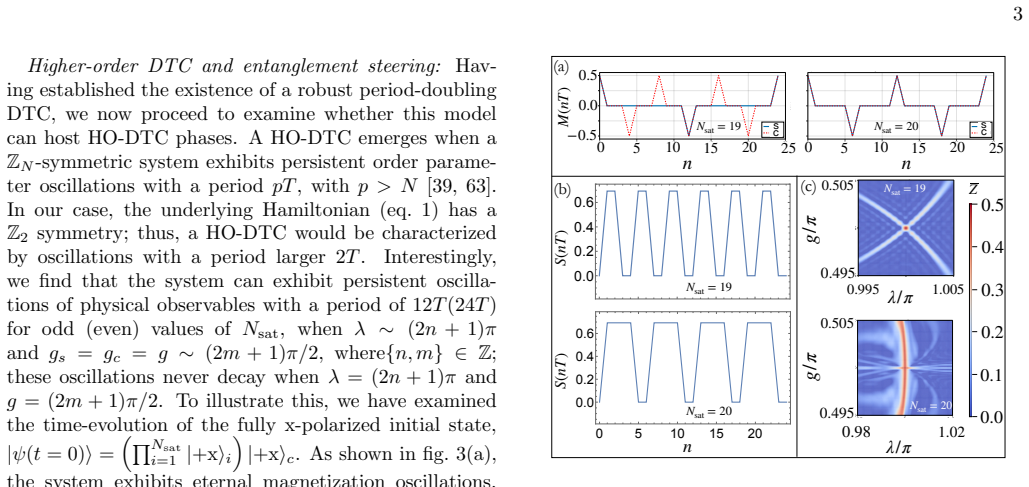
The central discovery is that a two-step Floquet drive, with a field pulse and an Ising-coupling pulse, can be engineered so the two-period unitary becomes a local operator rather than a scrambling one. At λ=2π, each satellite S^z_j anti-commutes with the coupling unitary U0, so U(2T) collapses to U0($e^{{-ig_c S^z_c}}$⊗I)U0 $e^{{-ig_c S^z_c}}$; this equals the identity for odd Nsat and a pure central-spin rotation for even Nsat, which is why the period-doubling is exact and eternal for every initial state. At λ=π and g=π/2, the same machinery produces a higher-order cycle: fully x-polarized states evolve into Bell-cat states at 3T, reach a satellite spin-cat state at 4T for odd Nsat, and return exactly at 12T for even Nsat or 24T for odd Nsat, giving eternal magnetization and entanglement-entropy oscillations. On this basis the paper claims that these higher-order time crystals are a multiparameter sensing resource whose quantum Fisher information grows as n²Nsat² for odd Nsat and n²Nsat for even Nsat.
Load-bearing premise
The multiparameter sensing result rests on the inequality in Eq. (7) relating the summed estimation error to the quantum Fisher matrix; if the correct multiparameter Cramér–Rao bound is the trace of the inverse Fisher matrix rather than its reciprocal, the claimed Heisenberg scaling no longer follows.
Editorial extensions
If this is right
- For λ=2π, the satellite-spin magnetization oscillates with period 2T forever, for any number of satellite spins and any value of the applied fields; the central spin either returns every 2T for odd Nsat or rotates sinusoidally for even Nsat.
- For λ=(2n+1)π and g=(2m+1)π/2, the magnetization shows eternal 12T oscillations for even Nsat and 24T oscillations for odd Nsat, with the central-spin period equal to 8T for odd Nsat.
- The evolution passes through maximally entangled Bell-cat states at stroboscopic times, such as t=3T for even Nsat, providing a deterministic protocol for on-demand Bell-cat state preparation.
- If the sensing analysis holds, the higher-order time crystals give quantum Fisher information scaling as G ∝ n²Nsat² for odd Nsat and G ∝ n²Nsat for even Nsat, exceeding the standard quantum limit.
- The same many-body echo mechanism works for every initial state, so the revivals are not tied to a specially prepared product state.
Reading between the lines
- The echo identity at λ=2π is an operator statement, so a natural testable extension is whether small perturbations that preserve the Ising structure still leave long-lived, though not perfect, revivals; if so, the platform could serve as a disorder-free quantum memory insensitive to inhomogeneous satellite fields.
- The metrology bound in Eq. (7) should be checked against the standard multiparameter Cramér–Rao bound; if the inequality direction is inverted, the reported Heisenberg scaling may still indicate large Fisher information, but the error bound itself would need to be rederived.
- The same Floquet construction likely generalizes to driven central spin-S models with S>1/2, a direction the paper lists for future work; one could test whether the relevant anti-commutation identities survive for larger spin.
- Because even-Nsat and odd-Nsat cases give different revival periods and different QFI scaling, the parity of Nsat acts as a control knob that could switch between two distinct sensing behaviors in one device.
Editorial analysis
A structured set of objections, weighed in public.
Referee Report
Summary. The manuscript proposes a periodically driven central spin model in which the Ising coupling λ is tuned to specific values to produce exact, permanent revivals of the initial state. For λ = 2π, the satellite spin magnetization displays eternal period-doubling oscillations for any number of satellite spins, with the central spin dynamics depending on the parity of Nsat. For λ = (2n+1)π and g = (2m+1)π/2, the authors report higher-order DTCs with periods 12T or 24T and the spontaneous generation of Bell-cat states. The final claim is that these higher-order DTCs enable Heisenberg-limited multiparameter sensing of λ and g.
Significance. The exact 'eternal' revival mechanism is a valuable addition to the DTC literature because it shows that in this fine-tuned but experimentally accessible model, the Floquet dynamics can be solved analytically and exhibit perfect subharmonic response at finite size. The Bell-cat state generation is also an interesting byproduct. However, the metrology claim, which is one of the three headline results, rests on an inverted multiparameter Cramér-Rao bound and is therefore unsupported. If corrected, the scaling results actually indicate that the HO-DTC states become less sensitive as Nsat and n increase, the opposite of the claimed quantum enhancement.
major comments (1)
- [Multi-parameter quantum metrology, Eq. (7)] The inequality in Eq. (7) is inverted. For a 2×2 quantum Fisher information matrix F, the equally weighted multiparameter Cramér-Rao bound is δλ^2 + δg^2 ≥ Tr(F^{-1}) = (F_λλ + F_gg)/(F_λλ F_gg − F_λg F_gλ) = G, where G is exactly the quantity defined in the text. The manuscript instead states δλ^2 + δg^2 ≥ G^{-1}. Consequently, a large value of G corresponds to a large lower bound on the total variance, i.e., poor measurement precision. The scaling results reported in Fig. 4(b), G ∝ n^2 N_sat^2 for odd N_sat and G ∝ n^2 N_sat for even N_sat, then imply that the variance bound grows with system size and evolution time, which is the opposite of Heisenberg-limited sensing. This error invalidates the central metrology claim and the associated scaling analysis.
minor comments (4)
- [Supplemental Material, after Eq. (S11)] The supplemental statement that the central spin magnetization oscillates with a period of 12T for odd Nsat contradicts the main text (Section 'Higher-order DTC and entanglement steering'), which states that the central spin period is 8T for odd Nsat; please correct this inconsistency.
- [Eq. (6)] In Eq. (6), the normalization factor is written as 1/N, but the sum runs over β time steps; the denominator should be β, and the symbol N is already used for N_sat elsewhere in the paper. Please clarify the notation.
- [Supplemental Material, Eq. (S1)] The central spin term in Eq. (S1), '(cos(gc/2)|+x⟩_c − i sin(gc/2)|−x⟩_c/2)', contains a stray '/2' in the second term that should be removed.
- [Conclusion] The word 'multi-prarameter' in the concluding section should be 'multiparameter'.
Circularity Check
The eternal DTC existence proofs are self-contained exact Floquet-unitary derivations; the only mild circularity is the Z order parameter, whose sampling period alpha is fixed from the very periods it is used to diagnose. The metrology section contains a serious inequality inversion (correctness, not circularity).
-
self definitional
[Eq. (6), Section 'Higher-order DTC and entanglement steering']
"Z = 1/N Σ_{n=1}^β Z_n, where Z_n = (−1)^n M(α nT). (6) We have set β = 200(100) and α = 6(12) for even (odd) N in our calculations; the results are shown in fig. 3(c)."
The values α=6 for even Nsat and α=12 for odd Nsat are taken from the 12T and 24T periods that the paper is claiming to detect. With this choice, Z_n compares M at half-period steps against a period-2α oscillation, so any magnetization that is periodic with period 2αT and flips sign at αT automatically gives Z near 0.5. The HO-DTC 'robustness' diagnostic is thus constructed from the target period rather than independently establishing it. This is not load-bearing for the existence proof, since the 12T/24T periodicities are derived exactly from the Floquet unitary in Eqs. S7–S12.
full rationale
The central claims—eternal period doubling at λ=2π and eternal HO-DTCs at λ=π, g=π/2—are derived explicitly from the Floquet unitary for arbitrary Nsat, with state-by-state calculations in the Supplemental Material (Eqs. S1–S12). These are self-contained algebraic derivations, not fits and not reductions to inputs. The only detected circular element is the Z order parameter of Eq. (6): its sampling period α is chosen as 6 or 12 from the 12T/24T periods under investigation, so Z is a diagnostic built from the target periodicity; however, this does not affect the existence proofs and is not load-bearing. No load-bearing self-citation was found: references [60,61] are cited only as related DMF examples, and the analytical explanations referenced to [62] are the paper's own Supplemental Material, which actually contains the derivations. Separately, the reader's skeptic is right that Eq. (7) inverts the multiparameter Cramér-Rao bound: the standard bound is δλ²+δg² ≥ Tr(F^{-1}) = G, so the paper's inequality δλ²+δg² ≥ G^{-1} is backwards. That is a correctness error in the metrology conclusion, not a circularity, so it is not counted in the circularity score.
Assumptions & free parameters
free parameters (4)
- λ (Ising coupling) =
2π or (2n+1)π
- g (drive field strength) =
(2m+1)π/2 for HO-DTC
- α (time scaling exponent) =
2
- β (size scaling exponent) =
2 (odd Nsat), 1 (even Nsat)
assumptions (3)
- domain assumption The dynamics is closed and unitary (no dissipation or decoherence).
- domain assumption The initial state for the HO-DTC and metrology protocols is fully x-polarized.
- domain assumption The multiparameter Cramér-Rao bound as stated in Eq. (7) is valid.
Cite this review
Pith. "Pith review of The Floquet central spin model: A platform to realize eternal time crystals, entanglement steering, and multiparameter metrology." pith.science (2026). https://pith.science/paper/J2U4OTDV
@misc{pith2026250118472,
  author       = {Pith},
  title        = {Pith review of: The Floquet central spin model: A platform to realize eternal time crystals, entanglement steering, and multiparameter metrology},
  year         = {2026},
  howpublished = {\url{https://pith.science/paper/J2U4OTDV}},
  note         = {Machine review of arXiv:2501.18472}
}
abstract
We propose and characterize protocols to realize eternal discrete time crystals (DTCs) in the periodically driven central spin model. These eternal DTCs exhibit perfect periodic revivals of the initial state at a time $mnT$ (where $n>1$ and $\{m,n\} \in \mathbb{Z}$), when the Ising interaction strength, $\lambda$ between the central spin and the satellite spins is tuned to certain values. The combination of perfect initial-state revival and time-translation-symmetry breaking leads to infinitely long-lived oscillations of the stroboscopic magnetization and the entanglement entropy in these DTCs even for a finite number of satellite spins. We analytically determine the conditions for the existence of these eternal DTCs and prove that the system exhibits eternal period-doubling oscillations ($n=2$) when $\lambda = 2 \pi$ for an arbitrary number of satellite spins. Furthermore, we propose a protocol to realize eternal higher-order(HO)-DTCs ($n>2$) by tuning $\lambda$ to $\pi$. Intriguingly, this protocol naturally steers the system through an entangled trajectory, thereby leading to the generation of maximally entangled Bell-cat states during the dynamical evolution of the HO-DTC. Finally, we demonstrate that these HO-DTCs can serve as a resource for Heisenberg-limited multiparameter sensing.
Figures


Figures from the paper (1 more)

Forward citations
Cited by 4 Pith papers
-
Power-law-graded Ising Interactions Stabilize Time Crystals Realizing Quantum Energy Storage and Sensing
Power-law-graded Ising interactions stabilize discrete time crystals in Floquet-driven spin-1/2 chains, yielding superlinear energy storage as a quantum battery and superextensive quantum Fisher information for timing...
-
Coexistence of inequivalent time-crystalline orders in a Floquet collective spin system
In a Lipkin–Meshkov–Glick spin model driven with different field strengths in two halves, distinct discrete time-crystal orders (2T and 6T) can coexist in the two spatial regions.
-
Finite-Bath Open Quantum Systems: Exact Dynamics
Exact time-local master equations are derived for a finite-bath central spin model (Heisenberg and stochastic dephasing couplings), producing a phase-covariant channel and a spin-bath realization of random telegraph noise.
-
Discrete time crystal order in spin chains enabled by Floquet flat bands
A flat-band drive that freezes spin dynamics for half each period, followed by a global spin flip, is claimed to produce period-doubling time-crystal order in clean spin chains—but the stated parameters yield only a π...
Reference graph
Works this paper leans on
- [1]
-
[2]
Harper, R
F. Harper, R. Roy, M. S. Rudner, and S. Sondhi, Annual Review of Condensed Matter Physics 11, 345 (2020)
2020
-
[3]
M. S. Rudner and N. H. Lindner, Nature Reviews Physics 2, 229 (2020)
2020
-
[4]
Oka and S
T. Oka and S. Kitamura, Annual Review of Condensed Matter Physics 10, 387 (2019)
2019
-
[5]
Weitenberg and J
C. Weitenberg and J. Simonet, Nature Physics 17, 1342 (2021)
2021
-
[6]
Emergent symmetries in prethermal phases of periodically driven quantum systems
T. Banerjee and K. Sengupta, arXiv preprint arXiv:2407.20764 (2024)
work page Pith review arXiv 2024
-
[7]
V. Khemani, A. Lazarides, R. Moessner, and S. L. Sondhi, Physical Review Letters 116, 250401 (2016)
work page 2016
-
[8]
C. W. von Keyserlingk, V. Khemani, and S. L. Sondhi, Physical Review B 94, 085112 (2016)
work page 2016
Show all 74 references
-
[9]
N. Y. Yao, A. C. Potter, I.-D. Potirniche, and A. Vish- wanath, Physical Review Letters 118, 030401 (2017)
2017
-
[10]
D. V. Else, B. Bauer, and C. Nayak, Physical Review Letters 117, 090402 (2016)
2016
-
[11]
Sacha, Physical Review A 91, 033617 (2015)
K. Sacha, Physical Review A 91, 033617 (2015)
2015
-
[12]
D. V. Else, C. Monroe, C. Nayak, and N. Y. Yao, Annual Review of Condensed Matter Physics 11, 467 (2020)
2020
-
[13]
M. P. Zaletel, M. Lukin, C. Monroe, C. Nayak, F. Wilczek, and N. Y. Yao, Reviews of Modern Physics 95, 031001 (2023)
2023
-
[14]
Sacha and J
K. Sacha and J. Zakrzewski, Reports on Progress in Physics 81, 016401 (2017)
2017
-
[15]
Estarellas, T
M. Estarellas, T. Osada, V. Bastidas, B. Renoust, K. Sanaka, W. Munro, and K. Nemoto, Science Advances 6, eaay8892 (2020)
2020
-
[16]
L. J. I. Moon, P. M. Schindler, R. J. Smith, E. Druga, Z.-R. Zhang, M. Bukov, and A. Ajoy, arXiv preprint arXiv:2410.05625 (2024)
2024 arXiv
-
[17]
Zhang et al., Nature 543, 217 (2017)
J. Zhang et al., Nature 543, 217 (2017)
2017
-
[18]
Kyprianidis et al., Science 372, 1192 (2021)
A. Kyprianidis et al., Science 372, 1192 (2021)
2021
-
[19]
Choi et al., Nature 543, 221 (2017)
S. Choi et al., Nature 543, 221 (2017)
2017
-
[20]
Randall, C
J. Randall, C. Bradley, F. van der Gronden, A. Galicia, M. Abobeih, M. Markham, D. Twitchen, F. Machado, N. Yao, and T. Taminiau, Science 374, 1474 (2021)
2021
-
[21]
Beatrez, C
W. Beatrez, C. Fleckenstein, A. Pillai, E. de Leon Sanchez, A. Akkiraju, J. Diaz Alcala, S. Conti, P. Reshetikhin, E. Druga, M. Bukov, and A. Ajoy, Nature Physics 19, 407 (2023)
2023
-
[22]
Bluvstein et al., Science 371, 1355 (2021)
D. Bluvstein et al., Science 371, 1355 (2021)
2021
-
[23]
Liu et al., Nature Communications 15, 9730 (2024)
B. Liu et al., Nature Communications 15, 9730 (2024)
2024
-
[24]
Mi et al., Nature 601, 531 (2022)
X. Mi et al., Nature 601, 531 (2022)
2022
-
[25]
Z. Bao, S. Xu, Z. Song, K. Wang, L. Xiang, Z. Zhu, J. Chen, F. Jin, X. Zhu, Y. Gao, et al., Nature Commu- nications 15, 1 (2024)
2024
-
[26]
H. Xu, J. Zhang, J. Han, Z. Li, G. Xue, W. Liu, Y. Jin, and H. Yu, arXiv preprint arXiv:2108.00942 (2021)
2021 arXiv
-
[27]
Khemani, R
V. Khemani, R. Moessner, and S. Sondhi, arXiv preprint arXiv:1910.10745 (2019)
2019 arXiv
-
[28]
Sacha, Time crystals, Vol
K. Sacha, Time crystals, Vol. 114 (Springer, 2020)
2020
-
[29]
D’Alessio and M
L. D’Alessio and M. Rigol, Physical Review X 4, 041048 (2014)
2014
-
[30]
Lazarides, A
A. Lazarides, A. Das, and R. Moessner, Physical Review E 90, 012110 (2014)
2014
-
[31]
Choudhury and E
S. Choudhury and E. J. Mueller, Physical Review A 90, 013621 (2014)
2014
-
[32]
Zhang, H
L. Zhang, H. Kim, and D. A. Huse, Physical Review E 91, 062128 (2015)
2015
-
[33]
Moessner and S
R. Moessner and S. L. Sondhi, Nature Physics 13, 424 (2017)
2017
-
[34]
Rovny, R
J. Rovny, R. L. Blum, and S. E. Barrett, Physical Review Letters 120, 180603 (2018)
2018
-
[35]
Rovny, R
J. Rovny, R. L. Blum, and S. E. Barrett, Physical Review B 97, 184301 (2018)
2018
-
[36]
S. Pal, N. Nishad, T. Mahesh, and G. Sreejith, Physical Review Letters 120, 180602 (2018)
2018
-
[37]
Huang, Y.-H
B. Huang, Y.-H. Wu, and W. V. Liu, Physical Review Letters 120, 110603 (2018)
2018
-
[38]
Pizzi, J
A. Pizzi, J. Knolle, and A. Nunnenkamp, Physical Re- view Letters 123, 150601 (2019)
2019
-
[39]
Pizzi, J
A. Pizzi, J. Knolle, and A. Nunnenkamp, Nature Com- munications 12, 2341 (2021)
2021
-
[40]
M. H. Mu˜ noz-Arias, K. Chinni, and P. M. Poggi, Physical Review Research 4, 023018 (2022)
2022
-
[41]
Russomanno, F
A. Russomanno, F. Iemini, M. Dalmonte, and R. Fazio, Physical Review B 95, 214307 (2017)
2017
-
[42]
F. M. Surace, A. Russomanno, M. Dalmonte, A. Silva, R. Fazio, and F. Iemini, Physical Review B 99, 104303 (2019)
2019
-
[43]
Maskara, A
N. Maskara, A. A. Michailidis, W. W. Ho, D. Bluvstein, S. Choi, M. D. Lukin, and M. Serbyn, Physical Review Letters 127, 090602 (2021)
2021
-
[44]
Sarkar and Y
S. Sarkar and Y. Dubi, ACS Nano 18, 27988 (2024)
2024
-
[45]
Liu, S.-X
S. Liu, S.-X. Zhang, C.-Y. Hsieh, S. Zhang, and H. Yao, Physical Review Letters 130, 120403 (2023)
2023
-
[46]
Frantzeskakis, J
R. Frantzeskakis, J. Van Dyke, L. Zaporski, D. A. Gan- gloff, C. Le Gall, M. Atat¨ ure, S. E. Economou, and E. Barnes, Physical Review B 108, 075302 (2023)
2023
-
[47]
Kumar, R
A. Kumar, R. Frantzeskakis, and E. Barnes, arXiv preprint arXiv:2402.18001 (2024)
2024 arXiv
-
[48]
Cabot, F
A. Cabot, F. Carollo, and I. Lesanovsky, Physical Review B 106, 134311 (2022)
2022
-
[49]
J. Geng, V. Vorobyov, D. Dasari, and J. Wrachtrup, arXiv preprint arXiv:2107.11748 (2021)
2021 arXiv
-
[50]
Vlastakis et al., Nature Communications 6, 8970 (2015)
B. Vlastakis et al., Nature Communications 6, 8970 (2015)
2015
-
[51]
Urbaszek, X
B. Urbaszek, X. Marie, T. Amand, O. Krebs, P. Voisin, P. Maletinsky, A. H¨ ogele, and A. Imamoglu, Reviews of Modern Physics 85, 79 (2013)
2013
-
[52]
Ashida, T
Y. Ashida, T. Shi, R. Schmidt, H. Sadeghpour, J. I. Cirac, and E. Demler, Physical Review Letters 123, 183001 (2019)
2019
-
[53]
Dobrzyniecki and M
J. Dobrzyniecki and M. Tomza, Physical Review A 108, 052618 (2023)
2023
-
[54]
Schwartz et al., Science Advances 4, eaat8978 (2018)
I. Schwartz et al., Science Advances 4, eaat8978 (2018)
2018
-
[55]
Childress, M
L. Childress, M. Gurudev Dutt, J. Taylor, A. Zibrov, F. Jelezko, J. Wrachtrup, P. Hemmer, and M. Lukin, Science 314, 281 (2006)
2006
-
[56]
Niknam, L
M. Niknam, L. F. Santos, and D. G. Cory, Physical Re- view Letters 127, 080401 (2021)
2021
-
[57]
Das, Physical Review B 82, 172402 (2010)
A. Das, Physical Review B 82, 172402 (2010)
2010
-
[58]
Bhattacharyya, A
S. Bhattacharyya, A. Das, and S. Dasgupta, Physical Re- view B 86, 054410 (2012)
2012
-
[59]
Haldar, D
A. Haldar, D. Sen, R. Moessner, and A. Das, Physical Review X 11, 021008 (2021)
2021
-
[60]
Banerjee, S
T. Banerjee, S. Choudhury, and K. Sengupta, arXiv preprint arXiv:2404.06536 (2024)
2024 arXiv
-
[61]
Gangopadhay and S
N. Gangopadhay and S. Choudhury, arXiv preprint arXiv:2409.17198 (2024). 6
2024 arXiv
-
[62]
See supplemental material for details
-
[63]
Giachetti, A
G. Giachetti, A. Solfanelli, L. Correale, and N. Defenu, Phys. Rev. B 108, L140102 (2023)
2023
-
[64]
Lajci, D
B. Lajci, D. O’Dell, and J. Mumford, arXiv preprint arXiv:2410.23532 (2024)
2024
-
[65]
Dooley, F
S. Dooley, F. McCrossan, D. Harland, M. J. Everitt, and T. P. Spiller, Physical Review A 87, 052323 (2013)
2013
-
[66]
Huang, M
J. Huang, M. Zhuang, B. Lu, Y. Ke, and C. Lee, Physical Review A 98, 012129 (2018)
2018
-
[67]
J. Liu, H. Yuan, X.-M. Lu, and X. Wang, Journal of Physics A: Mathematical and Theoretical 53, 023001 (2020)
2020
-
[68]
Demkowicz-Dobrza´ nski, W
R. Demkowicz-Dobrza´ nski, W. G´ orecki, and M. Gut ¸˘ a, Journal of Physics A: Mathematical and Theoretical 53, 363001 (2020)
2020
-
[69]
Montenegro, C
V. Montenegro, C. Mukhopadhyay, R. Yousefjani, S. Sarkar, U. Mishra, M. G. Paris, and A. Bayat, arXiv preprint arXiv:2408.15323 (2024)
2024 arXiv
-
[70]
C. Lyu, S. Choudhury, C. Lv, Y. Yan, and Q. Zhou, Physical Review Research 2, 033070 (2020)
2020
-
[71]
Yousefjani, K
R. Yousefjani, K. Sacha, and A. Bayat, arXiv preprint arXiv:2405.00328 (2024)
2024 arXiv
-
[72]
Iemini, R
F. Iemini, R. Fazio, and A. Sanpera, Physical Review A 109, L050203 (2024)
2024
-
[73]
R. K. Shukla, L. Chotorlishvili, S. K. Mishra, and F. Iem- ini, Phys. Rev. B 111, 024315 (2025)
2025
-
[74]
NsatY j=1 |+y⟩j |−z⟩c + i NsatY j=1 |−y⟩j |+z⟩c # , Nsat = 4n : 1√ 2
Y. Huang, New Journal of Physics 26, 072001 (2024). S1 Supplemental Material for ‘The Floquet central spin model: A platform to realize eternal time crystals, entanglement steering, and multiparameter metrology’ In this supplemental material, we provide an alternative analysis...
2024
Reviewed August 9, 2026 · model on record in the stance chip above.
Discussion (0). Continue with ORCID to comment.