REVIEW 3 major objections 5 minor 2 cited by
Reactor antineutrinos CE$\nu$NS on germanium: CONUS+ and TEXONO as a new gateway to SM and BSM physics
T0 review · 3 major / 5 minor · reviewed 2026-08-09 · deepseek-v4-flash
Pith's one-line read This paper claims that low-energy reactor CEνNS data from CONUS+ and TEXONO, including the neutrino-electron scattering channel, produce the tightest existing limit on the electron neutrino millicharge and a weak mixing angle consistent…
desk verdict A solid reactor CEνNS constraints paper whose headline millicharge limit rests on an EPA model with a hand-set systematic; worth refereeing, but the most stringent claim needs a harder look. read the letter →
The pith
A machine-rendered reading of the paper's core claim, the machinery that carries it, and where it could break.
The reading
What carries the argument
The machinery is the combined CEνNS plus neutrino-electron elastic scattering rate for germanium targets, with two ingredients doing the work: a Lindhard quenching factor $k(\mathrm{Ge}) = 0.162 \pm 0.004$ that converts nuclear recoil energies into electron-equivalent energies, and the equivalent photon approximation of Eq. (29), which ties the millicharged νES ionization cross section to the measured germanium photoabsorption cross section. At reactor energies the nuclear form factors are effectively unity, so the fits are largely independent of nuclear-radius uncertainties and depend on the weak charge, the neutrino flux, the quenching factor, and the BSM parameters.
What would settle it
A dedicated neutron-calibration measurement of the germanium quenching factor in the 160–300 eV nuclear-recoil range that disagrees with $k(\mathrm{Ge}) = 0.162 \pm 0.004$ would directly test the central premise; likewise, recomputing the millicharged νES rate with an independent atomic-structure method and finding a large discrepancy with the equivalent photon approximation would invalidate the quoted millicharge bound.
Extended reading notes
Core claim
The paper establishes that the low-threshold germanium data of CONUS+ and TEXONO are consistent with the Standard Model CEνNS prediction when the Lindhard quenching model is used, with data-over-SM ratios $\eta = 1.15 \pm 0.32$ for CONUS+ and $\eta < 4.2$ for TEXONO, and it converts that consistency into new physics constraints. The headline results are $\sin^2\theta_W(\mathrm{CONUS+}) = 0.26 \pm 0.05$, a 90% C.L. electron-neutrino millicharge window $q_{\nu_e} \in (-0.6, 0.6) \times 10^{-12}\,e_0$ from the equivalent photon approximation, magnetic-moment bounds $\mu_{\nu_e} < 1.2 \times 10^{-10}\mu_B$ for CONUS+ and $< 2.4 \times 10^{-10}\mu_B$ for TEXONO once the νES channel is included, and improved charge-radius, NSI, and light-mediator exclusions when the reactor data are combined with COHERENT.
Load-bearing premise
Every limit in the paper rests on the Lindhard quenching factor $k(\mathrm{Ge}) = 0.162 \pm 0.004$ correctly converting germanium nuclear-recoil energies into electron-equivalent energies in the 160–300 eV range, the premise contested in the earlier Dresden-II analysis; if that mapping is wrong, all quoted bounds shift.
Editorial extensions
If this is right
- With the CEνNS signal confirmed under Lindhard quenching, reactor experiments can measure $\sin^2\theta_W$ at $Q \sim$ few MeV with competitive precision, complementing higher-energy electroweak fits.
- The bound $|q_{\nu_e}| < 0.6 \times 10^{-12}\,e_0$ at 90% C.L. becomes the strongest laboratory constraint on an electron neutrino electric charge, excluding many BSM models that generate larger millicharges.
- Including the νES channel is essential rather than optional in BSM searches: it improves the magnetic-moment and millicharge limits by roughly three orders of magnitude at these thresholds.
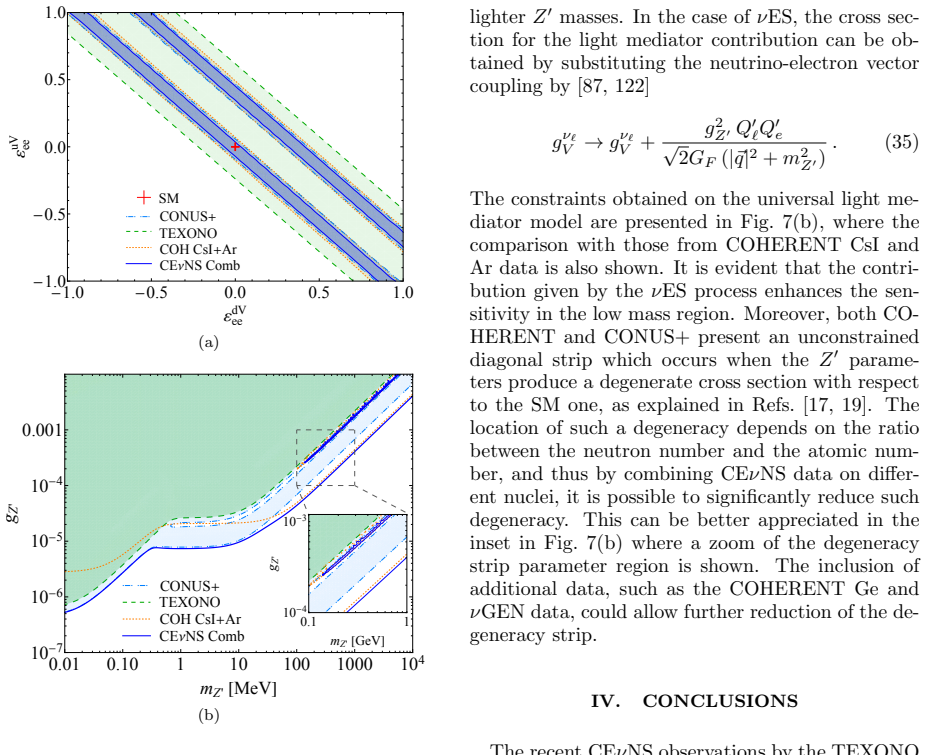
- Combining targets with different neutron-to-proton ratios breaks degeneracies in NSI and light-mediator fits, so the degeneracy strip in the $Z'$ parameter space shrinks when reactor and spallation-source data are fitted together.
Reading between the lines
- Beyond the paper: the same EPA-based rate calculation could be applied to dark-matter direct-detection germanium detectors, where sub-keV solar-neutrino recoils would yield comparable or stronger millicharge and magnetic-moment bounds without new reactor infrastructure.
- Beyond the paper: because the EPA millicharge rate scales as $\sigma_\gamma(T_e)/T_e$, an improved low-energy photoabsorption measurement for germanium would directly sharpen the $q_{\nu_e}$ limit even with existing CONUS+ and TEXONO data.
- Beyond the paper: the paper's emphasis on the $1/T_e$ enhancement suggests a testable scaling, namely that lowering the energy threshold from about 160 eV toward 80 eV should improve millicharge and magnetic-moment sensitivity faster than the square root of exposure alone.
Editorial analysis
A structured set of objections, weighed in public.
Referee Report
Summary. The paper analyzes the recent CONUS+ and TEXONO reactor CEνNS data, together with COHERENT CsI/Ar data where relevant, to extract the weak mixing angle and to derive constraints on neutrino charge radii, magnetic moment, millicharge, nonstandard interactions, and light Z' mediators. The central new claim is the 90% C.L. limit on the electron-neutrino millicharge obtained from elastic neutrino-electron scattering treated with the equivalent photon approximation, q_νe ∈ (-0.6, 0.6)×10^-12 e0 (Eq. 30), which the authors state is the most stringent limit to date. The paper also reports sin^2θ_W(CONUS+) = 0.26 ± 0.05, consistent with the Standard Model, and a suite of other BSM constraints.
Significance. If the EPA-based millicharge limit is correct, reactor CEνNS experiments become a competitive low-energy probe of neutrino electromagnetic properties, complementing spallation-source measurements. The paper's combination of reactor and SNS data to resolve degeneracies in NSI and light-mediator fits is useful, and the results agree with several independent concurrent analyses of the CONUS+ data. The analysis uses standard least-squares methods and clearly separates the CEνNS and νES contributions. However, the headline millicharge limit relies on an ad hoc inflation of the normalization systematic rather than a propagated uncertainty of the EPA cross section, and a key CONUS+ systematic is taken from private communication; these issues make the central claim conditional on information not fully available in the manuscript.
major comments (3)
- [III.D, Eq. (29)-(31)] The EPA-based millicharge limit is the paper's headline result, but the EPA cross section is used at Te = 160-300 eV without a dedicated validation in this energy range. The paper inflates the normalization uncertainty ση from 0.17 to 0.2 to account for 'further uncertainties on the EPA approach,' but this does not propagate the energy-dependent uncertainty of the measured photoelectric cross section σγ(Te) from the Henke data, nor does it quantify the known corrections to the EPA at the Ge M-shell edges. The limit depends sensitively on the EPA normalization; if the EPA rate were overestimated by a factor of a few, the CONUS+ bound would no longer be the most stringent. Please add a robustness scan over σγ(Te) or an overall EPA normalization factor, and/or a bin-by-bin comparison of the EPA prediction with the MCRRPA result in the analyzed bins.
- [II.C, Eq. (11)] The CONUS+ chi-square uses ση = 0.17 for the systematic uncertainty due to the neutrino flux, threshold, and quenching factor, citing a private communication [84], and the data are used in the form of an effective single detector with a 160 eV threshold [82]. This systematic directly controls the quoted uncertainty on sin^2θ_W and on all BSM limits derived from CONUS+. As written, the analysis is not fully reproducible by a reader without private access to the CONUS+ collaboration. The authors should either derive ση from publicly documented CONUS+ systematics or show how the results change when ση is varied over a conservative range.
- [II.C, Eq. (8) and III.A] All results inherit the assumption k(Ge) = 0.162 ± 0.004 for the Lindhard quenching factor down to 160 eV. This is consistent with the CONUS+ collaboration's analysis, but the low-energy quenching behavior was the central point of the Dresden-II controversy, and the uncertainty may be energy-dependent rather than a single multiplicative factor. The paper folds the quenching uncertainty into the global pull ση; it should show a direct propagation of the quenching-factor uncertainty into at least the sin^2θ_W measurement and the millicharge limit, where CEνNS contributes to the same low-energy bins.
minor comments (5)
- [III.E] The sentence 'i.e. i.e. the universal model' contains a duplicated 'i.e.' and should be corrected.
- [III.D] The statement that 'the use of EPA results in a further improvement of about a factor 3 on EC' should read 'by about a factor of 3,' and the value '3' should be given with the corresponding uncertainty or confidence level.
- [Fig. 5] The comparison of existing limits is only presented visually; a numerical table of the 90% C.L. bounds would make the 'most stringent' claim easier to verify and would help readers compare the new CONUS+ and TEXONO limits with GEMMA, LZ, XMASS, and other experiments.
- [II.C] The definition of T^{'min}_{nr} as the 'minimum average ionization energy in Ge' is confusing; since 2.96 eV is the electron-hole pair creation energy, the text should clarify that this is the minimum energy deposition required to produce ionization, not a nuclear recoil threshold.
- [I and III] The spelling of the νGeN experiment is inconsistent: it appears as 'νGEN,' 'νGeN,' and 'nuGeN' in different places; please unify the nomenclature.
Circularity Check
No significant circularity: all quoted constraints come from direct least-squares fits to published TEXONO/CONUS+ data, with the BSM parameters as free fit parameters and external inputs from independent measurements.
full rationale
The derivation chain is: experimental event counts from TEXONO [54] and CONUS+ [55] are compared via the chi-square functions in Eqs. (10) and (11) to theoretical rates whose BSM parameters are free. The quoted intervals (Eqs. 12, 18-21, 24-31) are obtained by profiling or marginalizing those parameters against the measured rates. No fitted nuisance parameter or best-fit value is later relabeled as a prediction. The millicharge claim rests on the EPA cross section in Eq. (29), where sigma_gamma(Te) is taken from independently measured photoabsorption data [118] and the EPA-to-MCRRPA equivalence is cited to the independent calculations in Refs. [76,77]; the paper explicitly enlarges the systematic contribution to sigma_eta = 0.2 to account for EPA uncertainties [119], which is a conservative limitation statement rather than a circular input. The Lindhard quenching factor k(Ge) = 0.162 +/- 0.004 is an external measurement [51], and the flux, fission fractions, Fano factor, and detector resolution inputs come from experimental publications. The self-citations, e.g., Refs. [20-22,71], provide tables and analysis frameworks, but they are not invoked as uniqueness theorems and are not the sole justification of any claimed result. The paper also cross-checks against independent CONUS+ analyses [85-87] and checks that different antineutrino flux models do not change the results. Therefore there is no exhibited reduction of a target result to its own input: no equation is defined in terms of its own output, and no fitted parameter is repackaged as a prediction.
Assumptions & free parameters
free parameters (8)
- Weak mixing angle sin^2(theta_W) =
0.26 +/- 0.05 (CONUS+), < 0.46 at 1 sigma (TEXONO)
- Electron neutrino millicharge q_nu_e =
-0.6 to 0.6 x 10^-12 e0 at 90% C.L. (EPA, CONUS+)
- Electron neutrino magnetic moment mu_nu_e =
< 1.2 x 10^-10 mu_B at 90% C.L. (CONUS+ including νES)
- Neutrino charge radii <r^2_nu_e> and <r^2_nu_mu> =
[-73,-67] and [-5,11] x 10^-32 cm^2 (90% C.L., combined)
- NSI parameters epsilon_uV_ee and epsilon_dV_ee =
2D contour at 90% C.L., not quoted numerically
- Universal light Z' coupling g_Z' vs mass m_Z' =
90% C.L. contour in Fig. 7(b)
- EPA systematic sigma_eta =
0.2
- Neutrino mass m_nu in EPA logarithm =
1 eV
assumptions (6)
- standard math The CEνNS differential cross section in Eq. (1) with the weak charge of Eq. (2) and SM couplings is the correct signal model.
- domain assumption Lindhard quenching with k(Ge) = 0.162 +/- 0.004 correctly converts nuclear recoil energy to electron-equivalent energy at 160-300 eV for germanium.
- domain assumption The EPA cross section for a millicharged neutrino, Eq. (29), accurately reproduces the MCRRPA calculation for germanium in the sub-keV regime.
- domain assumption Reactor antineutrino spectra from the summation method of Ref. [79], with the given fission fractions, describe the CONUS+ and TEXONO fluxes.
- domain assumption TEXONO background is fully described by a Compton 135Xe rate beta with nuisance parameters in Eq. (10).
- ad hoc to paper The universal light Z' model with Q'_l = Q'_f = 1 and equal coupling to all SM fermions is the benchmark for light mediator constraints.
Cite this review
Pith. "Pith review of Reactor antineutrinos CE$\nu$NS on germanium: CONUS+ and TEXONO as a new gateway to SM and BSM physics." pith.science (2026). https://pith.science/paper/QWUUQBMX
@misc{pith2026250118550,
  author       = {Pith},
  title        = {Pith review of: Reactor antineutrinos CE$\nu$NS on germanium: CONUS+ and TEXONO as a new gateway to SM and BSM physics},
  year         = {2026},
  howpublished = {\url{https://pith.science/paper/QWUUQBMX}},
  note         = {Machine review of arXiv:2501.18550}
}
abstract
Coherent elastic neutrino-nucleus scattering (CE$\nu$NS) is a key process for probing Standard Model and beyond the Standard Model (BSM) properties. Following its first detection by the COHERENT Collaboration, recent reactor-based experiments provide a unique opportunity to refine our current understanding. In particular, the high-precision data from CONUS+, combined with the strong bounds from TEXONO, not only validate the CE$\nu$NS process at low energies but also provide improved constraints on the weak mixing angle, neutrino electromagnetic properties (including the charge radius, millicharge, and magnetic moment), and nonstandard interactions and light mediators. We also examine the role of elastic neutrino-electron scattering, which gains significance in certain BSM scenarios and allows us to obtain the best limit for the millicharge of the electron neutrinos. By combining reactor and higher-energy spallation neutron source measurements, this work strengthens CE$\nu$NS as a precision tool for testing the Standard Model and beyond.
Figures


Figures from the paper (4 more)


Forward citations
Cited by 2 Pith papers
-
Prospect of the NUCLEUS Experiment at Chooz for Coherent Elastic Neutrino-Nucleus Scattering and New Physics Searches
Assuming the low-energy background can be eliminated, a 7-gram NUCLEUS detector at Chooz is projected to see coherent neutrino-nucleus scattering at 4.7σ in one year and to set competitive bounds on new neutrino interactions.
-
Testing lepton non-unitarity with the next generation of Germanium-based CE$\nu$NS reactor experiments
A future 100-kg Germanium reactor CEνNS experiment could constrain lepton non-unitarity to 1−α11² ≈ 0.005 and, under low-scale seesaw assumptions, probe new-physics scales up to ~2.5 TeV.
Reference graph
Works this paper leans on
-
[119]
J.-W. Chen, H.-C. Chi, H.-B. Li, C. P. Liu, L. Singh, H. T. Wong, C.-L. Wu, and C.-P. Wu, Phys. Rev. D 90, 011301 (2014), arXiv:1405.7168 [hep-ph]
arXiv 2014
-
[84]
C. Buck, M. Lindner, and W. Maneschg, private communication
-
[82]
N. Ackermann et al. (CONUS+), Eur. Phys. J. C 84, 1265 (2024), [Erratum: Eur.Phys.J.C 85, 19 (2025)], arXiv:2407.11912 [hep-ex]
arXiv 2024
-
[1]
D. Z. Freedman, Phys. Rev. D 9, 1389 (1974)
1974
-
[2]
D. Akimov et al. (COHERENT), Science 357, 1123 (2017), arXiv:1708.01294 [nucl-ex]
arXiv 2017
-
[3]
D. Akimov et al. (COHERENT), “COHERENT Collaboration data release from the first observa- tion of coherent elastic neutrino-nucleus scatter- ing,” (2018), arXiv:1804.09459 [nucl-ex]
arXiv 2018
-
[4]
M. Cadeddu, F. Dordei, and C. Giunti, EPL 143, 34001 (2023), arXiv:2307.08842 [hep-ph]
arXiv 2023
-
[5]
V. De Romeri, D. K. Papoulias, G. Sanchez Gar- cia, C. A. Ternes, and M. T´ ortola, JCAP 05, 080 (2025), arXiv:2412.14991 [hep-ph]
arXiv 2025
Show all 120 references
-
[6]
First constraints on the co- herent elastic scattering of reactor antineutrinos off xenon nuclei,
D. Y. Akimov et al., “First constraints on the co- herent elastic scattering of reactor antineutrinos off xenon nuclei,” (2024), arXiv:2411.18641 [hep-ex]
2024 arXiv
-
[7]
Bounds on new neutrino interactions from the first CEνNS data at direct detection experiments,
V. De Romeri, D. K. Papoulias, and C. A. Ternes, “Bounds on new neutrino interactions from the first CEνNS data at direct detection experiments,” (2024), arXiv:2411.11749 [hep-ph]
2024 arXiv
-
[8]
Constraining low scale Dark Hyper- charge symmetry at spallation, reactor and Dark Matter direct detection experiments,
A. Majumdar, D. K. Papoulias, H. Prajapati, and R. Srivastava, “Constraining low scale Dark Hyper- charge symmetry at spallation, reactor and Dark Matter direct detection experiments,” (2024), arXiv:2411.04197 [hep-ph]
2024 arXiv
-
[9]
Pandey, Prog
V. Pandey, Prog. Part. Nucl. Phys. 134, 104078 (2024), arXiv:2309.07840 [hep-ph]
2024 arXiv
-
[10]
Coloma, M
P. Coloma, M. C. Gonzalez-Garcia, M. Maltoni, J. a. P. Pinheiro, and S. Urrea, JHEP 08, 032 (2023), arXiv:2305.07698 [hep-ph]
2023 arXiv
-
[11]
Implications of first neutrino-induced nu- clear recoil measurements in direct detection ex- periments,
D. Aristizabal Sierra, N. Mishra, and L. Stri- gari, “Implications of first neutrino-induced nu- clear recoil measurements in direct detection ex- periments,” (2024), arXiv:2409.02003 [hep-ph]
2024 arXiv
-
[12]
Cadeddu, C
M. Cadeddu, C. Giunti, Y. F. Li, and Y. Y. Zhang, Phys. Rev. Lett. 120, 072501 (2018), arXiv:1710.02730 [hep-ph]
2018 arXiv
-
[13]
Cadeddu, C
M. Cadeddu, C. Giunti, K. A. Kouzakov, Y.-F. Li, Y.-Y. Zhang, and A. I. Studenikin, Phys. Rev. D 98, 113010 (2018), [Erratum: Phys.Rev.D 101, 059902 (2020)], arXiv:1810.05606 [hep-ph]
2018 arXiv
-
[14]
Cadeddu, F
M. Cadeddu, F. Dordei, C. Giunti, Y. F. Li, and Y. Y. Zhang, Phys. Rev. D 101, 033004 (2020), arXiv:1908.06045 [hep-ph]
2020 arXiv
-
[15]
Cadeddu, F
M. Cadeddu, F. Dordei, C. Giunti, Y. F. Li, E. Pic- ciau, and Y. Y. Zhang, Phys. Rev. D 102, 015030 (2020), arXiv:2005.01645 [hep-ph]
2020 arXiv
-
[16]
Cadeddu and F
M. Cadeddu and F. Dordei, Phys. Rev. D 99, 033010 (2019), arXiv:1808.10202 [hep-ph]
2019 arXiv
-
[17]
Cadeddu, N
M. Cadeddu, N. Cargioli, F. Dordei, C. Giunti, Y. F. Li, E. Picciau, and Y. Y. Zhang, JHEP 01, 116 (2021), arXiv:2008.05022 [hep-ph]
2021 arXiv
-
[18]
Cadeddu, N
M. Cadeddu, N. Cargioli, F. Dordei, C. Giunti, Y. F. Li, E. Picciau, C. A. Ternes, and Y. Y. Zhang, Phys. Rev. C 104, 065502 (2021), arXiv:2102.06153 [hep-ph]
2021 arXiv
-
[19]
Atzori Corona, M
M. Atzori Corona, M. Cadeddu, N. Cargioli, F. Dordei, C. Giunti, Y. F. Li, E. Picciau, C. A. Ternes, and Y. Y. Zhang, JHEP 05, 109 (2022), arXiv:2202.11002 [hep-ph]
2022 arXiv
-
[21]
Atzori Corona, M
M. Atzori Corona, M. Cadeddu, N. Cargioli, F. Dordei, C. Giunti, and G. Masia, Eur. Phys. J. C 83, 683 (2023), arXiv:2303.09360 [nucl-ex]
2023 arXiv
-
[22]
Atzori Corona, M
M. Atzori Corona, M. Cadeddu, N. Cargioli, F. Dordei, and C. Giunti, JHEP 05, 271 (2024), 11 arXiv:2402.16709 [hep-ph]
2024 arXiv
-
[23]
Coloma, M
P. Coloma, M. C. Gonzalez-Garcia, M. Maltoni, and T. Schwetz, Phys. Rev. D 96, 115007 (2017), arXiv:1708.02899 [hep-ph]
2017 arXiv
-
[24]
Liao and D
J. Liao and D. Marfatia, Phys. Lett. B 775, 54 (2017), arXiv:1708.04255 [hep-ph]
2017 arXiv
-
[25]
Lindner, W
M. Lindner, W. Rodejohann, and X.-J. Xu, JHEP 03, 097 (2017), arXiv:1612.04150 [hep-ph]
2017 arXiv
- [26]
-
[27]
P. B. Denton, Y. Farzan, and I. M. Shoemaker, JHEP 07, 037 (2018), arXiv:1804.03660 [hep-ph]
2018 arXiv
-
[28]
Aristizabal Sierra, V
D. Aristizabal Sierra, V. De Romeri, and N. Rojas, Phys. Rev. D 98, 075018 (2018), arXiv:1806.07424 [hep-ph]
2018 arXiv
-
[29]
O. G. Miranda, D. K. Papoulias, G. Sanchez Gar- cia, O. Sanders, M. T´ ortola, and J. W. F. Valle, JHEP 05, 130 (2020), [Erratum: JHEP 01, 067 (2021)], arXiv:2003.12050 [hep-ph]
2020 arXiv
-
[30]
Banerjee, B
H. Banerjee, B. Dutta, and S. Roy, Phys. Rev. D 104, 015015 (2021), arXiv:2103.10196 [hep-ph]
2021 arXiv
-
[31]
D. K. Papoulias, T. S. Kosmas, R. Sahu, V. K. B. Kota, and M. Hota, Phys. Lett. B 800, 135133 (2020), arXiv:1903.03722 [hep-ph]
2020 arXiv
-
[32]
P. B. Denton and J. Gehrlein, Phys. Rev. D 106, 015022 (2022), arXiv:2204.09060 [hep-ph]
2022 arXiv
-
[33]
D. K. Papoulias and T. S. Kosmas, Phys. Rev. D 97, 033003 (2018), arXiv:1711.09773 [hep-ph]
2018 arXiv
-
[34]
Dutta, D
B. Dutta, D. Kim, S. Liao, J.-C. Park, S. Shin, and L. E. Strigari, Phys. Rev. Lett. 124, 121802 (2020), arXiv:1906.10745 [hep-ph]
2020 arXiv
-
[35]
Abdullah, J
M. Abdullah, J. B. Dent, B. Dutta, G. L. Kane, S. Liao, and L. E. Strigari, Phys. Rev. D 98, 015005 (2018), arXiv:1803.01224 [hep-ph]
2018 arXiv
- [36]
-
[37]
O. G. Miranda, D. K. Papoulias, O. Sanders, M. T´ ortola, and J. W. F. Valle, JHEP 12, 191 (2021), arXiv:2109.09545 [hep-ph]
2021 arXiv
-
[38]
L. J. Flores, N. Nath, and E. Peinado, JHEP 06, 045 (2020), arXiv:2002.12342 [hep-ph]
2020 arXiv
-
[39]
Farzan, M
Y. Farzan, M. Lindner, W. Rodejohann, and X.-J. Xu, JHEP 05, 066 (2018), arXiv:1802.05171 [hep- ph]
2018 arXiv
-
[40]
Brdar, W
V. Brdar, W. Rodejohann, and X.-J. Xu, JHEP 12, 024 (2018), arXiv:1810.03626 [hep-ph]
2018 arXiv
-
[42]
Akimov et al
D. Akimov et al. (COHERENT), Phys. Rev. Lett. 126, 012002 (2021), arXiv:2003.10630 [nucl-ex]
2021 arXiv
-
[43]
Adamski et al
S. Adamski et al. (COHERENT), Phys. Rev. Lett. 134, 231801 (2025)
2025
-
[44]
Aprile et al
E. Aprile et al. (XENON), Phys. Rev. Lett. 133, 191002 (2024), arXiv:2408.02877 [nucl-ex]
2024
-
[45]
Bo et al
Z. Bo et al. (PandaX), Phys. Rev. Lett. 133, 191001 (2024), arXiv:2407.10892 [hep-ex]
2024 arXiv
-
[46]
Colaresi, J
J. Colaresi, J. I. Collar, T. W. Hossbach, A. R. L. Kavner, C. M. Lewis, A. E. Robinson, and K. M. Yocum, Phys. Rev. D 104, 072003 (2021), arXiv:2108.02880 [hep-ex]
2021 arXiv
-
[47]
Atzori Corona, M
M. Atzori Corona, M. Cadeddu, N. Cargioli, F. Dordei, and C. Giunti, Phys. Lett. B 852, 138627 (2024), arXiv:2307.12911 [hep-ph]
2024 arXiv
-
[48]
Lindhard, V
J. Lindhard, V. Nielsen, M. Scharff, and P. V. Thomsen, Kgl. Danske Videnskab., Selskab. Mat. Fys. Medd. 33, 10(1963)
1963
-
[49]
M. F. Albakry et al. (SuperCDMS), Phys. Rev. D 105, 122002 (2022), arXiv:2202.07043 [physics.ins- det]
2022 arXiv
-
[50]
Bonet et al
H. Bonet et al. (CONUS), Phys. Rev. Lett. 126, 041804 (2021), arXiv:2011.00210 [hep-ex]
2021 arXiv
-
[51]
Bonhomme et al., Eur
A. Bonhomme et al., Eur. Phys. J. C 82, 815 (2022), arXiv:2202.03754 [physics.ins-det]
2022 arXiv
-
[52]
Ackermann et al
N. Ackermann et al. (CONUS), Phys. Rev. Lett. 133, 251802 (2024), arXiv:2401.07684 [hep-ex]
2024 arXiv
-
[53]
Alekseev et al
I. Alekseev et al. ( νGeN), Phys. Rev. D 106, L051101 (2022), arXiv:2205.04305 [nucl-ex]
2022 arXiv
-
[54]
Karmakar et al
S. Karmakar et al. (TEXONO), Phys. Rev. Lett. 134, 121802 (2025), arXiv:2411.18812 [nucl-ex]
2025
-
[55]
First observation of reac- tor antineutrinos by coherent scattering,
N. Ackermann et al., “First observation of reac- tor antineutrinos by coherent scattering,” (2025), arXiv:2501.05206 [hep-ex]
2025 arXiv
-
[56]
G. Co’, M. Anguiano, and A. M. Lallena, JCAP 04, 044 (2020), arXiv:2001.04684 [nucl-th]
2020 arXiv
-
[57]
Belov et al
V. Belov et al. (nuGeN), (2025), 10.1088/1674- 1137/adb9c8, arXiv:2502.18502 [hep-ex]
2025 arXiv
-
[58]
Neutrino Electromagnetic Properties,
C. Giunti, K. Kouzakov, Y.-F. Li, and A. Stu- denikin, “Neutrino Electromagnetic Properties,” (2024), arXiv:2411.03122 [hep-ph]
2024 arXiv
-
[59]
Erler and S
J. Erler and S. Su, Prog. Part. Nucl. Phys. 71, 119 (2013), arXiv:1303.5522 [hep-ph]
2013 arXiv
-
[60]
S. e. a. Navas (Particle Data Group Collaboration), Phys. Rev. D 110, 030001 (2024)
2024
-
[61]
Berglund and M
M. Berglund and M. E. Wieser, Pure and Applied Chemistry 83, 397 (2011)
2011
-
[62]
R. H. Helm, Phys. Rev. 104, 1466 (1956)
1956
-
[63]
Piekarewicz, A
J. Piekarewicz, A. R. Linero, P. Giuliani, and E. Chicken, Phys. Rev. C 94, 034316 (2016), arXiv:1604.07799 [nucl-th]
2016 arXiv
-
[64]
Klein and J
S. Klein and J. Nystrand, Phys. Rev. C 60, 014903 (1999), arXiv:hep-ph/9902259
1999 arXiv
-
[65]
Fricke, C
G. Fricke, C. Bernhardt, K. Heilig, L. A. Schaller, L. Schellenberg, E. B. Shera, and C. W. de Jager, Atom. Data Nucl. Data Tabl. 60, 177 (1995)
1995
-
[66]
Angeli and K
I. Angeli and K. P. Marinova, Atom. Data Nucl. Data Tabl. 99, 69 (2013)
2013
-
[67]
Nuclear charge radii 32ge germanium: Datasheet from landolt-bornstein - group i elementary particles, nuclei and atoms, vol- ume 20,
G. Fricke and K. Heilig, “Nuclear charge radii 32ge germanium: Datasheet from landolt-bornstein - group i elementary particles, nuclei and atoms, vol- ume 20,” (2004), copyright 2004 Springer-Verlag Berlin Heidelberg
2004
-
[68]
Hoferichter, J
M. Hoferichter, J. Men´ endez, and A. Schwenk, Phys. Rev. D 102, 074018 (2020), arXiv:2007.08529 [hep-ph]
2020 arXiv
-
[69]
Coloma, I
P. Coloma, I. Esteban, M. C. Gonzalez-Garcia, L. Larizgoitia, F. Monrabal, and S. Palomares- Ruiz, JHEP 05, 037 (2022), arXiv:2202.10829 [hep- ph]. 12
2022 arXiv
-
[70]
COHERENT Collaboration data release from the first detection of coherent elastic neutrino-nucleus scattering on argon,
D. Akimov et al. (COHERENT), “COHERENT Collaboration data release from the first detection of coherent elastic neutrino-nucleus scattering on argon,” (2020), arXiv:2006.12659 [nucl-ex]
2020 arXiv
-
[71]
Atzori Corona, W
M. Atzori Corona, W. M. Bonivento, M. Cadeddu, N. Cargioli, and F. Dordei, Phys. Rev. D 107, 053001 (2023), arXiv:2207.05036 [hep-ph]
2023 arXiv
-
[72]
K. A. Kouzakov and A. I. Studenikin, Adv. High Energy Phys. 2014, 569409 (2014), arXiv:1406.4999 [hep-ph]
2014 arXiv
-
[73]
K. N. Huang and W. R. Johnson, Phys. Rev. A 25, 634 (1982)
1982
-
[74]
Huang, Phys
K.-N. Huang, Phys. Rev. A 26, 734 (1982)
1982
-
[75]
Chen, H.-C
J.-W. Chen, H.-C. Chi, K.-N. Huang, C. P. Liu, H.-T. Shiao, L. Singh, H. T. Wong, C.-L. Wu, and C.-P. Wu, Phys. Lett. B 731, 159 (2014), arXiv:1311.5294 [hep-ph]
2014 arXiv
-
[76]
Chen, H.-C
J.-W. Chen, H.-C. Chi, K.-N. Huang, H.-B. Li, C. P. Liu, L. Singh, H. T. Wong, C.-L. Wu, and C.-P. Wu, Phys. Rev. D 91, 013005 (2015), arXiv:1411.0574 [hep-ph]
2015 arXiv
-
[77]
Hsieh, L
C.-C. Hsieh, L. Singh, C.-P. Wu, J.-W. Chen, H.-C. Chi, C. P. Liu, M. K. Pandey, and H. T. Wong, Phys. Rev. D 100, 073001 (2019), arXiv:1903.06085 [hep-ph]
2019 arXiv
-
[78]
Measurement of the Co- herent Elastic Neutrino-Nucleus Scattering Cross Section on CsI by COHERENT,
D. Akimov et al., “Measurement of the Co- herent Elastic Neutrino-Nucleus Scattering Cross Section on CsI by COHERENT,” (2021), arXiv:2110.07730 [hep-ex]
2021 arXiv
-
[79]
Periss´ e, A
L. Periss´ e, A. Onillon, X. Mougeot, M. Vivier, T. Lasserre, A. Letourneau, D. Lhuillier, and G. Mention, Phys. Rev. C 108, 055501 (2023), arXiv:2304.14992 [nucl-ex]
2023 arXiv
-
[80]
Comprehensive Measurement of the Reactor Antineutrino Spectrum and Flux at Daya Bay,
F. P. An et al., “Comprehensive Measurement of the Reactor Antineutrino Spectrum and Flux at Daya Bay,” (2025), arXiv:2501.00746 [nucl-ex]
2025
-
[81]
Almaz´ anet al
H. Almaz´ anet al. (STEREO), Nature 613, 257 (2023), arXiv:2210.07664 [hep-ex]
2023 arXiv
-
[83]
H. T. Wong et al. (TEXONO), Phys. Rev. D 75, 012001 (2007), arXiv:hep-ex/0605006
2007 arXiv
-
[85]
Exploring the Standard Model and Beyond from the Evidence of CE νNS with Reactor Antineutrinos in CONUS+,
M. Alp ´ ızar-Venegas, L. J. Flores, E. Peinado, and E. V´ azquez-J´ auregui, “Exploring the Standard Model and Beyond from the Evidence of CE νNS with Reactor Antineutrinos in CONUS+,” (2025), arXiv:2501.10355 [hep-ph]
2025 arXiv
-
[86]
Probing Standard Model and Beyond with Reactor CE νNS Data of CONUS+ experiment,
A. Chattaraj, A. Majumdar, and R. Srivas- tava, “Probing Standard Model and Beyond with Reactor CE νNS Data of CONUS+ experiment,” (2025), arXiv:2501.12441 [hep-ph]
2025 arXiv
-
[87]
Implications of the first CONUS+ measurement of coherent elas- tic neutrino-nucleus scattering,
V. De Romeri, D. K. Papoulias, and G. Sanchez Garcia, “Implications of the first CONUS+ measurement of coherent elas- tic neutrino-nucleus scattering,” (2025), arXiv:2501.17843 [hep-ph]
2025 arXiv
-
[88]
T. A. Mueller et al., Phys. Rev. C 83, 054615 (2011), arXiv:1101.2663 [hep-ex]
2011 arXiv
-
[89]
Estienne et al., Phys
M. Estienne et al., Phys. Rev. Lett. 123, 022502 (2019), arXiv:1904.09358 [nucl-ex]
2019 arXiv
-
[90]
Vogel and J
P. Vogel and J. Engel, Phys. Rev. D 39, 3378 (1989)
1989
-
[91]
V. I. Kopeikin, L. A. Mikaelyan, and V. V. Sinev, Phys. Atom. Nucl. 63, 1012 (2000), arXiv:hep- ph/9904384
2000
-
[92]
V. I. Kopeikin, Phys. Atom. Nucl. 75, 143 (2012)
2012
-
[93]
Cadeddu, N
M. Cadeddu, N. Cargioli, F. Dordei, C. Giunti, and E. Picciau, Phys. Rev. D 104, 011701 (2021), arXiv:2104.03280 [hep-ph]
2021 arXiv
-
[94]
Safronova, D
M. Safronova, D. Budker, D. DeMille, D. F. J. Kimball, A. Derevianko, and C. W. Clark, Reviews of Modern Physics 90 (2018), 10.1103/revmodphys.90.025008
2018 doi
-
[95]
M. A. Corona, M. Cadeddu, N. Cargioli, P. Finelli, and M. Vorabbi, Phys. Rev. C 105, 055503 (2022), arXiv:2112.09717 [hep-ph]
2022 arXiv
-
[96]
Cadeddu, N
M. Cadeddu, N. Cargioli, J. Erler, M. Gorchtein, J. Piekarewicz, X. Roca-Maza, and H. Spies- berger, Phys. Rev. C 110, 035501 (2024), arXiv:2407.09743 [hep-ph]
2024 arXiv
-
[97]
P. L. Anthony et al. (SLAC E158), Phys. Rev. Lett. 95, 081601 (2005), hep-ex/0504049 [hep-ex]
2005 arXiv
-
[98]
Wang et al
D. Wang et al. (PVDIS), Nature 506, 67 (2014)
2014
-
[99]
Androic et al
D. Androic et al. (Qweak), Nature 557, 207 (2018)
2018
-
[100]
Atzori Corona, M
M. Atzori Corona, M. Cadeddu, N. Cargioli, F. Dordei, and C. Giunti, Phys. Rev. D 110, 033005 (2024), arXiv:2405.09416 [hep-ph]
2024 arXiv
-
[101]
Bernabeu, L
J. Bernabeu, L. G. Cabral-Rosetti, J. Papavassil- iou, and J. Vidal, Phys. Rev. D 62, 113012 (2000), arXiv:hep-ph/0008114
2000 arXiv
-
[102]
Bernabeu, J
J. Bernabeu, J. Papavassiliou, and J. Vidal, Phys. Rev. Lett. 89, 101802 (2002), [Erratum: Phys.Rev.Lett. 89, 229902 (2002)], arXiv:hep- ph/0206015
2002
-
[103]
K. A. Kouzakov and A. I. Studenikin, Phys. Rev. D 95, 055013 (2017), [Erratum: Phys.Rev.D 96, 099904 (2017)], arXiv:1703.00401 [hep-ph]
2017 arXiv
-
[104]
Giunti and A
C. Giunti and A. Studenikin, Rev. Mod. Phys. 87, 531 (2015), arXiv:1403.6344 [hep-ph]
2015 arXiv
-
[105]
Giunti, K
C. Giunti, K. A. Kouzakov, Y.-F. Li, A. V. Lokhov, A. I. Studenikin, et al., Annalen Phys. 528, 198 (2016), arXiv:1506.05387 [hep-ph]
2016 arXiv
-
[106]
A. Beda, V. Brudanin, V. Egorov, D. Medvedev, V. Pogosov, et al., Adv.High Energy Phys. 2012, 350150 (2012)
2012
-
[107]
Agostini et al
M. Agostini et al. (Borexino), Phys. Rev. D 96, 091103 (2017), arXiv:1707.09355 [hep-ex]
2017 arXiv
-
[108]
D. W. Liu et al. (Super-Kamiokande), Phys. Rev. Lett. 93, 021802 (2004), arXiv:hep-ex/0402015
2004 arXiv
-
[109]
Atzori Corona, M
M. Atzori Corona, M. Cadeddu, N. Cargi- oli, F. Dordei, C. Giunti, Y. F. Li, C. A. Ternes, and Y. Y. Zhang, JHEP 09, 164 (2022), arXiv:2205.09484 [hep-ph]
2022 arXiv
-
[110]
Daraktchieva et al
Z. Daraktchieva et al. (MUNU), Phys. Lett. B615, 153 (2005), arXiv:hep-ex/0502037. 13
2005 arXiv
-
[111]
R. C. Allen, H. H. Chen, P. J. Doe, R. Hausam- mann, W. P. Lee, X. Q. Lu, H. J. Mahler, M. E. Potter, K. C. Wang, T. J. Bowles, R. L. Burman, R. D. Carlini, D. R. F. Cochran, J. S. Frank, E. Pi- asetzky, V. D. Sandberg, D. A. Krakauer, and R. L. Talaga, Phys. Rev. D 47, 11 (1993)
1993
-
[112]
Ahrens, S
L. Ahrens, S. Aronson, P. Connolly, B. Gibbard, M. Murtagh, et al., Phys. Rev. D41, 3297 (1990)
1990
-
[113]
L. B. Auerbach et al. (LSND), Phys. Rev. D 63, 112001 (2001), arXiv:hep-ex/0101039
2001 arXiv
-
[114]
Abe et al
K. Abe et al. (XMASS), Phys. Lett. B 809, 135741 (2020), arXiv:2005.11891 [hep-ex]
2020 arXiv
-
[115]
Navas et al
S. Navas et al. (Particle Data Group), Phys. Rev. D 110, 030001 (2024)
2024
-
[116]
Bonet et al
H. Bonet et al. (CONUS), Eur. Phys. J. C 82, 813 (2022), arXiv:2201.12257 [hep-ex]
2022 arXiv
-
[117]
Aprile et al
E. Aprile et al. ((XENON Collaboration), XENON), Phys. Rev. Lett. 129, 161805 (2022), arXiv:2207.11330 [hep-ex]
2022 arXiv
-
[118]
Henke, E
B. Henke, E. Gullikson, and J. Davis, Atomic Data and Nuclear Data Tables 54, 181 (1993)
1993
-
[120]
D. K. Papoulias, Phys. Rev. D 102, 113004 (2020), arXiv:1907.11644 [hep-ph]
2020 arXiv
-
[121]
Bertuzzo, G
E. Bertuzzo, G. Grilli di Cortona, and L. M. D. Ramos, JHEP 06, 075 (2022), arXiv:2112.04020 [hep-ph]
2022 arXiv
-
[122]
De Romeri, D
V. De Romeri, D. K. Papoulias, and C. A. Ternes, JHEP 05, 165 (2024), arXiv:2402.05506 [hep-ph]. 14
2024 arXiv
Reviewed August 9, 2026 · model on record in the stance chip above.
Discussion (0). Continue with ORCID to comment.