REVIEW 4 major objections 6 minor 3 cited by
Evidence for a volcanic atmosphere on the sub-Earth L98-59b
T0 review · 4 major / 6 minor · reviewed 2026-08-09 · deepseek-v4-flash
Pith's one-line read The paper claims that JWST NIRSpec G395H transmission spectra of the sub-Earth L 98-59 b favor an SO$_2$-rich atmosphere by $3.6\sigma$ over a flat line, and interprets this as evidence for volcanically sustained outgassing.
desk verdict Careful JWST spectrum of L98-59b shows a Bayesian hint of SO2 at 3.6σ, but the flat-line null cannot be rejected (p=0.81) and NRS2 systematics remain a real worry; the title overstates the case. read the letter →
The pith
A machine-rendered reading of the paper's core claim, the machinery that carries it, and where it could break.
The reading
What carries the argument
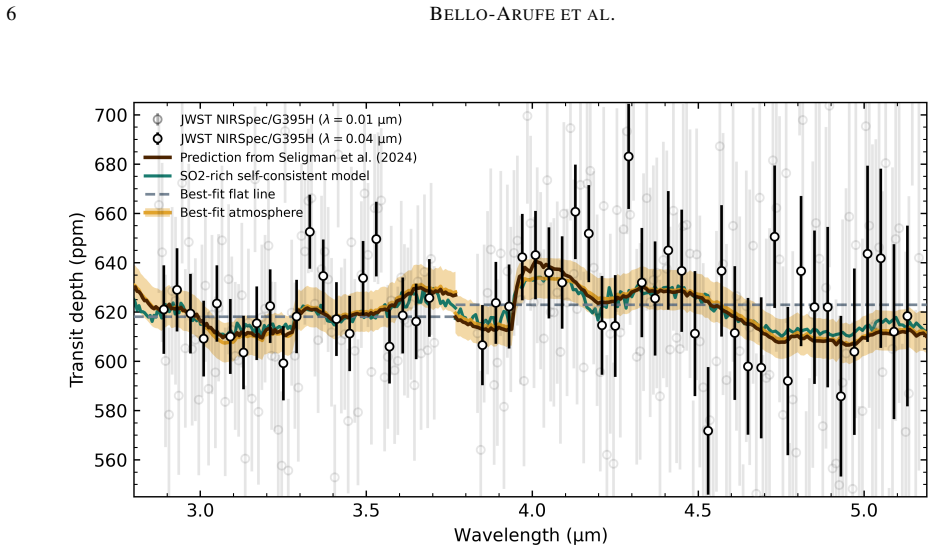
The mechanism that carries the argument is Bayesian model comparison of transmission spectra: a flat-line (airless) model is compared, via nested-sampling evidence estimation, against atmospheric models containing SO$_2$, using spectra from two independent data reductions and three retrieval frameworks. The physical hinge is the steady-state balance between volcanic outgassing and atmospheric escape, which converts the spectral preference into quantitative interior constraints: a required heat flux, tidal quality factor, oxygen fugacity of the mantle, and magma ocean radius. The spectral signatures that drive the preference are the SO$_2$ absorption bands at $2.8\text{--}3.1$ and $3.9\text{--}4.5$ microns.
What would settle it
Observe additional transits of L 98-59 b with the same instrument and check whether the SO$_2$ absorption bands at $3.9\text{--}4.5$ microns deepen and reach roughly $5\sigma$; if the preference stays below $5\sigma$ or the band shape changes under different systematics treatments, the volcanic-atmosphere claim would be falsified.
Extended reading notes
Core claim
The paper's central claim is that the combined transmission spectrum of L 98-59 b from four NIRSpec G395H transits shows a statistical preference, based on Bayesian evidence, for an SO$_2$-dominated atmosphere over a featureless flat line. The airless model remains statistically acceptable, and no individual gas abundance is tightly constrained by the retrievals, but three independent retrieval analyses consistently find the SO$_2$ scenario preferred at roughly $3\text{--}3.6\sigma$, and leave-one-out cross-validation shows the preference is driven by the spectral regions where SO$_2$ is the dominant absorber. Self-consistent photochemical forward models of a volcanically sustained SO$_2$ atmosphere reproduce the data well and predict high abundances of SO$_3$ and elemental sulfur. The authors then read the result as indicating active volcanism: balancing the inferred SO$_2$ inventory against XUV-driven escape requires an outgassing rate per unit mass at least eight times that of Io, and if the runaway melting mechanism operates, a subsurface magma ocean extending to $60\text{--}90\%$ of the planet's radius would be present.
Load-bearing premise
The spectral features that favor SO$_2$ are small, and the claim depends on the assumption that residual correlated noise in the lightcurves is not strong enough to create or cancel the $3.9\text{--}4.5$ micron bands; the $\sim50\text{--}100$ ppm inter-detector offsets applied in one reduction show this is a live concern.
Editorial extensions
If this is right
- If the SO$_2$ atmosphere is real, L 98-59 b would be the first sub-Earth exoplanet with a detected atmosphere, and the first volcanic atmosphere known beyond the solar system.
- The planet would need roughly eight times the volcanic outgassing and tidal heating per unit mass of Io, and likely a subsurface magma ocean reaching $60\text{--}90\%$ of its radius.
- The atmosphere's persistence implies the planet retained part of its sulfur supply, and the SO$_2$-rich composition implies an oxidized mantle with oxygen fugacity above $f\mathrm{O}_2 > \mathrm{IW}+2.7$.
- Volcanic outgassing would be established as a viable mechanism for reviving secondary atmospheres on tidally heated rocky planets around M dwarfs, changing expectations for why atmosphere detections on such planets have been rare.
- The self-consistent chemical model predicts an atmosphere dominated by SO$_2$ with abundant SO$_3$ and elemental sulfur, and no sulfur haze, so the same planet should appear clear of aerosol extinction at other wavelengths.
Reading between the lines
- A clean test would be additional transits: the paper estimates six more could push the Bayesian preference to roughly $5\sigma$ if the SO$_2$ interpretation is correct, so a non-confirmation would indicate systematic noise rather than a volcanic atmosphere.
- Because the chi-squared p-value cannot distinguish the flat line from the SO$_2$ model, the case rests on the prior volume and model parametrization; a different choice of prior on mixing ratios (e.g., allowing a nitrogen-dominated flat atmosphere) could change the significance, as the paper notes in one of its retrieval analyses.
- The inference of a magma ocean assumes runaway melting driven by tidal heating; if the volcanism is instead powered by radiogenic heat, the interior structure constraints would be very different and the apparent tidal-quality-factor constraint would not apply.
- If confirmed, the result would suggest that atmospheric searches around M dwarfs should prioritize tidally heated planets, since their outgassing can maintain high-molecular-weight atmospheres even when XUV stripping is severe.
Editorial analysis
A structured set of objections, weighed in public.
Referee Report
Summary. The paper presents JWST NIRSpec G395H transmission spectroscopy of the sub-Earth L 98-59 b from four transits, analyzed with two independent reduction pipelines (Eureka! and FIREFLy) and interpreted with three retrieval frameworks (ExoTR, Aurora, POSEIDON) plus self-consistent photochemical-climate models from EPACRIS. The central claim is that a 100% SO2 atmosphere is preferred over a flat line by 3.6σ in Bayesian evidence, which the authors interpret as evidence for a volcanically outgassed, steady-state SO2 atmosphere sustained by tidal heating. The paper also derives geophysical consequences (tidal quality factor, subsurface magma ocean radius, mantle oxygen fugacity) conditional on this interpretation. The authors explicitly state that the result should not be considered a detection, that the flat line cannot be rejected by p-value (p=0.81), and that the SO2 signal is degenerate with an N2 flat model, but the title and abstract nevertheless assert evidence for a volcanic atmosphere.
Significance. If the SO2 atmosphere on L 98-59 b is real, this would be the first detection of a volcanically sustained atmosphere on a rocky sub-Earth, with major implications for atmospheric escape, tidal heating, interior evolution, and the cosmic shoreline. The paper is methodologically strong in several respects: it uses two independent reductions, three independent retrieval codes, includes a self-consistent photochemical model, and compares against spectra that were published before the JWST observations (Seligman et al. 2024), avoiding circularity. The data and products are promised to be public. However, the statistical evidence is currently a Bayesian model preference rather than a detection, and the interpretation as volcanic hinges on assumptions that are not tested by the data. The paper would be publishable as a tentative, well-characterized hint, but as written the title and conclusions overstate the robustness of the detection.
major comments (4)
- [Abstract; Section 4.2; Section 6] The 3.6σ figure is a Bayesian evidence preference for a 100% SO2 model over a flat line, not a detection in the frequentist sense. The flat-line model has χ2=197.84 for 216 dof (p=0.81), and the pure SO2 model also has p=0.91; neither is rejected. The paper itself says in Section 4.1 that the result 'should not be considered as a detection.' Despite this, the title and abstract state 'Evidence for a volcanic atmosphere.' This is an overstatement of the statistical support, and since all geophysical inferences in Sections 5.2 and 5.3 proceed under the assumption that the SO2 atmosphere is real, the framing must be made explicitly tentative.
- [Section 4.1; Section 3.1] The ExoTR analysis states that SO2 is degenerate with N2, which would result in a flat transmission spectrum. An N2-dominated atmosphere is therefore indistinguishable from a bare rock in the G395H bandpass under the current data quality. The reported Bayes factor between the SO2 model and the flat line is consequently not a test of 'atmosphere vs. no atmosphere' but only of SO2 spectral features vs. a featureless spectrum. A direct model comparison including an N2 (or other high mean molecular weight, flat-spectrum) atmosphere is needed to support the claim that the data favor an atmosphere at all, rather than merely a particular absorber.
- [Sections 2.1 and 2.2; Section 4.2; Figure 6] The SO2 signal that drives the model preference is concentrated in the 3.9–4.5 µm region on NRS2, which is the same detector that required the most aggressive systematics corrections in both pipelines. Eureka! trimmed the first 640 integrations of the second and fourth NRS2 visits because of low-frequency undulations, and FIREFLy used up to 6th-order polynomial systematics plus 50–100 ppm inter-detector offsets, which the authors themselves describe as 'much too large to be physical.' The amplitude of the SO2 features is comparable to or smaller than these corrections. Agreement between two pipelines that both model the same detector's time-correlated noise with flexible functions does not exclude a common systematic mode. Please provide robustness tests such as retrievals on data with the trimmed regions removed, fits using only NRS1 data, or injection-and-recovery tests of synthetic SO2 signals in the presence of the observed systematics.
- [Section 4.3; Appendix A.4] POSEIDON finds no evidence for spectral deviations from a flat line in any individual visit; the preference for an atmosphere appears only in the combined four-visit spectrum. Meanwhile, the white-lightcurve fits show significant visit-to-visit and pipeline-to-pipeline differences in Rp/Rs, which the authors attribute to correlated noise rather than stellar inhomogeneities. This raises the possibility that the apparent SO2 features in the combined spectrum arise from coherent averaging of time-correlated systematics rather than a real planetary signal. The paper should report the per-visit evidence for the SO2 feature and assess whether the feature is consistently present across all four visits.
minor comments (6)
- [Section 2.1] The phrase 'due because' should be corrected to 'because' or 'due to'.
- [Section 4.2] The sentence 'these model assessments metrics provide a single value' should read 'these model assessment metrics provide a single value.'
- [Section 5.2] The comparison of volcanic outgassing rates between L 98-59 b and Io should explicitly state the masses used for the per-unit-mass factor, since the raw rate ratio and the per-unit-mass ratio differ by a factor of order the mass ratio.
- [Table A1] In Table A1, the FIREFLy row for Transit 2 NRS1 appears to be missing entries for i and a/Rs in the printed text; please check the table formatting.
- [Appendix B] The adoption of S4 cross sections as a proxy for S8 opacity and the use of the GJ 176 MUSCLES spectrum as a proxy for L 98-59's high-energy flux are assumptions that should be flagged in the main text, not only in the appendix, since they affect the self-consistent photochemical model predictions.
- [Figure 6] The color scale for Δelpd is hard to read when the figure is printed in grayscale; please use a more perceptually uniform colormap or add labels to the color bar.
Circularity Check
No significant circularity: the SO2 model comparison is independent of the volcanic interpretation, and the Seligman et al. prediction predates the JWST data.
full rationale
The paper's central claim is a Bayesian model comparison between measured transmission spectra and atmospheric models, not a quantity fitted into existence. The 100% SO2 and 14-parameter Aurora models are compared to the data with the same number of free parameters as the flat-line null model, so the reported 3.6 sigma preference is a direct likelihood/evidence calculation rather than a circular reduction. The Seligman et al. (2024) volcanic SO2 spectra are cited prominently, and one author overlaps, but those spectra were published before the JWST observations and are tested against the data with only free vertical offsets; the shape of the predicted SO2 features is not fitted from the observed spectrum. The paper even states in Section 4.1 that 'This result should not be considered as a detection' and reports flat-line p=0.81, so the statistical weakness is explicitly disclosed and belongs to correctness risk rather than circularity. The interior and geochemical inferences in Sections 5 and 6 are explicitly conditional on the assumed SO2 scenario and do not feed back into the detection. No equation or fitted parameter is used both as input and as the claimed output.
Assumptions & free parameters
free parameters (10)
- SO2 volume mixing ratio =
Posterior peaks near 100% (log10 SO2 = -0.09+0.09/-1.85 in POSEIDON; 97+2/-5% in EPACRIS-coupled retrievals)
- Inter-detector offset (NRS1 vs NRS2) =
A few ppm, consistent with zero (e.g. -4.8+5.4/-5.1 ppm)
- Transit depth / planetary radius at reference pressure =
~0.85 R_Earth (prior range 0.72-0.98)
- Atmospheric temperature =
596 +125/-143 K (Aurora 14-param); ExoTR prefers ~250 K
- Cloud top pressure =
Unconstrained; Psurf > 1e-5 bar to 2 sigma
- Lightcurve systematics model coefficients =
Polynomial degrees 1-6 plus x/y shift terms per visit/detector
- Escape efficiency =
1% (assumed)
- Volatile (sulfur and carbon) content x in magma =
100-200 ppm (bulk silicate Earth)
- Love number k2 =
0.1-0.5 (assumed range)
- Tidal quality factor Q =
Q_L98-59b < 1400 Q_Io (from Appendix E)
assumptions (8)
- domain assumption Energy-limited escape formula with 1% efficiency governs atmospheric mass loss.
- ad hoc to paper The bulk silicate Earth's volatile content (x ~ 100-200 ppm) applies to L98-59b.
- domain assumption The runaway melting mechanism of Peale et al. (1979) and Seligman et al. (2024) applies to L98-59b.
- domain assumption SO2 detected in transmission originates from volcanism, not from other sources.
- domain assumption The eccentricity and tidal heating parameters from Demangeon et al. (2021) and Rajpaul et al. (2024) are correct.
- ad hoc to paper GJ 176's MUSCLES spectrum is a suitable proxy for L98-59's high-energy stellar flux.
- ad hoc to paper S4 cross sections approximate S8 opacity in the UV/visible.
- standard math Transmission spectroscopy assumes hydrostatic equilibrium and a known pressure-radius reference.
Cite this review
Pith. "Pith review of Evidence for a volcanic atmosphere on the sub-Earth L98-59b." pith.science (2026). https://pith.science/paper/GJ4S62YQ
@misc{pith2026250118680,
  author       = {Pith},
  title        = {Pith review of: Evidence for a volcanic atmosphere on the sub-Earth L98-59b},
  year         = {2026},
  howpublished = {\url{https://pith.science/paper/GJ4S62YQ}},
  note         = {Machine review of arXiv:2501.18680}
}
abstract
Assessing the prevalence of atmospheres on rocky planets around M-dwarf stars is a top priority of exoplanet science. High-energy activity from M-dwarfs can destroy the atmospheres of these planets, which could explain the lack of atmosphere detections to date. Volcanic outgassing has been proposed as a mechanism to replenish the atmospheres of tidally-heated rocky planets. L 98-59 b, a sub-Earth transiting a nearby M dwarf, was recently identified as the most promising exoplanet to detect a volcanic atmosphere. We present the transmission spectrum of L 98-59 b from four transits observed with JWST NIRSpec G395H. Although the airless model provides an adequate fit to the data based on its $\chi^2$, an SO$_2$ atmosphere is preferred by 3.6$\sigma$ over a flat line in terms of the Bayesian evidence. Such an atmosphere would likely be in a steady state where volcanism balances escape. If so, L 98-59 b must experience at least eight times as much volcanism and tidal heating per unit mass as Io. If volcanism is driven by runaway melting of the mantle, we predict the existence of a subsurface magma ocean in L 98-59 b extending up to $R_p\sim 60-90\%$. An SO$_2$-rich volcanic atmosphere on L 98-59 b would be indicative of an oxidized mantle with an oxygen fugacity of $f\rm{O}_2>IW+2.7$, and it would imply that L 98-59 b must have retained some of its volatile endowment despite its proximity to its star. Our findings suggest that volcanism may revive secondary atmospheres on tidally heated rocky planets around M-dwarfs.
Figures


Figures from the paper (6 more)


Forward citations
Cited by 3 Pith papers
-
Pyrat Bay 2.0: an Upgraded Framework for Exoplanet Atmosphere Modeling in the JWST Era
Pyrat Bay 2.0 adds equilibrium chemistry, radiative equilibrium, and vertically varying abundance retrieval, and simulations indicate JWST-quality spectra can recover such variations.
-
Constraining Ongoing Volcanic Outgassing Rates and Interior Compositions of Extrasolar Planets with Mass Measurements of Plasma Tori
A circumstellar plasma torus fed by exoplanet volcanism would imprint detectable atomic absorption lines, letting astronomers estimate volcanic outgassing rates.
-
AGNI: A radiative-convective model for lava planet atmospheres
AGNI is an open-source, energy-conserving radiative-convective model for lava planet atmospheres, built for coupling with interior evolution simulations.
Reference graph
Works this paper leans on
-
[1]
Alderson, L., Batalha, N. E., Wakeford, H. R., et al. 2024, AJ, 167, 216, doi: 10.3847/1538-3881/ad32c9
-
[2]
Alexander, C. M. O., Wynn, J. G., Bowden, R., & Scott, E. 2022, M&PS, 57, 334, doi: 10.1111/maps.13746 20 B ELLO -A RUFE ET AL
-
[3]
August, P. C., Buchhave, L. A., Diamond-Lowe, H., et al. 2024, arXiv e-prints, arXiv:2410.11048, doi: 10.48550/arXiv.2410.11048
-
[4]
Azzam, A. A. A., Tennyson, J., Yurchenko, S. N., & Naumenko, O. V . 2016, MNRAS, 460, 4063, doi: 10.1093/mnras/stw1133
-
[5]
Banerjee, A., Barstow, J. K., Gressier, A., et al. 2024, arXiv e-prints, arXiv:2408.15707, doi: 10.48550/arXiv.2408.15707
-
[6]
2022, The Journal of Open Source Software, 7, 4503, doi: 10.21105/joss.04503
Bell, T., Ahrer, E.-M., Brande, J., et al. 2022, The Journal of Open Source Software, 7, 4503, doi: 10.21105/joss.04503
-
[7]
J., Welbanks, L., Schlawin, E., et al
Bell, T. J., Welbanks, L., Schlawin, E., et al. 2023, Nature, 623, 709, doi: 10.1038/s41586-023-06687-0
-
[8]
2012, ApJ, 753, 100, doi: 10.1088/0004-637X/753/2/100
Benneke, B., & Seager, S. 2012, ApJ, 753, 100, doi: 10.1088/0004-637X/753/2/100
Show all 99 references
-
[9]
2013, Icarus, 223, 308, doi: 10.1016/j.icarus.2012.11.020
Beuthe, M. 2013, Icarus, 223, 308, doi: 10.1016/j.icarus.2012.11.020
2013 doi
-
[10]
I., & Smith, A
Billmers, R. I., & Smith, A. L. 1991, The Journal of Physical Chemistry, 95, 4242
1991
-
[11]
M., Ferruit, P., Giardino, G., et al
Birkmann, S. M., Ferruit, P., Giardino, G., et al. 2022, A&A, 661, A83, doi: 10.1051/0004-6361/202142592
2022 doi
-
[12]
2003, Journal of Photochemistry and Photobiology A: Chemistry, 157, 167
Bogumil, K., Orphal, J., Homann, T., et al. 2003, Journal of Photochemistry and Photobiology A: Chemistry, 157, 167
2003
-
[13]
2014, A&A, 564, A125, doi: 10.1051/0004-6361/201322971
Buchner, J., Georgakakis, A., Nandra, K., et al. 2014, A&A, 564, A125, doi: 10.1051/0004-6361/201322971
2014 doi
-
[14]
B., & McKeen, S
Burkholder, J. B., & McKeen, S. 1997, Geophysical research letters, 24, 3201
1997
-
[15]
2019, A&A, 629, A111, doi: 10.1051/0004-6361/201935957
Cloutier, R., Astudillo-Defru, N., Bonfils, X., et al. 2019, A&A, 629, A111, doi: 10.1051/0004-6361/201935957
2019 doi
-
[16]
2024, ApJL, 968, L22, doi: 10.3847/2041-8213/ad5204
Damiano, M., Bello-Arufe, A., Yang, J., & Hu, R. 2024, ApJL, 968, L22, doi: 10.3847/2041-8213/ad5204
2024 doi
-
[17]
2020, AJ, 159, 175, doi: 10.3847/1538-3881/ab79a5 —
Damiano, M., & Hu, R. 2020, AJ, 159, 175, doi: 10.3847/1538-3881/ab79a5 —. 2021, AJ, 162, 200, doi: 10.3847/1538-3881/ac224d —. 2022, AJ, 163, 299, doi: 10.3847/1538-3881/ac6b97
2020 doi
-
[18]
2022, AJ, 164, 225, doi: 10.3847/1538-3881/ac9472 de Wit, J., Lewis, N
Damiano, M., Hu, R., Barclay, T., et al. 2022, AJ, 164, 225, doi: 10.3847/1538-3881/ac9472 de Wit, J., Lewis, N. K., Langton, J., et al. 2016, ApJL, 820, L33, doi: 10.3847/2041-8205/820/2/L33
2022 doi
-
[19]
Demangeon, O. D. S., Zapatero Osorio, M. R., Alibert, Y ., et al. 2021, A&A, 653, A41, doi: 10.1051/0004-6361/202140728
2021 doi
-
[20]
2024, Nature Astronomy, doi: 10.1038/s41550-024-02428-z
Ducrot, E., Lagage, P.-O., Min, M., et al. 2024, Nature Astronomy, doi: 10.1038/s41550-024-02428-z
2024 doi
-
[21]
G., & Guinan, E
Engle, S. G., & Guinan, E. F. 2023, ApJL, 954, L50, doi: 10.3847/2041-8213/acf472
2023 doi
-
[22]
P., & Bridges, M
Feroz, F., Hobson, M. P., & Bridges, M. 2009, Monthly Notices of the Royal Astronomical Society, 398, 1601, doi: 10.1111/j.1365-2966.2009.14548.x
2009
-
[23]
W., Lang, D., & Goodman, J
Foreman-Mackey, D., Hogg, D. W., Lang, D., & Goodman, J. 2013, PASP, 125, 306, doi: 10.1086/670067
2013 doi
-
[24]
F., Ahlers, J
Fromont, E. F., Ahlers, J. P., do Amaral, L. N. R., et al. 2024, ApJ, 961, 115, doi: 10.3847/1538-4357/ad0e0e
2024 doi
-
[25]
2022, Earth and Planetary Science Letters, 577, 117255, doi: 10.1016/j.epsl.2021.117255
Gaillard, F., Bernadou, F., Roskosz, M., et al. 2022, Earth and Planetary Science Letters, 577, 117255, doi: 10.1016/j.epsl.2021.117255
2022
-
[26]
J., Lichtenberg, T., Boukrouche, R., & Pierrehumbert, R
Graham, R. J., Lichtenberg, T., Boukrouche, R., & Pierrehumbert, R. T. 2021, PSJ, 2, 207, doi: 10.3847/PSJ/ac214c
2021 doi
-
[27]
Grant, D., & Wakeford, H. R. 2022, Exo-TiC/ExoTiC-LD: ExoTiC-LD v3.0.0, v3.0.0, Zenodo, doi: 10.5281/zenodo.7437681
2022 doi
-
[28]
P., Bell, T
Greene, T. P., Bell, T. J., Ducrot, E., et al. 2023, Nature, 618, 39, doi: 10.1038/s41586-023-05951-7
2023 doi
- [29]
-
[30]
L., Malik, M., Kitzmann, D., et al
Grimm, S. L., Malik, M., Kitzmann, D., et al. 2021, The Astrophysical Journal Supplement Series, 253, 30
2021
-
[31]
Heng, K., & Marley, M. S. 2018, Radiative Transfer for Exoplanet Atmospheres (Cham: Springer International Publishing), 2137–2152, doi: 10.1007/978-3-319-55333-7 102
2018 doi
-
[32]
E., Kjaergaard, H
Hintze, P. E., Kjaergaard, H. G., Vaida, V ., & Burkholder, J. B. 2003, The Journal of Physical Chemistry A, 107, 1112
2003
-
[33]
2019, The Astrophysical Journal, 887, 166 —
Hu, R. 2019, The Astrophysical Journal, 887, 166 —. 2021, ApJ, 921, 27, doi: 10.3847/1538-4357/ac1789
2019 doi
-
[34]
2012, The Astrophysical Journal, 761, 166 —
Hu, R., Seager, S., & Bains, W. 2012, The Astrophysical Journal, 761, 166 —. 2013a, The Astrophysical Journal, 769, 6 —. 2013b, ApJ, 769, 6, doi: 10.1088/0004-637X/769/1/6
2012 doi
-
[35]
2024, Nature, 630, 609, doi: 10.1038/s41586-024-07432-x
Hu, R., Bello-Arufe, A., Zhang, M., et al. 2024, Nature, 630, 609, doi: 10.1038/s41586-024-07432-x
2024 doi
-
[36]
O., Wende-von Berg, S., Dreizler, S., et al
Husser, T. O., Wende-von Berg, S., Dreizler, S., et al. 2013, A&A, 553, A6, doi: 10.1051/0004-6361/201219058
2013 doi
-
[37]
2022, A&A, 661, A80, doi: 10.1051/0004-6361/202142663
Jakobsen, P., Ferruit, P., Alves de Oliveira, C., et al. 2022, A&A, 661, A80, doi: 10.1051/0004-6361/202142663
2022 doi
-
[38]
G., & Sasselov, D
Kaltenegger, L., Henning, W. G., & Sasselov, D. D. 2010, AJ, 140, 1370, doi: 10.1088/0004-6256/140/5/1370
2010 doi
-
[39]
E., van der Avoird, A., et al
Karman, T., Gordon, I. E., van der Avoird, A., et al. 2019, Icarus, 328, 160, doi: 10.1016/j.icarus.2019.02.034
2019 doi
-
[40]
T., Matsuyama, I., Bierson, C
Keane, J. T., Matsuyama, I., Bierson, C. J., & Trinh, A. 2023, Tidal Heating and the Interior Structure of Io, ed. R. M. C. Lopes, K. de Kleer, & J. Tuttle Keane (Cham: Springer International Publishing), 95–146, doi: 10.1007/978-3-031-25670-7 4
2023 doi
-
[41]
Kipping, D. M. 2013, MNRAS, 435, 2152, doi: 10.1093/mnras/stt1435
2013 doi
-
[42]
S., & Barnett, M
Kite, E. S., & Barnett, M. N. 2020, Proceedings of the National Academy of Science, 117, 18264, doi: 10.1073/pnas.2006177117
2020 doi
-
[43]
2015, PASP, 127, 1161, doi: 10.1086/683602
Kreidberg, L. 2015, PASP, 127, 1161, doi: 10.1086/683602
2015 doi
-
[44]
2009, Nature, 459, 957, doi: 10.1038/nature08108
Lainey, V ., Arlot, J.-E., Karatekin,¨O., & van Hoolst, T. 2009, Nature, 459, 957, doi: 10.1038/nature08108
2009 doi
-
[45]
2009, Nature, 457, 562, doi: 10.1038/nature07649 A VOLCANIC ATMOSPHERE ON L 98-59 B 21
Laughlin, G., Deming, D., Langton, J., et al. 2009, Nature, 457, 562, doi: 10.1038/nature07649 A VOLCANIC ATMOSPHERE ON L 98-59 B 21
2009 doi
-
[46]
B., & Shorttle, O
Liggins, P., Jordan, S., Rimmer, P. B., & Shorttle, O. 2022, Journal of Geophysical Research (Planets), 127, e07123, doi: 10.1029/2021JE007123
2022 doi
-
[47]
Lopes, R. M. C., & Spencer, J. R. 2007, Io After Galileo: A New View of Jupiter’s V olcanic Moon, doi: 10.1007/978-3-540-48841-5
2007 doi
-
[48]
Loyd, R. O. P., France, K., Youngblood, A., et al. 2016, ApJ, 824, 102, doi: 10.3847/0004-637X/824/2/102
2016 doi
-
[49]
2022, Science, 377, 1211, doi: 10.1126/science.abl7164
Luque, R., & Pall´e, E. 2022, Science, 377, 1211, doi: 10.1126/science.abl7164
2022 doi
-
[50]
M., et al
Lustig-Yaeger, J., Fu, G., May, E. M., et al. 2023, Nature Astronomy, 7, 1317, doi: 10.1038/s41550-023-02064-z
2023 doi
-
[51]
MacDonald, R. J. 2023, The Journal of Open Source Software, 8, 4873, doi: 10.21105/joss.04873
2023 doi
-
[52]
J., & Madhusudhan, N
MacDonald, R. J., & Madhusudhan, N. 2017, MNRAS, 469, 1979, doi: 10.1093/mnras/stx804
2017 doi
-
[53]
2023, ApJL, 956, L13, doi: 10.3847/2041-8213/acf577
Madhusudhan, N., Sarkar, S., Constantinou, S., et al. 2023, ApJL, 956, L13, doi: 10.3847/2041-8213/acf577
2023 doi
-
[54]
2009, ApJ, 707, 24, doi: 10.1088/0004-637X/707/1/24
Madhusudhan, N., & Seager, S. 2009, ApJ, 707, 24, doi: 10.1088/0004-637X/707/1/24
2009 doi
-
[55]
2015, A&A, 573, A90, doi: 10.1051/0004-6361/201423804
Magic, Z., Chiavassa, A., Collet, R., & Asplund, M. 2015, A&A, 573, A90, doi: 10.1051/0004-6361/201423804
2015 doi
-
[56]
M., MacDonald, R
May, E. M., MacDonald, R. J., Bennett, K. A., et al. 2023, arXiv e-prints, arXiv:2310.10711. https://arxiv.org/abs/2310.10711
2023 arXiv
-
[57]
2023, MNRAS, 520, 259, doi: 10.1093/mnras/stac3532
McGill, P., Anderson, J., Casertano, S., et al. 2023, MNRAS, 520, 259, doi: 10.1093/mnras/stac3532
2023 doi
-
[58]
A., Synnott, S
Morabito, L. A., Synnott, S. P., Kupferman, P. N., & Collins, S. A. 1979, Science, 204, 972, doi: 10.1126/science.204.4396.972
1979 doi
-
[59]
E., Stevenson, K
Moran, S. E., Stevenson, K. B., Sing, D. K., et al. 2023, ApJL, 948, L11, doi: 10.3847/2041-8213/accb9c
2023 doi
-
[60]
D., & Dermott, S
Murray, C. D., & Dermott, S. F. 1999, Solar system dynamics
1999
-
[61]
M., Guzewich, S
Ostberg, C. M., Guzewich, S. D., Kane, S. R., et al. 2023, AJ, 166, 199, doi: 10.3847/1538-3881/acfe12
2023 doi
-
[62]
V ., Johnson, R
Oza, A. V ., Johnson, R. E., Lellouch, E., et al. 2019, ApJ, 885, 168, doi: 10.3847/1538-4357/ab40cc
2019 doi
-
[63]
J., & Cassen, P
Peale, S. J., & Cassen, P. 1978, Icarus, 36, 245, doi: 10.1016/0019-1035(78)90109-4
1978 doi
-
[64]
J., Cassen, P., & Reynolds, R
Peale, S. J., Cassen, P., & Reynolds, R. T. 1979, Science, 203, 892, doi: 10.1126/science.203.4383.892
1979 doi
-
[65]
E., Schwieterman, E
Pidhorodetska, D., Moran, S. E., Schwieterman, E. W., et al. 2021, AJ, 162, 169, doi: 10.3847/1538-3881/ac1171
2021 doi
-
[66]
V ., Madhusudhan, N., & Apai, D
Pinhas, A., Rackham, B. V ., Madhusudhan, N., & Apai, D. 2018, MNRAS, 480, 5314, doi: 10.1093/mnras/sty2209
2018 doi
-
[67]
L., Kyuberis, A
Polyansky, O. L., Kyuberis, A. A., Zobov, N. F., et al. 2018, MNRAS, 480, 2597, doi: 10.1093/mnras/sty1877
2018 doi
-
[68]
C., Roberge, A., Mlinar, A
Quick, L. C., Roberge, A., Mlinar, A. B., & Hedman, M. M. 2020, PASP, 132, 084402, doi: 10.1088/1538-3873/ab9504
2020 doi
-
[69]
2017, ApJ, 834, 151, doi: 10.3847/1538-4357/aa4f6c
Rackham, B., Espinoza, N., Apai, D., et al. 2017, ApJ, 834, 151, doi: 10.3847/1538-4357/aa4f6c
2017 doi
-
[70]
M., Barrag´an, O., & Zicher, N
Rajpaul, V . M., Barrag´an, O., & Zicher, N. 2024, MNRAS, 530, 4665, doi: 10.1093/mnras/stae778
2024 doi
-
[71]
E., Rothman, L
Richard, C., Gordon, I. E., Rothman, L. S., et al. 2012, JQSRT, 113, 1276, doi: 10.1016/j.jqsrt.2011.11.004
2012 doi
-
[72]
2023, PASP, 135, 048001, doi: 10.1088/1538-3873/acb293
Rigby, J., Perrin, M., McElwain, M., et al. 2023, PASP, 135, 048001, doi: 10.1088/1538-3873/acb293
2023 doi
-
[73]
S., Gordon, I
Rothman, L. S., Gordon, I. E., Barber, R. J., et al. 2010, JQSRT, 111, 2139, doi: 10.1016/j.jqsrt.2010.05.001
2010 doi
-
[74]
K., Liu, R., & Wang, A
Rustamkulov, Z., Sing, D. K., Liu, R., & Wang, A. 2022, ApJL, 928, L7, doi: 10.3847/2041-8213/ac5b6f
2022 doi
-
[75]
K., Mukherjee, S., et al
Rustamkulov, Z., Sing, D. K., Mukherjee, S., et al. 2023, Nature, 614, 659, doi: 10.1038/s41586-022-05677-y
2023 doi
-
[76]
R., et al
Scarsdale, N., Wogan, N., Wakeford, H. R., et al. 2024, AJ, 168, 276, doi: 10.3847/1538-3881/ad73cf
2024 doi
-
[77]
Z., Feinstein, A
Seligman, D. Z., Feinstein, A. D., Lai, D., et al. 2024, ApJ, 961, 22, doi: 10.3847/1538-4357/ad0b82
2024 doi
-
[78]
A., Soderblom, L
Smith, B. A., Soderblom, L. A., Johnson, T. V ., et al. 1979, Science, 204, 951, doi: 10.1126/science.204.4396.951
1979 doi
-
[79]
G., Terrile, R
Strom, R. G., Terrile, R. J., Masursky, H., & Hansen, C. 1979, Nature, 280, 733, doi: 10.1038/280733a0
1979 doi
-
[80]
A., & Perevalov, V
Tashkun, S. A., & Perevalov, V . I. 2011, Journal of Quantitative Spectroscopy and Radiative Transfer, 112, 1403, doi: 10.1016/j.jqsrt.2011.03.005
2011 doi
-
[81]
N., Al-Refaie, A
Tennyson, J., Yurchenko, S. N., Al-Refaie, A. F., et al. 2016, Journal of Molecular Spectroscopy, 327, 73, doi: 10.1016/j.jms.2016.05.002
2016 doi
-
[82]
2019, A&A, 630, A70, doi: 10.1051/0004-6361/201935297
Tobie, G., Grasset, O., Dumoulin, C., & Mocquet, A. 2019, A&A, 630, A70, doi: 10.1051/0004-6361/201935297
2019 doi
-
[83]
2023, The Journal of Open Source Software, 8, 4602, doi: 10.21105/joss.04602
Townsend, R., & Lopez, A. 2023, The Journal of Open Source Software, 8, 4602, doi: 10.21105/joss.04602
2023 doi
-
[84]
2008, Contemporary Physics, 49, 71, doi: 10.1080/00107510802066753
Trotta, R. 2008, Contemporary Physics, 49, 71, doi: 10.1080/00107510802066753
2008 doi
-
[85]
1982, Reviews of Geophysics, 20, 233
Turco, R., Whitten, R., & Toon, O. 1982, Reviews of Geophysics, 20, 233
1982
-
[86]
S., Tennyson, J., Yurchenko, S
Underwood, D. S., Tennyson, J., Yurchenko, S. N., et al. 2016, MNRAS, 459, 3890, doi: 10.1093/mnras/stw849 van Dokkum, P. G. 2001, PASP, 113, 1420, doi: 10.1086/323894
2016 doi
-
[87]
K., Diamond-Lowe, H., et al
Wachiraphan, P., Berta-Thompson, Z. K., Diamond-Lowe, H., et al. 2024, arXiv e-prints, arXiv:2410.10987, doi: 10.48550/arXiv.2410.10987
2024 doi
-
[88]
L., Batalha, N
Wallack, N. L., Batalha, N. E., Alderson, L., et al. 2024, AJ, 168, 77, doi: 10.3847/1538-3881/ad3917 Weiner Mansfield, M., Xue, Q., Zhang, M., et al. 2024, ApJL, 975, L22, doi: 10.3847/2041-8213/ad8161
2024 doi
-
[89]
2019, AJ, 157, 206, doi: 10.3847/1538-3881/ab14de —
Welbanks, L., & Madhusudhan, N. 2019, AJ, 157, 206, doi: 10.3847/1538-3881/ab14de —. 2021, ApJ, 913, 114, doi: 10.3847/1538-4357/abee94 —. 2022, ApJ, 933, 79, doi: 10.3847/1538-4357/ac6df1
2019 doi
-
[90]
2023, AJ, 165, 112, doi: 10.3847/1538-3881/acab67 22 B ELLO -A RUFE ET AL
Welbanks, L., McGill, P., Line, M., & Madhusudhan, N. 2023, AJ, 165, 112, doi: 10.3847/1538-3881/acab67 22 B ELLO -A RUFE ET AL
2023 doi
-
[91]
J., Beatty, T
Welbanks, L., Bell, T. J., Beatty, T. G., et al. 2024, Nature, 630, 836, doi: 10.1038/s41586-024-07514-w
2024 doi
-
[92]
2015, Atmospheric Chemistry and Physics, 15, 1843
Whitehill, A., Jiang, B., Guo, H., & Ono, S. 2015, Atmospheric Chemistry and Physics, 15, 1843
2015
-
[93]
F., Batalha, N
Wogan, N. F., Batalha, N. E., Zahnle, K. J., et al. 2024, The Astrophysical Journal Letters, 963, L7
2024
-
[94]
2024, The Astrophysical Journal, 966, 189, doi: 10.3847/1538-4357/ad35c8
Yang, J., & Hu, R. 2024, The Astrophysical Journal, 966, 189, doi: 10.3847/1538-4357/ad35c8
2024 doi
-
[95]
N., Amundsen, D
Yurchenko, S. N., Amundsen, D. S., Tennyson, J., & Waldmann, I. P. 2017, Astronomy and Astrophysics, 605, A95, doi: 10.1051/0004-6361/201731026
2017 doi
-
[96]
J., & Catling, D
Zahnle, K. J., & Catling, D. C. 2017, ApJ, 843, 122, doi: 10.3847/1538-4357/aa7846
2017 doi
-
[97]
2024, ApJL, 961, L44, doi: 10.3847/2041-8213/ad1a07
Zhang, M., Hu, R., Inglis, J., et al. 2024, ApJL, 961, L44, doi: 10.3847/2041-8213/ad1a07
2024 doi
-
[98]
2022, AJ, 164, 203, doi: 10.3847/1538-3881/ac8fe9
Zhou, L., Ma, B., Wang, Y ., & Zhu, Y . 2022, AJ, 164, 203, doi: 10.3847/1538-3881/ac8fe9
2022 doi
-
[99]
2023, Nature, 620, 746, doi: 10.1038/s41586-023-06232-z
Zieba, S., Kreidberg, L., Ducrot, E., et al. 2023, Nature, 620, 746, doi: 10.1038/s41586-023-06232-z
2023 doi
Reviewed August 9, 2026 · model on record in the stance chip above.
Discussion (0). Continue with ORCID to comment.