REVIEW 2 major objections 6 minor 28 references
Temperature-redshift relation in energy-momentum-powered gravity models
T0 review · 2 major / 6 minor · reviewed 2026-08-09 · deepseek-v4-flash
Pith's one-line read CMB temperature history pins modified-gravity power to |n|<0.01.
desk verdict The paper has a genuinely new observation and a clean analysis, but the central T(z) prediction is derived for a single-fluid universe and then applied to the real matter-plus-radiation universe without deriving the two-fluid continuity equations, so the headline constraints are not established. read the letter →
The pith
A machine-rendered reading of the paper's core claim, the machinery that carries it, and where it could break.
The reading
What carries the argument
The central object is the dimensionless density $r(z)=\rho(z)/\rho_0$ defined from the radiation or matter energy density, governed by the modified continuity equation, e.g. Eq. (25) for radiation, with the parameter $Q=\eta\,\rho_0^{2n-1}/\kappa$ quantifying the strength of the nonlinear term. The temperature-redshift relation $T(z)=T_0\,r(z)^{1/4}$ is the observable probe. The mechanism that carries the argument is the complementarity of data sets: CMB temperature measurements are nearly insensitive to $\Omega_m$ but highly sensitive to $n$, so they break the $\Omega_m$--$n$ degeneracy that weakens constraints from background cosmology alone.
What would settle it
A future measurement of the CMB temperature at $z\simeq2$--$3$ with sub-percent precision that exactly tracks $T_0(1+z)$ would push $|n|$ below $10^{-2}$; conversely, a statistically significant deviation following the shape $T_0\,r(z)^{1/4}$ with $n\simeq0.005$ would confirm the predicted violation. A detection of CMB spectral distortions attributable to non-adiabatic or frequency-dependent photon processes would invalidate the paper's central mapping and break the constraint chain.
Extended reading notes
Core claim
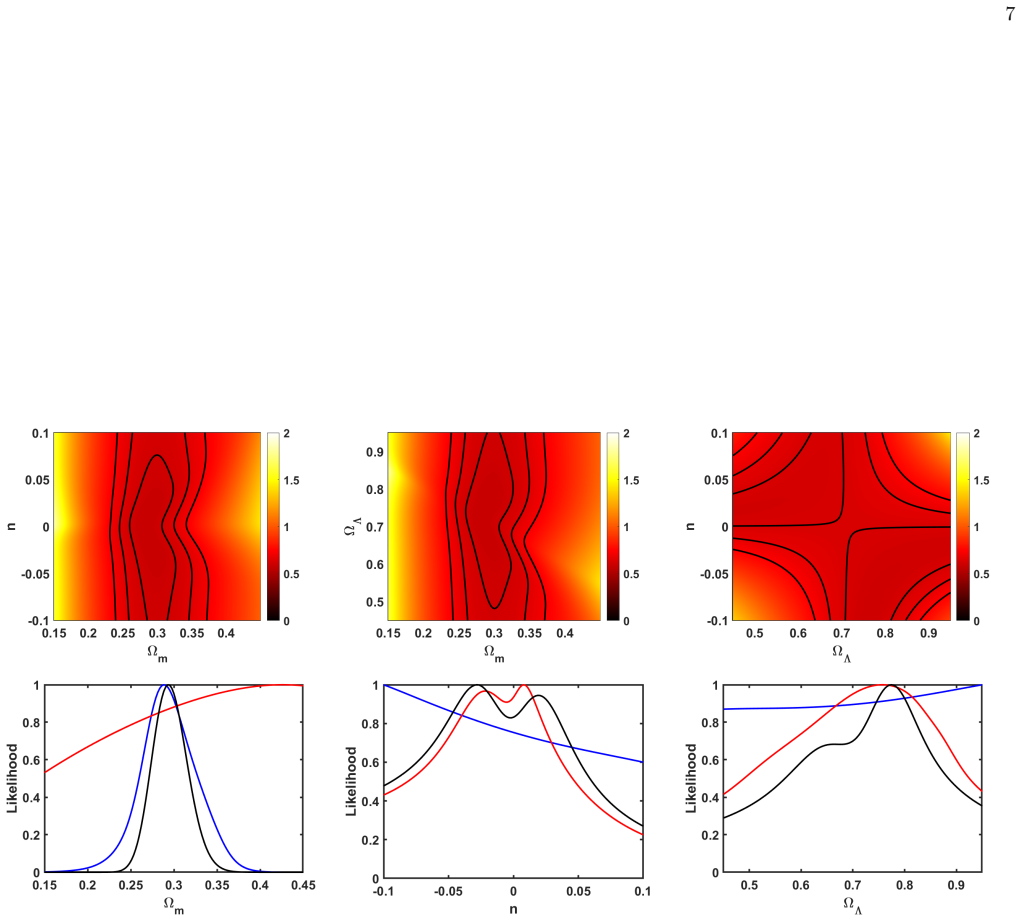
In EMP gravity the radiation fluid obeys a modified continuity equation, Eq. (25), whose solution $r(z)$ enters the temperature-redshift relation $T(z)=T_0\,r(z)^{1/4}$, Eq. (26). This differs from the standard $T_0(1+z)$ for all $n$ except $n=0$ and $n=5/8$. Fitting the 45-measurement CMB temperature compilation jointly with the 1048 Type Ia supernova sample and the 38-measurement Hubble-parameter compilation, the authors find $|n|<0.01$ at $1\sigma$ for flat models without a cosmological constant and $|n|<0.1$ when $\Omega_\Lambda\neq0$, with $\Omega_m=0.30\pm0.02$ in the joint fit. The nonlinear term is thus required to be subdominant and effectively indistinguishable from a cosmological constant.
Load-bearing premise
The constraints assume that the processes that create or destroy photons in these models do so evenly at all frequencies and without adding heat, so the cosmic microwave background stays a perfect blackbody; if those processes are not so gentle, the measured temperatures cannot be translated into the model's $T(z)$.
Editorial extensions
If this is right
- The original energy-momentum-squared gravity ($n=1$) is ruled out by more than an order of magnitude.
- Without a cosmological constant, acceleration cannot be sourced by the nonlinear term; the model behaves as an effective cosmological constant with $n\simeq0$.
- With a cosmological constant, $n$ is still forced to $|n|<0.1$, excluding the special value $n=1/2$.
- The combined data improve the matter-density constraint to $\Omega_m=0.30\pm0.02$, roughly a factor of two better than using background data alone.
- At low redshift, EMP models are observationally indistinguishable from $\Lambda$CDM.
Reading between the lines
- Adding high-redshift data, such as the CMB power spectrum, would likely tighten the $n$ bound further, as the paper itself notes in closing.
- The same temperature-redshift probe could be applied to any modified-gravity or photon-number-nonconserving theory whose continuity equation predicts a nonstandard $r(z)$.
- The adiabatic, achromatic requirement for the photon processes is a testable prior: a future detection of CMB spectral distortions at the level expected for non-benign processes would invalidate the mapping from measured temperatures to the modeled $T(z)$.
- Because the temperature data are insensitive to $\Omega_m$, this degeneracy-breaking strategy generalizes to other cosmological parameter pairs where one parameter enters the temperature history and the other does not.
Editorial analysis
A structured set of objections, weighed in public.
Referee Report
Summary. The paper studies energy-momentum-powered gravity models, whose action (1) contains a nonlinear term η(T^2)^n built from the energy-momentum tensor. It derives the Friedmann and continuity equations for a single perfect fluid, specializes them to matter and radiation, and obtains the radiation temperature-redshift relation T(z) = T0 r(z)^{1/4} (Eq. 26), which differs from the standard T0(1+z) except for n = 0 and n = 5/8. The authors combine low-redshift background data (Pantheon supernovae and H(z) measurements) with 45 CMB temperature measurements to constrain the parameter n, reporting |n| < 0.01 for models without a cosmological constant and |n| < 0.1 when Λ is allowed, together with improved constraints on Ωm. They also present robustness tests with nonstandard matter and radiation equations of state. The main novelty is the use of CMB temperature measurements to break degeneracies between n and Ωm.
Significance. If the temperature-redshift prediction is correct, the paper provides a genuinely new low-redshift probe of a broad class of modified gravity models, improving previous constraints on n by about an order of magnitude and tightening the matter-density constraint. The analysis uses standard datasets, a transparent likelihood with analytic marginalization of H0 and T0, and independent custom-built codes validated against each other and against earlier work, which is a strength. The robustness tests with wm and wr are useful. However, the central prediction currently rests on a single-fluid specialization of the continuity equation, while the CMB lives in a matter-plus-radiation universe; the two-fluid derivation is missing. The acknowledged assumption that any photon production or destruction is adiabatic and achromatic is also a substantial condition on the interpretation of the data. These issues mean the headline constraints are not yet established.
major comments (2)
- [II.B, Eq. (25)] The relation T(z) = T0 r(z)^{1/4} is obtained by specializing the single-fluid continuity equation (17) to w = 1/3. In the actual universe the CMB is a subdominant component in a matter background, and the action (1) contains (T^2)^n with the total energy-momentum tensor, so the matter and radiation fluids are coupled through cross terms in the nonlinear Lagrangian. The authors never derive the two-fluid EMP continuity equations, so it is not demonstrated that Eq. (25) describes the radiation component of the real matter-plus-radiation universe. This is load-bearing because the headline constraints in Section IV are obtained by substituting this T(z) into the CMB temperature likelihood. The authors should either derive the radiation continuity equation from the total-T action or explicitly justify why the single-fluid specialization is valid.
- [IV.A, Eqs. (13), (16), and (25)] In the ΩΛ = 0 case the flatness condition is used to eliminate Q through the matter density parameter Ωm, but Eq. (25) requires Q defined with the radiation density (Eq. 8 with ρ0 = ρ_r0). The manuscript never introduces Ω_r or explains the relation between the matter-based Q and the radiation-based Q; for the values of n considered, these two normalizations differ by a factor (ρ_r0/ρ_m0)^{2n-1}, which is not small. Consequently the (Ωm, n) parameter grid used for the 'cosmology' and 'joint' constraints in Section IV.A is not demonstrably connected to the radiation evolution that produces the predicted T(z). This is a separate but related gap that must be resolved before the reported constraints can be accepted.
minor comments (6)
- [II.B, after Eq. (26)] The phrase 'which which case' should read 'in which case'.
- [IV.B] The statement that the alternative parameter choice would yield differences 'of the other of ten percent' should read 'on the order of ten percent'.
- [V.B and Figure 4] In Section V.B, 'rule of the model' should be 'rule out the model', and in the Figure 4 caption 'ΩΛ = 00' should be 'ΩΛ = 0'.
- [VI] In the Conclusions, 'can presumably the obtained' should be 'can presumably be obtained', and 'high-reshhift data' should be 'high-redshift data'.
- [Table I] The column header 'TCM B' is a formatting error and should read 'T_CMB'.
- [II.B and V.B] The paper explicitly acknowledges that the temperature-redshift relation is observationally plausible only if the photon production/destruction processes are adiabatic and achromatic; because no microphysical mechanism is supplied, the constraints in the abstract and conclusions should be phrased as conditional on this assumption rather than unconditional.
Circularity Check
No significant circularity: the T(z) prediction follows from the EMP field equations and is then constrained by independent CMB temperature data.
full rationale
The central derivation is self-contained. Starting from the EMP action (1), the paper presents the Friedmann and continuity equations (2)-(4); specializing the general fluid continuity equation (17) to radiation, w = 1/3, gives Eq. (25), and the blackbody relation between radiation density and temperature yields T(z) = T0 r(z)^{1/4} in Eq. (26). This is a genuine model prediction in the sense that it follows algebraically from the model's field equations and the stated adiabatic, achromatic assumption; it is not defined in terms of the CMB temperature data used to constrain n. Section IV then fits (Omega_m, n) to independent data sets (Pantheon SNe, H(z) measurements, and 45 CMB temperature measurements), so the reported constraints are parameter fits, not re-labelled inputs. The self-citations to [6-8] and [10,11] are contextual: they provide prior constraints, the CMB temperature compilation, or methodological comparisons, but the derivation in Section II does not lean on them as its logical foundation, and the underlying astrophysical data are external. The paper explicitly flags the physical caveat that photon production/destruction must be benign, saying 'This ‘benign’ case is the only one worth considering: outside it one would have CMB spectral distortions which would rule out the model'; that is a stated assumption limiting applicability, not a circular step. A possible concern is that Eq. (25) is derived for a single radiation fluid and applied to a matter-plus-radiation universe; however, that is a question of whether the multi-fluid generalization is established (a correctness or completeness issue), not an instance where an output is identical to an input by construction. Under the hard rule requiring an exhibited reduction, no circular step can be identified. Verdict: no significant circularity, score 1 reflecting only the presence of minor, non-load-bearing self-citations.
Assumptions & free parameters
free parameters (4)
- n (power of (T^2)^n term) =
0.005 ± 0.005 (joint, ΩΛ=0); [-0.07, +0.05] (joint, ΩΛ≠0)
- Ωm (matter density) =
0.30 ± 0.02 (joint, ΩΛ=0); 0.29 ± 0.02 (joint, ΩΛ≠0)
- ΩΛ (cosmological constant density, in the Λ≠0 model) =
0.77 +0.08/-0.17 (joint)
- Q (normalization of the nonlinear term) =
not directly reported; eliminated via flatness in Λ=0, determined by ΩΛ relation in Λ≠0
assumptions (5)
- domain assumption The EMP action S = (1/2κ)∫[R + η(T^2)^n - 2Λ]d^4x + S_matter (Eq. 1) is a valid phenomenological gravitational theory.
- domain assumption The universe is spatially flat, so ΩΛ = 1 - (1 + (n - 1/2)Q)Ωm (Eq. 13).
- domain assumption Matter and radiation are perfect fluids with constant equations of state wm = 0 and wr = 1/3 (in the main analysis).
- ad hoc to paper Any photon production or destruction caused by the modified dynamics is adiabatic and achromatic, so the CMB remains a blackbody and T(z) = T0 r^{1/4} holds.
- standard math The Bianchi identity ensures only two of the Einstein equations are independent, so the continuity equation follows from the field equations.
invented entities (1)
-
Nonlinear energy-momentum term η(T^2)^n in the gravitational action
Cite this review
Pith. "Pith review of Temperature-redshift relation in energy-momentum-powered gravity models." pith.science (2026). https://pith.science/paper/ESAZLLNO
@misc{pith2026250119177,
  author       = {Pith},
  title        = {Pith review of: Temperature-redshift relation in energy-momentum-powered gravity models},
  year         = {2026},
  howpublished = {\url{https://pith.science/paper/ESAZLLNO}},
  note         = {Machine review of arXiv:2501.19177}
}
abstract
There has been recent interest in the cosmological consequences of energy-momentum-powered gravity models, in which the matter side of Einstein's equations includes a term proportional to some power, $n$, of the energy-momentum tensor, in addition to the canonical linear term. Previous works have suggested that these models can lead to a recent accelerating universe without a cosmological constant, but they can also be seen as phenomenological extensions of the standard $\Lambda$CDM, which are observationally constrained to be close to the $\Lambda$CDM limit. Here we show that these models violate the temperature-redshift relation, and are therefore further constrained by astrophysical measurements of the cosmic microwave background temperature. We provide joint constraints on these models from the combination of astrophysical and background cosmological data, showing that this power is constrained to be about $|n|<0.01$ and $|n|<0.1$, respectively in models without and with a cosmological constant, and improving previous constraints on this parameter by more than a factor of three. By breaking degeneracies between this parameter and the matter density, constraints on the latter are also improved by a factor of about two.
Figures


Figures from the paper (1 more)

Reference graph
Works this paper leans on
-
[1]
M. Roshan and F. Shojai, Phys. Rev. D94, 044002 (2016), arXiv:1607.06049 [gr-qc]
arXiv 2016
-
[2]
C. V. R. Board and J. D. Barrow, Phys. Rev. D96, 123517 (2017), [Erratum: Phys. Rev.D98,no.12,129902(2018)], arXiv:1709.09501 [gr- qc]
arXiv 2017
- [3]
-
[4]
A. G. Riess et al. , Astrophys. J. 853, 126 (2018), arXiv:1710.00844 [astro-ph.CO]
arXiv 2018
- [5]
-
[6]
M. C. F. Faria, C. J. A. P. Martins, F. Chiti, and B. S. A. Silva, Astron. Astrophys. 625, A127 (2019), arXiv:1905.02792 [astro-ph.CO]
work page Pith review arXiv 2019
-
[7]
E. A. Kolonia and C. J. A. P. Martins, in 16th Marcel Grossmann Meeting on Recent Developments in Theor- etical and Experimental General Relativity, Astrophysics and Relativistic Field Theories (2022) arXiv:2201.00591 [astro-ph.CO]
work page Pith review arXiv 2022
-
[8]
E. A. Kolonia and C. J. A. P. Martins, Phys. Dark Univ. 36, 101021 (2022), arXiv:2204.08016 [astro-ph.CO]
work page Pith review arXiv 2022
Show all 28 references
-
[9]
D. J. Fixsen, Astrophys. J. 707, 916–920 (2009)
2009
-
[10]
L. Gelo, C. J. A. P. Martins, N. Quevedo, and A. M. M. Vieira, Phys. Lett. B 835, 137570 (2022), arXiv:2211.05377 [astro-ph.CO]
2022 arXiv
-
[11]
C. J. A. P. Martins and A. M. M. Vieira, Phys. Dark Univ. 44, 101494 (2024), arXiv:2404.05037 [astro- ph.CO]
2024 arXiv
-
[12]
Freese and M
K. Freese and M. Lewis, Phys. Lett. B540, 1 (2002), arXiv:astro-ph/0201229 [astro-ph]
2002 arXiv
-
[13]
Katırcı and M
N. Katırcı and M. Kavuk, Eur. Phys. J. Plus 129, 163 (2014), arXiv:1302.4300 [gr-qc]
2014 arXiv
-
[14]
Avgoustidis, R
A. Avgoustidis, R. T. G´ enova-Santos, G. Luzzi, and C. J. A. P. Martins, Phys. Rev. D 93, 043521 (2016), arXiv:1511.04335 [astro-ph.CO]
2016 arXiv
-
[15]
Martinelli et al
M. Martinelli et al. (Euclid), Astron. Astrophys. 644, A80 (2020), arXiv:2007.16153 [astro-ph.CO]
2020 arXiv
-
[16]
Chluba, Mon
J. Chluba, Mon. Not. Roy. Astron. Soc.443, 1881 (2014), arXiv:1405.1277 [astro-ph.CO]
2014 arXiv
-
[17]
D. M. Scolnic et al. (Pan-STARRS1), Astrophys. J. 859, 101 (2018), arXiv:1710.00845 [astro-ph.CO]
2018 arXiv
-
[18]
Hurier, N
G. Hurier, N. Aghanim, M. Douspis, and E. Pointe- couteau, Astron. Astrophys. 561, A143 (2014), arXiv:1311.4694 [astro-ph.CO]
2014 arXiv
-
[19]
Saro et al
A. Saro et al. (SPT), Mon. Not. Roy. Astron. Soc. 440, 2610 (2014), arXiv:1312.2462 [astro-ph.CO]
2014 arXiv
-
[20]
Srianand, P
R. Srianand, P. Petitjean, and C. Ledoux, Nature 408, 931 (2000), arXiv:astro-ph/0012222
2000 arXiv
-
[21]
V. V. Klimenko, A. V. Ivanchik, P. Petitjean, P. Noter- daeme, and R. Srianand, Astron. Lett. 46, 715 (2021), arXiv:2106.00119 [astro-ph.CO]
2021 arXiv
-
[22]
D. A. Riechers, A. Weiss, F. Walter, C. L. Carilli, P. Cox, R. Decarli, and R. Neri, Nature 602, 58 (2022), arXiv:2202.00693 [astro-ph.GA]
2022 arXiv
- [23]
-
[24]
F. K. Anagnostopoulos and S. Basilakos, Phys. Rev. D97, 063503 (2018), arXiv:1709.02356 [astro-ph.CO]
2018 arXiv
-
[25]
Tutusaus, B
I. Tutusaus, B. Lamine, A. Blanchard, A. Dupays, Y. Rousset, and Y. Zolnierowski, Phys. Rev. D94, 123515 (2016), arXiv:1607.08016 [astro-ph.CO]
2016 arXiv
-
[26]
Ili´ c, M
S. Ili´ c, M. Kopp, C. Skordis, and D. B. Thomas, Phys. Rev. D 104, 043520 (2021), arXiv:2004.09572 [astro- ph.CO]
2021 arXiv
-
[27]
Jetzer, D
P. Jetzer, D. Puy, M. Signore, and C. Tortora, Gen. Rel. Grav. 43, 1083 (2011), arXiv:1007.2325 [astro-ph.CO]
2011 arXiv
-
[28]
Jetzer and C
P. Jetzer and C. Tortora, Phys. Rev. D84, 043517 (2011), arXiv:1107.4610 [astro-ph.CO]
2011 arXiv
Reviewed August 9, 2026 · model on record in the stance chip above.
Discussion (0). Continue with ORCID to comment.