REVIEW 3 major objections 5 minor 1 cited by
Exploring the DGLAP resummation in the JIMWLK Hamiltonian
T0 review · 3 major / 5 minor · reviewed 2026-08-09 · deepseek-v4-flash
Pith's one-line read A numerical study in SU(2) gauge theory shows that the DGLAP-resummed JIMWLK evolution makes the dressed-gluon S-matrix lose unitarity at a rate that is independent of the coupling constant.
desk verdict A clean numerical study of DGLAP-resummed JIMWLK in SU(2) with a real but overstated alpha_s-independence claim; worth refereeing after tightening the abstract and adding error bars. read the letter →
The pith
A machine-rendered reading of the paper's core claim, the machinery that carries it, and where it could break.
The reading
What carries the argument
The central object is the dressed-gluon S-matrix $S_Q$, a real $3\times3$ matrix in SU(2) decomposed into a rotational scalar $A=1+\Delta$, a vector $\lambda^a$, and a symmetric traceless tensor $B^{ab}$; unitarity of $S_Q$ would require $\Delta$ and $B$ to be determined by $\lambda$ alone (Eqs. (50)-(51)). The machinery is the set of dilute-limit evolution equations (11)-(13), where the $\lambda$ equation decouples and acts as a source for $\Delta$ and $B$. The claim is carried by the ratios (62)-(63): each compares the unitarity deficit (numerator) to the total amount of evolution (denominator). The $\alpha_s$-independence follows because, expanding in $\alpha_s$, both numerator and denominator are linear in $\alpha_s$ (Eqs. (66)-(70)), so the ratio is a nontrivial function of $p$ and $Q$ with no leading coupling dependence.
What would settle it
Compute the solutions of the full nonlinear SU(2) equations (8)-(10) (or the SU(3) generalization) with the same dipole initial condition and no weak-field truncation, and check whether $R_\Delta$ and $R_B$ remain independent of $\alpha_s$ when $\alpha_s$ is varied from 0.05 to 1; if the ratios change significantly once higher-order terms are included, the universality is a truncation artifact.
Extended reading notes
Core claim
The paper establishes that for SU(2) pure gauge theory, the DGLAP-resummed JIMWLK evolution drives the dressed-gluon S-matrix $S_Q$ away from unitarity in a way that is significant but highly structured. Defining two ratios, $R_\Delta = (1-\Delta^U_Q/\Delta_Q)/(1-\Delta_Q/\Delta_{Q_T})$ and $R_B = (1-B^U_Q/B_Q)/(1-B_Q/B_{Q_T})$, which measure unitarity violation relative to the amount of evolution, the numerical solution shows $R_\Delta$ close to $-1$ for $p<Q_T$ and $Q>Q_T/3$, meaning the unitarity deficit is equal and opposite to the evolution; for large $p$ the S-matrix stays nearly unitary. $R_B$ behaves complementarily, with violation dominated by the $B$ component at small and very large $p$. The central quantitative discovery is that both ratios are almost independent of $\alpha_s$ across all studied values, including $\alpha_s$ up to 1, because the numerator and denominator of each ratio are separately linear in $\alpha_s$ at leading order, Eqs. (69)-(70). The authors interpret this as dominance of the $O(\alpha_s)$ terms over higher-order terms in the perturbative expansion.
Load-bearing premise
The load-bearing assumption is that the weak-field (dilute) approximation is valid: $\lambda$ is treated as small ($\lambda\sim\alpha_s$), and the evolution equations are truncated at $O(\lambda)$ for $\lambda$ and $O(\lambda^2)$ for $\Delta$ and $B$; the observed $\alpha_s$ scaling could be an artifact of this truncation, as the authors themselves note.
Editorial extensions
If this is right
- For $p<Q_T$ and $Q>Q_T/3$, the ratio $R_\Delta$ is close to $-1$, so the unitarity deficit is equal in magnitude and opposite in sign to the amount of evolution away from the initial condition.
- At large $p\gg Q_T$ the S-matrix stays nearly unitary ($R_\Delta\approx 0$), while $R_B$ is small only at very small and very large $p$, meaning unitarity is violated in nearly every kinematic region but by different components of $S_Q$.
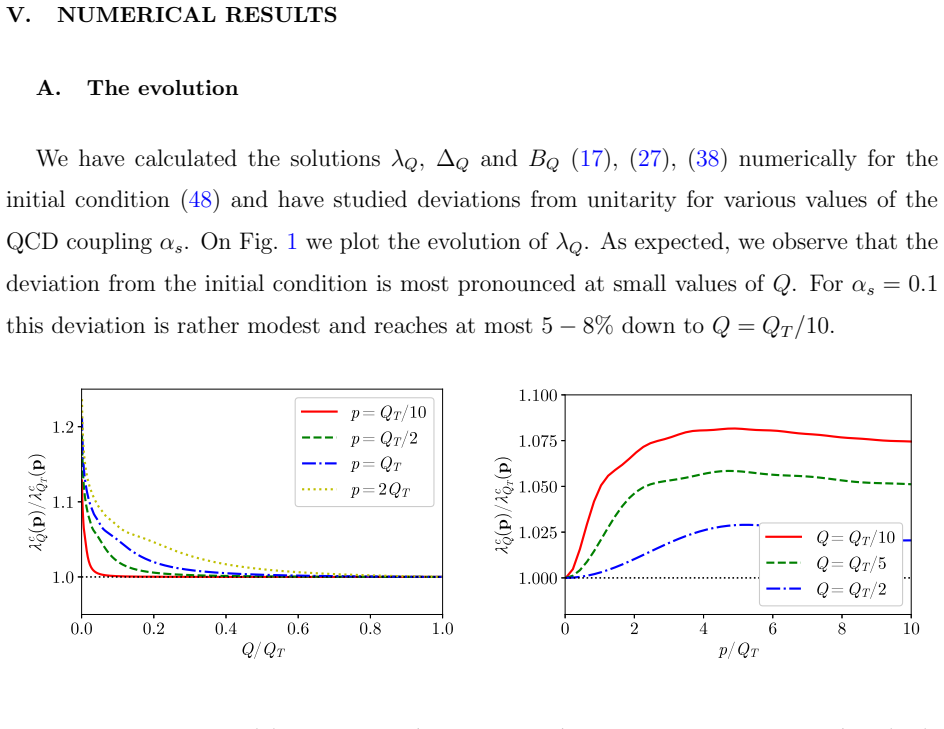
- The ratios $R_\Delta$ and $R_B$ are almost independent of $\alpha_s$ for $\alpha_s$ between 0.05 and 1, so the shape of the unitarity violation is fixed by the kinematic variables $p$ and $Q/Q_T$ rather than by the coupling.
- The source term quadratic in $\lambda$ in the $\Delta$ equation significantly tames the growth of $\Delta$ away from its initial condition, so the coupling between the adjoint and scalar components is essential for the quantitative pattern.
Reading between the lines
- If the same calculation is repeated for SU(3) without the weak-field truncation, the $\alpha_s$-independence should be checked; the authors leave this open, and it is the natural next test.
- A rotationally-invariant combination such as $R_\Delta - R_B$ or $|R_\Delta|+|R_B|$ might show even weaker $\alpha_s$ dependence than either ratio alone; this can be tested directly on the same numerical solutions.
- The persistence of linearity in $\alpha_s$ up to $\alpha_s=1$ suggests that the dilute expansion may be more reliable for these ratios than for the individual components, which would matter for applying the resummation at moderate couplings.
- The kinematic boundary where $R_\Delta$ flips sign is tied to accidental zeros in the amount of evolution; mapping this boundary in $\ln(p/Q_T)$ and $\ln(Q_T/Q)$ could give a simple diagnostic of where the truncated S-matrix is most trustworthy.
Editorial analysis
A structured set of objections, weighed in public.
Referee Report
Summary. The paper studies Eq. (1), the DGLAP-resummed evolution equation for the scattering matrix of a dressed gluon recently derived in [66], in the simplified SU(2) pure-gauge theory. The authors parametrize the 3x3 matrix S_Q in terms of A, lambda^a, and B^{ab}, truncate the coupled equations to the dilute limit (lambda ~ alpha_s, Delta, B ~ lambda^2), and solve the resulting linear inhomogeneous equations (17), (27), (38) in momentum space for a single-dipole initial condition. They then define ratios R_Delta and R_B (Eqs. (62)-(63)) that measure the deviation of S_Q from unitarity normalized by the amount of evolution, and find numerically that these ratios are nearly independent of alpha_s across a wide range of Q and p. The central claim is that this coupling independence is a robust, universal feature of the deviation from unitarity in the dilute regime.
Significance. If correct, the near-alpha_s-independence of R_Delta and R_B is a striking and practically useful statement about the structure of the DGLAP-resummed JIMWLK evolution: it would mean that the shape of unitarity violation is fixed once the kinematics are specified, independent of the coupling. The paper is explicit and internally consistent: the solutions (17), (27), (38) follow from the equations, and the numerical plots support the reported linearity of the numerator and denominator. The authors are also honest about the main limitation, stating in the Conclusions that it remains to be understood whether the pattern survives the full nonlinear regime. However, because the central claim is derived entirely within the weak-field truncation and the paper does not quantify the size of the dropped terms, the significance is contingent and needs strengthening.
major comments (3)
- [Section III, Eqs. (11)-(13)] The dilute truncation is the load-bearing step for the claimed alpha_s-independence. The lambda equation is decoupled by dropping the Delta-lambda and B-lambda terms from Eq. (9), and the Delta and B equations are truncated at O(lambda^2). These dropped terms are O(lambda^3) ~ O(alpha_s^3), while in the kinematics quoted in the paper (Q = Q_T/10, alpha_s up to 1) the evolution factor alpha_s beta_0/(4 pi) ln(Q_T^2/Q^2) is of order 2-3, so the retained O(alpha_s) terms and the dropped O(alpha_s^3) terms are not separated by a small parameter once lambda has grown by an order of magnitude. The authors explicitly flag this in the Conclusions ('One should also understand if this is an artifact of the weak field approximation...'). As it stands, the universality claim is conditional on an approximation whose self-consistency at the quoted parameters is not established.
- [Section V.C, Eqs. (66)-(70)] The analytical argument for alpha_s-independence is a leading-order statement: the ratio R_Delta = N_Delta/D_Delta is independent of alpha_s only to the extent that higher-order terms in N and D are negligible. The numerical linearity of N and D in alpha_s shown in Figs. 8-9 is obtained from the truncated dilute solutions (17), (27), (38), which do not contain the omitted Delta-lambda and B-lambda couplings; it therefore does not test the validity of the truncation. Moreover, Fig. 9 shows that the numerator already deviates from linearity for alpha_s greater than about 0.3 at small Q, so the claimed 'practical independence' is not exact even within the truncated system. To substantiate the claim, the paper should either estimate the size of the neglected terms (e.g., by computing the O(lambda^3) corrections to N and D) or perform a check against a partial solution of the full nonlinear equations in a controlled regime.
- [Abstract and Section V.B] The abstract and the introduction state the result as a universal pattern for 'this deviation from unitarity,' but the companion ratio R_B exhibits considerably worse alpha_s scaling than R_Delta (Section V.B, Fig. 7; the authors state that 'the scaling of R_B with alpha_s is not as good as for R_Delta'). Since R_B is a central part of the unitarity-violation characterization, the claim should be restricted to the specific kinematic domain and to the Delta component for which the numerical evidence supports it, or the paper should explain why the R_B scaling is expected to improve in the full theory.
minor comments (5)
- [Eq. (22)] The Bessel function J_0 is written with a vector argument Q^{-1}k; since J_0 depends only on |k|, please define k = |k| before using it inside the momentum integral, as is done later in Eq. (23).
- [Fig. 4 caption] The two panels are described with identical angle labels (phi = 0, pi/4, pi/2); clarify which panel corresponds to p = Q_T/2 and which to p = Q_T, and verify that the curves are not accidentally duplicated.
- [Eq. (6)] The last term contains the expression delta_{ae} delta_{ae}, which is not a valid tensor identity for a fixed index a; this appears to be a typo and should be corrected.
- [Figs. 6-7] The jumps in R_Delta and R_B are attributed to 'accidental' vanishing of the evolution; a brief explanation of this kinematic zero and an indication of the zero loci would help readers distinguish physical structure from numerical artifacts.
- [Section V] The paper provides no information on numerical grids, integration tolerances, or convergence checks. In view of the large cancellations noted in Section V.C in the evaluation of the Bessel integrals, a short numerical-accuracy statement would strengthen confidence in the quoted curves.
Circularity Check
No significant circularity: the αs-independence of RΔ and RB follows from an explicit leading-order expansion (Eqs. (66)-(70)), and the only self-citation (Eq. (1) from [66]) is the equation under study, not an input that fixes the claimed result.
full rationale
The paper's derivation chain is self-contained from Eq. (1) onward: the SU(2) decomposition (5), the evolution equations (8)-(10), the dilute truncation (11)-(13), and the closed solutions (17), (27), and (38) are all derived in the paper. The central claim, approximate αs-independence of the unitarity ratios RΔ and RB, is not fitted or defined into existence: Eqs. (66)-(70) expand the numerator and denominator in powers of αs and show that both start at O(αs), so the ratio is αs-independent at leading order; the numerical linearity in Figs. 8-9 then confirms that higher-order terms remain subdominant in the studied range. No parameter is tuned to reproduce the ratios, and the initial-condition amplitude λ cancels in the ratios. The only borrowed input is Eq. (1), taken from [66], which includes one of the present authors; this is a genuine self-citation, but it is not load-bearing for the paper's new numerical results, which test the consequences of that equation rather than trying to establish it. The authors' own caveat that the pattern 'may be an artifact of the weak field approximation' is a validity caveat about the truncation, not evidence that the result is equivalent to its inputs; we weigh it as a robustness/correctness concern, not circularity. No circular step of the enumerated kinds is present.
Assumptions & free parameters
free parameters (1)
- Initial dipole amplitude lambda =
unspecified, cancels in reported ratios
assumptions (5)
- domain assumption The DGLAP-resummed JIMWLK evolution equation for S_Q, Eq. (1), derived in [66], is correct.
- ad hoc to paper The dilute-limit truncation lambda ~ alpha_s, Delta, B ~ lambda^2, keeping only O(lambda) terms in Eq. (12) and O(lambda^2) terms in Eqs. (11) and (13).
- standard math The SU(2) adjoint decomposition (5) and the trace identities (6)-(7).
- domain assumption The eikonal interpretation of S_Q as a truncated S-matrix whose unitarity is not required.
- domain assumption The single-dipole initial condition (48) with S_{Q_T} unitary to O(lambda^2) via (50)-(51).
Cite this review
Pith. "Pith review of Exploring the DGLAP resummation in the JIMWLK Hamiltonian." pith.science (2026). https://pith.science/paper/BDAE4Q4O
@misc{pith2026250119250,
  author       = {Pith},
  title        = {Pith review of: Exploring the DGLAP resummation in the JIMWLK Hamiltonian},
  year         = {2026},
  howpublished = {\url{https://pith.science/paper/BDAE4Q4O}},
  note         = {Machine review of arXiv:2501.19250}
}
abstract
We explore the recently derived equation that resums DGLAP corrections to the JIMWLK Hamiltonian in the simplified setting of the SU(2) gauge theory. We solve the equation numerically for the scattering matrix of a dressed gluon for a particular initial condition, that corresponds to a dipole initial state. As expected, the $S$-matrix of a single dressed gluon state ceases to be unitary if evolved to significant $\ln Q^2/Q_s^2$. Our numerical results indicate an interesting universal (independent of the coupling constant) pattern for this deviation from unitarity.
Figures


Figures from the paper (6 more)


Forward citations
Cited by 1 Pith paper
-
Running coupling effects in the anti-collinear resummation in high energy evolution
Running coupling plus anti-collinear resummation in BFKL/JIMWLK slows evolution and cuts the anti-collinear Pomeron intercept, while χ(γ=1) is protected by a cancellation between kernel and DGLAP running.
Reference graph
Works this paper leans on
-
[66]
A. Kovner, M. Lublinsky, V. V. Skokov, and Z. Zhao, JHEP 07, 148 (2024), arXiv:2308.15545 [hep-ph]
work page Pith review arXiv 2024
-
[1]
I. Balitsky and A. Tarasov, JHEP 10, 017 (2015), arXiv:1505.02151 [hep-ph]
arXiv 2015
-
[2]
I. Balitsky and A. Tarasov, JHEP 06, 164 (2016), arXiv:1603.06548 [hep-ph]
arXiv 2016
-
[3]
Rapidity-only TMD factorization at one loop
I. Balitsky, JHEP 03, 029 (2023), arXiv:2301.01717 [hep-ph]
work page Pith review arXiv 2023
-
[4]
B.-W. Xiao, F. Yuan, and J. Zhou, Nucl. Phys. B 921, 104 (2017), arXiv:1703.06163 [hep-ph]
arXiv 2017
-
[5]
R. Boussarie and Y. Mehtar-Tani, JHEP 07, 080 (2022), arXiv:2112.01412 [hep-ph]
arXiv 2022
-
[6]
R. Boussarie and Y. Mehtar-Tani, JHEP 10, 056 (2024), arXiv:2309.16576 [hep-ph]
arXiv 2024
-
[7]
S. Mukherjee, V. V. Skokov, A. Tarasov, and S. Tiwari, Phys. Rev. D 109, 034035 (2024), arXiv:2311.16402 [hep-ph]
arXiv 2024
Show all 69 references
- [8]
-
[9]
H. Duan, A. Kovner, and M. Lublinsky, (2024), arXiv:2412.05085 [hep-ph]
2024 arXiv
-
[10]
H. Duan, A. Kovner, and M. Lublinsky, (2024), arXiv:2412.05097 [hep-ph]
2024 arXiv
-
[11]
V. N. Gribov and L. N. Lipatov, Sov. J. Nucl. Phys. 15, 438 (1972)
1972
-
[12]
V. N. Gribov and L. N. Lipatov, Sov. J. Nucl. Phys. 15, 675 (1972)
1972
-
[13]
Altarelli and G
G. Altarelli and G. Parisi, Nucl. Phys. B 126, 298 (1977)
1977
-
[14]
Y. L. Dokshitzer, Sov. Phys. JETP 46, 641 (1977)
1977
-
[15]
J. C. Collins and D. E. Soper, Nucl. Phys. B 193, 381 (1981), [Erratum: Nucl.Phys.B 213, 545 (1983)]
1981
-
[16]
J. C. Collins, D. E. Soper, and G. F. Sterman, Nucl. Phys. B 250, 199 (1985)
1985
-
[17]
J. C. Collins and D. E. Soper, Ann. Rev. Nucl. Part. Sci. 37, 383 (1987)
1987
-
[18]
J. C. Collins, D. E. Soper, and G. F. Sterman, Adv. Ser. Direct. High Energy Phys. 5, 1 (1989), arXiv:hep-ph/0409313
1989 arXiv
-
[19]
V. S. Fadin and L. N. Lipatov, Phys. Lett. B 429, 127 (1998), arXiv:hep-ph/9802290
1998 arXiv
-
[20]
Ciafaloni and G
M. Ciafaloni and G. Camici, Phys. Lett. B 430, 349 (1998), arXiv:hep-ph/9803389
1998 arXiv
-
[21]
E. A. Kuraev, L. N. Lipatov, and V. S. Fadin, Sov. Phys. JETP 45, 199 (1977)
1977
-
[22]
I. I. Balitsky and L. N. Lipatov, Sov. J. Nucl. Phys. 28, 822 (1978)
1978
-
[23]
L. N. Lipatov, Sov. Phys. JETP 63, 904 (1986)
1986
-
[24]
D. A. Ross, Phys. Lett. B 431, 161 (1998), arXiv:hep-ph/9804332. 24
1998 arXiv
-
[25]
Y. V. Kovchegov and A. H. Mueller, Phys. Lett. B 439, 428 (1998), arXiv:hep-ph/9805208
1998 arXiv
-
[26]
Armesto, J
N. Armesto, J. Bartels, and M. A. Braun, Phys. Lett. B 442, 459 (1998), arXiv:hep- ph/9808340
1998
-
[27]
Accardi et al., Eur
A. Accardi et al., Eur. Phys. J. A 52, 268 (2016), arXiv:1212.1701 [nucl-ex]
2016 arXiv
-
[28]
Abdul Khalek et al., Nucl
R. Abdul Khalek et al., Nucl. Phys. A 1026, 122447 (2022), arXiv:2103.05419 [physics.ins-det]
2022 arXiv
-
[29]
G. P. Salam, JHEP 07, 019 (1998), arXiv:hep-ph/9806482
1998 arXiv
-
[30]
Ciafaloni and D
M. Ciafaloni and D. Colferai, Phys. Lett. B 452, 372 (1999), arXiv:hep-ph/9812366
1999 arXiv
-
[31]
Ciafaloni, D
M. Ciafaloni, D. Colferai, and G. P. Salam, Phys. Rev. D 60, 114036 (1999), arXiv:hep- ph/9905566
1999
-
[32]
Ciafaloni, D
M. Ciafaloni, D. Colferai, and G. P. Salam, JHEP 10, 017 (1999), arXiv:hep-ph/9907409
1999 arXiv
-
[33]
Ciafaloni, D
M. Ciafaloni, D. Colferai, D. Colferai, G. P. Salam, and A. M. Stasto, Phys. Lett. B 576, 143 (2003), arXiv:hep-ph/0305254
2003 arXiv
-
[34]
Ciafaloni, D
M. Ciafaloni, D. Colferai, G. P. Salam, and A. M. Stasto, Phys. Rev. D 68, 114003 (2003), arXiv:hep-ph/0307188
2003 arXiv
-
[35]
Altarelli, R
G. Altarelli, R. D. Ball, and S. Forte, Nucl. Phys. B 599, 383 (2001), arXiv:hep-ph/0011270
2001 arXiv
-
[36]
Altarelli, R
G. Altarelli, R. D. Ball, and S. Forte, Nucl. Phys. B 621, 359 (2002), arXiv:hep-ph/0109178
2002 arXiv
-
[37]
Altarelli, R
G. Altarelli, R. D. Ball, and S. Forte, Nucl. Phys. B 742, 1 (2006), arXiv:hep-ph/0512237
2006 arXiv
-
[38]
Altarelli, R
G. Altarelli, R. D. Ball, and S. Forte, Nucl. Phys. B 799, 199 (2008), arXiv:0802.0032 [hep-ph]
2008 arXiv
-
[39]
Kutak and A
K. Kutak and A. M. Stasto, Eur. Phys. J. C 41, 343 (2005), arXiv:hep-ph/0408117
2005 arXiv
- [40]
-
[41]
Motyka and A
L. Motyka and A. M. Stasto, Phys. Rev. D 79, 085016 (2009), arXiv:0901.4949 [hep-ph]
2009 arXiv
- [42]
- [43]
- [44]
-
[45]
Jalilian-Marian, A
J. Jalilian-Marian, A. Kovner, A. Leonidov, and H. Weigert, Nucl. Phys. B 504, 415 (1997), arXiv:hep-ph/9701284
1997 arXiv
-
[46]
Jalilian-Marian, A
J. Jalilian-Marian, A. Kovner, A. Leonidov, and H. Weigert, Phys. Rev. D 59, 014014 (1998), arXiv:hep-ph/9706377
1998 arXiv
-
[47]
Jalilian-Marian, A
J. Jalilian-Marian, A. Kovner, and H. Weigert, Phys. Rev. D 59, 014015 (1998), arXiv:hep- ph/9709432
1998
-
[48]
Y. V. Kovchegov, Phys. Rev. D 61, 074018 (2000), arXiv:hep-ph/9905214. 25
2000 arXiv
-
[49]
Kovner and J
A. Kovner and J. G. Milhano, Phys. Rev. D 61, 014012 (2000), arXiv:hep-ph/9904420
2000 arXiv
-
[50]
Kovner, J
A. Kovner, J. G. Milhano, and H. Weigert, Phys. Rev. D 62, 114005 (2000), arXiv:hep- ph/0004014
2000
- [51]
-
[52]
Iancu, A
E. Iancu, A. Leonidov, and L. D. McLerran, Nucl. Phys. A 692, 583 (2001), arXiv:hep- ph/0011241
2001
-
[53]
Iancu, A
E. Iancu, A. Leonidov, and L. D. McLerran, Phys. Lett. B 510, 133 (2001), arXiv:hep- ph/0102009
2001
-
[54]
Ferreiro, E
E. Ferreiro, E. Iancu, A. Leonidov, and L. McLerran, Nucl. Phys. A 703, 489 (2002), arXiv:hep-ph/0109115
2002 arXiv
-
[55]
Balitsky and G
I. Balitsky and G. A. Chirilli, Phys. Rev. D 77, 014019 (2008), arXiv:0710.4330 [hep-ph]
2008 arXiv
-
[56]
Balitsky and G
I. Balitsky and G. A. Chirilli, Phys. Rev. D 88, 111501 (2013), arXiv:1309.7644 [hep-ph]
2013 arXiv
-
[57]
A. V. Grabovsky, JHEP 09, 141 (2013), arXiv:1307.5414 [hep-ph]
2013 arXiv
-
[58]
Kovner, M
A. Kovner, M. Lublinsky, and Y. Mulian, Phys. Rev. D 89, 061704 (2014), arXiv:1310.0378 [hep-ph]
2014 arXiv
-
[59]
Kovner, M
A. Kovner, M. Lublinsky, and Y. Mulian, JHEP 08, 114 (2014), arXiv:1405.0418 [hep-ph]
2014 arXiv
-
[60]
Lublinsky and Y
M. Lublinsky and Y. Mulian, JHEP 05, 097 (2017), arXiv:1610.03453 [hep-ph]
2017 arXiv
- [61]
-
[62]
Iancu, J
E. Iancu, J. D. Madrigal, A. H. Mueller, G. Soyez, and D. N. Triantafyllopoulos, Phys. Lett. B 750, 643 (2015), arXiv:1507.03651 [hep-ph]
2015 arXiv
-
[63]
Iancu, J
E. Iancu, J. D. Madrigal, A. H. Mueller, G. Soyez, and D. N. Triantafyllopoulos, Phys. Lett. B 744, 293 (2015), arXiv:1502.05642 [hep-ph]
2015 arXiv
-
[64]
Duclou´ e, E
B. Duclou´ e, E. Iancu, A. H. Mueller, G. Soyez, and D. N. Triantafyllopoulos, JHEP 04, 081 (2019), arXiv:1902.06637 [hep-ph]
2019 arXiv
-
[65]
Lappi and H
T. Lappi and H. M¨ antysaari, Phys. Rev. D 93, 094004 (2016), arXiv:1601.06598 [hep-ph]
2016 arXiv
-
[67]
Balitsky, Phys
I. Balitsky, Phys. Rev. D 75, 014001 (2007)
2007
-
[68]
Y. V. Kovchegov and H. Weigert, Nucl. Phys. A 784, 188 (2007)
2007
-
[69]
Those latter splittings 26 are already present in the JIMWLK evolution
One should keep in mind that (1) is not the full DGLAP equation, as it only resumms splittings which are not already resummed in the double logarithmic regime. Those latter splittings 26 are already present in the JIMWLK evolution. As a result of this, (1) is somewhat peculiar...
Reviewed August 9, 2026 · model on record in the stance chip above.
Discussion (0). Continue with ORCID to comment.