REVIEW 3 major objections 6 minor 2 cited by
Two-site Kitaev sweet spots evolving into topological islands
T0 review · 3 major / 6 minor · reviewed 2026-08-09 · deepseek-v4-flash
Pith's one-line read As an artificial Kitaev chain grows past about 20 sites, its fragile two-site Majorana sweet spot expands into a protected 'topological island' readable as quantized conductance.
desk verdict Useful scaling result for QD-based Majorana chains, but the 'strictly zero-energy' disorder-robust claim needs a numerical-threshold rewrite. read the letter →
The pith
A machine-rendered reading of the paper's core claim, the machinery that carries it, and where it could break.
The reading
What carries the argument
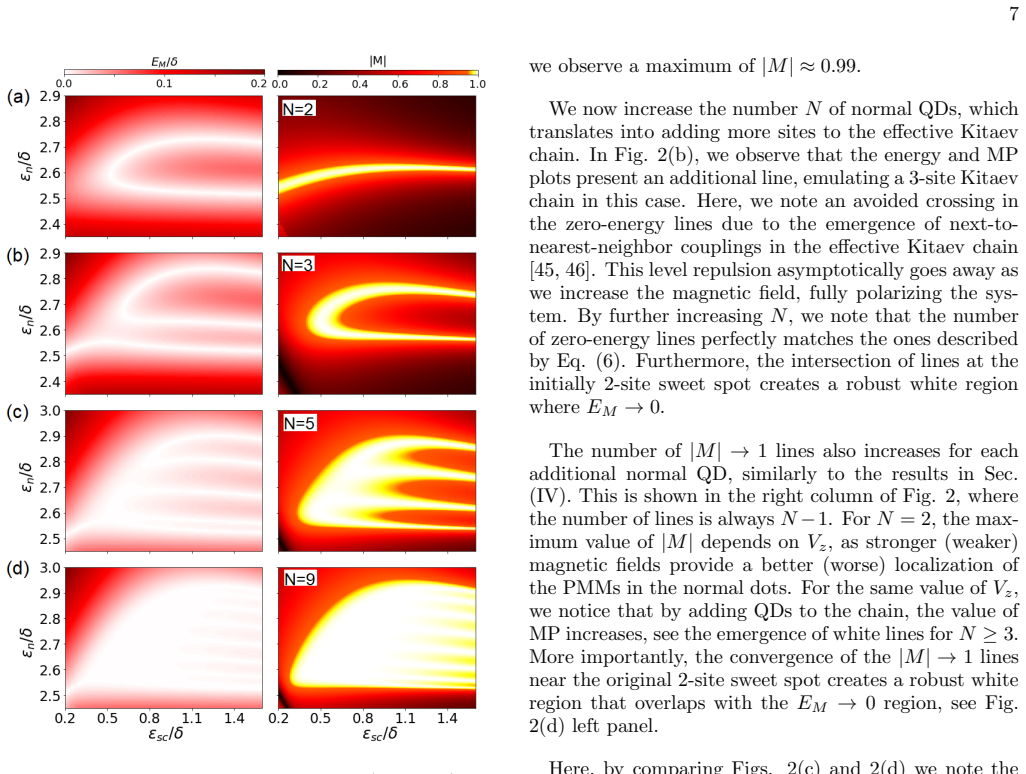
Two diagnostics carry the argument. First, $\gamma^2 = \sum_j u_j v_j$ computed for the lowest Bogoliubov mode: particle-hole symmetry makes $\gamma^2 = 1/2$ if and only if the mode is exactly at zero energy and its Bogoliubov operator is self-adjoint (a Majorana operator), whereas finite-energy fermionic modes have $\gamma^2 = 0$. Second, the Majorana polarization $M_j = 2u_j v_j/(u_j^2 + v_j^2)$, whose magnitude is $1$ when the local electron and hole weights are equal, signaling edge-localized, non-overlapping Majorana wave functions. The structural reason for the sweet spot's growth is the analytic family of zero-energy lines from the diagonalization of the Kitaev model, Eq. (6), all converging at the two-site sweet spot; adding sites adds lines, so the zero-energy and maximal-polarization conditions are satisfied on an ever larger region.
What would settle it
A direct numerical check: for $N=25$ at the plateau center ($\mu=0$, $t=\Delta$) and $W=\Delta$, compute the minimum value of $\gamma^2$ and the minimum excitation gap over the 100 disorder realizations rather than the average; if any realization deviates from $\gamma^2 = 1/2$ by more than numerical tolerance, the strict zero-energy plateau claim fails. Experimentally, the predicted $e^2/2h$ flat conductance plateau must persist when the side-coupled dot is detuned across the island and disappear outside its boundaries in the $(\mu,t)$ plane; a purely Lorentzian dot conductance inside the island would falsify the detection claim.
Extended reading notes
Core claim
The central claim is that the isolated sweet spot of a two-site Kitaev chain is not a special accident but the $N = 2$ member of a family of zero-energy lines, $\mu^{(n)} = 2\sqrt{t^2 - \Delta^2}\,\cos(n\pi/(N+1))$, that all converge at the same point. As $N$ increases, convergence of these lines produces an extended region—the topological island—where the lowest Bogoliubov excitation has zero energy and the Majorana polarization is maximal. In long chains ($N \geq 20$) the island becomes a strictly zero-energy plateau: $\gamma^2 = \sum_j u_j v_j$ equals $1/2$, the value forced by particle-hole symmetry for an exact zero mode, and the plateau survives disorder averaging over 50–100 realizations for disorder strengths up to the gap. The paper further claims that a spin-polarized quantum dot side-coupled to the chain shows a zero-bias conductance of $e^2/2h$ exactly when $\gamma^2 = 1/2$ and a flat conductance plateau as a function of the dot level, so the topological island can be observed in transport.
Load-bearing premise
The load-bearing premise is that a disorder-averaged numerical quantity, $\gamma^2 = 1/2$, computed for the lowest mode of a finite chain, genuinely establishes an exact zero-energy Majorana mode that is protected in every disorder realization, not just on average.
Editorial extensions
If this is right
- Adding sites from $N=2$ to $N=9$ already converts the sweet spot into a finite 'sweet region' where energy stays near zero and $|M|$ stays near 1 under simultaneous variation of all chemical potentials and hoppings, so 4–5 site chains should be significantly easier to tune than 2-site ones.
- For $N \geq 20$, the zero-energy plateau survives disorder strengths up to the pairing gap, implying that longer quantum-dot arrays enter a genuinely protected regime rather than simply extending the fragile two-site device.
- A zero-bias conductance of $e^2/2h$ through the side-coupled dot occurs exactly when $\gamma^2 = 1/2$, so transport can certify the topologically protected regime; outside it, conductance is set by the dot alone.
- Detuning the probe-dot level $\varepsilon_d$ sharpens the conductance map of the island at finite temperature, giving an experimental dial that trades signal magnitude for resolution.
- Within the topological island the derivative of the energy splitting with respect to parameter fluctuations vanishes, which should lengthen dephasing times in Majorana-based qubits.
Reading between the lines
- Beyond the paper, the same $\gamma^2 = 1/2$ plateau diagnostic could be applied to perturbations the authors did not test, such as correlated disorder or pairing-phase fluctuations, to see whether the topological island survives them.
- Beyond the paper, because the plateau width grows with $N$ and is bounded by the $|\mu| < 2t$ topological phase boundary, the island area should saturate; sweeping plateau width versus $N$ between 5 and 20 would yield a direct experimental curve for the PMM-to-MBS crossover.
- Beyond the paper, the flatness of the conductance plateau as the dot level $\varepsilon_d$ is varied could serve as a calibration of residual Majorana hybridization, since the detuning at which flatness is lost sets an upper bound on the hybridization energy $E_M$.
Editorial analysis
A structured set of objections, weighed in public.
Referee Report
Summary. The paper investigates how the two-site Kitaev-chain sweet spot, at which Poor man's Majorana bound states appear, evolves as the number of sites N increases. Using exact diagonalization of the BdG Hamiltonian, the authors study the lowest-energy excitation EM and the Majorana polarization MP for both the spinless Kitaev model and a more realistic spinful quantum-dot array. They define a numerical diagnostic γ² = Σ_j u_j v_j for the lowest Bogoliubov mode, argue that γ² = 1/2 identifies a self-adjoint (Majorana) operator, and use this to map out regions of parameter space where the energy is claimed to be strictly zero. For short chains (N < 10) they find that the sweet spot expands into a region of low EM and high MP; for N ≥ 20 they report 'strictly zero-energy plateaus' robust against Anderson disorder, which they call topological islands. They also derive an analytic conductance formula for a quantum dot side-coupled to the chain, showing G = e²/2h when γ² = 1/2 and G = 0 otherwise, and verify this numerically.
Significance. The paper addresses a timely experimental question: whether extending two-site Kitaev chains to longer arrays relaxes the fine-tuning required for Majorana-like states. The main conceptual message—that sweet spots grow into protected regions as N increases—is physically plausible and is supported by the convergence of known zero-energy lines (Ref. [30]) and by the numerical trends in Figs. 1 and 3. A clear strength is the analytic conductance derivation in Appendix A: the scattering-matrix formalism yields closed-form expressions for the e²/2h plateau, and the comparison with numerics in Fig. 4 is convincing, with no fitting parameters. The paper also makes a falsifiable prediction: the zero-bias conductance through a side-coupled dot can track the topological island (Eq. (26)). These positive features make the manuscript a potentially useful contribution, but the central claim of 'strictly zero-energy plateaus' requires more careful statistical and numerical analysis.
major comments (3)
- [Sec. VI, Fig. 3] The evidence for 'strictly zero-energy plateaus robust against disorder' is not established by the presented data. The quantity γ² plotted in Fig. 3(a) is binary per disorder realization: for an exact eigenvector at E ≠ 0, γ² = 0 (as the paper itself notes in Sec. III.A), while γ² = 1/2 only for an exactly degenerate zero mode. Averaging this binary quantity over 50 realizations does not reveal the fraction of realizations with γ² = 1/2; a region with average γ² ≈ 1/2 could mean either that all realizations have γ² = 1/2 or that a fraction do. The authors should report the percentage of realizations yielding γ² = 1/2, or show the distribution of the lowest positive eigenvalue EM, to support the claim that the zero-energy region survives in every realization.
- [Sec. III.A, Eq. (10) and Sec. VI] The identification 'γ² = 1/2 implies an exact zero-energy mode' is only exact for an eigenvector at E = 0. In a finite chain with nonzero EM, the exact BdG eigenvector satisfies γ² = 0, so the numerical observation of γ² = 1/2 indicates that EM is below the solver's numerical threshold, not that EM is exactly zero. The paper does not specify the diagonalization tolerance or the numerical precision, and the 'topological island' boundaries in Fig. 3(a) are therefore defined by that threshold rather than by a physical condition. The authors should either provide direct evidence of exact zero energy (e.g., a symmetry argument), or revise the wording to 'numerically zero' or 'exponentially small' and show, for instance, log EM versus N to demonstrate the exponential suppression that underlies the plateau.
- [Sec. VI, Figs. 3(c) and 3(d)] The disorder robustness claim is made solely on the basis of disorder-averaged γ² curves. For N = 20, the plateau is 'significantly depleted' at W = 0.5Δ and absent at W = Δ, but the average could hide realizations where γ² = 1/2 still occurs with lower probability. For N = 40, the plateau appears unchanged, but again the average does not show whether every realization retains γ² = 1/2. The authors should provide per-realization statistics, such as the fraction of realizations with γ² = 1/2 or the median and variance of EM, to substantiate the claim that the zero-energy mode is robust in each realization, not merely on average.
minor comments (6)
- [Sec. VI, Fig. 3 caption] The caption says 'random fluctuations in the hopping and chemical potential of 5% of Δ', but the text in Sec. VI says 'random fluctuations of 5% of the gap'. Please use a consistent definition of the disorder strength and specify whether W = 0.05Δ for the data in Fig. 3(a).
- [Sec. V] In the spinful model, the parameters are set as Vz = 2.5δ, t = 0.5δ, and tso = 0.2t, but it is not explicitly stated that t in 'tso = 0.2t' is the spin-conserving hopping of Eq. (2). Clarify to avoid confusion with the effective Kitaev hopping.
- [Sec. VII, Eq. (31)] The formula Γ_eff = Γ t0² / (εd² + 2t0²) is presented without parentheses in the text; please format it as Γ_eff = Γ t0² / (εd² + 2t0²) to avoid ambiguity.
- [Sec. III.A] The statement that γ²(E ≠ 0) = 0 for 'fermionic operators' relies on the choice of a real gauge for the BdG eigenvectors. The paper does not state whether the numerical diagonalization returns real eigenvectors or whether a gauge transformation is applied. This should be clarified because the diagnostic is central to the rest of the work.
- [Sec. IV, Fig. 1] The figure caption refers to 'EM → 0' and '|M| → 1' in the white regions, but the color scale is not shown. Adding a color bar or explicitly stating the color-to-value mapping would improve readability.
- [Sec. VII, Eq. (26)] The claim G = 0 for γ² = 0 is derived in the limit T → 0 and for the specific voltage-drop parameter α = 1/2 in Eq. (25). The paper later discusses general α, but Eq. (26) should explicitly state that it applies at T = 0 and for the symmetric voltage configuration, as is done in the text.
Circularity Check
No significant circularity: the central numerical maps and the conductance derivation are self-contained, and the only self-citations are contextual or rederived.
full rationale
The derivation chain is self-contained. The zero-energy line formula, Eq. (6), is imported from an external analytical diagonalization (Ref. [30]) and then used as input to the numerical maps; it is not fitted to the paper's own outputs. The short-chain maps in Figs. 1-2 and the long-chain plateau maps in Fig. 3 are direct BdG diagonalizations, with disorder included as stated, not as parameters fitted to produce the claimed plateaus. The conductance result G = e^2/2h for EM = 0 is derived analytically in Appendix A (Eqs. 21-25) and only afterward compared with the earlier result of Ref. [32], so the self-citation to Ref. [32] is confirmatory rather than load-bearing. The identification of gamma^2 = 1/2 with an exact zero-energy mode (Eq. (10) and Sec. III.A) is a mathematical consequence of particle-hole symmetry for exact BdG eigenstates, not a definition that smuggles in the conclusion; whether finite disordered chains actually produce exact zero eigenvalues to numerical precision is a correctness and validation concern, not a circularity. No fitted parameter is renamed as a prediction, and no uniqueness claim is imported from the authors' prior work. The paper contains self-citations (Refs. [12] and [32]), but they are contextual or rederived, so they do not raise the circularity score above 1.
Assumptions & free parameters
assumptions (6)
- standard math The zero-energy line formula Eq. (6), μ(n) = 2√(t² − Δ²) cos(nπ/(N+1)), taken from Refs. [30,40], is exact for the homogeneous N-site Kitaev chain.
- domain assumption The effective Kitaev Hamiltonian Eq. (1) captures the physics of the quantum-dot array after projection of the superconducting dots.
- domain assumption The spinful quantum-dot model Eq. (2) with neglected Coulomb interactions adequately describes the experimental quantum-dot arrays at the parameters used, V_z = 2.5δ.
- domain assumption Anderson-type disorder in all parameters, with uniform distribution in [-W,W], is the relevant model for parameter fluctuations in the experimental system.
- ad hoc to paper The numerical diagnostic γ2 = 1/2 faithfully identifies an exactly zero-energy Majorana mode, and is used to define the topological island and its disorder robustness.
- domain assumption The wide-band limit, symmetric lead coupling Γ1 = Γ2 = Γ, and the low-energy effective model Eq. (4) are valid for the conductance calculation.
Cite this review
Pith. "Pith review of Two-site Kitaev sweet spots evolving into topological islands." pith.science (2026). https://pith.science/paper/S4HDOMVN
@misc{pith2026250119376,
  author       = {Pith},
  title        = {Pith review of: Two-site Kitaev sweet spots evolving into topological islands},
  year         = {2026},
  howpublished = {\url{https://pith.science/paper/S4HDOMVN}},
  note         = {Machine review of arXiv:2501.19376}
}
abstract
Artificial Kitaev chains based on arrays of quantum dots are promising platforms for realizing Majorana Bound States (MBSs). In a two-site Kitaev chain, it is possible to find these non-Abelian zero-energy excitations at certain points in parameter space (sweet spots). These states, commonly referred to as Poor man's Majorana bound states (PMMs), are challenging to find and stabilize experimentally. In this work, we investigate the evolution of the sweet spots as we increase the number of sites of the Kitaev chain. To this end, we use the Bogoliubov-de Gennes representation to study the excitations of the system, and the scattering matrix and Green functions formalisms to calculate the zero-bias conductance. Our results show that the sweet spots evolve into a region that grows bigger and becomes gradually more protected as the number of sites $N$ increases. Due to the protection of the MBSs, we refer to this region as a topological island. We obtain similar results by considering a realistic spinful model with finite magnetic fields in a chain of normal-superconducting quantum dots. For long chains, $N \geq 20$, we show the emergence of strictly zero-energy plateaus robust against disorder. Finally, we demonstrate that the topological islands can be observed by performing conductance measurements via a quantum dot side-coupled to the Kitaev chain. Our work shows that the fine-tuning required to create and detect PMMs in a 2-site Kitaev chain is significantly relaxed as the length of the chain increases and details how PMMs evolve into MBSs. Our results are consistent with experimental reports for 2 and 3-site chains.
Figures


Figures from the paper (3 more)


Forward citations
Cited by 2 Pith papers
-
Measuring coherence factors of states in superconductors through local current
A two-point local current ratio, sqrt(I_L(Γ_R=0)/I_L(Γ_R=Γ_L)), estimates the local Majorana polarization in short quantum-dot Kitaev chains.
-
Procedure of tuning up a three-site artificial Kitaev chain based on transmon measurements
A numerical protocol uses transmon spectra to tune a three-site artificial Kitaev chain to sweet spots, with a new classification into ECT-dominated, genuine, and CAR-dominated types.
Reference graph
Works this paper leans on
- [30]
-
[1]
A. Y. Kitaev, Annals of Physics 303, 2 (2003)
2003
-
[2]
Nayak, S
C. Nayak, S. H. Simon, A. Stern, M. Freedman, and S. Das Sarma, Rev. Mod. Phys. 80, 1083 (2008)
2008
-
[3]
Mourik, K
V. Mourik, K. Zuo, S. M. Frolov, S. Plissard, E. P. Bakkers, and L. P. Kouwenhoven, Science 336, 1003 (2012)
2012
-
[4]
Leijnse and K
M. Leijnse and K. Flensberg, Semiconductor Science and Technology 27, 124003 (2012)
2012
-
[5]
Alicea, Rep
J. Alicea, Rep. Prog. Phys. 75, 076501 (2012)
2012
- [6]
-
[7]
S. Nadj-Perge, I. K. Drozdov, J. Li, H. Chen, S. Jeon, 13 J. Seo, A. H. MacDonald, B. A. Bernevig, and A. Yaz- dani, Science 346, 602 (2014)
work page 2014
Show all 57 references
-
[8]
J. Chen, B. Woods, P. Yu, M. Hocevar, D. Car, S. Plis- sard, E. Bakkers, T. Stanescu, and S. Frolov, Physical review letters 123, 107703 (2019)
2019
-
[9]
Flensberg, F
K. Flensberg, F. von Oppen, and A. Stern, Nature Re- views Materials 6, 944 (2021)
2021
-
[10]
Prada, P
E. Prada, P. San-Jose, M. W. de Moor, A. Geresdi, E. J. Lee, J. Klinovaja, D. Loss, J. Nyg ˚ ard, R. Aguado, and L. P. Kouwenhoven, Nature Reviews Physics 2, 575 (2020)
2020
-
[11]
van Loo, G
N. van Loo, G. P. Mazur, T. Dvir, G. Wang, R. C. Dekker, J.-Y. Wang, M. Lemang, C. Sfiligoj, A. Bordin, D. van Driel, et al. , Nature Communications 14, 3325 (2023)
2023
-
[12]
R. A. Dourado, P. H. Penteado, and J. C. Egues, Physical Review B 110, 014504 (2024)
2024
-
[13]
Aghaee, A
M. Aghaee, A. Akkala, Z. Alam, R. Ali, A. Al- caraz Ramirez, M. Andrzejczuk, A. E. Antipov, P. Aseev, M. Astafev, B. Bauer, et al. (Microsoft Quantum), Phys. Rev. B 107, 245423 (2023)
2023
-
[14]
A. Y. Kitaev, Physics-Uspekhi 44, 131 (2001)
2001
-
[15]
D. A. Ivanov, Phys. Rev. Lett. 86, 268 (2001)
2001
-
[16]
T. Dvir, G. Wang, N. van Loo, C.-X. Liu, G. P. Mazur, A. Bordin, S. L. D. ten Haaf, J.-Y. Wang, D. van Driel, F. Zatelli, X. Li, F. K. Malinowski, S. Gazibegovic, G. Badawy, E. P. A. M. Bakkers, M. Wimmer, and L. P. Kouwenhoven, Nature 614, 445 (2023)
2023
-
[17]
Bordin, C.-X
A. Bordin, C.-X. Liu, T. Dvir, F. Zatelli, S. L. ten Haaf, D. van Driel, G. Wang, N. van Loo, T. van Caekenberghe, J. C. Wolff, et al. , arXiv preprint arXiv:2402.19382 (2024)
2024 arXiv
-
[18]
Bordin, X
A. Bordin, X. Li, D. Van Driel, J. C. Wolff, Q. Wang, S. L. Ten Haaf, G. Wang, N. Van Loo, L. P. Kouwen- hoven, and T. Dvir, Physical review letters 132, 056602 (2024)
2024
-
[19]
E. Lieb, T. Schultz, and D. Mattis, Annals of Physics 16, 407 (1961)
1961
-
[20]
J. D. Sau and S. Das Sarma, Nat. Commun. 3, 964 (2012)
2012
-
[21]
I. C. Fulga, A. Haim, A. R. Akhmerov, and Y. Oreg, New J. Phys. 15, 045020 (2013)
2013
-
[22]
C.-X. Liu, G. Wang, T. Dvir, and M. Wimmer, Phys. Rev. Lett. 129, 267701 (2022)
2022
-
[23]
Tsintzis, R
A. Tsintzis, R. S. Souto, and M. Leijnse, Physical Review B 106, L201404 (2022)
2022
-
[24]
G. Wang, T. Dvir, G. P. Mazur, C.-X. Liu, N. van Loo, S. L. D. ten Haaf, A. Bordin, S. Gazibegovic, G. Badawy, E. P. A. M. Bakkers, M. Wimmer, and L. P. Kouwen- hoven, Nature 612, 448 (2022)
2022
-
[25]
Bordin, G
A. Bordin, G. Wang, C.-X. Liu, S. L. ten Haaf, N. van Loo, G. P. Mazur, D. Xu, D. van Driel, F. Zatelli, S. Gazibegovic, G. Badawy, E. P. Bakkers, M. Wimmer, L. P. Kouwenhoven, and T. Dvir, Physical Review X 13, 10.1103/physrevx.13.031031 (2023)
2023 doi
-
[26]
Leijnse and K
M. Leijnse and K. Flensberg, Phys. Rev. B 86, 134528 (2012)
2012
-
[27]
S. L. Ten Haaf, Q. Wang, A. M. Bozkurt, C.-X. Liu, I. Kulesh, P. Kim, D. Xiao, C. Thomas, M. J. Manfra, T. Dvir, et al. , Nature 630, 329 (2024)
2024
-
[28]
S. L. D. ten Haaf, Y. Zhang, Q. Wang, A. Bordin, C.-X. Liu, I. Kulesh, V. P. M. Sietses, C. G. Prosko, D. Xiao, C. Thomas, M. J. Manfra, M. Wimmer, and S. Goswami, Edge and bulk states in a three-site kitaev chain (2024)
2024
-
[29]
Sedlmayr and C
N. Sedlmayr and C. Bena, Physical Review B 92, 115115 (2015)
2015
-
[31]
D. E. Liu and H. U. Baranger, Phys. Rev. B 84, 201308(R) (2011)
2011
-
[32]
Vernek, P
E. Vernek, P. H. Penteado, A. C. Seridonio, and J. C. Egues, Phys. Rev. B 89, 165314 (2014)
2014
-
[33]
D. A. Ruiz-Tijerina, E. Vernek, L. G. G. V. Dias da Silva, and J. C. Egues, Phys. Rev. B 91, 115435 (2015)
2015
-
[34]
Weymann and K
I. Weymann and K. W´ ojcik, Physical Review B 95, 155427 (2017)
2017
-
[35]
R. S. Souto, A. Tsintzis, M. Leijnse, and J. Danon, Phys- ical Review Research 5, 043182 (2023)
2023
-
[36]
Stepanenko, M
D. Stepanenko, M. Rudner, B. I. Halperin, and D. Loss, Physical Review B—Condensed Matter and Materials Physics 85, 075416 (2012)
2012
-
[37]
C. J. Bolech and E. Demler, Phys. Rev. Lett. 98, 237002 (2007)
2007
-
[38]
K. T. Law, P. A. Lee, and T. K. Ng, Phys. Rev. Lett. 103, 237001 (2009)
2009
-
[39]
Tsintzis, R
A. Tsintzis, R. S. Souto, K. Flensberg, J. Danon, and M. Leijnse, PRX Quantum 5, 010323 (2024)
2024
-
[40]
Leumer, M
N. Leumer, M. Grifoni, B. Muralidharan, and M. Mar- ganska, Physical Review B 103, 165432 (2021)
2021
-
[41]
R. V. Mishmash, B. Bauer, F. von Oppen, and J. Alicea, Phys. Rev. B 101, 075404 (2020)
2020
-
[42]
Danon, A
J. Danon, A. B. Hellenes, E. B. Hansen, L. Casparis, A. P. Higginbotham, and K. Flensberg, Physical Review Letters 124, 036801 (2020)
2020
-
[43]
We note that the magnetic field can not be arbitrarily increased in the superconductors as it might suppress the s-wave pairing amplitude ∆
-
[44]
Luethi, H
M. Luethi, H. F. Legg, D. Loss, and J. Klinovaja, Phys. Rev. B 110, 245412 (2024)
2024
-
[45]
Svensson and M
V. Svensson and M. Leijnse, Phys. Rev. B 110, 155436 (2024)
2024
-
[46]
Miles, D
S. Miles, D. van Driel, M. Wimmer, and C.-X. Liu, Phys. Rev. B 110, 024520 (2024)
2024
-
[47]
Jackiw and C
R. Jackiw and C. Rebbi, Phys. Rev. D 13, 3398 (1976)
1976
-
[48]
A. R. Akhmerov, Phys. Rev. B 82, 020509 (2010)
2010
-
[49]
Nilsson, A
J. Nilsson, A. R. Akhmerov, and C. W. J. Beenakker, Phys. Rev. Lett. 101, 120403 (2008)
2008
-
[50]
A. Vuik, B. Nijholt, A. R. Akhmerov, and M. Wimmer, SciPost Phys. 7, 061 (2019)
2019
-
[51]
Dresen, Quantum transport of non-interacting elec- trons in 2D systems of arbitrary geometries , Ph.D
D. Dresen, Quantum transport of non-interacting elec- trons in 2D systems of arbitrary geometries , Ph.D. the- sis, Master’s thesis, R WTH Aachen University, Germany (2014)
2014
-
[52]
Blonder, m
G. Blonder, m. M. Tinkham, and k. T. Klapwijk, Physical Review B 25, 4515 (1982)
1982
-
[53]
Maiani, M
A. Maiani, M. Geier, and K. Flensberg, Physical Review B 106, 104516 (2022)
2022
-
[54]
G. B. Lesovik and I. A. Sadovskyy, Physics-Uspekhi 54, 1007 (2011)
2011
-
[55]
Fu, Physical review letters 104, 056402 (2010)
L. Fu, Physical review letters 104, 056402 (2010)
2010
-
[56]
(5) as HT = X k,i=1,2 ˜tk,i(d† k,i − dk,i)¯γ, (30) such that Γef f= Γ t2 0 ε2 d + 2t2 0
by rewriting Eq. (5) as HT = X k,i=1,2 ˜tk,i(d† k,i − dk,i)¯γ, (30) such that Γef f= Γ t2 0 ε2 d + 2t2 0 . (31) This result tells us that the effective coupling of the MBS to the lead can be controlled via εd. Therefore, for larger values of εd, the conductance more sharply fo...
2020
-
[57]
Flensberg, Physical Review B 82, 180516 (2010)
K. Flensberg, Physical Review B 82, 180516 (2010)
2010
Reviewed August 9, 2026 · model on record in the stance chip above.
Discussion (0). Continue with ORCID to comment.