REVIEW 3 major objections 5 minor 50 references
Spherically symmetric and static black bounces with multiple horizons, throats, and anti-throats in four dimensions
T0 review · 3 major / 5 minor · reviewed 2026-08-09 · deepseek-v4-flash
Pith's one-line read The paper constructs a new family of regular, asymptotically flat black-bounce spacetimes whose metric functions can oscillate, giving multiple horizons, wormhole throats, and anti-throats, with a partly phantom scalar field and a…
desk verdict Genuinely new family of smooth black-bounce metrics with multiple horizons and throats, but the claimed scalar+NED source has a likely single-valuedness problem in L(F), so the solution-to-action claim is not established. read the letter →
The pith
A machine-rendered reading of the paper's core claim, the machinery that carries it, and where it could break.
The reading
What carries the argument
The load-bearing structure is the pair of metric functions $A(x)=1-\frac{2M\cos(a_0/\sqrt{a^2+x^2})}{\sqrt{a^2+x^2}}$ and $r^2(x)=x^2\cos^2(a_0/\sqrt{a^2+x^2})+a^2$, with $M$, $a$, and $a_0$ as parameters. The cosine factors make both $A(x)$ and the area $4\pi r^2(x)$ oscillate with $x$, so zeros of $A(x)$ give horizons and extrema of the area give throats and anti-throats, while the constant $a^2$ term prevents $r$ from reaching zero. The source construction is carried by the identity $h(\varphi)\,\varphi'^2=-r''/r$, which fixes the scalar kinetic coupling once $\varphi$ is chosen as $\arctan(x/a)$, and then determines the electrodynamics functions $L(x)$ and $L_F(x)$; the consistency of those functions is asserted through the relation $L_F\,dF/dr-dL/dr=0$.
What would settle it
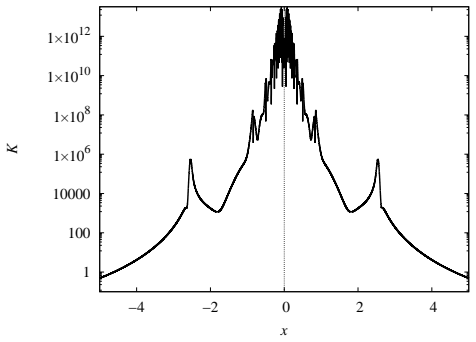
Substitute the metric functions and $\varphi=\arctan(x/a)$ into the four field equations and evaluate the residuals on a dense grid of $x$ across several oscillations for representative parameters; if any residual fails to vanish numerically, or if the consistency relation $L_F\,dF/dr-dL/dr=0$ breaks down away from the plotted points, the proposed source does not generate the spacetime. A second check is to scan allowed parameters for a divergence of the curvature invariant at finite $x$, which would contradict the regularity claim.
Extended reading notes
Core claim
The central claim is that the two functions $A(x)=1-\frac{2M\cos(a_0/\sqrt{a^2+x^2})}{\sqrt{a^2+x^2}}$ and $r^2(x)=x^2\cos^2(a_0/\sqrt{a^2+x^2})+a^2$ define a new exact family of static, spherically symmetric, asymptotically flat black-bounce solutions. The oscillatory cosines are what produce multiple zeros of $A(x)$, each a horizon, and multiple extrema of the area $4\pi r^2(x)$, each a throat or an anti-throat; the parameter $a$ keeps the area radius from reaching zero, which removes the central singularity. In the limits $a_0=0$ and $a_0=a=0$ the solution returns to the usual black-bounce metric and to Schwarzschild. The paper claims the spacetime is generated by a scalar field with a kinetic coupling that changes sign between canonical and phantom behavior, together with a nonlinear electrodynamics magnetic monopole, and it supports the identification through plots and the consistency condition $L_F\,dF/dr-dL/dr=0$.
Load-bearing premise
The load-bearing premise is that the reverse-engineered matter source is globally consistent: with the scalar field fixed as $\varphi=\arctan(x/a)$, there is a single-valued potential $V(\varphi)$ and a single-valued nonlinear electrodynamics Lagrangian $L(F)$ that satisfy all field equations everywhere, a point supported only by an asserted consistency relation and graphical checks rather than explicit formulas or a verification.
Editorial extensions
If this is right
- The two parameters $a$ and $a_0$ tune the number and position of horizons, throats, and anti-throats, so physical predictions can be mapped as the causal structure changes.
- At large distances the metric is Schwarzschild to leading order, so weak-field tests are preserved, while strong-field phenomena can differ because of the extra structure.
- The source is a partially phantom scalar plus a magnetic monopole, so the spacetime is presented as a genuine solution of an Einstein-scalar-nonlinear-electrodynamics action rather than only a regularized metric.
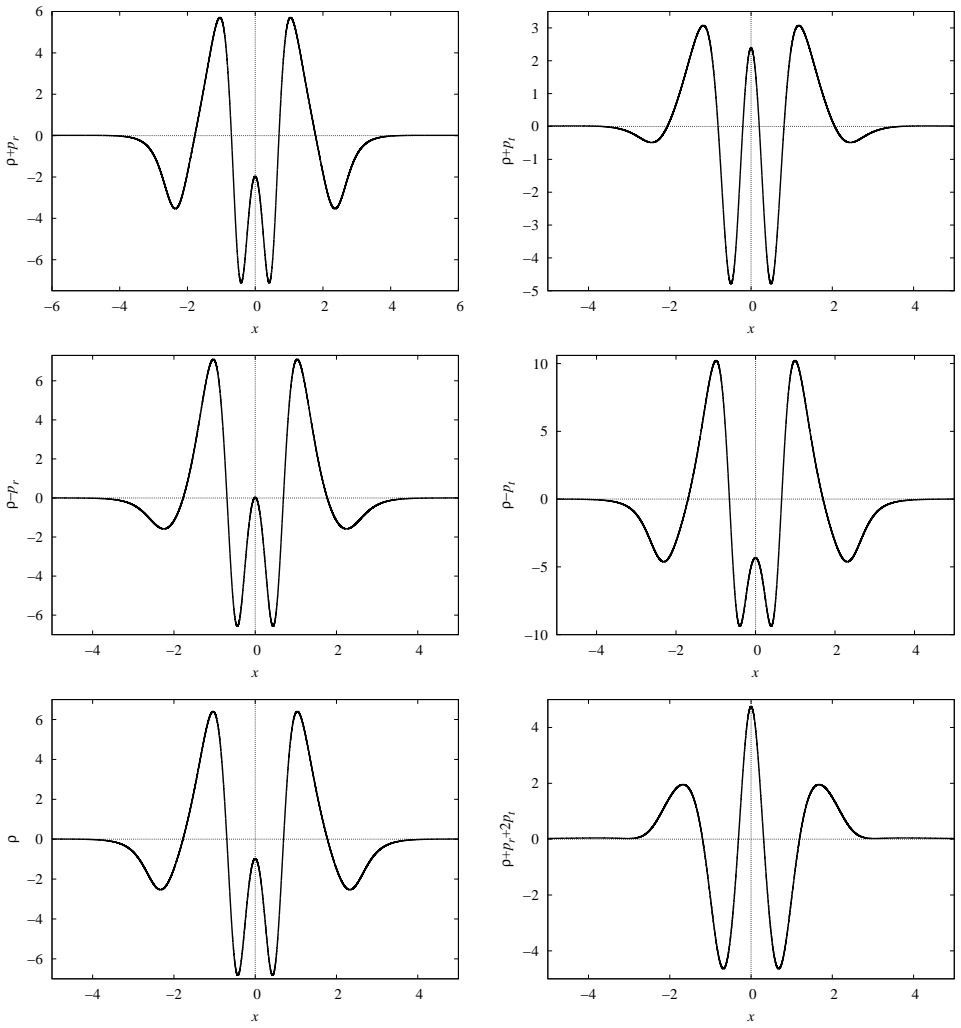
- Energy conditions are violated only in some regions, contrary to typical black bounces, so the model provides an example where wormhole-like features do not require global exotic matter.
- The quasi-local mass can become negative while approaching $M$ at infinity, giving the geometry a nonstandard interior energy content.
Reading between the lines
- The paper does not prove that the scalar potential and the electrodynamics Lagrangian are single-valued; the plotted Lagrangian develops cusps between oscillation branches, so a full action-level description may require branch choices or a modified formulation.
- A direct numerical test of the field equations with the proposed source, including the oscillatory region, would either confirm or break the construction; such a check is not included.
- The multiple horizons invite horizon-by-horizon thermodynamic quantities such as surface gravity, entropy, and temperature, and a generalized first law, none of which the paper computes.
- If the family is extended to rotating or time-dependent metrics, the oscillatory structure should persist and could leave distinctive imprints in shadows and quasinormal-mode spectra.
Editorial analysis
A structured set of objections, weighed in public.
Referee Report
Summary. The paper introduces a new family of static, spherically symmetric metrics, Eq. (2), with A(x) = 1 - 2M cos(a0/sqrt(a^2+x^2))/sqrt(a^2+x^2) and r^2(x) = x^2 cos^2(a0/sqrt(a^2+x^2)) + a^2. It claims that these are regular black bounce spacetimes with multiple horizons, throats, and anti-throats, that they reduce asymptotically to Schwarzschild, and that they are generated by a partially phantom scalar field together with a nonlinear electrodynamics magnetic monopole. The analysis is largely graphical: horizon/throat structure and the Kretschmann scalar are illustrated, the source functions are displayed as plots, energy conditions are evaluated through an anisotropic fluid, and the quasi-local mass is discussed. The paper does not provide explicit formulas for V(phi) or L(F), and it asserts rather than proves the consistency of the reverse-engineered matter sector.
Significance. If the construction were complete, the family would be a useful addition to the black bounce program: it is an explicit deformation of Simpson-Visser with richer causal structure and potentially new observational signatures. The geometrical part of the claim is credible because for a>0 the metric functions are smooth, r^2(x) >= a^2 > 0, the spacetime is asymptotically flat, and the oscillatory coefficients can plausibly generate multiple horizons and area extrema. However, the central physical claim is that Eq. (2) is a solution of the action (11) with a scalar field and a single-valued NED Lagrangian; that claim is not established and appears to fail on the manuscript's own admission that L(F) splits into two different curves. The paper is explicit about its reverse-engineering method, which is a strength, but the source sector remains incomplete. The significance is therefore prospective rather than established.
major comments (3)
- [Sec. III, Eq. (27) and text after Fig. 6] The action (11) requires a single-valued Lagrangian L(F). The paper states that oscillations in F(x) generate two different curves in the Lagrangian, with transitions through a cusp; this is an explicit admission that no global single-valued function L(F) exists. The consistency relation (27) is a local identity along the one-parameter curve x and cannot exclude multi-valuedness on disconnected level sets of F. Therefore the claim that the metric (2) is generated by the scalar-field plus NED action (11) is not supported. The authors need to exhibit L(F) as a single-valued function and verify (27) globally, or explicitly restrict the solution to a domain on which F is monotonic, which would forfeit the multiple-throat structure.
- [Sec. III, Eqs. (19)-(26)] The scalar potential V(phi) and the NED Lagrangian L(F) are never given as explicit or parametric functions; V is only displayed graphically in Fig. 5 and L in Fig. 6. A plot is not a definition of a function, and without formulas for V and L, together with their domains, the field equations (19)-(22) cannot be checked. The asserted consistency relation (27) is also presented without derivation or numerical verification. This is a load-bearing gap because the central claim is that Eq. (2) solves the field equations of action (11).
- [Sec. II, Eqs. (2)-(7)] The counting of horizons, throats, and anti-throats is only demonstrated for one numerical example in Fig. 1 (and a second parameter set later in the energy-conditions section). The abstract and introduction claim multiple horizons and throats, but no parameter ranges or existence statements are proven. Since the metric functions are explicit, a rigorous count should be possible; the present claims are purely graphical.
minor comments (5)
- [Sec. II, Eq. (4)] The symbol A is used both for the metric function A(x) and for the area 4 pi r^2(x), which is confusing; a different symbol such as script-A should be used for the area.
- [Sec. II, Fig. 1 caption] The caption refers to the 'area of a spherical surface with radius x', but the horizontal coordinate is x and the areal radius is r(x); the caption should say 'with areal radius r(x)'.
- [Sec. II, Eq. (3)] The paper only discusses the asymptotic region x going to +infinity, but since r(x) is approximately |x|, there is also an asymptotically flat region as x goes to -infinity; the two-end structure should be stated explicitly.
- [Sec. II, Eq. (2)] At x=0, r(0)=a>0, so x=0 is a wormhole throat rather than a 'center' of the spacetime; the terminology should be adjusted accordingly.
- [Sec. II, Eq. (5)] The regularity argument would be stronger and simpler if the authors noted that for a>0, r^2(x) >= a^2 > 0 and A(x), r(x) are smooth on R, so the Kretschmann scalar (5) is smooth on R; the asymptotic expansions then suffice to establish boundedness.
Circularity Check
No significant circularity: the metric family is an explicit ansatz, and the matter sources are openly reverse-engineered from the field equations; the few self-citations supply method rather than load-bearing support.
full rationale
The derivation is self-contained in the sense relevant to circularity. Section II defines the metric functions A(x) and r^2(x) as an explicit ansatz (Eq. 2); horizons, throats, and anti-throats are read directly from A(x)=0 and extrema of r^2(x), while regularity is analyzed from the standard Kretschmann formula. Section III specifies the action (11) and then solves the field equations backwards: phi=arctan(x/a) is chosen explicitly, h(phi) is obtained from Eq. (26), and V and L are determined from Eqs. (23)-(24). The paper itself acknowledges this is 'a type of reverse engineering' (Sec. V), so no fitted quantity is relabeled as a prediction. The self-citations to [13], [25], and [47] are methodological: [13] supplies the Kretschmann and quasi-local-mass formulas, [25] supplies the monotonic-scalar-field construction, and [47] supplies the throat/anti-throat language. None is used as an external uniqueness theorem that forces the metric. The main unproven step is Eq. (27), the consistency relation L_F dF/dr - dL/dr = 0, which is asserted without derivation, and the paper admits that oscillations in F make L(F) split into two curves joined at a cusp; this is a real correctness risk for the existence of a single-valued NED Lagrangian, but it is not a circular reduction of the result to its inputs. The regularity claim is supported only asymptotically and graphically, which is likewise an evidentiary limitation rather than circularity. Score 2 reflects the presence of same-author citations in the construction chain; the central metric and source-construction claims do not reduce to those citations.
Assumptions & free parameters
free parameters (4)
- a =
0.1, 0.2, 1 in figures
- a0 =
4 in most figures
- M =
10 in Figs. 1-2, 1 in Figs. 3 and 7
- q =
0.2 in Fig. 6
assumptions (5)
- domain assumption Einstein equations with the action (11) containing a scalar field with kinetic coupling h(phi) and NED term L(F)
- standard math Metric ansatz (1) with g_xx=-1/A and r^2(x)>=a^2>0
- domain assumption Bronnikov reverse-engineering method determines sources from a given metric
- ad hoc to paper Choice phi=arctan(x/a) is admissible and yields a well-defined h(phi)
- domain assumption Kretschmann scalar boundedness at x=0 and infinity plus smoothness implies global regularity
Cite this review
Pith. "Pith review of Spherically symmetric and static black bounces with multiple horizons, throats, and anti-throats in four dimensions." pith.science (2026). https://pith.science/paper/AZWCDAWX
@misc{pith2026250200502,
  author       = {Pith},
  title        = {Pith review of: Spherically symmetric and static black bounces with multiple horizons, throats, and anti-throats in four dimensions},
  year         = {2026},
  howpublished = {\url{https://pith.science/paper/AZWCDAWX}},
  note         = {Machine review of arXiv:2502.00502}
}
read the original abstract
Black bounce spacetimes usually arise from the Simpson-Visser regularization method. This type of metric presents a wormhole throat inside an event horizon. In this paper, we presented new classes of black bounce spacetime solutions, which have multiple horizons, throats, and anti-throats. These solutions are variants of black holes and wormholes, based on modifications of the Schwarzschild and Simpson-Visser metrics. The metric function allows for multiple horizons and throats, and the asymptotic behavior recovers the Schwarzschild solution. The article considers a scalar field coupled to nonlinear electrodynamics, generating solutions with a partially phantom scalar field and a magnetic monopole. The energy conditions can be satisfied or violated depending on the region of spacetime, analyzed through an anisotropic fluid. The regularity of the spacetime is ensured by the analysis of the Kretschmann scalar.
Figures


Figures from the paper (4 more)


Reference graph
Works this paper leans on
-
[1]
Wald, General Relativity (Chicago Univ
Robert M. Wald, General Relativity (Chicago Univ. Pr., Chicago, USA, 1984)
1984
-
[2]
Salvatore Capozziello and Mariafelicia De Laurentis, “ Extended Theories of Gravity,” Phys. Rept. 509, 167–321 (2011), arXiv:1108.6266 [gr-qc]
arXiv 2011
-
[3]
Multihorizon regular black holes
Stefano Ansoldi and Lorenzo Sindoni, “Multihorizon reg ular black holes,” in 13th Marcel Grossmann Meeting on Recent Developments in Theo retical and Experimental General Relativity, Astr (2015) pp. 1198–1200, arXiv:1209.3950 [gr-qc]
work page Pith review arXiv 2015
-
[4]
Kirill A. Bronnikov and Sergey G. Rubin, Black Holes, Cosmology and Extra Dimensions (WSP, 2012)
work page 2012
-
[5]
Nonsingular Black Holes in $f(R)$ Theories
Gonzalo J. Olmo and Diego Rubiera-Garcia, “Nonsingular Black Holes in f (R) Theories,” Universe 1, 173–185 (2015), arXiv:1509.02430 [hep-th]
work page Pith review arXiv 2015
-
[6]
K. A. Bronnikov and J. C. Fabris, “Regular phantom black h oles,” Phys. Rev. Lett. 96, 251101 (2006), arXiv:gr-qc/0511109
arXiv 2006
-
[7]
Stefano Ansoldi, “Spherical black holes with regular ce nter: A Review of existing models including a recent realization with Gaussian sources,” in Conference on Black Holes and Naked Singularities (2008) arXiv:0802.0330 [gr-qc]
arXiv 2008
-
[8]
The Bardeen model a s a nonlinear magnetic monopole,
Eloy Ayon-Beato and Alberto Garcia, “The Bardeen model a s a nonlinear magnetic monopole,” Phys. Lett. B 493, 149–152 (2000), arXiv:gr-qc/0009077
arXiv 2000
Show all 50 references
-
[9]
Regular black holes with a symptotically Minkowski cores,
Alex Simpson and Matt Visser, “Regular black holes with a symptotically Minkowski cores,” Universe 6, 8 (2019), arXiv:1911.01020 [gr-qc]
2019 arXiv
-
[10]
Regular black holes as an alterna tive to black bounce,
Kirill A. Bronnikov, “Regular black holes as an alterna tive to black bounce,” Phys. Rev. D 110, 024021 (2024), arXiv:2404.14816 [gr-qc]
2024 arXiv
-
[11]
A Regular Center Instead of a Black Bounce,
S. V. Bolokhov, K. A. Bronnikov, and M. V. Skvortsova, “A Regular Center Instead of a Black Bounce,” Grav. Cosmol. 30, 265–278 (2024), arXiv:2405.09124 [gr-qc]
2024 arXiv
-
[12]
Black-bounce to travers able wormhole,
Alex Simpson and Matt Visser, “Black-bounce to travers able wormhole,” JCAP 02, 042 (2019), arXiv:1812.07114 [gr-qc]
2019 arXiv
-
[13]
Novel black-bounce spacetimes: wormholes, regul arity, energy conditions, and causal struc- ture,
Francisco S. N. Lobo, Manuel E. Rodrigues, Marcos V. de S ousa Silva, Alex Simpson, and Matt Visser, “Novel black-bounce spacetimes: wormholes, regul arity, energy conditions, and causal struc- ture,” Phys. Rev. D 103, 084052 (2021), arXiv:2009.12057 [gr-qc]. 14
2021 arXiv
-
[14]
Charged black- bounce spacetimes,
Edgardo Franzin, Stefano Liberati, Jacopo Mazza, Alex Simpson, and Matt Visser, “Charged black- bounce spacetimes,” JCAP 07, 036 (2021), arXiv:2104.11376 [gr-qc]
2021 arXiv
-
[15]
BTZ Black-Bounce to Tr aversable Wormhole,
Job Furtado and Geov´ a Alencar, “BTZ Black-Bounce to Tr aversable Wormhole,” Universe 8, 625 (2022), arXiv:2210.06608 [gr-qc]
2022 arXiv
-
[16]
Black String Bounce to Traversable Wormhole,
Arthur Menezes Lima, Geov´ a Maciel de Alencar Filho, an d Job Saraiva Furtado Neto, “Black String Bounce to Traversable Wormhole,” Symmetry 15, 150 (2023), arXiv:2211.12349 [gr-qc]
2023 arXiv
-
[17]
Cylindrical black bounces and their field sources,
Kirill A. Bronnikov, Manuel E. Rodrigues, and Marcos V. de S. Silva, “Cylindrical black bounces and their field sources,” Phys. Rev. D 108, 024065 (2023), arXiv:2305.19296 [gr-qc]
2023 arXiv
-
[18]
Charged black string bounce and its field source,
A. Lima, G. Alencar, R. N. Costa Filho, and R. R. Landim, “ Charged black string bounce and its field source,” Gen. Rel. Grav. 55, 108 (2023), arXiv:2306.03029 [gr-qc]
2023 arXiv
-
[19]
R egularizing rotating black strings with a new black-bounce solution,
A. Lima, G. Alencar, and Diego S´ aez-Chillon G´ omez, “R egularizing rotating black strings with a new black-bounce solution,” Phys. Rev. D 109, 064038 (2024), arXiv:2307.07404 [gr-qc]
2024 arXiv
-
[20]
Braneworld black bounce to transversable wormhole,
Tiago M. Crispim, Milko Estrada, C. R. Muniz, and G. Alen car, “Braneworld black bounce to transversable wormhole,” JCAP 10, 063 (2024), arXiv:2405.08048 [hep-th]
2024 arXiv
-
[21]
Can different black holes cast the same shadow?
Haroldo C. D. Lima, Junior., Lu ´ ıs C. B. Crispino, Pedro V. P. Cunha, and Carlos A. R. Herdeiro, “Can different black holes cast the same shadow?” Ph ys. Rev. D 103, 084040 (2021), arXiv:2102.07034 [gr-qc]
2021 arXiv
-
[22]
Shadows and optical appearance of black bounces illuminated by a thi n accretion disk,
Merce Guerrero, Gonzalo J. Olmo, Diego Rubiera-Garcia , and Diego S´ aez-Chill´ on G´ omez, “Shadows and optical appearance of black bounces illuminated by a thi n accretion disk,” JCAP 08, 036 (2021), arXiv:2105.15073 [gr-qc]
2021 arXiv
-
[23]
Horizon-scale tests of gravity theories and fundamental physics from the Event Horizon Telescope image of Sagittarius A,
Sunny Vagnozzi et al. , “Horizon-scale tests of gravity theories and fundamental physics from the Event Horizon Telescope image of Sagittarius A,” Class. Quant. Grav. 40, 165007 (2023), arXiv:2205.07787 [gr-qc]
2023 arXiv
-
[24]
Field sourc es for Simpson-Visser spacetimes,
Kirill A. Bronnikov and Rahul Kumar Walia, “Field sourc es for Simpson-Visser spacetimes,” Phys. Rev. D 105, 044039 (2022), arXiv:2112.13198 [gr-qc]
2022 arXiv
-
[25]
Black bounces, wormholes, and partly phantom scalar fields,
K. A. Bronnikov, “Black bounces, wormholes, and partly phantom scalar fields,” Phys. Rev. D 106, 064029 (2022), arXiv:2206.09227 [gr-qc]
2022 arXiv
-
[26]
Corrected form of the first law of thermodynamics for regular black holes,
Meng-Sen Ma and Ren Zhao, “Corrected form of the first law of thermodynamics for regular black holes,” Class. Quant. Grav. 31, 245014 (2014), arXiv:1411.0833 [gr-qc]
2014 arXiv
-
[27]
First law and Smarr formula of black hole mechanics in nonlinear gauge theories,
Yuan Zhang and Sijie Gao, “First law and Smarr formula of black hole mechanics in nonlinear gauge theories,” Class. Quant. Grav. 35, 145007 (2018), arXiv:1610.01237 [gr-qc]. 15
2018 arXiv
-
[28]
Thermodynamics of a class of regular black holes with a generalized uncertainty principle,
R. V. Maluf and Juliano C. S. Neves, “Thermodynamics of a class of regular black holes with a generalized uncertainty principle,” Phys. Rev. D 97, 104015 (2018), arXiv:1801.02661 [gr-qc]
2018 arXiv
-
[29]
Bardeen-Kiselev black hole with a cosmological constant,
Manuel E. Rodrigues, Marcos V. de S. Silva, and Henrique A. Vieira, “Bardeen-Kiselev black hole with a cosmological constant,” Phys. Rev. D 105, 084043 (2022), arXiv:2203.04965 [gr-qc]
2022 arXiv
-
[30]
Charged Black Hole with Inverse E lectrodynamics,
Marcos V. de S. Silva, “Charged Black Hole with Inverse E lectrodynamics,” Int. J. Theor. Phys. 63, 220 (2024)
2024
-
[31]
Regular magnetic black holes and monopoles from nonlinear electrodynamics,
Kirill A. Bronnikov, “Regular magnetic black holes and monopoles from nonlinear electrodynamics,” Phys. Rev. D 63, 044005 (2001), arXiv:gr-qc/0006014
2001 arXiv
-
[32]
Geometrical aspects of light propagation in nonlinear electrodynamics,
M. Novello, V. A. De Lorenci, J. M. Salim, and Renato Klip pert, “Geometrical aspects of light propagation in nonlinear electrodynamics,” Phys. Rev. D 61, 045001 (2000), arXiv:gr-qc/9911085
2000 arXiv
-
[33]
Can a light ray distin- guish charge of a black hole in nonlinear electrodynamics?
Bobir Toshmatov, Bobomurat Ahmedov, and Daniele Malaf arina, “Can a light ray distin- guish charge of a black hole in nonlinear electrodynamics?” Phys. Rev. D 103, 024026 (2021), arXiv:2101.05496 [gr-qc]
2021 arXiv
-
[34]
Regular black holes sourced by no nlinear electrodynamics,
Kirill A. Bronnikov, “Regular black holes sourced by no nlinear electrodynamics,” (2022), arXiv:2211.00743 [gr-qc]
2022 arXiv
-
[35]
Orbits Ar ound a Black Bounce Spacetime,
Marcos V. de S. Silva and Manuel E. Rodrigues, “Orbits Ar ound a Black Bounce Spacetime,” Int. J. Theor. Phys. 63, 101 (2024), arXiv:2404.15792 [gr-qc]
2024 arXiv
-
[36]
Shadow of the regular B ardeen black holes and comparison of the motion of photons and neutrinos,
Zdenek Stuchl ´ ık and Jan Schee, “Shadow of the regular B ardeen black holes and comparison of the motion of photons and neutrinos,” Eur. Phys. J. C 79, 44 (2019)
2019
-
[37]
Shadow and massless particles around regula r Bardeen black holes in 4D Einstein Gauss–Bonnet gravity,
Javlon Rayimbaev, Dilshodbek Bardiev, Temurbek Mirza ev, Ahmadjon Abdujabbarov, and Akram Khalmirzaev, “Shadow and massless particles around regula r Bardeen black holes in 4D Einstein Gauss–Bonnet gravity,” Int. J. Mod. Phys. D 31, 2250055 (2022)
2022
-
[38]
Electrically charged regular black holes in nonlinear ele ctrodynamics: Light rings, shadows, and gravitational lensing,
Marco A. A. de Paula, Haroldo C. D. Lima Junior, Pedro V. P . Cunha, and Lu ´ ıs C. B. Crispino, “Electrically charged regular black holes in nonlinear ele ctrodynamics: Light rings, shadows, and gravitational lensing,” Phys. Rev. D 108, 084029 (2023), arXiv:2305.04776 [gr-qc]
2023 arXiv
-
[39]
Pho- ton rings as tests for alternative spherically symmetric ge ometries with thin accretion disks,
Lu ´ ıs F. Dias da Silva, Francisco S. N. Lobo, Gonzalo J. O lmo, and Diego Rubiera-Garcia, “Pho- ton rings as tests for alternative spherically symmetric ge ometries with thin accretion disks,” Phys. Rev. D 108, 084055 (2023), arXiv:2307.06778 [gr-qc]
2023 arXiv
-
[40]
Regular multihor izon black holes in modified gravity with nonlinear electrodynamics,
Shin’ichi Nojiri and S. D. Odintsov, “Regular multihor izon black holes in modified gravity with nonlinear electrodynamics,” Phys. Rev. D 96, 104008 (2017), arXiv:1708.05226 [hep-th]. 16
2017 arXiv
-
[41]
B lack hole and cosmos with multi- ple horizons and multiple singularities in vector-tensor t heories,
Changjun Gao, Youjun Lu, Shuang Yu, and You-Gen Shen, “B lack hole and cosmos with multi- ple horizons and multiple singularities in vector-tensor t heories,” Phys. Rev. D 97, 104013 (2018), arXiv:1711.00996 [gr-qc]
2018 arXiv
-
[42]
Regul ar multihorizon black holes in f (G) gravity with nonlinear electrodynamics,
Manuel E. Rodrigues and Marcos V. de Sousa Silva, “Regul ar multihorizon black holes in f (G) gravity with nonlinear electrodynamics,” Phys. Rev. D 99, 124010 (2019), arXiv:1906.06168 [gr-qc]
2019 arXiv
-
[43]
Regular multihorizon black holes in General Relativity,
Manuel E. Rodrigues, Marcos V. de Sousa Silva, and Andre w S. de Siqueira, “Regular multihorizon black holes in General Relativity,” Phys. Rev. D 102, 084038 (2020), arXiv:2010.09490 [gr-qc]
2020 arXiv
-
[44]
Mimetic Euler-He isenberg theory, charged solutions, and multihorizon black holes,
G. G. L. Nashed and Shin’ichi Nojiri, “Mimetic Euler-He isenberg theory, charged solutions, and multihorizon black holes,” Phys. Rev. D 104, 044043 (2021), arXiv:2107.13550 [gr-qc]
2021 arXiv
-
[45]
Wormholes in space-time a nd their use for interstellar travel: A tool for teaching general relativity,
M. S. Morris and K. S. Thorne, “Wormholes in space-time a nd their use for interstellar travel: A tool for teaching general relativity,” Am. J. Phys. 56, 395–412 (1988)
1988
-
[46]
Generalization of the “Schwarzsc hild Surface
C. V. Vishveshwara, “Generalization of the “Schwarzsc hild Surface”’ to Arbitrary Static and Sta- tionary Metrics,” J. Math. Phys. 9, 1319–1322 (1968)
1968
-
[47]
Black-bo unces with multiple throats and anti- throats,
Manuel E. Rodrigues and Marcos V. de S. Silva, “Black-bo unces with multiple throats and anti- throats,” Class. Quant. Grav. 40, 225011 (2023), arXiv:2204.11851 [gr-qc]
2023 arXiv
-
[48]
Matt Visser, Lorentzian wormholes: From Einstein to Hawking (1995)
1995
-
[49]
On black bounce space-times in non-li near electrodynamics,
G. Alencar, Kirill A. Bronnikov, Manuel E. Rodrigues, D iego S´ aez-Chill´ on G´ omez, and Marcos V. de S. Silva, “On black bounce space-times in non-li near electrodynamics,” Eur. Phys. J. C 84, 745 (2024), arXiv:2403.12897 [gr-qc]
2024 arXiv
-
[50]
V aidya spacetimes, black-bounces, and traversable wormholes,
Alex Simpson, Prado Martin-Moruno, and Matt Visser, “V aidya spacetimes, black-bounces, and traversable wormholes,” Class. Quant. Grav. 36, 145007 (2019), arXiv:1902.04232 [gr-qc]. 17
2019 arXiv
Reviewed August 9, 2026 · model on record in the stance chip above.
Discussion (0). Continue with ORCID to comment.