REVIEW 6 minor 1 cited by
Violations of the null convergence condition in kinematical transitions between singular and regular black holes, horizonless compact objects, and bounces
T0 review · 0 major / 6 minor · reviewed 2026-08-09 · deepseek-v4-flash
Pith's one-line read The paper claims that smooth kinematical transitions between singular and regular black holes, horizonless compact objects, and bounces generically violate the null convergence condition at intermediate times, even when both endpoint…
desk verdict Correct and honest kinematics: transitions to regular black holes force transient NCC violations, and the mean-value theorem makes the result independent of the specific interpolant; the real caveat is dynamics, which the paper openly leaves out. read the letter →
The pith
A machine-rendered reading of the paper's core claim, the machinery that carries it, and where it could break.
The reading
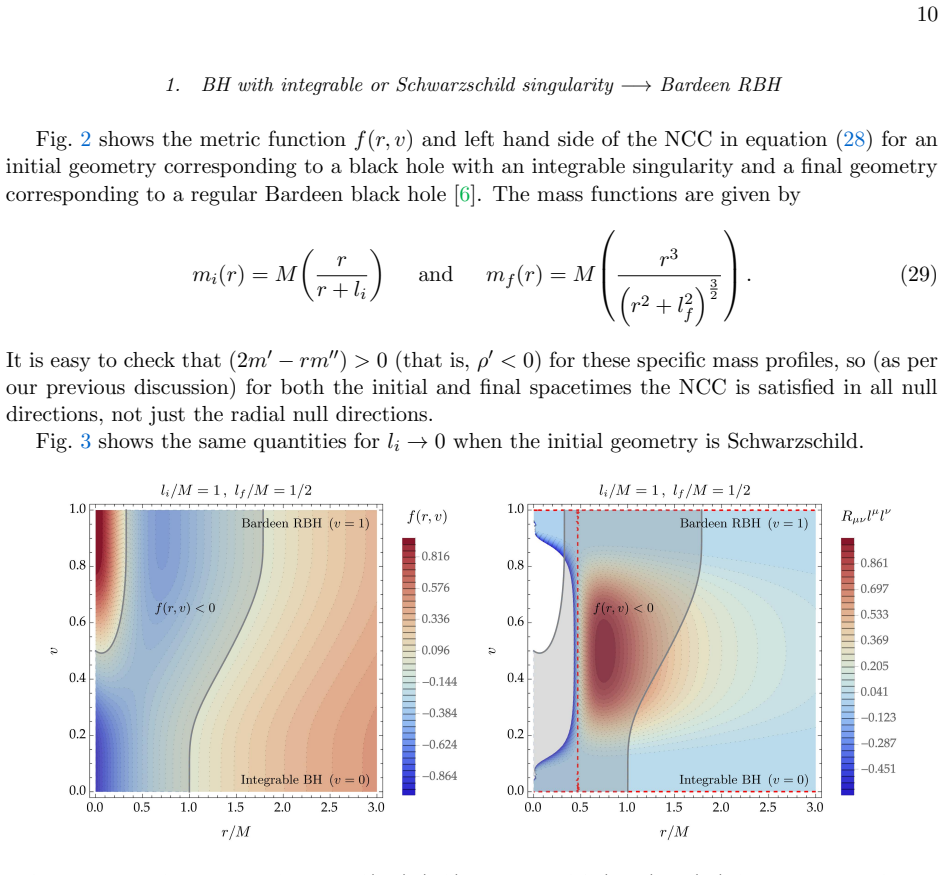
What carries the argument
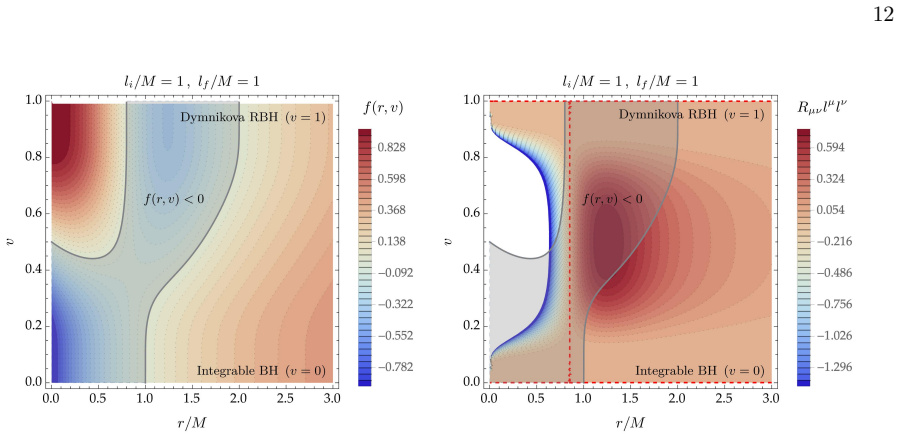
The load-bearing device is the kinematical interpolation ansatz of Eqs. (16) and (24): a smooth step function $\sigma(v)$ that switches from 0 to 1 is used to take convex combinations of the initial and final mass functions, $m(r,v) = (1-\sigma)m_i + \sigma m_f$, and of the initial and final radial functions, $R(r,v) = (1-\sigma)R_i + \sigma R_f$, with an analogue for length parameters. Because $\dot\sigma>0$ during the transition, the sign of $\dot m$ is controlled by $\Delta m = m_f - m_i$, and the sign of $R''$ is controlled by $\Delta R'' = R''_f - R''_i$. The central identities are $R_{\mu\nu} k^\mu k^\nu = -2R''/R$ and, for $R=r$, $R_{\mu\nu} l^\mu l^\nu = 2\dot m/r^2$, which convert the NCC into two elementary derivative inequalities. This reduces the question of whether a transition can respect the NCC to the relative shapes of the endpoint mass and radial profiles.
What would settle it
Exhibit one explicit smooth, spherically symmetric, globally hyperbolic dynamical spacetime that begins as Schwarzschild (or an integrable-singularity black hole), ends as Bardeen (or Dymnikova), and satisfies the NCC for all times and all null vectors. Under the paper's interpolation ansatz this is impossible, because $\dot m = (m_f-m_i)\dot\sigma$ is negative wherever $m_f<m_i$; a single NCC-respecting interpolation of this type would refute the claim that transient violation is unavoidable.
Extended reading notes
Core claim
Working with spherically symmetric metrics in ingoing Eddington–Finkelstein form, $ds^2 = -f(r,v)dv^2 + 2drdv + R(r,v)^2 d\Omega^2$, the paper derives that for $R=r$ the radial null convergence condition reduces to $\dot m \ge 0$, where $m$ is the mass function, while for geometries with a throat it reduces to $R'' \le 0$ at the throat. It then constructs transitions by convex interpolation, $m(r,v)=(1-\sigma(v))m_i(r)+\sigma(v)m_f(r)$ and similarly for $R$, with a smooth step $\sigma$. For transitions from a Schwarzschild or integrable-singularity black hole to Bardeen or Dymnikova regular black holes, $m_f(r)<m_i(r)$ on an open region, so $\dot m<0$ and the NCC is violated throughout the transition even though both endpoints satisfy the NCC. The same happens for transitions from a regular black hole to its horizonless compact counterpart when the regularization length increases, and for black-bounce and wormhole transitions the positive $R''$ near the throat gives unavoidable violation. The paper concludes that NCC violation is a generic, seemingly unavoidable feature of such kinematical transitions.
Load-bearing premise
The paper's conclusion rests on assuming that real dynamical transitions are faithfully represented by the linear convex interpolation of the mass and radial functions; if actual collapse proceeds along a different evolutionary path, with non-monotonic or non-linear mixing, the inevitability of NCC violation is not established.
Editorial extensions
If this is right
- Any smooth transition from a Schwarzschild black hole to a Bardeen or Dymnikova regular black hole, within this interpolation class, passes through a phase of NCC violation near the origin where the interpolated mass is decreasing.
- A transition from a regular black hole to a horizonless compact object of the same family violates the NCC whenever the regularization length parameter grows, even though the two stationary endpoints individually satisfy the NCC.
- Transitions into black-bounce or wormhole geometries violate the NCC because the interpolated radial function acquires a positive second derivative at the throat; for these endpoints the NCC is also violated in the stationary final state.
- The Penrose singularity theorem is therefore evaded dynamically in these models: the focusing condition fails during the transition, not at the static endpoint, and no Cauchy horizon is needed for the evasion.
- In any realistic dynamical completion, the transient NCC violation would have to be supplied by quantum effects, so the renormalized stress-energy tensor would have to violate the null energy condition in precisely the spacetime region identified by these inequalities.
Reading between the lines
- The specific examples are probably instantiations of a more general statement: for any two static spherically symmetric spacetimes with $R=r$ and equal ADM mass, if the final mass profile lies below the initial one on any open set, every monotone convex interpolation violates the NCC; the paper states this pattern but does not elevate it to a theorem.
- A dynamical proof that the interpolating family is the unique or dominant path to regular black holes would turn 'NCC violation occurs in these models' into 'NCC violation is unavoidable in nature'; the paper explicitly leaves such a formal universality proof as desirable.
- For wormhole endpoints the violation is not a transient artifact of the interpolation, since the final geometry itself violates the NCC; the sharp claim to test is therefore the intermediate-time violation for regular-black-hole endpoints, which could serve as a target for numerical collapse codes.
- The same inequalities could be used to reverse the logic: given a plausible quantum-gravity-corrected metric during collapse, checking the sign of $\dot m$ and $R''$ supplies a fast diagnostic for where the null energy condition must break down.
Editorial analysis
A structured set of objections, weighed in public.
Referee Report
Summary. The paper analyzes the null convergence condition (NCC) in time-dependent spherically symmetric spacetimes of the form (1), focusing on kinematical transitions between static geometries: singular black holes to regular black holes, regular black holes to horizonless compact objects, singular black holes to bounces/wormholes, and bounces to naked wormholes. The authors derive general NCC expressions for the two radial null vectors, Eqs. (4), (5), (8), and (9), and then construct smooth interpolations of the mass and radial functions, Eqs. (16), (19), (24), and (26), to model the transitions. They find that, for the chosen examples, the NCC is violated at intermediate times even when both end-point geometries satisfy the NCC, and they interpret this in the context of the Penrose singularity theorem and the formation of regular black holes.
Significance. The paper provides a clear and correct demonstration that transient NCC violations are generic within the kinematic class considered. The algebraic derivations in Section II are transparent, and the examples in Section III are concrete, with figures that allow the violations to be identified explicitly. The authors are careful to state that their analysis is kinematic, that no specific dynamics is assumed, and that a formal proof of universality is not provided. If the results hold, they sharpen the geometric constraints on dynamical models of regular black hole formation and connect the evasion of the Penrose theorem to transient NCC violation rather than to stationary inner horizons alone. The paper also correctly distinguishes the NCC from the NEC and engages with the singularity-theorem literature.
minor comments (6)
- [Section I] There is a typo on page 3: 'explicity' should read 'explicitly'.
- [Section IV] On page 19, 'gemoetries' should be 'geometries', and 'thermodynamics quantities' should be 'thermodynamic quantities'.
- [Section III.A] Around Eq. (14), the paper should state explicitly that the interpolation is performed at fixed coordinate r and that the initial and final times v_i and v_f are set to 0 and 1 without loss of generality; this would clarify the coordinate conventions used in the plots.
- [Figure 11] The caption of Fig. 11 refers to a 'Simpson–Visser black hole', but the text in Section III.D.2 and the figure content describe a transition to a Simpson–Visser naked wormhole; the caption should be corrected for consistency.
- [Abstract and Section IV] The abstract's statement that NCC violations 'occur frequently' and the Discussion's phrase 'seemingly unavoidable' are not formal theorems. The authors do acknowledge in Section IV that 'a formal proof of the universality of this behaviour would certainly be desirable', but the abstract should more precisely state that the results hold for the interpolating metrics (16) and (24) under the conditions (18), (22), (25), and (27), and that the broader claim is not proven.
- [References] Reference [5] is listed only as 'To Appear' with no further information; if an arXiv identifier or journal reference is available, it should be provided.
Circularity Check
No significant circularity: the NCC-violation results follow self-containedly from the explicit interpolation ansatz and are neither fitted inputs nor conclusions assumed by definition.
full rationale
The paper's derivation chain is self-contained. From the spherically symmetric line element (1) and the definition of the NCC (2), the authors compute the contractions for the radial null vectors, obtaining Eq. (4) for R_mu nu k^mu k^nu and Eq. (8) for R_mu nu l^mu l^nu in the R(r,v)=r case. The kinematic transition is then specified by an explicit ansatz: the mass function is the convex combination (16) and the radial function is the convex combination (24), with a monotone smooth transition function sigma(v). No parameter is fitted to data and no external benchmark is invoked. The key sign conditions are direct algebra: Eq. (17) gives \dot m = (m_f - m_i)\dot\sigma, so Eq. (8) changes sign exactly when m_f(r) < m_i(r), as stated in Eq. (18). Likewise, Eq. (25) makes R'' a convex combination of R_i'' and R_f'', so Eq. (4) gives NCC violation whenever the final radial profile has positive second derivative, as stated in Section III D. These are consequences of the stated model, not restatements of the conclusion. The paper does not claim to derive the interpolation from dynamics; it explicitly says 'we do not consider fully realistic collapse scenarios' and limits the analysis to 'kinematic models that interpolate between standard physics and regular black holes.' That is a scope limitation, not circularity. The self-citations to [5], [14], [23], [24], [25] and [29-31] are used for background, motivation, and example geometries, but the central NCC computation in Section II and the interpolation argument in Section III do not depend on those citations. The endpoint spacetimes being NCC-satisfying is checked explicitly, e.g., '(2m' - rm'') > 0 (that is, rho' < 0) for these specific mass profiles.' No step reduces, by definition or by authority, to the target claim that NCC violation occurs during the transitions. The honest finding is therefore no significant circularity.
Assumptions & free parameters
free parameters (1)
- length parameters l_i, l_f =
various: e.g., l_i/M = 1, l_f/M = 1/2 for Bardeen; l_i/M = 0, l_f/M = 1 for Schwarzschild to Dymnikova; etc.
assumptions (4)
- domain assumption Spherical symmetry and the line element (1) with R >= 0.
- ad hoc to paper The interpolated metrics (16) and (24) are smooth and define valid spacetimes.
- domain assumption The NCC can be evaluated kinematically without specifying dynamics.
- domain assumption Global hyperbolicity can be maintained during the transition (inner horizon not a Cauchy horizon).
Cite this review
Pith. "Pith review of Violations of the null convergence condition in kinematical transitions between singular and regular black holes, horizonless compact objects, and bounces." pith.science (2026). https://pith.science/paper/2N3GBLAN
@misc{pith2026250200548,
  author       = {Pith},
  title        = {Pith review of: Violations of the null convergence condition in kinematical transitions between singular and regular black holes, horizonless compact objects, and bounces},
  year         = {2026},
  howpublished = {\url{https://pith.science/paper/2N3GBLAN}},
  note         = {Machine review of arXiv:2502.00548}
}
read the original abstract
How do regular black holes evade the Penrose singularity theorem? Various models of stationary regular black holes globally satisfy the null convergence condition (NCC). At first glance this might seem puzzling, as the NCC must generically be violated to avoid the focusing point implied by the Penrose theorem. In fact, the Penrose singularity theorem depends on subtle global assumptions and does not provide information about where and when the singularity actually forms. In particular inner horizons are typically reached at finite affine parameter, before null geodesic focusing occurs, and the region inside the inner horizon is not itself a trapped region. Specifically, the Bardeen, Dymnikova, Hayward models of stationary regular black holes feature an inner Cauchy horizon which violates global hyperbolicity, hence violating one of the key assumptions of Penrose's singularity theorem, and furthermore challenging their viability as long-living end-points of gravitational collapse. In contrast, during non-stationary processes describing kinematic transitions between standard singular black holes and regular black holes or horizonless compact objects, the inner horizon -- when present -- need not act as a Cauchy horizon. This raises the intriguing possibility that the NCC might instead be violated during intermediate stages of such transitions. Our detailed analysis confirms that NCC violations occur frequently during such kinematic transitions, even when the stationary end-point spacetimes respect the NCC. We also investigate analogous transitions toward black-bounce spacetimes and their horizonless compact counterparts, wormholes, where the NCC is always violated. These findings offer new insights into how regular black holes and related objects evade the constraints imposed by the Penrose singularity theorem.
Figures


Figures from the paper (9 more)


Forward citations
Cited by 1 Pith paper
-
Regular black holes from pure gravity in four dimensions
A construction of four-dimensional pure-gravity actions whose vacuum solutions include the Hayward and Dymnikova regular black holes, via a lift from two-dimensional Horndeski theory.
Reference graph
Works this paper leans on
-
[1]
BH with integrable or Schwarzschild singularity − →Bardeen RBH 10
-
[2]
Transitions from regular black holes to horizonless compact objects 13
BH with integrable or Schwarzschild singularity − →Dymnikova RBH 11 C. Transitions from regular black holes to horizonless compact objects 13
-
[3]
Bardeen RBH − →Bardeen HCO 13
-
[4]
Transitions from singular black holes to bouncing or wormhole geometries 14
Dymnikova RBH − →Dymnikova HCO 14 D. Transitions from singular black holes to bouncing or wormhole geometries 14
-
[5]
BH with integrable or Schwarzschild singularity − →SV black bounce 15
-
[6]
Transitions from bouncing geometries to wormhole geometries 18
BH with integrable or Schwarzschild singularity − →SV naked wormhole 17 E. Transitions from bouncing geometries to wormhole geometries 18
-
[7]
SV black bounce − →SV naked wormhole 18 IV. Discussion 19 Acknowledgments 20 References 20 3 I. INTRODUCTION How do regular black holes (RBHs) evade the Hawking–Penrose singularity theorems [1, 2] (see also [3, 4])? This question is more subtle than one might suppose. In this paper we will focus on the Penrose (1965) singularity theorem [1] and treat the ...
work page 1965
-
[8]
BH with integrable or Schwarzschild singularity − →Bardeen RBH Fig. 2 shows the metric function f (r, v) and left hand side of the NCC in equation (28) for an initial geometry corresponding to a black hole with an integrable singularity and a final geometry corresponding to a regular Bardeen black hole [6]. The mass functions are given by mi(r) = M r r + ...
Show all 61 references
-
[9]
BH with integrable or Schwarzschild singularity − →Dymnikova RBH Fig. 4 shows the metric function f (r, v) and left hand side of the NCC in equation (28) for an initial geometry corresponding to a black hole with an integrable singularity and a final geometry corresponding to ...
-
[10]
(31) Fig
Bardeen RBH − →Bardeen HCO For a transition from a regular black hole to a horizonless compact object based on a Bardeen geometry, we set the mass function to be m(r, v) = M r3 (r2 + l2(v)) 3 2 ! . (31) Fig. 6 shows the metric function f (r, v) and left hand side of the NCC in...
-
[11]
(32) Fig
Dymnikova RBH − →Dymnikova HCO For a transition from a regular black hole to a horizonless compact object based on a Dymnikova geometry, we set the mass function to be m(r, v) = M 1 − e − r3 l3 f (v) ! . (32) Fig. 7 shows the metric function f (r, v) and the NCC in equation (2...
-
[12]
BH with integrable or Schwarzschild singularity − →SV black bounce Fig. 8 shows the expressions (35) for an initial geometry with parameter li such that the space- time contains a black hole with an integrable singularity and a final parameter lf such that the spacetime contai...
-
[13]
BH with integrable or Schwarzschild singularity − →SV naked wormhole Fig. 10 shows the expressions (35) for an initial geometry with parameter li such that the spacetime contains a black hole with an integrable singularity and a final parameter lf such that the spacetime conta...
-
[14]
stan- dard physics
SV black bounce − →SV naked wormhole For the transition from a Simpson–Visser black-bounce spacetime to a Simpson–Visser wormhole spacetime [9, 29–31] we use the interpolating mass function m(r, v) in (16) and set mi(r) = mf (r) = M . (36) Moreover, according to equation (26) ...
1965
-
[15]
Penrose, Gravitational collapse and space-time singularities , Phys
R. Penrose, Gravitational collapse and space-time singularities , Phys. Rev. Lett. 14 (1965) 57–59
1965
-
[16]
S. W. Hawking and R. Penrose, The Singularities of gravitational collapse and cosmology , Proc. Roy. Soc. Lond. A 314 (1970) 529–548
1970
-
[17]
J. M. M. Senovilla and D. Garfinkle, The 1965 Penrose singularity theorem , Class. Quant. Grav. 32 (2015), no. 12 124008, [ arXiv:1410.5226]
2015 arXiv
-
[18]
S. W. Hawking and G. F. R. Ellis, The Large Scale Structure of Space-Time . Cambridge Monographs on Mathematical Physics. Cambridge University Press, 2, 2023
2023
-
[19]
Borissova, S
J. Borissova, S. Liberati, and M. Visser, To Appear,
-
[20]
Bardeen, Non-singular general-relativistic gravitational collapse , Abstracts of GR5 — the 5th international conference on gravitation and the theory of relativity, eds
J. Bardeen, Non-singular general-relativistic gravitational collapse , Abstracts of GR5 — the 5th international conference on gravitation and the theory of relativity, eds. V. A. Fock et al. (Tbilisi University Press, Tbilisi, Georgia, former USSR) (1968) 174–175
1968
-
[21]
Dymnikova, Vacuum nonsingular black hole , Gen
I. Dymnikova, Vacuum nonsingular black hole , Gen. Rel. Grav. 24 (1992) 235–242
1992
-
[22]
S. A. Hayward, Formation and evaporation of regular black holes , Phys. Rev. Lett. 96 (2006) 031103, [gr-qc/0506126]
2006 arXiv
-
[23]
Simpson and M
A. Simpson and M. Visser, Black-bounce to traversable wormhole , JCAP 02 (2019) 042, [arXiv:1812.07114]. 21
2019 arXiv
-
[24]
Simpson and M
A. Simpson and M. Visser, Regular black holes with asymptotically Minkowski cores , Universe 6 (2019), no. 1 8, [ arXiv:1911.01020]
2019 arXiv
-
[25]
Berry, A
T. Berry, A. Simpson, and M. Visser, Photon spheres, ISCOs, and OSCOs: Astrophysical observables for regular black holes with asymptotically Minkowski cores , Universe 7 (2020), no. 1 2, [arXiv:2008.13308]
2020 arXiv
-
[26]
Simpson and M
A. Simpson and M. Visser, The eye of the storm: a regular Kerr black hole , JCAP 03 (2022), no. 03 011, [arXiv:2111.12329]
2022 arXiv
-
[27]
Simpson and M
A. Simpson and M. Visser, Astrophysically viable Kerr-like spacetime , Phys. Rev. D 105 (2022), no. 6 064065, [arXiv:2112.04647]
2022 arXiv
-
[28]
Carballo-Rubio, F
R. Carballo-Rubio, F. Di Filippo, S. Liberati, and M. Visser, Geodesically complete black holes , Phys. Rev. D 101 (2020) 084047, [ arXiv:1911.11200]
2020 arXiv
-
[29]
Curiel, A Primer on Energy Conditions , Einstein Stud
E. Curiel, A Primer on Energy Conditions , Einstein Stud. 13 (2017) 43–104, [ arXiv:1405.0403]
2017 arXiv
-
[30]
Borde, Geodesic focusing, energy conditions and singularities , Class
A. Borde, Geodesic focusing, energy conditions and singularities , Class. Quant. Grav. 4 (1987) 343–356
1987
-
[31]
Barcel´ o and M
C. Barcel´ o and M. Visser, Twilight for the energy conditions? , Int. J. Mod. Phys. D 11 (2002) 1553–1560, [gr-qc/0205066]
2002 arXiv
-
[32]
Visser and C
M. Visser and C. Barcel´ o, Energy conditions and their cosmological implications , in 3rd International Conference on Particle Physics and the Early Universe , pp. 98–112, 2000. gr-qc/0001099
2000 arXiv
-
[33]
Mart ´ ın-Moruno and M
P. Mart ´ ın-Moruno and M. Visser,Classical and semi-classical energy conditions , Fundam. Theor. Phys. 189 (2017) 193–213, [ arXiv:1702.05915]
2017 arXiv
-
[34]
Mart ´ ın-Moruno and M
P. Mart ´ ın-Moruno and M. Visser,Semiclassical energy conditions for quantum vacuum states , JHEP 09 (2013) 050, [ arXiv:1306.2076]
2013 arXiv
-
[35]
Mart ´ ın-Moruno and M
P. Mart ´ ın-Moruno and M. Visser,Classical and quantum flux energy conditions for quantum vacuum states, Phys. Rev. D 88 (2013), no. 6 061701, [ arXiv:1305.1993]
2013 arXiv
-
[36]
Mart ´ ın-Moruno and M
P. Mart ´ ın-Moruno and M. Visser,Semi-classical and nonlinear energy conditions , in 14th Marcel Grossmann Meeting on Recent Developments in Theoretical and Experimental General Relativity, Astrophysics, and Relativistic Field Theories , vol. 2, pp. 1442–1447, 2017. arXiv:1510.00158
2017 arXiv
-
[37]
Carballo-Rubio, F
R. Carballo-Rubio, F. Di Filippo, S. Liberati, and M. Visser, Opening the Pandora’s box at the core of black holes , Class. Quant. Grav. 37 (2020), no. 14 14, [ arXiv:1908.03261]
2020 arXiv
-
[38]
Carballo-Rubio, F
R. Carballo-Rubio, F. Di Filippo, S. Liberati, C. Pacilio, and M. Visser, On the viability of regular black holes , JHEP 07 (2018) 023, [ arXiv:1805.02675]
2018 arXiv
-
[39]
Carballo-Rubio, F
R. Carballo-Rubio, F. Di Filippo, S. Liberati, and M. Visser, A connection between regular black holes and horizonless ultracompact stars , JHEP 08 (2023) 046, [ arXiv:2211.05817]
2023 arXiv
-
[40]
Fu and D
Z. Fu and D. Marolf, Bag-of-gold spacetimes, Euclidean wormholes, and inflation from domain walls in AdS/CFT, JHEP 11 (2019) 040, [ arXiv:1909.02505]
2019 arXiv
-
[41]
Marolf, Black Holes, AdS, and CFTs , Gen
D. Marolf, Black Holes, AdS, and CFTs , Gen. Rel. Grav. 41 (2009) 903–917, [ arXiv:0810.4886]
2009 arXiv
-
[42]
N. O. Murchadha, The bag of gold reopened , Classical and Quantum Gravity 4 (nov, 1987) 1609
1987
-
[43]
F. S. N. Lobo, M. E. Rodrigues, M. V. de Sousa Silva, A. Simpson, and M. Visser, Novel black-bounce spacetimes: wormholes, regularity, energy conditions, and causal structure , Phys. Rev. D 103 (2021), no. 8 084052, [ arXiv:2009.12057]
2021 arXiv
-
[44]
Franzin, S
E. Franzin, S. Liberati, J. Mazza, A. Simpson, and M. Visser, Charged black-bounce spacetimes, JCAP 07 (2021) 036, [ arXiv:2104.11376]
2021 arXiv
-
[45]
F. S. N. Lobo, A. Simpson, and M. Visser, Dynamic thin-shell black-bounce traversable wormholes , Phys. Rev. D 101 (2020), no. 12 124035, [ arXiv:2003.09419]
2020 arXiv
-
[46]
A. C. Wall, The Generalized Second Law implies a Quantum Singularity Theorem , Class. Quant. Grav. 30 (2013) 165003, [ arXiv:1010.5513]. [Erratum: Class.Quant.Grav. 30, 199501 (2013)]
2013 arXiv
-
[47]
Carballo-Rubio, F
R. Carballo-Rubio, F. Di Filippo, S. Liberati, C. Pacilio, and M. Visser, Inner horizon instability and the unstable cores of regular black holes , JHEP 05 (2021) 132, [ arXiv:2101.05006]
2021 arXiv
-
[48]
Di Filippo, R
F. Di Filippo, R. Carballo-Rubio, S. Liberati, C. Pacilio, and M. Visser, On the Inner Horizon Instability of Non-Singular Black Holes , Universe 8 (2022), no. 4 204, [ arXiv:2203.14516]
2022 arXiv
-
[49]
Carballo-Rubio, F
R. Carballo-Rubio, F. Di Filippo, S. Liberati, and M. Visser, Mass Inflation without Cauchy Horizons, Phys. Rev. Lett. 133 (2024), no. 18 181402, [ arXiv:2402.14913]
2024 arXiv
-
[50]
Hollands, R
S. Hollands, R. M. Wald, and J. Zahn, Quantum instability of the Cauchy horizon in Reissner–Nordstr¨ om–deSitter spacetime, Class. Quant. Grav. 37 (2020), no. 11 115009, [arXiv:1912.06047]. 22
2020 arXiv
-
[51]
McMaken and A
T. McMaken and A. J. S. Hamilton, Hawking radiation inside a rotating black hole , Phys. Rev. D 109 (2024), no. 6 065023, [ arXiv:2401.03098]
2024 arXiv
-
[52]
McMaken, Backreaction from quantum fluxes at the Kerr inner horizon , Phys
T. McMaken, Backreaction from quantum fluxes at the Kerr inner horizon , Phys. Rev. D 110 (2024), no. 4 045019, [ arXiv:2405.13221]
2024 arXiv
-
[53]
In-Vacuum
R. Balbinot and A. Fabbri, The Unruh Vacuum and the “In-Vacuum” in Reissner-Nordstr¨ om Spacetime †, Universe 10 (2024), no. 1 18, [ arXiv:2311.09943]
2024 arXiv
-
[54]
S. W. Hawking, Information Preservation and Weather Forecasting for Black Holes , arXiv:1401.5761
-
[55]
Visser, Physical observability of horizons , Phys
M. Visser, Physical observability of horizons , Phys. Rev. D 90 (2014), no. 12 127502, [arXiv:1407.7295]
2014 arXiv
-
[56]
Ashtekar and B
A. Ashtekar and B. Krishnan, Isolated and dynamical horizons and their applications , Living Rev. Rel. 7 (2004) 10, [ gr-qc/0407042]
2004 arXiv
-
[57]
Carballo-Rubio, F
R. Carballo-Rubio, F. Di Filippo, S. Liberati, and M. Visser, Singularity-free gravitational collapse: From regular black holes to horizonless objects , arXiv:2302.00028
-
[58]
Di Filippo, S
F. Di Filippo, S. Liberati, and M. Visser, Fully extremal black holes: A black hole graveyard? , Int. J. Mod. Phys. D 33 (2024), no. 15 2440005, [ arXiv:2405.08069]
2024 arXiv
-
[59]
Afshordi et al., Black Holes Inside and Out 2024: visions for the future of black hole physics , 10,
N. Afshordi et al., Black Holes Inside and Out 2024: visions for the future of black hole physics , 10,
2024
-
[60]
Visser, Black holes, Cauchy horizons, and mass inflation , Gen
M. Visser, Black holes, Cauchy horizons, and mass inflation , Gen. Rel. Grav. 56 (2024), no. 12 146
2024
-
[61]
Carballo-Rubio et al., Towards a Non-singular Paradigm of Black Hole Physics , arXiv:2501.05505
R. Carballo-Rubio et al., Towards a Non-singular Paradigm of Black Hole Physics , arXiv:2501.05505
Reviewed August 9, 2026 · model on record in the stance chip above.
Discussion (0). Continue with ORCID to comment.