REVIEW 3 major objections 6 minor 37 references
Adjustable picometer-stable interferometers for testing space-based gravitational wave detectors
T0 review · 3 major / 6 minor · reviewed 2026-08-09 · deepseek-v4-flash
Pith's one-line read A clamp-mounted optical bench keeps cavity length noise below 1 pm/√Hz down to 3 mHz, reaching LISA ground-test stability for most frequencies.
desk verdict A genuinely useful engineering demonstration of reconfigurable picometer-stable interferometers, but the abstract's 'verified' overstates what a single non-stationary, detrended beat record can establish. read the letter →
The pith
A machine-rendered reading of the paper's core claim, the machinery that carries it, and where it could break.
The reading
What carries the argument
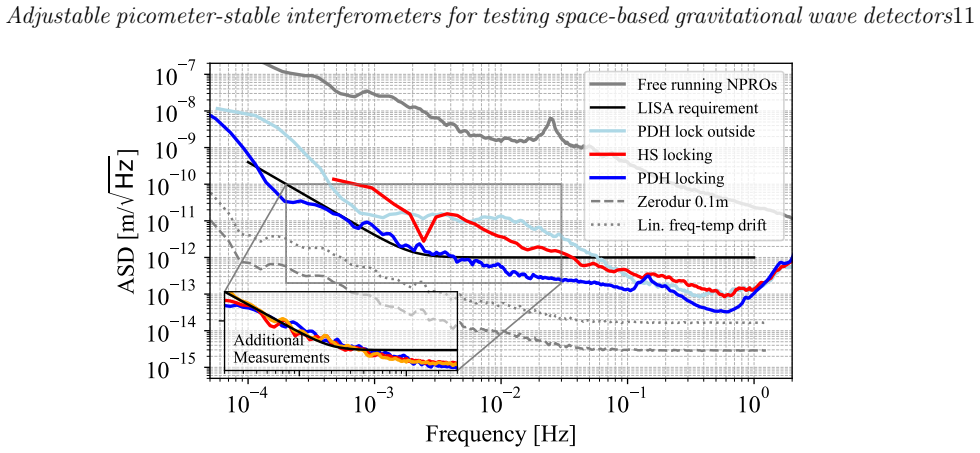
The central object is the toolset for adjustable picometer-stable interferometers (TAPSI): a Zerodur optical bench on which optics sit on posts held by clamps and screws, with Newport ZeroDrift mirror mounts chosen for low tilt-to-length coupling and an Invar compensation plate placed between mount and post so that the thermal expansions of mount and plate cancel at the mirror center. The argument is carried by measuring the length change of a 10 cm prototype cavity built with these mounts, comparing its beat frequency against a 21 cm ULE reference cavity with known $7.5\,\mathrm{fm}/\sqrt{\mathrm{Hz}}$ stability, using two locking schemes (heterodyne stabilization and Pound-Drever-Hall). The PDH result is the carrier of the central claim: it stays below the LISA requirement curve except for a slight excess at 0.8-3 mHz.
What would settle it
Directly measure the coefficient of thermal expansion of the ZeroDrift mirror-mount and Invar compensation-plate assembly, then compute the resulting 10 cm cavity length drift; if the drift projected onto the noise spectrum rises above the LISA requirement curve in the 0.1-3 mHz band, the assumed thermal cancellation fails.
Extended reading notes
Core claim
The central demonstrated claim is that adjustable, clamp-mounted optics on a low-expansion Zerodur bench can be picometer-stable at the low frequencies relevant to LISA. Using a prototype 10 cm cavity with finesse 627 assembled entirely with the TAPSI concept, a 1064 nm laser locked by the Pound-Drever-Hall technique showed relative cavity length noise below $1\,\mathrm{pm}/\sqrt{\mathrm{Hz}}$ down to $3\,\mathrm{mHz}$, below the LISA requirement curve except for a small excess between 0.8 and 3 mHz. The same cavity probed with heterodyne laser frequency stabilization was limited by an analogue demodulation delay effect, not by the mounting concept. The authors therefore conclude that the concept is suitable for flexible, reusable optical ground support equipment for LISA and future space interferometry missions.
Load-bearing premise
The whole approach rests on the assumption that the thermal expansion of the mirror mounts and the Invar plate underneath them cancel well enough to keep the mirror position stable, but that cancellation is never measured directly in the paper.
Editorial extensions
If this is right
- Interferometers for ground testing of LISA can be assembled in hours rather than weeks or months, because components are clamped and repositionable rather than bonded.
- The same bench and components can be reused across different experiments, reducing the cost of optical ground support equipment.
- The concept extends to other future low-frequency space interferometry missions such as Taiji and DECIGO, which need picometer-stable ground testbeds.
- The remaining gap at 0.8-3 mHz in the PDH lock is attributed to stray light and readout effects rather than the mounting concept, so higher cavity finesse and digital demodulation should close it.
Reading between the lines
- If the mount-plate thermal cancellation holds more generally, the concept could be portable to other low-expansion benches and to testbeds where bonding is impractical; the paper only demonstrates one cavity geometry, so this portability is an inference.
- The unmeasured coefficient of thermal expansion of the ZeroDrift mounts means the compensation plate is currently matched by assumption; a direct CTE characterization would let the design be tuned, and thermal cycling tests would reveal whether the stability is robust across temperature ranges.
- The sub-hour assembly time suggests a workflow where candidate interferometer layouts for LISA ground support are prototyped and compared on one bench before a final bonded design is committed; the paper does not explicitly propose this workflow.
- Because the heterodyne approach was limited by an analogue demodulation delay rather than by the optics, moving to digital demodulation could let the simpler heterodyne scheme itself reach LISA stability on the same bench; the paper plans this but has not demonstrated it.
Editorial analysis
A structured set of objections, weighed in public.
Referee Report
Summary. The paper presents TAPSI, an opto-mechanical concept in which mirrors and other optics are placed on a Zerodur bench with adjustable, clamped Invar posts and thermally compensated mirror mounts, rather than being bonded or glued. A 10 cm prototype cavity built with this concept is characterized against a ULE reference cavity using two locking schemes, heterodyne stabilization (HS) and Pound-Drever-Hall (PDH) locking. The authors report a temperature stability of 10 µK/√Hz down to 10 mHz, an initial alignment time under one hour, and a PDH cavity-length noise that they state is below the LISA requirement for most frequencies and only slightly above at 0.8–3 mHz. The abstract goes further, claiming that the cavity length noise is verified to be below 1 pm/√Hz down to 3 mHz. The paper concludes that TAPSI is suitable for flexible optical ground support equipment for LISA and future missions.
Significance. If the central claim holds, TAPSI would be a practically valuable alternative to permanently bonded optical benches for ground-based testing of space interferometers: it promises reconfigurability and much faster assembly while maintaining picometer-level length stability. The paper has notable strengths: the length measurement is made against an external reference cavity, the thermal floor of the Zerodur bench is estimated forward from measured temperature noise and literature CTE values, two locking schemes are compared, and the authors are candid about known limitations such as stray light and the unmeasured mount CTE. However, the headline 'verified below 1 pm/√Hz down to 3 mHz' is not fully supported by the evidence presented, and the paper's own Section 5 appears to contradict the abstract at the 3 mHz point. The underlying concept is credible and the measurement is a useful upper bound, but the verification claim needs either additional data or more careful wording.
major comments (3)
- [Abstract; Section 5; Eq. (1)] The abstract states that 'we verified that the cavity length noise is below 1 pm/sqrt(Hz) for frequencies down to 3 mHz,' but Section 5 says the PDH trace 'is below the LISA requirements for most frequencies and only slightly above at 0.8 to 3 mHz.' Since Eq. (1) gives u(3 mHz) ≈ 1.09 pm/sqrt(Hz), being above the LISA requirement at 3 mHz implies the noise is not below 1 pm/sqrt(Hz) at that frequency. Please reconcile these statements by specifying the exact frequency at which the trace crosses 1 pm/sqrt(Hz) and clarify whether the claim applies to 3 mHz inclusive.
- [Section 5, Figs. 7 and 8, Eq. (8)] The central verification rests on a single beat-note ASD. Figure 8 shows a linear temperature drift removed via Eq. (8) and a quadratic drift removed before spectral estimation, and the residual is described as containing non-stationary noise attributed to parasitic beams. The paper gives no run-to-run statistics, no uncertainty bars on the ASD, and no analysis of how the detrending affects the value at 3 mHz. The plotted trace is therefore a favorable processed upper bound from one non-stationary record, not a statistical verification of the stated stability. Please provide at least two independent records, error bars or segment-to-segment scatter, and a statement of the detrending procedure's effect at the lowest reported frequency.
- [Section 2] The thermal-compensation mechanism is central to the design: the mirror mount and Invar compensation plate are intended to cancel each other's expansion, yet the CTE of the ZeroDrift mount is stated to be unknown and the authors note that a future study is needed to optimize the plate. The demonstrated picometer stability is therefore shown for one specific geometry and thermal environment, not as a property of the adjustable mounting concept in general. Either measure the mount's effective CTE or demonstrate repeatability after reassembly or in a different configuration before claiming that TAPSI provides adjustable picometer-stable interferometers as a general toolset.
minor comments (6)
- [Section 5, Eq. (8)] Equation (8) is typographically ambiguous: 'dL/dT = d f/fLaser LCavity · 1/dT' should be written as (df/f_laser) * L_cavity / dT, with units specified for each quantity.
- [Section 4] The phrase '7.5 fm/sqrt(Hz) (20 Hz sqrt(Hz)) down to 3 mHz' appears malformed; please clarify whether the reference cavity stability is 7.5 fm/sqrt(Hz) at 20 Hz or some other specification.
- [References] References [20] and [21] are the same paper (Korth et al., 'Passive, free-space heterodyne laser gyroscope'); one should be removed and citations renumbered.
- [List of Abbreviations] The abbreviation list contains 'ASD' twice; please deduplicate.
- [Figure 7 caption] The caption mentions 'the free-running laser noise of a 10 cm cavity' but the text does not define how this curve was measured or modeled; please add a brief explanation.
- [Section 3] The text refers to 'Johnsen-Nyquist noise'; this should be 'Johnson-Nyquist noise.'
Circularity Check
No significant circularity: the central pm-stability claim is a beat-note measurement against an external ULE reference cavity, not a fitted or self-cited construction.
full rationale
The paper's central claim is an experimental measurement: the prototype cavity length ASD is obtained by locking two lasers to cavities and measuring the beat frequency, converted by Eq. 2 (dL = dnu/nu * L). The benchmark is external (LISA requirement, Eq. 1), and the reference-cavity stability is cited from an independent prior measurement [37], far below the claimed 1 pm/sqrt(Hz) level. The only fitted parameter, dL/dT ~ 4e-8 m/K (Eq. 8), is extracted from the same beat and temperature records but is used diagnostically to show that linear temperature coupling is not limiting; it is not used to generate the stability number. The theoretical Zerodur thermal floor is computed forward from the literature CTE and measured temperature noise. The one self-citation, [7], is invoked only to note that the analogue-HS delay-beat problem has been overcome digitally elsewhere, and the authors explicitly state their analogue implementation is still constrained; it is not load-bearing for the PDH result. The strongest caveat is non-circular: the low-frequency endpoint relies on a single detrended, non-stationary beat record, so the abstract's word 'verified' may overstate reproducibility; that is a robustness and statistics concern, not circularity.
Assumptions & free parameters
free parameters (1)
- dL/dT linear temperature-to-length coupling =
4e-8 m/K
assumptions (4)
- domain assumption The ULE reference cavity delivers 7.5 fm/sqrt(Hz) stability down to 3 mHz as measured in Ref [37].
- domain assumption The ZeroDrift mirror mounts have small CTE and the Invar compensation plate cancels the mount's thermal expansion.
- standard math The beat-frequency ASD maps to cavity length noise through dL = (dv/v) L with v = 282 THz.
- standard math Zerodur's nominal CTE, multiplied by the measured temperature noise, bounds the bench's thermal length noise.
Cite this review
Pith. "Pith review of Adjustable picometer-stable interferometers for testing space-based gravitational wave detectors." pith.science (2026). https://pith.science/paper/STJPRSCK
@misc{pith2026250201212,
  author       = {Pith},
  title        = {Pith review of: Adjustable picometer-stable interferometers for testing space-based gravitational wave detectors},
  year         = {2026},
  howpublished = {\url{https://pith.science/paper/STJPRSCK}},
  note         = {Machine review of arXiv:2502.01212}
}
read the original abstract
Space-based gravitational wave detectors, such as the Laser Interferometer Space Antenna (LISA), use picometer-precision laser interferometry to detect gravitational waves at frequencies from 1 Hz down to below 0.1 mHz. Laser interferometers used for on-ground prototyping and testing of such instruments are typically constructed by permanently bonding or gluing optics onto an ultra-stable bench made of low-expansion glass ceramic. This design minimizes temperature coupling to length and tilt, which dominates the noise at low frequencies due to finite temperature stability achievable in laboratories and vacuum environments. Here, we present the study of an alternative opto-mechanical concept where optical components are placed with adjustable and freely positionable mounts on an ultra-stable bench, while maintaining picometer length stability. With this concept, a given interferometer configuration can be realised very quickly due to a simplified and speed-up assembly process, reducing the realisation time from weeks or months to a matter of hours. We built a corresponding test facility and verified the length stability of our concept by measuring the length change in an optical cavity that was probed with two different locking schemes, heterodyne laser frequency stabilisation and Pound-Drever-Hall locking. We studied the limitations of both locking schemes and verified that the cavity length noise is below 1 pm/sqrt(Hz) for frequencies down to 3 mHz. We thereby demonstrate that our concept can simplify the testing of interferometer configurations and opto-mechanical components and is suitable to realise flexible optical ground support equipment for space missions that use laser interferometry, such as future space-based gravitational wave detectors and satellite geodesy missions.
Figures


Figures from the paper (5 more)



Reference graph
Works this paper leans on
-
[1]
J Aasi, B P Abbott, R Abbott, T Abbott, M R Abernathy, K Ackley, C Adams, T Adams, P Addesso, R X Adhikari, V Adya, C Affeldt, N Aggarwal, O D Aguiar, A Ain, P Ajith, A Alemic, B Allen, D Amariutei, S B Anderson, W G Anderson, K Arai, M C Araya, C Arceneaux, J S Areeda, G Ashton, S Ast, S M Aston, P Aufmuth, C Aulbert, B E Aylott, S Babak, P T Baker, S W ...
work page 2015
-
[2]
Advanced virgo: a second-generation interferometric gravitational wave detector
F Acernese, M Agathos, K Agatsuma, D Aisa, N Allemandou, A Allocca, J Amarni, P Astone, G Balestri, G Ballardin, F Barone, J-P Baronick, M Barsuglia, A Basti, F Basti, Th S Bauer, V Bavigadda, M Bejger, M G Beker, C Belczynski, D Bersanetti, A Bertolini, M Bitossi, M A Bizouard, S Bloemen, M Blom, M Boer, G Bogaert, D Bondi, F Bondu, L Bonelli, R Bonnand,...
work page 2014
-
[3]
Gabriella Agazie, Akash Anumarlapudi, Anne M. Archibald, Paul T. Baker, Bence B´ ecsy, Laura Blecha, Alexander Bonilla, Adam Brazier, Paul R. Brook, Sarah Burke-Spolaor, Rand Burnette, Robin Case, J. Andrew Casey-Clyde, Maria Charisi, Shami Chatterjee, Katerina Chatziioannou, Belinda D. Cheeseboro, Siyuan Chen, Tyler Cohen, James M. Cordes, Neil J. Cornis...
work page 2023
-
[4]
John Baker, Simon F. Barke, Peter L. Bender, Emanuele Berti, Robert Caldwell, John W. Conklin, Neil Cornish, Elizabeth C. Ferrara, Kelly Holley-Bockelmann, Brittany Kamai, Shane L. Larson, Jeff Livas, Sean T. McWilliams, Guido Mueller, Priyamvada Natarajan, Norman Rioux, Shannon R Sankar, Jeremy Schnittman, Deirdre Shoemaker, Jacob Slutsky, Robin Stebbins...
work page 2019
-
[5]
Eric D. Black. An introduction to pound–drever–hall laser frequency stabilization. American Journal of Physics , 69(1):79–87, January 2001
work page 2001
-
[6]
J. Bogenstahl, C. Diekmann, E. D. Fitzsimons, R. Fleddermann, E. Granova, C. J. Killow, J. Pijnenburg, D. I. Robertson, A. Shoda, A. Sohmer, M. Tr¨ obs, H. Ward, D. Weise, L. d’Arcio, M. Dehne, G. Heinzel, H. Hogenhuis, M. Perreur-Lloyd, A. Taylor, and G. Wanner. Optical bench development for lisa. In Naoto Kadowaki, editor, International Conference on Sp...
work page 2010
-
[7]
Integrating high-precision and fringe-scale displacement sensing using heterodyne cavity- tracking
Shreevathsa Chalathadka Subrahmanya, Christian Darsow-Fromm, and Oliver Gerberding. Integrating high-precision and fringe-scale displacement sensing using heterodyne cavity- tracking. Optics Express, 33(3):4044, January 2025
work page 2025
-
[8]
Design and construction of an optical test bed for lisa imaging systems and tilt- to-length coupling
M Chwalla, K Danzmann, G Fern´ andez Barranco, E Fitzsimons, O Gerberding, G Heinzel, C J Killow, M Lieser, M Perreur-Lloyd, D I Robertson, S Schuster, T S Schwarze, M Tr¨ obs, H Ward, and M Zwetz. Design and construction of an optical test bed for lisa imaging systems and tilt- to-length coupling. Classical and Quantum Gravity , 33(24):245015, November 2016
work page 2016
Show all 37 references
-
[9]
Corsi, I
C. Corsi, I. Liontos, S. Cavalieri, M. Bellini, G. Venturi, and R. Eramo. An ultrastable michelson interferometer for high-resolution spectroscopy in the xuv. Optics Express, 23(4):4106, February 2015
2015
-
[10]
Lisa technology concept, status, prospects
Karsten Danzmann and Albrecht Ruediger. Lisa technology concept, status, prospects. Classical and Quantum Gravity , 20(10):S1–S9, April 2003
2003
-
[11]
Construction and noise behaviour of ultra-stable optical systems for space interferometers
Marina Dehne. Construction and noise behaviour of ultra-stable optical systems for space interferometers. 2012
2012
-
[12]
Tanner, and Guido Mueller
Johannes Eichholz, David B. Tanner, and Guido Mueller. Heterodyne laser frequency stabilization for long baseline optical interferometry in space-based gravitational wave detectors. Phys. Rev. D, 92:022004, Jul 2015
2015
-
[13]
Sub-pm √ Hz −1 non-reciprocal noise in the lisa backlink fiber
Roland Fleddermann, Christian Diekmann, Frank Steier, Michael Tr¨ obs, Gerhard Heinzel, and Karsten Danzmann. Sub-pm √ Hz −1 non-reciprocal noise in the lisa backlink fiber. Classical and Quantum Gravity , 35(7):075007, February 2018
2018
-
[14]
Concepts and status of chinese space gravitational wave detection projects
Yungui Gong, Jun Luo, and Bin Wang. Concepts and status of chinese space gravitational wave detection projects. Nature Astronomy, 5(9):881–889, September 2021
2021
-
[15]
Residual amplitude modulation mechanisms in modulation transfer spectroscopy that use electro-optic modulators
Esa Jaatinen, David J Hopper, and Julian Back. Residual amplitude modulation mechanisms in modulation transfer spectroscopy that use electro-optic modulators. Measurement Science and Technology, 20(2):025302, December 2008
2008
-
[16]
Picometer sensitive prototype of the optical truss interferometer for lisa, 2024
Kylan Jersey, Harold Hollis, Han-Yu Chia, Jose Sanjuan, Paul Fulda, Guido Mueller, and Felipe Guzman. Picometer sensitive prototype of the optical truss interferometer for lisa, 2024
2024
-
[17]
J. B. Johnson. Thermal agitation of electricity in conductors. Physical Review, 32(1):97–109, July 1928
1928
-
[18]
Current status of space gravitational wave antenna decigo and b-decigo
Seiji Kawamura, Masaki Ando, Naoki Seto, Shuichi Sato, Mitsuru Musha, Isao Kawano, Jun’ichi Yokoyama, Takahiro Tanaka, Kunihito Ioka, Tomotada Akutsu, Takeshi Takashima, Kazuhiro Agatsuma, Akito Araya, Naoki Aritomi, Hideki Asada, Takeshi Chiba, Satoshi Eguchi, Motohiro Enoki,...
2021
-
[19]
Korth, Nicolas Smith-Lefebvre, Koji Arai, and Rana X
Keiko Kokeyama, Kiwamu Izumi, William Z. Korth, Nicolas Smith-Lefebvre, Koji Arai, and Rana X. Adhikari. Residual amplitude modulation in interferometric gravitational wave detectors. Journal of the Optical Society of America A , 31(1):81, December 2013
2013
-
[21]
Passive, free-space heterodyne laser gyroscope
W Z Korth, A Heptonstall, E D Hall, K Arai, E K Gustafson, and R X Adhikari. Passive, free-space heterodyne laser gyroscope. Classical and Quantum Gravity , 33(3):035004, January 2016
2016
-
[22]
Ultrastable optical components using adjustable commercial mirror mounts anchored in a ule spacer
Soham Kulkarni, Ada Umi´ nska, Joseph Gleason, Simon Barke, Reid Ferguson, Jose Sanju´ an, Paul Fulda, and Guido Mueller. Ultrastable optical components using adjustable commercial mirror mounts anchored in a ule spacer. Applied Optics, 59(23):6999, August 2020
2020
-
[23]
Springer Berlin Heidelberg, 2024
Alexey Kupriyanov, Arthur Reis, Annike Knabe, Nina Fletling, Alireza HosseiniArani, Mohsen Romeshkani, Manuel Schilling, Vitali M¨ uller, and J¨ urgen M¨ uller.Analysis of Novel Sensors and Satellite Formation Flights for Future Gravimetry Missions . Springer Berlin Heidelberg, 2024
2024
-
[24]
Tianqin: a space-borne gravitational wave detector
Jun Luo, Li-Sheng Chen, Hui-Zong Duan, Yun-Gui Gong, Shoucun Hu, Jianghui Ji, Qi Liu, Jianwei Mei, Vadim Milyukov, Mikhail Sazhin, Cheng-Gang Shao, Viktor T Toth, Hai-Bo Tu, Yamin Wang, Yan Wang, Hsien-Chi Yeh, Ming-Sheng Zhan, Yonghe Zhang, Vladimir Zharov, and Ze-Bing Zhou. ...
2016
-
[25]
Ultra-stable and versatile high- energy resolution setup for attosecond photoelectron spectroscopy
Sizuo Luo, Robin Weissenbilder, Hugo Laurell, Mattias Ammitzb¨ oll, V´ enus Poulain, David Busto, Lana Neoriˇ ci´ c, Chen Guo, Shiyang Zhong, David Kroon, Richard J Squibb, Raimund Feifel, Mathieu Gisselbrecht, Anne L’Huillier, and Cord L Arnold. Ultra-stable and versatile hig...
2023
-
[26]
Annealed proton exchanged optical waveguides in lithium niobate: differences between the x- and z-cuts
Pavla Nekvindov´ a, JarmilaˇSpirkov´ a, JarmilaˇCerven´ a, Milos Budnar, Alenka Razpet, Benjamin Zorko, and Primoˇ z Pelicon. Annealed proton exchanged optical waveguides in lithium niobate: differences between the x- and z-cuts. Optical Materials, 19(2):245–253, April 2002
2002
-
[27]
Suprema ® zerodrift™ thermally compensated mirror mounts - su100tw-f2k
Newport. Suprema ® zerodrift™ thermally compensated mirror mounts - su100tw-f2k. Technical report, Spectra-Physics GmbH, 2020
2020
-
[28]
H. Nyquist. Thermal agitation of electric charge in conductors. Physical Review, 32(1):110–113, July 1928
1928
-
[29]
Diaz Ortiz, J
M. Diaz Ortiz, J. Gleason, H. Grote, A. Hallal, M. T. Hartman, H. Hollis, K. S. Isleif, A. James, K. Karan, T. Kozlowski, A. Lindner, G. Messineo, G. Mueller, J. H. Poeld, R. C. G. Smith, A. D. Spector, D. B. Tanner, L. W. Wei, and B. Willke. Design of the alps ii optical system, 2020
2020
-
[30]
Construction and testing of the optical bench for lisa pathfinder
D I Robertson, E D Fitzsimons, C J Killow, M Perreur-Lloyd, H Ward, J Bryant, A M Cruise, G Dixon, D Hoyland, D Smith, and J Bogenstahl. Construction and testing of the optical bench for lisa pathfinder. Classical and Quantum Gravity , 30(8):085006, March 2013
2013
-
[31]
Resistive- based micro-kelvin temperature resolution for ultra-stable space experiments
David Roma-Dollase, Vivek Gualani, Martin Gohlke, Klaus Abich, Jordan Morales, Alba Gonzalvez, Victor Mart ´ ın, Juan Ramos-Castro, Josep Sanjuan, and Miquel Nofrarias. Resistive- based micro-kelvin temperature resolution for ultra-stable space experiments. Sensors, 23(1):145,...
2022
-
[32]
Sanju´ an, A
J. Sanju´ an, A. Lobo, M. Nofrarias, J. Ramos-Castro, and P. J. Riu. Thermal diagnostics front-end electronics for lisa pathfinder. Review of Scientific Instruments , 78(10), October 2007
2007
-
[33]
C P Sasso, G Mana, and S Mottini. The lisa interferometer: impact of stray light on the phase of Adjustable picometer-stable interferometers for testing space-based gravitational wave detectors20 the heterodyne signal. Classical and Quantum Gravity , 36(7):075015, March 2019
2019
-
[34]
Roberts, Lucie Cros, Ben T
Etienne Savalle, Aur´ elien Hees, Florian Frank, Etienne Cantin, Paul-Eric Pottie, Benjamin M. Roberts, Lucie Cros, Ben T. McAllister, and Peter Wolf. Searching for dark matter with an optical cavity and an unequal-delay interferometer. Phys. Rev. Lett. , 126:051301, Feb 2021
2021
-
[35]
B. S. Sheard, G. Heinzel, K. Danzmann, D. A. Shaddock, W. M. Klipstein, and W. M. Folkner. Intersatellite laser ranging instrument for the grace follow-on mission. Journal of Geodesy , 86(12):1083–1095, May 2012
2012
-
[36]
Construction of the lisa back-side fibre link interferometer prototype
F Steier, R Fleddermann, J Bogenstahl, C Diekmann, G Heinzel, and K Danzmann. Construction of the lisa back-side fibre link interferometer prototype. Classical and Quantum Gravity , 26(17):175016, August 2009
2009
-
[37]
Laser development and stabilization for the spaceborne interferometric gravitational wave detector lisa
Michael Tr¨ obs. Laser development and stabilization for the spaceborne interferometric gravitational wave detector lisa. 2005
2005
-
[38]
Improved spectrum estimation from digitized time series on a logarithmic frequency axis
Michael Tr¨ obs and Gerhard Heinzel. Improved spectrum estimation from digitized time series on a logarithmic frequency axis. Measurement, 39(2):120–129, February 2006
2006
Reviewed August 9, 2026 · model on record in the stance chip above.
Discussion (0). Continue with ORCID to comment.