REVIEW 3 major objections 5 minor 55 references
Flyby-induced displacement: analytic solution
T0 review · 3 major / 5 minor · reviewed 2026-08-09 · deepseek-v4-flash
Pith's one-line read For a hyperbolic Scarf approximation of the flyby gravitational-wave profile, the transverse geodesic equations admit exact closed-form solutions only at discrete 'magical' amplitudes, confirming the displacement-memory prediction in a…
desk verdict A small, honest toy-model paper whose final solutions look right, but the Nikiforov-Uvarov derivation as printed has a genuine sign-and-branch flaw that needs fixing before the quantization claim is proven. read the letter →
The pith
A machine-rendered reading of the paper's core claim, the machinery that carries it, and where it could break.
The reading
What carries the argument
The load-bearing tool is the Nikiforov-Uvarov method, a systematic procedure that solves second-order linear ODEs of generalized hypergeometric type by finding a gauge transformation that leaves a polynomial equation; the requirement that the solution be polynomial imposes the quantization condition λ = -n τ' - (1/2) n(n-1) σ'', which in this problem selects the amplitudes |g_n| = (2n+1) sqrt(n(n+1)). The paper also uses the change of variable t = sinh U to put the geodesic equation in the required form, and the hyperbolic Scarf potential as an exactly solvable stand-in for the derivative-of-Gaussian flyby profile. The output is a closed-form trajectory whose polynomial part has exactly n real zeros, counted as half-waves in the wave zone.
What would settle it
Numerically integrate the two transverse geodesic equations for the Scarf profile with a value of g slightly larger than (2n+1) sqrt(n(n+1)) for some small n; if the asymptotic transverse velocities do not stay vanishingly small, the exact-solution claim for those special amplitudes is not confirmed. A sharper test is to compare the exact trajectory (11)-(13) for n=1 with a high-precision numerical integration of (5)-(6) for the same g: any disagreement beyond round-off would invalidate the solution. Physically, one could compare the Scarf profile against a numerically simulated flyby wave form from a full general-relativity code; if the profile departs substantially from that wave form, the toy model's prediction of clean displacement memory loses observational relevance.
Extended reading notes
Core claim
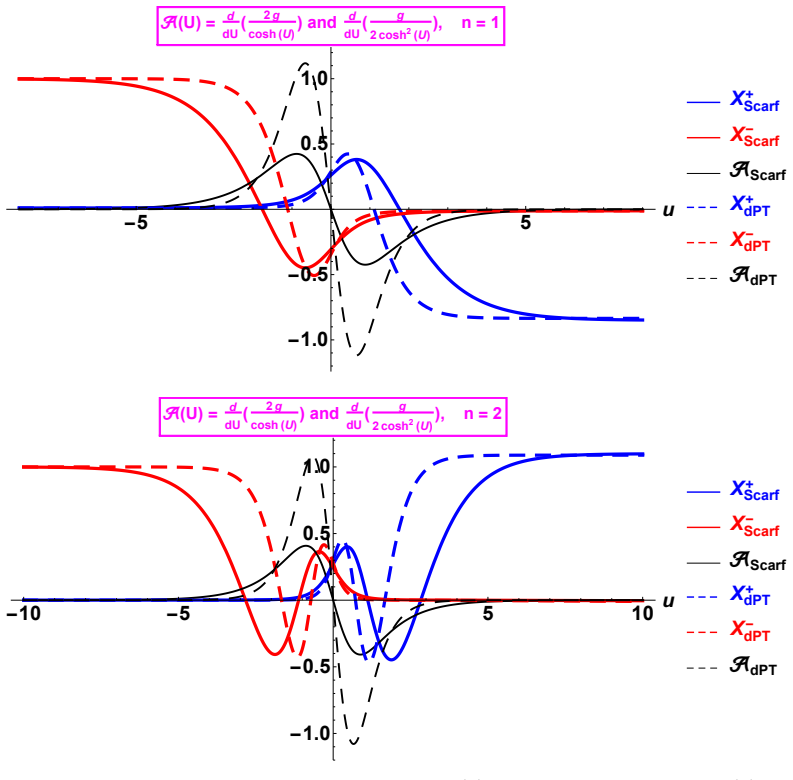
For the Scarf profile A(U) = -2g $\sinh$(U)/$\cosh$^2(U), the geodesic equations $d^{2}$ X_±/$dU^{2}$ ∓ (1/2) A(U) X_± = 0 with both transverse velocities vanishing at U = ±∞ admit exact solutions X_n(t) given by equations (11)–(13) precisely when |g| = (2n+1) $\sqrt$(n(n+1)), for any natural integer n. The solutions are built from a gauge factor and a polynomial y_n(t) obtained by the Nikiforov-Uvarov method, and they reproduce the numerically obtained displacement-memory trajectories of the derived Pöschl-Teller model. The same coupling constant works for both transverse components because the sign changes in the two equations are compensated by the odd profile, resolving a 'half-memory' difficulty present in other profiles.
Load-bearing premise
The physical relevance rests on the modeling assumption that a real flyby gravitational-wave burst is well approximated by the derivative of a Gaussian, and then by the hyperbolic Scarf potential, a choice made for solvability rather than derived from source dynamics.
Editorial extensions
If this is right
- For every natural integer n, the amplitude |g| = (2n+1) sqrt(n(n+1)) yields exact displacement-memory trajectories with vanishing initial and final relative velocity.
- The same n-th amplitude works for both transverse components X_+ and X_-, avoiding the 'half displacement memory' obstruction that occurs for the un-derived Pöschl-Teller profile.
- The exact solutions agree with the semi-analytic derived-Pöschl-Teller trajectories, and remain accurate for high wave numbers where the earlier numerical method becomes impractical.
- The number of half-waves in the wave zone equals the number of zeros of the polynomial y_n(t), giving a concrete interpretation of the quantization condition.
- The parity relation X_n^±(-t) = (-1)^n X_n^∓(t) explains why both components exhibit displacement memory for odd-derivative-of-even profiles.
Reading between the lines
- If real flyby bursts are well approximated by any odd derivative of a bell-shaped function, the same exact-solvability mechanism may hold, suggesting a broader family of analytically tractable flyby-memory profiles.
- The quantization condition could act as a selection rule: for a given burst amplitude, only wave forms with an integer number of half-waves produce clean displacement memory, which might be testable with next-generation detectors.
- The Scarf profile's slower falloff at large U implies off-resonance amplitudes produce residual velocity memory whose magnitude differs from the Pöschl-Teller case; this difference is a potential observational discriminator between the two approximations.
- Because the authors note the same method applies to other profiles such as a Coulomb-like potential in constant-curvature space, the analytic approach may transfer to memory effects in curved backgrounds.
Editorial analysis
A structured set of objections, weighed in public.
Referee Report
Summary. The manuscript studies the displacement memory effect for geodesics in a Brinkmann plane-wave spacetime whose profile is approximated by the hyperbolic Scarf potential A_Scarf(U) = -2g sinh(U)/cosh^2(U). The transverse geodesic equations (5) are reduced by t = sinh(U) to the generalized hypergeometric equation (9), and the Nikiforov-Uvarov method is used to derive the quantization condition |g| = (2n+1) sqrt(n(n+1)) together with the explicit trajectories (11)-(13). The authors argue that these solutions satisfy the displacement-memory boundary conditions (6) for both transverse components, in agreement with the Zel'dovich-Polnarev prediction and with earlier numerical results for the derived Poschl-Teller profile.
Significance. If the derivation is correct, the paper supplies a new exactly solvable toy model for flyby displacement memory, with explicit closed-form trajectories and a transparent quantization rule. The main strengths are that the final formulas are explicit and checkable, that the model is not fitted to data, and that the parity pairing (23) is a crisp structural prediction connected to supersymmetric quantum mechanics. The significance is, however, conditional: the Nikiforov-Uvarov derivation as printed contains a branch/sign inconsistency that affects the proof of the quantization condition, and the physical content is limited by the toy-model nature of the profile.
major comments (3)
- [III, Eqs. (17)-(19)] The derivation of the quantization condition is not valid as printed because epsilon = sign(t + 2k/g) is treated as a constant. In Eq. (17) the square root sqrt(sigma_3) is written with an absolute value, so pi is not a polynomial, and in Eqs. (18)-(19) tau' and lambda are t-dependent through epsilon. The Nikiforov-Uvarov quantization condition (A12) applies only when pi is a polynomial and tau and lambda are constants. The correct procedure is to choose a global branch sqrt(sigma_3) = s |g|/(2 sqrt(k)) (t + 2k/g) with fixed s = +/- 1, derive k_n and lambda_n on that branch, and then verify that the resulting pi is polynomial on the whole real line. I note that the final formulas (11)-(13) do satisfy Eq. (9) for n = 1 with |g| = 3 sqrt(2), so the result may survive such a repair, but the argument as written is incomplete.
- [III, Eqs. (20)-(22)] There is a sign inconsistency between the gauge function and the claimed solution. Eq. (20) gives pi(t) = -n t - sign(g) sqrt(n(n+1)), which would yield phi' = (-n t - sign(g) sqrt(n(n+1)))/(1+t^2) and hence phi = -(n/2) ln(1+t^2) - sign(g) sqrt(n(n+1)) arctan(t), matching the prefactor in Eq. (11). However Eq. (21) has a plus sign in the numerator and Eq. (22) integrates to phi = -(n/2) ln(1+t^2) + sign(g) sqrt(n(n+1)) arctan(t), which gives the opposite exponential in the solution. The sign in Eqs. (21)-(22) must be corrected, or the sign convention in Eq. (11) must be revised consistently.
- [II/III, Eq. (9) and following] The treatment of the two transverse components is not fully explicit. Eq. (9) contains the symbol -/+ g t/(1+t^2), and Sec. III sets sigma_1 = -g t, which corresponds to only one component or to a particular sign of g. Since the final result claims that the same g works for both components, the derivation should state which sign choice is being made and how the second component follows. As written, the reader must infer that the g -> -g symmetry of the quantization condition (10) supplies the second component; this should be stated and checked explicitly.
minor comments (5)
- [III heading and Appendix A] Nikiforov-Uvarov is misspelled as Nikoforov-Uvarov in the Section III heading and in the Appendix A heading.
- [References and Acknowledgments] There are small typos: 'Singaspore' in reference [5] and 'correspondance' in the Acknowledgments should be 'Singapore' and 'correspondence'.
- [Eq. (12) sentence] The sentence 'The normalization constants Bn is determined from the initial conditions' should read 'The normalization constants B_n are determined from the initial conditions.'
- [Figure 2 caption] The caption uses the labels XdPT, XScarf, pi dPT, and pi Scarf without defining them in the caption; a brief explanation of the rescaling and the plotted quantities would improve readability.
- [Fig. 1 discussion] The claim of 'almost perfect overlapping' after dilating U is qualitative; a simple quantitative statement about the rescaling and the deviation would make the approximation argument easier to assess.
Circularity Check
No significant circularity: the Scarf magic values are derived from the NU polynomial condition and are not fitted or imported from the authors' prior work.
full rationale
The central claim—that the Scarf profile (4) gives analytic geodesics only for |g|=(2n+1)sqrt(n(n+1))—is derived in Sec. III from the Nikiforov-Uvarov method: Eq. (16) follows from sigma3 having a double root, Eq. (A12) gives the quantization condition, and Eqs. (20)-(22) construct the solution (11)-(13). No parameter is fitted to the Zel'dovich-Polnarev displacement prediction or to the dPT numerics; the boundary conditions (6) encode the DM effect being tested, and the quantization is a nontrivial output, not an input. The cited prior work by the same authors ([19,21]) supplies motivation, the dPT analogue, and numerical comparison, but none of its values are used to determine g_n; the paper even notes the Scarf and dPT trajectories are 'similar however not fully identical.' The self-citation to [38] as confirmation is not load-bearing. A separate concern—the handling of epsilon=sign(t+2k/g) as constant in the printed NU step (Eqs. 17-19)—is a rigor/correctness issue, not a circularity, and does not affect the circularity score.
Assumptions & free parameters
free parameters (1)
- wave amplitude g =
|g| = |g_n| = (2n+1) sqrt(n(n+1)), n a natural integer
assumptions (4)
- domain assumption The flyby gravitational wave profile is approximated by the derivative of a Gaussian (2), which is further approximated by the hyperbolic Scarf potential (4).
- domain assumption The motion of test particles is governed by the transverse geodesic equations (5) in the Brinkmann metric (1), with the displacement memory boundary conditions (6).
- standard math The Nikiforov-Uvarov method correctly characterizes all polynomial solutions of the generalized hypergeometric-type equation, including the quantization condition (A12) and Rodrigues formula (A13).
- ad hoc to paper The choices k > 0 and the lower signs in Eq. (17)-(18) select the relevant real solutions and do not discard displacement-memory solutions.
Cite this review
Pith. "Pith review of Flyby-induced displacement: analytic solution." pith.science (2026). https://pith.science/paper/KLR65CFC
@misc{pith2026250201326,
  author       = {Pith},
  title        = {Pith review of: Flyby-induced displacement: analytic solution},
  year         = {2026},
  howpublished = {\url{https://pith.science/paper/KLR65CFC}},
  note         = {Machine review of arXiv:2502.01326}
}
read the original abstract
The motion of particles hit by a burst of gravitational waves generated by flyby admits, for the derivative-of-the-Gaussian profile, only a numerical description. The profile can however be approximated by the hyperbolic Scarf potential which admits an exact analytic solution via the Nikiforov-Uvarov method. Our toy model is consistent with the prediction of Zel'dovich and Polnarev provided the wave amplitude takes certain ``magical'' values.
Figures

Reference graph
Works this paper leans on
-
[1]
Gravitational-wave bursts with memory experiments and experimental prospects
V B Braginsky and K. S. Thorne, “Gravitational-wave bursts with memory experiments and experimental prospects”, Nature 327, 123 (1987)
work page 1987
-
[2]
Gravitational wave displacement and velocity memory effects,
L. Bieri and A. Polnarev, “Gravitational wave displacement and velocity memory effects,” Class. Quant. Grav.41, no.13, 135012 (2024) doi:10.1088/1361-6382/ad4dfe [arXiv:2402.02594 [gr-qc]]
arXiv 2024
-
[3]
Gravitational wave memory and its effects on particles and fields
A. I. Harte, T. B. Mieling, M. A. Oancea and E. Steininger, “Gravitational wave mem- ory and its effects on particles and fields,” Phys. Rev. D 111, no.2, 024034 (2025) doi:10.1103/PhysRevD.111.024034 [arXiv:2407.00174 [gr-qc]]. 10
work page Pith review arXiv 2025
-
[4]
A review of gravitational memory and BMS frame fixing in numerical relativity,
K. Mitman, M. Boyle, L. C. Stein, N. Deppe, L. E. Kidder, J. Moxon, H. P. Pfeiffer, M. A. Scheel, S. A. Teukolsky and W. Throwe, et al. “A review of gravitational memory and BMS frame fixing in numerical relativity,” Class. Quant. Grav. 41, no.22, 223001 (2024) doi:10.1088/1361-6382/ad83c2 [arXiv:2405.08868 [gr-qc]]
arXiv 2024
-
[5]
Displacement memory and BMS symmetries
S. Kumar, “Displacement memory and BMS symmetries,” in R. Ruffini, G. Vereshchagin (Eds.) The Sixteenth Marcel Grossmann Meeting. World Scientific, Singaspore, 2023. pp.1179- 1195 doi:10.1142/9789811269776 0094 [arXiv:2109.13082 [gr-qc]]
work page Pith review arXiv 2023
-
[6]
Exact solutions of the gravitational field equations,
J. Ehlers and W. Kundt, “Exact solutions of the gravitational field equations,” in Gravitation: An Introduction to Current Research, edited by L. Witten (Wiley, New York, London, 1962)
work page 1962
-
[7]
Detection of Long Period Gravitational radiation
G.W. Gibbons, “Detection of Long Period Gravitational radiation”, Nature Physical Science, vol. 230 (1971) pp.113-114
work page 1971
-
[8]
Radiation of gravitational waves by a cluster of superdense stars,
Ya. B. Zel’dovich and A. G. Polnarev, “Radiation of gravitational waves by a cluster of superdense stars,” Astron. Zh. 51, 30 (1974) [Sov. Astron. 18 17 (1974)]
work page 1974
Show all 55 references
-
[9]
The gravitational-wave memory effect,
M. Favata, “The gravitational-wave memory effect,” Class. Quant. Grav. 27 (2010), 084036 doi:10.1088/0264-9381/27/8/084036 [arXiv:1003.3486 [gr-qc]]
2010 arXiv
-
[10]
Post-Newtonian Theory for Gravitational Waves,
L. Blanchet, “Post-Newtonian Theory for Gravitational Waves,” Living Rev. Rel. 17 (2014), 2 doi:10.12942/lrr-2014-2 [arXiv:1310.1528 [gr-qc]]
2014 arXiv
-
[11]
Mea- suring gravitational wave memory with LISA
H. Inchausp´ e, S. Gasparotto, D. Blas, L. Heisenberg, J. Zosso and S. Tiwari, “Mea- suring gravitational wave memory with LISA”, Phys. Rev. D 111, no.4, 044044 (2025) doi:10.1103/PhysRevD.111.044044 [arXiv:2406.09228 [gr-qc]]
2025 arXiv
-
[12]
Detecting the gravitational wave memory effect with TianQin
S. Sun, C. Shi, J. d. Zhang and J. Mei, “Detecting the gravitational wave memory effect with TianQin”, Phys. Rev. D 107, no.4, 044023 (2023) doi:10.1103/PhysRevD.107.044023 [arXiv:2207.13009 [gr-qc]]
2023 arXiv
-
[13]
Measuring gravitational-wave memory in the first LIGO/Virgo gravitational-wave transient catalog
M. H¨ ubner, C. Talbot, P. D. Lasky and E. Thrane, “Measuring gravitational-wave memory in the first LIGO/Virgo gravitational-wave transient catalog”, Phys. Rev. D 101, no.2, 023011 (2020) doi:10.1103/PhysRevD.101.023011 [arXiv:1911.12496 [astro-ph.HE]]
2020 arXiv
-
[14]
The NANOGrav 15-year Data Set: Search for Gravitational Wave Memory
G. Agazie, A. Anumarlapudi, A. M. Archibald, Z. Arzoumanian, J. G. Baier, P. T. Baker, B. Becsy, L. Blecha, A. Brazier and P. R. Brook, et al. “The NANOGrav 15-year Data Set: Search for Gravitational Wave Memory”, The Astrophysical Journal, 987 (2025), 5. doi: https://doi.org/...
2025 arXiv
-
[15]
Nonlinear nature of gravitation and gravitational wave experiments,
D. Christodoulou, “Nonlinear nature of gravitation and gravitational wave experiments,” 11 Phys. Rev. Lett. 67 (1991), 1486-1489 doi:10.1103/PhysRevLett.67.1486
1991 doi
-
[16]
Gravitational Waves in General Relativity. 13: Caustic Prop- erty of Plane Waves,
H. Bondi and F. A. E. Pirani, “Gravitational Waves in General Relativity. 13: Caustic Prop- erty of Plane Waves,” Proc. Roy. Soc. Lond. A421 (1989), 395-410 doi:10.1098/rspa.1989.0016
1989
-
[17]
The Memory Effect for Plane Gravitational Waves,
P. M. Zhang, C. Duval, G. W. Gibbons and P. A. Horvathy, “The Memory Effect for Plane Gravitational Waves,” Phys. Lett. B 772, 743-746 (2017) doi:10.1016/j.physletb.2017.07.050 [arXiv:1704.05997 [gr-qc]]
2017 arXiv
-
[18]
half DM” [21]: we get a DM solution in one or in the other sector, but not for both in general — unless the “wrong
argues that in linear theory the Riemann tensor of a gravitational wave is proportional to the fourth time derivative of the quadrupole moment of the source [22, 28]. This lead us to propose the derivative of the Gaussian, AdG ∝ d dU exp[−U 2] (2) as profile. The geodesic equa...
-
[19]
Soft gravitons and the memory effect for plane gravitational waves,
P. M. Zhang, C. Duval, G. W. Gibbons and P. A. Horvathy, “Soft gravitons and the memory effect for plane gravitational waves,” Phys. Rev. D 96 (2017) no.6, 064013 doi:10.1103/PhysRevD.96.064013 [arXiv:1705.01378 [gr-qc]]
2017 arXiv
-
[20]
Displacement within velocity effect in gravitational wave memory
P. M. Zhang and P. A. Horvathy, “Displacement within velocity effect in gravitational wave memory”, Annals of Physics. 470 (2024) 169784 doi:10.1016/j.aop.2024.169784. [arXiv:2405.12928 [gr-qc]]
2024
-
[21]
Displacement versus velocity memory effects from a gravitational plane wave,
J. Ben Achour and J. P. Uzan, “Displacement versus velocity memory effects from a gravitational plane wave,” JCAP 08 (2024), 004 doi:10.1088/1475-7516/2024/08/004 [arXiv:2406.07106 [gr-qc]]
2024 arXiv
-
[22]
Displacement memory for flyby,
P. M. Zhang, Q. L. Zhao, J. Balog and P. A. Horvathy, “Displacement memory for flyby,” Annals Phys. 473 (2025), 169890 doi:10.1016/j.aop.2024.169890 [arXiv:2407.10787 [gr-qc]]
2025
-
[23]
Theory of the detection of short bursts of gravitational radiation,
G. W. Gibbons and S. W. Hawking, “Theory of the detection of short bursts of gravitational radiation,” Phys. Rev. D 4, 2191-2197 (1971) doi:10.1103/PhysRevD.4.2191
1971 doi
-
[24]
New Soluble Energy Band Problem
F. L. Scarf, “New Soluble Energy Band Problem”, Phys. Rev. 112, 1137-1140 (1958) doi:10.1103/PhysRev.112.1137
1958 doi
-
[25]
The real exact solutions to the hyperbolic Scarf potential,
D. E. Alvarez-Castillo and M. Kirchbach, “The real exact solutions to the hyperbolic Scarf potential,” Rev. Mex. Fis. E 53, 143-154 (2007) [arXiv:quant-ph/0603122 [quant-ph]]
2007 arXiv
-
[26]
Einstein spaces which are mapped conformally on each other,
M. W. Brinkmann, “Einstein spaces which are mapped conformally on each other,” Math. Ann. 94 (1925) 119–145
1925
-
[27]
Bargmann Structures and Newton-cartan Theory,
C. Duval, G. Burdet, H. P. Kunzle and M. Perrin, “Bargmann Structures and Newton-cartan Theory,” Phys. Rev. D 31 (1985), 1841-1853 doi:10.1103/PhysRevD.31.1841
1985 doi
-
[28]
Celestial mechanics, conformal structures and gravi- tational waves,
C. Duval, G.W. Gibbons, P. Horvathy, “Celestial mechanics, conformal structures and gravi- tational waves,” Phys. Rev. D43 (1991) 3907 [hep-th/0512188]
1991 arXiv
-
[29]
G. W. Gibbons (private communication) 12
-
[30]
Bemerkungen zur Quantenmechanik des anharmonischen Oszilla- tors,
G. P¨ oschl and E. Teller, “Bemerkungen zur Quantenmechanik des anharmonischen Oszilla- tors,” Z. Phys. 83 (1933), 143-151 doi:10.1007/BF01331132
1933 doi
-
[31]
Geodesic congruences in exact plane wave spacetimes and the memory effect,
I. Chakraborty and S. Kar, “Geodesic congruences in exact plane wave spacetimes and the memory effect,” Phys. Rev. D 101 (2020) no.6, 064022 doi:10.1103/PhysRevD.101.064022 [arXiv:1901.11236 [gr-qc]]
2020 arXiv
-
[32]
Completely integrable Hamiltonian sys- tems connected with semisimple Lie algebras
M. A. Olshanetsky and A. M. Perelomov, “Completely integrable Hamiltonian sys- tems connected with semisimple Lie algebras”, Invent. Math. 37, 93-108 (1976) doi:10.1007/BF01418964
1976 doi
-
[33]
Quantum Integrable Systems Related to Lie Alge- bras
M. A. Olshanetsky and A. M. Perelomov, “Quantum Integrable Systems Related to Lie Alge- bras”, Phys. Rept. 94, 313-404 (1983) doi:10.1016/0370-1573(83)90018-2
1983 doi
-
[34]
Derivation of Exact Spectra of the Schrodinger Equation by Means of Supersymmetry,
L. E. Gendenshtein, “Derivation of Exact Spectra of the Schrodinger Equation by Means of Supersymmetry,” JETP Lett. 38 (1983), 356-359
1983
-
[35]
Natanson, “On history of the Gendenshtein (Scarf II) potential, Researchgate preprint,
G. Natanson, “On history of the Gendenshtein (Scarf II) potential, Researchgate preprint,
-
[36]
A Search for Shape Invariant Solvable Potentials,
G. Levai, “A Search for Shape Invariant Solvable Potentials,” J. Phys. A 22 (1989), 689-702 doi:10.1088/0305-4470/22/6/020
1989 doi
-
[37]
Supersymmetry, Shape Invariance and Exactly Solvable Potentials,
R. Dutt, A. Khare and U. P. Sukhatme, “Supersymmetry, Shape Invariance and Exactly Solvable Potentials,” Am. J. Phys. 56 (1988), 163-168 doi:10.1119/1.15697
1988 doi
-
[38]
Displacement memory effect from super- symmetry,
E. Catak, M. Elbistan and M. Mullahasanoglu, “Displacement memory effect from super- symmetry,” Eur. Phys. J. Plus 140 (2025) no.6, 540. doi:10.1140/epjp/s13360-025-06516-5 [arXiv:2504.05043 [gr-qc]]
2025 arXiv
-
[39]
Unusual isospectral factorizations of shape invariant Hamiltonians with Scarf II potential,
Y. C. Acar, L. Acevedo S ¸. and Kuru, “Unusual isospectral factorizations of shape invariant Hamiltonians with Scarf II potential,” Phys. Scr. 98, 125229 (2023) [arXiv:2309.06044 [math- ph]]
2023 arXiv
-
[40]
On Potentials Integrated by the Nikiforov- Uvarov Method,
L. Ellis, I. Ellis, C. Koutschan and S. K. Suslov, “On Potentials Integrated by the Nikiforov- Uvarov Method,” [arXiv:2303.02560 [quant-ph]]
-
[41]
A. F. Nikiforov and V. B. Uvarov. Special Functions of Mathematical Physics: A Unified Introduction with Applications. Springer Basel AG, (1988)
1988
-
[42]
An Introduction to Special Functions with Some Applications to Quantum Mechanics
S. K. Suslov, J. M. Vega-Guzm´ an and K. Barley, “An Introduction to Special Functions with Some Applications to Quantum Mechanics”, in M. Foupouagnigni, W. Koepf (Eds) Orthogonal Polynomials. Birkh¨ auser, Cham, 2020
2020
-
[43]
Application of the Nikiforov-Uvarov Method in Quantum Mechanics
C. Berkdemir, “Application of the Nikiforov-Uvarov Method in Quantum Mechanics”, in M. R. Pahlavani (Ed.) Theoretical Concepts of Quantum Mechanics. InTech, Rijeka, 2012. doi: 10.5772/33510. 13
2012 doi
-
[44]
Romanovski polynomials in selected physics problems,
A. P. Raposo, H. J. Weber, D. E. Alvarez-Castillo and M. Kirchbach, “Romanovski polynomials in selected physics problems,” Central Eur. J. Phys. 5 (2007) no.3, 253-284 doi:10.2478/s11534-007-0018-5 [arXiv:0706.3897 [quant-ph]]
2007 arXiv
-
[45]
A General Approach for the Exact Solution of the Schr¨ odinger Equation,
C. Tezcan and R. Sever, “A General Approach for the Exact Solution of the Schr¨ odinger Equation,” Int. J. Theor. Phys. 48 (2009), 337-350. doi: 10.1007/s10773-008-9806-y
2009 doi
-
[46]
Frequency space derivation of linear and nonlinear memory gravitational wave signals from eccentric binary orbits,
A. Hait, S. Mohanty and S. Prakash, “Frequency space derivation of linear and nonlinear memory gravitational wave signals from eccentric binary orbits,” Phys. Rev. D 109 (2024) no.8, 084037 doi:10.1103/PhysRevD.109.084037 [arXiv:2211.13120 [gr-qc]]
2024 arXiv
-
[47]
The trigonometric Rosen-Morse potential in supersym- metric quantum mechanics and its exact solutions
C. B. Compean and M. Kirchbach: “The trigonometric Rosen-Morse potential in supersym- metric quantum mechanics and its exact solutions”, J. Phys. A: Math. Gen., Vol. 39, (2006), pp. 547-557
2006
-
[48]
Displacement memory and B-memory in generalised Ellis- Bronnikov wormholes,
S. Bhattacharya and S. Ghosh, “Displacement memory and B-memory in generalised Ellis- Bronnikov wormholes,” [arXiv:2502.03007 [gr-qc]]
-
[49]
Gravitational memory signal from neutrino self-interactions in supernova,
S. Bhattacharya, D. Bose, I. Chakraborty, A. Hait and S. Mohanty, “Gravitational memory signal from neutrino self-interactions in supernova,” Phys. Rev. D 110 (2024) no.6, L061501 doi:10.1103/PhysRevD.110.L061501 [arXiv:2311.03315 [gr-qc]]
2024 arXiv
-
[50]
Elementary atoms in spaces of constant curvature by the Nikiforov–Uvarov method,
A. E. Alizzi, A. E. Sagaydak and Z. K. Silagadze, “Elementary atoms in spaces of constant curvature by the Nikiforov–Uvarov method,” Annals Phys. 479 (2025), 170066 doi:10.1016/j.aop.2025.170066 [arXiv:2504.07150 [quant-ph]]
2025
-
[51]
Gravitational wave memory: fur- ther examples,
P. M. Zhang, Q. L. Zhao, M. Elbistan and P. A. Horvathy, “Gravitational wave memory: fur- ther examples,” Int. Journ.Meths.in Mod.Phys. https://doi.org/10.1142/S0219887825400195 [arXiv:2412.02705 [gr-qc]]
-
[52]
Solvable quan- tum mechanical examples of broken supersymmetry,
R. Dutt, A. Gangopadhyaya, A. Khare, A. Pagnamenta and U. Sukhatme, “Solvable quan- tum mechanical examples of broken supersymmetry,” Phys. Lett. A 174 (1993), 363-367 doi:10.1016/0375-9601(93)90191-2 14
1993 doi
-
[53]
Supersymmetry and quantum mechanics,
F. Cooper, A. Khare and U. Sukhatme, “Supersymmetry and quantum mechanics,” Phys. Rept. 251 (1995), 267-385 doi:10.1016/0370-1573(94)00080-M [arXiv:hep-th/9405029 [hep- th]]
1995 arXiv
-
[55]
quantization condition
M.E.H. Ismail, Classical and Quantum Orthogonal Polynomials in One Variable. Cambridge University Press, 2005. Appendix A: Compendium on the Nikoforov-Uvarov method As it was already mentioned in the text, the Nikoforov-Uvarov method applies to second- order differential equat...
2005
-
[2018]
doi:10.13140/RG.2.2.20949.73444/1
Reviewed August 9, 2026 · model on record in the stance chip above.
Discussion (0). Continue with ORCID to comment.