REVIEW 3 major objections 5 minor 71 references
JWST sighting of decameter main-belt asteroids and view on meteorite sources
T0 review · 3 major / 5 minor · reviewed 2026-08-09 · deepseek-v4-flash
Pith's one-line read This paper reports serendipitous JWST/MIRI detections of the smallest main-belt asteroids ever observed—down to about 10 m—and derives a size-frequency distribution with a break near 100 m, indicating a collisional cascade.
desk verdict A genuinely new decameter main-belt sample with a plausible SFD break, but the thermal-model and slope-inconsistency issues need fixing before the quantitative slopes are cited. read the letter →
The pith
A machine-rendered reading of the paper's core claim, the machinery that carries it, and where it could break.
The reading
What carries the argument
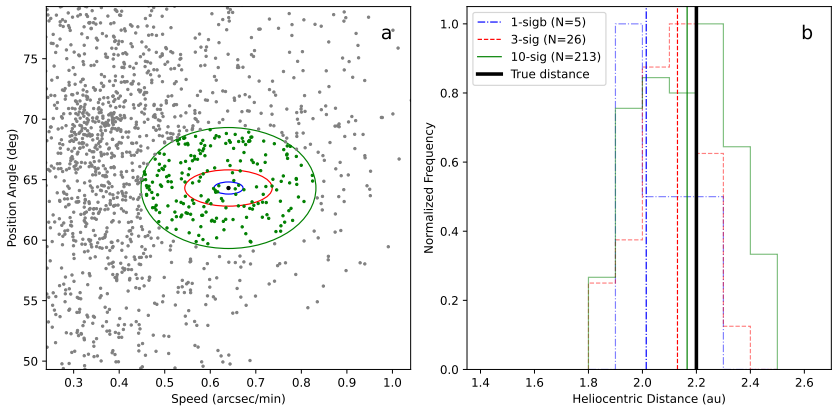
The central machinery is synthetic tracking: a blind 'shift-and-stack' search over many velocity vectors that co-adds exposures to reveal moving objects too faint for single frames. Distances are then assigned by a population-based method that compares each unknown asteroid's speed and position angle with known asteroids predicted near the pointing, yielding observer-target distances with typical uncertainties of 0.2-0.3 au. Sizes come from the Near-Earth Asteroid Thermal Model (NEATM), a standard radiometric model treating asteroids as non-rotating smooth spheres in instantaneous thermal equilibrium, with the infrared beaming parameter $\eta$ set by a published phase-angle relation. The paper also uses Monte Carlo resampling of diameter uncertainties to debias the size-frequency distribution and to map apparent slopes onto true slopes.
What would settle it
Recover orbits or obtain a second MIRI thermal band for the same 139 objects: if the fast-rotating thermal model is correct, a 1 microjansky source at 2.75 au from the Sun is about 55 m across rather than the 32 m of the standard model, moving the ~100 m break and changing the reported slopes.
Extended reading notes
Core claim
The paper claims the first direct detections of decameter-scale main-belt asteroids, enabled by synthetic tracking of undithered JWST/MIRI exposures at 15 microns. Despite observing arcs of only 30 minutes to 8 hours, the authors constrain observer-target distances by using the speed and position angle of each unknown object relative to ensembles of known asteroids near the field, then convert 15-micron fluxes into diameters with a standard radiometric model. The resulting debiased cumulative size-frequency distribution, $N(>D)=C D^q$, has a break near $\sim 100$ m: reported slopes are roughly $q \approx -2.25$ to $-2.66$ below 100 m and $q \approx -0.97$ to $-0.98$ above it. They interpret the steep sub-100 m branch as the signature of collisional fragmentation in the strength regime, and associate the sampled objects with the Nysa, Polana, and Massalia families. The paper further argues that JWST long stares near the ecliptic will serendipitously detect thousands of decameter asteroids and probe meteorite source regions directly.
Load-bearing premise
The sizes rest on a thermal model calibrated mainly for larger asteroids; if tens-of-meter bodies rotate fast or have different infrared beaming, the same measured flux yields diameters up to roughly 50% larger, which would shift the break and slopes.
Editorial extensions
If this is right
- If the debiased slope below 100 m is as steep as reported, the main belt contains far more tens-of-meter bodies than earlier extrapolations suggested, implying a higher decameter impactor flux into near-Earth space.
- The break near 100 m matches the size where asteroids are thought to be weakest, supporting the idea that this population is shaped by a collisional cascade rather than by primordial formation.
- The sampled objects are consistent with the Nysa, Polana, and Massalia families; if confirmed, JWST can directly probe the family source regions of meteorite samples.
- With roughly 500 hours of planned MIRI stares at exoplanet host stars, many within 20 degrees of the ecliptic, JWST should detect hundreds to thousands of additional decameter asteroids.
- JWST infrared rotation curves of roughly 300 m and larger asteroids can constrain family history, rotationally evolved structures, and interior properties during close encounters.
Reading between the lines
- If decameter asteroids rotate as fast as small-body surveys suggest, the fast-rotating thermal model would make the true diameters systematically larger than the paper's default NEATM values, possibly shifting the 100 m break upward and steepening the sub-100 m slope.
- The near-ecliptic pointing geometry preferentially sampled low-inclination families, so the claimed family associations and the derived size-frequency distribution may not represent the full main-belt population away from the ecliptic.
- Multi-visit JWST observations or ground-based recovery of the same objects could turn the population-based distance estimates into real orbits, providing a direct test of the method on objects as small as tens of meters.
- Running the same synthetic-tracking search on other undithered MIRI long stares, including archival exoplanet observations, would test the paper's prediction of thousands of serendipitous decameter detections.
Editorial analysis
A structured set of objections, weighed in public.
Referee Report
Summary. The paper reports the serendipitous detection of 139 previously unknown main-belt asteroids (with 8 known asteroids also recovered) in long-stare JWST/MIRI 15 micron observations of TRAPPIST-1, using GPU-based synthetic tracking. For the unknown objects, distances are assigned through a population-based prior using known asteroids in the same speed/position-angle space, and sizes are derived with the NEATM radiometric model. The debiased size-frequency distribution is claimed to exhibit a break near 100 m, with steep cumulative slopes at smaller sizes and shallow slopes at larger sizes, and the authors interpret this as evidence of a collisionally evolved population and link the detections to the Nysa, Polana, and Massalia families.
Significance. If correct, this is the first direct observational census of decameter main-belt asteroids, a size range that has been essentially unconstrained by previous surveys and that is critical for understanding the collisional cascade, meteorite delivery, and the impact hazard from decameter NEOs. The paper's methodology is a strength: the detections are supported by injection-recovery tests with a reported completeness threshold at about 0.5 microJy, the photometry is calibrated against the stable TRAPPIST-1 flux, and the uncertainty propagation to the SFD uses Monte Carlo methods rather than a single best-fit curve. The population-based distance estimation is validated in a blind test on eight known asteroids, and the authors explicitly discuss the information content and sampling biases of their SFD. However, the quantitative conclusions—the location of the break and the debiased slopes—are not yet robust because the dominant thermal-model systematic at decameter sizes is not propagated into the SFD, and because the reported slope values are internally inconsistent across the abstract, main text, and figure captions.
major comments (3)
- [Methods, 'Size and albedo determination'] The paper states that for very small asteroids the NEATM model is 'not well tested' and that a Fast-Rotating Model (FRM) is more appropriate for small, rapidly rotating objects, yet the size ranges derived in steps 1–4 of the unknown-object procedure vary only albedo and the beaming parameter eta by ±10%, not the choice of thermal model. The text quotes that for a 1 microJy source at 2.75 au, NEATM gives D = 32 m while FRM gives D = 55 m, a ~70% difference, and states that differences remain below 50% at the smaller heliocentric distances typical of the faintest detections. Because FRM sizes are systematically larger, the diameter scale, the position of the claimed ~100 m break, and both debiased slopes would shift if the FRM alternative (or any intermediate model) were adopted. This systematic must be propagated into the SFD or defended with a reason why NEATM is the correct choice at decameter sizes.
- [Abstract, main text, and Fig. 3 caption] The reported cumulative slopes for the size-frequency distribution are mutually inconsistent. The abstract gives q = -2.66 +/- 0.60 for diameters below ~100 m and q = -0.97 +/- 0.14 above; the main text (paragraph after Fig. 4) gives q = -2.25 +/- 0.07 and q = -0.98 +/- 0.14; and the Fig. 3 caption gives q = -2.25 +/- 0.14 and q = -0.98 +/- 0.07. Additionally, the information-content section states that the observed slopes q = -1.45 and q = -0.85 correspond to true slopes q >= -2.2 and q >= -0.95, which is not numerically consistent with any of the quoted pairs. These inconsistencies must be resolved and the final quoted values stated unambiguously before the quantitative SFD claim can be assessed.
- [Methods, 'On the information content and sensitivity of the size-frequency distribution'] The debiasing step relies on a mapping between apparent and true SFD slopes that depends on the assumed relative size uncertainty sigma_D/D, shown as a dashed line in Extended Data Fig. 10b, but the text does not state the numerical value of sigma_D/D adopted for the unknown asteroids. The sentence 'somewhat consistent with our JWST observations' is not a quantitative justification, and the resulting debiased slopes are central to the paper's headline claim. The authors should specify the actual distribution of sigma_D/D for the 139 detections and show how the inferred true slopes and their uncertainties respond to a conservative range of sigma_D/D values, including the larger size uncertainties that would result from the FRM thermal model.
minor comments (5)
- [Abstract] The abstract reports '138 detections' while the main text and figure captions consistently report 139 detections; this number should be corrected in the abstract.
- [Figure 13 and Figure 14 captions] The captions contain the typo 'Overiew' instead of 'Overview'.
- [Methods, 'Orbit estimations'] The text refers to 'Fg. 5' instead of 'Fig. 5'.
- [Extended Data Figure 10 caption] The caption uses the label 'c' twice for the third and fourth panels; the fourth panel should be labeled 'd'.
- [Extended Data Figure 5] The axis label and legend use '1-sig' and '3-sig' instead of the standard '1-sigma' and '3-sigma'; this is a cosmetic issue but should be made consistent.
Circularity Check
No significant circularity: the SFD break and slopes are derived from measured fluxes through a transparent radiometric chain; self-citations are not load-bearing.
full rationale
The central derivation chain is self-contained against external benchmarks: JWST/MIRI images are searched with synthetic tracking, whose completeness is independently characterized by injection-recovery tests; fluxes are calibrated against TRAPPIST-1's known F1500W flux; distances are inferred from ensembles of known asteroids and validated by recovering the distances of eight known asteroids; sizes are then obtained via NEATM radiometry. The debiased size-frequency distribution is produced by propagating the measured size uncertainties through Monte Carlo simulations and by forward-modeling the mapping between apparent and true power-law slopes, rather than by fitting the target slopes as inputs. The break near 100 m appears in the observed (non-debiased) SFD and is not imposed by the debiasing procedure. The paper explicitly acknowledges that NEATM is not well tested at decameter sizes and that fast-rotating models give larger sizes; this is a model-uncertainty / correctness risk, not circularity, because the claimed slopes are not defined in terms of the model choice. Self-citations to the authors' synthetic tracking framework and to submitted family-collision models are used as tools or interpretive context; the quantitative SFD result does not reduce to these citations. The inconsistent slope values between the abstract, main text, and figure captions are an internal-consistency issue, not evidence of circularity. Overall, no step in the derivation is equivalent by construction to its own input, so the circularity score is low.
Assumptions & free parameters
free parameters (1)
- Speed/PA ellipse widths for distance priors =
1-sigma widths of 5% in speed and 0.5 deg in PA; 3-sigma and 10-sigma ellipses scale these by 3 and 10
assumptions (5)
- domain assumption NEATM thermal model applies to decameter main-belt asteroids, with emissivity fixed at 0.9 and beaming parameter taken from a literature relation.
- domain assumption Distances to unknown asteroids can be estimated from ensembles of known asteroids with similar speed and position angle within a 6 by 2 degree area around TRAPPIST-1.
- domain assumption The eta(alpha) beaming relation from Aligo-Lagoa et al. 2018, based on more than 5000 asteroids observed at 9 and 18 microns, applies to single-band MIRI F1500W observations at 15 microns.
- domain assumption Injection-recovery completeness measured for position angles 70 to 80 degrees and speeds 0.2 to 0.3 arcsec/min represents completeness over the full search space.
- domain assumption The SFD debiasing mapping from apparent slope to true slope is valid under Gaussian diameter uncertainties with sigma proportional to D and a sample size of about 150.
Cite this review
Pith. "Pith review of JWST sighting of decameter main-belt asteroids and view on meteorite sources." pith.science (2026). https://pith.science/paper/KBQC7KKQ
@misc{pith2026250201744,
  author       = {Pith},
  title        = {Pith review of: JWST sighting of decameter main-belt asteroids and view on meteorite sources},
  year         = {2026},
  howpublished = {\url{https://pith.science/paper/KBQC7KKQ}},
  note         = {Machine review of arXiv:2502.01744}
}
abstract
Asteroid discoveries are essential for planetary-defense efforts aiming to prevent impacts with Earth, including the more frequent megaton explosions from decameter impactors. While large asteroids ($\geq$100 km) have remained in the main belt since their formation, small asteroids are commonly transported to the near-Earth object (NEO) population. However, due to the lack of direct observational constraints, their size-frequency distribution--which informs our understanding of the NEOs and the delivery of meteorite samples to Earth--varies significantly among models. Here, we report 138 detections of the smallest asteroids ($\gtrapprox $10 m) ever observed in the main belt, which were enabled by JWST's infrared capabilities covering the asteroids' emission peaks and synthetic tracking techniques. Despite small orbital arcs, we constrain the objects' distances and phase angles using known asteroids as proxies, allowing us to derive sizes via radiometric techniques. Their size-frequency distribution exhibits a break at ${\sim}100$ m (debiased cumulative slopes of $q = -2.66\pm0.60$ and $-0.97\pm0.14$ for diameters smaller and larger than $\sim $100 m, respectively), suggestive of a population driven by collisional cascade. These asteroids were sampled from multiple asteroid families--most likely Nysa, Polana and Massalia--according to the geometry of pointings considered here. Through additional long-stare infrared observations, JWST is poised to serendipitously detect thousands of decameter-scale asteroids across the sky, probing individual asteroid families and the source regions of meteorites "in-situ".
Figures


Figures from the paper (12 more)




Reference graph
Works this paper leans on
-
[1]
Cheng, A. F. et al. AIDA DART asteroid deflection test: Planetary defense and science objectives. Planetary Space Science 157, 104–115 (2018)
work page 2018
-
[2]
Brown, P., Spalding, R. E., ReVelle, D. O., Tagliaferri, E. & Worden, S. P. The flux of small near-Earth objects colliding with the Earth. Nature 420, 294–296 (2002)
work page 2002
-
[3]
Chyba, C. F., Thomas, P. J. & Zahnle, K. J. The 1908 Tunguska explosion: atmospheric disruption of a stony asteroid. Nature 361, 40–44 (1993)
work page 1993
-
[4]
Chao, E. C. T., Shoemaker, E. M. & Madsen, B. M. First Natural Occurrence of Coesite. Science 132, 220–222 (1960)
work page 1960
-
[5]
St ¨offler, D., Artemieva, N. A. & Pierazzo, E. Modeling the Ries-Steinheim impact event and the formation of the moldavite strewn field.Meteor. Planet. Sci.37, 1893–1907 (2002)
work page 2002
-
[6]
Near-Earth asteroid 2012 TC4 observing campaign: Results from a global planetary defense exercise
Reddy, V .et al. Near-Earth asteroid 2012 TC4 observing campaign: Results from a global planetary defense exercise. Icarus 326, 133–150 (2019)
work page 2019
-
[7]
Bottke, W. F. et al. The fossilized size distribution of the main asteroid belt. Icarus 175, 111–140 (2005)
work page 2005
-
[8]
Farinella, P., V okrouhlick ´y, D. & Hartmann, W. K. Meteorite Delivery via Yarkovsky Orbital Drift. Icarus 132, 378–387 (1998). 44
work page 1998
Show all 71 references
-
[9]
Chesley, S. R. et al. Direct Detection of the Yarkovsky Effect by Radar Ranging to Asteroid 6489 Golevka. Science 302, 1739–1742 (2003)
2003
-
[10]
Brown, P. G. et al. A 500-kiloton airburst over Chelyabinsk and an enhanced hazard from small impactors. Nature 503, 238–241 (2013)
2013
-
[11]
Harris, A. W. & Chodas, P. W. The population of near-earth asteroids revisited and updated. Icarus 365, 114452 (2021)
2021
-
[12]
Nesvorn ´y, D. et al. NEOMOD 2: An updated model of Near-Earth Objects from a decade of Catalina Sky Survey observations. Icarus 411, 115922 (2024). 2312.09406
2024 arXiv
-
[13]
Bro ˇz, M. et al. Young asteroid families as the primary source of meteorites.Nature, submit. (2024). 2403.08552
2024 arXiv
-
[14]
Marsset, M. et al. The Massalia asteroid family as the origin of ordinary L chondrites. Nature, submit. (2024). 2403.08548
2024 arXiv
-
[15]
M ¨uller, T. G. et al. Asteroids seen by JWST-MIRI: Radiometric size, distance, and orbit constraints. Astron. Astrophys. 670, A53 (2023). 2302.06921
2023 arXiv
-
[16]
& Hut, P
Tyson, J., Guhathakurta, P., Bernstein, G. & Hut, P. Limits on the surface density of faint kuiper belt objects. In American Astronomical Society Meeting Abstracts, vol. 181, 06–10 (1992). 45
1992
-
[17]
Shao, M. et al. Finding very small near-earth asteroids using synthetic tracking. Astrophys. J. 782, 1 (2014)
2014
-
[18]
Y ., Hasler, S
Burdanov, A. Y ., Hasler, S. N. & de Wit, J. GPU-based framework for detecting small Solar system bodies in targeted exoplanet surveys. Mon. Not. R. Astron. Soc. 521, 4568– 4578 (2023). 2303.07293
2023 arXiv
-
[19]
& Carruba, V
Nesvorn ´y, D., Broˇz, M. & Carruba, V . Identification and Dynamical Properties of Asteroid Families. In Michel, P., DeMeo, F. E. & Bottke, W. F. (eds.) Asteroids IV, 297–321 (Univ. Arizona Press, 2015)
2015
-
[20]
& Kavelaars, J
Gladman, B. & Kavelaars, J. J. Kuiper Belt searches from the Palomar 5-m telescope. Astron. Astrophys. 317, L35–L38 (1997). astro-ph/9610150
1997 arXiv
-
[21]
Bernstein, G. M. et al. The Size Distribution of Trans-Neptunian Bodies. Astron. J. 128, 1364–1390 (2004). astro-ph/0308467
2004 arXiv
-
[22]
Zhai, C. et al. Detection of a Faint Fast-moving Near-Earth Asteroid Using the Synthetic Tracking Technique. Astrophys. J. 792, 60 (2014). 1403.4353
2014 arXiv
-
[23]
N., Metchev, S
Heinze, A. N., Metchev, S. & Trollo, J. Digital Tracking Observations Can Discover Asteroids 10 Times Fainter Than Conventional Searches. Astron. J. 150, 125 (2015). 1508.01599
2015 arXiv
-
[24]
Hasler, S. N. et al. Small body harvest with the Antarctic Search for Transiting Exoplanets (ASTEP) project. Mon. Not. R. Astron. Soc. 526, 3601–3609 (2023). 2309.14180. 46
2023 arXiv
-
[25]
Rieke, G. H. et al. The Mid-Infrared Instrument for the James Webb Space Telescope, VII: The MIRI Detectors. Publ. Astron. Soc. Pacific127, 665 (2015). 1508.02362
2015 arXiv
-
[26]
Dohnanyi, J. S. Collisional Model of Asteroids and Their Debris. Journal of Geophysics Research 74, 2531–2554 (1969)
1969
-
[27]
& Asphaug, E
Benz, W. & Asphaug, E. Catastrophic Disruptions Revisited. Icarus 142, 5–20 (1999). arXiv:astro-ph/9907117
1999 arXiv
-
[28]
Bro ˇz, M. et al. Source regions of carbonaceous meteorites and NEOs. Astron. Astrophys., submit. (2024)
2024
-
[29]
Gladman, B. J. et al. On the asteroid belt’s orbital and size distribution. Icarus 202, 104– 118 (2009)
2009
-
[30]
Ryan, E. L. et al. The kilometer-sized Main Belt asteroid population revealed by Spitzer. Astron. Astrophys. 578, A42 (2015)
2015
-
[31]
Garc ´ıa-Mart´ın, P. et al. Hubble Asteroid Hunter. III. Physical properties of newly found asteroids. Astron. Astrophys. 683, A122 (2024). 2401.02605
2024 arXiv
-
[32]
Redfield, S. et al. Report of the Working Group on Strategic Exoplanet Initiatives with HST and JWST. arXiv e-prints arXiv:2404.02932 (2024). 2404.02932
2024 arXiv
-
[34]
Zieba, S. et al. No thick carbon dioxide atmosphere on the rocky exoplanet TRAPPIST-1 c. Nature 620, 746–749 (2023). 2306.10150
2023 arXiv
-
[35]
R., Paolicchi, P., Cellino, A
Farinella, P., Davis, D. R., Paolicchi, P., Cellino, A. & Zappala, V . Asteroid collisional evo- lution - an integrated model for the evolution of asteroid rotation rates. Astron. Astrophys. 253, 604–614 (1992)
1992
-
[36]
Bottke, J., William F., V okrouhlick´y, D., Rubincam, D. P. & Nesvorn´y, D. The Yarkovsky and Yorp Effects: Implications for Asteroid Dynamics. Annual Review of Earth and Plan- etary Sciences 34, 157–191 (2006)
2006
-
[37]
Carruba, V . et al. The population of rotational fission clusters inside asteroid collisional families. Nature Astronomy 4, 83–88 (2020)
2020
-
[38]
Spin axes and shape models of asteroid pairs: Fingerprints of YORP and a path to the density of rubble piles
Polishook, D. Spin axes and shape models of asteroid pairs: Fingerprints of YORP and a path to the density of rubble piles. Icarus 241, 79–96 (2014). 1406.3359
2014 arXiv
-
[39]
Dinsmore, J. T. & de Wit, J. Constraining the interiors of asteroids through close encoun- ters. Mon. Not. R. Astron. Soc. 520, 3459–3475 (2023). 2210.10754
2023 arXiv
-
[40]
LSST Science Book, Version 2.0
LSST Science Collaboration et al. LSST Science Book, Version 2.0. arXiv e-prints arXiv:0912.0201 (2009). 0912.0201
2009 arXiv
-
[41]
W., Alvarez, W., Asaro, F
Alvarez, L. W., Alvarez, W., Asaro, F. & Michel, H. V . Extraterrestrial Cause for the Cretaceous-Tertiary Extinction. Science 208, 1095–1108 (1980). 48
1980
-
[42]
& Ulam, S
Metropolis, N. & Ulam, S. The monte carlo method. Journal of the American Statistical As- sociation 44, 335–341 (1949). URL http://www.jstor.org/stable/2280232
1949
-
[43]
Harris, C. R. et al. Array programming with NumPy. Nature 585, 357–362 (2020). URL https://doi.org/10.1038/s41586-020-2649-2
2020 doi
-
[44]
Hunter, J. D. Matplotlib: A 2d graphics environment. Computing in Science & Engineering 9, 90–95 (2007)
2007
-
[45]
Astropy: A community Python package for astronomy.Astron
Astropy Collaboration et al. Astropy: A community Python package for astronomy.Astron. Astrophys. 558, A33 (2013). 1307.6212
2013 arXiv
-
[46]
The Astropy Project: Building an Open-science Project and Status of the v2.0 Core Package
Astropy Collaboration et al. The Astropy Project: Building an Open-science Project and Status of the v2.0 Core Package. Astron. J. 156, 123 (2018). 1801.02634
2018 arXiv
-
[47]
Virtanen, P. et al. SciPy 1.0: Fundamental Algorithms for Scientific Computing in Python. Nature Methods 17, 261–272 (2020)
2020
-
[48]
development team, T. P. pandas-dev/pandas: Pandas (2020). URL https://doi.org/ 10.5281/zenodo.3509134
2020 doi
-
[49]
Data Structures for Statistical Computing in Python
Wes McKinney. Data Structures for Statistical Computing in Python. In St ´efan van der Walt & Jarrod Millman (eds.) Proceedings of the 9th Python in Science Conference , 56 – 61 (2010). 49
2010
-
[50]
Ginsburg, A. et al. astroquery: An Astronomical Web-querying Package in Python.Astron. J. 157, 98 (2019). 1901.04520
2019 arXiv
-
[51]
Bradley, L. et al. astropy/photutils: 1.8.0 (2023). URL https://doi.org/10.5281/ zenodo.7946442
2023
-
[52]
Tycho tracker: A new tool to facilitate the discovery and recovery of asteroids using synthetic tracking and modern gpu hardware
Parrott, D. Tycho tracker: A new tool to facilitate the discovery and recovery of asteroids using synthetic tracking and modern gpu hardware. Journal of the American Association of Variable Star Observers (JAAVSO)48, 262 (2020)
2020
-
[53]
Greene, T. P. et al. Thermal emission from the Earth-sized exoplanet TRAPPIST-1 b using JWST. Nature 618, 39–42 (2023). 2303.14849
2023 arXiv
-
[54]
Hoffmann, T. et al. Debiasing astro-photometric observations with corrections using statis- tics (dephocus). arXiv preprint arXiv:2408.07474(2024). URL https://arxiv.org/ abs/2408.07474. 2408.07474
2024 arXiv
-
[55]
Harris, A. W. A Thermal Model for Near-Earth Asteroids. Icarus 131, 291–301 (1998)
1998
-
[56]
Masiero, J. R. et al. Main Belt Asteroids with WISE/NEOWISE. I. Preliminary Albedos and Diameters. Astrophys. J. 741, 68 (2011). 1109.4096
2011 arXiv
-
[57]
& Delbo’, M
Al ´ı-Lagoa, V . & Delbo’, M. Sizes and albedos of Mars-crossing asteroids from WISE/NEOWISE data. Astron. Astrophys. 603, A55 (2017). 1705.10263. 50
2017 arXiv
-
[58]
G., Usui, F
Al ´ı-Lagoa, V ., M¨uller, T. G., Usui, F. & Hasegawa, S. The AKARI IRC asteroid flux catalogue: updated diameters and albedos. Astron. Astrophys. 612, A85 (2018). 1712. 07496
2018
-
[59]
D., Green, S
Wolters, S. D., Green, S. F., McBride, N. & Davies, J. K. Thermal infrared and optical observations of four near-Earth asteroids. Icarus 193, 535–552 (2008)
2008
-
[60]
Mainzer, A. et al. NEOWISE Observations of Near-Earth Objects: Preliminary Results. Astrophys. J. 743, 156 (2011). 1109.6400
2011 arXiv
-
[61]
Grav, T. et al. WISE/NEOWISE Observations of the Hilda Population: Preliminary Re- sults. Astrophys. J. 744, 197 (2012). 1110.0283
2012 arXiv
-
[62]
TNOs are Cool
Vilenius, E. et al. “TNOs are Cool”: A survey of the trans-Neptunian region. VI. Her- schel/PACS observations and thermal modeling of 19 classical Kuiper belt objects.Astron. Astrophys. 541, A94 (2012). 1204.0697
2012 arXiv
-
[63]
& Harris, A
Pravec, P. & Harris, A. W. Fast and Slow Rotation of Asteroids. Icarus 148, 12–20 (2000)
2000
-
[64]
Lebofsky, L. A. & Spencer, J. R. Radiometry and thermal modeling of asteroids. In Binzel, R. P., Gehrels, T. & Matthews, M. S. (eds.)Asteroids II, 128–147 (1989)
1989
-
[65]
Harris, A. W. & Lagerros, J. S. V . Asteroids in the Thermal Infrared. In Asteroids III, 205–218 (2002). 51
2002
-
[66]
DeMeo, F. E. & Carry, B. Solar System evolution from compositional mapping of the asteroid belt. Nature 505, 629–634 (2014). 1408.2787
2014 arXiv
-
[67]
Burdanov, A. Y . et al. SPECULOOS Northern Observatory: Searching for Red Worlds in the Northern Skies. Publ. Astron. Soc. Pacific134, 105001 (2022). 2209.09112
2022 arXiv
-
[68]
Delrez, L. et al. SPECULOOS: a network of robotic telescopes to hunt for terrestrial planets around the nearest ultracool dwarfs. In Marshall, H. K. & Spyromilio, J. (eds.) Ground- based and Airborne Telescopes VII, vol. 10700 ofSociety of Photo-Optical Instrumentation Enginee...
2018 arXiv
-
[69]
Jehin, E. et al. Trappist: Transiting planets and planetesimals small telescope. The Mes- senger 145, 2–6 (2011)
2011
-
[70]
PHOTOMETRYPIPELINE: An automated pipeline for calibrated photom- etry
Mommert, M. PHOTOMETRYPIPELINE: An automated pipeline for calibrated photom- etry. Astronomy and Computing 18, 47–53 (2017). 1702.00834
2017 arXiv
-
[71]
Levine, S. E. et al. Status and performance of the Discovery Channel Telescope during commissioning. In Stepp, L. M., Gilmozzi, R. & Hall, H. J. (eds.) Ground-based and Airborne Telescopes IV, vol. 8444 of Society of Photo-Optical Instrumentation Engineers (SPIE) Conference Se...
2012
-
[72]
Christensen, E. J. et al. Status of the Catalina Sky Survey. In LPI Contributions, vol. 2851 of LPI Contributions, 2587 (2023). 52
2023
Reviewed August 9, 2026 · model on record in the stance chip above.
Discussion (0). Continue with ORCID to comment.