REVIEW 3 major objections 7 minor 1 cited by
$Lux$: A generative, multi-output, latent-variable model for astronomical data with noisy labels
T0 review · 3 major / 7 minor · reviewed 2026-08-09 · deepseek-v4-flash
Pith's one-line read Lux, a generative latent-variable model, treats stellar labels and spectra as two views of one shared latent vector, and the paper shows that a linear realization matches ASPCAP precision and transfers GALAH abundances to APOGEE stars.
desk verdict A useful linear generative model for spectra and labels, honestly validated in-survey; the cross-survey transfer for line-free elements is correlation-based, and the paper needs a baseline comparison and code. read the letter →
The pith
A machine-rendered reading of the paper's core claim, the machinery that carries it, and where it could break.
The reading
What carries the argument
The central mechanism is a multi-output linear latent-variable decoder: one latent vector $z_n$ per star is projected to labels by $\ell_n = A\,z_n$ and to fluxes by $f_n = B\,z_n$, with Gaussian noise of reported variances on both outputs, plus a learned per-pixel scatter term $s$ on the fluxes. The model maximizes the product of the per-star Gaussian likelihoods over $A$, $B$, the latent vectors, and $s$, with L2 regularization on the latents. Because the same latent vector feeds both decoders, the full spectrum constrains every label, missing labels can be handled by inflating their variances to large values, and a survey-to-survey transfer is trained by pairing spectra from one survey with labels from another on cross-matched stars.
What would settle it
Train Lux on the APOGEE-GALAH overlap sample, then apply it to a set of APOGEE giants with independently measured $[\mathrm{Eu/Fe}]$ from high-resolution optical spectra (e.g., r-process-enhanced stars) and compare the Lux-predicted values to those direct measurements; if Lux fails to track the independent values, the correlation-based transfer is falsified, and if it tracks them, the transfer is at least partly causal.
Extended reading notes
Core claim
The paper claims that a single shared latent vector per star, projected linearly onto both the label space (through the matrix $A$) and the spectral-flux space (through the matrix $B$), is sufficient for data-driven stellar label inference. Lux places the reported label values and their uncertainties directly into a Gaussian likelihood, so the objective is the joint probability of labels and fluxes; missing labels are entered with a very large variance so they are effectively ignored during training. A trained model reads a new spectrum by optimizing that star's latent vector against the fixed $B$ matrix and then maps the latent vector through $A$ to obtain labels. In held-out APOGEE red-giant tests this recovers ASPCAP labels with biases smaller than the reported ASPCAP uncertainties and RMSE values comparable to those uncertainties; the same procedure, trained on APOGEE spectra paired with GALAH labels for 4,000 overlapping giants, predicts GALAH abundances for the APOGEE-only test giants. The paper flags that for elements without detectable lines in the APOGEE passband (e.g., $[\mathrm{Eu/Fe}]$, $[\mathrm{Li/Fe}]$), the transferred values are likely inherited from label-label correlations rather than from spectral-feature causality.
Load-bearing premise
That a single linear mapping from a shared latent vector, with Gaussian noise, captures the relationship between spectra and labels across stellar types and between surveys.
Editorial extensions
If this is right
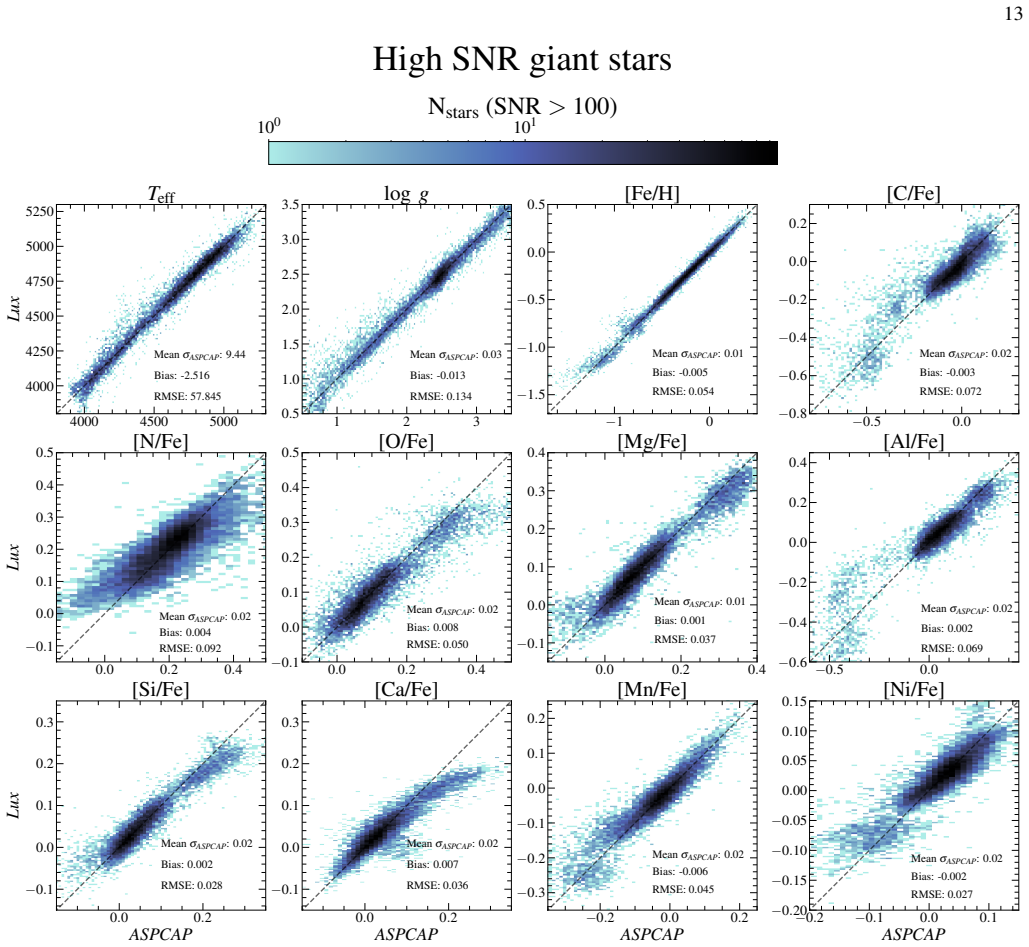
- Lux can emulate a physics-based label pipeline (ASPCAP) on APOGEE spectra with biases smaller than the reported label uncertainties and RMSE comparable to those uncertainties, across red giants, lower-SNR spectra, and open-cluster benchmark stars.
- A linear Lux model trained on cross-matched APOGEE spectra and GALAH labels predicts GALAH abundances for APOGEE-only giants, including elements like [Eu/Fe], [Y/Fe], and [Li/Fe] that are not directly measurable from APOGEE spectra alone.
- Because the likelihood folds in label uncertainties and inflated variances for missing labels, Lux can train on partial label sets and still produce labels for stars lacking a measurement, e.g., stars with no GALAH [Li/Fe] measurement receive a median-imputed value rather than failing.
- Lux is fast enough for large surveys: training on 5,000 stars takes about 30 minutes on one CPU and testing on 10,000 stars about 20 minutes, making it practical for emulating pipelines on millions of spectra.
- The framework is extensible in principle to additional outputs (e.g., photometry, astrometry, kinematics) and to nonlinear decoders, though the paper only demonstrates the linear version.
Reading between the lines
- If the linear shared-latent assumption holds, Lux's transferred abundances for elements without detectable lines (e.g., [Eu/Fe]) are only as trustworthy as the stability of the label-label correlations in the training set; applying it to chemically unusual populations (e.g., r-process-enhanced stars) would test whether those correlations hold.
- The same machinery could be pointed the other way: train on GALAH spectra with APOGEE labels to transfer APOGEE-quality labels to GALAH targets, or add Gaia photometry as an extra output block to infer distances and extinctions.
- A direct spectral-fidelity test comparing visible weak lines of a transferred element in the best-fit spectrum would separate causal line-driven transfer from correlation-driven transfer, a distinction the paper explicitly leaves open.
- The near-unity reduced chi-squared on held-out spectra suggests the Gaussian-noise model with per-pixel scatter captures the dominant variance; extending Lux to non-Gaussian noise or nonlinear decoders might be required when moving to surveys with different systematics.
Editorial analysis
A structured set of objections, weighed in public.
Referee Report
Summary. This paper presents Lux, a generative multi-output latent-variable model that links stellar spectra and stellar labels through a shared latent vector z with linear transformations A and B (Eqs. 1-2). The Gaussian likelihood (Eqs. 3-6) includes label and flux uncertainties and an extra per-pixel scatter term; the parameters are fit by maximizing the penalized likelihood (Eq. 7) with a two-part block-coordinate schedule (Section 4.2) and hyperparameters (latent dimensionality P, regularization strength Omega) chosen by K-fold cross-validation (Appendix A). The authors demonstrate emulation of ASPCAP labels from APOGEE spectra for high- and low-SNR RGB stars, open cluster members, and mixed stellar types (Section 4), and label transfer from GALAH to APOGEE including elements without strong APOGEE spectral features (Section 5), with additional tests on synthetic Korg spectra (Appendix C) and latent-space visualization (Appendix D).
Significance. If the reported results hold, Lux is a useful addition to the data-driven stellar spectroscopy toolbox: the likelihood formulation explicitly incorporates label and flux uncertainties plus missing data (Eqs. 3-6), the implementation is clearly specified, and the held-out validations span SNR regimes, open clusters, mixed stellar types, and a cross-survey transfer, each with reported RMSE and bias statistics. The in-survey emulation results in Section 4 are credible and do not depend on the transfer caveats. The paper also provides a K-fold procedure for setting the latent dimensionality and regularization strength, and an explicit statement of the correlation-versus-causation limitation for line-free elements. However, the lack of a quantitative baseline comparison and the overstatement of the transfer and RMSE results currently temper the strength of the claims.
major comments (3)
- [Section 5, Figure 17] The headline claim that Lux is successful at performing label transfer between APOGEE and GALAH is not established for elements without spectral features in the APOGEE band, for which the paper itself provides the caveat that predictions may be based on correlation rather than causation. The held-out test (samples G and H, Section 2.2) draws from the same APOGEE-GALAH cross-match as the training set, so the validation only demonstrates interpolation within the label-correlation structure of that single parent sample. For [Li/Fe], [Y/Fe], and [Eu/Fe], the APOGEE wavelength region has no known features, and the Figure 17 RMSE values are several times the reported GALAH uncertainties (e.g., [Li/Fe] RMSE 0.404 vs mean sigma_GALAH 0.08 dex; [Y/Fe] 0.201 vs 0.11 dex). To support the transfer claim, the authors should either validate on a population-disjoint held-out set (e.g., metallicity- or age-disjoint) demonstrating that the learned correlations generalize, or qualify the abstract and conclusions to present these as correlation-based estimates that require follow-up. As written, the abstract's unqualified claim of successful label transfer overstates what is demonstrated.
- [Sections 1, 4.5, and 7] The paper motivates Lux by limitations of existing data-driven methods (The Cannon, The Payne), asserting that prior models assume labels are ground truth and can lead to biases, but it provides no quantitative comparison against either method on the same training and test data. The only side-by-side is the qualitative inspection in Figure 8, and the statements that Lux labels appear tighter and show less scatter are not supported by measured metrics. Since the central novelty claim is that Lux properly accounts for uncertainties and missing data, a benchmark against The Cannon (and ideally The Payne) on identical splits would substantiate the claimed improvements and is standard for a methods paper of this kind.
- [Section 4.5, Figure 7] The text and the Figure 7 caption state that for most labels the RMSE is comparable to the average ASPCAP uncertainty, but the numbers in the figure contradict this for several important labels: Teff RMSE is 57.8 K versus mean sigma_ASPCAP of 9.44 K, log g RMSE 0.134 versus 0.03, [Fe/H] 0.054 versus 0.01, and [N/Fe] 0.092 versus 0.02. Only a few labels (e.g., [Si/Fe], [Ni/Fe]) lie within roughly a factor of two of the reported uncertainty. The text and caption should report the RMSE-to-uncertainty ratios accurately or reframe the claim in terms of absolute precision rather than comparability to ASPCAP uncertainties.
minor comments (7)
- [Section 4.3, Eq. (10)] The test-step objective in Eq. (10) optimizes z using only the flux likelihood and applies no L2 penalty, while the training objective in Eq. (7) applies a sizable penalty (Omega = 10^3); the authors should state whether this asymmetry is intentional and confirm that the reported precision estimates are robust to including the penalty in the test step.
- [Figure 3 caption] The caption contains a typo (high-SNR fiend RGB-test) that should be corrected, and the text label Spectra for giant stars appears to be a figure title rather than part of the caption.
- [Appendix C, Figure 18] The Korg spectra are attributed to Wheeler et al. (2022) in the Appendix C text and Figure 18 caption but to Wheeler et al. (2023) in Section 1; the citations should be reconciled.
- [Section 4.6, Figure 10] The precision values in Figure 10 measure only the conditional label uncertainty under the fitted model (from flux realizations) and do not include model mis-specification or parameter uncertainty; the text should state this limitation when summarizing the precision claims.
- [Section 7] No code availability statement or repository link is provided; a public release of the Lux code would materially aid reproducibility of the optimization schedule and hyperparameter choices.
- [Section 3.1] The model assumes Gaussian label noise with variances taken from the catalogs; since underestimated label uncertainties could bias the joint likelihood, the authors should briefly report the experiment they mention in Section 3.1 in which per-label scatter terms were found to be unnecessary.
- [Section 4.5] Because Lux is trained to reproduce ASPCAP labels, the in-survey validation demonstrates fidelity as an emulator rather than astrophysical accuracy of the labels; a sentence clarifying this distinction would prevent readers from over-interpreting the agreement.
Circularity Check
Lux's held-out label predictions are genuine held-out predictions; the line-free label-transfer caveat is disclosed in the manuscript and does not reduce the central derivation to its inputs by construction.
full rationale
The derivation chain is self-contained as a supervised generative model: Lux specifies linear decoders l_n = A z_n (Eq. 1) and f_n = B z_n (Eq. 2), optimizes A, B, z, and scatter terms on a training sample, and then infers test-set latent vectors from fluxes alone via Eq. 10 before projecting through the trained A. Training and test stars are disjoint by the sample definitions in Section 2.2, so the ASPCAP emulation results (Figures 7, 9, 11, 12) are genuine held-out predictions, not fits to the test labels. The validation against ASPCAP is self-referential only in the intended sense of emulation: the paper explicitly frames the agreement as 'the Lux model is emulating the ASPCAP pipeline well,' not as an independent physical calibration. The APOGEE-to-GALAH label transfer for line-free elements ([Eu/Fe], [Y/Fe], [Li/Fe]) does rely on training-set label correlations, and the paper itself states: 'the prediction may be based on correlation rather than causation' and 'The model may therefore fail to correctly infer these abundances for stars with different label-correlation behaviors.' That is a disclosed extrapolation limitation, not a circular reduction: the held-out test in Figure 17 is still disjoint from training and tests interpolation within the same cross-match population. Self-citations, such as the Cannon initialization procedure (Ness et al. 2015) and cluster-removal catalog (Horta et al. 2020), are procedural and not load-bearing for the claims; no uniqueness theorem or prior result is invoked to force the model choice. No specific circular step can be exhibited from the paper's equations or argument, so the score reflects the minor self-referential validation target and the correlation caveat rather than actual circularity.
Assumptions & free parameters
free parameters (3)
- P (latent dimensionality) =
4M (M = number of labels)
- Omega (L2 regularization strength) =
10^3
- s_f (per-pixel scatter vector) =
initialized ln s = -8, then optimized in Agenda 2
assumptions (5)
- domain assumption Gaussian likelihood for labels and fluxes with known catalog variances (Eqs. 3-4).
- domain assumption Linear generative mapping from latent z to labels and fluxes (Eqs. 1-2).
- ad hoc to paper Missing labels can be imputed by median value with sigma=9999 (Section 2.1).
- ad hoc to paper L2 regularization on latent vectors z is beneficial (Eq. 7).
- domain assumption ASPCAP and GALAH catalog labels are reliable enough to serve as training targets and validation references.
Cite this review
Pith. "Pith review of $Lux$: A generative, multi-output, latent-variable model for astronomical data with noisy labels." pith.science (2026). https://pith.science/paper/EEXMOQZN
@misc{pith2026250201745,
  author       = {Pith},
  title        = {Pith review of: $Lux$: A generative, multi-output, latent-variable model for astronomical data with noisy labels},
  year         = {2026},
  howpublished = {\url{https://pith.science/paper/EEXMOQZN}},
  note         = {Machine review of arXiv:2502.01745}
}
abstract
The large volume of spectroscopic data available now and from near-future surveys will enable high-dimensional measurements of stellar parameters and properties. Current methods for determining stellar labels from spectra use physics-driven models, which are computationally expensive and have limitations in their accuracy due to simplifications. While machine learning methods provide efficient paths toward emulating physics-based pipelines, they often do not properly account for uncertainties and have complex model structure, both of which can lead to biases and inaccurate label inference. Here we present $Lux$: a data-driven framework for modeling stellar spectra and labels that addresses prior limitations. $Lux$ is a generative, multi-output, latent variable model framework built on JAX for computational efficiency and flexibility. As a generative model, $Lux$ properly accounts for uncertainties and missing data in the input stellar labels and spectral data and can either be used in probabilistic or discriminative settings. Here, we present several examples of how $Lux$ can successfully emulate methods for precise stellar label determinations for stars ranging in stellar type and signal-to-noise from the $APOGEE$ surveys. We also show how a simple $Lux$ model is successful at performing label transfer between the $APOGEE$ and $GALAH$ surveys. $Lux$ is a powerful new framework for the analysis of large-scale spectroscopic survey data. Its ability to handle uncertainties while maintaining high precision makes it particularly valuable for stellar survey label inference and cross-survey analysis, and the flexible model structure allows for easy extension to other data types.
Figures


Figures from the paper (16 more)




Forward citations
Cited by 1 Pith paper
-
From stellar light to astrophysical insight: automating variable star research with machine learning
An invited review of machine learning for automated variable star research, covering data cleaning, variability classification, stellar parameter inference, and foundation models.
Reference graph
Works this paper leans on
-
[1]
- [1] #1 = = ^ ^ ^ .\!\!^ d .\!\!^ h .\!\!^ m .\!\!^ s .\!\!^ @mss
thebibliography [1] 20pt to REFERENCES 6pt =0pt 10pt plus 3pt =0pt =0pt =1pt plus 1pt =0pt =0pt -12pt =13pt plus 1pt =20pt =13pt plus 1pt \@M =10000 =-1.0em =0pt =0pt 0pt =0pt =1.0em @enumiv\@empty 10000 10000 `\.\@m \@noitemerr \@latex@warning Empty `thebibliography' environment \@ifnextchar \@reference \@latexerr Missing key on reference command Each re...
2019
-
[2]
2022, , 259, 35, 10.3847/1538-4365/ac4414
Abdurro'uf , Accetta , K., Aerts , C., et al. 2022, , 259, 35, 10.3847/1538-4365/ac4414
-
[3]
Allende Prieto , C., Beers , T. C., Wilhelm , R., et al. 2006, , 636, 804, 10.1086/498131
doi:10.1086/498131 2006
-
[5]
2023 b , , 267, 8, 10.3847/1538-4365/acd53e
---. 2023 b , , 267, 8, 10.3847/1538-4365/acd53e
- [7]
-
[8]
Beaton , R. L., Oelkers , R. J., Hayes , C. R., et al. 2021, arXiv e-prints, arXiv:2108.11907. 2108.11907
arXiv 2021
-
[9]
Blanton , M. R., Bershady , M. A., Abolfathi , B., et al. 2017, , 154, 28, 10.3847/1538-3881/aa7567
-
[10]
2021, arXiv preprint arXiv:2105.15183
Blondel, M., Berthet, Q., Cuturi, M., et al. 2021, arXiv preprint arXiv:2105.15183
arXiv 2021
Show all 75 references
-
[11]
S., & Vaughan , A
Bowen , I. S., & Vaughan , A. H., J. 1973, , 12, 1430, 10.1364/AO.12.001430
1973 doi
-
[12]
2018, JAX : composable transformations of P ython+ N um P y programs, 0.3.13
Bradbury, J., Frostig, R., Hawkins, P., et al. 2018, JAX : composable transformations of P ython+ N um P y programs, 0.3.13. http://github.com/google/jax
2018
- [13]
-
[14]
2020, arXiv e-prints, arXiv:2011.02505
Buder , S., Sharma , S., Kos , J., et al. 2020, arXiv e-prints, arXiv:2011.02505. 2011.02505
2020 arXiv
- [15]
- [16]
-
[17]
P., Koposov, S
Cooper, A. P., Koposov, S. E., Allende Prieto, C., et al. 2023, The Astrophysical Journal, 947, 37, 10.3847/1538-4357/acb3c0
2023 doi
-
[18]
V., Hasselquist , S., et al
Cunha , K., Smith , V. V., Hasselquist , S., et al. 2017, , 844, 145, 10.3847/1538-4357/aa7beb
2017 doi
-
[19]
S., Bellido-Tirado , O., Chiappini , C., et al
de Jong , R. S., Bellido-Tirado , O., Chiappini , C., et al. 2012, in Society of Photo-Optical Instrumentation Engineers (SPIE) Conference Series, Vol. 8446, Ground-based and Airborne Instrumentation for Astronomy IV, ed. I. S. McLean , S. K. Ramsay , & H. Takami , 84460T, 10....
2012 doi
-
[20]
W., Rix , H.-W., & Ness , M
Eilers , A.-C., Hogg , D. W., Rix , H.-W., & Ness , M. K. 2019, , 871, 120, 10.3847/1538-4357/aaf648
2019 doi
-
[21]
Freeman , K. C. 2012, in Astronomical Society of the Pacific Conference Series, Vol. 458, Galactic Archaeology: Near-Field Cosmology and the Formation of the Milky Way, ed. W. Aoki , M. Ishigaki , T. Suda , T. Tsujimoto , & N. Arimoto , 393
2012
-
[22]
Gaia Collaboration , Brown , A. G. A., Vallenari , A., et al. 2020, arXiv e-prints, arXiv:2012.01533. 2012.01533
2020 arXiv
-
[23]
Gaia Collaboration , Vallenari , A., Brown , A. G. A., et al. 2023, , 674, A1, 10.1051/0004-6361/202243940
2023 doi
-
[24]
E., Allende Prieto , C., Holtzman , J
Garc \' a P \'e rez , A. E., Allende Prieto , C., Holtzman , J. A., et al. 2016, , 151, 144, 10.3847/0004-6256/151/6/144
2016 doi
-
[25]
2012, The Messenger, 147, 25
Gilmore , G., Randich , S., Asplund , M., et al. 2012, The Messenger, 147, 25
2012
-
[26]
2024, , 682, A9, 10.1051/0004-6361/202347122
Guiglion , G., Nepal , S., Chiappini , C., et al. 2024, , 682, A9, 10.1051/0004-6361/202347122
2024 doi
-
[27]
E., Siegmund , W
Gunn , J. E., Siegmund , W. A., Mannery , E. J., et al. 2006, , 131, 2332, 10.1086/500975
2006 doi
-
[28]
2008, , 486, 951, 10.1051/0004-6361:200809724
Gustafsson , B., Edvardsson , B., Eriksson , K., et al. 2008, , 486, 951, 10.1051/0004-6361:200809724
2008 doi
-
[29]
J., Davies , G
Hall , O. J., Davies , G. R., Elsworth , Y. P., et al. 2019, , 486, 3569, 10.1093/mnras/stz1092
2019 doi
-
[30]
2016, , 833, 81, 10.3847/1538-4357/833/1/81
Hasselquist , S., Shetrone , M., Cunha , K., et al. 2016, , 833, 81, 10.3847/1538-4357/833/1/81
2016 doi
-
[31]
Ho , A. Y. Q., Rix , H.-W., Ness , M. K., et al. 2017 a , , 841, 40, 10.3847/1538-4357/aa6db3
2017 doi
-
[32]
Ho , A. Y. Q., Ness , M. K., Hogg , D. W., et al. 2017 b , , 836, 5, 10.3847/1538-4357/836/1/5
2017 doi
-
[33]
W., Eilers, A.-C., & Rix, H.-W
Hogg, D. W., Eilers, A.-C., & Rix, H.-W. 2019, The Astronomical Journal, 158, 147, 10.3847/1538-3881/ab398c
2019 doi
-
[34]
P., Mackereth , J
Horta , D., Schiavon , R. P., Mackereth , J. T., et al. 2020, , 493, 3363, 10.1093/mnras/staa478
2020 doi
-
[35]
Hunter, J. D. 2007, Computing In Science & Engineering, 9, 90, 10.1109/MCSE.2007.55
2007 doi
-
[36]
C., Dalton, G
Jin, S., Trager, S. C., Dalton, G. B., et al. 2023, Monthly Notices of the Royal Astronomical Society, 530, 2688–2730, 10.1093/mnras/stad557
2023 doi
-
[37]
2014, , 564, A133, 10.1051/0004-6361/201322440
Jofr \'e , P., Heiter , U., Soubiran , C., et al. 2014, , 564, A133, 10.1051/0004-6361/201322440
2014 doi
-
[38]
2024, SpectraFM: Tuning into Stellar Foundation Models
Koblischke, N., & Bovy, J. 2024, SpectraFM: Tuning into Stellar Foundation Models. 2411.04750
2024 arXiv
- [39]
-
[40]
2013, , 146, 134, 10.1088/0004-6256/146/5/134
Kordopatis , G., Gilmore , G., Steinmetz , M., et al. 2013, , 146, 134, 10.1088/0004-6256/146/5/134
2013 doi
-
[41]
W., & Bovy, J
Leung, H. W., & Bovy, J. 2018, Monthly Notices of the Royal Astronomical Society, 10.1093/mnras/sty3217
2018 doi
-
[42]
J., Cannon , R
Lewis , I. J., Cannon , R. D., Taylor , K., et al. 2002, , 333, 279, 10.1046/j.1365-8711.2002.05333.x
2002
-
[43]
Li , J., Wong , K. W. K., Hogg , D. W., Rix , H.-W., & Chandra , V. 2024, , 272, 2, 10.3847/1538-4365/ad2b4d
2024 doi
-
[44]
R., Schiavon , R
Majewski , S. R., Schiavon , R. P., Frinchaboy , P. M., et al. 2017, , 154, 94, 10.3847/1538-3881/aa784d
2017 doi
-
[45]
K., et al
Manea , C., Hawkins , K., Ness , M. K., et al. 2024, , 972, 69, 10.3847/1538-4357/ad58d9
2024 doi
-
[46]
L., Sharma , S., Buder , S., et al
Martell , S. L., Sharma , S., Buder , S., et al. 2017, , 465, 3203, 10.1093/mnras/stw2835
2017 doi
-
[47]
A., Ness, M
McKinnon, K. A., Ness, M. K., Rockosi, C. M., & Guhathakurta, P. 2024, Data-driven Discovery of Diffuse Interstellar Bands with APOGEE Spectra. 2307.05706
2024 arXiv
-
[48]
E., et al
M \'e sz \'a ros , S., Holtzman , J., Garc \' a P \'e rez , A. E., et al. 2013, , 146, 133, 10.1088/0004-6256/146/5/133
2013 doi
-
[49]
2022, , 164, 85, 10.3847/1538-3881/ac7ce5
Myers , N., Donor , J., Spoo , T., et al. 2022, , 164, 85, 10.3847/1538-3881/ac7ce5
2022 doi
-
[50]
W., Rix , H
Ness , M., Hogg , D. W., Rix , H. W., Ho , A. Y. Q., & Zasowski , G. 2015, , 808, 16, 10.1088/0004-637X/808/1/16
2015 doi
-
[51]
W., Rix , H
Ness , M., Hogg , D. W., Rix , H. W., et al. 2016, , 823, 114, 10.3847/0004-637X/823/2/114
2016 doi
-
[52]
2016, , 152, 14, 10.3847/0004-6256/152/1/14
Ness , M., & Lang , D. 2016, , 152, 14, 10.3847/0004-6256/152/1/14
2016 doi
- [53]
-
[54]
L., Holtzman , J
Nidever , D. L., Holtzman , J. A., Allende Prieto , C., et al. 2015, , 150, 173, 10.1088/0004-6256/150/6/173
2015 doi
-
[55]
L., Hasselquist, S., Hayes, C
Nidever, D. L., Hasselquist, S., Hayes, C. R., et al. 2020, The Astrophysical Journal, 895, 88, 10.3847/1538-4357/ab7305
2020 doi
-
[56]
A., Harva , M
Nolan , L. A., Harva , M. O., Kab \'a n , A., & Raychaudhury , S. 2006, , 366, 321, 10.1111/j.1365-2966.2005.09868.x
2006
-
[57]
2006--, NumPy : A guide to NumPy , USA: Trelgol Publishing
Oliphant, T. 2006--, NumPy : A guide to NumPy , USA: Trelgol Publishing. http://www.numpy.org/
2006
-
[58]
Piskunov, N., & Valenti, J. A. 2016, Astronomy & Astrophysics, 597, A16, 10.1051/0004-6361/201629124
2016 doi
-
[59]
Price-Whelan , A. M. 2017, The Journal of Open Source Software, 2, 388, 10.21105/joss.00388
2017 doi
- [60]
-
[61]
A., Beaton , R
Santana , F. A., Beaton , R. L., Covey , K. R., et al. 2021, arXiv e-prints, arXiv:2108.11908. 2108.11908
2021
-
[62]
P., Phillips , S
Schiavon , R. P., Phillips , S. G., Myers , N., et al. 2024, , 528, 1393, 10.1093/mnras/stad3020
2024 doi
-
[63]
2015, Journal of Astronomical Telescopes, Instruments, and Systems, 1, 035002, 10.1117/1.JATIS.1.3.035002
Sheinis , A., Anguiano , B., Asplund , M., et al. 2015, Journal of Astronomical Telescopes, Instruments, and Systems, 1, 035002, 10.1117/1.JATIS.1.3.035002
2015 doi
-
[64]
V., Bizyaev , D., Cunha , K., et al
Smith , V. V., Bizyaev , D., Cunha , K., et al. 2021, , 161, 254, 10.3847/1538-3881/abefdc
2021 doi
-
[65]
2006, , 132, 1645, 10.1086/506564
Steinmetz , M., Zwitter , T., Siebert , A., et al. 2006, , 132, 1645, 10.1086/506564
2006 doi
-
[66]
2018, , 860, 159, 10.3847/1538-4357/aac6c9
Ting , Y.-S., Conroy , C., Rix , H.-W., & Asplund , M. 2018, , 860, 159, 10.3847/1538-4357/aac6c9
2018 doi
-
[67]
2019, , 879, 69, 10.3847/1538-4357/ab2331
Ting , Y.-S., Conroy , C., Rix , H.-W., & Cargile , P. 2019, , 879, 69, 10.3847/1538-4357/ab2331
2019 doi
-
[68]
H., Fragkoudi , F., & Ness , M
Wheeler , A., Abril-Cabezas , I., Trick , W. H., Fragkoudi , F., & Ness , M. 2022, , 935, 28, 10.3847/1538-4357/ac7da0
2022 doi
-
[69]
J., Abruzzo , M
Wheeler , A. J., Abruzzo , M. W., Casey , A. R., & Ness , M. K. 2023, , 165, 68, 10.3847/1538-3881/acaaad
2023 doi
-
[70]
C., Hearty , F
Wilson , J. C., Hearty , F. R., Skrutskie , M. F., et al. 2019, , 131, 055001, 10.1088/1538-3873/ab0075
2019 doi
-
[71]
2017, , 232, 2, 10.3847/1538-4365/aa80e4
Xiang , M., Liu , X., Shi , J., et al. 2017, , 232, 2, 10.3847/1538-4365/aa80e4
2017 doi
-
[72]
2019, , 245, 34, 10.3847/1538-4365/ab5364
Xiang , M., Ting , Y.-S., Rix , H.-W., et al. 2019, , 245, 34, 10.3847/1538-4365/ab5364
2019 doi
-
[73]
J., et al
Yanny , B., Rockosi , C., Newberg , H. J., et al. 2009, , 137, 4377, 10.1088/0004-6256/137/5/4377
2009 doi
-
[74]
A., Frinchaboy , P
Zasowski , G., Johnson , J. A., Frinchaboy , P. M., et al. 2013, , 146, 81, 10.1088/0004-6256/146/4/81
2013 doi
-
[75]
E., Chojnowski , S
Zasowski , G., Cohen , R. E., Chojnowski , S. D., et al. 2017, , 154, 198, 10.3847/1538-3881/aa8df9
2017 doi
-
[76]
2008, Machine Learning, 73, 221, 10.1007/s10994-008-5050-1
Zhang, J., Ghahramani, Z., & Yang, Y. 2008, Machine Learning, 73, 221, 10.1007/s10994-008-5050-1
2008 doi
-
[77]
2012, Research in Astronomy and Astrophysics, 12, 723, 10.1088/1674-4527/12/7/002
Zhao , G., Zhao , Y.-H., Chu , Y.-Q., Jing , Y.-P., & Deng , L.-C. 2012, Research in Astronomy and Astrophysics, 12, 723, 10.1088/1674-4527/12/7/002
2012 doi
Reviewed August 9, 2026 · model on record in the stance chip above.
Discussion (0). Continue with ORCID to comment.