REVIEW 4 major objections 5 minor 60 references
Density Ratio Estimation with Conditional Probability Paths
T0 review · 4 major / 5 minor · reviewed 2026-08-09 · deepseek-v4-flash
Pith's one-line read Density ratio estimation can be made faster and more accurate by learning the time score through conditional probability paths; the paper proves the conditional objective is equivalent to the original up to a constant.
desk verdict A useful DRE trick with an overreaching theory: the CTSM objective works in practice, but the stated equivalence theorem needs regularity conditions it does not have. read the letter →
The pith
A machine-rendered reading of the paper's core claim, the machinery that carries it, and where it could break.
The reading
What carries the argument
The load-bearing object is the conditioning variable $z$ with Gaussian conditional paths $p_t(x \mid z) = \mathcal{N}(x; \mu_t(z), k_t I)$, for example the variance-preserving path $x = \alpha_t x_1 + \sqrt{1-\alpha_t^2}\,x_0$. The identity $\partial_t \log p_t(x) = \mathbb{E}_{p_t(z \mid x)}[\partial_t \log p_t(x \mid z)]$ lets the intractable marginal score be replaced by a tractable conditional score inside a squared loss; expanding the loss shows the cross-term matches because of this expectation identity, leaving only a constant difference. A vectorized version sums per-dimension conditional scores, and a novel time-score normalization weighting $\lambda(t)$ stabilizes training.
What would settle it
Construct $p_0$ and $p_1$ with a known ratio and choose a path that is not a mixture of Gaussian conditionals, such as $p_t(x) = (1-t)p_0(x) + t p_1(x)$; train the CTSM objective, integrate the resulting score, and compare with the true $\log(p_1/p_0)$. A systematic discrepancy would show the mixture identity is load-bearing.
Extended reading notes
Core claim
The central discovery is that the marginal time score $\partial_t \log p_t(x)$ equals the posterior expectation of the conditional time score $\partial_t \log p_t(x \mid z)$ when the marginal path is a mixture of conditional paths, and that square-loss regression against the two targets produces the same minimizer up to an additive constant (Theorems 1-3). This holds for scalar time scores and for the vectorized autoregressive decomposition, so a network can be trained with a closed-form Gaussian target and then the estimated score integrated over time, $\log(p_1(x)/p_0(x)) = \int_0^1 \hat{s}(x,t)\,dt$ approximately, to recover the density ratio. The paper further derives an explicit KL error bound (Theorem 4) and an asymptotic sample-size rate (Proposition 5) for integrating an estimated time score.
Load-bearing premise
The method assumes the marginal probability path is exactly a mixture of the chosen conditional paths with the conditioning variable drawn independently of time; if that decomposition does not hold, the conditional loss is no longer equivalent to the time score loss.
Editorial extensions
If this is right
- The TSM objective can be optimized without double automatic differentiation, because CTSM never evaluates $\partial_t \log p_t(x)$ or its parameter derivatives; this is why each iteration is several times cheaper.
- The learned time score, integrated over time, yields the density ratio and hence an unnormalized model for $p_1$ when $p_0$ is known; the paper demonstrates this by modeling MNIST directly in pixel space.
- The error bound shows that accuracy scales as $1/K^2$ in the number of integration steps and $1/N$ in sample size, so both discretization and optimization contribute in a controlled way.
- Vectorized CTSM is essential in practice: the non-vectorized CTSM was essentially untrainable on MNIST, while CTSM-v achieved competitive or better BPD than TSM at a fraction of the per-step cost.
- The general regression equivalence (Theorem 3) applies to any intractable function that is a conditional expectation of a tractable one, not only time scores.
Reading between the lines
- If the mixture identity fails, for a path not representable as $p_t(x) = \int p_t(x\mid z)\,p(z)\,dz$ with $z$ independent of $t$, the CTSM objective regresses a different target and the integrated ratio becomes biased; testing this on non-Gaussian or deterministic paths would quantify the method's robustness.
- The same conditional-expectation trick could be applied to other intractable functionals, such as the Stein score or velocities, unifying conditional score matching and flow matching objectives under one theorem; the paper notes related versions but does not push this unification.
- The vectorized objective suggests an autoregressive view of time scores; in very high dimensions, learning per-dimension components may interact with network inductive biases differently than learning the scalar score, which could be studied by ablating the vectorization.
- Weighting by the inverse variance of the conditional time score is derived under an assumed constant $c$ set to 1; estimating $c$ from data is a natural tuning knob that the paper reports sometimes helps and sometimes hurts.
Editorial analysis
A structured set of objections, weighed in public.
Referee Report
Summary. The paper proposes new objectives, Conditional Time Score Matching (CTSM) and its vectorized variant (CTSM-v), for estimating the time score ∂t log pt(x) along a probability path connecting two densities, and uses the integrated time score to estimate the density ratio log p1(x)/p0(x). The objectives are obtained by conditioning on a latent variable z so that the conditional time score is available in closed form; the paper proves that the TSM and CTSM losses have the same minimizer up to an additive constant (Theorems 1--3), gives a general error bound and an asymptotic M-estimation bound (Theorem 4 and Proposition 5), and reports experiments on Gaussians, Gaussian mixtures, mutual information estimation, and MNIST energy-based modeling, claiming substantial speedups and competitive or better accuracy relative to TSM.
Significance. The core idea---regressing conditional time scores rather than the marginal time score---is a natural and useful extension of denoising score matching and flow matching to density ratio estimation, and Theorem 3 generalizes the known conditional-score identity to arbitrary functions. If the theoretical statements are made rigorous with appropriate regularity conditions, and if the empirical comparison is properly controlled, the contribution would be valuable: it offers a tractable objective that avoids the double backpropagation required by TSM, provides closed-form weighting functions for VP and Schrödinger bridge paths, and supplies formal error guarantees that prior work in this line (Rhodes et al., 2020; Choi et al., 2022) lacked. The release of code and the detailed appendices are strengths. However, as stated, the theoretical results are incomplete and partly not applicable to the paper's own VP path, and the main experimental comparison does not isolate the proposed objective from the concurrent change of weighting function.
major comments (4)
- [§3.1, Theorem 1 / Appendix D.1--D.2] The equality between the TSM loss (Eq. 4) and the CTSM loss (Eq. 8) requires the conditional time score to have finite second moments, but for the VP path with αt = t used throughout the paper this fails. Equation (65) gives Var[∂t log pt(x|z)] = O((1−t)^{-2}) as t → 1, so with uniform t and λ(t)=1 the CTSM loss is infinite for every θ. As a concrete counterexample, for p0 = p1 = N(0, I) the marginal time score is identically zero and the TSM loss is finite, while the CTSM loss is infinite, so the claimed finite additive constant in Theorem 1 cannot exist; the gradient proof in D.2 is not valid for infinite losses. The subsequent theorems that rely on the same identity (Theorems 2 and 3, and through them Proposition 5) inherit this issue. The paper's practical safeguards (ε-clipping, time score normalization Eq. 20--21, importance sampling with t1 = 0.9) avoid the singularity, but the theorems are stated without these restrictions. The statements should be revised to hold on a truncated interval t ∈ [0, 1−ε], or under a weighting λ(t) that vanishes sufficiently fast near t=1, or under explicit finite-moment assumptions, and the proofs should justify differentiating under the integral in Eq. (78).
- [§5, Proposition 5 / Eq. (114)] Proposition 5 is an M-estimation result, but its validity requires the population loss to be finite and the gradient covariance G(θ*) in Eq. (114) to be finite. As noted above, for the VP path the residual w(x,z,t) = ∂t log pt(x|z) − ∂t log pt(x) has infinite second moment near t=1 under uniform weighting, so G(θ*) is infinite and the asymptotic expansion √N(θ̂ − θ*) ⇒ N(0, H^{-1} G H^{-1}) is not justified. Even if one restricts to a truncated time interval, the proposition should explicitly state the regularity conditions (finite second moments of the conditional time score, interchange of differentiation and integration, well-specified model, and standard M-estimation conditions) rather than leaving them implicit in the proof. Without these, the claimed o(1/N) rate for the final density-ratio error is not established for the paper's own running example.
- [§5, Theorem 4 / Eq. (24) and Appendix D.3] The theorem is stated as a bound on KL(p1, p̂1), but Eq. (23) defines log p̂1(x) as an integral of an estimated time score plus log p0(x), which does not in general produce a normalized density. For unnormalized p̂1, the quantity E_{p1}[log p1 − log p̂1] is not the KL divergence; the proof in D.3 actually bounds the squared pointwise error of the log-density ratio, E_{p1}[(log p1(x) − log p̂1(x))^2]. The theorem should either be restated for this squared log-ratio error, or a normalization-constant term should be carried through. Separately, the proof of the discretization term uses the left rectangular rule with K equal subintervals, but Eq. (23) does not specify that the ti form a uniform grid; if the ti are arbitrary or sampled (e.g., from an importance distribution as in §4), the bound L(x)/(2K) in Eq. (24) does not follow. Both issues affect Proposition 5, which invokes Theorem 4.
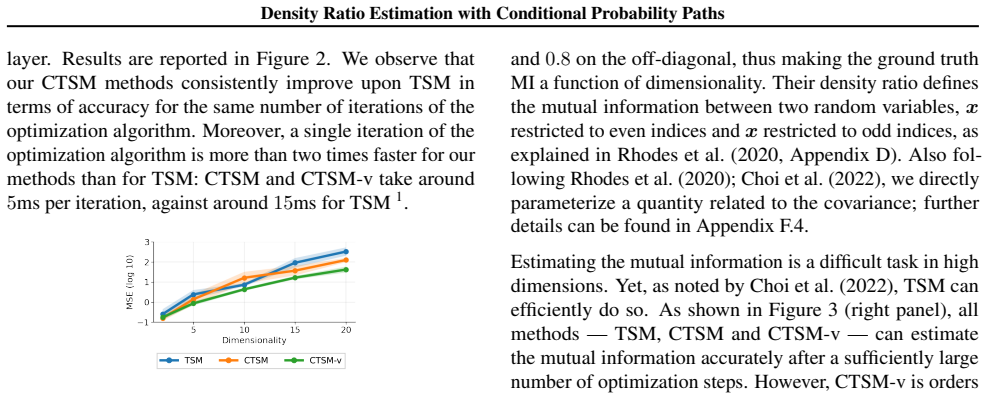
- [§6, Tables 2--3 and Figure 2] The empirical comparison is confounded by a concurrent change of weighting function. Throughout Section 6, TSM is trained with Stein score normalization (Eq. 19, λ(t) ∝ kt) while CTSM and CTSM-v are trained with time score normalization (Eq. 20--21), and in the EBM experiments the CTSM-v architecture additionally differs from TSM's (Fourier feature embeddings vs. linear embeddings, and a different U-Net in the ambient-space experiments). Since the authors declare time score normalization to be an integral part of CTSM, the observed accuracy differences cannot be attributed solely to the proposed objective. Appendix Table 4 provides a partial TSM-with-time-normalization comparison only for the Gaussian toy problem, which helps but is not the main text comparison. The main claims would be supported by reporting TSM+Time normalization in the main figures, or by adding an ablation in which CTSM uses Stein normalization, and by separating the effect of the vectorized objective from the effect of the weighting and architecture changes.
minor comments (5)
- [Appendix B.1, Eq. (65)] The variance formula in Eq. (65) is missing a factor of D that follows from Lemma 6: the variance of the scalar time score is proportional to D. Since D does not depend on t, the proportional weighting in Eq. (21) is unaffected, but the displayed formula is incorrect as a standalone identity.
- [§3.2, Eq. (9)] The notation xi and x<i in the definition of the vectorized conditional time score is introduced informally; for the VP path the components do not depend on x<i, but this should be stated explicitly to avoid confusion about the ordering of the autoregressive decomposition.
- [§5, Proposition 5] Proposition 5 should state explicitly that the model is assumed to be well-specified (existence of θ* with s_{θ*}(x,t) = ∂t log pt(x)) and that standard M-estimation regularity conditions hold; these are currently only mentioned inside the proof.
- [§6.4] The statement that 'in practice, CTSM could not be used for this task' is reported without supporting results; since the paper advocates the vectorized variant, a brief explanation or a reference to preliminary experiments would help the reader assess the limitation of the non-vectorized objective.
- [§4, Eq. (21)] The definition of the time score normalization for CTSM-v is said to assume each dimension has equal scale; the manuscript would benefit from stating what is done when this assumption is violated and how the scalar weighting λ̂(t) is applied to the vectorized objective.
Circularity Check
No circularity: the CTSM objective is derived from a standard conditioning identity and the central claims are not reductions of fitted inputs; self-citations are background only.
full rationale
The central equivalence (Theorem 1; general version Theorem 3) is not a fitting or definitional identity. The proof expands both losses and uses Eq. 7, ∂t log pt(x) = E_{pt(z|x)}[∂t log pt(x|z)], which follows from the mixture construction pt(x)=∫pt(x|z)p(z)dz (Appendix D.1). Both sides are defined independently: the TSM target is the marginal time score, the CTSM target is the conditional time score, and the theorem shows their squared-error objectives differ by the constant E[f^2]−E[g^2]. No parameter is fitted to the right-hand side and then called a prediction; the learned sθ is evaluated against the density-ratio integral Eq. 2 on held-out data. Theorem 4 and Proposition 5 are standard decompositions (Jensen, Lipschitz discretization, M-estimator asymptotics via Bach and van der Vaart) and do not use the paper's fitted values. The paper honestly credits earlier versions of Theorem 3 (Vincent 2011; Lipman et al. 2023; Pooladian et al. 2023; Tong et al. 2024a). Self-citations (Chehab et al. 2023a,b) appear only as background for NCE variance and normalizing-constant estimation, not as load-bearing justification for the central derivation. The substantive weakness is a regularity gap, not circularity: Eq. 7 requires differentiating under the integral and finite variance of ∂t log pt(x|z), and for the VP path with αt=t the conditional time-score variance diverges like D/(2(1−t)^2) as t→1 (Eq. 65), so with λ=1 the CTSM loss is not finite and the 'additive constant' in Theorem 1 is not well-defined; the paper's ε-clipping and time-score normalization are practical fixes not reflected in the stated theorems. This affects soundness of the theoretical statements but is not a reduction of the result to its inputs.
Assumptions & free parameters
free parameters (3)
- c in time score normalization =
1 in most experiments (Eq. 21)
- σ in Schrodinger bridge path =
1.0 for GMM experiments
- t1 in importance sampling =
0.9
assumptions (4)
- domain assumption Mixture identity: pt(x)=∫ pt(x|z)p(z)dz with p(z) independent of t, and interchanging ∂t with the integral is valid.
- domain assumption Well-specified model: there exists θ* such that s_{θ*}(x,t)=∂t log pt(x).
- domain assumption Lipschitz regularity: t ↦ s(x,t) is L(x)-Lipschitz.
- standard math Standard M-estimator regularity conditions from van der Vaart (2000, Thm 5.23) and Bach (2024, Sec 4.7).
Cite this review
Pith. "Pith review of Density Ratio Estimation with Conditional Probability Paths." pith.science (2026). https://pith.science/paper/GFWYJB5C
@misc{pith2026250202300,
  author       = {Pith},
  title        = {Pith review of: Density Ratio Estimation with Conditional Probability Paths},
  year         = {2026},
  howpublished = {\url{https://pith.science/paper/GFWYJB5C}},
  note         = {Machine review of arXiv:2502.02300}
}
read the original abstract
Density ratio estimation in high dimensions can be reframed as integrating a certain quantity, the time score, over probability paths which interpolate between the two densities. In practice, the time score has to be estimated based on samples from the two densities. However, existing methods for this problem remain computationally expensive and can yield inaccurate estimates. Inspired by recent advances in generative modeling, we introduce a novel framework for time score estimation, based on a conditioning variable. Choosing the conditioning variable judiciously enables a closed-form objective function. We demonstrate that, compared to previous approaches, our approach results in faster learning of the time score and competitive or better estimation accuracies of the density ratio on challenging tasks. Furthermore, we establish theoretical guarantees on the error of the estimated density ratio.
Figures


Figures from the paper (2 more)


Reference graph
Works this paper leans on
-
[1]
Albergo, M. S. and Vanden-Eijnden, E. Building Normalizing Flows with Stochastic Interpolants . In The Eleventh International Conference on Learning Representations , 2023
work page 2023
-
[2]
Learning Theory from First Principles
Bach, F. Learning Theory from First Principles. MIT Press, 2024
work page 2024
-
[3]
D., Hutchinson, M., Wirnsberger, P., and Doucet, A
Bortoli, V. D., Hutchinson, M., Wirnsberger, P., and Doucet, A. Target Score Matching , 2024. \_eprint: 2402.08667
arXiv 2024
-
[4]
Accurate and conservative estimates of MRF log-likelihood using reverse annealing
Burda, Y., Grosse, R., and Salakhutdinov, R. Accurate and conservative estimates of MRF log-likelihood using reverse annealing . In Proceedings of the Eighteenth International Conference on Artificial Intelligence and Statistics, volume 38 of Proceedings of Machine Learning Research, pp.\ 102--110, San Diego, California, USA, 09--12 May 2015. PMLR
work page 2015
-
[5]
Chehab, O., Gramfort, A., and Hyvarinen, A. Optimizing the Noise in Self - Supervised Learning : from Importance Sampling to Noise - Contrastive Estimation , 2023 a . \_eprint: 2301.09696
arXiv 2023
-
[6]
Chehab, O., Hyvarinen, A., and Risteski, A. Provable benefits of annealing for estimating normalizing constants: Importance Sampling , Noise - Contrastive Estimation , and beyond. In Advances in Neural Information Processing Systems , volume 36, pp.\ 45945--45970. Curran Associates, Inc., 2023 b
work page 2023
-
[7]
The probability flow ODE is provably fast
Chen, S., Chewi, S., Lee, H., Li, Y., Lu, J., and Salim, A. The probability flow ODE is provably fast. In Thirty-seventh Conference on Neural Information Processing Systems, 2023
work page 2023
-
[8]
On the importance of noise scheduling for diffusion models, 2023
Chen, T. On the importance of noise scheduling for diffusion models, 2023
work page 2023
Show all 60 references
-
[9]
Density ratio estimation via infinitesimal classification
Choi, K., Meng, C., Song, Y., and Ermon, S. Density ratio estimation via infinitesimal classification. In Proceedings of The 25th International Conference on Artificial Intelligence and Statistics, volume 151 of Proceedings of Machine Learning Research, pp.\ 2552--2573. PMLR, ...
2022
-
[10]
Fast and Accurate Deep Network Learning by Exponential Linear Units ( ELUs )
Clevert, D.-A., Unterthiner, T., and Hochreiter, S. Fast and Accurate Deep Network Learning by Exponential Linear Units ( ELUs ). In Bengio, Y. and LeCun, Y. (eds.), 4th International Conference on Learning Representations , ICLR 2016, San Juan , Puerto Rico , May 2-4, 2016, C...
2016
-
[11]
W., and Doucet, A
De Bortoli, V., Mathieu, E., Hutchinson, M., Thornton, J., Teh, Y. W., and Doucet, A. Riemannian Score - Based Generative Modelling . In Advances in Neural Information Processing Systems , volume 35, pp.\ 2406--2422. Curran Associates, Inc., 2022
2022
-
[12]
Dormand, J. R. and Prince, P. J. A family of embedded Runge - Kutta formulae. Journal of Computational and Applied Mathematics, 6 0 (1): 0 19--26, 1980
1980
-
[13]
B., Dieleman, S., Fergus, R., Sohl-Dickstein, J
Du, Y., Durkan, C., Strudel, R., Tenenbaum, J. B., Dieleman, S., Fergus, R., Sohl-Dickstein, J. N., Doucet, A., and Grathwohl, W. Reduce, reuse, recycle: Compositional generation with energy-based diffusion models and mcmc. In International Conference on Machine Learning, 2023
2023
-
[14]
Random fields and diffusion processes
F \"o llmer, H. Random fields and diffusion processes. Ecole d'Ete de probabilities de Saint-Flour XV-XVII,1985-87. LNM 1362. Springer-Verlag, Berlin, 1988
1985
-
[15]
P., Xu, Z., Dai, A
Gao, R., Nijkamp, E., Kingma, D. P., Xu, Z., Dai, A. M., and Wu, Y. N. Flow contrastive estimation of energy-based models. 2020 IEEE/CVF Conference on Computer Vision and Pattern Recognition (CVPR), pp.\ 7515--7525, 2019
2020
-
[16]
Gao, Y., Huang, J., and Jiao, a. Y. Gaussian Interpolation Flows . Journal of Machine Learning Research, 25 0 (253): 0 1--52, 2024
2024
-
[17]
Generative Adversarial Networks
Goodfellow, I., Pouget-Abadie, J., Mirza, M., Xu, B., Warde-Farley, D., Ozair, S., Courville, A., and Bengio, Y. Generative Adversarial Networks . Commun. ACM, 63 0 (11): 0 139--144, October 2020. Place: New York, NY, USA Publisher: Association for Computing Machinery
2020
-
[18]
Provable Benefit of Annealed Langevin Monte Carlo for Non -log-concave Sampling
Guo, W., Tao, M., and Chen, Y. Provable Benefit of Annealed Langevin Monte Carlo for Non -log-concave Sampling . In The Thirteenth International Conference on Learning Representations , ICLR 2025, Singapore , April 24-28, 2025 . OpenReview.net, 2025
2025
-
[19]
Gutmann, M. U. and Hyv \"a rinen, A. Noise-contrastive estimation of unnormalized statistical models, with applications to natural image statistics. Journal of Machine Learning Research, 13 0 (11): 0 307--361, 2012
2012
-
[20]
Deep Residual Learning for Image Recognition
He, K., Zhang, X., Ren, S., and Sun, J. Deep Residual Learning for Image Recognition . In 2016 IEEE Conference on Computer Vision and Pattern Recognition ( CVPR ) , pp.\ 770--778, 2016. doi:10.1109/CVPR.2016.90
2016 doi
-
[21]
Denoising Diffusion Probabilistic Models
Ho, J., Jain, A., and Abbeel, P. Denoising Diffusion Probabilistic Models . In Advances in Neural Information Processing Systems , volume 33, pp.\ 6840--6851. Curran Associates, Inc., 2020
2020
-
[22]
Estimation of non-normalized statistical models by score matching
Hyv \"a rinen, A. Estimation of non-normalized statistical models by score matching. Journal of Machine Learning Research, 6 0 (24): 0 695--709, 2005
2005
-
[23]
High- Dimensional Density Ratio Estimation with Extensions to Approximate Likelihood Computation
Izbicki, R., Lee, A., and Schafer, C. High- Dimensional Density Ratio Estimation with Extensions to Approximate Likelihood Computation . In Proceedings of the Seventeenth International Conference on Artificial Intelligence and Statistics , volume 33 of Proceedings of Machine L...
2014
-
[24]
P., and Mallat, S
Kadkhodaie, Z., Guth, F., Simoncelli, E. P., and Mallat, S. Generalization in diffusion models arises from geometry-adaptive harmonic representations. In The Twelfth International Conference on Learning Representations , 2024
2024
-
[25]
and Ganguli, S
Kamb, M. and Ganguli, S. An analytic theory of creativity in convolutional diffusion models, 2024. \_eprint: 2412.20292
2024 arXiv
-
[26]
Multi-task learning using uncertainty to weigh losses for scene geometry and semantics
Kendall, A., Gal, Y., and Cipolla, R. Multi-task learning using uncertainty to weigh losses for scene geometry and semantics. 2018 IEEE/CVF Conference on Computer Vision and Pattern Recognition, pp.\ 7482--7491, 2017
2018
-
[27]
and Bondell, H
Kimura, M. and Bondell, H. Density Ratio Estimation via Sampling along Generalized Geodesics on Statistical Manifolds . In Proceedings of The 28th International Conference on Artificial Intelligence and Statistics , volume 258 of Proceedings of Machine Learning Research , pp.\...
2025
-
[28]
and Gao, R
Kingma, D. and Gao, R. Understanding diffusion objectives as the elbo with simple data augmentation. In Oh, A., Naumann, T., Globerson, A., Saenko, K., Hardt, M., and Levine, S. (eds.), Advances in Neural Information Processing Systems, volume 36, pp.\ 65484--65516. Curran Ass...
2023
-
[29]
MNIST handwritten digit database
LeCun, Y., Cortes, C., and Burges, C. MNIST handwritten digit database. ATT Labs [Online]. Available: http://yann.lecun.com/exdb/mnist, 2, 2010
2010
-
[30]
P., and Risteski, A
Lee, H., Pabbaraju, C., Sevekari, A. P., and Risteski, A. Pitfalls of gaussians as a noise distribution in NCE . In The Eleventh International Conference on Learning Representations, 2023
2023
-
[31]
Lipman, Y., Chen, R. T. Q., Ben-Hamu, H., Nickel, M., and Le, M. Flow matching for generative modeling. In The Eleventh International Conference on Learning Representations, 2023
2023
-
[32]
K., and Risteski, A
Liu, B., Rosenfeld, E., Ravikumar, P. K., and Risteski, A. Analyzing and improving the optimization landscape of noise-contrastive estimation. In International Conference on Learning Representations, 2022
2022
-
[33]
Minimizing f -divergences by interpolating velocity fields
Liu, S., Yu, J., Simons, J., Yi, M., and Beaumont, M. Minimizing f -divergences by interpolating velocity fields. In Salakhutdinov, R., Kolter, Z., Heller, K., Weller, A., Oliver, N., Scarlett, J., and Berkenkamp, F. (eds.), Proceedings of the 41st International Conference on ...
2024
-
[34]
Flow Straight and Fast : Learning to Generate and Transfer Data with Rectified Flow
Liu, X., Gong, C., and liu, q. Flow Straight and Fast : Learning to Generate and Transfer Data with Rectified Flow . In The Eleventh International Conference on Learning Representations , 2023
2023
-
[35]
Autoregressive Score Matching
Meng, C., Yu, L., Song, Y., Song, J., and Ermon, S. Autoregressive Score Matching . In Larochelle, H., Ranzato, M., Hadsell, R., Balcan, M. F., and Lin, H. (eds.), Advances in Neural Information Processing Systems , volume 33, pp.\ 6673--6683. Curran Associates, Inc., 2020
2020
-
[36]
Annealed importance sampling
Neal, R. Annealed importance sampling. Statistics and Computing, 11: 0 125--139, 1998
1998
-
[37]
Nichol, A. Q. and Dhariwal, P. Improved denoising diffusion probabilistic models. In Proceedings of the 38th International Conference on Machine Learning, volume 139 of Proceedings of Machine Learning Research, pp.\ 8162--8171. PMLR, 18--24 Jul 2021
2021
-
[38]
Pooladian, A.-A., Ben-Hamu, H., Domingo-Enrich, C., Amos, B., Lipman, Y., and Chen, R. T. Q. Multisample flow matching: Straightening flows with minibatch couplings. In International Conference on Machine Learning, 2023
2023
-
[39]
Rhodes, B., Xu, K., and Gutmann, M. U. Telescoping Density - Ratio Estimation . In Advances in Neural Information Processing Systems , volume 33, pp.\ 4905--4916. Curran Associates, Inc., 2020
2020
-
[40]
An overview of multi-task learning in deep neural networks
Ruder, S. An overview of multi-task learning in deep neural networks. ArXiv, abs/1706.05098, 2017
2017 arXiv
-
[41]
Scarvelis, C., Borde, H. S. d. O., and Solomon, J. Closed- Form Diffusion Models , 2024
2024
-
[42]
Sinha, A., O' Kelly, M., Tedrake, R., and Duchi, J. C. Neural Bridge Sampling for Evaluating Safety - Critical Autonomous Systems . In Advances in Neural Information Processing Systems , volume 33, pp.\ 6402--6416. Curran Associates, Inc., 2020
2020
-
[43]
Deep Unsupervised Learning using Nonequilibrium Thermodynamics
Sohl-Dickstein, J., Weiss, E., Maheswaranathan, N., and Ganguli, S. Deep Unsupervised Learning using Nonequilibrium Thermodynamics . In Proceedings of the 32nd International Conference on Machine Learning , volume 37 of Proceedings of Machine Learning Research , pp.\ 2256--226...
2015
-
[44]
and Ermon, S
Song, J. and Ermon, S. Understanding the Limitations of Variational Mutual Information Estimators . In International Conference on Learning Representations , 2020
2020
-
[45]
Maximum Likelihood Training of Score - Based Diffusion Models
Song, Y., Durkan, C., Murray, I., and Ermon, S. Maximum Likelihood Training of Score - Based Diffusion Models . In Advances in Neural Information Processing Systems , volume 34, pp.\ 1415--1428. Curran Associates, Inc., 2021 a
2021
-
[46]
P., Kumar, A., Ermon, S., and Poole, B
Song, Y., Sohl-Dickstein, J., Kingma, D. P., Kumar, A., Ermon, S., and Poole, B. Score-based generative modeling through stochastic differential equations. In International Conference on Learning Representations, 2021 b
2021
-
[47]
Srivastava, A., Han, S., Xu, K., Rhodes, B., and Gutmann, M. U. Estimating the Density Ratio between Distributions with High Discrepancy using Multinomial Logistic Regression . Transactions on Machine Learning Research, 2023. ISSN 2835-8856
2023
-
[48]
Density ratio estimation: A comprehensive review
Sugiyama, M., Suzuki, T., and Kanamori, T. Density ratio estimation: A comprehensive review. In Statistical Experiment and Its Related Topics , Research Institute for Mathematical Sciences Kokyuroku , volume 1703, pp.\ 10--31, 2010. Presented at Research Institute for Mathemat...
2010
-
[49]
Fourier features let networks learn high frequency functions in low dimensional domains
Tancik, M., Srinivasan, P., Mildenhall, B., Fridovich-Keil, S., Raghavan, N., Singhal, U., Ramamoorthi, R., Barron, J., and Ng, R. Fourier features let networks learn high frequency functions in low dimensional domains. In Advances in Neural Information Processing Systems, vol...
2020
-
[50]
Improving and generalizing flow-based generative models with minibatch optimal transport
Tong, A., Fatras, K., Malkin, N., Huguet, G., Zhang, Y., Rector-Brooks, J., Wolf, G., and Bengio, Y. Improving and generalizing flow-based generative models with minibatch optimal transport. Transactions on Machine Learning Research, 2024 a . ISSN 2835-8856. Expert Certification
2024
-
[51]
Y., Malkin, N., Fatras, K., Atanackovic, L., Zhang, Y., Huguet, G., Wolf, G., and Bengio, Y
Tong, A. Y., Malkin, N., Fatras, K., Atanackovic, L., Zhang, Y., Huguet, G., Wolf, G., and Bengio, Y. Simulation-free S chrödinger bridges via score and flow matching. In Proceedings of The 27th International Conference on Artificial Intelligence and Statistics, volume 238 of ...
2024
-
[52]
Asymptotic Statistics
van der Vaart , A. Asymptotic Statistics. Asymptotic Statistics. Cambridge University Press, 2000
2000
-
[53]
A connection between score matching and denoising autoencoders
Vincent, P. A connection between score matching and denoising autoencoders. Neural Computation, 23: 0 1661--1674, 2011
2011
-
[54]
E., Haberland, M., Reddy, T., Cournapeau, D., Burovski, E., Peterson, P., Weckesser, W., Bright, J., van der Walt, S
Virtanen, P., Gommers, R., Oliphant, T. E., Haberland, M., Reddy, T., Cournapeau, D., Burovski, E., Peterson, P., Weckesser, W., Bright, J., van der Walt, S. J., Brett, M., Wilson, J., Millman, K. J., Mayorov, N., Nelson, A. R. J., Jones, E., Kern, R., Larson, E., Carey, C. J....
2020
-
[55]
Learning Calibrated Uncertainties for Domain Shift : A Distributionally Robust Learning Approach
Wang, H., Yu, Z., Yue, Y., Anandkumar, A., Liu, A., and Yan, J. Learning Calibrated Uncertainties for Domain Shift : A Distributionally Robust Learning Approach . In Proceedings of the Thirty - Second International Joint Conference on Artificial Intelligence , IJCAI -23 , pp.\...
2023
-
[56]
J., Wang, L., Ying, Q., Liu, S., and Kolar, M
Williams, D. J., Wang, L., Ying, Q., Liu, S., and Kolar, M. High- Dimensional Differential Parameter Inference in Exponential Family using Time Score Matching . In Proceedings of The 28th International Conference on Artificial Intelligence and Statistics , volume 258 of Procee...
2025
-
[57]
and Xie, Y
Wu, D. and Xie, Y. Annealing Flow Generative Models Towards Sampling High - Dimensional and Multi - Modal Distributions , 2025. \_eprint: 2409.20547
2025 arXiv
-
[58]
Computing high-dimensional optimal transport by flow neural networks
Xu, C., Cheng, X., and Xie, Y. Computing high-dimensional optimal transport by flow neural networks. In Proceedings of The 28th International Conference on Artificial Intelligence and Statistics , volume 258 of Proceedings of Machine Learning Research , pp.\ 2872--2880. PMLR, May 2025
2025
-
[59]
Classification Diffusion Models : Revitalizing Density Ratio Estimation
Yadin, S., Elata, N., and Michaeli, T. Classification Diffusion Models : Revitalizing Density Ratio Estimation . In The Thirty -eighth Annual Conference on Neural Information Processing Systems , 2024
2024
-
[60]
and Michaeli, T
Yair, O. and Michaeli, T. Thinking fourth dimensionally: Treating time as a random variable in EBM s, 2023
2023
Reviewed August 9, 2026 · model on record in the stance chip above.
Discussion (0). Continue with ORCID to comment.