REVIEW 3 major objections 6 minor 21 references
Signal shape studies and rate dependence of HFO-based gas mixtures in RPC detectors
T0 review · 3 major / 6 minor · reviewed 2026-08-09 · deepseek-v4-flash
Pith's one-line read HFO/CO2 gas blends can replace the standard RPC gas, at a cost in working voltage and charge per hit.
desk verdict Useful beam-test data on HFO/CO2 RPC mixtures, but the headline 1.6/1.7 charge-per-hit ratio rests on a rate-independent assumption the paper does not justify. read the letter →
The pith
A machine-rendered reading of the paper's core claim, the machinery that carries it, and where it could break.
The reading
What carries the argument
The load-bearing object is Eq. (1), $I/A = \langle Q\rangle\cdot N_{\gamma-\mathrm{detected}}/(A\cdot\Delta t) + \mathrm{DCD}$, which states that the current density drawn by an RPC is a linear function of the measured gamma cluster rate, with slope equal to the average charge released per detected gamma hit and intercept equal to the dark current density. The analysis fits this line to current-versus-rate data taken at the working point and uses the slope as a mixture-by-mixture estimator of charge per hit, connecting detector chemistry to aging risk. Two auxiliary tools carry the comparison: the working point defined as the knee of a logistic fit to the efficiency curve plus 150 V, and a correction for the voltage drop across the resistive bakelite electrodes, which is estimated as the product of circulating current and electrode resistance.
What would settle it
Compare the slope of current density versus gamma cluster rate with the average charge per hit measured directly from digitized waveform integrals, at several irradiation levels and voltages. If the slope changes with rate or voltage, or disagrees with the direct integral, the single-charge linear assumption fails.
Extended reading notes
Core claim
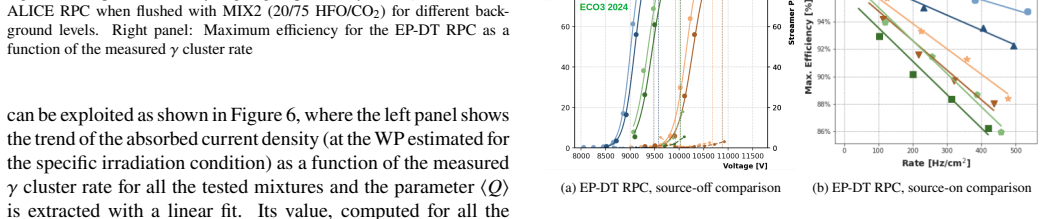
The paper claims that replacing C2H2F4 with HFO/CO2 is viable: all tested HFO-based mixtures reached full muon efficiency in avalanche mode, and the efficiency curves show a slight improvement in maximum efficiency as HFO concentration rises. The cost is an increase of the detector working point of about 1 kV per 10% HFO, and prompt-charge distributions shifted to higher values, meaning larger avalanche signals and more large-signal contamination. At the working point, the average total charge released per detected gamma hit, extracted as the slope of current density versus gamma cluster rate, is about 1.6/1.7 times higher for the eco-friendly mixtures than for the standard gas; this higher charge per hit is the paper's main concern for long-term aging. The paper also reports that one year of irradiation (about 115 mC/cm2 on one detector) produced only a small working-point shift and no significant efficiency degradation, so the aging question remains open.
Load-bearing premise
The analysis assumes that the current density is a linear function of the gamma cluster rate with a single rate-independent average charge per hit; if the average charge drifts with rate or voltage, the mixture comparisons and the aging-risk estimate lose their footing.
Editorial extensions
If this is right
- Adding HFO to the gas raises the working point by roughly 1 kV per 10% HFO, so selecting a mixture is a trade-off between eco-friendliness and available high voltage, not a free upgrade.
- The average charge released per gamma hit is about 1.6/1.7 times higher for HFO/CO2 blends than for the standard mixture, which the paper treats as a concrete aging risk that the ongoing long-term campaign is designed to test.
- Increasing the HFO fraction improves the detector response, but the large-signal contamination grows more steeply with voltage than for the standard gas, narrowing the useful operating window.
- Under gamma irradiation, efficiency curves shift to higher voltages and maximum efficiency drops, an effect the paper attributes to the voltage drop on the resistive electrodes as absorbed current rises.
- After one year of irradiation corresponding to about 115 mC/cm2 on one detector, only a slight working-point increase and about 2% efficiency loss were observed, with no significant performance degradation.
Reading between the lines
- If the single-charge linear model is exact, the ratio of slopes between mixtures predicts the relative aging rate; a detector run on a 35% HFO blend would be expected to accumulate charge about 1.6/1.7 times faster than on the standard gas at equal rate, so the aging campaign should compare integrated charge rather than calendar time.
- The 1 kV-per-10% HFO rule implies that a mixture with high HFO fraction may exceed the comfortable voltage range of existing chambers; a practical drop-in would therefore need either a lower-HFO blend with acceptable response or a reduction of the electrode gap or resistivity.
- The same linear-fit method could be applied to the large-signal (streamer) contribution separately, separating the avalanche charge and streamer charge per gamma hit; the paper does not separate them.
- A testable prediction: if the bakelite voltage drop is the cause of the rate-dependent efficiency loss, the extracted slope $\langle Q\rangle$ should appear constant at low rates and deviate only once the voltage drop becomes appreciable; checking that boundary would validate the method.
Signed reviews
Editorial analysis
A structured set of objections, weighed in public.
Referee Report
Summary. The paper reports beam-test studies of Resistive Plate Chambers operated with HFO/CO2-based gas mixtures as an eco-friendly alternative to the standard C2H2F4-based mixture. The authors present source-off efficiency curves and prompt-charge distributions for several mixtures plus a standard reference, rate-dependent behavior when the GIF++ 137Cs source is turned on, and a linear extraction of the average charge per gamma hit from current density versus measured gamma cluster rate. They also compare source-off and source-on performance before and after one year of irradiation, corresponding to an integrated charge of about 115 mC/cm2 for the EP-DT detector. The central claims are that increasing HFO concentration improves the RPC response, raises the working point by about 1 kV per 10% HFO, and that HFO-based mixtures release about 1.6/1.7 times more charge per hit than the standard gas, motivating an ongoing aging campaign.
Significance. If the quantitative charge-per-hit result holds, the paper provides important input for the LHC RPC community's transition away from fluorinated greenhouse gases. The study is significant for its systematic comparison across many mixtures, using two independent detector systems (ALICE and EP-DT) and a well-characterized irradiation facility. The qualitative trends—working-point increase with HFO fraction, higher prompt-charge distributions, and rate-dependent efficiency loss—are direct measurements and are likely robust. The main quantitative inference, the average-charge ratio from Eq. (1), is a simple linear-fit interpretation, and the aging comparison provides useful long-term data. The paper's central claims are not circular; they rest on direct measurements rather than an assumed model. The main weaknesses are the lack of uncertainties on the presented data and the insufficiently supported assumption of a rate-independent average charge per hit.
major comments (3)
- [Section 3.1, Eq. (1), Fig. 6] The average charge per gamma hit <Q> is extracted from the slope of a linear fit of I/A versus measured gamma cluster rate, but the data points are taken at working points estimated for each irradiation condition. Because Figure 5a shows that the efficiency curves shift with rate and the text attributes part of this shift to the voltage drop on the bakelite electrodes, the actual voltage across the gas gap may differ from point to point. If <Q> is rate-dependent, for instance because of gain changes from the bakelite I*R drop, the fitted slope becomes a rate-weighted average rather than a mixture property, and the comparison across mixtures is biased. This is load-bearing because the conclusion that HFO mixtures release about 1.6/1.7 times more charge per hit and the associated aging-risk estimate rest directly on this slope. The paper should state whether the effective high voltage was corrected for the bakelite voltage drop before the working point was chosen, and should report fit residuals, fit-parameter uncertainties, or a rate-restricted repeat of the fit to demonstrate that a constant slope is tenable.
- [Figures 3, 5, and 6] The central quantitative claims—the approximately 1 kV per 10% HFO working-point increase, the charge-per-hit ratio of 1.6/1.7, and the rate-dependent efficiency loss—are presented without statistical or systematic error bars. This makes it impossible to assess whether differences between mixtures are significant or whether the reported trends are consistent within uncertainties. Please add at least statistical uncertainties on the efficiency points, current densities, gamma cluster rates, and the linear-fit parameters, and discuss systematic uncertainties such as the absolute normalization of the gamma rate, the choice of working point, and the uncertainty on the effective high voltage.
- [Section 3.2, Fig. 7] The approximately 2% decrease in maximum efficiency between July 2023 and July 2024 is attributed to "a geometrical misalignment of the detector in 2024, not present in 2023," but no alignment measurement, survey, or data supporting this statement is presented. Since this attribution is used to argue that no significant performance degradation occurred apart from the working-point increase, it is load-bearing for the aging conclusion. Please either provide quantitative evidence for the misalignment or present the aging comparison without that attribution.
minor comments (6)
- [Abstract vs. Section 3.1] The abstract and conclusions quote the charge-per-hit ratio as about 1.6/1.7 times higher than the standard gas, while Section 3.1 states "this quantity is ≈1.5/2 times higher"; please reconcile the quoted ratio.
- [Section 2.1] In the description of the analysis output, "the trend of the aforementioned vales" should read "the trend of the aforementioned values."
- [Section 3.2] The phrase "a a geometrical misalignment" contains a duplicated article; please correct it.
- [Figure 5a caption and text] The caption of Figure 5a refers to "Efficiency/large signal probability vs HV eff" while the text in Section 3.1 refers to "efficiency and large signal contamination"; please use consistent terminology.
- [Section 2.1 and Eq. (1)] The gamma cluster rate is measured by the RPC itself with a detection efficiency of the order of one per mille; the paper should state explicitly whether the rate entering Eq. (1) and Figure 6 is the raw detected rate or a corrected rate, since the equation formally uses the measured cluster rate.
- [Table 2] MIX0 contains no HFO but 95% CO2, so it is not an HFO/CO2 blend in the same sense as the other mixtures; a sentence explaining why this mixture is included in the HFO/CO2 scan would improve clarity.
Circularity Check
No significant circularity: the central claims are direct measurements; the only model input, Eq. (1), is a linear parameterization used to define <Q> rather than a prediction derived from itself.
full rationale
The paper's central results are direct experimental measurements: source-off efficiency curves, prompt-charge distributions, and current-versus-rate data. The quantitative claim that HFO/CO2 mixtures release about 1.6/1.7 times more charge per hit than the standard mixture comes from the slope of Eq. (1), I/A = <Q> * (gamma cluster rate) + DCD, fitted in Figure 6. This is a measurement procedure: <Q> is defined as the slope of current density versus measured gamma cluster rate, and the cross-mixture ratio is a ratio of fitted slopes. It is not a prediction of data that were used to fit the parameter, and it does not reduce to an input by construction. The possible rate dependence of <Q> due to the bakelite-resistance voltage drop, raised in the skeptic's analysis, is a correctness or robustness concern about the linear model, not circularity, because Eq. (1) is not claimed to be derived from the very data it is used to interpret. The paper self-cites the collaboration's prior work, notably [12] for the HVeff definition and the bakelite voltage-drop correction and [19] for the aging-test methodology, but these citations are contextual and methodological, not the load-bearing justification for the main trend. The qualitative response improvement with HFO is also supported by the directly measured efficiency curves and charge spectra in Figures 3 and 4, independent of the fitted <Q> values. No step in the paper equates its conclusion with its assumptions by definition, and no fitted parameter is renamed as a prediction.
Assumptions & free parameters
free parameters (3)
- Average charge per detected gamma cluster <Q> =
per mixture, about 1.5-2x the STD value (Figure 6b)
- Logistic-fit parameters (knee voltage, maximum efficiency) =
WP = knee + 150 V; values per mixture in Figures 3-5
- Dark current density DCD =
intercept of the linear fit in Figure 6a (not quoted numerically)
assumptions (4)
- domain assumption RPC signal identification: a muon hit is a signal above threshold in the muon window, with peak polarity matching the expected polarity and no cross-talk pattern (Section 2.1).
- domain assumption The relation I/A = <Q> * rate + DCD (Eq. 1) is linear, with <Q> constant across the scanned voltage and rate range.
- domain assumption The electrode voltage drop correction, subtracting the product of absorbed current and electrode resistance from HVeff, accurately predicts detector gain at rate (Section 3.1, cf. [12]).
- domain assumption Maintaining relative humidity at 40% keeps bakelite resistivity constant (Section 2).
Cite this review
Pith. "Pith review of Signal shape studies and rate dependence of HFO-based gas mixtures in RPC detectors." pith.science (2026). https://pith.science/paper/XVFYMZOE
@misc{pith2026250202374,
  author       = {Pith},
  title        = {Pith review of: Signal shape studies and rate dependence of HFO-based gas mixtures in RPC detectors},
  year         = {2026},
  howpublished = {\url{https://pith.science/paper/XVFYMZOE}},
  note         = {Machine review of arXiv:2502.02374}
}
abstract
The RPCs employed at the LHC experiments are currently operated in avalanche mode, with a mixture containing a large fraction of C$_{2}$H$_{2}$F$_{4}$ ($\approx$90\% or more) with the addition of i-C$_{4}$H$_{10}$ and SF$_{6}$ in different concentrations. However, C$_{2}$H$_{2}$F$_{4}$ and SF$_{6}$ are fluorinated greenhouse gases (F-gases) with Global Warming Potential (GWP) of $\approx$1400 and $\approx$22800, respectively. EU regulations imposed a progressive phase-down of C$_{2}$H$_{2}$F$_{4}$ production and consumption, aiming at strongly reducing its emission. This is already resulting in an increase of its price and reduction in availability. The most desirable long-term solution to this problem is to find an alternative, F-gases-free gas mixture, able to maintain similar detector performance. To address this challenge, the RPC ECOGasas@GIF++ collaboration (including RPC experts of ALICE, ATLAS, CMS, SHiP/LHCb, and the CERN EP-DT group) was created in 2019. The collaboration is currently studying a gas from the olefine family, the C$_{3}$H$_{2}$F$_{4}$ (or simply HFO, with GWP $\approx$6), to be used, in combination with CO$_{2}$, as a substitute for C$_{2}$H$_{2}$F$_{4}$. This contribution will focus on the signal shape studies that have been carried out by the collaboration during dedicated beam test periods. The methodology used in the data analysis will be presented, together with the results obtained with several HFO-based gas mixtures, and with the currently employed one. Furthermore, results on the counting-rate dependence of the RPC performance, obtained by combining the muon beam with the GIF++ $^{137}$Cs source with different attenuation factors, will also be presented.
Figures


Figures from the paper (4 more)



Reference graph
Works this paper leans on
-
[1]
ALICE collaboration, ALICE Technical Design Report of the Dimuon Forward Spectrometer, CERN/LHCC 99-22 (1999)
work page 1999
-
[2]
CMS collaboration, The CMS muon project: Technical Design Report , CERN/LHCC 97-32 (1997)
work page 1997
-
[3]
ATLAS collaboration, ATLAS muon spectrometer: Technical Design Re- port, CERN/LHCC 97-022 (1997)
work page 1997
-
[4]
LHCb collaboration, Framework TDR for the LHCb Upgrade II: Opportu- nities in flavour physics, and beyond, in the HL-LHC era, CERN-LHCC- 2021-012 (2021)
work page 2021
-
[5]
Council of European Union, Council regulation (EU) no 517/2014(2014)
work page 2014
-
[6]
Council of European Union, Council regulation (EU) no 573/2024(2024)
work page 2024
-
[7]
Mandelli, B. et al., Strategies for reducing the use of greenhouse gases from particle detectors operation at the CERN LHC Experiments, Journal of Physics: Conference Series (2022)
work page 2022
-
[8]
Proto, G., Study of the performance of the RPC detector with new eco- friendly gas mixtures, Il nuovo Cimento C (2021)
work page 2021
Show all 21 references
-
[9]
et al., Studies on tetrafluoropropene-based gas mixtures with low environmental impact for Resistive Plate Chambers, JINST 15 C04039 (2020)
Bianchi, A. et al., Studies on tetrafluoropropene-based gas mixtures with low environmental impact for Resistive Plate Chambers, JINST 15 C04039 (2020)
2020
-
[10]
et al., Characterization of RPC detectors with LHC-like back- ground radiation and new eco-friendly gas mixtures , JINST 15 C11003 (2020)
Rigoletti, G. et al., Characterization of RPC detectors with LHC-like back- ground radiation and new eco-friendly gas mixtures , JINST 15 C11003 (2020)
2020
-
[11]
et al., A study of HFO-1234ze (1,3,3,3-Tetrafluoropropene) as an eco-friendly replacement in RPC detectors, INFN-REPORT-INFN-14- 14-LNF (2015)
Benussi, L. et al., A study of HFO-1234ze (1,3,3,3-Tetrafluoropropene) as an eco-friendly replacement in RPC detectors, INFN-REPORT-INFN-14- 14-LNF (2015)
2015
-
[12]
et al., High-rate tests on resistive plate chambers operated with eco-friendly gas mixtures, EPJ-C 84, 300 (2024)
Abbrescia, M. et al., High-rate tests on resistive plate chambers operated with eco-friendly gas mixtures, EPJ-C 84, 300 (2024)
2024
-
[13]
Abbrescia, M. et al. , Performance of thin-RPC detectors for high rate applications with eco-friendly gas mixtures, EPJ-C 84, 605 (2024)
2024
-
[14]
Abbrescia, M. et al. , Preliminary results on the long term operation of RPCs with eco-friendly gas mixtures under irradiation at the CERN Gamma Irradiation Facility, EPJ-Plus 140, 40 (2025)
2025
-
[15]
et al., Atmospheric perfluorinated acid precursors: chemistry, occurrence, and impacts , Rev
Young, C.J. et al., Atmospheric perfluorinated acid precursors: chemistry, occurrence, and impacts , Rev. Environ. Contam. Toxicol. 208, 1-109 (2010)
2010
-
[16]
et al., Kinetics of mass transfer of carbonyl fluoride, trifluo- roacetyl fluoride, and trifluoroacetyl chloride at the air/water interface, J
George, C. et al., Kinetics of mass transfer of carbonyl fluoride, trifluo- roacetyl fluoride, and trifluoroacetyl chloride at the air/water interface, J. Phys. Chem. 98, 10857–10862 (1994)
1994
-
[17]
et al., Trifluoroacetic acid deposition from emissions of HFO- 1234yf in India, China and the Middle East , Atmos
David, L.M. et al., Trifluoroacetic acid deposition from emissions of HFO- 1234yf in India, China and the Middle East , Atmos. Chem. Phys. 21, 14833–14849 (2021)
2021
-
[18]
et al., The radiation field in the Gamma Irradiation Facility GIF++ at CERN, NIM A, vol
Pfeiffer, D. et al., The radiation field in the Gamma Irradiation Facility GIF++ at CERN, NIM A, vol. 866 91-103 (2017)
2017
-
[19]
et al., Performance and long-term ageing studies on Eco- Friendly Resistive Plate Chamber detectors, published in these Proceed- ings
Abbrescia, M. et al., Performance and long-term ageing studies on Eco- Friendly Resistive Plate Chamber detectors, published in these Proceed- ings
-
[20]
Shah et al., The CMS RPC detector performance and stability during LHC RUN-2, JINST 14 C11012 (2019)
M.A. Shah et al., The CMS RPC detector performance and stability during LHC RUN-2, JINST 14 C11012 (2019)
2019
-
[21]
Alberghi, Performance of the ATLAS RPC first level Muon trigger during the Run-2 data takin, JINST 14 C06007 (2019) 6
G.L. Alberghi, Performance of the ATLAS RPC first level Muon trigger during the Run-2 data takin, JINST 14 C06007 (2019) 6
2019
Reviewed August 9, 2026 · model on record in the stance chip above.
Discussion (0). Continue with ORCID to comment.